Meet Me in the Garden Summary, Characters and Themes
Meet Me in the Garden by Nina LaCour is a historical novel centered on Odette Honoré, a Black queer woman whose life moves from wartime New Orleans to postwar Southern California.
Across two decades, Odette confronts racial discrimination, family secrecy, forbidden love, motherhood, artistic ambition, and the pressure to build a life that appears socially acceptable. Her relationships with Delphine, Hattie, Felix, Ginny, and her children continually force her to reconsider what protection, honesty, and belonging actually mean. At its center, the novel follows a woman gradually learning that survival is not enough if it requires hiding the most essential parts of herself.
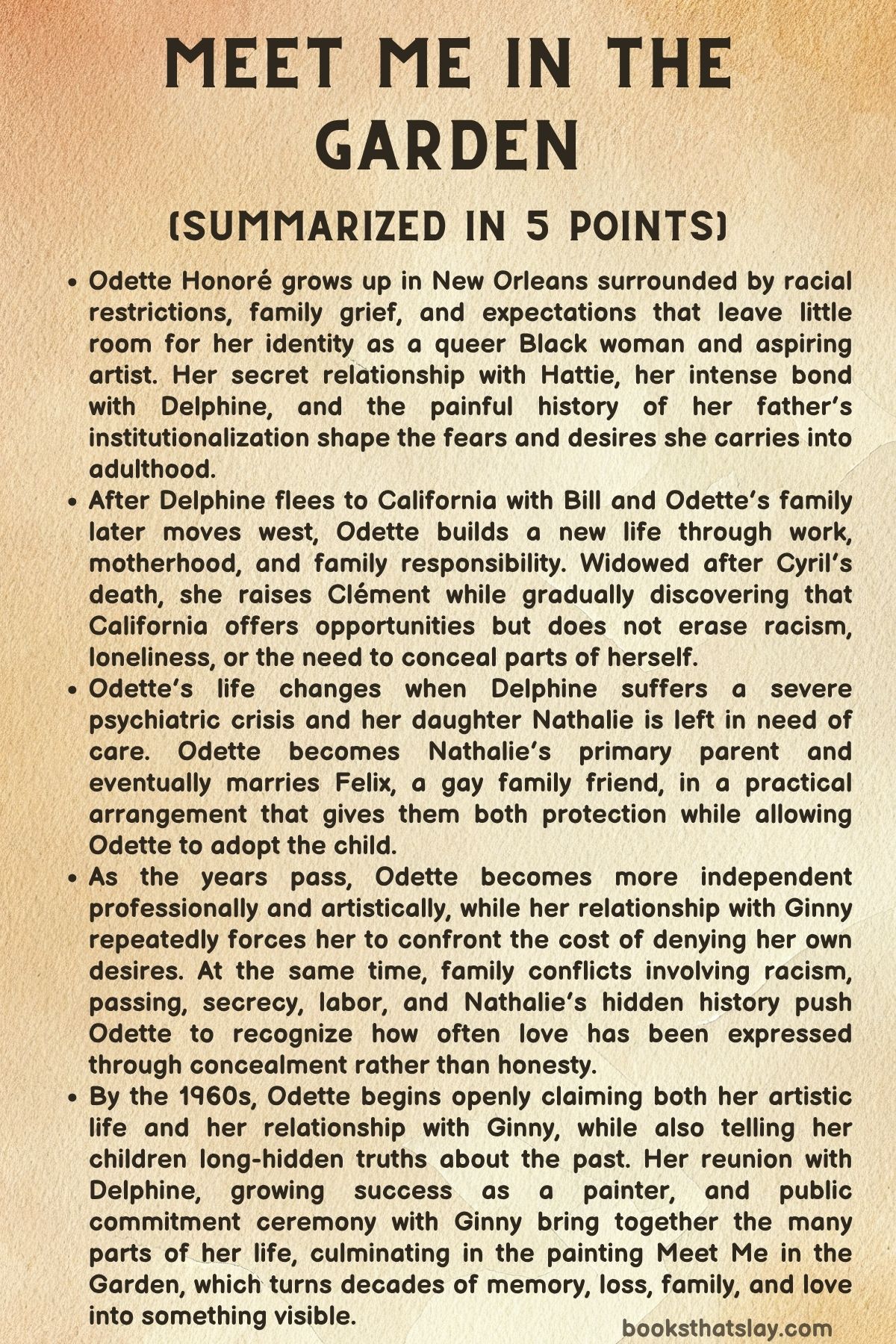
Summary
Odette Honoré grows up in New Orleans carrying grief over her father’s death and finding comfort in a private garden shared with her cousin and closest friend, Delphine. Their garden becomes a place where they draw, talk freely, and imagine futures outside the restrictions surrounding them.
Delphine reveals that she is secretly involved with Bill, an older white photographer. Because Delphine is light-skinned, Bill can invite her into spaces where darker Black people would be rejected, including his photography studio marked by a segregation sign.
Odette understands the risks of forbidden love because she is secretly involved with Hattie Laurent. Their relationship must remain hidden not only from family but from a society that could punish them severely for loving women.
Odette is already burdened by anger toward her mother. Her father returned from war traumatized, was institutionalized, contracted tuberculosis, and died, and Odette believes her mother abandoned him when he most needed protection.
Her sisters Claire and Adele are building conventional married lives, while Odette has difficulty imagining herself following them. She wants to become an artist, remain connected to Hattie, and preserve the freedom she experiences with Delphine.
The family eventually begins planning a move to California, hoping that employment and greater opportunity will provide a better future. Odette hesitates because leaving New Orleans would mean leaving Hattie and everything associated with her father and childhood.
Delphine’s own situation becomes desperate when she becomes pregnant by Bill. Louisiana law prevents them from marrying legally because she is officially considered Black and he is white, while Delphine’s mother reacts to the pregnancy by threatening institutionalization.
Delphine and Bill flee to Los Angeles. Her departure gives Odette proof that escape is possible, but it also removes the person who most completely understands her secret life.
Odette pressures Hattie to decide whether their relationship has a future. Hattie finally admits that she loves Odette but refuses to build a public life with her, believing the risks are too great.
Hattie instead encourages Odette to consider her brother Cyril. Odette agrees partly because Cyril reminds her of Hattie and partly because marriage offers an acceptable role that can conceal what she cannot openly acknowledge.
Odette and Cyril marry shortly before he leaves for military service. Their brief marriage is emotionally complicated because Odette cares for him without loving him as she loves Hattie.
Before leaving Louisiana, Odette visits the hospital where her father died and discovers that the family never claimed his body. He was buried in the institution’s cemetery rather than receiving the funeral Odette had been led to believe occurred.
The discovery creates a lasting rupture between Odette and her mother. Shortly afterward, Odette suspects she is pregnant and leaves for California carrying unresolved grief, anger, and uncertainty.
Years later, Odette has established herself in Southern California with Claire, Adele, their husbands, and their children. She works at the Columbia Records pressing plant and raises her son, Clément, after Cyril dies in a military training accident.
Motherhood changes Odette profoundly. Clément becomes central to her emotional life, yet she worries that her own sadness has somehow been passed to him.
Odette eventually meets Ginny, a confident woman whose openness about attraction to women immediately awakens feelings Odette has tried to silence since leaving Hattie. Around the same period, Adele reveals that she and Claire once saw Delphine in Los Angeles with a baby carriage.
Knowing Delphine survived transforms Odette’s understanding of their separation. Ginny also shows her that another kind of life remains possible, especially after kissing her and introducing her to people living outside ordinary social expectations.
Odette begins saving for an independent home with Clément. She purchases a Studebaker, a financially reckless decision that nevertheless gives her something that belongs entirely to her and represents greater control over her movements.
Her plans change suddenly when she sees Delphine wandering through traffic, disoriented and apparently unable to care for herself. The family searches for her and learns that she has been admitted to Camarillo State Hospital.
Delphine’s young daughter Nathalie is effectively left without a parent. Odette and her family take the child in, and Nathalie slowly becomes attached to Odette even while struggling with fear, anger, and the instability caused by her mother’s disappearance.
When Odette visits Delphine, she discovers that her cousin is experiencing severe psychiatric distress. Delphine believes she must erase her Black identity and eventually asks Odette to tell Nathalie that she is dead.
Delphine later insists that Odette adopt Nathalie. When Odette explains that her unmarried status may prevent the adoption, Delphine threatens to expose Odette’s attraction to women.
The threat terrifies Odette because exposure could damage her employment, reputation, custody of Clément, and ability to adopt Nathalie. Nevertheless, her bond with the girl has already become maternal.
To help Nathalie cope, Odette allows her to believe that Delphine has died and even creates a memorial at the beach. The deception protects the child temporarily but begins another cycle of family secrecy similar to the one that once harmed Odette.
Because adoption may require marriage, Odette attempts to consider possible husbands. These efforts end badly until she recognizes something important about Felix, a family friend and Pullman porter: he is attracted to men.
Odette proposes that they marry for mutual protection. She can adopt Nathalie and maintain legal respectability, while Felix gains companionship, family, and the freedom to live without pretending that their marriage is romantically conventional.
Their arrangement succeeds for years. Odette adopts Nathalie, purchases a house in Willowbrook, raises both children, and gradually returns to art.
She also advances at the record plant by helping women gain entry into the Listening Department, a position previously reserved for men. The new work gives her more mental space and occasional opportunities to sketch.
Odette meets Elise Eriksen, an affluent woman who becomes a friend and important supporter of her artistic ambitions. Elise recognizes Odette’s ability and encourages her to treat painting as serious work instead of a private hobby.
At the same time, Ginny reenters Odette’s life. Their attraction remains powerful, and they eventually spend a night together.
Odette refuses to continue the relationship because she believes openness would endanger the secure world she has created for Clément and Nathalie. Yet ending things with Ginny does not eliminate her feelings.
Her marriage also changes when Felix realizes that their arrangement no longer gives him the life he needs. He returns permanently to New Orleans, leaving Odette devastated by the loss of a companion she loved deeply even without romantic attraction.
The separation affects the children as well. Nathalie, already shaped by abandonment, interprets Felix’s departure as confirmation that people eventually disappear.
Odette increasingly recognizes similarities between herself and Nathalie. When Nathalie resists rigid authority at school, Odette initially tells her to follow the rules, then realizes she is repeating the same demands for conformity that once silenced her.
She removes Nathalie and Clément from their Catholic school and apologizes. Instead of teaching unquestioning obedience, she begins encouraging them to trust their own judgments.
Meanwhile, Odette’s painting becomes stronger and more personal. Memories of gardens, birds, family, death, interiors, and lost relationships gradually become part of the visual language through which she processes her life.
Ginny continues appearing in Odette’s world. Their relationship resumes during periods when the children are away, but Odette repeatedly imposes limits because she remains afraid that lasting love will expose them.
Racial danger also continues despite the family’s move west. Lionel experiences discrimination through pigeon breeding and becomes the target of threats from white men who resent his independence and expertise.
Odette begins recognizing that California never eliminated the forces her family hoped to escape. Racism has simply appeared in different forms.
Family conversations also expose unresolved questions about skin color and passing. Claire considers moving into a predominantly white neighborhood where her lighter appearance gives her access that Adele and darker members of the family cannot easily claim.
Odette finally begins telling relatives the truth about herself. When she admits to Al that she loves Ginny, his reaction is far less condemning than she had feared, challenging the assumptions that kept her silent for years.
She also tells Clément and Nathalie about Hattie and explains why she married Cyril. The children respond with a secret of their own: they have seen Felix during visits to New Orleans and concealed it because they thought they were protecting Odette.
That revelation makes Odette recognize how deeply silence has shaped the family. People repeatedly hide the truth out of love, yet those hidden truths often create new wounds.
The most painful reckoning comes when Odette finally tells Nathalie that Delphine is alive. Nathalie is furious that the adults she trusted allowed her to believe her mother had died.
Odette understands that she cannot defend herself simply by claiming that the lie was meant to protect a child. Having suffered from her own mother’s concealment, she recognizes that she has repeated part of the same pattern.
As Clément and Nathalie approach adulthood, Odette’s reasons for denying herself begin weakening. Her paintings attract professional attention through Elise, while Ginny remains the woman she continues to love.
Odette finally tells her sisters about Ginny and gradually allows their relationship to become part of ordinary family life. When the record plant declines, she is forced to leave the job that once represented security, but art has now become a genuine career.
In 1965, the Watts uprising brings racial injustice directly into the family’s conversations. Smoke, violence, police actions, deaths, anger, and disagreement force everyone to confront the distance between personal success and the continuing vulnerability of Black communities.
During this period, Delphine writes to Nathalie. Mother and daughter arrange to meet in San Francisco, with Odette accompanying Nathalie.
Delphine is now stable enough to work and live independently. She explains that during her psychiatric crises she suffered beliefs that made familiar people and reality itself feel untrustworthy.
The reunion cannot erase Nathalie’s abandonment or Odette’s years of responsibility. Still, it allows all three women to replace imagined versions of one another with more complicated truths.
Odette then prepares to make another important commitment. Ginny asks for a ceremony acknowledging their relationship before the people they love, despite their inability to marry legally.
Odette agrees and begins gathering people from different parts of her past. She contacts Hattie, who responds with affection and offers to make her dress, transforming a relationship once defined by secrecy into an important part of the celebration.
Felix also returns. Rather than treating his disappearance as an unforgivable betrayal, Odette welcomes him back into the extended family.
At the ceremony, Odette and Ginny openly receive their guests together. Friends, children, relatives, former partners, and members of their wider community witness the commitment that Odette once believed she could never safely acknowledge.
Afterward, the guests enter Odette’s studio and see the enormous painting that has become the culmination of her artistic life. She has titled it Meet Me in the Garden.
The painting contains traces of Delphine, her father, New Orleans, birds, plants, furniture, remembered rooms, and the many people who shaped her. Rather than hiding the separate versions of herself, Odette has finally transformed them into something visible.
Standing among those she loves, she understands that a life can contain grief, contradiction, change, beauty, and survival without requiring any of them to erase the others. The frightened young woman who once left New Orleans has become an artist capable of looking directly at her history and claiming it as her own.
Characters
Odette Honoré
Odette is the central consciousness of Meet Me in the Garden, and nearly every major conflict is filtered through her struggle between self-preservation and self-expression. As a young woman, she understands very early that race, gender, sexuality, and family expectation determine which parts of a person may safely be visible.
Her anger over her father’s institutionalization establishes one of her deepest psychological patterns. She distrusts any version of protection that requires silence because her mother’s attempt to manage suffering through concealment leaves Odette feeling betrayed.
At the same time, Odette repeatedly recreates that pattern herself. She hides her relationships with women, enters a marriage with Cyril, creates another socially acceptable marriage with Felix, and participates in the lie that Delphine is dead because each decision appears to offer safety.
Her development comes through recognizing the emotional cost of those protective structures. She gradually understands that survival achieved by suppressing truth can reproduce the very injuries she resents in previous generations.
Motherhood also transforms her. Her relationships with Clément and Nathalie force her to consider freedom not only for herself but for children who must eventually become independent adults capable of deciding what they believe.
Art becomes Odette’s most complete language of integration. Painting allows her to bring grief, race, sexuality, family history, memory, and love into the same space without forcing one identity to defeat another.
By the end, her decision to commit publicly to Ginny is significant because she is no longer organizing her life primarily around fear. Odette does not become free because prejudice disappears; she becomes freer because she stops allowing anticipated judgment to determine every choice.
Delphine
Delphine is one of the most tragic and psychologically complicated figures in Meet Me in the Garden. As Odette’s childhood companion, she initially represents intimacy, courage, beauty, and the possibility of escaping restrictive social categories.
Her relationship with Bill exposes the violence hidden inside racial classifications. Delphine’s light complexion permits her temporary access to white spaces, but that access depends upon concealment and the willingness of others to overlook or reinterpret her identity.
Her desire to escape with Bill therefore carries both romantic hope and profound danger. What appears to be liberation gradually becomes another form of instability as Delphine becomes increasingly separated from family, history, and a secure understanding of herself.
Her later psychiatric illness intensifies these conflicts. Her obsessive desire to become white cannot be separated from the social world that repeatedly teaches her that whiteness offers safety, legitimacy, and mobility unavailable to Black people.
Her decision to surrender Nathalie is simultaneously loving and devastating. Delphine believes Odette can provide the stability she cannot, yet her threat to expose Odette’s sexuality shows how illness, fear, and desperation can turn intimacy into coercion.
When Delphine reappears years later, the novel refuses to reduce her to the person she was during her crisis. Her recovery gives her dignity and complexity while acknowledging that recovery cannot restore the years Nathalie lost.
Ginny
Ginny represents a form of possibility that Odette repeatedly approaches and then retreats from in Meet Me in the Garden. She lives with greater openness about her attraction to women and therefore reveals how much of Odette’s fear comes not from lack of desire but from the belief that desire must always remain temporary.
Ginny is patient with Odette without being endlessly passive. She understands the genuine risks Odette faces but eventually challenges the idea that fear should permanently control their relationship.
Her love is especially important because she refuses to accept only fragments of Odette. Where Hattie ultimately chooses caution, Ginny continues imagining partnership even when Odette insists that their intimacy must have an expiration date.
Ginny also becomes connected to Odette’s family rather than existing solely in a hidden romantic world. Her willingness to help during crises and interact with Clément, Nathalie, Lionel, and others gradually proves that romantic truth does not automatically destroy family belonging.
By the conclusion, Ginny is not presented as a reward waiting for Odette. She is a person who has maintained her own boundaries and insists that love must eventually involve mutual recognition.
Felix
Felix becomes one of the most unusual and important relationships in Meet Me in the Garden. His marriage to Odette begins not through romantic love but through mutual recognition between two people whose sexuality makes conventional marriage impossible to inhabit honestly.
Their arrangement offers both practical security and emotional companionship. Felix gives Odette the social standing necessary to adopt Nathalie, while Odette provides him with family and an accepted domestic identity without demanding romantic exclusivity.
Despite the practical origin of the marriage, their bond becomes genuine. His eventual departure therefore hurts Odette deeply even though neither partner has misunderstood the nature of their relationship.
Felix’s decision to leave reveals an important limit to compromise. An arrangement can protect people for a period without necessarily giving them the full life they ultimately need.
His eventual return to Odette’s ceremony also demonstrates the novel’s broader understanding of family. A relationship can end in one form without becoming meaningless, and Felix remains part of the history and affection that shaped Odette’s household.
Nathalie
Nathalie becomes one of the strongest emotional forces in Meet Me in the Garden because her life demonstrates both the power and danger of decisions adults make in the name of protecting children. She enters Odette’s household frightened, angry, confused, and uncertain whether anyone will remain.
Odette gradually becomes her mother through daily acts of patience rather than biology alone. Nathalie’s trust develops slowly because abandonment has already taught her not to assume stability.
As she grows older, Nathalie becomes increasingly resistant to authority. Her clashes at school mirror Odette’s younger resistance to expectations, forcing Odette to decide whether she will encourage obedience or support the independence she once wanted for herself.
The revelation that Delphine is alive fundamentally changes Nathalie’s understanding of her childhood. Her anger is directed not only at Delphine but at the entire structure of secrecy created by adults who decided what she was allowed to know.
Her eventual decision to meet Delphine shows growing maturity without implying easy forgiveness. Nathalie wants access to her own history and refuses to let other people determine what relationship she should have with it.
Her singing also parallels Odette’s painting. Both women discover forms of expression that help them claim identities beyond the roles assigned to them.
Clément
Clément is Odette and Cyril’s son and the first person to transform Odette’s understanding of motherhood. His birth follows a period filled with death and displacement, making him both a reminder of Cyril and a new reason for Odette to continue building a life.
As a child, Clément seems unusually melancholy, which causes Odette to worry that her grief has somehow passed into him. Her fear reveals how intensely she monitors the emotional consequences of her own past.
His fascination with Birmingham Roller pigeons gradually becomes an identity separate from Odette. Lionel encourages this passion, allowing Clément to form a meaningful bond with another adult and develop a world that does not depend entirely on his mother.
The death of his pigeon KR becomes an important emotional experience. His grief is treated seriously, helping Odette understand that children require room to encounter loss rather than being protected from every painful truth.
As he matures, Clément becomes capable of understanding his mother as a complicated person rather than simply as a parent. His eventual acceptance of Ginny and affectionate participation in Odette’s ceremony reflects the family culture Odette has ultimately created.
Hattie Laurent
Hattie is Odette’s first great love and one of the people whose influence continues long after their romantic relationship ends. Their hidden meetings provide Odette with intimacy during a period when open same-sex relationships could carry devastating consequences.
Hattie genuinely loves Odette, yet fear determines the limits she places on that love. She cannot imagine building a public life together and therefore refuses to move to California.
Encouraging Odette to marry Cyril is both generous and painful. Hattie believes she is guiding Odette toward security, but she also participates in the social logic that treats heterosexual marriage as the safest solution.
Her creation of an art space for Odette shows that she understands another essential part of her identity. Even while ending their romantic future, Hattie encourages the artistic self Odette has difficulty protecting.
Decades later, Hattie’s decision to make Odette’s ceremonial dress gives their relationship a different meaning. Their love does not need to become lifelong partnership in order to remain important, and their later tenderness allows memory without requiring bitterness.
Cyril Laurent
Cyril is Hattie’s brother and Odette’s first husband. He enters Odette’s life as the socially acceptable alternative to a relationship she cannot openly pursue.
Odette’s reasons for marrying him are emotionally compromised, but Cyril himself is not treated as an enemy. His vulnerability before military service makes it impossible for Odette to think of him merely as an obstacle.
Their brief marriage reveals the difference between affection and romantic love. Odette cares about Cyril and feels responsibility toward him even though the deepest part of her romantic attachment remains elsewhere.
His accidental death before the war ends leaves Odette widowed and pregnant, turning what began as a compromise into a permanent part of her history through Clément. Cyril therefore remains present indirectly in the family long after his death.
Lionel
Lionel is a crucial member of the extended Honoré family and one of the characters through whom the story examines the persistence of racism beyond the South. His repeated encounters with police violence in Louisiana help strengthen the family’s determination to move west.
California initially appears to offer greater freedom, but Lionel repeatedly discovers that geographic relocation does not eliminate racial hierarchy. His experiences at work and later within pigeon-breeding circles expose prejudice operating through both institutions and supposedly friendly relationships.
His passion for Birmingham Roller pigeons gives him an area of expertise and pride. He shares this interest with Clément, becoming an important influence on the boy.
Lionel’s relationship with Odette is particularly strong because they can express anger and frustration around each other without elaborate explanation. He is often present at moments when Odette needs practical support rather than judgment.
His forced move to Oakland after threats from white pigeon breeders reinforces one of the book’s central realities: success and expertise cannot guarantee safety in a racist society.
Claire
Claire is one of Odette’s sisters and represents a version of domestic respectability that Odette both values and resists. She builds a family-centered life with Bernard and finds meaning in household stability.
Her miscarriages reveal the pain hidden beneath appearances of domestic order. Odette’s support during these losses strengthens their sisterly relationship even when other conflicts remain unresolved.
Claire also participates in concealing Delphine’s presence in California. Her decision not to tell Odette reflects the family pattern of withholding painful information because someone believes secrecy will protect another person.
Her ability to pass more easily as white becomes increasingly important when she and Bernard consider moving into a predominantly white neighborhood. Claire’s choices raise difficult questions about whether using racial ambiguity for security becomes a form of separation from relatives who cannot make the same choice.
Adele
Adele is another stabilizing presence in Odette’s extended family. Her marriage to Al and her commitment to family life contrast with Odette’s discomfort with conventional domestic expectations.
Unlike Claire, Adele eventually admits that they once saw Delphine in Los Angeles. Her confession reflects both guilt and the growing difficulty of maintaining family secrets.
Adele also admits that domestic perfection is exhausting. This vulnerability complicates Odette’s assumption that her sisters naturally belong to the roles she herself rejects.
Her conflict with Claire over moving into a white neighborhood exposes Adele’s awareness that skin color produces unequal options even within one family. Because her husband and children are darker, racial passing is not simply an abstract question for her.
Al
Al is Adele’s husband and an important figure in the family’s economic development after the move to California. His work at Columbia Records initially symbolizes the professional opportunities the family hoped to find in the West.
Labor conflict later disrupts that sense of security. When the company turns against workers, Al is forced to reconsider the assumption that loyalty and hard work will guarantee stability.
His move toward independent music work gives him another source of purpose. It also connects his career more directly with Black cultural and economic networks.
Al becomes important to Odette on a personal level when she tells him she loves Ginny. His relatively accepting response weakens the fear that family knowledge will automatically produce rejection.
Bernard
Bernard is Claire’s husband and another major provider within the extended family. His early furniture commission helps make the California move financially possible.
His damaged hand, a result of war, quietly connects him to the novel’s larger treatment of wartime trauma. He carries experiences that are not always openly discussed, much as Odette and other relatives carry private histories.
At the record plant, Bernard’s managerial position eventually creates conflict when labor disputes place him between company authority and family loyalty. His situation demonstrates how economic advancement can create new moral pressures rather than simple security.
Near the end, his interpretation of Odette’s garden painting reveals memories of soldiers killed during the war. The moment shows how art can produce meanings beyond the artist’s original intention.
Elise Eriksen
Elise becomes the person who most directly validates Odette’s artistic ability. Her friendship opens access to galleries, books, exhibitions, intellectual conversations, and social circles that Odette might otherwise struggle to enter.
Elise’s encouragement matters because Odette has spent years treating art as secondary to survival. By taking the paintings seriously, Elise helps Odette imagine herself as an artist rather than merely someone who enjoys making art.
Their friendship is not untouched by inequality. Elise’s whiteness and wealth give her access to spaces where Odette remains conscious of being judged differently.
The novel allows both realities to exist at once. Elise can genuinely support Odette while still benefiting from privileges that Odette cannot share.
Her later gallery ambitions provide the professional structure through which Odette’s paintings reach buyers and a wider audience.
Odette’s Mother
Odette’s mother is one of the most important sources of unresolved anger in her life. Her decision to institutionalize Odette’s father after his wartime trauma becomes, in Odette’s mind, a defining act of abandonment.
The later discovery that his body was never claimed deepens that anger. Odette believes her mother replaced an unbearable truth with a false version of events rather than allowing the family to confront what happened.
Her colorism creates another wound. Comments about darker skin reveal prejudices operating inside the family rather than only outside it.
Yet the character also represents a generation shaped by survival strategies Odette cannot easily accept. Her belief that forgetting can sometimes be necessary reflects an approach to trauma built around endurance rather than emotional transparency.
Papa
Odette’s father is physically absent for most of the story but psychologically present throughout it. His wartime trauma, institutionalization, illness, and lonely burial become central to Odette’s understanding of betrayal and memory.
Odette repeatedly returns to the question of whether people are protected by forgetting or harmed by it. Much of that conflict begins with what happened to Papa.
His paintings are equally important. When they eventually reach Odette in California, they connect her artistic identity to him and restore something that institutionalization and death seemed to erase.
His presence within Odette’s final large painting suggests that she has finally found a way to remember him without allowing his death to define every future choice.
Bill / Robert Kelley
Bill, whose real name is Robert Kelley, is Delphine’s white lover and Nathalie’s father. His relationship with Delphine initially appears to offer escape from racial restrictions because he is willing to cross the boundaries that officially prohibit their union.
Yet the relationship is built within unequal racial conditions. Bill can move freely through spaces from which Delphine would be excluded if her racial identity were openly recognized.
His eventual disappearance from Nathalie’s life leaves significant unanswered questions. Whatever love he once felt does not provide the lasting security Delphine and their daughter need.
His role therefore demonstrates how private affection cannot automatically overcome unequal social power.
Espen
Espen is Elise’s husband and part of the artistic and intellectual world into which Odette is gradually introduced. His presence helps establish the comparatively unconventional environment surrounding Elise.
He supports Elise’s gallery ambitions and participates in the social networks that eventually expose Odette’s work to serious attention. Although less central than Elise, he contributes to the professional setting that makes Odette’s transition into the art world possible.
Sister Bethany
Sister Bethany represents institutional authority in Nathalie’s childhood. Her humiliating and harsh treatment of students becomes a major test of Odette’s parenting.
Odette initially encourages obedience because she believes children must learn how to survive within systems they cannot control. Nathalie’s resistance eventually forces Odette to recognize the danger in teaching submission as a permanent virtue.
Sister Bethany therefore functions as a catalyst in Odette’s changing understanding of motherhood. Through conflict with the school, Odette begins encouraging her children to trust themselves rather than automatically accept authority.
Themes
Secrecy, Protection, and the Cost of Concealment
Secrecy operates throughout Meet Me in the Garden as both a survival mechanism and a source of emotional damage. Characters conceal information because the truth can carry genuine consequences, particularly when race, sexuality, mental illness, and social respectability are involved.
Odette and Hattie hide their relationship because discovery could destroy their reputations and safety. Felix conceals his attraction to men for similar reasons, while Delphine’s racial identity becomes something that strangers interpret differently according to appearance and circumstance.
Family secrecy follows the same logic. Odette’s mother hides the truth about Papa’s burial because she believes forgetting may make survival possible, while Claire and Adele conceal having seen Delphine because they think the knowledge might hurt Odette.
Odette later repeats the pattern when she allows Nathalie to believe Delphine is dead. Her decision grows from love and fear rather than cruelty, yet Nathalie eventually experiences the lie as a theft of her own history.
The novel therefore refuses to treat secrecy as either completely wrong or completely justified. In dangerous environments, concealment can protect jobs, children, homes, and physical safety.
The problem emerges when temporary concealment becomes the structure of an entire life. People begin making choices based on anticipated punishment, and loved ones are denied the information required to understand their own families.
Odette’s development involves learning that protection without honesty can become another form of control. Her later conversations with her children, sisters, Delphine, Ginny, and former partners show her gradually choosing truth even when she cannot control how others will respond.
Race, Colorism, and the Limits of Geographic Escape
The Honoré family’s migration from Louisiana to California is motivated partly by the hope that leaving the segregated South will create greater opportunity. California does provide important economic and social possibilities, yet racism continues shaping nearly every generation of the family.
Lionel’s experiences make this particularly clear. Police violence follows him in Louisiana, while discrimination in employment and pigeon breeding later demonstrates that prejudice does not depend upon Southern segregation laws.
Delphine’s life shows another dimension of racial identity. Her light skin permits her to enter white spaces under conditions that darker relatives cannot access, but that apparent advantage creates intense psychological pressure.
Her relationship with Bill depends partly on the unstable possibility that others will not identify her as Black. Later, during psychiatric illness, her fixation on becoming white reveals how deeply racial hierarchy has entered her sense of identity.
Claire faces a related dilemma when she considers moving into a predominantly white neighborhood. Her appearance gives her a degree of acceptance that Adele’s darker family cannot automatically share.
These differences create painful arguments because privilege exists even among relatives who share the same ancestry. The novel therefore presents colorism as an internal family issue created by wider racial systems.
The Watts uprising finally places individual achievement beside community anger. Members of the family may own homes and build careers, yet those successes do not cancel police violence, segregation, economic inequality, or the vulnerability of Black neighborhoods.
Geographic movement can alter opportunity, but it cannot by itself eliminate the structures that made migration necessary.
Art, Memory, and Self-Recognition
Odette’s artistic development provides the clearest measure of how her relationship with herself changes. As a young woman, she wants desperately to paint but doubts the value of what she produces.
Years of work, motherhood, migration, and secrecy push art further to the margins. She continues drawing intermittently, but creative work remains something she fits into whatever space daily survival leaves available.
Elise changes this by treating Odette’s paintings as serious work. External recognition matters because Odette has rarely been allowed to imagine artistic ambition as practical or legitimate.
The deeper change, however, occurs when Odette begins trusting what she herself wants to paint. Gardens, birds, furniture, family memories, death, lovers, childhood rooms, and fragments of New Orleans increasingly appear in her work because she stops separating respectable subjects from painful ones.
Painting becomes a way of looking directly at experiences that ordinary conversation cannot easily contain. When Clément’s pigeon dies, making art from that loss helps Odette understand that grief does not have to be avoided in order to survive it.
Her final enormous canvas gathers people and places that once belonged to separate compartments of her identity. The artwork matters because it refuses the divisions around which she has organized much of her life.
Private memory becomes visible without becoming simple. Art gives Odette a method of acknowledging contradiction rather than solving it, allowing loss and beauty, resentment and affection, distance and belonging to occupy the same space.
Chosen Family, Love, and the Right to Live Fully
Family in Meet Me in the Garden is defined less by conventional structure than by continued acts of care. Odette’s household eventually includes biological relatives, adopted children, former spouses, lovers, friends, and people whose relationships do not fit the categories society expects.
Her marriage to Felix demonstrates this idea clearly. Their bond is not romantic, yet it creates genuine companionship, legal protection, parenthood, and emotional connection.
Nathalie’s adoption further complicates ordinary definitions of motherhood. Delphine is her biological mother, while Odette becomes the person who raises her, protects her, disciplines her, comforts her, and eventually faces her anger.
Neither relationship cancels the other. Nathalie’s later reunion with Delphine requires space for multiple forms of maternal connection rather than a simple choice between two women.
Ginny’s eventual place in the family represents another change. Odette initially assumes that loving a woman must remain separate from motherhood and respectable domestic life.
Over time, the very family she fears losing becomes capable of accommodating Ginny. Acceptance is imperfect, but Odette no longer believes she must obtain universal approval before claiming love.
The final ceremony brings these various relationships together without pretending that all past injuries have disappeared. Hattie, Felix, Ginny, the children, relatives, and friends belong to different periods and different forms of intimacy.
Their presence shows that a meaningful family can be built through loyalty, recognition, forgiveness, responsibility, and choice. Odette’s final achievement is therefore larger than romantic fulfillment: she creates a life in which love no longer has to remain hidden in order to survive.