My Sister Is Going to Kill Me Summary, Characters and Themes
My Sister Is Going to Kill Me by Nina Simon is a mystery thriller that combines a deadly wilderness adventure with a complicated relationship between two sisters.
Set against the dramatic landscape of the Grand Canyon, the novel follows Liv and Mandy Chisholm, whose annual vacation becomes a dangerous investigation when a wellness entrepreneur disappears and members of their rafting group begin receiving threats. As the sisters uncover corporate conspiracies, financial secrets, and suspicious deaths, they must also confront the unresolved grief that has kept them emotionally distant for years. The story explores deception, family loyalty, personal freedom, and the consequences of trusting appearances.
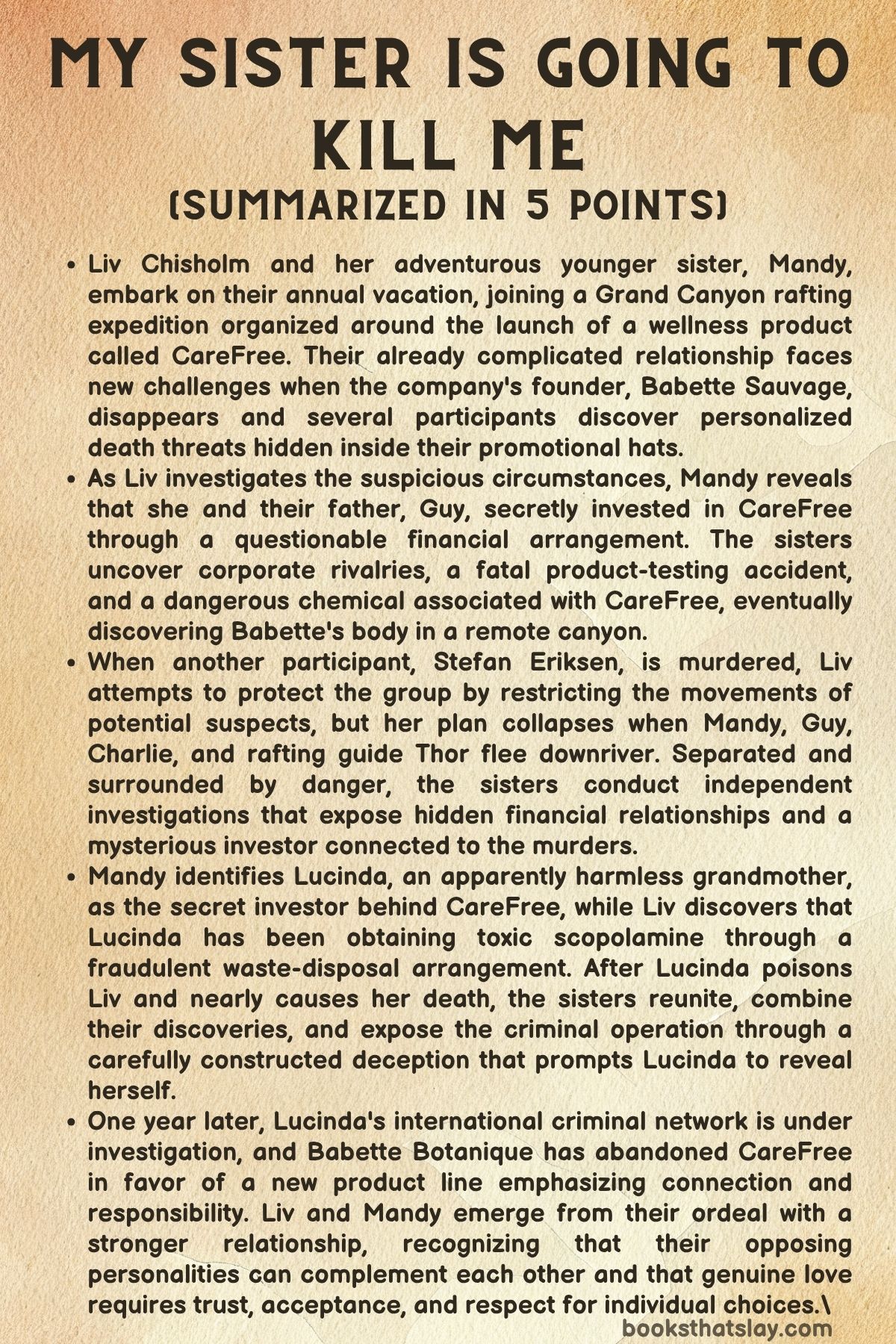
Summary
Liv Chisholm arrives at the Grand Canyon expecting another exhausting vacation with her younger sister, Mandy. An organized State Department investigator, Liv prefers predictable schedules and controlled environments, making Mandy’s choice of a dangerous rafting expedition particularly unwelcome.
Their annual vacations began ten years earlier, following their father’s arrest for fraud. With their mother already dead and their family fractured, the sisters used money left behind by their father to establish a tradition intended to preserve their relationship.
Despite their commitment to these trips, they remain fundamentally different. Liv approaches life through careful analysis and planning, while Mandy embraces adventure, improvisation, and an occasional disregard for the truth.
Mandy’s personality immediately creates problems when she misses her shuttle connection. Rather than accept the delay, she invents an elaborate story about visiting her dying father, persuading the driver to return for her.
When Mandy finally reaches Liv, she introduces another deception, telling strangers that the sisters are newly engaged to obtain complimentary drinks. Liv is embarrassed but recognizes that Mandy’s outrageous behavior is part of their familiar relationship.
The rafting expedition brings them into contact with an unusual collection of travelers associated with Babette Botanique, a successful wellness company preparing to launch a revolutionary product called CareFree.
The participants include Charlie and Devon Sauvage, siblings of the company’s founder; dermatologist Fiona Moon; investor representative Stefan Eriksen; personal assistant PK; teenage influencer Imogen; and Imogen’s grandmother, Lucinda.
Mandy initially presents herself as an enthusiastic admirer of Babette Sauvage. However, Liv suspects that her sister’s invitation to this expensive expedition involves something more complicated.
The group’s journey begins with an unsettling development: Babette fails to appear for her own product-launch event.
Despite her absence, the rafting guides explain that logistical restrictions make postponement difficult. Charlie assumes responsibility for the launch presentation, and the guests proceed down the Colorado River.
The expedition’s first dangerous rapids demonstrate how quickly conditions can change. Liv struggles with her fear of heights and rushing water, while Mandy approaches the experience with excitement.
When Charlie and Devon are thrown from their raft, the guides and other participants help rescue them. Afterward, Liv discovers a threatening message concealed inside Charlie’s promotional hat.
The message warns that crossing someone will result in his death.
Charlie privately reveals that Babette Botanique experienced a fatal accident during CareFree’s development. He fears that Babette may be targeting him and Devon because they intend to challenge her leadership.
Liv initially considers his suspicions excessive, but another discovery changes her assessment.
Mandy’s own hat contains a warning that money cannot protect her.
Pressed for an explanation, Mandy admits that she and their father, Guy, secretly invested in CareFree. Because Guy’s fraud conviction complicates his financial activities, he placed the investment in Mandy’s name through an offshore arrangement.
Liv is furious. Her sister has concealed potentially serious legal complications while bringing her into an isolated corporate gathering shortly before an important overseas assignment.
Nevertheless, the two decide to investigate together.
Liv contributes her professional skills, examining inconsistencies and identifying possible motives. Mandy uses her social confidence to gain information from people who might resist formal questioning.
Their inquiries reveal that CareFree is derived from datura, a toxic plant containing powerful compounds associated with hallucinations, confusion, and memory disruption.
Devon, who developed the product, insists that its finished formulation is safe and produces temporary freedom from anxiety.
However, Fiona explains that a participant named Justine Long died during an earlier testing phase. Following the accident, Fiona was removed from the project under a confidentiality agreement.
The sisters also discover additional threatening messages. Devon’s hat challenges her claim to the company, while PK’s warns that everyone is replaceable.
These discoveries suggest that someone possesses detailed knowledge of the group’s private vulnerabilities.
Meanwhile, Charlie and Devon acknowledge that they have been negotiating with Stefan to remove Babette from her executive position. Their proposed arrangement would install Devon as CEO while leaving Babette in a less powerful public-facing role.
The company’s financial future appears extraordinarily valuable, giving several participants reasons to manipulate its leadership.
News eventually arrives that Babette is approaching the group from the North Rim with an unidentified companion.
The travelers separate temporarily, with some continuing by raft and others hiking through the surrounding canyon.
During the hike, Mandy becomes increasingly attracted to guide Thor, whose enthusiasm for risk resembles her own. Their relationship deteriorates when he deliberately leaves her to negotiate a dangerous passage alone.
Mandy begins recognizing that forcing someone into danger without their consent can be cruel, even when the intention is to encourage courage.
Elsewhere, Liv learns that Babette has been seen traveling with two men and a mule. Yet the entrepreneur fails to arrive at the designated meeting point.
The mystery intensifies when the search party encounters Guy Chisholm.
Guy claims Babette summoned him to help defend her company against a threatened takeover. According to his account, she became seriously ill during the hike, and their guide, Marc, remained with her.
The search party eventually discovers Charlie near a sandstone formation called the Throne Room.
He is holding Babette’s water bottle and crying uncontrollably.
Above him lies Babette’s lifeless body.
Fiona examines the corpse and finds no obvious traumatic injury. Charlie explains that Babette became confused and suffered severe physical distress before dying.
Although heatstroke initially appears possible, Fiona notices signs inconsistent with an ordinary heat-related death.
The group returns to camp, but rescue services cannot immediately reach them because another emergency has diverted available resources.
Liv attempts to protect everyone while continuing her investigation.
Fiona then reveals that Babette’s physical symptoms resemble those observed after Justine Long’s fatal exposure to a dangerous chemical associated with CareFree’s production.
The possibility of deliberate poisoning becomes increasingly credible.
During an informal memorial, several participants apply CareFree. Mandy experiences its calming effects, becoming unusually relaxed and emotionally open.
Her altered perspective nevertheless produces an important observation: the people Liv considers suspects may also be potential victims who need protection.
Liv consequently establishes a security arrangement.
She orders Guy, Charlie, and Stefan, the men with the clearest opportunities to approach Babette, to remain restrained in separate positions aboard the supply boat overnight.
Mandy protests that this treatment is inhumane, but Liv believes it necessary.
The plan collapses before dawn.
Mandy discovers Stefan dead with his throat cut, despite his restraints.
Nearby lies a distinctive silver folding knife.
Guy claims he heard Stefan arguing with a woman who referred to disrespect and replacement. Charlie, terrified that he will be murdered next, insists they must escape.
Guy and Charlie bribe Thor into taking them downriver.
Mandy refuses to abandon Liv, but Thor physically forces her onto the departing raft.
When Liv awakens, she discovers Stefan’s body and realizes that Mandy, Guy, Charlie, and Thor have disappeared with essential survival equipment.
The escapees have taken the radio, satellite phone, water filter, paddles, and life jackets, leaving the remaining travelers dangerously stranded.
Liv finds a note Mandy concealed inside her scrunchie.
It explains that Mandy did not leave willingly and warns Liv to beware of the mysterious lady.
Recognizing that her conventional methods have failed, Liv begins adopting Mandy’s willingness to improvise.
She applies CareFree and deliberately invents a story identifying Thor as Stefan’s murderer. Her objective is not to establish guilt but to persuade the remaining travelers that the killer has departed, allowing them to cooperate.
The deception works.
While searching Stefan’s belongings, Liv discovers documents concerning Attention to Detail Disposal Inc., known as ADD Inc.
The company handles dangerous chemical waste generated during CareFree’s manufacture.
Devon explains that the waste contains highly concentrated scopolamine, a substance capable of causing severe poisoning.
Babette recently terminated ADD’s contract, but Stefan brought documents intended to reinstate the arrangement.
Liv begins questioning why a waste-disposal agreement would matter so much during a corporate leadership struggle.
Meanwhile, Mandy questions Charlie about the proposed takeover.
She learns that Stefan represented the Regent Group, whose financial backing enabled CareFree’s expansion. However, the identity of the ultimate investor has remained secret.
Guy eventually reveals that Babette believed someone had infiltrated her expedition.
Before her death, she apparently discovered that an unexpected participant was present and summoned Guy to help protect her position.
Mandy suspects that the uninvited person is connected to the secret investor.
Their investigation is interrupted when the stolen raft becomes trapped against a boulder in Upset Rapid.
The passengers narrowly survive, but Thor recognizes the silver knife recovered near Stefan’s body.
It belonged to Marc, the guide who accompanied Babette into the canyon.
This discovery introduces another unexplained connection.
Determined to stop the escape, Mandy deliberately punctures the raft, forcing everyone to land at Bloody Ledges.
As they continue investigating, Mandy connects Stefan’s repeated references to a lady with the Regent Group’s investment categories: love, attention, distraction, and yearning.
Their initials spell LADY.
She concludes that Stefan may have been referring to the concealed investor rather than an ordinary unidentified woman.
Mandy then remembers that Marc appeared familiar with Lucinda, despite their supposedly unrelated positions on the expedition.
Both have Canadian connections, and Marc possesses a military background.
She also recalls that the box containing the promotional hats was mistakenly delivered to Imogen and Lucinda’s room before the expedition.
Lucinda therefore had access to the hats before the threatening messages appeared.
Mandy realizes that Lucinda could have prepared the threats and that Marc may have been working for her.
Meanwhile, Liv investigates ADD Inc. more closely.
She discovers that restoring its contract would give the hidden investor access to enormous quantities of dangerous chemical waste.
The apparent financial dispute may therefore conceal something far more sinister.
During the group’s pursuit of the escapees, Lucinda offers Liv a spare promotional hat to protect her from the sun.
Liv accepts.
Soon afterward, she becomes confused, overheated, and increasingly unable to control her thoughts.
When the supply boat enters dangerous rapids, Liv suddenly jumps into the Colorado River.
Mandy sees the emergency from Bloody Ledges.
She and Thor rush into the water, rescue Liv, and perform CPR until she begins breathing again.
Once conscious, Liv reveals that Lucinda poisoned her through the hat.
The sisters finally combine their discoveries.
Lucinda is the secret investor behind the Regent Group and controls ADD Inc. Through the waste-disposal arrangement, she has been obtaining concentrated scopolamine for an international criminal drug operation.
Babette discovered the arrangement, canceled the contract, and prepared to expose it.
Lucinda therefore had a reason to eliminate her.
Marc’s connection to Lucinda explains how Babette could have been poisoned during her journey into the canyon, while the threatening hats helped redirect suspicion toward corporate rivals.
Lucinda attempts to discredit the sisters by emphasizing Mandy and Guy’s history of dishonesty.
Liv responds with a deception of her own.
She claims Babette left a written statement proving the criminal operation.
Lucinda panics, produces the missing gun, and demands the supposed evidence.
Her reaction exposes her involvement.
She shoots Liv in the shoulder before the others restrain her.
As Mandy holds her injured sister, Liv reveals that the letter never existed. She invented it to provoke Lucinda into revealing herself.
One year later, the sisters attend a Babette Botanique event in Las Vegas.
Lucinda’s criminal network is under international investigation, supported by Marc’s testimony, Imogen’s recordings, and documents recovered from Babette’s office.
Devon now leads the company, which has abandoned CareFree and introduced a new product line called Care.
Liv continues recovering from her injuries while her State Department career remains under review. She has spent much of the year living near Mandy in Austin.
Mandy gives her sister a matching moonstone ring engraved with a datura flower.
The sisters have not become identical or resolved every disagreement. Instead, they have learned that love does not require controlling another person’s choices.
Their relationship survives because each finally recognizes the value of the qualities she once found most difficult in the other.
Characters
Liv Chisholm
Liv Chisholm is the central investigative figure in My Sister Is Going to Kill Me, representing discipline, analytical intelligence, and the desire to impose order on uncertain circumstances.
Her professional background as a State Department investigator shapes nearly every aspect of her personality. She studies people’s behavior, evaluates inconsistencies, and approaches unfamiliar situations through careful preparation.
These abilities make her particularly suited to investigating the suspicious events surrounding Babette Botanique. However, they also create difficulties in her personal relationships, especially with Mandy.
Liv frequently treats her younger sister’s behavior as a problem requiring correction. Her frustration with Mandy’s dishonesty reflects both professional principles and painful memories of their father’s criminal conduct.
The sisters’ unresolved grief further complicates her personality.
Following their mother’s death, Liv responded by accepting practical responsibilities rather than expressing her emotions openly. Her apparent competence concealed an inability to acknowledge how deeply the loss affected her.
This habit eventually developed into emotional distance. Liv believes that maintaining control protects her from disappointment, yet her efforts repeatedly prevent genuine closeness.
The Grand Canyon forces her to confront the limitations of this worldview.
Although she initially views the rafting expedition as an exercise in unnecessary risk, the experience demonstrates that preparation cannot eliminate uncertainty.
Her investigation develops similarly. The more carefully she attempts to contain danger, the more unpredictable the situation becomes.
Her decision to restrain potential suspects illustrates how protective intentions can produce harmful consequences.
Stefan’s murder exposes the failure of her security plan, while Mandy’s forced departure leaves Liv confronting the possibility of losing the person she most wants to protect.
Liv’s transformation becomes apparent when she begins using deception strategically.
Her false accusation against Thor and invented evidence against Lucinda show that she has learned to distinguish rigid adherence to rules from effective judgment.
Nevertheless, she does not simply adopt Mandy’s personality. She retains her analytical strengths while becoming more flexible in applying them.
Her willingness to jeopardize her career to find Mandy also reveals how profoundly her priorities have changed.
By the novel’s conclusion, Liv understands that loving her sister requires accepting uncertainty rather than trying to eliminate it.
Mandy Chisholm
Mandy Chisholm provides the emotional and behavioral counterpoint to Liv in My Sister Is Going to Kill Me.
Where Liv seeks structure, Mandy values spontaneity. She approaches strangers confidently, enjoys physical challenges, and frequently transforms inconvenient situations through inventive storytelling.
Her relationship with dishonesty is particularly significant.
Mandy believes that a fabricated story can create connection, entertain strangers, or transform an otherwise disappointing experience. Unlike Liv, she does not automatically regard every departure from literal truth as morally unacceptable.
However, this attitude makes her vulnerable to rationalizing increasingly serious deceptions.
Her secret investment in CareFree demonstrates the consequences of this weakness.
By allowing Guy to use her name in a questionable financial arrangement, Mandy exposes herself and potentially Liv to legal and professional risks.
Her decision to conceal the arrangement also illustrates her desire to avoid uncomfortable conversations.
Despite these flaws, Mandy possesses considerable emotional intelligence.
She recognizes people’s insecurities, encourages them to speak freely, and establishes relationships that formal questioning might never produce.
Her conversations with PK, Stefan, and other participants become essential to the investigation.
Mandy’s enthusiasm for danger initially appears uncomplicated, but her experiences with Thor expose its darker implications.
When he abandons her during a dangerous climb, she recognizes that an adventure imposed without consent can become frightening and cruel.
This recognition changes her understanding of Liv.
For years, Mandy has interpreted her sister’s caution as judgment or unnecessary restriction. She gradually realizes that Liv’s fear often originates in genuine concern for her safety.
Her forced departure from camp develops this insight further.
Separated from Liv, Mandy experiences the helplessness of loving someone whose safety she cannot guarantee.
Her subsequent investigation shows increasing discipline. Rather than relying entirely on charm and instinct, she reconstructs timelines, evaluates contradictions, and connects seemingly unrelated clues.
Her identification of Lucinda emerges from combining her natural social awareness with methods learned from Liv.
By the end, Mandy remains adventurous and unconventional, but she understands that independence carries responsibilities toward the people who love her.
Guy Chisholm
Guy Chisholm is one of the novel’s most ambiguous family figures, embodying the seductive power and destructive consequences of deception.
His fraud conviction establishes the historical circumstances surrounding the sisters’ fractured family life. Although he remains involved with his daughters, his past makes his statements difficult to trust.
Guy’s personality closely resembles Mandy’s.
Both rely on charm, improvisation, and persuasive storytelling. However, Guy’s conduct demonstrates what happens when these qualities become detached from accountability.
His investment arrangement with Mandy illustrates this problem.
Rather than allowing legal restrictions to prevent his participation in CareFree, he uses his daughter’s name to conceal his involvement.
He presents the arrangement as an opportunity for financial success while disregarding the consequences for his children.
His arrival in the Grand Canyon further complicates his characterization.
Guy claims Babette summoned him to help protect her company, but his financial interests make his motives uncertain.
His reluctance to involve authorities also reflects a recurring tendency to place personal security above transparency.
Nevertheless, Guy is not portrayed as incapable of attachment.
He expresses concern for Mandy and participates in the investigation, even though his methods repeatedly create new dangers.
His decision to flee with Charlie demonstrates the difference between protecting someone and determining their choices without consent.
Ultimately, Guy functions as both a source of affection and a warning about the long-term costs of irresponsible improvisation.
Babette Sauvage
Babette Sauvage dominates the events of My Sister Is Going to Kill Me despite remaining physically absent through much of the narrative.
As the founder of Babette Botanique, she has constructed a public identity around empowerment, confidence, and personal transformation.
Her reputation attracts devoted admirers, including Mandy, who initially regards her as an inspiring entrepreneur.
However, the accounts provided by Babette’s employees and business associates reveal a more complicated personality.
She is demanding, controlling, ambitious, and capable of treating professional relationships as extensions of her authority.
Her unwillingness to surrender control creates conflict with Charlie and Devon, who believe the company requires different leadership.
Nevertheless, Babette’s response to discovering the criminal exploitation of CareFree’s waste complicates any interpretation of her as merely self-interested.
She cancels ADD Inc.’s contract and begins investigating the suspicious financial arrangements surrounding the company.
These actions place her in direct conflict with Lucinda.
Babette’s death is consequently connected to her determination to regain control over an enterprise whose activities have escaped her supervision.
Her final moments also expose the contradiction underlying her public philosophy.
The entrepreneur who promises freedom from fear dies in circumstances created by manipulation, secrecy, and the misuse of a substance marketed as emotionally liberating.
Although Babette’s personal conduct often deserves criticism, her efforts to uncover the criminal operation contribute significantly to the eventual investigation.
Charlie Sauvage
Charlie Sauvage represents the financial and managerial dimensions of the conflict surrounding Babette Botanique.
As Babette’s brother and a participant in the company’s development, he believes he has a legitimate interest in its leadership and future profitability.
His approach differs from Babette’s emphasis on public identity.
Charlie is particularly interested in CareFree’s commercial possibilities, and he regards his sister’s management as an obstacle to expanding the business.
His negotiations with Stefan and Devon demonstrate considerable ambition.
The proposed removal of Babette from executive control may reflect genuine concerns about management, but it also promises Charlie greater influence over the company.
His threatening hat initially positions him as a potential victim.
However, his secrecy regarding the leadership challenge makes it difficult for Liv to distinguish legitimate fear from strategic manipulation.
The discovery of Babette’s body places him under further suspicion.
His visible grief complicates the investigation because his emotional response appears sincere despite his financial motives.
Stefan’s murder intensifies Charlie’s fear and contributes to his decision to flee.
Charlie ultimately demonstrates how corporate ambition can create suspicion even when a person’s objectives do not necessarily include violence.
His conduct is frequently self-serving, but the novel distinguishes those failings from responsibility for the murders.
Devon Sauvage
Devon Sauvage embodies the scientific ambition behind CareFree and the ethical questions surrounding its development.
As the researcher responsible for transforming datura-derived compounds into a marketable product, she possesses technical knowledge essential to understanding the murders.
Devon believes that her research has produced something commercially extraordinary.
Her confidence in the finished product reflects professional pride and a conviction that scientific development can overcome the dangers associated with its original materials.
However, Justine Long’s death exposes serious problems in the research process.
Devon’s disagreement with Fiona over safety procedures demonstrates the tension between scientific progress, financial pressure, and responsible oversight.
Her decision to remove Fiona from the project raises questions about her willingness to accept criticism.
At the same time, Devon insists that the finished formulation is safe and distinguishes it from the lethal manufacturing waste.
Her participation in the proposed leadership transition reflects a belief that she possesses the expertise necessary to direct the company’s future.
Following Babette’s death and Lucinda’s exposure, Devon assumes leadership.
Her decision to abandon CareFree suggests a significant reassessment of the company’s direction.
Rather than continuing to market chemical freedom from anxiety, she introduces a product line emphasizing human connection.
This transition gives Devon a role in translating the novel’s lessons into a different corporate philosophy.
Fiona Moon
Fiona Moon is an important scientific witness whose professional history connects the earlier testing tragedy with Babette’s death.
Her involvement in CareFree’s development gives her detailed knowledge of its chemical properties and manufacturing risks.
Following Justine Long’s death, Fiona advocated stricter safety measures.
Her recommendations brought her into conflict with Devon, ultimately resulting in her removal from the project.
The confidentiality agreement she accepted complicates her moral position.
Although she recognized the danger, her silence allowed the company to continue developing CareFree without publicly confronting the full implications of the accident.
Fiona’s return to Babette’s circle initially makes her suspicious.
She possesses technical knowledge of the lethal substance, has reasons to resent company leadership, and received a sample of the finished product shortly before the expedition.
Nevertheless, her observations become crucial to identifying the murder mechanism.
By recognizing similarities between Justine’s and Babette’s physical symptoms, she establishes the possibility that both deaths resulted from exposure to concentrated scopolamine.
Her character demonstrates the importance of specialized knowledge while also illustrating the ethical responsibilities that accompany it.
Stefan Eriksen
Stefan Eriksen represents the influence of investment capital over the direction of Babette Botanique.
As the Regent Group’s representative, he evaluates CareFree primarily through its potential profitability.
His explanation of the firm’s investment categories reveals a business philosophy built around human desires for attention, emotional relief, and distraction.
CareFree appeals to this philosophy because it offers consumers a chemical means of escaping uncomfortable thoughts.
Stefan participates in negotiations intended to replace Babette as CEO.
His involvement places him at the center of the company’s leadership struggle, making him a plausible suspect following her death.
However, his repeated references to a mysterious lady introduce another dimension to his role.
Those statements eventually help Mandy identify the concealed investor controlling the operation.
Stefan’s murder demonstrates that financial importance does not guarantee personal safety.
Despite his influence over the company’s future, he becomes another victim of the criminal interests concealed behind its investment structure.
His death also exposes the limitations of Liv’s attempt to create safety through restraint and surveillance.
Lucinda
Lucinda emerges as the central antagonist in My Sister Is Going to Kill Me, although her introduction encourages a very different interpretation.
Initially, she appears to be a practical, affectionate grandmother accompanying Imogen on an unusual adventure.
Her observations about social media, corporate authenticity, and consumer manipulation seem sensible and perceptive.
These qualities encourage both Mandy and Liv to treat her as a trustworthy outsider.
Her apparent independence from the company’s internal conflicts also conceals her financial involvement.
In reality, Lucinda is the secret investor behind the Regent Group and controls ADD Inc., the business responsible for handling CareFree’s dangerous chemical waste.
Her criminal operation depends on obtaining concentrated scopolamine through apparently legitimate commercial arrangements.
Babette’s discovery of this activity threatens Lucinda’s interests, providing the motive for murder.
Lucinda’s methods demonstrate considerable patience and strategic intelligence.
She uses personalized messages to exploit the insecurities of other participants, creating an atmosphere in which nearly everyone appears suspicious.
Her connection with Marc provides an additional means of operating beyond the group’s immediate attention.
Her willingness to poison Liv through an apparently helpful gift reveals the calculated cruelty concealed beneath her grandmotherly presentation.
Ultimately, Lucinda’s downfall results from her own reliance on controlling information.
When Liv invents a nonexistent letter, Lucinda reacts as though the document genuinely threatens her.
The deception turns her instinct for self-preservation against her.
PK
PK’s characterization centers on professional dependence and the emotional consequences of serving a powerful employer.
As Babette’s assistant, he manages the details of her public appearances and corporate activities.
His admiration for Babette persists despite her unreasonable demands and controlling behavior.
PK frequently interprets surviving her difficult treatment as evidence of his importance.
This attitude reveals how deeply his professional identity has become attached to her approval.
The message concealed inside his hat, warning that everyone is replaceable, exploits precisely this insecurity.
His distress over Babette’s disappearance and subsequent death appears genuine.
Nevertheless, his access to company information initially makes him a plausible suspect.
PK illustrates the vulnerability of employees whose careers become inseparable from influential personalities.
His loyalty is sincere, but it also prevents him from evaluating Babette’s conduct with complete independence.
Imogen
Imogen represents the commercial performance of authenticity in an environment dominated by social-media marketing.
As CareFree’s promotional ambassador, she cultivates an online identity associated with honesty and openness.
However, her participation in a carefully organized product launch exposes the difference between spontaneous self-expression and commercially managed visibility.
Her behavior frequently reflects an awareness that her experiences may become content for an audience.
This tendency makes her appear superficial to some of the other travelers.
Yet her continuous recording becomes critically important to the investigation.
Her footage eventually provides evidence connecting Lucinda to the contaminated hat and other suspicious activities.
Imogen’s characterization therefore challenges the assumption that constant documentation is necessarily empty performance.
The same habit that supports her commercial identity also preserves facts that powerful people attempt to conceal.
Her relationship with Lucinda adds a personal dimension to the revelation, as her apparently protective grandmother is exposed as a dangerous criminal.
Thor
Thor embodies the attraction and limitations of a philosophy based on physical risk and personal freedom.
As a rafting guide, he possesses genuine wilderness skills and confidence in dangerous environments.
His adventurous personality initially appeals strongly to Mandy.
Both value excitement and believe that challenging experiences can reveal hidden strengths.
However, Thor’s treatment of Mandy during their dangerous shortcut exposes the selfishness beneath his philosophy.
By deliberately leaving her to negotiate a hazardous section alone, he assumes that his interpretation of personal growth justifies frightening someone else.
Mandy’s anger reveals that freedom cannot meaningfully exist without choice.
Thor repeats this pattern when he physically forces her to accompany the fleeing group.
His decision to accept money from Guy and Charlie also demonstrates that his adventurous independence does not necessarily translate into sound ethical judgment.
Nevertheless, he contributes significantly to the group’s survival through his knowledge of the river.
His assistance in rescuing Liv reveals that his abilities can serve genuinely protective purposes when directed toward another person’s needs.
Big Pete
Big Pete represents practical authority grounded in experience rather than ambition or personal ideology.
As the expedition leader, he understands the dangers of the Colorado River and the logistical restrictions governing wilderness travel.
His decisions frequently frustrate Liv, particularly when she believes immediate investigative action is necessary.
However, Big Pete must balance the needs of the group against the risks created by the environment.
His refusal to abandon safety procedures demonstrates the responsibilities associated with leadership.
He also recognizes that Liv’s professional knowledge does not automatically give her authority over wilderness operations.
Their disagreements expose the difference between investigating danger and managing it.
Big Pete’s willingness to contact the Park Service, despite pressure from financially interested participants, further establishes his commitment to appropriate procedures.
His character provides a practical counterweight to the ambition, anxiety, and deception surrounding the corporate travelers.
Katy
Katy is a secondary but significant figure whose behavior reflects the pressures of maintaining order during a dangerous expedition.
As a member of the rafting crew, she possesses practical responsibilities that differ from the financial concerns of the corporate guests.
Her knowledge of datura and its dangerous qualities contributes to the atmosphere of uncertainty surrounding CareFree.
When conflict escalates over Liv’s proposed security arrangements, Katy produces the group’s firearm and insists that safety be taken seriously.
The intervention reveals both her determination and the increasing volatility of the situation.
Later, she remains behind while Big Pete takes the others downriver.
This decision places her in a difficult position, responsible for maintaining the abandoned campsite while the investigation continues elsewhere.
Although she receives less attention than the principal characters, Katy helps demonstrate the consequences of the mystery for people who have no personal stake in Babette Botanique.
Marc
Marc’s apparent role as a mule guide conceals his connection to the criminal operation.
Initially, he seems to occupy a peripheral position because he is expected to return to the canyon rim rather than accompany the rafting expedition.
His involvement in Babette’s journey becomes important only after her disappearance.
Guy claims Marc remained with the ill entrepreneur, creating uncertainty about the circumstances of her death.
The discovery that the knife used to kill Stefan belonged to Marc establishes another connection between apparently separate events.
His Canadian background and military experience eventually contribute to Mandy’s suspicions concerning Lucinda.
Marc’s relationship with the secret investor reveals that the criminal operation extends beyond the obvious corporate participants.
His later cooperation with investigators also becomes essential to establishing the larger conspiracy.
By accepting immunity and providing testimony, he helps expose the network that Babette had begun investigating.
Justine Long
Justine Long never participates directly in the expedition, but her death establishes the scientific and ethical background of the central mystery.
As a participant in CareFree’s third testing phase, she was exposed to a dangerous chemical associated with the product’s development.
Her death revealed the lethal potential of the manufacturing process.
The company’s response exposed conflicts between scientific responsibility and commercial ambition.
Fiona advocated stronger safeguards, while Devon resisted aspects of her recommendations.
Justine consequently represents the human cost of treating dangerous research primarily as a commercial opportunity.
Her death also supplies the crucial medical precedent that allows Fiona to recognize Babette’s poisoning.
Although Justine has little direct characterization, her experience continues influencing the decisions and suspicions of the surviving characters.
Themes
Sisterhood, Grief, and Emotional Reconciliation
The relationship between Liv and Mandy develops through a conflict between their desire for closeness and their fear of emotional vulnerability.
Their annual vacations appear to demonstrate a strong family bond, yet the tradition also allows them to maintain an appearance of connection without confronting the difficulties separating them.
Their mother’s death established the emotional pattern that continues shaping their adult relationship.
Liv responded by managing practical responsibilities, while Mandy sought comfort through different means. Neither sister understood how the other’s response reflected grief rather than indifference.
As a result, they developed contrasting methods of emotional self-protection.
Liv embraced structure and professional achievement, while Mandy pursued novelty, excitement, and the comfort of reinventing difficult experiences.
These approaches became sources of mutual criticism.
Liv interpreted Mandy’s recklessness as irresponsibility, while Mandy considered Liv’s caution a rejection of everything that made her distinctive.
The Grand Canyon changes their relationship because survival requires them to acknowledge the value of each other’s abilities.
Liv discovers that Mandy’s social intelligence can obtain information unavailable through formal questioning. Mandy learns that Liv’s disciplined reasoning can transform scattered observations into meaningful evidence.
Their eventual cooperation demonstrates that reconciliation does not require eliminating differences.
Instead, it requires recognizing that contrasting personalities can provide complementary forms of strength.
In My Sister Is Going to Kill Me, the sisters’ separation becomes particularly significant because each experiences the fear that normally governs the other’s behavior.
Mandy finally understands Liv’s anxiety about losing someone, while Liv recognizes that excessive protection can become a denial of another person’s independence.
Their reunion transforms these insights into emotional acceptance.
The matching rings at the conclusion symbolize a bond strengthened not by perfect agreement but by a willingness to remain connected despite uncertainty.
Truth, Deception, and the Construction of Identity
Dishonesty initially appears to provide a straightforward distinction between Liv and Mandy.
Liv’s investigative profession depends on establishing facts, while Mandy frequently manipulates reality to entertain people, escape inconvenience, or obtain advantages.
Their father introduces a third perspective through his history of fraudulent conduct.
Unlike Mandy, whose inventions often originate in social improvisation, Guy has repeatedly used deception to protect his financial interests.
The contrast establishes an important question: whether dishonesty is defined solely by its departure from factual accuracy or also by its intentions and consequences.
Mandy’s early lies frequently seem harmless.
However, her concealed investment reveals that the same habit can become dangerous when used to avoid responsibility.
The corporate world surrounding Babette Botanique develops this question on a larger scale.
Babette sells a carefully constructed image of empowerment, while Imogen promotes an identity based on supposedly spontaneous honesty.
Both operate within commercial systems that reward selective presentation.
Even Lucinda’s reassuring grandmotherly personality becomes a form of calculated misrepresentation.
The difference between visible identity and concealed reality consequently becomes central to identifying the murderer.
Liv’s development complicates the moral framework further.
Initially, she assumes that truthfulness is inherently superior to invention. Yet her investigation eventually requires her to conceal evidence, manipulate perceptions, and invent information.
Her fabricated accusation against Thor demonstrates the potential usefulness of deception, although it also carries risks.
Her invented letter becomes decisive because it exposes Lucinda’s reaction to a threat that does not actually exist.
The novel therefore distinguishes truth as an objective from rigid truth-telling as a universal method.
In My Sister Is Going to Kill Me, deception can protect, exploit, comfort, or destroy, depending on how it is used.
The sisters ultimately recognize that trustworthy relationships require more than literal accuracy.
They also demand responsibility, emotional honesty, and an understanding of the consequences that concealed information can produce.
Freedom, Control, and the Responsibility of Choice
CareFree’s commercial promise reflects a widespread desire to escape anxiety, obligation, and unwanted emotional experiences.
Its development suggests that personal freedom can be manufactured, packaged, and sold through the temporary alteration of consciousness.
However, the product’s history exposes the dangerous assumptions underlying that promise.
The same chemical process that produces relaxation also generates substances capable of disrupting memory, judgment, and bodily control.
The distinction between liberation and vulnerability becomes increasingly uncertain.
Liv and Mandy embody opposing attitudes toward freedom.
Liv believes security emerges from preparation and restraint, while Mandy associates meaningful experience with spontaneity and risk.
Neither approach proves universally sufficient.
Liv’s restrictive security plan fails to prevent Stefan’s murder, demonstrating that control can create an illusion of safety.
Mandy’s experiences with Thor reveal the opposite problem.
When he forces her into frightening situations, his philosophy of personal liberation becomes a justification for overriding her choices.
The experience teaches Mandy that freedom cannot be imposed upon someone for their supposed benefit.
The corporate conflict extends these questions into the economic sphere.
Babette presents CareFree as an instrument of empowerment while attempting to maintain personal control over the company.
Charlie and Devon seek managerial authority, while Stefan represents financial interests capable of influencing corporate decisions.
Lucinda takes this struggle further by transforming a commercial supply chain into a mechanism of criminal exploitation.
Her operation represents the extreme consequence of seeking freedom from accountability through wealth and secrecy.
The resolution offers a different interpretation of liberation.
When Devon abandons CareFree in favor of Care, the company rejects the premise that emotional obligations are necessarily burdens to escape.
The sisters’ reconciliation reaches a similar conclusion.
Liv learns that protecting Mandy does not entitle her to determine every decision, while Mandy accepts that independence involves considering how her actions affect others.
Freedom consequently emerges as the ability to choose responsibly rather than the absence of restraint or attachment.
Corporate Greed, Scientific Ethics, and Commercialized Wellness
Babette Botanique’s development of CareFree exposes the conflict between commercial ambition and ethical responsibility.
The company’s public identity emphasizes empowerment and consumer well-being, yet its internal relationships are shaped by secrecy, competition, and extraordinary financial expectations.
CareFree promises a marketable solution to anxiety.
By transforming an emotional experience into something that can supposedly be relieved through a cosmetic product, the company creates an opportunity for enormous financial expansion.
This commercial potential influences the behavior of nearly every principal corporate participant.
Charlie considers the product a transformative investment opportunity, while Devon views it as the culmination of valuable scientific research.
Stefan’s involvement introduces the priorities of external capital.
His investment philosophy treats human attention and emotional dissatisfaction as commercially exploitable resources.
The earlier death of Justine Long reveals the ethical costs that can accompany such ambitions.
Although Fiona identifies the need for stronger safety procedures, professional conflict and financial incentives interfere with the company’s response.
Her removal demonstrates how organizations can marginalize inconvenient expertise while continuing to pursue profitable objectives.
The dangerous waste-disposal arrangement develops this criticism further.
ADD Inc. initially appears to perform an ordinary industrial function, but its concealed ownership transforms the contract into a mechanism for obtaining toxic chemicals.
Lucinda’s operation succeeds because legitimate corporate structures provide opportunities to obscure criminal activity.
Her wealth and apparent respectability further protect her from scrutiny.
Babette’s eventual discovery shows that corporate authority does not necessarily guarantee knowledge of every activity occurring within an organization.
Her attempts to terminate the contract threaten the hidden operation and ultimately lead to her death.
The novel also examines the distinction between public ethical branding and meaningful accountability.
Claims about empowerment and authenticity offer little protection when an organization fails to confront the consequences of its practices.
The abandonment of CareFree therefore represents more than a change in product strategy.
It reflects a recognition that commercial success cannot adequately justify dangerous scientific practices or the exploitation of consumers’ emotional needs.
Through the company’s transformation, the story emphasizes responsibility toward employees, research participants, customers, and the wider public as an essential consideration in commercial innovation.