Nearshore by Steve Hawk Summary, Characters and Themes
Nearshore by Steve Hawk is a contemporary thriller that combines nuclear terrorism, corporate power, and the intimate challenges of building a family after tragedy.
Set primarily along California’s rugged coastline, the novel follows a veteran lifeguard whose search for answers about a friend’s death leads him toward a conspiracy involving one of the world’s most influential corporations. As the threat of nuclear catastrophe grows, the story examines the competing forces of fear, responsibility, and human connection. Through its portrayal of scientific discovery, political extremism, and coastal life, the book explores how ordinary individuals respond when powerful institutions place countless lives in danger.
Summary
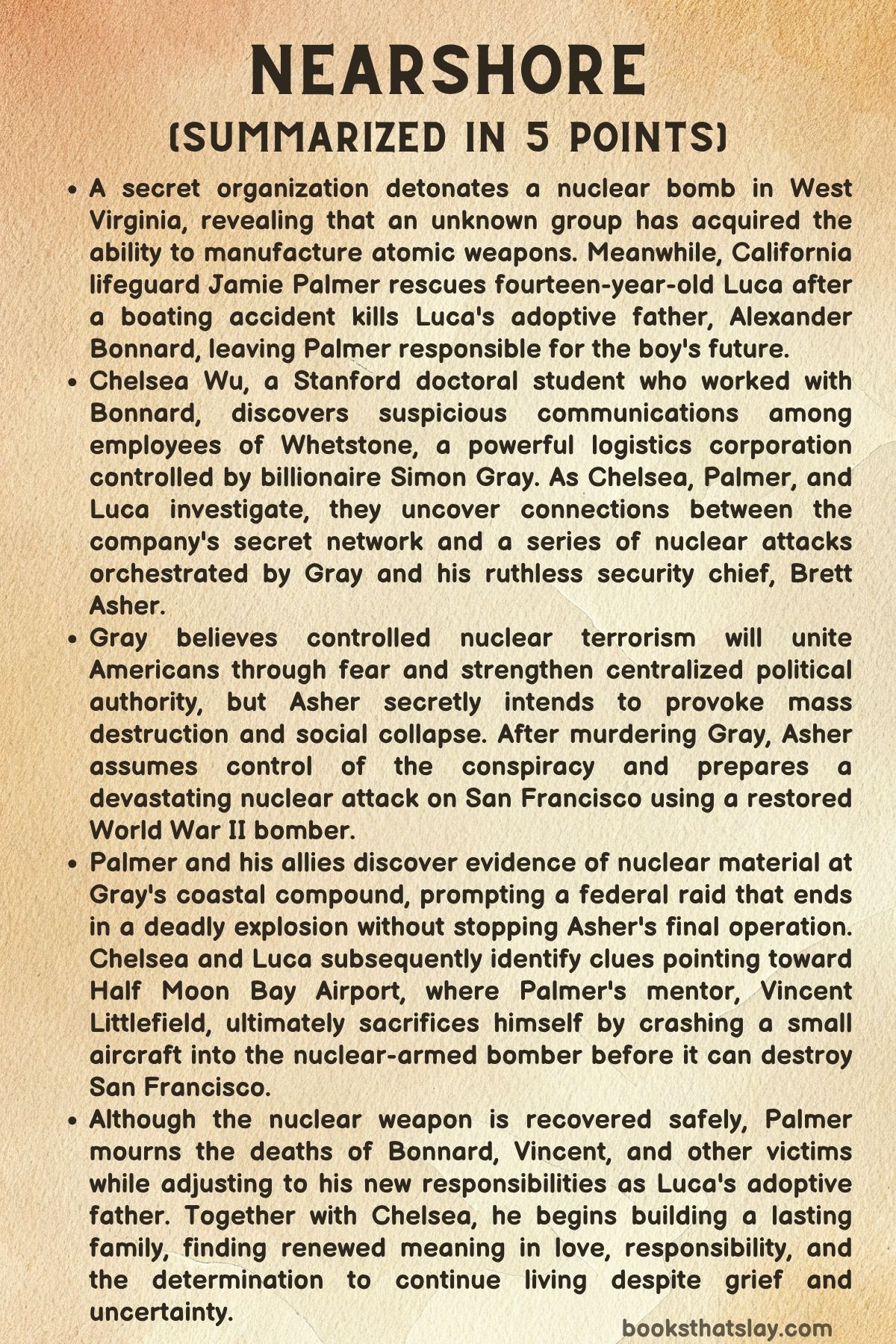
A secretive group of twelve specialists spends more than a year constructing an atomic bomb in the Appalachian hills. Although the physicists, engineers, machinists, and other experts understand their individual responsibilities, none knows where their weapons-grade uranium originated.
Once their device is completed, the group relocates west, leaving one volunteer behind to deliver the weapon. On a March morning, the bomb detonates beside Interstate 77 near Charleston, West Virginia, killing two people.
Federal investigators initially believe the explosion resulted from an accident involving a crude nuclear device. However, evidence eventually establishes that the detonation was deliberate, while isotope testing fails to identify the uranium’s source.
The realization that an unidentified organization can manufacture nuclear weapons creates widespread fear.
Across the country, California State Parks lifeguard Jamie Palmer notices an unmanned fishing boat circling uncontrollably offshore. Recognizing the vessel as belonging to his closest friend, Alexander “Boneyard” Bonnard, Palmer immediately begins searching for Boneyard and his fourteen-year-old adopted son, Luca.
Palmer eventually rescues Luca, who is seriously injured and suffering from hypothermia. The boy explains that his father struck his head, fell overboard, and was subsequently hit by the circling boat.
Although Palmer returns to search for his friend, Boneyard remains missing. The tragedy leaves Luca dependent on Palmer, who is named as the boy’s guardian in Boneyard’s will.
Palmer gradually welcomes Luca into his coastal cottage. Their developing relationship is complicated by Luca’s earlier experiences in foster care and Palmer’s own fear of assuming responsibility for someone he might fail to protect.
Meanwhile, Chelsea Wu, a Stanford doctoral student who worked under Boneyard, approaches Palmer with disturbing information.
Chelsea studies corporate communication patterns using computational linguistics. While examining millions of anonymized messages from Whetstone, a powerful logistics corporation, she and Boneyard discovered an unusual network of employees communicating through obscure language.
The participants occupy unrelated positions throughout the company, and their communications appear to serve purposes unrelated to legitimate business.
Boneyard secretly identified the individuals behind the messages by accessing information that the research agreement prohibited him from examining. Before his death, he became convinced that the network represented something dangerous.
Chelsea subsequently discovers that the network’s activity increased before the West Virginia nuclear explosion and stopped shortly before the detonation.
The pattern raises the possibility that Whetstone participated in organizing the attack. Luca, who learned coding and data analysis from his father, possesses information that could help Chelsea investigate further.
Behind the corporation stands billionaire Simon Gray, a man who believes social stability depends on hierarchy, collective fear, and the existence of a common enemy.
Gray considers modern democratic societies dangerously fragmented. He believes that carefully controlled nuclear attacks could frighten Americans into abandoning their divisions and accepting stronger centralized authority.
His security chief, Brett Asher, has recruited extremists and technical specialists to implement this strategy through a clandestine operation called Apollo.
However, Asher secretly desires something considerably more destructive. Rather than limited attacks designed to produce political unity, he intends to provoke mass casualties, racial conflict, and revolutionary violence.
As Palmer and Chelsea investigate Whetstone, their personal relationship develops into a romance. Palmer also brings their evidence to Grace Bergstrom, a trusted former colleague working in regional intelligence.
Bergstrom initially considers the connection between suspicious communications and nuclear terrorism too uncertain to justify major intervention.
Palmer separately investigates Boneyard’s boating accident, suspecting that Whetstone might have arranged his death. An examination of the boat reveals that a corroded steering component failed, causing the vessel to circle uncontrollably.
The findings establish that Boneyard’s death was apparently accidental, but they do nothing to eliminate the larger threat.
When a second nuclear device explodes near West Wendover, Nevada, killing dozens of people, the earlier communications pattern becomes substantially more significant.
Bergstrom brings radiation specialist Mark Sweeney into the investigation. The possibility that Whetstone’s global transportation infrastructure could conceal the movement of nuclear material receives increasing attention.
Unknown to the investigators, Asher operates a secret uranium-enrichment facility at a former military installation on Adak in Alaska’s Aleutian Islands.
The remote facility produces weapons-grade uranium using advanced centrifuges. Its existence explains why authorities cannot connect the material from the first two bombs to any recognized national stockpile.
Asher arranges for another shipment of uranium to travel south through ordinary fishing and seafood transportation networks.
The material eventually reaches a concealed bombmaking compound on Simon Gray’s coastal property near Tunitas Creek.
Gray intends the third nuclear device to explode offshore from San Francisco. Its mushroom cloud will be visible across the metropolitan area, but he expects comparatively limited direct casualties.
Asher rejects this plan because he wants a catastrophic attack inside the city.
Their disagreement becomes irreconcilable. During a supposed reconnaissance trip offshore, Asher’s associate Olivia Duffy murders Gray, and the conspirators dispose of his body in the Pacific.
With Gray eliminated, Asher assumes control of Apollo and orders the bombmakers to increase the destructive power of their final weapon.
He arranges for the device, called Father, to be transported to Half Moon Bay Airport. There, retired Army Colonel Henry F. Conrad will carry it aboard a restored World War II Avro Lancaster bomber.
The planned attack will involve a one-way flight over San Francisco, where the bomb will detonate in the air.
Meanwhile, Luca discovers suspicious activity around Gray’s coastal compound. He and his friend Quinn encounter children living there, one of whom claims that their fathers are saving the world.
Palmer recruits his former lifeguarding mentor, Vincent Littlefield, to investigate the property.
Using an old route through coastal cliffs, Palmer and Vince conduct reconnaissance and identify structures suggesting an underground installation.
Sweeney supplies a compact radiation detector, which Palmer positions near a suspected ventilation outlet.
The instrument subsequently records the characteristic signature of uranium-235, providing the physical evidence needed to justify federal intervention.
Before the authorities move against the compound, Palmer and Luca decide to proceed with formal adoption. Palmer finally accepts that their relationship has become a permanent family bond.
He then moves Luca and Chelsea to his father’s farmhouse without explaining the impending operation.
During their stay, Palmer confesses a painful memory from his rescue career. He once failed to challenge deputies who had prematurely declared a drowned child dead, even though resuscitation should have been attempted.
The experience has haunted him for years and contributed to his fear of becoming responsible for Luca.
The federal assault on the Tunitas compound ends disastrously when a nuclear device detonates during the operation.
Dozens die, including twenty-seven military, law-enforcement, and emergency-response personnel. Investigators initially believe the principal conspirators have perished.
However, Asher and his associates have already moved the larger weapon elsewhere.
Chelsea subsequently examines a secret copy of Whetstone’s communications archive. Working with Luca, she identifies references to aircraft, a queen, and an upcoming event called Dream Machines.
The clues lead Palmer, Chelsea, Luca, and Vince to the Pacific Coast Dream Machines show at Half Moon Bay Airport.
There they discover the restored Lancaster bomber named Pomona Queen. Its original manufacturer serial number matches another mysterious reference in the communications.
The group realizes that Apollo’s final attack is still being prepared.
The following morning, Palmer, Vince, and Bergstrom investigate a suspicious hangar. They discover an underground storage pit and equipment consistent with concealing a massive weapon.
Outside, the Lancaster is preparing to depart.
Olivia Duffy suddenly attacks, fatally shooting Bergstrom. Palmer kills Duffy but cannot prevent the bomber from taking off.
Vince commandeers a small Cessna and prepares to pursue the aircraft. Palmer climbs aboard, intending to accompany him.
Recognizing that Palmer now has a son who needs him, Vince forces him to jump into the ocean before continuing alone.
As the Lancaster approaches San Francisco, Asher prepares for the nuclear detonation that he believes will transform the nation through mass destruction.
At the last possible moment, Vince deliberately crashes his Cessna into the bomber.
The collision destroys the Lancaster’s ability to remain airborne, sending it into the water beneath the Golden Gate Bridge.
The nuclear weapon remains secured inside its bomb rack and does not detonate.
Authorities evacuate millions while specialists recover the aircraft, secure the bomb, and dismantle it offshore. The immediate nuclear threat ends, although the operation produces enormous disruption.
Evidence subsequently exposes political connections surrounding the conspiracy, and the effort to remove presidential term limits collapses.
Whetstone survives despite legal action against it because officials believe its destruction would severely disrupt international supply chains.
Vince’s body is eventually recovered from the wreckage of his aircraft, confirming that his sacrifice prevented the attack.
In the aftermath, Palmer, Chelsea, and Luca gather at the creek Vince spent years restoring. They scatter part of his ashes and remember his dedication to the natural world.
Luca casually calls Palmer Dad, confirming how completely their relationship has changed.
The novel closes with Palmer watching young steelhead repeatedly attempt to swim up a waterfall, despite being pushed backward by the current.
Their persistence offers him a renewed appreciation of life, continuity, and the determination to keep moving forward after devastating loss.
Characters
Jamie Palmer
Jamie Palmer is the central protagonist of Nearshore, a veteran California State Parks lifeguard whose professional courage contrasts with his deep personal insecurities. His identity is rooted in the Pacific coast, where he has spent decades developing an extraordinary understanding of waves, currents, and the dangers of the ocean.
Palmer instinctively approaches emergencies rather than retreating from them. His rescue of Luca demonstrates both his physical abilities and his willingness to risk his life when someone needs assistance.
Yet his confidence in professional situations does not extend naturally to parenthood. Years of recovering drowning victims and witnessing preventable tragedies have left him terrified of becoming responsible for a child.
His unresolved memories of a failed rescue involving a young boy reveal the emotional burden beneath his outward composure. Palmer’s recurring nightmares suggest that he measures his worth partly through the lives he could not save.
Boneyard’s death forces Palmer to confront these fears. Becoming Luca’s guardian requires him to offer stability, establish boundaries, and remain emotionally available even when the boy challenges his authority.
His developing relationship with Chelsea introduces another form of vulnerability. Palmer worries that their different intellectual backgrounds make him inadequate, although Chelsea recognizes qualities in him that have little to do with academic achievement.
Throughout the conspiracy investigation, Palmer repeatedly struggles to distinguish reasonable caution from abandoning people who need his help.
His eventual decision to adopt Luca represents a transformation in his understanding of responsibility. He learns that caring for another person does not require guaranteeing their safety or possessing answers to every problem.
By the conclusion, Palmer has accepted a future defined by relationships rather than professional independence alone. His grief over Boneyard and Vince remains, but it no longer prevents him from embracing the family that has formed around him.
Luca Bonnard
Luca Bonnard brings the novel’s exploration of loss and belonging into particularly sharp focus. At fourteen, he has already experienced the uncertainty of foster care before finding a loving home with Alexander Bonnard.
His father’s sudden death threatens the stability he had finally acquired. Although Palmer becomes his guardian, Luca initially finds it difficult to believe that another adult will remain committed to him permanently.
Luca possesses considerable intelligence and unusual technological skills for his age. His familiarity with coding and data analysis allows him to contribute meaningfully to Chelsea’s investigation of Whetstone.
These abilities also create difficulties because Luca frequently acts without permission. He downloads confidential information, investigates dangerous locations, and challenges Palmer’s attempts to protect him.
His decision to bring home a goat without permission reveals more than ordinary adolescent defiance. He is testing whether Palmer’s affection will survive conflict, reflecting his earlier experiences of rejection and instability.
The arguments between them become essential to Luca’s emotional development. He gradually learns that parental authority does not necessarily mean domination and that disagreement does not automatically result in abandonment.
Luca’s willingness to tell Palmer about his discoveries near the Whetstone compound demonstrates growing trust.
His eventual acceptance of adoption confirms that he is beginning to regard Palmer as a permanent parent rather than a temporary substitute for Boneyard.
By the ending, his casual use of Dad shows that their family relationship has become an ordinary part of his life.
Chelsea Wu
Chelsea Wu is one of the principal intellectual forces in Nearshore. A Stanford doctoral student specializing in computational linguistics, she recognizes patterns in large datasets that others might overlook.
Her discovery of the clandestine communications network becomes the foundation of the investigation. Without her analytical abilities, Whetstone’s suspicious internal activity might have remained invisible.
Chelsea’s character also raises difficult questions about academic ethics. She initially understands that accessing confidential information could destroy her career, yet the possibility of preventing further nuclear attacks eventually outweighs those concerns.
Her willingness to cooperate with Luca demonstrates that she values ability and insight rather than conventional hierarchies of expertise.
Emotionally, Chelsea is more complex than her professional confidence initially suggests. She has spent much of her life defined by mathematical talent and academic achievement, leaving her relatively inexperienced in relationships that demand emotional openness.
Her romance with Palmer challenges this imbalance. She comes to value his practical intelligence, emotional resilience, and capacity for compassion.
Chelsea also helps Palmer confront the memories he has concealed for years. Rather than treating his fears as weaknesses, she encourages him to recognize how his experiences have shaped his understanding of responsibility.
Her confrontation with Professor Pierce represents a decisive rejection of institutional priorities that place reputation above moral accountability.
By preserving the communications archive and discovering the clues leading to the Pomona Queen, she demonstrates that her intellectual independence has consequences extending far beyond her academic career.
Alexander “Boneyard” Bonnard
Alexander Bonnard is one of the most influential characters in Nearshore, despite dying near the beginning of the novel. His presence continues through the memories, relationships, and discoveries he leaves behind.
As a Stanford professor, Boneyard combines intellectual curiosity with a willingness to challenge conventional restrictions. His decision to identify the people behind Whetstone’s suspicious messages violates research rules but exposes information that eventually proves essential.
His relationship with Luca reveals another dimension of his character. Rather than treating his adopted son as incapable of understanding sophisticated ideas, he teaches him coding and includes him in aspects of his research.
This approach gives Luca both confidence and valuable analytical abilities, although it also introduces him to dangers that Boneyard could not have anticipated.
Boneyard’s friendship with Palmer is equally significant. Their shared history of surfing, travel, and coastal exploration establishes a bond that resembles brotherhood.
His death creates the emotional circumstances through which Palmer must confront his fear of parenthood.
The discovery that Boneyard died because of mechanical failure rather than murder also preserves the distinction between tragic chance and deliberate wrongdoing.
Although he never witnesses the conspiracy’s exposure, his research initiates the investigation, and his decision to name Palmer as Luca’s guardian creates the family that survives him.
Simon Gray
Simon Gray embodies the dangerous intersection of extraordinary wealth, ideological certainty, and technological power. As Whetstone’s billionaire founder, he possesses resources that allow him to pursue political ambitions outside ordinary institutional restraints.
His childhood experiences help explain the development of his worldview. Exposure to his parents’ countercultural environment, followed by his father’s violent death, contributes to his rejection of the ideals they represented.
Gray eventually concludes that societies require fear, hierarchy, and common enemies to remain cohesive.
His theory of controlled nuclear terrorism rests on the belief that limited destruction can produce desirable political consequences. He considers the deaths caused by Apollo unfortunate but acceptable within his larger vision.
This reasoning reveals his capacity to transform human suffering into an abstract calculation.
Gray’s greatest weakness is his conviction that he can control every consequence through money and organizational authority. He trusts Asher to handle violence without understanding the full extent of his subordinate’s ambitions.
His murder exposes the limits of that confidence. The man who believes himself capable of directing national history cannot control the individual he has empowered to implement his plans.
Gray’s fate illustrates how systems built upon coercion and secrecy can turn against their creators.
Brett Asher
Brett Asher is the novel’s principal antagonist and represents a more openly destructive form of extremism than Simon Gray.
A former military psychological-operations specialist, he combines organizational intelligence, operational experience, and a willingness to employ extreme violence.
Asher recruits specialists from extremist networks and creates a clandestine structure capable of constructing and transporting nuclear weapons.
His effectiveness depends partly on compartmentalization. By restricting what individual participants know, he reduces the likelihood that any single person can expose the entire operation.
Unlike Gray, Asher does not consider mass death an unfortunate consequence of a larger political project. He actively desires destruction because he believes widespread violence can accelerate social collapse.
His increasingly independent actions reveal that his commitment is not to Gray’s political strategy but to his own revolutionary ambitions.
Asher’s cruelty toward a homeless man demonstrates how little his ideological language conceals his contempt for vulnerable people.
His murder of Gray marks the moment when the conspiracy becomes fully subordinated to his destructive objectives.
By choosing to accompany the final bomber mission, Asher reveals that personal survival matters less to him than witnessing the catastrophe he has engineered.
His death in the crashed Lancaster completes the trajectory of a character who seeks power through annihilation but ultimately loses control over the violence he has unleashed.
Vincent Littlefield
Vincent Littlefield provides one of the strongest examples of practical moral courage in Nearshore. A former lifeguard supervisor and Palmer’s mentor, he combines extensive rescue experience with a commitment to protecting the natural world.
His restoration of a damaged steelhead stream reveals his patience and determination. Vince is willing to undertake difficult, sometimes unauthorized work when he believes bureaucratic restrictions obstruct a necessary improvement.
This independence also characterizes his response to the Whetstone investigation.
When Palmer asks for help, Vince does not dismiss the danger or retreat behind institutional responsibilities. He contributes his knowledge of coastal conditions and accompanies Palmer during reconnaissance of Gray’s property.
Vince serves as a paternal influence on Palmer, offering an example of responsibility grounded in action rather than authority.
His final decision to pursue the Lancaster becomes the novel’s decisive act of sacrifice. He understands that the bomber may be carrying a nuclear weapon and that stopping it could cost him his life.
Before continuing, he forces Palmer to leave the aircraft because Luca needs his father.
The choice reveals how completely Vince understands the value of the family Palmer has built.
His memorial at the restored creek reinforces the continuity between his environmental work and his sacrifice. Both arise from a willingness to protect life even when the personal cost is considerable.
Grace Bergstrom
Grace Bergstrom represents the possibility of principled action within complex security institutions. Her previous professional relationship with Palmer allows him to approach her with evidence that might otherwise appear implausible.
Initially, she refuses to treat statistical correlation as proof of nuclear terrorism. Her caution reflects an understanding of the serious consequences that could follow an unsupported accusation.
However, Bergstrom remains willing to reconsider her position as new evidence emerges.
The second nuclear explosion changes her assessment, and she begins involving trusted specialists while protecting the identities of Palmer’s sources.
Her character demonstrates the importance of professional skepticism when it remains open to revision.
Bergstrom also understands that sensitive investigations can be compromised by premature disclosure. Her insistence on secrecy creates difficulties for Palmer’s personal relationships but reflects genuine operational concerns.
Her death during the airport confrontation emphasizes the vulnerability of individuals working within institutions that cannot always respond quickly enough to emerging threats.
Although she does not survive to witness the final resolution, her involvement helps transform Chelsea’s discoveries into an actionable investigation.
Mark Sweeney
Mark Sweeney is a radiation specialist whose expertise provides the investigation with essential scientific credibility.
He explains the difficulty of detecting shielded nuclear material and the complications involved in responding to unconventional nuclear threats.
Unlike characters who treat technology as an almost unlimited source of power, Sweeney recognizes its practical limitations.
He understands that sophisticated detection systems cannot automatically overcome insufficient information, bureaucratic confusion, or deliberately concealed activity.
His decision to provide Palmer with a compact radiation detector reflects a difficult judgment. He knows that allowing civilians to approach a suspected nuclear facility is dangerous, but he also recognizes the potential value of obtaining physical evidence.
The uranium signature recorded near Gray’s compound ultimately justifies federal intervention.
Sweeney demonstrates how specialized knowledge becomes most effective when combined with the observations and initiative of people outside formal scientific institutions.
Stanley Palmer
Stanley Palmer is Jamie’s father and represents continuity, stability, and the enduring importance of family.
A lifelong farmer, he is reserved and practical, expressing care primarily through dependable actions rather than elaborate emotional declarations.
His relationship with Jamie has been shaped by the disappearance of Jamie’s mother and the silence that followed within their household.
Nevertheless, Stanley remains a reliable presence in his son’s life.
When Luca enters the family, Stanley welcomes him without hesitation and offers another source of security.
The visit to the farmhouse allows Luca to experience traditions that extend beyond his immediate relationship with Palmer.
Stanley’s inclusion of the boy in ordinary family life helps demonstrate that adoption means belonging to a wider network of relationships.
His character also highlights the difference between wealth and genuine security. While Gray controls enormous financial resources, Stanley offers something more personal: a home built upon consistency, shared history, and unconditional availability.
Olivia Duffy
Olivia Duffy is one of Asher’s closest operatives and a crucial participant in the conspiracy’s final stages.
Her outwardly composed manner conceals an ability to commit extreme violence without visible hesitation.
She murders Simon Gray during the offshore reconnaissance trip, allowing Asher to take complete control of Apollo.
Her participation reveals that the conspiracy depends not only on ideological planners and technical specialists but also on individuals willing to execute its most brutal decisions.
Duffy later helps prepare the final attack at Half Moon Bay Airport.
Her conversation with Asher suggests that she retains some interest in survival, distinguishing her from his increasingly self-destructive ambitions.
Nevertheless, she remains loyal to the operation and attempts to prevent Palmer and Bergstrom from interfering.
By killing Bergstrom, she transforms the airport investigation into a deadly confrontation.
Her own death at Palmer’s hands demonstrates the immediate human consequences of the conspiracy’s commitment to violence.
Henry F. Conrad
Retired Army Colonel Henry F. Conrad provides the aviation expertise required for Asher’s final nuclear attack.
His military background and personal family history shape his understanding of nuclear weapons.
Conrad’s father served as a wartime pilot whose experiences were profoundly affected by the atomic bombings of Japan and the cancellation of a planned invasion.
Conrad interprets this history as evidence that nuclear weapons can decisively reshape political and military circumstances.
However, he transforms that historical interpretation into a justification for terrorism.
His willingness to pilot the Pomona Queen on a one-way mission demonstrates the depth of his ideological commitment.
Unlike Gray, who seeks to preserve his own position while manipulating others, Conrad accepts his death as part of the operation.
His character illustrates how military tradition and historical memory can be selectively interpreted to justify fundamentally different purposes.
Hartley Pierce
Professor Hartley Pierce represents the institutional pressures surrounding Chelsea’s research.
As her replacement dissertation adviser, he approaches her work through questions of methodology, professional ethics, and academic reputation.
His skepticism is not entirely baseless. Chelsea and Boneyard did violate the terms governing their access to confidential corporate information.
However, Pierce appears more concerned with the consequences for Stanford’s relationships with powerful corporations than with the extraordinary danger the researchers uncovered.
His interactions with Chelsea expose the limitations of a system that evaluates conduct primarily through procedural compliance.
The meeting in which Chelsea walks out of his office marks her rejection of an academic future controlled by those priorities.
Pierce functions as a contrast to Boneyard, whose intellectual curiosity and willingness to take risks helped reveal the conspiracy.
Beth
Beth, Chelsea’s roommate, provides a glimpse into Chelsea’s ordinary personal life beyond the investigation.
Her teasing about Chelsea’s relationship with Palmer encourages Chelsea to acknowledge how emotionally important the romance has become.
Although Beth is not directly involved in exposing Whetstone, her presence prevents Chelsea’s identity from being defined entirely by research and danger.
She represents the everyday friendships and personal routines that remain valuable even when extraordinary events dominate the characters’ lives.
Quinn
Quinn is Luca’s school friend and accompanies him during his unauthorized exploration near Gray’s coastal property.
Their encounter with children living at the compound produces an important clue about the possible activities taking place there.
Quinn’s involvement highlights Luca’s adolescence. Despite his technical abilities and the seriousness of the investigation, Luca still participates in impulsive adventures with friends.
The episode also demonstrates how apparently ordinary curiosity can expose hidden dangers.
The Bombmakers and Their Families
The specialists recruited to manufacture Apollo’s nuclear devices function collectively as an important representation of ideological cooperation.
Their backgrounds and motivations are not identical, but they share sufficient loyalty, resentment, and technical ambition to participate in the conspiracy.
Some view themselves as participants in a historic transformation, while others appear motivated by professional pride or commitment to their closed community.
The presence of spouses and children complicates the moral and practical circumstances of the operation.
One specialist privately questions Asher’s increasingly destructive plans but remains silent because withdrawal might endanger his family.
These characters demonstrate how participation in organized wrongdoing can become sustained through social dependence, fear, and gradual acceptance of increasingly extreme demands.
Themes
Fear as an Instrument of Power
Fear becomes a mechanism through which powerful individuals attempt to influence society in Nearshore. Simon Gray believes that political fragmentation can be overcome by manufacturing an external threat, allowing frightened citizens to unite behind centralized authority.
His nuclear attacks are therefore designed not simply to destroy physical targets but to alter collective behavior. He assumes that widespread anxiety will encourage people to surrender political disagreements in exchange for the promise of security.
This conception of power reduces ordinary citizens to objects of psychological manipulation. Their suffering matters to Gray primarily as a factor in his calculations about political stability.
Brett Asher offers a more destructive variation of the same principle. While Gray wants fear to produce obedience, Asher wants it to generate hatred, retaliation, and social collapse.
Their disagreement exposes the instability of attempting to control collective responses through violence. Neither man can guarantee that frightened people will react according to his preferred ideological outcome.
The Nevada bombing illustrates this unpredictability when a witness, believing civilization is ending, kills his wife and himself. The tragedy demonstrates that fear can produce consequences far removed from the intentions of those who create it.
Palmer’s behavior provides an opposing model. Rather than manipulating fear, he recognizes it as a natural response to danger that must be managed through knowledge, preparation, and responsibility.
The novel consequently distinguishes between leadership that exploits human vulnerability and courage that seeks to protect vulnerable people.
Parenthood, Belonging, and the Responsibility to Protect
Luca’s arrival transforms Palmer’s understanding of family by forcing him to confront responsibilities he has spent much of his adult life avoiding.
Palmer is accustomed to rescuing strangers during immediate emergencies. Parenthood, however, requires a different form of commitment because its demands continue long after the initial crisis has passed.
His fear of becoming Luca’s father originates partly in his professional experiences with death. Having witnessed children die despite rescue efforts, he worries that loving a child will expose him to unbearable loss.
Luca approaches their developing relationship from another direction. His experiences in foster care have taught him that adult affection can be temporary, making him reluctant to trust promises of permanence.
Their arguments over rules, independence, and honesty become expressions of these competing fears.
The episode involving the goat demonstrates how Luca tests Palmer’s commitment through deliberate misbehavior. Palmer must learn that maintaining boundaries does not contradict unconditional affection.
Chelsea and Stanley contribute to the formation of this family by offering different kinds of emotional support.
Chelsea encourages openness, while Stanley provides continuity through ordinary domestic traditions. Together, they show Luca that belonging extends beyond a single relationship.
The decision to proceed with adoption marks Palmer’s acceptance that parenthood cannot be reduced to preventing danger.
Vince’s final sacrifice reinforces this understanding. By forcing Palmer to abandon the pursuit of the bomber, he protects Luca’s future with his father.
The closing scenes suggest that family is sustained not by an absence of loss but by the willingness to remain connected despite uncertainty.
Scientific Knowledge, Corporate Power, and Moral Accountability
The conspiracy reveals how scientific expertise and technological infrastructure can become dangerous when separated from ethical responsibility.
Whetstone’s extraordinary logistical capabilities ordinarily support global commerce. Under Gray and Asher, those same systems conceal uranium transportation, clandestine facilities, and preparations for nuclear terrorism.
The secret enrichment plant illustrates how financial resources can place capabilities once associated primarily with governments within the reach of private organizations.
The danger does not arise from scientific knowledge alone. It emerges when specialized expertise operates inside a structure that discourages transparency and concentrates decision-making authority.
The bombmakers understand their technical responsibilities but frequently lack knowledge of the operation’s complete purpose.
This compartmentalization allows individuals to contribute to catastrophic wrongdoing while treating their own work as a limited professional assignment.
Chelsea’s research introduces a different ethical problem. She violates confidentiality restrictions while investigating communications that may reveal a threat to public safety.
Her actions challenge the assumption that compliance with institutional procedures always produces morally responsible outcomes.
Professor Pierce’s response exposes the conflict between protecting academic relationships and recognizing the public consequences of research discoveries.
Nearshore does not suggest that expertise or institutional rules are inherently harmful. Sweeney’s scientific assistance and Bergstrom’s professional judgment demonstrate their indispensable value.
Instead, the novel examines what happens when organizations treat technical achievement, legal compliance, or financial stability as sufficient substitutes for moral accountability.
Whetstone’s survival after the conspiracy’s exposure further complicates the issue. Its economic importance limits the consequences imposed upon the corporation, demonstrating how deeply institutional dependence can protect concentrations of power.
Grief, Sacrifice, and the Persistence of Life
Loss shapes Palmer’s identity long before the central events of the novel begin. His mother’s disappearance leaves unresolved questions that influence his emotional development and his understanding of abandonment.
His lifeguarding career exposes him to further deaths, many of which remain present through memories and the small objects he collects from recovery scenes.
These keepsakes reflect his refusal to regard the dead as anonymous incidents. Each represents an individual life that continues to matter after its physical end.
Boneyard’s death intensifies Palmer’s grief while creating an unexpected responsibility. Through Luca, the friendship survives in a new form, requiring Palmer to transform mourning into active care.
Vince’s death produces another devastating loss, but its circumstances differ from the accident that killed Boneyard.
Vince knowingly sacrifices himself to prevent a nuclear catastrophe. His decision raises questions about the relationship between individual survival and responsibility toward others.
The novel avoids presenting grief as something that disappears once a heroic purpose has been established. Palmer still mourns the people he has lost, even when their actions have helped preserve other lives.
The memorial at Vince’s restored creek gives this idea a physical expression.
By scattering his ashes into a place he spent years protecting, the characters acknowledge that his influence continues through the living environment.
The young steelhead attempting to swim against the waterfall provide the story’s final image of persistence.
Their repeated efforts appear futile when considered individually, yet the instinct to continue represents the continuity of life itself.
For Palmer, watching them becomes an affirmation that survival does not require certainty about the future.
The novel concludes by suggesting that human resilience consists not in escaping grief or controlling every outcome, but in continuing to love, protect, and participate in life despite the certainty of further challenges.