Not A Word Summary, Characters and Themes
Not A Word by Linwood Barclay is a psychological thriller that explores the devastating consequences of family secrets, buried crimes, and misplaced loyalty.
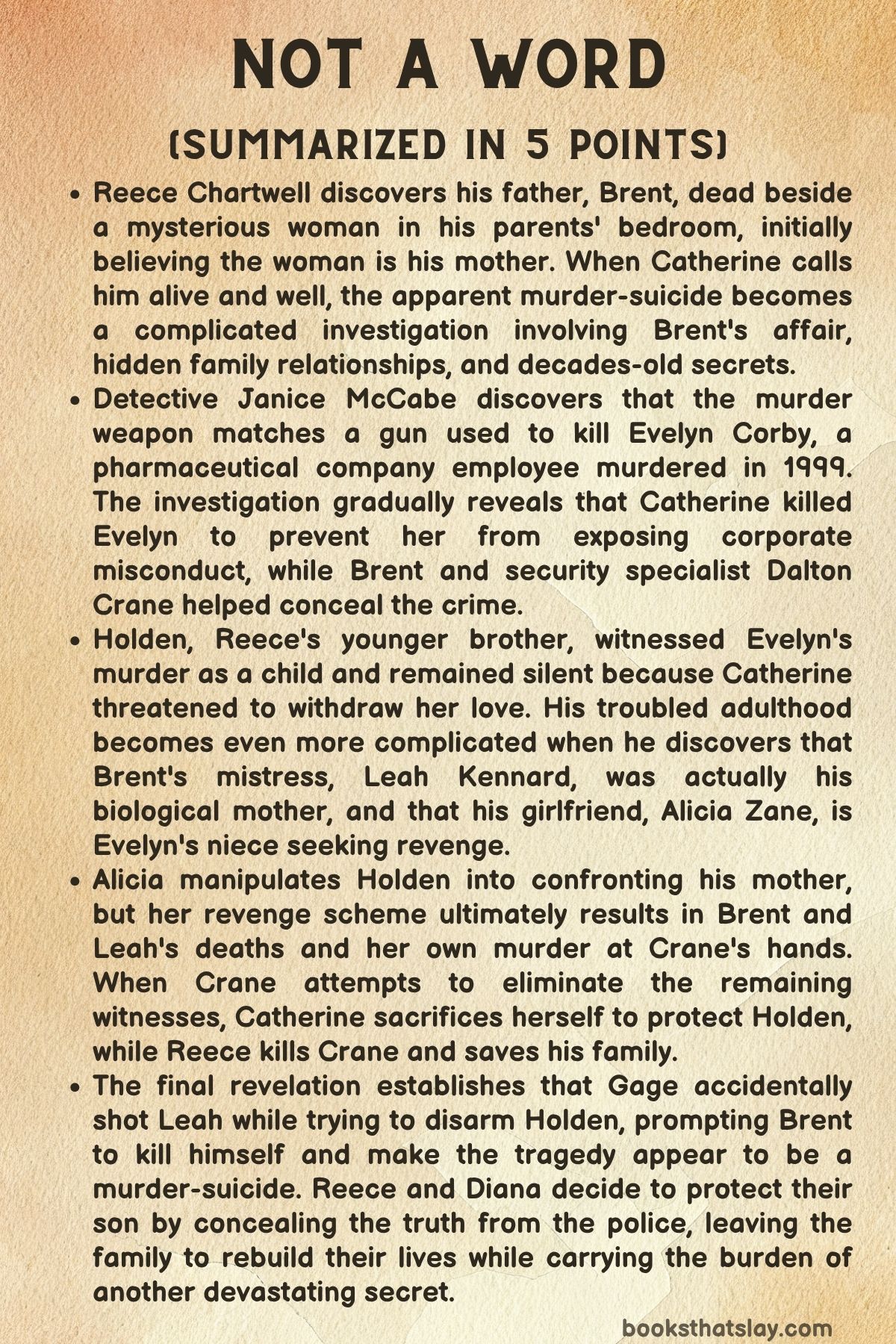
The story begins when Reece Chartwell discovers his father dead beside an unidentified woman, only to learn that his mother is alive and concealing something disturbing. As Detective Janice McCabe investigates the apparent murder-suicide, the evidence leads to an unsolved killing from more than two decades earlier. Through the experiences of three generations of the Chartwell family, Barclay examines how love can become a weapon of manipulation and how the desire to protect loved ones can result in terrible sacrifices.
Summary
Reece Chartwell’s life changes when he visits his parents’ house and discovers two bodies in their bedroom. His father, Brent, lies dead beside a woman who has been shot in the head, while a handgun near Brent’s hand suggests that he murdered her before killing himself.
Initially believing the woman is his mother, Catherine, Reece struggles to comprehend the apparent murder-suicide. His confusion becomes overwhelming when Catherine telephones him from a restaurant, asking why her husband is not answering his calls.
Detective Janice McCabe soon identifies the dead woman as Leah Kennard. Messages on a second phone belonging to Brent establish that they were romantically involved, introducing the possibility that the deaths resulted from an extramarital affair.
Meanwhile, Catherine behaves strangely after learning what happened. Rather than immediately meeting Reece, she deliberately avoids him, ignores telephone calls, and privately contacts a mysterious man who appears to know something about her past.
Reece must also consider how the tragedy will affect his wife, Diana, their teenage son, Gage, and his younger brother, Holden. Holden has struggled with addiction for years, while Gage shared an unusually close relationship with his grandfather.
As the family attempts to process Brent’s death, tensions surrounding Catherine become increasingly apparent. Gage openly blames his grandmother for the family’s unhappiness, suggesting that her controlling behavior contributed to Holden’s addiction and Brent’s dissatisfaction.
Catherine eventually reveals that she knew about Brent’s relationship with Leah. However, her concerns extend beyond marital betrayal, and she repeatedly questions whether Brent truly killed himself.
McCabe’s investigation initially produces evidence supporting the murder-suicide explanation. Brent’s fingerprints and gunshot residue are found on the weapon, and a handwritten note appears to accept responsibility for the deaths.
Nevertheless, a forensic discovery connects the weapon to the unsolved murder of Evelyn Corby in 1999.
Evelyn worked alongside Brent at Wiffel-Smith, a pharmaceutical company that had become enormously profitable through its addictive pain medication, Oxy-Mirac.
Years earlier, Evelyn’s nephew Miles died after becoming addicted to the drug. Consumed by guilt, Evelyn obtained documents suggesting that Wiffel-Smith knowingly encouraged dangerous prescribing practices while concealing evidence of addiction.
She approached Brent and asked him to help expose the company. Although reluctant to sacrifice his financial security, Brent eventually agreed.
Catherine, however, had different priorities.
Having grown up in poverty, she valued the comfortable lifestyle Brent’s career provided and feared losing everything if Evelyn’s revelations destroyed the company.
Catherine had also developed a secret relationship with Dalton Crane, Wiffel-Smith’s security chief. After becoming frightened by threats associated with Brent’s work, she persuaded Crane to teach her how to shoot and provide her with an unregistered handgun.
When Evelyn arrived at the Chartwell residence with incriminating documents, Catherine intervened and threatened her with the weapon.
Evelyn attempted to escape toward the backyard pond. Catherine pursued her and shot her in the back, killing her.
Brent was horrified. Catherine threw the gun into the pond before persuading him to contact Crane, who arranged to dispose of Evelyn’s body and conceal evidence connecting the murder to the Chartwell household.
The killing had another witness.
Young Holden watched his mother shoot Evelyn from his bedroom window. Catherine subsequently told him that revealing what he had witnessed would destroy their family and threatened to stop loving him if he ever disclosed the truth.
Terrified of losing his mother’s affection, Holden promised to remain silent.
Brent never forgave Catherine. He left Wiffel-Smith and remained married primarily for their children’s sake, while their relationship became increasingly distant.
The secret also damaged Holden, whose childhood trauma contributed to years of addiction and emotional instability.
More than two decades later, the consequences of Evelyn’s death return through Alicia Zane, a woman Holden meets during rehabilitation.
Alicia claims that her aunt was murdered during a bank robbery. In reality, her aunt was Evelyn Corby.
During therapy, Holden reveals that he witnessed his mother murder a woman who intended to expose a pharmaceutical company. Alicia recognizes the connection to Evelyn’s death and gradually gains Holden’s confidence.
Rather than immediately reporting Catherine to the police, Alicia decides to seek personal revenge.
She begins a romantic relationship with Holden and encourages him to blame Catherine for his suffering. She also deliberately undermines his recovery, hoping to make him sufficiently angry to kill his mother.
Alicia’s plans become more dangerous when she discovers that Holden secretly retrieved the Beretta from the pond shortly after Evelyn’s murder.
He kept the gun for years, eventually having it cleaned and tested.
Alicia recognizes that the weapon could provide an opportunity to punish Catherine using the same gun that killed Evelyn.
Meanwhile, another family secret emerges.
Catherine reveals to Reece that Leah Kennard was Holden’s biological mother. Unable to conceive naturally at the time, Catherine and Brent arranged for Leah to become their surrogate.
Leah gave birth to Holden, whom Catherine subsequently raised as her own son. Shortly afterward, Catherine unexpectedly conceived Reece naturally.
Reece is shocked to discover that he and Holden are biologically half brothers. He insists that Holden deserves to know the truth, but Catherine fears that revealing it will further destabilize him.
Detective McCabe independently discovers the connection after finding an album containing photographs of Holden in Leah’s home. The pictures identify him by the name Tom, which Leah privately used for the son she surrendered.
When McCabe confronts Holden with the photographs, he telephones Catherine and demands an explanation.
The revelation intensifies his longstanding insecurity about his mother’s love. He wonders whether Catherine found it easier to threaten him as a child because he was not biologically hers.
As the investigation continues, Catherine receives anonymous threatening calls from Alicia.
Alicia initially wants Catherine dead, but eventually demands a substantial payment in exchange for leaving her alone.
Catherine once again turns to Dalton Crane.
Crane has spent years concealing criminal activities associated with Wiffel-Smith, including the murder of its founder, Graham Wiffel, whose death he staged as a suicide.
He recognizes that exposure of Evelyn’s murder could threaten his own freedom.
Following Crane’s instructions, Catherine arranges a false payment. Alicia retrieves a package she believes contains money but discovers magazines instead.
Crane subsequently tracks Alicia to her apartment and confronts her.
During their encounter, Alicia admits that Holden told her about Evelyn’s murder. She also reveals that Gage knows something about the old crime.
Crane shoots Alicia in the forehead.
Having eliminated one person who could expose the secret, Crane decides to kill Holden and Gage as well. He also concludes that Catherine has become too dangerous to protect.
Meanwhile, Gage has begun investigating Alicia’s background.
After discovering that her supposed aunt’s bank robbery never occurred, he identifies her connection to Evelyn Corby. He informs Holden, who realizes that Alicia’s affection concealed a calculated revenge scheme.
The two visit Alicia’s apartment and discover her body.
They also find a magazine addressed to Brent, suggesting that Alicia had a previously unexplained connection to the Chartwell family.
Holden eventually confronts Catherine, accompanied by Gage. Catherine admits that she killed Evelyn and enlisted Crane to conceal the crime.
She also reveals that Alicia was responsible for Brent and Leah’s deaths, having apparently mistaken Leah for Catherine during an attempt to kill her.
Catherine realizes that Crane is now eliminating everyone who knows about the original murder. She urgently warns Holden and Gage to escape.
Reece and Diana arrive shortly afterward, and the family gathers near the backyard pond.
Under pressure, Catherine finally confesses the full circumstances of Evelyn’s murder, explaining how her determination to protect the family’s wealth destroyed her marriage and damaged Holden’s life.
Before they can contact the police, Crane appears with a gun.
Recognizing that the family knows too much, he prepares to kill them.
Holden charges toward him, but Catherine throws herself between her son and the gunman. Crane shoots her in the chest.
Reece orders Diana and Gage to run before attacking Crane with the broken end of an old wooden paddle.
He fatally wounds Crane, ending the immediate threat.
As Catherine lies dying, she apologizes to Holden for the cruelty of her childhood threat. She assures him that he has always been as much her son as Reece.
Holden forgives her, and Catherine dies in his arms.
Although Crane’s death brings the violence to an end, McCabe remains unable to explain precisely how Alicia obtained the weapon used in Evelyn’s murder.
Holden refuses to reveal that he recovered the gun from the pond. Without that information, the detective finds insufficient evidence connecting Alicia to Brent and Leah’s deaths.
She therefore concludes that Brent most likely murdered Leah before taking his own life.
Reece and Diana struggle to accept this explanation, particularly because their memories of Brent suggest a compassionate man who consistently protected his family.
The final revelation comes when Reece discovers a handwritten message from Brent addressed to Holden.
Gage admits that he was supposed to deliver it but never did. He then explains what actually happened in the bedroom.
On the day of the killings, Holden arrived at his parents’ house with the Beretta, intending to confront Catherine about Evelyn’s murder.
Gage followed him, hoping to prevent a disaster.
Instead, they discovered Brent and Leah together.
Holden demanded to know who Leah was, but before the situation could be resolved, Gage attempted to take the gun from his uncle.
During their struggle, the weapon accidentally discharged.
The bullet struck Leah in the back of the head, killing her instantly.
Holden fled in panic, leaving Gage alone with his grandfather.
Brent recognized that the shooting was accidental. Determined to protect both boys from the consequences, he wiped the gun, instructed Gage to remove possible evidence, and wrote two notes.
One reassured Holden of his father’s love. The other accepted responsibility for the deaths.
Brent then sent Gage away.
As the boy reached the front door, he heard another gunshot. Brent had killed himself, deliberately creating the appearance that he had murdered Leah.
The apparent murder-suicide was therefore a final act of sacrifice.
After learning the truth, Reece and Diana decide not to inform McCabe. They believe that exposing Gage and Holden would accomplish little beyond extending the family’s suffering.
However, they also recognize the damage caused by Catherine’s treatment of Holden.
Unlike Catherine, who used secrecy to isolate and control her son, they encourage Gage to discuss his guilt openly with them.
The family gradually begins rebuilding its life. Brent and Catherine are buried together, the Chartwell house is prepared for sale, and Reece considers new professional opportunities.
Nevertheless, Gage continues experiencing nightmares, and Holden remains burdened by grief.
Not A Word concludes with Reece and Diana comforting their son while protecting the truth about Brent’s death. Their decision preserves the final family secret, leaving unresolved the question of whether concealing a terrible event can ever truly protect the people involved.
Characters
Reece Chartwell
Reece Chartwell is the central viewpoint character in Not A Word, serving as the emotional connection between the family’s troubled past and its increasingly dangerous present. His discovery of Brent’s body initiates the investigation and forces him to reconsider nearly everything he believed about his parents.
Recently unemployed after losing his television news writing position, Reece is already experiencing professional uncertainty when the tragedy occurs. His father’s death adds grief, responsibility, and financial concerns to an already difficult period.
Reece’s relationship with Brent was complicated by differences in ambition and personality. Although he loved his father, he often believed Brent valued business accomplishments more than his son’s interests in journalism.
His memories contrast with Gage’s experience of Brent as an attentive, understanding grandfather. This difference gradually encourages Reece to recognize aspects of his father’s character that he overlooked.
Reece also struggles with Catherine’s controlling behavior and Holden’s addiction. He repeatedly assumes responsibility for family problems, even when his efforts create tension with Diana.
His determination to uncover the truth places him in conflict with Catherine, particularly after learning that Leah was Holden’s biological mother. Reece believes that preserving family stability cannot justify indefinitely withholding information about someone’s identity.
His most significant transformation occurs after Gage confesses the circumstances of Leah’s death.
Reece must decide whether to reveal the truth or protect his son. His decision to remain silent demonstrates the moral complexity he once believed belonged only to other members of his family.
Although he rejects Catherine’s emotional manipulation, he ultimately accepts that parental love can involve difficult choices without clear solutions.
Catherine Chartwell
Catherine Chartwell is one of the most psychologically complicated characters in Not A Word. Her actions drive the original murder, its decades-long concealment, and much of the subsequent violence.
Her childhood poverty profoundly influences her understanding of security. Having experienced financial hardship, Catherine considers wealth and social status essential protections against uncertainty.
Brent’s successful pharmaceutical career provides the comfortable lifestyle she desires. Consequently, Evelyn Corby’s intention to expose Wiffel-Smith represents more than a threat to the company; Catherine perceives it as a threat to everything she has achieved.
Her decision to shoot Evelyn reveals the destructive consequences of allowing financial security to outweigh moral responsibility.
Catherine’s relationship with Holden demonstrates another troubling aspect of her personality. Although she genuinely considers him her son, she uses the threat of withdrawing her love to ensure his silence about Evelyn’s murder.
This manipulation produces lasting emotional consequences, contributing to Holden’s insecurity and addiction.
Her refusal to reveal his biological origins further damages their relationship. She believes she is protecting him, but her secrecy reinforces his suspicion that her affection has always been conditional.
Catherine’s relationship with Dalton Crane reveals her willingness to rely on dangerous people when her circumstances become threatening. She repeatedly turns to him rather than confronting the consequences of her actions.
Nevertheless, Catherine is not entirely without genuine affection. Her final decision to shield Holden from Crane’s bullet demonstrates that her love for him exists independently of their biological relationship.
Her death provides a moment of moral recognition. She apologizes for the cruelty she inflicted on Holden and assures him that he was never less deserving of love than Reece.
Although her sacrifice cannot erase the suffering she caused, it allows Holden to receive the affirmation he desperately needed.
Brent Chartwell
Brent Chartwell initially appears to be a successful businessman whose secret affair culminates in a brutal murder-suicide. As the novel progresses, however, his character emerges as considerably more complicated.
His work at Wiffel-Smith provides financial stability for his family but also implicates him in a pharmaceutical industry responsible for widespread addiction.
Brent’s guilt becomes personal when Holden develops substance abuse problems. He interprets his son’s suffering as a possible consequence of the wealth he accumulated through the company’s activities.
His encounter with Evelyn Corby establishes his capacity for moral change.
Although initially reluctant to expose Wiffel-Smith, Brent ultimately agrees to support Evelyn because he recognizes the harm caused by the company’s conduct.
Catherine’s murder of Evelyn destroys his remaining faith in their marriage. Nevertheless, he assists in concealing the killing because he fears the consequences for his children.
His relationship with Leah offers an opportunity for emotional renewal. Having spent years in a distant marriage, Brent finds affection and understanding with the woman who gave birth to Holden.
His commitment to family is also evident in his treatment of Gage.
When Gage is caught stealing, Brent protects him from excessive punishment while ensuring that he understands his mistake. He approaches the incident as an opportunity to teach responsibility rather than exercise authority.
Brent’s final decision is the defining act of his character. After Leah’s accidental death, he accepts responsibility and kills himself to protect Holden and Gage.
This sacrifice demonstrates extraordinary devotion while raising troubling questions about whether protecting loved ones through deception is ultimately beneficial.
Brent is neither entirely innocent nor morally uncomplicated. His involvement in concealing Evelyn’s murder remains a serious wrongdoing, even though his final actions arise from love.
Holden Chartwell
Holden Chartwell represents the lasting psychological consequences of childhood trauma and emotional manipulation. His experiences form the emotional foundation of Not A Word, even when his significance is initially concealed.
As a child, Holden witnesses Catherine murder Evelyn Corby. Rather than receiving reassurance or an opportunity to process the experience, he is threatened with the loss of his mother’s love.
His silence becomes a source of enduring fear and guilt.
Holden’s addiction reflects his difficulty managing these unresolved emotions. Although his family repeatedly arranges rehabilitation, treatment cannot fully address the secret that shapes his understanding of himself.
His relationship with Catherine is characterized by conflicting feelings. He loves her and desires her approval, yet resents her control and suspects that she values Reece more highly.
Discovering that Leah was his biological mother intensifies these insecurities.
Holden begins questioning whether Catherine’s treatment of him was influenced by their lack of biological connection. The revelation also deprives him of the possibility of knowing Leah, who dies before he understands their relationship.
His involvement with Alicia demonstrates his vulnerability to manipulation.
Because Alicia appears to understand his suffering, Holden trusts her with information he has concealed for decades. He does not initially recognize that she intends to exploit his anger for revenge.
Nevertheless, Holden retains the capacity for affection and compassion. His closeness to Gage suggests that he can provide emotional understanding even while struggling with his own problems.
His final reconciliation with Catherine is especially significant. Her decision to protect him and her dying assurance of unconditional love provide the emotional recognition denied to him throughout childhood.
Holden survives, but his future remains uncertain. His experience illustrates how deeply childhood manipulation can affect adulthood and how difficult recovery becomes when the original source of suffering remains unaddressed.
Gage Chartwell
Gage Chartwell is Reece and Diana’s fourteen-year-old son and the character through whom the consequences of secrecy extend into a third generation.
His relationship with Brent is unusually close. Unlike his parents, who often emphasize rules and responsibilities, Brent makes Gage feel understood without being judged.
The convenience-store incident establishes the foundation of their relationship. Brent protects Gage from severe consequences while ensuring that he learns from his mistake.
Gage interprets this response as evidence that his grandfather’s love is unconditional.
His relationship with Holden is equally important. He admires his uncle’s intelligence, generosity, and willingness to discuss difficult subjects.
These relationships explain why Gage becomes involved in the family’s concealed history.
When Holden threatens to confront Catherine with a gun, Gage attempts to prevent violence. His intervention accidentally causes Leah’s death, creating a traumatic experience that mirrors Holden’s childhood exposure to Evelyn’s murder.
Gage subsequently faces overwhelming guilt.
His nightmares, emotional withdrawal, and resistance to discussing events reflect the psychological burden of knowing that an attempted act of protection resulted in tragedy.
He also struggles with Brent’s sacrifice, recognizing that his grandfather died to shield him from responsibility.
Unlike Holden, however, Gage eventually tells his parents what happened.
His confession establishes a significant difference between the generations. Although the family continues concealing the truth from outsiders, Gage is no longer required to suffer in complete isolation.
His character demonstrates the importance of emotional support after traumatic experiences and the dangers of expecting children to manage adult secrets independently.
Diana Chartwell
Diana Chartwell provides a comparatively stable emotional presence throughout the novel. Her practical judgment and concern for her family frequently counterbalance Reece’s tendency to become absorbed in his parents’ problems.
She responds to Brent’s death by organizing immediate responsibilities, including contacting Gage and ensuring that the household remains functioning.
However, Diana’s composure should not be mistaken for emotional detachment.
She recognizes that the Chartwell family’s difficulties have repeatedly affected her marriage. Holden’s addiction, Catherine’s demands, and the unequal financial treatment of the brothers have created longstanding tensions.
Diana is particularly protective of Gage.
Her frustration when he disappears reflects both ordinary parental anxiety and the increasingly dangerous circumstances surrounding the family.
Her recollection of accidentally damaging Brent’s prized Barracuda also reveals her understanding of his character. Brent responded with compassion rather than anger, demonstrating that he valued his family more than his possessions.
This memory helps Reece reconsider the apparent murder-suicide.
Diana’s final decision to protect Gage places her within the novel’s central moral conflict. Although she understands the destructive consequences of secrecy, she agrees that revealing the accident could cause further suffering.
Her distinction lies in how she approaches the concealment. Rather than demanding silence through fear, she encourages Gage to share his feelings and seek comfort.
Diana therefore represents an attempt to preserve family loyalty without repeating the emotional cruelty that damaged Holden.
Detective Janice McCabe
Detective Janice McCabe provides the investigative perspective in Not A Word, gradually uncovering connections between apparently unrelated deaths.
Her professional approach is characterized by persistence and attention to detail. She questions the initial murder-suicide explanation after noticing inconsistencies in the physical evidence.
Her recognition that the dead woman is not Catherine transforms the investigation.
McCabe subsequently identifies Leah Kennard, discovers Brent’s second phone, investigates Leah’s relationships, and uncovers the ballistic connection to Evelyn Corby’s murder.
Her willingness to revisit an old case demonstrates her determination to follow evidence beyond the most obvious explanation.
McCabe’s personal life provides an additional dimension to her character.
As a single mother raising Moira, she struggles to balance professional responsibilities with parental expectations. Her daughter’s rebellion creates conflicts that resemble the difficulties experienced by other families in the novel.
Unlike Catherine, McCabe attempts to establish boundaries without making affection conditional.
However, her investigation also demonstrates the limitations of even careful police work. Because Holden conceals his possession of the Beretta, McCabe cannot reconstruct the true circumstances of Brent and Leah’s deaths.
Her conclusion remains reasonable according to the available evidence, but it is ultimately incorrect.
Through McCabe, the novel distinguishes between an objectively complete account of events and the conclusions investigators can establish from incomplete testimony.
Alicia Zane
Alicia Zane is a major antagonist whose desire to avenge Evelyn Corby’s murder creates a new cycle of violence.
Her family history explains the origin of her determination. Evelyn’s death deprived Alicia of an important relative, leaving her with unresolved grief and anger.
When Holden reveals that he witnessed a woman being murdered by his mother, Alicia recognizes an opportunity to identify Evelyn’s killer.
However, she chooses manipulation rather than legal accountability.
She conceals her relationship to Evelyn and invents a story about an aunt murdered during a bank robbery. This deception allows her to gain Holden’s trust without revealing her intentions.
Alicia gradually encourages Holden to blame Catherine for his suffering. She also exploits his addiction, hoping to make him more susceptible to suggestions of violence.
Her discovery of the Beretta strengthens her desire for revenge.
Although she develops some affection for Holden, she remains willing to sacrifice his well-being to punish Catherine.
Her eventual decision to demand money reveals another transformation. Revenge becomes entangled with the prospect of financial escape, demonstrating how personal resentment can evolve into opportunism.
Alicia’s murder by Crane prevents her from achieving either objective.
Her character illustrates the dangers of treating another person’s trauma as an instrument of revenge. Rather than correcting the injustice of Evelyn’s death, Alicia contributes to further suffering and ultimately becomes another victim.
Dalton Crane
Dalton Crane is the novel’s most calculating antagonist, representing violence concealed beneath professional respectability.
As Wiffel-Smith’s security chief, he handles problems that the company cannot resolve through ordinary business procedures.
His methods include intimidation, bribery, and murder.
Crane’s relationship with Catherine begins when she seeks protection for her family. He provides firearms training and an unregistered handgun, gradually establishing himself as someone she can rely upon when ordinary solutions seem insufficient.
Their personal attraction never develops into a conventional relationship, but their shared secrets create a lasting connection.
Crane’s involvement in concealing Evelyn’s murder demonstrates his willingness to eliminate evidence and manipulate investigations.
His later murder of Graham Wiffel establishes that he is prepared to kill even the company’s founder when exposure threatens his interests.
Crane’s response to Alicia’s threats reveals his governing principle: anyone who possesses dangerous information becomes a potential target.
After killing Alicia, he decides that Holden, Gage, and eventually Catherine must also die.
His attitude toward Holden is particularly revealing. He regrets allowing the child to survive Evelyn’s murder because Holden eventually disclosed what he witnessed.
Crane therefore treats human relationships entirely through the calculation of risk.
His death at Reece’s hands ends the immediate danger, but his earlier actions have already produced irreversible consequences for several families.
Leah Kennard
Leah Kennard initially appears to be Brent’s mistress, but her significance expands when the novel reveals that she was Holden’s biological mother.
Her participation in the surrogacy arrangement connects her permanently to the Chartwell family, even though she does not raise the child she gives birth to.
After years of separation, Leah unexpectedly encounters Brent again.
Their renewed relationship begins when he offers financial assistance during a difficult period. Although his support initially reflects gratitude, their connection gradually becomes romantic.
Leah’s collection of photographs demonstrates her continuing emotional attachment to Holden.
She carefully removes other family members from pictures and preserves images documenting his growth, creating a private record of the son she never had the opportunity to raise.
Her decision to name him Tom within this personal collection suggests an imagined relationship that exists separately from his life as Holden Chartwell.
Leah’s relationship with Brent eventually offers the possibility of a shared future.
When she demands that their affair become something more substantial, Brent agrees to leave Catherine.
Their happiness is destroyed almost immediately by the accidental shooting.
Leah’s death is especially tragic because she never receives the opportunity to explain her identity to Holden. Her presence in the novel consequently highlights the emotional cost of concealed parentage and the permanent consequences of missed opportunities for reconciliation.
Evelyn Corby
Evelyn Corby is the catalyst for the historical crime that shapes the entire narrative.
A successful Wiffel-Smith salesperson, she initially benefits from the company’s wealth and promotional practices. Her perspective changes after her nephew Miles becomes addicted to Oxy-Mirac and dies from an overdose.
Evelyn recognizes her own involvement in his suffering because she helped him obtain the medication.
Her guilt eventually develops into a determination to expose the company’s misconduct.
She obtains confidential documents suggesting that Wiffel-Smith knowingly encouraged dangerous prescribing practices and concealed evidence of addiction.
Her decision to approach Brent demonstrates both courage and desperation.
Although she understands that revealing the documents could destroy her career, she believes the public deserves to know the truth.
Catherine’s response transforms Evelyn from a potential whistleblower into a murder victim.
Her death becomes the central secret around which the Chartwell family’s later tragedies develop.
Evelyn’s legacy also shapes Alicia’s actions. However, Alicia’s violent response contrasts with Evelyn’s original attempt to expose wrongdoing through documentary evidence and public accountability.
Evelyn therefore represents both the human consequences of corporate misconduct and the moral importance of confronting dangerous institutional practices.
Graham Wiffel
Graham Wiffel represents the financial and institutional power behind Wiffel-Smith.
His company’s success depends heavily on Oxy-Mirac, a medication whose addictive potential becomes central to the novel’s historical conflict.
Wiffel cultivates an atmosphere of luxury and professional privilege, rewarding successful employees and influential physicians through extravagant hospitality.
This culture encourages individuals such as Brent and Catherine to associate the company’s success with personal security.
Wiffel’s reliance on Dalton Crane also reveals the darker mechanisms protecting the business.
Crane handles threats that could damage the company’s reputation, allowing its executives to remain separated from the violence committed on their behalf.
When investigations begin threatening Wiffel-Smith, Crane murders Wiffel and stages his death as a suicide.
Wiffel’s fate demonstrates that the corrupt system he helped create ultimately becomes dangerous even to its own leadership.
Moira McCabe
Moira McCabe is Detective Janice McCabe’s teenage daughter and an important connection between the investigation and Gage’s personal life.
Her relationship with her mother is strained by disagreements about independence, curfews, and recreational drug use.
Moira resents the additional scrutiny she experiences because her mother is a police officer.
Nevertheless, she demonstrates considerable empathy when Gage visits her.
Rather than dismissing his concerns, she listens to his questions about family secrets and acknowledges that moral decisions often depend on circumstances and reliable evidence.
Her interest in true-crime stories also proves useful.
When Gage describes Alicia’s supposed aunt’s death, Moira searches for information and discovers that the story cannot easily be verified.
Although this discovery initially seems inconclusive, it contributes to Gage’s later recognition that Alicia has been lying.
Moira’s character also provides a contrast to Catherine’s relationship with Holden.
She challenges her mother’s authority openly, suggesting that disagreement between parents and children need not destroy affection.
Ray Stanhope
Ray Stanhope is Leah Kennard’s former boyfriend, whose history of possessiveness and aggression makes him an early suspect.
His relationship with Leah was troubled by jealousy, particularly after Brent began providing her with financial assistance.
Ray’s confrontation with Brent suggests that he might have possessed a motive for violence.
When McCabe approaches him, his attempt to flee initially strengthens suspicion, although he is actually worried about an unrelated assault.
His emotional reaction to Leah’s death appears genuine.
Ray admits that he still loved her, revealing the complicated feelings that remained after their relationship ended.
Although he ultimately has no established role in the central murders, his presence expands the investigation beyond the Chartwell family and demonstrates how misleading behavior can influence early assumptions.
Elaine Turcotte
Elaine Turcotte is Leah’s neighbor and an important source of information for McCabe.
She describes Leah as a helpful woman who occasionally cared for her young daughter.
Her observations establish that Brent visited Leah regularly and that their relationship had existed for some time.
Elaine also provides information about Ray Stanhope’s possessiveness and his confrontations with Brent.
Although her role is relatively limited, her testimony helps McCabe reconstruct Leah’s personal circumstances.
Elaine’s account gives Leah an identity beyond her involvement with Brent, establishing that she had relationships and responsibilities separate from the Chartwell family.
Giles Maitland
Giles Maitland is the retired investigator who originally examined Evelyn Corby’s murder.
His recollections help McCabe reconstruct the circumstances surrounding the discovery of Evelyn’s body and the abandoned vehicle.
Maitland explains that investigators considered several suspects but failed to establish who killed her.
His account also confirms that the apparent sexual assault was unsupported by forensic evidence, suggesting that the crime scene had been deliberately manipulated.
When McCabe reveals the ballistic connection between Evelyn’s murder and the Chartwell deaths, Maitland recognizes the significance of the discovery.
His character provides continuity between the historical crime and the present investigation.
Frank Chartwell
Frank Chartwell is Reece’s uncle and Brent’s estranged brother.
His brief appearance establishes that Brent’s family relationships extended beyond the immediate household, although not all of them remained close.
Frank’s cancer treatment prevents him from attending Brent’s funeral.
His admission that he and Brent had barely spoken in years introduces another example of emotional distance within the Chartwell family.
Although Frank does not directly influence the investigation, his presence reinforces the novel’s portrayal of relationships shaped by unresolved disagreements and prolonged separation.
Dr. Memphis
Dr. Memphis is associated with the Sharnwood rehabilitation facility and represents the professional support available to Holden.
Catherine contacts him after recognizing that Holden has relapsed.
His involvement establishes that Holden’s addiction has required repeated treatment and that the family has pursued medical assistance over several years.
However, Holden’s resistance to returning to rehabilitation demonstrates the limitations of intervention when the person receiving treatment remains unwilling or emotionally overwhelmed.
Dr. Memphis’s role also emphasizes the contrast between treating the visible symptoms of Holden’s addiction and addressing the concealed trauma contributing to his difficulties.
Ned McCabe
Ned McCabe is Janice McCabe’s former husband and Moira’s father.
His profession as a traveling poker player contributed to the breakdown of his marriage.
His frequent absences remain a source of frustration for Moira, who feels that he participates only intermittently in her life.
Although Ned appears mainly through references to the family’s history, his presence provides context for Janice’s responsibilities as a single mother.
He also helps establish Moira’s perspective on parental reliability and the importance of being emotionally available to children.
Themes
The Destructive Power of Family Secrets
Secrecy shapes the Chartwell family’s relationships long before Brent and Leah are discovered dead. Catherine’s murder of Evelyn Corby creates a concealed history that determines how family members understand themselves and one another.
Holden becomes the clearest example of the psychological consequences of enforced silence. After witnessing Evelyn’s murder, he is told that revealing the truth will cost him his mother’s love.
The threat changes his relationship with Catherine from one based on trust into one governed by fear. Although he continues loving her, he learns that affection may depend on concealing something terrible.
His addiction and emotional instability develop alongside this unresolved childhood experience.
The secrecy surrounding his biological origins intensifies the damage. When Holden discovers that Leah was his birth mother, he begins reconsidering Catherine’s treatment of him.
Information that might once have helped him understand his identity becomes devastating because it has been withheld for so long.
Reece also experiences the consequences of concealment. Every revelation forces him to reconsider his parents’ marriage, Brent’s professional history, and the foundations of his family.
The final revelation involving Gage brings the theme into sharper focus.
Brent sacrifices his life to conceal an accidental death, while Reece and Diana subsequently decide to preserve the deception.
Their decision demonstrates that Not A Word does not present secrecy as an exclusively malicious practice. People may conceal information because they believe disclosure would destroy those they love.
Nevertheless, the novel repeatedly illustrates that secrets create responsibilities and emotional burdens that extend beyond the individuals who originally choose silence.
Its ending leaves readers considering whether the Chartwells have interrupted this destructive pattern or merely created another secret whose consequences remain uncertain.
Parental Love, Protection, and Emotional Manipulation
Love becomes dangerous when parents confuse protecting their children with controlling their decisions and experiences.
Catherine’s relationship with Holden demonstrates the most explicit form of this problem. After he witnesses Evelyn’s murder, she threatens to withdraw her affection if he reveals what happened.
Her words exploit a child’s dependence on parental approval.
Holden consequently associates honesty with abandonment, an understanding that influences his emotional development long after the original event.
Catherine’s justification for concealing his parentage follows a similar pattern. She argues that revealing the truth would destabilize him, but her decision also protects her from confronting uncomfortable aspects of the family’s history.
Brent offers a contrasting model of parental affection.
When Gage is caught stealing, Brent responds with understanding while still holding him accountable. He recognizes that a mistake does not make the child undeserving of love.
However, Brent’s final sacrifice complicates this contrast.
His decision to accept responsibility for Leah’s death arises from genuine devotion, yet it leaves Gage burdened by the knowledge that his grandfather died to protect him.
Reece and Diana eventually face the same dilemma.
They choose not to disclose Gage’s involvement in the shooting, but they also recognize that forcing him into silence could repeat Holden’s experience.
Their response emphasizes communication within the family rather than emotional coercion.
In Not A Word, unconditional love is therefore distinguished from unquestioning protection. The desire to shield children from consequences becomes destructive when it prevents them from understanding their experiences or seeking emotional support.
The novel suggests that affection is most meaningful when children can acknowledge mistakes and painful truths without fearing the loss of their parents’ love.
Guilt, Responsibility, and the Consequences of Moral Compromise
Guilt influences the decisions of nearly every major character, although its effects differ according to their willingness to accept responsibility.
Brent’s involvement with Wiffel-Smith provides an early example of moral compromise. He earns considerable wealth through a company whose medication contributes to widespread addiction.
Initially, professional success makes it easier for him to overlook the consequences of the company’s practices.
Evelyn’s account of her nephew’s death forces him to confront the relationship between his prosperity and other people’s suffering.
His willingness to help expose Wiffel-Smith represents an attempt to correct his earlier inaction.
However, Catherine’s murder of Evelyn creates a new moral failure. Although Brent opposes the killing, he helps conceal it to protect his family.
His decision prevents accountability and allows the consequences of the crime to continue affecting others.
Catherine responds to guilt differently.
Rather than accepting responsibility, she repeatedly rationalizes her actions as necessary measures to preserve family security.
Her dependence on Dalton Crane demonstrates how one compromise creates pressure for another.
Holden experiences guilt for a crime he did not commit. His suffering arises from witnessing violence and believing that revealing it would destroy his family.
Alicia also allows grief and resentment to shape her moral decisions. Her desire to punish Catherine leads her to manipulate Holden and contribute to further deaths.
These contrasting responses demonstrate that guilt does not automatically produce ethical behavior.
Gage’s experience adds another dimension because Leah’s death is accidental.
Although he never intended to harm her, he feels responsible for the consequences of his intervention.
His eventual confession to his parents allows him to begin confronting that responsibility rather than remaining isolated.
The novel distinguishes between wrongdoing, accidental harm, and the guilt people experience afterward. It also demonstrates how refusing accountability can transform a single destructive event into a prolonged chain of suffering.
Justice, Revenge, and the Limits of Truth
The pursuit of justice becomes complicated when evidence, personal loyalty, and revenge produce conflicting understandings of what should happen.
Evelyn Corby’s original objective is to expose Wiffel-Smith’s misconduct through documentary evidence and public reporting.
Her intention is directed toward accountability for practices that have harmed patients, including her own nephew.
Catherine’s murder prevents that process from occurring.
Years later, Alicia attempts to avenge Evelyn, but her approach differs fundamentally from her aunt’s.
Rather than presenting information to investigators, Alicia manipulates Holden and attempts to turn him into an instrument of violence.
Her desire for punishment eventually becomes entangled with financial extortion.
The consequences demonstrate how revenge can reproduce the very harm it seeks to condemn.
Dalton Crane represents an even more extreme rejection of accountability. He treats murder as an acceptable solution whenever another person threatens his interests.
His actions create a system in which preserving secrecy becomes more important than human life.
Detective McCabe offers a contrasting approach based on evidence and investigation.
Her work uncovers the connection between Evelyn’s murder and the Chartwell deaths, but her final conclusions remain incomplete because crucial information is withheld.
The novel consequently distinguishes between what actually happened and what can be established through available evidence.
Brent’s death presents the most difficult example.
McCabe concludes that he murdered Leah, while the reader eventually learns that he sacrificed himself to protect Holden and Gage.
Reece and Diana decide that correcting the official account would expose their son to consequences they consider unnecessary.
Their choice raises questions about the relationship between legal accountability, personal responsibility, and compassion.
The ending does not provide a straightforward resolution.
Crane is dead, Catherine has confessed, and Gage receives emotional support, yet Leah’s accidental death remains officially misunderstood.
Justice is therefore presented as something more complicated than identifying a culprit or imposing punishment. The novel leaves open whether a family can achieve genuine peace while knowingly preserving an incomplete account of its past.