The Amateur by Chris Bohjalian Summary, Characters and Themes
The Amateur by Chris Bohjalian is a literary novel about guilt, responsibility, privilege, and the unpredictable consequences of human actions.
Set primarily in the late 1970s, it follows Mira Winston, a gifted teenage golfer whose life changes when an accidental shot kills a young caddy. As a criminal investigation threatens her future, Mira must also confront an exploitative relationship, family secrets, and her deteriorating mental health. The story examines the difference between causing harm and intending it, while questioning how society assigns blame. Through Mira’s retrospective narration, the novel explores the difficult process of understanding one’s past and recognizing how even innocent decisions can have irreversible consequences.
Summary
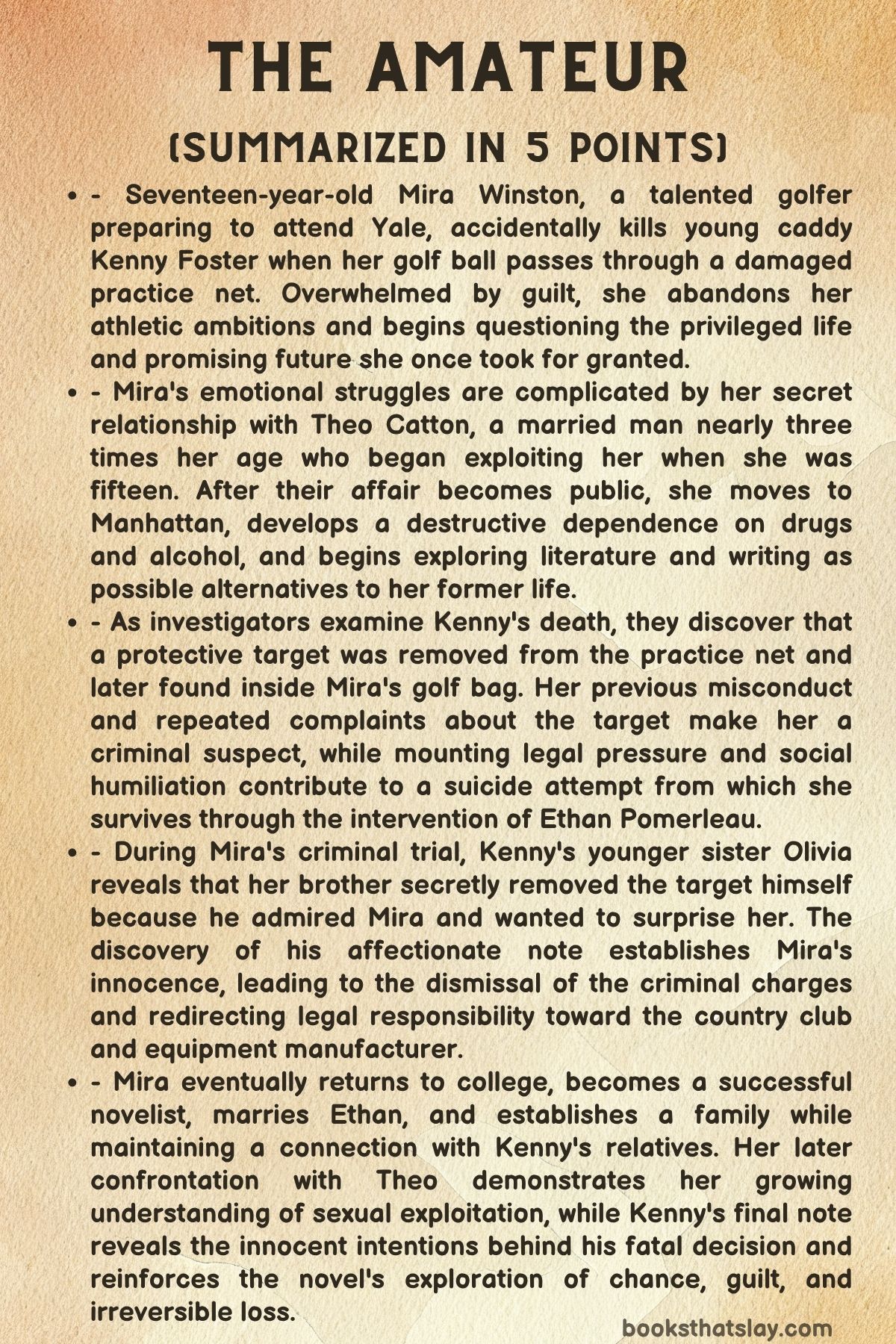
In the summer of 1978, seventeen-year-old Mira Winston is one of the most promising young golfers at an exclusive country club in Tallmadge, New York. Her extraordinary talent has earned her recognition, tournament victories, and a place at Yale University.
Her future appears secure until a terrible accident destroys the life she expects to lead.
While practicing her golf swing, Mira strikes a ball toward a protective net. The ball passes through an opening in the material and hits seventeen-year-old caddy Kenneth Foster in the head.
Kenny suffers a catastrophic brain injury and dies before emergency assistance arrives. Mira initially laughs when he falls, mistakenly believing that nothing serious has happened, and this involuntary reaction becomes an enduring source of shame.
Although the accident appears unintentional, Mira cannot separate her actions from their consequences. Her parents, Peter and Alexis Winston, insist that she is not responsible, but their reassurances do little to relieve her guilt.
Peter, a lawyer, immediately considers the legal implications, believing that the country club or the manufacturer of the net may be liable. Alexis concentrates on protecting her daughter emotionally and preserving her educational prospects.
Mira nevertheless announces that she will not attend Yale and intends to abandon golf.
Her distress is intensified by difficulties that existed long before Kenny’s death.
Since she was fifteen, Mira has maintained a secret sexual relationship with Theo Catton, a married man nearly three times her age. She initially regarded his attention as evidence that she was unusually mature, failing to recognize the imbalance of experience and power between them.
Mira also knows that Alexis is having an affair with their neighbor, Sam Stetson. Her knowledge of this secret complicates her willingness to accept her mother’s judgments about relationships.
As Mira struggles with her guilt, she visits Kenny’s family to offer condolences.
His mother, Sharon Foster, initially responds with understandable resentment. The meeting exposes the distance between the wealthy Winston family and the Fosters, whose son had worked as a caddy to help finance his education.
Nevertheless, Sharon recognizes that Mira did not intend to kill Kenny, and the encounter ends with both women crying together.
At Kenny’s funeral, Mira meets his younger sisters, Olivia and Jane, and encounters his father, Nick. Their grief forces her to recognize that the boy she killed belonged to a family whose future has also been permanently changed.
Theo attempts to comfort Mira, encouraging her to view herself as another victim of the accident. His apparent sympathy, however, is inseparable from his desire to preserve their secret relationship.
Their affair becomes public when Nick Foster discovers evidence of their involvement and informs Mira’s parents.
Peter and Alexis are horrified to learn that their daughter has been involved with a much older married man. Mira initially lies about when the relationship began, claiming that she was already eighteen.
Her parents reject her insistence that the relationship is entirely consensual. Alexis attempts to explain that Theo’s age and experience gave him considerable influence over her.
Mira responds by exposing her mother’s affair, forcing Alexis to confront her own marital dishonesty.
Peter subsequently confronts Theo, contributing to the public exposure of the relationship and the collapse of the Catton marriage.
Desperate to escape Tallmadge, Mira moves to Manhattan and begins working at a travel magazine while living with her aunt Julie and uncle Terence.
Although the change of surroundings provides temporary relief, she increasingly relies on alcohol, cocaine, and other drugs to manage her distress.
Through her friend Marie Morris, she meets Dennis Kerrington, an older novelist and college professor.
Dennis encourages her interest in literature, introduces her to important writers, and becomes her lover. Mira begins experimenting with fiction, drawing particularly on her experiences with Theo.
Dennis recommends Vladimir Nabokov’s Lolita, a novel that eventually helps Mira reconsider the relationship she once understood as romantic.
Meanwhile, the investigation into Kenny’s death becomes increasingly serious.
Investigators discover that a protective target previously attached to the practice net had disappeared before the accident. Its removal apparently weakened the equipment and allowed golf balls to escape.
Mira had repeatedly complained that the target interfered with her practice.
Detectives Richie Marino and Jerry Corbin therefore begin considering whether she removed it herself.
During depositions, Mira admits that she disliked the target but insists that she never interfered with it. Her earlier acts of vandalism and impulsive behavior become damaging evidence against her.
The investigation also threatens to expose details of her private life.
Mira’s lawyer, Cleon Barker, argues that the club failed to inspect its equipment properly and that multiple people could have accessed the net.
Nevertheless, the discovery of the missing target inside Mira’s golf bag makes her position increasingly precarious.
As the legal pressure grows, Mira receives admission to Smith College.
She hopes that returning to education will allow her to establish a different identity, but her drug use and unresolved psychological distress continue to undermine her efforts.
Her relationship with Dennis also deteriorates when he reads her fictional account of her involvement with Theo.
Rather than responding exclusively to its literary qualities, Dennis becomes angry about the possibility that the manuscript could expose the real people behind the story.
He damages the manuscript, but Mira reveals that she still possesses the original draft.
The confrontation demonstrates that Dennis’s encouragement has limits. Although he admires her intelligence, he is uncomfortable when her writing challenges the interests of powerful older men.
Before leaving for Smith, Mira becomes better acquainted with Kenny’s sisters.
Olivia and Jane tell her about their brother’s interests, his love of reading, and his enjoyment of music and dancing. They also show her his preserved bedroom, where his possessions remain almost exactly as he left them.
These encounters deepen Mira’s understanding of Kenny as a complete person rather than simply the victim of her accident.
At Smith, Mira meets Ethan Pomerleau, an older Amherst student and Vietnam veteran.
Ethan approaches her differently from Theo and Dennis. He listens to her experiences without attempting to control her interpretation of them.
Their developing relationship offers Mira a possibility of companionship founded on understanding rather than secrecy.
Nevertheless, rumors about her past spread through her residence. Her roommate Tina objects to her drug use, while other students invent stories about a concealed pregnancy and an abandoned child.
Already overwhelmed by guilt and the approaching criminal proceedings, Mira becomes increasingly desperate.
After a particularly humiliating encounter, she attempts suicide.
Ethan becomes concerned about her, returns to her residence, and discovers what has happened. His intervention saves her life.
Following hospitalization, Mira temporarily withdraws from Smith and returns to Tallmadge.
Her parents begin recognizing the seriousness of her suffering. Their concern becomes more attentive, although the family’s longstanding difficulties do not immediately disappear.
Mira also attempts to reduce her substance use and rebuild her relationship with Ethan.
Meanwhile, the criminal case proceeds.
By March 1980, prosecutors have constructed an argument that Mira deliberately removed the target because she found it inconvenient.
They emphasize her competitive temperament, her previous vandalism, and the discovery of the missing material in her golf bag.
Cleon Barker counters that the practice net was improperly situated and inadequately maintained.
Harry Fallows, the club professional, admits that he noticed the target’s disappearance but failed to inspect the net for damage. Barker also establishes that the bag room was accessible to numerous people.
The medical examiner’s testimony about Kenny’s injuries proves particularly distressing for Mira.
Nevertheless, the prosecution continues treating her past conduct as evidence of her possible responsibility.
The decisive revelation occurs during the testimony of Curt Bolger, Harry’s assistant.
Curt mentions that Kenny had occasionally entered the restricted bag room.
Olivia Foster suddenly interrupts the proceedings and reveals that her brother removed the target himself.
She explains that Kenny had secretly been practicing golf and had developed romantic feelings for Mira.
Knowing how much Mira disliked the target, he cut it down and placed it in her golf bag as a surprise.
He also wrote her a note explaining his intentions.
Olivia discovered the note after his death and kept it.
Her revelation establishes that the missing target was not evidence of Mira’s recklessness. It was the result of Kenny’s attempt to please someone he admired.
The criminal case against Mira is dismissed, and she is removed from the civil lawsuit.
The country club and the equipment manufacturer subsequently contribute to a settlement with the Foster family.
Although the legal proceedings end, Mira understands that her exoneration cannot restore Kenny’s life.
Over the following decades, she returns to education, becomes a successful novelist, and marries Ethan. Together, they raise children and establish a life beyond the events of her adolescence.
Mira maintains a connection with Kenny’s family.
Years later, Olivia attends one of her literary appearances and tells her about the lives she and Jane have built.
Olivia has named her son Kenneth after her brother, while Jane has become an accomplished golfer who teaches younger players.
Mira eventually encounters Theo again as an elderly man in Florida.
Their conversation reveals how differently they understand their former relationship. When Theo notices a quotation tattooed on Mira’s arm, she explains its connection to the sexual exploitation she experienced.
The moment demonstrates the distance between her adolescent understanding of love and her adult recognition of Theo’s behavior.
The novel concludes by revealing Kenny’s original note.
He expresses admiration for Mira, imagines that they might become closer at Yale, and explains that he removed the target as an affectionate surprise.
He also mentions that although everyone calls him Kenny, he prefers Ken.
The final detail restores a measure of individuality to the boy whose death has shaped Mira’s existence.
His innocent gesture unintentionally created the circumstances of his death, leaving Mira to confront the extraordinary difference between intention and consequence.
Characters
Mira Winston
Mira Winston is the central character and retrospective narrator of The Amateur, a gifted young golfer whose adolescence is permanently transformed by an accidental death. Her development involves understanding the difference between responsibility, guilt, exploitation, and the judgments imposed by others.
Before the accident, Mira possesses extraordinary athletic discipline and competitive determination. Her golfing achievements demonstrate her ability to concentrate under pressure, recover from mistakes, and pursue difficult goals.
These qualities coexist with impulsiveness and a tendency to respond aggressively when she feels humiliated or threatened. Her confrontation with Frank Pendleton illustrates how quickly her anger can become destructive.
Kenny Foster’s death challenges Mira’s understanding of herself. Although she never intends to hurt him, she believes that her involvement makes her responsible for the suffering of his family.
Her guilt becomes so powerful that she abandons golf and Yale, sacrificing the achievements that previously defined her identity.
Mira’s relationship with Theo further complicates her emotional development. Having been sexually involved with him since she was fifteen, she initially interprets his attention as proof of her maturity and independence.
Only gradually does she understand that his age, experience, and secrecy gave him power she did not possess.
Her involvement with Dennis demonstrates that recognizing one harmful relationship does not immediately free her from familiar patterns.
Mira’s substance use, social isolation, and suicide attempt reveal the destructive consequences of her unresolved distress. Her recovery begins when she encounters care that does not depend on manipulation or secrecy.
As an adult, Mira becomes capable of interpreting her past with greater compassion and clarity. Her literary career allows her to transform personal experience into a means of understanding herself and others.
She ultimately recognizes that she can acknowledge Kenny’s death without accepting blame for an act she never committed.
Kenneth Foster
Kenneth Foster, commonly called Kenny, is the young caddy whose accidental death initiates the events of The Amateur. Although he dies at the beginning, his personality, aspirations, and relationships remain central to the novel.
Kenny belongs to a family whose financial circumstances differ considerably from those of the country club’s wealthy members. His caddying provides money that he hopes will help finance his education.
He is intelligent, reserved, and fond of reading. His interest in literature and his ambitions for college suggest a young man developing a strong intellectual identity.
Through his sisters, readers discover additional aspects of his personality, including his enthusiasm for music and dancing.
Kenny’s feelings for Mira reveal his romantic idealism. He admires her golfing ability and imagines that their shared interests might lead to a closer relationship.
His decision to remove the target is intended as an affectionate surprise. He does not understand that altering the net could create a fatal danger.
The revelation that he caused the equipment’s alteration transforms the meaning of the accident without making him morally responsible for his own death.
Kenny becomes a powerful representation of unrealized possibility. His future remains unknowable, and the impossibility of recovering it shapes the grief experienced by everyone who loved him.
The disclosure that he preferred being called Ken offers a final reminder that he possessed an identity extending beyond the circumstances of his death.
Theo Catton
Theo Catton is a wealthy, married country club member whose sexual relationship with adolescent Mira represents one of the central abuses of power in The Amateur. His behavior demonstrates how attention and apparent affection can conceal exploitation.
Theo initially approaches Mira through golf, recognizing her extraordinary talent and encouraging her participation in adult social circles.
His interest makes her feel sophisticated and valued, particularly because he treats her abilities seriously.
As their relationship develops, however, he establishes rules that protect his marriage and reputation while restricting Mira’s independence.
His control over her interactions with boys her own age reveals the possessiveness underlying his apparent affection.
Theo also attempts to influence Mira’s interpretation of Kenny’s death. By presenting himself as someone uniquely capable of understanding her suffering, he reinforces her emotional dependence.
When their relationship becomes public, the difference between his adult responsibilities and her adolescent vulnerability becomes increasingly evident.
Mira initially defends him because she understands their relationship through the feelings she experienced at the time.
Their eventual reunion demonstrates how substantially her perspective has changed.
Theo’s limited understanding of the harm he caused contrasts with Mira’s recognition that her apparent consent existed within a profoundly unequal relationship.
Ethan Pomerleau
Ethan Pomerleau represents a different model of romantic companionship in The Amateur. An older Amherst student and Vietnam veteran, he enters Mira’s life when she is attempting to establish a new identity at Smith College.
His military experiences have contributed to a seriousness that Mira finds appealing. Unlike Theo, he does not rely on secrecy or her admiration to establish emotional authority.
Ethan listens to Mira’s account of Kenny’s death and recognizes that her suffering cannot be explained by a single event.
He also becomes aware of her drug use and the hostility she encounters among her classmates.
His concern proves decisive when he discovers her suicide attempt and obtains emergency assistance.
Nevertheless, Ethan’s significance extends beyond his intervention during the crisis. He offers Mira companionship without demanding control over her choices or her interpretation of the past.
Their relationship develops through mutual understanding and continues during her recovery.
Their eventual marriage and family life demonstrate that Mira can establish enduring intimacy without reproducing the destructive patterns of her adolescence.
Ethan does not eliminate her guilt or resolve every difficulty, but he supports the conditions under which she can begin rebuilding her life.
Peter Winston
Peter Winston, Mira’s father, is a lawyer whose professional instincts strongly influence his response to family crises.
Following Kenny’s death, he immediately considers the possibility of legal liability. His attention turns toward the country club, the equipment manufacturer, and the evidence surrounding the accident.
This practical approach protects Mira’s legal interests but does not always address her emotional needs.
Peter’s concern for the family’s reputation also shapes his reaction to her relationship with Theo. His anger reflects both paternal protectiveness and anxiety about the public consequences of the scandal.
When the criminal investigation intensifies, Peter relies heavily on legal strategy and professional expertise.
His actions reveal a man accustomed to solving problems through argument, procedure, and institutional authority.
However, Mira’s psychological deterioration exposes the limitations of this approach.
Following her suicide attempt, Peter must recognize that legal protection alone cannot provide the emotional security his daughter requires.
His character illustrates the difference between defending someone from external consequences and understanding their internal suffering.
Alexis Winston
Alexis Winston, Mira’s mother, attempts to protect her daughter while struggling with contradictions in her own life.
She initially hopes that Mira will recover from the accident by attending Yale and maintaining some connection to her previous ambitions.
Her reassurances arise from maternal concern, but they sometimes underestimate the depth of Mira’s guilt.
Alexis’s affair with Sam Stetson complicates her moral authority. When she condemns Mira’s involvement with Theo, her daughter challenges her apparent hypocrisy.
Nevertheless, Alexis identifies a distinction that Mira initially refuses to acknowledge.
Unlike an affair between adults, Mira’s relationship with Theo began when she was a child, making the imbalance of experience and authority particularly serious.
Alexis therefore becomes an important voice in Mira’s eventual recognition of exploitation.
After the suicide attempt, her concern becomes more attentive and immediate.
Although she cannot erase her earlier mistakes, Alexis begins responding to her daughter’s vulnerability with greater seriousness.
Her characterization presents motherhood as a relationship requiring continual adjustment rather than an automatic source of perfect understanding.
Spencer Winston
Spencer Winston is Mira’s older brother and one of the more sympathetic figures within her immediate family.
He recognizes her intelligence, athletic talent, and emotional distress without treating her primarily as a legal problem.
During their conversations, Spencer encourages Mira to distinguish between an accident and deliberate wrongdoing.
He also acknowledges the suffering of the Foster family, demonstrating that compassion for Kenny’s relatives need not require condemning Mira.
His perspective contrasts with Peter’s legal calculations and Alexis’s efforts to reassure her daughter.
Spencer provides a form of support grounded in familiarity with Mira’s personality and history.
Although he cannot prevent her deterioration, his concern establishes that meaningful family relationships remain possible despite the Winston household’s emotional distance.
Sharon Foster
Sharon Foster is Kenny’s grieving mother, whose response to Mira reveals the complexity of bereavement.
When Mira visits the Foster home, Sharon initially expresses anger and resentment. Her reaction reflects the devastating loss of her son and the social differences separating the two families.
Nevertheless, Sharon eventually acknowledges that Mira did not deliberately cause Kenny’s death.
Their emotional encounter demonstrates that compassion can coexist with grief and resentment.
Sharon’s decision to preserve Kenny’s bedroom reflects her difficulty accepting the permanent absence of her child.
His possessions become tangible reminders of the life she expected him to continue living.
Her character gives the accident a deeply personal dimension, preventing Kenny’s death from becoming merely an abstract question of legal responsibility.
Nick Foster
Nick Foster, Kenny’s father, responds to his son’s death with a combination of grief, restraint, and concern for others.
His treatment of Mira initially surprises her because he does not express the unrestrained hostility she expects.
His willingness to recognize her lack of malicious intent contrasts with her inability to forgive herself.
Nick becomes particularly significant when he discovers Mira’s relationship with Theo.
Rather than ignoring the situation because of his family’s suffering, he informs her parents.
His intervention suggests that his concern for young people extends beyond his own household.
Nick’s actions also illustrate a distinction between seeking justice for his son and allowing grief to determine every subsequent moral judgment.
His concern for Mira does not diminish Kenny’s importance but reflects a broader understanding of parental responsibility.
Olivia Foster
Olivia Foster is Kenny’s younger sister and one of the most consequential characters in the novel.
Her relationship with Mira begins in the aftermath of her brother’s death, when the two girls occupy very different emotional positions.
Olivia gradually shares memories of Kenny that allow Mira to recognize his individuality beyond the accident.
Her invitation to visit his bedroom becomes an important moment in their developing connection.
Olivia’s most significant action occurs during Mira’s criminal trial.
Unable to remain silent while the prosecution presents Mira as responsible for removing the target, she reveals that Kenny performed the act himself.
Her decision demonstrates moral courage because the truth complicates the public understanding of her brother’s death.
By producing his note, Olivia restores the distinction between what actually happened and what investigators assumed had happened.
As an adult, she continues honoring her brother by naming her son Kenneth.
Her character embodies the possibility of maintaining love for the dead while continuing to participate in life.
Jane Foster
Jane Foster, Kenny’s other younger sister, contributes to the novel’s portrayal of grief across different stages of childhood.
Alongside Olivia, she shares memories of her brother that extend Mira’s understanding of his personality.
Their conversations establish Kenny as someone who enjoyed family life, music, and activities unrelated to the country club.
Jane’s presence also emphasizes the continuing consequences of his death for children who must grow up without an older sibling.
As an adult, she becomes an accomplished golfer and teaches younger players.
This development establishes an unexpected connection between her life and Mira’s abandoned athletic ambitions.
Jane’s decision to pursue golf demonstrates that the sport can retain meanings beyond the tragedy that once defined it for Mira.
Dennis Kerrington
Dennis Kerrington is an older novelist and college professor who becomes Mira’s lover during her time in Manhattan.
Initially, he appears to offer intellectual encouragement and recognition of her literary abilities.
He introduces her to important literature and helps her imagine a future beyond competitive golf.
His recommendation of Lolita becomes especially influential because it eventually provides Mira with language for reconsidering Theo’s exploitation.
However, Dennis’s support becomes conditional when Mira begins writing fiction based on her relationship with Theo.
His anger at the manuscript reveals his discomfort with a young woman’s ability to expose the behavior of older men.
By damaging her writing, he attempts to exercise authority over the artistic independence he previously encouraged.
Dennis consequently represents a less overt but still troubling version of the unequal relationships Mira repeatedly encounters.
Marie Morris
Marie Morris is Mira’s close friend and an important connection to her life before Kenny’s death.
She knows about Mira’s relationship with Theo, making her one of the few people aware of the secret before its public exposure.
Her companionship provides Mira with opportunities to discuss experiences she cannot openly share with her family.
Marie also connects Mira with Dennis Kerrington during her time in Manhattan.
Although she cannot resolve Mira’s psychological difficulties, her friendship represents a continuity that survives the disruption of her former life.
Her character illustrates the importance of ordinary companionship amid circumstances dominated by scandal and public judgment.
Harry Fallows
Harry Fallows is the country club professional whose relationship with Mira is complicated by her extraordinary golfing talent.
He recognizes her ability but sometimes appears resentful of her competitiveness and the special treatment she receives.
Mira’s repeated complaints about the practice net’s target become an important source of tension between them.
During the criminal trial, Harry acknowledges that he noticed the target’s disappearance before Kenny’s death.
His failure to inspect the net subsequently becomes central to questions about the club’s negligence.
Although he denies removing the target, his testimony demonstrates that professional responsibility extends beyond knowing who altered a piece of equipment.
Harry’s character illustrates how inadequate supervision can contribute to tragic consequences even when the individual involved has no intention of causing harm.
Curt Bolger
Curt Bolger is Harry Fallows’s assistant and a significant witness in the investigation of Kenny’s death.
His familiarity with the country club’s routines provides important information about the practice net, the bag room, and the people who could access club equipment.
During the trial, he recalls Mira’s dissatisfaction with the target and statements she made while practicing.
These recollections initially appear to support the prosecution’s argument.
However, Curt also reveals that Kenny sometimes entered the restricted bag room.
This detail prompts Olivia to disclose the truth about her brother’s involvement.
Curt’s testimony demonstrates how evidence can acquire different meanings as additional information emerges.
Cleon Barker
Cleon Barker is Mira’s attorney and the principal defender of her legal interests during the investigation and criminal trial.
He challenges the prosecution’s reliance on Mira’s reputation, arguing that previous misconduct does not establish responsibility for Kenny’s death.
His defense emphasizes the absence of direct evidence connecting Mira to the target’s removal.
He also investigates the country club’s maintenance failures, the unsafe positioning of the net, and the possibility that other people accessed the equipment.
Cleon’s professional discipline contrasts with Mira’s emotional responses to the proceedings.
Although his approach cannot eliminate her distress, it provides the practical protection she requires.
His eventual success demonstrates the importance of examining physical evidence rather than relying on assumptions about personality.
Richie Marino and Jerry Corbin
Detectives Richie Marino and Jerry Corbin investigate the circumstances surrounding Kenny’s death.
Their inquiries gradually transform Mira from a witness to a possible suspect.
They focus particularly on her complaints about the target, her earlier vandalism, and the discovery of the missing material inside her golf bag.
Their investigation reflects the difficulties of reconstructing events when important physical evidence has been altered.
However, their emphasis on Mira’s behavior encourages a narrative in which her temperament becomes a substitute for direct proof.
Their failure to establish who actually removed the target contributes to the prosecution’s mistaken interpretation of the accident.
Together, they represent the limitations of an investigation shaped by plausible but incomplete assumptions.
Frank Pendleton
Frank Pendleton is a young man who previously attempted to sexually assault Mira.
Her retaliation, which involved smashing his car window, contributes to her reputation for impulsiveness and aggression.
When he later encounters her following the exposure of her relationship with Theo, he taunts her about the scandal.
Mira responds by striking his legs with her car door.
Frank’s presence exposes the connection between Mira’s anger and her experiences of sexual mistreatment.
His actions also demonstrate how damaging incidents from a person’s past can be interpreted without sufficient attention to their circumstances.
During the criminal investigation, Mira’s earlier vandalism becomes evidence used to suggest that she might have deliberately damaged the practice net.
Frank therefore serves an important function in the novel’s examination of reputation and selective judgment.
Tina
Tina is Mira’s roommate at Smith College and an important figure in the deterioration of her social environment.
She becomes uncomfortable with Mira’s substance use and eventually arranges to move into another room.
Her response reflects legitimate concerns about sharing a living space with someone whose behavior has become increasingly unstable.
However, the surrounding rumors and hostility intensify Mira’s isolation.
Tina’s role illustrates how social rejection can deepen the suffering of someone already experiencing psychological distress.
She also demonstrates the difficulty of distinguishing personal boundaries from participation in a judgmental social environment.
Heidi Romming
Heidi Romming is Mira’s golf coach and an important connection to her former athletic identity.
She recognizes the exceptional talent Mira possesses and understands the years of discipline behind her achievements.
Following Kenny’s death, Heidi attempts to persuade her not to abandon golf.
Her concern reflects an awareness that Mira is sacrificing something central to her development.
However, Heidi cannot fully understand the emotional association Mira has formed between the sport and Kenny’s death.
Her character represents the possibility of a future Mira initially cannot imagine reclaiming.
Julie and Terence
Julie and Terence are Mira’s aunt and uncle, who provide her with accommodation when she moves to Manhattan.
Their home gives her a degree of independence unavailable in Tallmadge.
Although the move does not resolve her psychological difficulties, their assistance makes it possible for Mira to pursue employment and encounter a different social environment.
They represent the wider family network that remains available even when her relationship with her parents becomes strained.
Eleanor Catton
Eleanor Catton is Theo’s wife, whose marriage deteriorates following the exposure of his relationship with Mira.
Although she occupies a relatively limited position in the narrative, her circumstances establish that Theo’s conduct harms people beyond Mira.
Her separation from him demonstrates the consequences of his deception.
Eleanor also complicates Mira’s adolescent interpretation of their affair as a private relationship between two consenting individuals.
Her presence reveals the wider emotional damage produced by Theo’s actions.
Sam Stetson
Sam Stetson is the Winston family’s neighbor and Alexis’s extramarital partner.
His relationship with Mira’s mother exposes the contradictions beneath Tallmadge’s respectable social appearance.
Mira’s discovery of the affair changes her perception of her family and contributes to her distrust of adult moral authority.
Sam’s presence also demonstrates how the private lives of the wealthy club community differ from the public identities its members maintain.
Although his role is secondary, his affair becomes important when Mira challenges Alexis’s condemnation of Theo.
Themes
Guilt, Responsibility, and the Limits of Blame
The distinction between causing harm and being morally responsible for it forms the central conflict of The Amateur. Mira’s golf shot kills Kenny Foster, but the circumstances surrounding the accident are considerably more complicated than the immediate sequence of events suggests.
Mira initially treats the consequences of her action as sufficient proof of her guilt. Because she struck the ball that killed Kenny, she believes that her suffering is justified regardless of whether she intended any harm.
This conviction leads her to abandon golf, reject Yale, and gradually withdraw from the future she once imagined.
Her response demonstrates how guilt can become disconnected from actual responsibility. Emotional certainty does not necessarily correspond to the evidence surrounding an event.
The criminal investigation introduces another understanding of blame. Prosecutors attempt to establish responsibility by examining intention, negligence, and the physical circumstances of the accident.
Their argument depends heavily on Mira’s previous misconduct and her dislike of the target. These facts make their theory plausible but do not establish that she removed the equipment.
The eventual revelation that Kenny altered the net himself exposes the danger of treating an apparently convincing explanation as established truth.
Nevertheless, the discovery does not make his death less devastating. It simply changes the understanding of how the tragedy occurred.
The novel also distinguishes legal responsibility from emotional reconciliation. Mira’s exoneration does not restore Kenny to his family or erase the suffering associated with his death.
Her recovery requires accepting that she can mourn him without making herself morally responsible for every consequence of the accident.
This distinction becomes the foundation of her eventual ability to live beyond the tragedy.
Power, Sexual Exploitation, and the Development of Autonomy
Mira’s relationships with older men expose the difference between apparent consent and genuine freedom within unequal relationships. Theo Catton’s attention initially appears flattering because it gives her access to an adult world in which she feels respected.
His admiration for her golfing ability allows the relationship to develop through an activity that already defines her identity.
However, Theo gradually establishes conditions that protect his interests while restricting her choices. His secrecy and control demonstrate that his apparent respect does not extend to recognizing her independence.
Mira initially resists describing the relationship as exploitative because she remembers experiencing affection and desire.
Her response illustrates why recognizing manipulation can be especially difficult when the person being exploited believes that participation demonstrates maturity.
Alexis attempts to explain that emotional sincerity does not eliminate differences in age, experience, and authority.
Mira’s eventual understanding develops through experience rather than immediate acceptance of her mother’s argument.
Her relationship with Dennis reinforces the pattern. Although he encourages her intellectual ambitions, his support diminishes when her writing threatens to expose the behavior of another older man.
By damaging her manuscript, Dennis reveals that his admiration does not necessarily include respect for her independent judgment.
Ethan provides an important contrast because he does not require Mira to surrender control over her experiences.
His companionship allows her to make decisions without constantly protecting a lover’s reputation or responding to possessive demands.
The tattoo inspired by Lolita eventually symbolizes Mira’s ability to reinterpret her adolescence.
Her final encounter with Theo establishes that reclaiming autonomy does not require his agreement with her interpretation.
She can recognize the relationship as exploitative even when he remains unable or unwilling to understand its consequences.
Privilege, Social Class, and the Administration of Justice
The country club establishes a social hierarchy in which wealth determines access to opportunities, leisure, and institutional protection. Mira belongs to a family capable of financing an elite education, while Kenny works as a caddy to help secure his future.
Their lives overlap geographically and socially, but they occupy fundamentally different positions within the same community.
Mira’s golfing talent gives her recognition and privileges that Kenny does not possess. His ambitions depend more directly on employment, scholarships, and academic achievement.
The accident exposes these inequalities because the two families approach the tragedy with different resources.
Peter Winston can draw upon professional knowledge and legal connections to protect his daughter. The Foster family must confront both the emotional devastation of Kenny’s death and the practical consequences of losing him.
The civil lawsuit makes these differences especially visible. Lawyers and financial experts attempt to calculate Kenny’s lost earning potential, reducing an unknowable future to estimates of economic value.
Such calculations may be necessary within the legal system, but they cannot represent the full significance of his life.
The Amateur also examines how privilege shapes public judgment. Mira’s wealth and earlier misconduct make her an attractive subject for a narrative about a reckless young woman escaping consequences.
The prosecution relies partly on this image, presenting her personality as evidence of likely guilt.
However, the novel does not suggest that her privilege makes her innocent or that criticism of wealthy people is inherently unjustified.
Instead, it demonstrates why social assumptions cannot replace careful investigation.
The club’s maintenance failures and the manufacturer’s inadequate warnings eventually become central to the settlement.
The outcome establishes that responsibility must be examined through actual conduct and institutional obligations rather than determined solely by social resentment or personal reputation.
Chance, Lost Possibility, and the Reconstruction of Identity
Kenny’s death results from a sequence of ordinary actions whose consequences nobody anticipates. A teenager attempts to please someone he admires, removes an inconvenient target, and unintentionally alters a piece of protective equipment.
Another teenager practices a familiar golf shot, unaware that the net can no longer reliably contain the ball.
The resulting tragedy demonstrates the enormous consequences that can emerge from seemingly insignificant decisions.
This understanding challenges the human desire to impose a clear narrative of intention and responsibility upon every disaster.
Mira repeatedly searches for an explanation that might make Kenny’s death comprehensible. Her guilt initially provides one because it gives the accident a recognizable cause in her own behavior.
The revelation of Kenny’s note destroys that explanation without supplying a comforting alternative.
His death remains the result of circumstances that could easily have unfolded differently.
The novel also explores the futures that disappear when a person dies young. Kenny’s preserved bedroom contains evidence of his intellectual interests, personal relationships, and unrealized ambitions.
His plans to attend Yale suggest that he imagined a future extending well beyond his employment at the country club.
No one can determine whether he would have fulfilled those ambitions, fallen in love with Mira, or pursued an entirely different life.
The uncertainty makes his loss especially difficult to comprehend.
For Mira, survival involves confronting a different form of lost possibility. She abandons the athletic future that once seemed inevitable, but eventually discovers an identity as a novelist.
Her transformation does not imply that Kenny’s death was necessary for her development or that tragedy produces some predetermined benefit.
Instead, it illustrates the human capacity to construct a meaningful life after irreversible loss.
Her eventual marriage, family, and literary career demonstrate that a disrupted future need not become an empty one.
Kenny’s final note reinforces this understanding by restoring his individuality. His preference for the name Ken reminds readers that even someone whose life ended prematurely possessed a private identity, personal desires, and possibilities beyond the circumstances of his death.