Vow of Eternal Night Summary, Characters and Themes
Vow of Eternal Night by Lily Crozier is a gothic fantasy romance centered on Clara Wagner, a young woman raised to fear Prince Raleigh Linford von Rostenburg, the vampire ruler blamed for her mother’s death and her valley’s suffering.
What begins as a forced engagement becomes a much larger story about consent, inherited hatred, political corruption, trauma, and the difference between appearing monstrous and choosing cruelty. Clara’s search for a cure forces her to reconsider nearly everything she believes about Raleigh, her father, her former fiancé, and herself, while an ancient vampire queen threatens to turn their personal struggle into a battle for freedom.
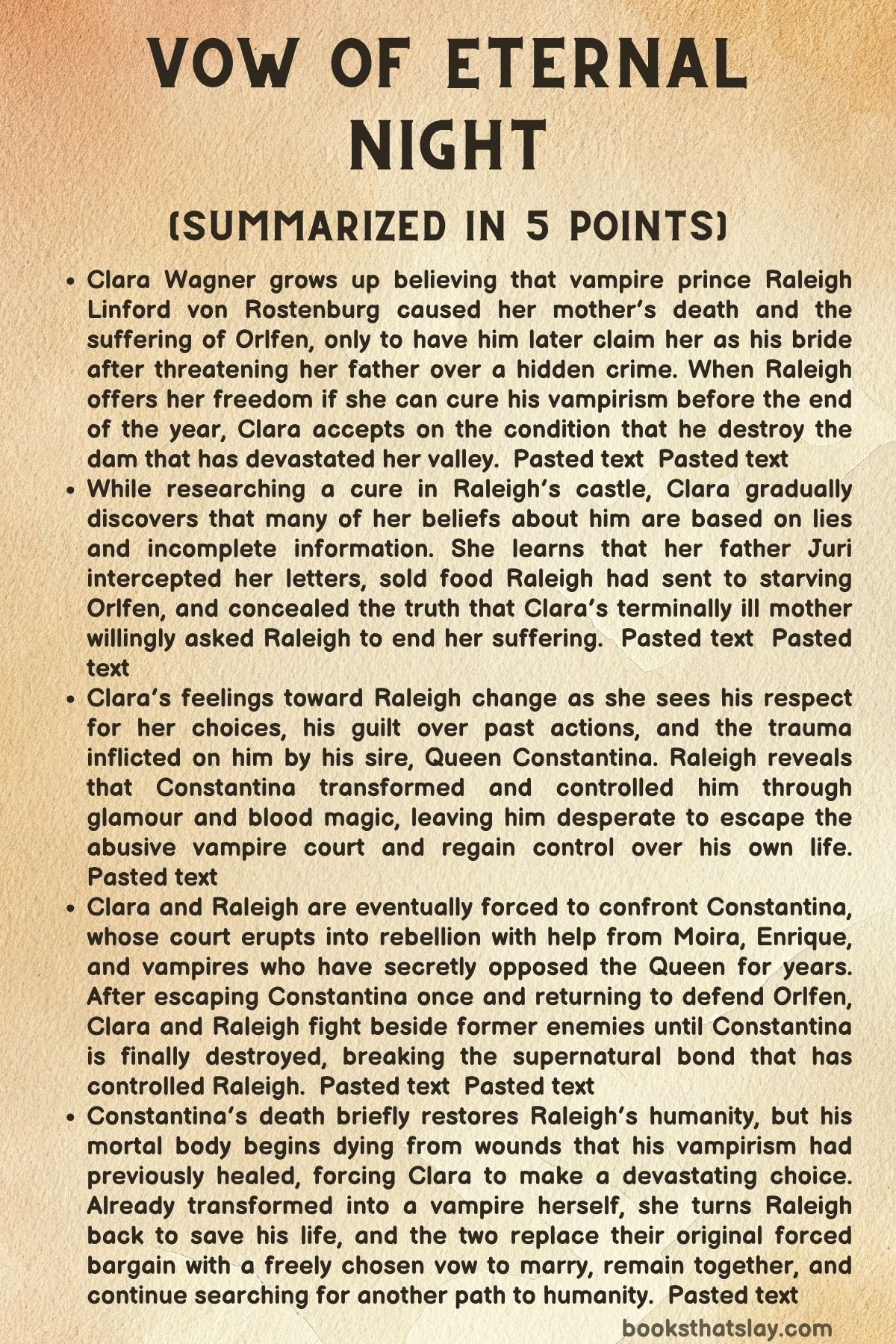
Summary
Clara Wagner’s relationship with Prince Raleigh begins when she is ten years old and living in the struggling valley of Orlfen. Raleigh returns after a long absence and immediately orders Clara’s father, Mayor Juri Wagner, to rebuild an old mountain dam, even though doing so will deprive the valley of water; soon afterward, Clara’s sick mother Marianna is found dead and drained of blood, leaving Clara convinced that Raleigh murdered her.
Fourteen years later, Orlfen has been devastated by drought and hunger, while Raleigh has become a figure of terror in local memory. Clara reaches her twenty-fifth birthday believing that she can finally marry her childhood companion Yann, a baker with whom she hopes to leave the valley and begin a new life in Salzburg.
Their plans collapse when Raleigh appears at the Wagner home and announces that he intends to marry Clara. He claims that Juri has committed a serious offense that requires punishment, threatens Yann when Juri mentions the existing engagement, and makes clear that Clara will either come willingly or be taken by force.
Juri unexpectedly helps Clara flee with Yann, but the enchanted forest around Raleigh’s territory confuses their thoughts and prevents a clean escape. Raleigh eventually catches them, saves them from a wolf, injures Yann when he challenges him, and takes Clara to Castle Rostenburg after she claims Raleigh as her betrothed to prevent Yann from being killed.
Clara awakens inside an enchanted castle whose corridors shift whenever she attempts to escape. She arms herself with improvised crosses, a wooden stake, and other protections drawn from vampire folklore, only to discover that many of her assumptions about vampires are inaccurate and that Raleigh is more amused than endangered by her preparations.
Her situation changes when Raleigh admits that he hates being a vampire and offers her a bargain. Clara has until the end of the year to discover a cure for his condition; if she succeeds she will receive her freedom and financial independence, but if she fails she must marry him and eventually become a vampire herself, while Clara demands in return that he destroy the dam responsible for Orlfen’s devastation.
Clara begins searching Raleigh’s enormous library and realizes that her ability to read several languages makes her unusually useful. Assisted by Moira, Raleigh’s intelligent and sharp-tongued housekeeper, she studies folklore, medical writings, historical records, and vampire research while slowly becoming accustomed to Raleigh’s company.
Raleigh’s behavior increasingly conflicts with Clara’s image of him as a simple predator. He notices her difficulties with old English texts and buys her a useful dictionary, restores her starving horse Sovereign to health, respects her scholarship, and repeatedly displays forms of consideration that Clara finds difficult to reconcile with the monster she has hated since childhood.
A visit to Orlfen destabilizes Clara’s loyalties further. Yann remains convinced that Raleigh is murdering villagers, while Clara learns that her own letters have been reaching home and that Juri has secretly intercepted them, allowing her to believe Raleigh was responsible for isolating her from everyone she loved.
Juri and Yann then imprison Clara in her childhood bedroom to prevent her from returning to the castle. Raleigh arrives to rescue her but, instead of simply taking her away, gives her the choice to remain; Clara chooses to return with him, and during their escape she protects the weakened vampire after Juri shoots him with silver and Yann uses a powerful crucifix against him.
Life at the castle becomes increasingly collaborative. Raleigh assures Clara that marriage would never entitle him to sexual access without her consent, shows her the physical effects of sunlight, and begins laboratory experiments with her, while mysterious letters from the vampire Queen Constantina suggest that Raleigh’s deadline is connected to a much older danger.
Clara eventually learns that Constantina is Raleigh’s sire and discovers that destroying a vampire’s sire can break the curse affecting their descendants. Raleigh reacts with fear rather than relief because he already knows the method and considers Constantina nearly impossible to kill, but Clara secretly decides that she cannot abandon a possible path to freedom merely because it is dangerous.
Her investigations outside the castle expose further contradictions in the history she learned from Juri. Father Leon tells her that Raleigh has protected people in Triz and gives her an ancient silver vampire-killing dagger, while Clara discovers evidence that Triz prospered during the years when Juri claimed the entire region was suffering from shortages.
The truth becomes undeniable when castle records show that Raleigh repeatedly sent large quantities of food to Orlfen during the famine and that Juri personally accepted every delivery. Juri finally confesses that he sold the supplies in Triz and used the money to build Clara an enormous dowry, claiming that he wanted to secure her future even though his actions condemned his own people to unnecessary hunger.
Clara then learns that Raleigh did not murder Marianna. Marianna was dying from a painful illness and voluntarily asked Raleigh to end her suffering, while Juri knew the truth, promised that Clara would eventually be told, and apparently helped create the false story that turned Raleigh into Orlfen’s public enemy.
As Clara’s hatred disappears, her feelings for Raleigh become increasingly difficult to deny. Their growing closeness is interrupted when vampires Lukas and Yorik arrive on Constantina’s behalf and force the pair to attend the Queen’s court, where Clara and Raleigh must pretend to be passionately in love even though much of what they perform has already become genuine.
Before the journey, Raleigh finally reveals the full history of his vampirism. Constantina manipulated him when he was young and lonely, transformed him without giving him a meaningful understanding of what he was accepting, controlled him through glamour and blood magic, exploited him through her court, and eventually granted temporary freedom on the condition that he prove within fifteen years that he could love and be loved by someone who knew his true nature.
At Constantina’s palace, the danger becomes immediate. Constantina demonstrates her supernatural control over Raleigh, Clara uses Father Leon’s silver dagger to defend him, and a long-prepared rebellion inside the vampire court erupts, allowing Clara, Raleigh, Moira, and Enrique to escape even though Constantina survives.
The journey home forces Clara and Raleigh to abandon their remaining emotional defenses. Raleigh becomes dangerously weak from injury and starvation, Clara willingly allows him to feed from her, and he stops their first intensely physical encounter because both blood hunger and vampire venom are affecting their judgment; later, with neither coercion nor supernatural influence involved, they openly confess their love and freely choose one another.
When they reach Orlfen, Clara publicly exposes Juri’s theft of the famine supplies just as Constantina’s forces invade the valley. Raleigh offers the villagers protection inside Castle Rostenburg, turning the place Clara once regarded as a prison into a refuge where humans, hunters, former enemies, and vampires fight together against the Queen’s followers.
During the final battle, Constantina uses her bond with Raleigh to order him against Clara, while Clara fights through severe injuries to help defeat her. Constantina is finally destroyed, breaking the curse on Raleigh and restoring his humanity, but his newly mortal body can no longer heal the wounds that were survivable when he was undead.
Clara refuses to let him die. Having secretly transformed herself after drinking from Raleigh’s blood vial, she turns Raleigh back into a vampire, choosing continued immortality with him over allowing his long-awaited humanity to become the cause of his death.
Raleigh initially reacts with horror at Clara’s sacrifice, but they agree that neither will seek mortality through the other’s death. Clara replaces their original coercive bargain with a mutual vow to search for another cure and chooses freely to marry him, transforming the forced engagement that began their relationship into a commitment both now want.
Yann accepts that his relationship with Clara has ended, although both acknowledge that their earlier love was real. Clara also finds Juri dead after the battle and grieves him despite everything he did, recognizing that his final actions helped save lives even though they cannot erase years of manipulation and suffering.
The survivors begin rebuilding Rostenburg and Orlfen under completely different circumstances. Former members of Constantina’s court find new places in the region, humans and vampires reconsider old assumptions about one another, and Clara and Raleigh face an uncertain eternity together while continuing to seek a life defined by choice rather than control.
Characters
Clara Wagner
Clara is the emotional and moral center of Vow of Eternal Night, beginning as a woman whose identity has been shaped by grief, hunger, family obligation, and a fixed belief that Raleigh destroyed everything she loved. Her courage is present from childhood, when she challenges the prince despite his power, but adulthood forces her to develop a more difficult form of bravery: the willingness to reconsider convictions when evidence contradicts them.
Her strongest quality is intellectual independence. Clara does not merely accept Raleigh’s proposed reading list, her father’s explanations, Yann’s assumptions, or even the conclusions she herself has carried for years; she investigates, compares evidence, translates difficult material, conducts experiments, and eventually uncovers truths that nearly every authority figure around her has concealed.
Clara’s development is also closely connected to autonomy. At first Juri decides whom she should marry, Raleigh claims her as punishment, and Yann assumes that their long relationship gives him a legitimate claim over her future, but Clara gradually rejects every system that treats her as an object to be possessed.
Her eventual love for Raleigh matters because it develops only after she gains enough independence to refuse him. By choosing him after receiving opportunities to leave, challenging his behavior, setting boundaries, and seeing his vulnerabilities, Clara turns a relationship founded in coercion into one that she consciously accepts.
Becoming a vampire is the most controversial expression of that determination. Clara sacrifices mortality to save Raleigh, but she refuses to frame the decision as passive devotion; she insists that the choice belongs to her and then establishes a new shared goal in which neither partner will die merely to restore the other.
Prince Raleigh Linford von Rostenburg
Raleigh is the most deliberately misjudged figure in Vow of Eternal Night. He initially appears cruel, entitled, threatening, and almost entirely consistent with Clara’s childhood image of a vampire prince, yet the story gradually reveals a man whose worst actions cannot be separated from centuries of supernatural control, trauma, guilt, and self-hatred.
His treatment of Clara begins with a serious moral failure. He takes her as punishment for Juri, threatens Yann, and assumes that his need to satisfy Constantina’s deadline justifies forcing another person into a relationship, later recognizing that he has reproduced the same pattern of control once inflicted upon him.
That recognition becomes crucial to his development. Raleigh increasingly gives Clara choices, respects her sexual boundaries, refuses to exploit her during moments when blood or venom could compromise consent, and finally commands her through vampire magic only to live for herself rather than submit to another person’s will.
His moral discipline is particularly visible in his relationship with blood. Raleigh tries to survive without harming healthy humans, often taking this principle so far that starvation makes him more dangerous, showing that guilt can become destructive when it turns into self-punishment rather than responsible restraint.
Raleigh’s deepest conflict concerns whether he believes himself worthy of continuing to live. Clara’s love does not simply offer romance; it challenges his assumption that death or restored mortality is the only possible release from what Constantina made him, and by the end he begins imagining an eternal future rather than treating immortality only as a sentence.
Juri Wagner
Juri is one of the most morally complicated human characters in Vow of Eternal Night because his love for Clara exists alongside enormous selfishness and abuse of authority. He sees himself as a father securing his daughter’s future, yet that belief allows him to justify controlling her choices, manipulating public fear, and profiting while his own community starves.
His theft of Raleigh’s food supplies exposes the gap between his private justification and public responsibility. Juri argues that he sold the supplies to create a dowry large enough to give Clara a better life, but doing so required allowing families in Orlfen to suffer while he maintained the lie that Raleigh had abandoned them.
Juri also manipulates Clara emotionally. He withholds the truth of Marianna’s death, intercepts Clara’s correspondence, allows her to blame Raleigh for her isolation, and eventually imprisons her when she tries to exercise an independent choice.
His actions show a recurring belief that love gives him authority over Clara. Even when his motives contain genuine parental concern, he repeatedly decides that he understands what she needs better than she does, making his affection inseparable from possession.
His death prevents a simple reconciliation. Juri dies fighting during the final conflict and helps weaken the enemy, allowing Clara to recognize courage in his last actions without pretending that heroism at the end erases the damage he caused earlier.
Yann
Yann initially represents the ordinary future Clara believes she wants in Vow of Eternal Night. He is her childhood companion, her first chosen fiancé, and the person connected with dreams of Salzburg, baking, marriage, and escape from the fear surrounding Orlfen.
His love for Clara is genuine, but it carries assumptions that become more visible once their relationship is threatened. Yann expects Clara to occupy the traditional position of wife and eventual mother, and when she begins questioning Raleigh rather than simply condemning him, Yann interprets her changing views as corruption rather than intellectual independence.
His participation in Clara’s imprisonment is the decisive failure in their relationship. By siding with Juri, physically preventing her departure, and later insisting that she must have been bewitched, Yann demonstrates that he can defend Clara’s freedom only while her choices remain compatible with the future he wants.
Yet Yann is not reduced to an antagonist. He later fights alongside Clara and Raleigh, accepts that Clara will not marry him, and acknowledges the painful reality that their imagined future was partly supported by habit, expectation, and mutually assigned roles.
Their final conversation allows their earlier relationship to retain meaning without requiring it to remain permanent. Clara can honestly say that she loved Yann while also understanding that loving someone at one stage of life does not create an obligation to choose that person forever.
Marianna Wagner
Marianna’s death shapes Clara long after her actual presence in the story has ended. Clara remembers a sick mother whose apparently violent death seemed to confirm Raleigh’s monstrosity, making Marianna the emotional foundation of a hatred that influences Clara for fifteen years.
The eventual truth transforms Marianna from a passive victim into someone who made a difficult decision concerning her own suffering. Faced with a fatal illness and an approaching painful death, she accepted Raleigh’s offer to end her life, a choice that Juri later concealed from Clara.
Her request that Clara forgive Raleigh gains new importance once Clara understands what happened. Marianna had recognized the moral complexity of his action before Clara was old enough to do so, leaving behind a message that could only become meaningful when the surrounding lies were exposed.
Moira
Moira initially appears to be an unusually blunt and educated housekeeper, but she gradually becomes one of Clara’s most reliable allies. She refuses to indulge Clara’s assumptions, encourages her to think practically, assists with research, and understands both Raleigh’s weaknesses and his better qualities without idealizing him.
Her later revelation as a trained vampire hunter greatly expands her importance. Moira has spent years living beside a vampire while carrying the skills and weapons required to kill one, which means her continued loyalty to Raleigh is based on judgment rather than ignorance.
She repeatedly risks herself for Clara and Raleigh, suffering serious injuries while fighting Constantina’s forces. At the same time, she remains willing to challenge Raleigh when his refusal to feed becomes self-destructive, making her loyalty active rather than obedient.
Enrique
Enrique enters the castle as a brilliant former palace chef whose confidence and sharp humor immediately distinguish him from a conventional servant. His knowledge of vampire society, however, soon proves more important than his cooking.
His family history gives him personal reasons to oppose Constantina. His father belonged to the Queen’s vampire lineage, meaning Enrique understands the damage her rule has caused across generations and has connections that Clara and Raleigh initially underestimate.
Enrique also trains Clara to fight, forcing her to confront the limits of human strength rather than encouraging fantasies of easily defeating an ancient vampire. Later he is revealed as an important organizer connected with the rebellion inside Constantina’s court, showing that resistance existed long before Clara understood its scale.
Queen Constantina
Constantina is the central embodiment of coercive power in Vow of Eternal Night. Her danger does not depend only on physical strength; she controls people through glamour, blood bonds, emotional manipulation, humiliation, sexual exploitation, fear, and the deliberate destruction of personal autonomy.
Her relationship with Raleigh reveals the extent of that control. She identifies his longing for love, exploits it, transforms him without meaningful informed consent, and later keeps enough of his blood to maintain supernatural authority over him even during the years when he appears physically free.
Constantina is especially dangerous because she can present domination as affection. She speaks politely to Clara, offers apparent alternatives, and behaves with elegance, but every choice she offers is structured so that Constantina remains the person holding power.
The rebellion against her therefore represents more than the defeat of an individual villain. Her death breaks a system in which obedience has been enforced through magical and psychological dependence, giving many of her followers their first real opportunity to determine what kind of existence they want.
Lukas
Lukas represents the cruelty that flourishes within Constantina’s court. He treats Raleigh with mocking familiarity and Clara as something available for intimidation, manipulation, or consumption, showing how thoroughly the court has normalized violations of individual boundaries.
His attempt to glamour Clara is especially revealing because he tries to replace her own emotional judgment with thoughts more useful to him. During the later fighting he continues acting as one of Constantina’s most violent supporters, making him a personal extension of the culture she created.
Yorik
Yorik arrives with Lukas as one of the ancient vampires sent to bring Raleigh and Clara to Constantina. Although he receives less individual development, his presence reinforces the overwhelming imbalance of power confronting the pair.
He helps establish that Raleigh’s former court is not merely a distant political problem. Its members can enter his home, threaten the people he protects, and carry Constantina’s demands directly into the place where he has tried to establish a separate life.
Father Leon
Father Leon challenges Clara’s assumption that religious authority must automatically view every vampire as equally evil. He knows what Raleigh is yet regards him as a protector because he has judged him through observed behavior rather than supernatural category.
His decision to give Clara the old Linford silver dagger also places him directly within the struggle against Constantina. Leon understands the practical danger vampires can pose while still distinguishing between individuals, allowing religious faith to become a source of discernment rather than indiscriminate hatred.
Johanna
Johanna represents the ordinary people of Orlfen whose perceptions have been shaped by years of fear. As the Wagner household’s servant, she has lived near Clara and Juri while also absorbing the village’s belief that Raleigh is a supernatural threat.
Her later fear of Clara demonstrates how quickly communal suspicion can be transferred. Once Clara lives with Raleigh, villagers begin treating her as though association with a vampire has contaminated her, showing the social cost of challenging an accepted public story.
Kay
Kay is a relatively minor character, but his hostility toward Clara reflects Orlfen’s culture of fear. When Clara returns from the castle, he treats her as though she has become something dangerous simply because she has lived beside Raleigh.
His attempt to strike Clara also provides an important moment in her changing identity. She instinctively warns him about her betrothed and realizes that the person she means is Raleigh rather than Yann, revealing an emotional shift that she has not yet consciously accepted.
Kay’s later death during Constantina’s invasion gives that earlier conflict a darker perspective. Clara does not need to like him for his death to matter, and his loss demonstrates that the Queen’s violence threatens the entire community rather than only the central characters.
Leopold Linford
Leopold, Raleigh’s older brother, is largely a figure from the past, but his death changes the direction of Raleigh’s entire existence. Raleigh had not been raised expecting to inherit Rostenburg, and Leopold’s death suddenly places the title, political duties, and arranged expectations of rulership upon him.
That disruption creates the emotional circumstances in which Constantina finds Raleigh. Newly burdened with a life he had never expected and desperate for authentic affection, he becomes particularly vulnerable to someone who appears to offer love and freedom from obligation.
Themes
Autonomy, Consent, and the Right to Choose
Choice is repeatedly taken away from characters in Vow of Eternal Night, making autonomy one of the story’s central moral concerns. Clara begins surrounded by men who believe they possess some legitimate authority over her future: Juri arranges her marriage prospects, Yann assumes their shared history determines what she should want, and Raleigh initially treats marriage as a punishment he can impose.
The story does not erase Raleigh’s early coercion simply because his motives later become understandable. His development depends on recognizing that taking Clara repeated the same logic Constantina once used against him, which forces him to confront the uncomfortable possibility that victims of control can reproduce controlling behavior when they believe their circumstances justify it.
Clara’s growth therefore depends on gaining meaningful opportunities to say either yes or no. Her decision to return to the castle matters because Raleigh allows her to remain in Orlfen, while her eventual romantic and sexual choices matter because she makes them after repeatedly demonstrating that she can reject him.
Consent is treated as something that must remain valid even during moments of love or physical desire. Raleigh refuses to continue when Clara is affected by vampire venom and he is blood-drunk, later allowing intimacy only when both can choose clearly without glamour, supernatural influence, or obligation.
The same principle reaches its clearest form when Raleigh gives Clara a supernatural command designed not to control her but to protect her independence. By ordering her to live for herself and obey no will but her own, he transforms an instrument of domination into a defense of personal agency.
Monstrosity, Reputation, and Moral Judgment
The division between human and monster becomes increasingly unreliable as Clara learns how much of Orlfen’s accepted history is false. Raleigh is literally a vampire and has committed terrible acts, yet Juri, an ordinary human father and mayor, creates famine conditions through theft, manipulates public fear, lies about Marianna’s death, and imprisons his daughter while insisting that his choices are made for her protection.
The story therefore asks characters to judge morality through conduct rather than species, appearance, or reputation. Father Leon understands this distinction before Clara does, recognizing that Raleigh can be dangerous while still choosing to protect people and that other vampires may be far crueler.
Raleigh’s morality is deliberately imperfect. He has harmed people, participated in Constantina’s violence, threatened Yann, and abducted Clara, meaning the correction of his public reputation does not require pretending he has always been innocent.
What changes is the context in which those actions are understood. Some of his early crimes occurred under supernatural control, while his later choices show sustained efforts to avoid feeding without consent, protect civilians, respect Clara’s boundaries, and resist becoming the creature everyone expects him to be.
Orlfen’s eventual experience of fighting beside vampires forces the community into the same reconsideration Clara undergoes. The final conflict destroys the comfortable belief that humanity automatically signals goodness or vampirism automatically signals evil, replacing inherited categories with judgment based on individual choices.
Love as Freedom Rather Than Possession
Love in Vow of Eternal Night repeatedly becomes dangerous when people confuse affection with ownership. Juri loves Clara but believes that love permits him to control her correspondence, marriage, movements, and knowledge, while Yann genuinely cares for her yet struggles to accept decisions that contradict the future he has imagined for them.
Raleigh initially makes the same mistake from another direction. Desperate to satisfy Constantina’s condition and escape a life he hates, he chooses Clara as a bride without granting her meaningful consent, turning his longing to be loved into an attempt to obtain the conditions under which love might appear.
Their relationship becomes viable only after he abandons that logic. Raleigh increasingly accepts that Clara must remain capable of leaving, refusing him, disagreeing with him, or choosing a future that does not include him.
Clara undergoes a parallel change. Her feelings are not created by discovering that Raleigh is secretly flawless; they develop as she sees both his failures and his capacity to change, while he learns to accept that loving her cannot mean deciding what she should feel.
This distinction becomes especially important when Raleigh fears that his original coercion has invalidated Clara’s later affection. Clara insists that he cannot claim ownership even over the interpretation of her emotions, because deciding that she cannot truly love him would still be another way of denying her authority over herself.
Their eventual vow therefore matters more than the original bargain. The bargain is imposed under unequal circumstances, while the vow is mutual, freely offered, and based on facing an uncertain future together without requiring either person to surrender individual choice.
Power, Corruption, and Responsibility to Community
Political authority repeatedly fails when leaders treat the people beneath them as instruments for personal goals. Raleigh’s early order to rebuild the dam demonstrates aristocratic power exercised without accountability, while Juri’s later theft of food shows local authority becoming equally destructive when secrecy and private ambition replace public responsibility.
Juri’s justification is particularly revealing because he does not view himself as simply greedy. He claims that accumulating Clara’s dowry is an act of parental protection, showing how corruption can survive through narratives that allow a person to describe exploitation as sacrifice.
Constantina represents this problem on a much larger scale. Her court survives through enforced loyalty, possession of her descendants’ blood, manipulation, terror, and the destruction of meaningful resistance.
Her followers are not simply governed; they are psychologically and supernaturally prevented from acting as independent people. The rebellion succeeds because individuals who have privately rejected her rule eventually cooperate, demonstrating that authoritarian power appears permanent partly because those who oppose it are kept isolated from one another.
The transformation of Castle Rostenburg after the battle offers a different model of leadership. A building once associated with isolation becomes a refuge, former enemies participate in reconstruction, administrators and craftspeople return, and Raleigh can no longer remain a distant prince disconnected from the ordinary functioning of his territory.
Responsibility therefore becomes the opposite of possession. Genuine leadership requires protecting people without treating them as property, acknowledging the consequences of past failures, and building structures in which power serves communal survival rather than private fear, status, or desire.