Wings of Reverie Summary, Characters and Themes
Wings of Reverie by Anna Bright is a fantasy adventure set in Pixie Hollow’s Winter Woods, where curiosity, dreams, grief, trust, and identity become closely connected.
At its center is Periwinkle, a frost-talent fairy who unexpectedly begins dreaming after encountering a strange piece of magic near the seasonal border. Her dreams lead her toward Weaver, a secretive fairy whose forgotten talent connects him to an ancient form of dream magic. What initially appears to be a quest to save Pixie Hollow gradually becomes a story about deception, emotional responsibility, second chances, and the difference between allowing pain to control a person and choosing what to become despite it. It’s the 2nd book of the Wings of Pixie Hollow.
Summary
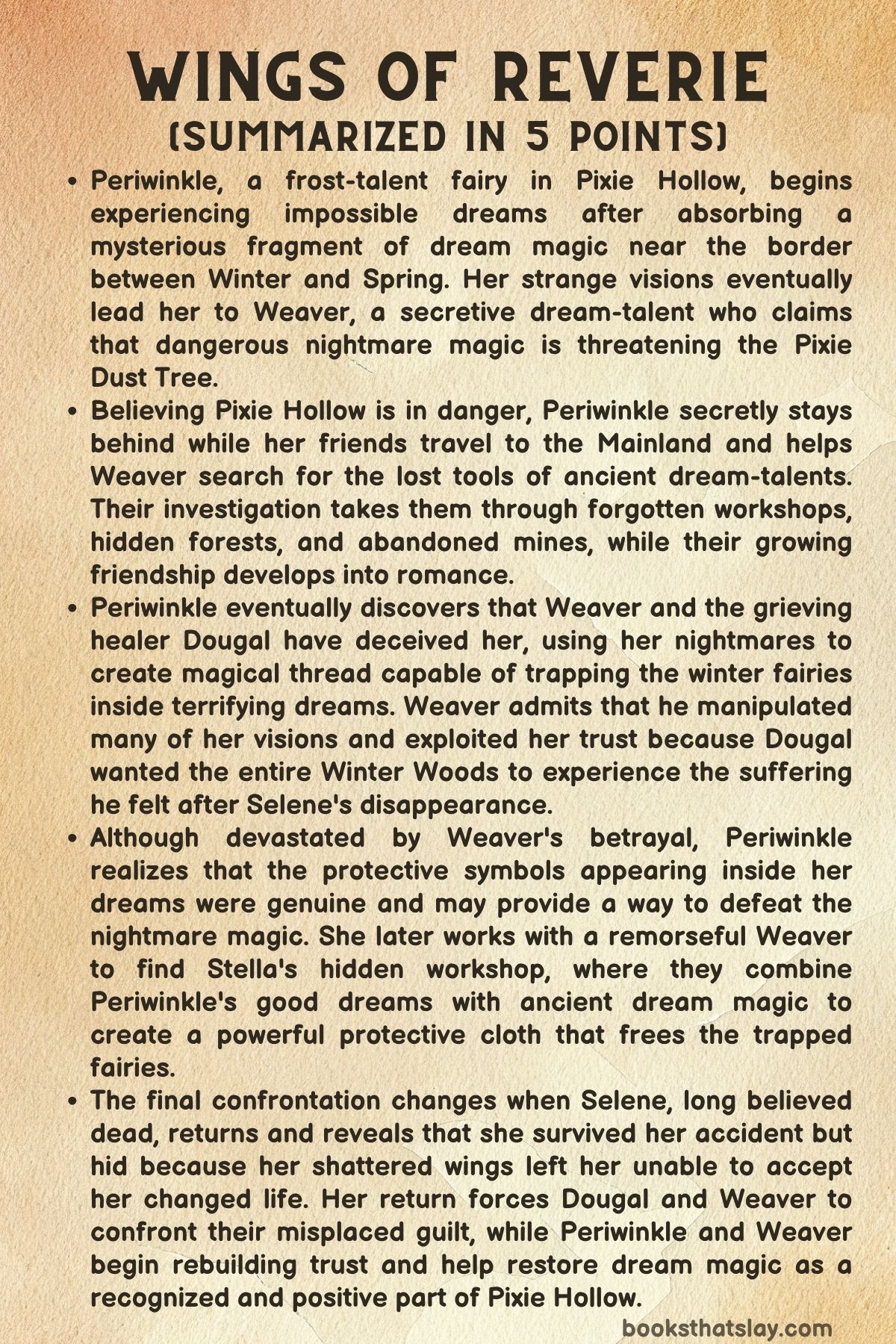
Periwinkle has always been unusually fascinated by borders, discoveries, and anything that seems to exist between familiar categories. Although fairies normally do not dream, her life changes after she finds a mysterious iridescent puff near the boundary between Winter and Spring and absorbs it into her skin.
Soon afterward, Periwinkle begins experiencing dreams in secret. Some are amusing reflections of daily life, but others become frightening visions involving violent storms, a strange violet haze, the Pixie Dust Tree, and the possibility that the Winter Woods could be destroyed.
While her friends Gliss and Spike prepare with her for their seasonal journey to the Mainland, Periwinkle also struggles with the romantic expectations surrounding Fletcher. He is pleasant, attractive, and clearly interested in her, but Periwinkle cannot convince herself that affection should simply arise because everyone considers him suitable.
Her dreams become more serious when Periwinkle sleepwalks into the woods and encounters strange colored wisps around her. There she meets Weaver, an isolated sparrow man who reveals that the wisps are physical manifestations of her dreams and that he possesses a nearly forgotten dream talent.
Weaver explains that ancient dream-talents once collected dreams arriving from human children and turned them into magical thread. According to the old stories he knows, good dreams could strengthen magical structures, while nightmares carried dangerous power capable of causing corruption and destruction.
He then shows Periwinkle a black stain beside the Pixie Dust Root and claims it is nightmare rot. Weaver argues that the damage could spread through the tree and make it unable to survive the violent storm both of them have seen in their dreams, convincing Periwinkle that her unusual dreaming may have given her a responsibility to prevent disaster.
Instead of leaving for the Mainland with the other winter fairies, Periwinkle deliberately wets her wings so that she will be forced to remain behind. Her decision means deceiving Lord Milori, Gliss, Spike, Fletcher, and everyone else who cares about her, but she believes saving Pixie Hollow justifies the secrecy.
Periwinkle and Weaver give themselves the duration of the Frost Festival to recover the lost tools once used by dream-talents. Weaver continues gathering her dreams each night, separating the pleasant ones from the nightmares, while Periwinkle becomes increasingly fascinated by both dream magic and the fairy practicing it.
Their personalities differ sharply. Periwinkle approaches unfamiliar things with wonder and assumes that people can usually be reached through patience and kindness, whereas Weaver expects disappointment and views darker emotions as more revealing than socially acceptable behavior.
As they search old books and secret records, their mission also becomes personal for Weaver. Discovering names such as Stella, Morpheus, and Orion proves that dream-talents once had a real history, community, and purpose, challenging his lifelong belief that there was something fundamentally wrong with him.
Their clues eventually lead them beneath the enormous Drift, where they discover a hidden forest inhabited by dream spiders. Following the creatures brings them to Morpheus’s abandoned workshop and the magical scissors once used to work with dream material.
Periwinkle and Weaver grow steadily closer during the search. Weaver repeatedly retreats whenever their emotional connection becomes too strong, convinced that closeness to him will eventually hurt Periwinkle, but she refuses to let him decide on her behalf whether he deserves affection.
Their conflict finally ends in a kiss, confirming feelings that have been developing throughout their mission. At the same time, Periwinkle notices details she does not yet understand, including Weaver’s recurring headaches, his strange relationship with nightmares, and the way the dream spider Legs protects him from his own dark dreams.
Their next clue leads them toward an abandoned Sapphire Mine. Inside, they locate another dream-talent workshop containing a magical spindle and, even more importantly for Weaver, a communal journal showing that the old dream-talents worked together, joked with one another, made mistakes, and supported each other.
A cave-in traps Periwinkle and Weaver underground, forcing them into a period of unusual honesty. Weaver reveals that Selene, the fairy believed to have died while searching for medicine, had been one of his closest friends and that she undertook her dangerous journey partly because Weaver himself was ill.
Weaver has therefore spent the following year burdened by guilt. Periwinkle begins to understand that much of his hostility and isolation comes from grief rather than simple bitterness, while Weaver briefly becomes the more hopeful of the two when she starts doubting whether their mission can actually succeed.
They eventually escape with the spindle and return in time for the First Frost Ball. Weaver presents Periwinkle with a spectacular gown inspired by the colors of her dreams and gives her a protective bracelet made from dream material, but his behavior carries a strange sense of finality.
Periwinkle discovers the reason when she follows Weaver away from the celebration. She watches him meet Dougal, spin her collected nightmares into dark thread, and hand that material over so Dougal can encircle the Hall of Winter with it.
The nightmare magic quickly overwhelms the celebration. Fairies collapse into unnatural sleep and become trapped inside terrifying dreams, while Periwinkle remains protected by Weaver’s bracelet and realizes that the entire explanation she was given about saving the Pixie Dust Tree cannot be true.
Dougal reveals that his real objective is to make the Winter Woods experience the fear and helplessness he has endured since Selene disappeared. Grief has convinced him that others should suffer before they can understand him, and Weaver allowed his own guilt and resentment to make him part of the scheme.
The black mark at the Pixie Dust Root was manufactured with nightmare magic. The storm was ordinary winter weather, the tree was never secretly dying, and Lord Milori had not ignored an approaching catastrophe.
The betrayal becomes even more personal when Weaver admits that Periwinkle began dreaming because she accidentally encountered a piece of one of his dreams that he had lost near the seasonal border. Once Weaver and Dougal realized what had happened, they decided to exploit her unusual ability to produce enough nightmare material for their plan.
Weaver confesses that he manipulated Periwinkle’s dreams, intensified her nightmares, and deliberately caused her to sleepwalk to the Pixie Dust Well so that their first meeting would appear accidental. He had initially considered her shallow, privileged, and easy to mislead, making the genuine affection that later developed between them inseparable from a relationship that began through deception.
Periwinkle leaves him and flies alone into the storm, questioning whether any part of her experience had meaning. Her crisis is not merely romantic; Weaver’s confession attacks the part of her identity that believes accidental discoveries can contain possibilities worth trusting.
Gradually, however, Periwinkle realizes that Weaver cannot explain everything she experienced. He created the nightmares, but he did not create the golden thread, needle, mysterious light, or protective web that repeatedly appeared inside them and sometimes showed Periwinkle things before she encountered them in waking life.
She therefore separates Weaver’s manipulation from the deeper dream magic that repeatedly guided her toward protection rather than destruction. Remembering the bracelet that defended her at the ball, she concludes that good dreams may provide a way to neutralize the nightmare magic.
Periwinkle returns to the Hall of Winter and finds Weaver injuring himself as he desperately tries to undo what he helped create. Instead of defending his behavior, he accepts responsibility and reveals that he secretly preserved an entire supply of Periwinkle’s good dreams because learning about the old dream-talents had awakened a desire to use his ability constructively.
Periwinkle does not pretend that his betrayal has disappeared. She chooses instead to work with him because people are capable of making new decisions after terrible ones, and because saving the sleeping fairies matters more than preserving her anger in that moment.
They travel through the storm to Snow Globe Mountain, following clues associated with Stella. An invisible magical connection eventually guides them into Stella’s lost workshop, where they discover the golden web Periwinkle has seen throughout her dreams.
Their first hope fails when Stella’s ancient loom is found shattered. Periwinkle refuses to treat the damage as final, however, and uses her frost talent to repair the broken structure enough for Weaver to work with it.
They still lack enough dream material until Periwinkle asks the golden web for help. The magic responds to her desire to protect others and allows itself to become part of their creation, while Periwinkle voluntarily permits Weaver to experience her dreams during the process.
That consent transforms the meaning of their work. Weaver once entered and manipulated Periwinkle’s inner world without permission; now she consciously chooses what he may receive, and he uses his talent to create protection rather than control.
They return to the Hall of Winter with the completed dream-cloth and place it over the remaining nightmare magic. The darkness disappears, the trapped fairies awaken, and Weaver prepares to confess his role rather than hiding behind Dougal or grief.
Dougal still cannot release his anger and attacks Lord Milori, but the confrontation is interrupted by the return of a fairy everyone believed was dead. Icaria, the recently arrived stranger Periwinkle had befriended during the festival, reveals herself as Selene.
Selene explains that she survived her accident near Snow Globe Mountain but suffered permanently shattered wings. Believing that losing her ability to fly meant losing the identity she understood, she chose to disappear rather than return to the Winter Woods in a changed body.
Her return destroys the assumptions upon which Dougal and Weaver built their guilt. Selene insists that nobody forced her into the dangerous decision that caused her accident, rejecting the idea that Dougal, Weaver, Lord Milori, or anyone else must spend the rest of life punishing themselves or one another for her choice.
Selene also demonstrates that identity cannot be reduced to a single talent or ability. Her wings remain damaged, yet she chooses to find new ways to move, travel, and experience freedom rather than allowing the loss of flight to define the limits of her existence.
Dougal finally begins acknowledging the harm he has caused, while Weaver accepts that grief never justified manipulating Periwinkle or attacking innocent fairies. Periwinkle and Weaver later meet at the Pixie Dust Well and choose to continue their relationship without pretending that forgiveness erases accountability.
The Winter Woods changes significantly afterward. Periwinkle tells Gliss and Spike the truth, Selene builds a new life with different forms of mobility, and Weaver receives another talent-choosing ceremony in which a dream spider publicly identifies him as Pixie Hollow’s first recognized dream-talent in centuries.
Other fairies soon begin dreaming as well, allowing Weaver and his new companions to restore the forgotten workshops and recover lost dream practices. Freed from suppressing his identity, Weaver’s mysterious headaches disappear.
When Periwinkle prepares to return to the Mainland months later, Weaver goes with her carrying newly created dream magic. What began as an accidental encounter becomes the foundation for a revived magical tradition, while Periwinkle and Weaver move forward with a relationship built not on the illusion that mistakes never happened, but on the decision to act differently after confronting them.
Characters
Periwinkle
At the center of Wings of Reverie, Periwinkle is defined by curiosity, optimism, and an instinctive attraction to boundaries. She is interested in places where one thing becomes another, which explains why the seasonal border fascinates her long before dream magic enters her life.
Her greatest strength is her willingness to see possibility where other characters see limitations. The dreams do not frighten her into immediately wishing them away; even when they become disturbing, she wants to understand what they might reveal.
That curiosity can also make her reckless. She deliberately damages her ability to travel to the Mainland, deceives her friends and Lord Milori, enters dangerous abandoned places, and repeatedly accepts Weaver’s explanations because they fit her desire to believe she has discovered something meaningful.
Periwinkle nevertheless possesses a strong moral center. Her argument with Weaver over whether dark emotions reveal a person’s true self establishes her belief that identity is created through choices, especially the choices people make when resentment, fear, or selfishness would be easier.
The betrayal at the First Frost Ball challenges that belief more severely than any magical danger. Weaver has not merely lied to her; he has used her trust, manipulated her dreams, and built their first meeting around a deception.
Her eventual decision to work with him again therefore does not represent simple forgetfulness. Periwinkle distinguishes forgiveness from denial and recognizes that Weaver’s wrongdoing can remain real while his later actions also reveal the possibility of change.
Her final understanding of dream magic reflects her own development. She begins by wanting an adventure to have a predetermined meaning, but she ends by recognizing that an accidental beginning can become meaningful through what a person chooses to do with it.
Weaver
In Wings of Reverie, Weaver is both Periwinkle’s romantic counterpart and the character responsible for the story’s deepest personal betrayal. His intelligence, sarcasm, secrecy, loneliness, and buried tenderness make him appealing to Periwinkle, yet the same defensive habits also enable him to justify serious wrongdoing.
Weaver grows up without a clear understanding of his talent. Because the normal talent-choosing process fails to identify him, he settles into ordinary craft work while privately experiencing abilities that no one around him seems able to explain.
That uncertainty leaves him convinced that he is an error rather than part of a forgotten tradition. Finding records of Stella, Morpheus, Orion, and the other dream-talents therefore affects him profoundly because it gives him something he has never possessed: evidence of belonging.
His cynicism is partly defensive. Weaver expects selfishness and cruelty because assuming the worst allows him to avoid the vulnerability involved in trusting others, and his early judgment of Periwinkle as shallow reveals how readily he reduces people to convenient assumptions.
Selene’s disappearance deepens those tendencies. Because she went searching for medicine partly while Weaver was ill, he converts grief into guilt and eventually allows Dougal’s desire for revenge to offer that guilt a direction.
His treatment of Periwinkle is consequently morally serious. He does not merely hide information; he alters her nightmares, engineers their first encounter, takes advantage of her trust, and participates in using her dream material against innocent fairies.
What keeps Weaver from remaining an antagonist is his capacity to recognize what he has become. His affection for Periwinkle eventually becomes genuine, his discovery of the old dream community awakens a healthier vision of his talent, and he secretly preserves her good dreams even while still participating in Dougal’s plan.
After the disaster, Weaver stops trying to make guilt function as an excuse. He harms himself attempting to undo the nightmare magic, apologizes without demanding immediate forgiveness, helps Periwinkle save the Winter Woods, and later accepts public responsibility for his true talent.
His final development is therefore not about proving that his earlier actions were misunderstood. It is about accepting that he caused real harm and choosing a different relationship with grief, magic, community, and love.
Dougal
Within Wings of Reverie, Dougal demonstrates how genuine grief can become morally destructive when suffering is transformed into entitlement. As a healer, he should represent care and restoration, yet Selene’s disappearance gradually changes his understanding of pain.
Dougal believes the Winter Woods continued functioning too easily after his personal world collapsed. His anger toward Lord Milori originates in the belief that the search for Selene ended too soon and that everyone else escaped the emotional consequences he was forced to endure.
That resentment becomes the foundation of his revenge. Instead of asking others to understand his grief, Dougal decides they must experience fear and helplessness for themselves, leading him to weaponize nightmare magic against an entire community.
His relationship with Weaver is especially troubling because he exploits guilt that he understands intimately. Weaver already blames himself for Selene’s journey, and Dougal allows their shared pain to reinforce increasingly dangerous beliefs rather than helping his friend process the loss.
Dougal’s plan also reveals the flaw in revenge as a substitute for mourning. Causing others to suffer does not restore Selene, answer what happened to her, or reduce his grief; it simply produces new victims and creates another source of guilt.
Selene’s return forces Dougal to confront the fact that the story he has repeated to himself for a year was incomplete. Most importantly, she refuses to let him assign responsibility for her choices to other people.
His eventual apology cannot erase the terror he caused, but it marks the beginning of emotional honesty. Dougal must finally accept that loving Selene does not give him the right to decide who should suffer because she was gone.
Selene
Wings of Reverie uses Selene first as an absence and later as a living challenge to almost every assumption formed around that absence. For much of the story, other characters construct identities around what they believe happened to her.
Dougal becomes consumed by anger, Weaver by guilt, and Lord Milori carries the burden of decisions made during the unsuccessful search. Selene’s apparent death becomes a wound around which several characters organize their understanding of themselves.
The revelation that she survived complicates rather than trivializes that suffering. Selene’s wings were permanently shattered, leaving her unable to return to the life and self-image she had known before the accident.
Her decision to hide shows that she also fell into the trap of believing identity could be reduced to ability. Because speed and flight were so important to her, she initially interpreted losing them as equivalent to losing the person she had been.
By returning, Selene rejects that conclusion. She accepts that her body and circumstances have changed while refusing to treat those changes as proof that her future has ended.
She is also remarkably clear about responsibility. Instead of allowing Weaver, Dougal, Milori, or Dewey to continue punishing themselves, she states that her dangerous choice was her own and refuses to let their guilt rewrite her agency.
Her later use of Harlow’s sled and a new flying machine demonstrates her renewed attitude toward limitation. Selene cannot restore her old wings, but she can build a life that includes movement, excitement, relationships, and freedom in different forms.
Lord Milori
In Wings of Reverie, Lord Milori initially appears through Periwinkle’s suspicion that authority may be concealing dangerous knowledge. Weaver’s claims encourage her to interpret Milori’s secrecy as evidence that he knows the Pixie Dust Tree is threatened and has chosen not to act.
The eventual truth is more complicated. Milori did recognize the black mark as a form of dark magic, but the tree was not dying, and Weaver deliberately used Milori’s reserved leadership style to make his false explanation believable.
Milori’s history with Selene also demonstrates the limits placed on leadership. He had to decide how long a dangerous search could continue while the Winter Woods still had responsibilities elsewhere, and that practical decision became a focus for Dougal’s grief.
Importantly, Milori later recognizes his own contribution to the atmosphere of suspicion. He acknowledges that greater openness about the black mark might have prevented some of the disaster, showing that leadership can involve responsibility without requiring acceptance of blame for everything others choose to do.
His character therefore represents restrained authority rather than simple wisdom or failure. He makes difficult decisions, withholds information he believes should remain private, and eventually learns that secrecy can create space in which false explanations flourish.
Gliss
Gliss is one of the clearest representations of Periwinkle’s existing community. She participates in Periwinkle’s ordinary winter life, travels with her, worries about her, and belongs to the group Periwinkle risks alienating when she chooses secrecy.
Her importance lies partly in what Periwinkle fears losing. The nightmares involving Gliss in danger give emotional weight to the supposed threat because Periwinkle’s motivation is never merely abstract concern for the Pixie Dust Tree; she fears losing specific people she loves.
Gliss also helps show why Weaver’s early assumptions about Periwinkle are incomplete. Periwinkle’s social life is not evidence that her relationships are superficial, because her friendships contain genuine loyalty and affection.
When Periwinkle finally reveals everything after the crisis, Gliss’s understanding response validates a lesson Periwinkle had resisted. Trusting friends with uncomfortable truths can be less damaging than trying to protect those relationships through secrecy.
Spike
Spike serves a role similar to Gliss while reinforcing the sense of companionship surrounding Periwinkle before the dream mystery isolates her. She is part of the familiar life Periwinkle chooses to leave temporarily when she remains behind in the Winter Woods.
The danger Periwinkle sees threatening Spike in her dreams makes the supposed catastrophe feel personal. Those images allow Weaver’s deception to work because Periwinkle is not simply afraid of magical destruction; she is terrified that her private choices might cause her friends to be harmed.
Spike’s eventual safe return from the Mainland provides closure to that fear. Her continued acceptance of Periwinkle also shows that honesty after a mistake can restore relationships that secrecy had placed at risk.
Fletcher
Fletcher is important because he represents a future that appears sensible from the outside but feels emotionally empty to Periwinkle. He is attractive, pleasant, cheerful, and clearly interested in her, giving Periwinkle no obvious reason to reject him.
Yet Periwinkle repeatedly notices that being around Fletcher produces none of the anticipation she associates with discovery or genuine attraction. Her inability to reciprocate his feelings shows that compatibility cannot be created simply because friends or social expectations identify a relationship as appropriate.
Fletcher also becomes important after Weaver’s betrayal. Periwinkle briefly thinks that the boredom she associated with Fletcher would have been easier to survive than the pain Weaver caused, revealing how deeply the deception has shaken her.
The comparison does not ultimately transform Fletcher into Periwinkle’s alternative romantic choice. Instead, he represents the difference between safety without emotional connection and connection that must still meet standards of honesty and respect.
Dewey
Dewey functions as the guardian of knowledge within the Winter Woods. His trust gives Periwinkle access to restricted historical material, allowing her and Weaver to discover that dream-talents really existed and that their tools may still survive.
His role also exposes one of the story’s central tensions between knowledge and interpretation. The records contain genuine information, but Periwinkle and Weaver repeatedly interpret that information through assumptions shaped by incomplete evidence.
Dewey’s conversation with Dougal shows another side of his character. He recognizes Dougal’s grief while also refusing the fantasy that some magical solution could simply undo emotional loss.
He therefore represents patient knowledge rather than certainty. Books and records can reveal forgotten truths, but they cannot decide how people should respond to grief, guilt, love, or responsibility.
Legs
Legs, the iridescent dream spider, initially appears almost like a magical companion attached to Weaver’s unusual talent. Its behavior gradually becomes important because it reveals aspects of dream magic that Weaver himself does not fully explain.
The spider captures Weaver’s nightmares and protects him from their effects. That action later makes Periwinkle realize that Weaver possessed access to forms of protection that he did not offer her while deliberately intensifying her nightmares.
Legs nevertheless remains separate from Weaver’s moral failures. The dream spiders guide Periwinkle and Weaver toward forgotten workshops, connecting the present to the lost community of dream-talents.
By the end, Legs represents the possibility that dream magic itself was never corrupt. The moral danger came from how fairies chose to use it.
Icaria
Icaria first appears as a newly arrived fairy whose snow-lantern sculpture Periwinkle accidentally damages. Their brief encounter seems minor, but Periwinkle’s encouragement that she begin again instead of allowing the ruined creation to define the entire experience quietly anticipates the character’s true identity.
The name Icaria reflects a desire to reach for the sky, which becomes especially meaningful after she is revealed as Selene. The identity allows Selene to experiment with existing as someone other than the fairy she believed she had to remain.
Her conversations with Periwinkle about talents and identity prepare the story for the later revelation that losing one ability does not erase the whole person. Icaria is therefore not merely a disguise but a transitional identity through which Selene slowly learns how to imagine a future again.
Harlow
Harlow, the wolf pup, provides practical help during the final stage of the crisis by pulling the sled toward Snow Globe Mountain and later helping bring Selene back to the Hall of Winter. His energetic presence also offers moments of physical movement and companionship during some of the story’s darkest events.
More symbolically, Harlow becomes part of Selene’s changed relationship with mobility. The sled gives her a way to travel swiftly despite her damaged wings, showing how adaptation can create possibilities without pretending that the original loss never occurred.
Floss
Floss contributes to Weaver’s public life through the craft workshop where he works under a talent identity that never fully explains him. Her workshop places Weaver within a community even while he emotionally keeps himself apart from the fairies around him.
The setting also allows Periwinkle to see that Weaver is talented, disciplined, and capable of creating beauty long before his dream talent receives public recognition. His work on Periwinkle’s ball gown becomes especially important because it is one of the first ways he uses intimate knowledge of her dreams to create something generous rather than harmful.
Flare
Flare is a supporting presence within Periwinkle’s social environment and the Frost Festival celebrations. Her familiarity with Periwinkle helps establish how connected Periwinkle already is to the Winter Woods community.
When Flare later becomes one of the fairies trapped by nightmare magic, the consequences of Weaver and Dougal’s plan become immediate rather than theoretical. People Periwinkle knows personally are suffering because of choices made by someone she trusted.
Alder
Alder appears primarily through Weaver’s workplace and later becomes one of the fairies Periwinkle tries unsuccessfully to awaken from the nightmare spell. His role strengthens the scale of the disaster by showing that the magic affects ordinary members of the community as well as major authority figures.
His presence also prevents Dougal’s revenge from being interpreted as narrowly directed against those involved in Selene’s disappearance. Innocent fairies with no responsibility for the tragedy are harmed, making the moral failure of the plan unmistakable.
Trim
Trim’s romantic interest in Weaver causes Periwinkle to recognize jealousy she has not yet openly acknowledged. The moment helps move Periwinkle’s feelings beyond curiosity and friendship because she realizes that the idea of Weaver becoming emotionally close to someone else genuinely troubles her.
Trim therefore functions less as a romantic rival than as a catalyst for Periwinkle’s self-awareness. Her interest forces Periwinkle to recognize feelings that she has been reluctant to name.
Themes
Trust, Deception, and the Meaning of Consent
Trust in Wings of Reverie is valuable precisely because it creates vulnerability. Periwinkle gives Weaver access not only to her time and emotions but eventually to the most private parts of her consciousness, believing that he is collecting her dreams to protect Pixie Hollow.
The betrayal is therefore deeper than an ordinary lie. Weaver manipulates her nightmares, causes her to sleepwalk, constructs a false explanation for their meeting, and uses material taken from her inner life to support Dougal’s revenge.
The contrast between the earlier manipulation and the later creation of protective dream-cloth is crucial. At Stella’s workshop, Periwinkle consciously permits Weaver to experience and use her dreams, turning an act that once represented violation into one based on choice.
Forgiveness does not remove this distinction. Periwinkle can recognize Weaver’s genuine remorse and cooperate with him while still understanding that his earlier behavior was wrong.
The book therefore presents trust as something that cannot be demanded simply because love or regret exists. Trust becomes meaningful when information is offered honestly, boundaries are respected, and another person’s willingness is treated as essential rather than inconvenient.
Identity Beyond Talent and Ability
Much of Wings of Reverie examines what happens when characters allow one role, ability, or failure to define their entire identity. Weaver believes there is something fundamentally defective about him because the established talent system cannot identify what he is.
Discovering the forgotten dream-talents changes that understanding. He learns that his difference is not evidence of worthlessness but evidence that part of Pixie Hollow’s history has been lost.
Selene faces the same issue through physical loss rather than social misidentification. When her wings are shattered, she assumes that losing flight means losing the person she used to be and hides because she cannot initially imagine another form of life.
Her return demonstrates a broader idea of selfhood. She remains the same person even though her relationship with movement must change, and new tools such as the sled and flying machine allow her to build possibilities around the reality of her damaged wings.
Periwinkle also learns that talent cannot determine emotional destiny. Fletcher may appear to fit naturally into her expected future, but personal identity cannot be created by satisfying the assumptions of friends or community.
Through all three characters, the story argues that abilities matter without being complete definitions. A person can lose, rediscover, reinterpret, or expand an ability without losing the right to imagine a new future.
Grief, Guilt, and the Choice Between Healing and Revenge
Grief shapes Weaver, Dougal, Selene, and even the decisions of Lord Milori. The story treats grief as genuine and powerful while drawing a firm distinction between suffering and the choices made because of suffering.
Dougal’s pain after Selene disappears is understandable, but he gradually converts it into a belief that other fairies owe him equivalent misery. His nightmare attack attempts to transform private grief into communal punishment.
Weaver follows a related path through guilt. Because Selene went looking for medicine partly while he was sick, he begins treating her disappearance as evidence that his existence harmed someone he loved.
His alliance with Dougal allows guilt to become self-destructive and then destructive toward others. Instead of processing his pain, Weaver joins a plan that creates additional victims and eventually gives him even more reason to feel ashamed.
Selene’s return challenges the assumptions sustaining both men. She refuses to let them rewrite her choice as something they caused and makes clear that guilt cannot honor her if it destroys the lives of everyone who survived.
Healing begins only when the characters stop asking pain to provide permission for harmful behavior. Grief does not disappear, but it becomes something that can be carried without requiring another person to suffer in exchange.
Choice, Change, and the Creation of Meaning
Periwinkle initially wants her dreams to have a special origin. She is excited by the possibility that mysterious magic deliberately selected her for an important purpose, making the later revelation that she began dreaming through an accident especially painful.
Her development comes from realizing that an accidental beginning does not make everything that follows meaningless. Weaver may have lost the dream fragment by chance, but Periwinkle’s curiosity, courage, compassion, and later decisions belong to her.
The same principle applies to Weaver. His past actions cannot be changed, and the story does not pretend that regret turns manipulation into innocence.
What Weaver can change is what he does next. He preserves Periwinkle’s good dreams, admits his responsibility, helps undo the nightmare attack, accepts his true talent publicly, and begins using dream magic to help rather than control.
Selene likewise cannot restore her original wings, yet she can decide whether the accident marks the end of her life or the beginning of a different one. Her new forms of movement arise from accepting reality without surrendering possibility.
Meaning therefore comes less from discovering that everything was predetermined than from responding deliberately to what happens. Chance creates circumstances, loss changes lives, and mistakes create consequences, but characters continue possessing the power to decide what those events will become.