These Walls Remember Summary, Characters and Themes
These Walls Remember by Del Sandeen is a supernatural family drama about a house in Savannah that holds more than physical history. At its center are Mickie Taylor-Hughes, her estranged sister Delilah, and Delilah’s daughter Joy, three women carrying years of grief, anger, and unfinished family conflict.
Their inheritance of their great-aunt Haddie’s old house brings them into contact with the suffering preserved inside its walls, especially the tragedy of Lewis Bell and his family. The novel connects haunting with memory, racial injustice, displacement, generational pain, and the difficult difference between remembering the dead and refusing to release them.
Summary
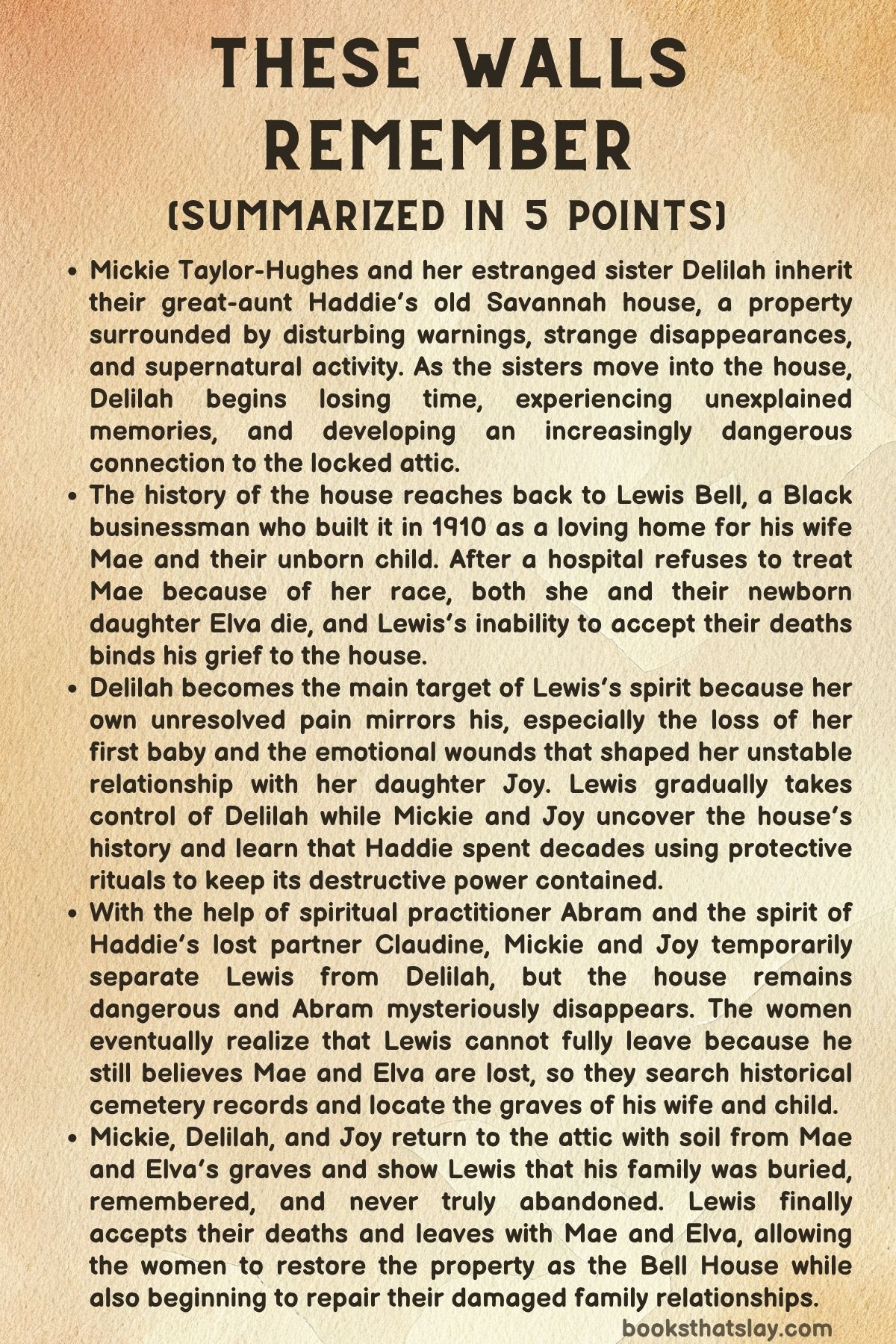
Mickie Taylor-Hughes travels to Savannah after the death of her estranged great-aunt, Haddie Taylor. She expects the inheritance to be mainly a practical problem, but attorney Briggs Campbell gives her Haddie’s papers, including disturbing drawings and a warning that “the house eats.”
Mickie is already vulnerable to thoughts of death because of a family superstition that deaths arrive in groups of three. Her anxiety grows when her younger sister, Delilah, unexpectedly appears and they learn that Haddie has left them the house at 724 Hartford Street jointly.
The sisters have been estranged for years, carrying resentment connected to their parents’ deaths, Delilah’s unstable life, and Mickie’s attempt to gain custody of Delilah’s daughter Joy. Their inheritance therefore forces two people who have spent years avoiding each other into the same deteriorating house.
The property immediately feels wrong. Dried herbs surround the locked attic entrance, Haddie repeatedly warned against entering it, and neighboring residents suggest that Haddie spent much of her life resisting something dangerous within the building.
Running parallel to the sisters’ experience is the history of Lewis Bell, a Black businessman who built the house in the early twentieth century. Lewis constructed it as a symbol of independence, dignity, and security for his pregnant wife Mae and the family they hoped to raise.
Lewis takes immense pride in creating something permanent after generations of hardship. He carves his initials with Mae’s into the attic and promises that they will remain in the house together, a loving declaration that will later acquire a terrible meaning.
In the present, Mickie and Delilah initially intend to repair and sell the property. Both women, however, have nowhere else they truly belong: Mickie is still rebuilding her life after losing her husband Solomon, while Delilah is nearly broke after another unstable relationship.
Strange events begin almost immediately. The sisters hear unexplained sounds, experience disturbing dreams, and repeatedly feel drawn toward the attic.
Delilah becomes particularly vulnerable to the house. She inexplicably knows that Haddie’s yellow dog is named Wes, loses track of time, and repeatedly finds herself near the attic without remembering how she arrived there.
Eventually she removes Haddie’s protective herbs from the attic doorway and breaks inside. The sisters discover candles, a blanket, and a shrine-like arrangement whose meaning they do not understand.
The candles later relight themselves. Mickie, who tries to explain everything practically, is forced to reconsider when she feels an invisible figure sitting beside her in bed and sees the physical depression it leaves behind.
The older neighbors, including Mrs. Gibson, warn the sisters that people connected to the house have disappeared before. Their warnings also introduce another conflict surrounding the property: the neighborhood is changing rapidly as older Black residents are displaced by renovations, short-term rentals, and rising prices.
Mickie gradually becomes uncertain about selling. She considers turning the property into a bed-and-breakfast, partly because hospitality represents a dream she once shared with Solomon, but Delilah objects that such a business could contribute to the same commercialization threatening the neighborhood.
At the same time, Delilah reveals that she has had cancer. Mickie’s fear of losing another family member intensifies, especially because she continues interpreting events through the belief that death comes in groups of three.
The supernatural danger soon becomes more explicit. Mickie encounters the apparition of Frank Reilly, a Black veteran whose despair after returning from war ended in suicide, while Delilah somehow knows his identity and history without being told.
Mickie realizes that her sister is receiving memories directly from the house. Their fear does not make them more cooperative, however, because years of resentment erupt whenever either woman feels threatened.
Delilah eventually disappears. Her belongings remain behind, making it clear that she has not simply walked away after an argument.
Mickie calls Joy, who initially wants nothing to do with her mother. Joy has spent much of her life hurt by Delilah’s instability and broken promises, but after learning about the cancer and disappearance, she comes to Savannah because she knows she could not live with herself if Delilah died while she stayed away.
Joy’s arrival exposes more of the family’s history. She describes a childhood shaped by frequent moves, unreliable relationships, and a mother she loved but could never fully depend upon.
Mickie admits that she once tried to gain custody because she believed Joy needed stability. The confession reveals that the estrangement between Mickie and Delilah grew not from a single disagreement but from incompatible ideas about love, responsibility, and protection.
Delilah then mysteriously reappears inside the house. She cannot explain where she has been and behaves as though the missing days belong to someone else.
The force controlling her is eventually identified as Lewis. Through Delilah, his memories reveal the tragedy that transformed the house.
During a catastrophic storm, Mae went into labor. Lewis fought through flooding and dangerous roads trying to obtain medical care, only to reach a hospital that refused to treat his wife because she was Black.
Mae and their newborn daughter Elva died. Lewis returned home with their bodies and discovered that his exhausted horse Wes had also died after the desperate journey.
Unable to accept such overwhelming loss, Lewis carried Mae and Elva into the attic and treated them as though they were still alive. He created the shrine that remains there more than a century later.
Neighbors, especially Alice, tried to help him accept their deaths and arrange proper burials. Lewis instead barricaded himself inside, threatened those attempting to intervene, and transformed the house he built for family and community into a place of isolation.
As Lewis himself weakened, something within the property offered him a way to remain with Mae and Elva if he surrendered his grief, rage, and pain. Lewis accepted, binding his suffering to the house and beginning a cycle in which the property preserved painful memories while consuming vulnerable people.
Delilah becomes an ideal target because she carries unresolved grief of her own. Lewis forces her to remember becoming pregnant as a teenager, being denied control over the decision to keep the child, and then losing the baby during premature labor after medical workers failed to take her suffering seriously.
That experience shaped Delilah’s later life. Her constant movement, unstable relationships, fierce independence, and complicated relationship with Joy are connected to pain she has spent decades avoiding.
Lewis convinces Delilah that he understands her because both of them have suffered devastating losses connected to parenthood and medical neglect. Yet his apparent sympathy is destructive because he encourages her to surrender to grief rather than continue living through it.
Mickie and Joy begin researching the property more seriously. They discover that entire families have disappeared there and gradually understand that Haddie’s supposed madness was actually the result of spending decades trying to contain the danger.
Abram, a spiritual practitioner who helped Haddie maintain protective wards, eventually returns. He explains that Delilah destroyed the barriers surrounding the attic when she removed the herbs.
Before they can solve the problem, John-Lester, the young man who maintains the yard, dies in a terrible accident. Shortly before his death, he sees a man in the attic window, proving that whatever lives in the house can influence events beyond its rooms.
John-Lester’s funeral becomes important to Mickie because she sees how many people remember him. His life continues through the community’s stories, giving Mickie a new understanding of remembrance that contrasts with the house’s method of trapping people through pain.
The family also discovers more about Haddie. She loved a woman named Claudine, a relationship that contributed to her estrangement from Mickie and Delilah’s deeply religious relatives.
Claudine disappeared inside the house. Haddie survived but spent the rest of her life placing wards around the property and isolating herself, not because she cared nothing for other people but because she was trying to protect them from what had taken the woman she loved.
Joy, Mickie, and Delilah are eventually forced to enter the attic together. The house exposes their deepest anger, grief, and resentments, but instead of allowing those emotions to divide them completely, the women begin speaking honestly.
Delilah talks about her first lost child. Joy describes the damage caused by her unstable childhood, while Mickie recognizes how grief and fear made her rigid, controlling, and quick to judge.
This honesty weakens Lewis’s power because hidden pain is one of his strongest tools. The family begins understanding that acknowledging grief is different from allowing grief to dominate every future choice.
Abram attempts to remove Lewis from Delilah, but the first confrontation fails. Lewis has become deeply attached to her and is determined to keep a connection to the living.
A later attempt uses Claudine’s locket to bring her spirit forward. Claudine appears furious about the life she lost with Haddie and ultimately helps separate Lewis from Delilah.
Delilah survives, but the danger is not finished. Mickie discovers Abram’s pouch and blood inside the house and realizes that Abram has vanished.
The property absorbs his blood into its walls, confirming Haddie’s warning in the most disturbing possible way. The house does not merely contain ghosts; it has been consuming suffering and people for generations.
Mickie, Delilah, and Joy consider leaving, but they understand that selling the property would simply expose another family to the same danger. Delilah senses that Lewis remains because he is still searching for Mae and Elva.
Joy initially drives away, repeating the family habit of escaping painful situations. She eventually recognizes that leaving will not resolve either the supernatural crisis or her relationship with her mother and returns.
The three women search burial records for Lewis’s family. In a historically Black cemetery, where incomplete records reflect how easily Black lives were excluded from official preservation, they find graves that they believe belong to Mae and baby Elva.
They collect soil from the graves and bring it back to Lewis. Instead of confronting him only as an enemy, they invite him to remember what actually happened.
Lewis finally recounts the storm, the hospital’s racism, and his refusal to bury his family. The women tell him that Mae and Elva were buried, cared for, and remembered even though he could not face their deaths.
Mae’s spirit appears and calls to Lewis. For the first time, he understands that staying in the house has not kept his family together but has actually prevented him from joining them.
Lewis releases his grief and acknowledges the suffering his refusal created. Mae and Elva join him, and the three finally leave together.
Afterward, the atmosphere changes. The attic becomes quiet, the candles stop relighting, and the house no longer feels predatory.
Mickie, Delilah, and Joy also begin repairing their relationships. They accept that reconciliation does not require erasing what happened or pretending that years of hurt never existed.
Mickie decides not to sell the property or turn it into a business. Instead, the women restore it as a family home and name it the Bell House, preserving Lewis’s achievement rather than allowing his tragedy to be the only thing remembered.
Joy prepares to return to her own life while promising to visit frequently. Mickie and Delilah settle into the house together, learning to disagree without allowing every conflict to reopen decades of resentment.
At the end, three dark butterflies rise above the restored home, two larger and one smaller. Their appearance suggests that Lewis, Mae, and Elva are finally together beyond the house, while the living women remain behind to build a future based on remembrance without captivity.
Characters
Mickie Taylor-Hughes
Mickie is the central stabilizing force in These Walls Remember, although much of her development comes from realizing that control is not the same thing as stability. She enters the story determined to organize the inheritance, repair the house, sell it, and continue with her life without becoming emotionally trapped by either Haddie’s death or her history with Delilah.
Her practicality is partly a defense against grief. Solomon’s death has left her without the future she expected, while her family superstition about deaths arriving in threes makes her intensely afraid of losing another person even when she tries to present herself as rational.
Mickie’s greatest weakness is her tendency to decide what is best for other people. Her earlier attempt to take custody of Joy shows genuine concern, but it also demonstrates how easily concern becomes judgment when Mickie assumes that her own ideas about responsibility are unquestionably correct.
Her transformation occurs as the supernatural crisis forces her to accept uncertainty. She stops treating Haddie as irrational, begins seeing Delilah’s pain more compassionately, rejects the inevitability of another family death, and eventually chooses restoration rather than escape.
Delilah Taylor
Delilah is one of the most emotionally complicated figures in These Walls Remember because her apparent irresponsibility conceals experiences she has never fully processed. She is restless, impulsive, financially unstable, and prone to leaving when relationships become difficult, yet these behaviors are connected to fear and unresolved loss rather than simple selfishness.
Her first pregnancy becomes the hidden center of her adult life. Losing that baby after being denied meaningful control and adequate care leaves her with grief that she buries instead of confronting.
Her relationship with Joy reflects the consequences of that avoidance. Delilah genuinely loves her daughter, but love alone cannot create the consistency and security Joy needed while growing up.
Lewis chooses Delilah because her grief resembles his own. Her eventual survival depends on recognizing that shared suffering does not give Lewis the right to consume her identity, and her later reconciliation with Joy shows her beginning to remain present rather than running from painful accountability.
Joy
Joy enters These Walls Remember carrying the emotional consequences of choices made long before she could understand them. She loves Delilah but has spent much of her life protecting herself from the repeated disappointment of an unpredictable mother.
Her anger is therefore defensive rather than empty hostility. Saying that she does not care what happens to Delilah allows her to pretend that another abandonment cannot hurt her, yet her decision to come to Savannah immediately exposes how deeply attached she remains.
Joy also functions as a corrective to Mickie’s fatalism. When Mickie fears that Delilah may become the next death in a supernatural pattern, Joy refuses to treat her mother’s fate as predetermined and insists that they act.
Her final decision to return after initially driving away is equally important. Joy chooses not to repeat the family habit of escaping unresolved conflict, and her growing acceptance of Delilah allows reconciliation without requiring her to deny the harm she experienced.
Lewis Bell
Lewis Bell is both the tragic center and primary supernatural threat of These Walls Remember. Before becoming associated with terror, he is shown as a loving husband, ambitious businessman, skilled builder, and Black man determined to create security for his family in a society structured to deny him equal opportunities.
The house originally represents everything generous about Lewis. He builds it for Mae and their future children, takes pride in creating a permanent home, and imagines his family benefiting from the education, comfort, and independence that previous generations were denied.
Mae and Elva’s deaths break his relationship with reality. Because the hospital refuses Mae treatment on racial grounds, his grief becomes inseparable from rage at an injustice that cannot be undone.
Lewis becomes dangerous when remembrance turns into possession. His refusal to bury his family, accept community support, or recognize death allows another force to transform love into imprisonment, but his final release confirms that he remains capable of acknowledging the damage he caused and choosing reunion over captivity.
Haddie Taylor
Haddie is absent physically from most of These Walls Remember, yet her decisions shape nearly every major event. At first she appears to be an eccentric relative whose final years in a psychiatric hospital confirm the family’s belief that she became unstable.
The truth reverses that assumption. Haddie understood the danger within the property more clearly than anyone around her and spent decades using Abram’s wards, restricting visitors, and isolating herself so that other people would not become victims.
Her relationship with Claudine adds another dimension to her isolation. Family rejection of her sexuality already pushed her to the margins, and Claudine’s disappearance inside the house left Haddie carrying private grief that few people understood.
Her warning that the house eats becomes the key to interpreting everything that follows. What her relatives treated as evidence of mental decline ultimately represents knowledge gained through survival.
Mae Bell
Mae represents the future Lewis originally intended the house to protect. Her happiness over the nursery, her pregnancy, and her life with Lewis give the property an early atmosphere of domestic hope before catastrophe changes its meaning.
Her death is especially devastating because it is preventable. The storm creates the emergency, but racial discrimination at the hospital turns danger into tragedy by denying her treatment on the basis of race.
Mae becomes crucial again at the end because she offers Lewis what the house never could. Her appearance shows that genuine reunion requires him to stop holding the living and dead inside his grief.
Elva Bell
Elva is Lewis and Mae’s newborn daughter, whose death becomes part of the loss Lewis refuses to accept. Although she never develops an independent personality in the story, her symbolic importance is enormous because she represents the future Lewis had imagined for his family.
Lewis’s imagined version of Elva continues growing even after her death, showing how thoroughly denial has replaced reality. The discovery of her grave finally gives physical confirmation that she was not erased from history and allows Lewis to accept that she was buried and remembered.
Abram
Abram serves as the bridge between the family and the spiritual knowledge Haddie relied upon for years. His herbs, roots, protective practices, and understanding of the house allow Mickie and Joy to interpret experiences that ordinary explanations cannot contain.
He is not presented as all-powerful. Abram repeatedly acknowledges uncertainty and danger, which makes his role more credible because he understands that spiritual knowledge does not provide absolute control.
His attachment to his late wife Lilac also gives him a personal understanding of grief. Unlike Lewis, Abram maintains a connection to the dead without demanding that death be reversed.
His disappearance becomes one of the story’s harshest sacrifices. Even after helping free Delilah, he is apparently taken by the house, leaving the surviving women responsible for ensuring that his name and contribution are not forgotten.
Claudine
Claudine is initially a mystery preserved through photographs, a locket, and fragments of supernatural memory. Her eventual identification reveals a hidden part of Haddie’s life and explains much of Haddie’s later behavior.
She loved Haddie and expected a future with her, only to disappear inside the property. Her anger when she returns is therefore directed not simply at death but at the stolen life, relationship, and future she never received.
Claudine becomes essential during Delilah’s rescue because her rage is finally given a clear target. Once she confronts Lewis and helps break his hold, she chooses release rather than remaining behind to continue the cycle of revenge and possession.
Mrs. Gibson
Mrs. Gibson represents neighborhood memory. She knows pieces of Haddie’s history, understands that something about the house has always been dangerous, and repeatedly tries to warn Mickie without pretending that every mystery can be easily explained.
She also gives the story a broader social dimension by discussing displacement and the transformation of historically Black neighborhoods. Through her, the question of what happens to the house becomes connected to what happens when communities lose their history to rising prices and outside investment.
Her presence reminds Mickie that ownership creates responsibilities beyond personal profit. She helps preserve stories that official records have neglected or forgotten.
John-Lester
John-Lester initially appears as a young man performing ordinary yard work, which makes his death especially shocking. His familiarity with Haddie and his connection to the neighborhood also give Mickie a glimpse of relationships her great-aunt maintained despite her apparent isolation.
His funeral becomes more important than his limited time in the story might suggest. Mickie discovers that he was surrounded by people who valued him, teaching her that remembrance can preserve a person without imprisoning anyone in grief.
His death also proves that the supernatural force is capable of causing physical consequences. His final perception of a man in the attic links Lewis directly to a tragedy occurring outside the house itself.
Julia Rogers
Julia represents a very different relationship to the changing neighborhood. She is enthusiastic about property values and renovations, approaching houses partly through their economic potential rather than their accumulated human history.
Her experience inside the attic breaks through that confidence. When the house traps and terrifies her, she briefly encounters a reality that cannot be reduced to renovation, investment, or resale.
Her photographs also provide evidence of a supernatural figure she did not consciously see. Through Julia, the novel shows that history can remain present even for people who enter a place without understanding what happened there.
Alice
Alice belongs to Lewis and Mae’s earlier community and serves as one of the clearest examples of the help Lewis rejects. Before the tragedy, she is a friend who assists Mae, notices the approaching storm, and participates naturally in the Bell family’s life.
After Mae and Elva die, Alice returns with compassion and tries to persuade Lewis to acknowledge reality. His decision to drive her and the other neighbors away becomes a decisive moment because it cuts him off from the community that might have helped him survive grief.
Alice therefore represents an alternative path Lewis could have taken. She cannot undo his loss, but she demonstrates that mourning does not have to become isolation.
Solomon
Solomon is dead before the main events, yet his absence strongly influences Mickie. Their shared dream of creating a hospitality business explains why she briefly sees the inherited house as a possible bed-and-breakfast.
More importantly, Solomon represents Mickie’s own unresolved grief. Her insistence on moving forward and controlling practical details partly protects her from admitting how much his death disrupted her identity and future.
Unlike Lewis, however, Mickie eventually learns that continuing to love someone does not require transforming the past into a permanent prison. Solomon’s memory can remain meaningful while she builds another life.
Wes
The name Wes connects two different animals separated by more than a century. Lewis’s horse Wes dies after carrying him through the storm during his desperate attempt to save Mae, making the animal another innocent casualty of the tragedy.
Haddie’s dog is also named Wes, and Delilah somehow knows the name without being told. Whether this repetition represents supernatural memory or another form of the house preserving the past, Wes repeatedly symbolizes loyalty, attachment, and continuity.
The dog’s return after Lewis finally leaves is especially significant. Instead of functioning as an omen, his peaceful presence helps signal that the house has changed from a place dominated by trapped grief into a home where living companionship is possible.
Themes
Grief, Memory, and the Danger of Refusing Release
Grief in These Walls Remember is not presented as something that simply disappears with time. Nearly every major character carries a loss that continues shaping behavior: Mickie mourns Solomon, Delilah carries the loss of her first baby, Joy mourns the childhood stability she never received, Haddie loses Claudine, Abram lives with Lilac’s absence, and Lewis cannot accept the deaths of Mae and Elva.
The crucial distinction is between remembering and possessing. Lewis believes that keeping Mae and Elva physically close will preserve his family, but his refusal to acknowledge death turns memory into captivity and eventually allows the house to feed on his suffering.
John-Lester’s funeral offers the opposite model. His life continues because people tell stories about him, speak his name, and remember what he meant to them without demanding that he remain physically present.
The cemetery search develops this idea further. Finding Mae and Elva’s graves proves that burial is not erasure and that releasing the dead does not mean abandoning them.
The ending therefore changes the meaning of remembrance. Lewis becomes free only when he understands that Mae and Elva were cared for after his death and that joining them requires him to surrender the version of grief that has kept everyone imprisoned.
Family Conflict, Accountability, and Repair
The supernatural danger exposes conflicts that already existed within Mickie, Delilah, and Joy’s family. The house does not create their resentment; it finds emotional wounds that have never been fully discussed and uses those wounds to separate them.
Mickie and Delilah represent opposing responses to instability. Mickie relies on control, planning, and judgment, while Delilah reacts through movement, avoidance, and impulsive reinvention.
Neither method protects the family completely. Mickie’s effort to gain custody of Joy damages her relationship with Delilah, while Delilah’s refusal to create consistency leaves Joy carrying years of anger and distrust.
Their eventual progress depends on honesty rather than easy forgiveness. Joy is allowed to describe what Delilah’s choices did to her, Delilah explains the pain that shaped her behavior, and Mickie recognizes that protecting someone does not automatically justify controlling them.
The restoration of the house parallels the restoration of these relationships. Broken walls, damaged rooms, and old imperfections are repaired without pretending that they never existed.
By the end, family reconciliation becomes a process rather than a perfect resolution. Joy still has reasons for anger, Delilah still has responsibility for past choices, and Mickie still carries controlling habits, but they choose continued relationship over permanent estrangement.
Racial Injustice, Historical Erasure, and Survival
Racial injustice is embedded directly in the origin of the haunting in These Walls Remember. Lewis’s tragedy begins with a storm but becomes catastrophic because a hospital refuses to treat Mae solely because she is Black.
This rejection turns a personal emergency into an example of institutional cruelty. Lewis does everything expected of a husband trying to save his wife, yet effort and determination cannot overcome a system that denies Mae equal access to medical care.
Historical erasure continues long after the Bell family’s deaths. Cemetery records are incomplete, former Black residents disappear from official histories, and Mickie must reconstruct stories through neighbors, archives, graves, objects, and supernatural memory.
The changing neighborhood extends the theme into the present. Mrs. Gibson and the Burrises worry that renovations, investment properties, and short-term rentals are removing longtime residents while preserving buildings stripped of the people who created their history.
Naming the property the Bell House therefore becomes more than a sentimental gesture. It restores Lewis’s identity as a builder, businessman, husband, and father rather than allowing him to be remembered only as a ghost.
The novel suggests that genuine preservation requires remembering people as well as architecture. A restored building without its history can become another form of forgetting.
Home, Ownership, and Belonging
The house changes meaning repeatedly depending on who inhabits it. For Lewis, it begins as proof that he can create security for Mae and their child; after their deaths, the same structure becomes a fortress protecting his denial.
For Haddie, the property is simultaneously inheritance, prison, responsibility, and danger. She remains there not because the house gives her uncomplicated comfort but because leaving the threat uncontrolled could expose others to what happened to Claudine.
Mickie initially sees ownership in financial terms. Selling could solve practical problems, while converting the property into a business could provide income and revive the dream she shared with Solomon.
The neighborhood challenges that understanding by reminding her that private property exists within a community. A decision that benefits one owner economically can also contribute to displacement, cultural loss, and the conversion of long-established neighborhoods into commodities.
By choosing to keep the property as a family home, Mickie changes the meaning of possession. Ownership stops being about extracting maximum value and becomes an act of stewardship.
Naming it the Bell House completes that transformation. The women do not erase its painful history or attempt to make the building completely new; they create belonging by preserving what deserves remembrance while refusing to let suffering remain the house’s defining force.