As the Snow Gathers Summary, Characters and Themes
As the Snow Gathers by Mere Joyce is a gothic horror novel about love, survival, prejudice, environmental retaliation, and the destructive power of grief.
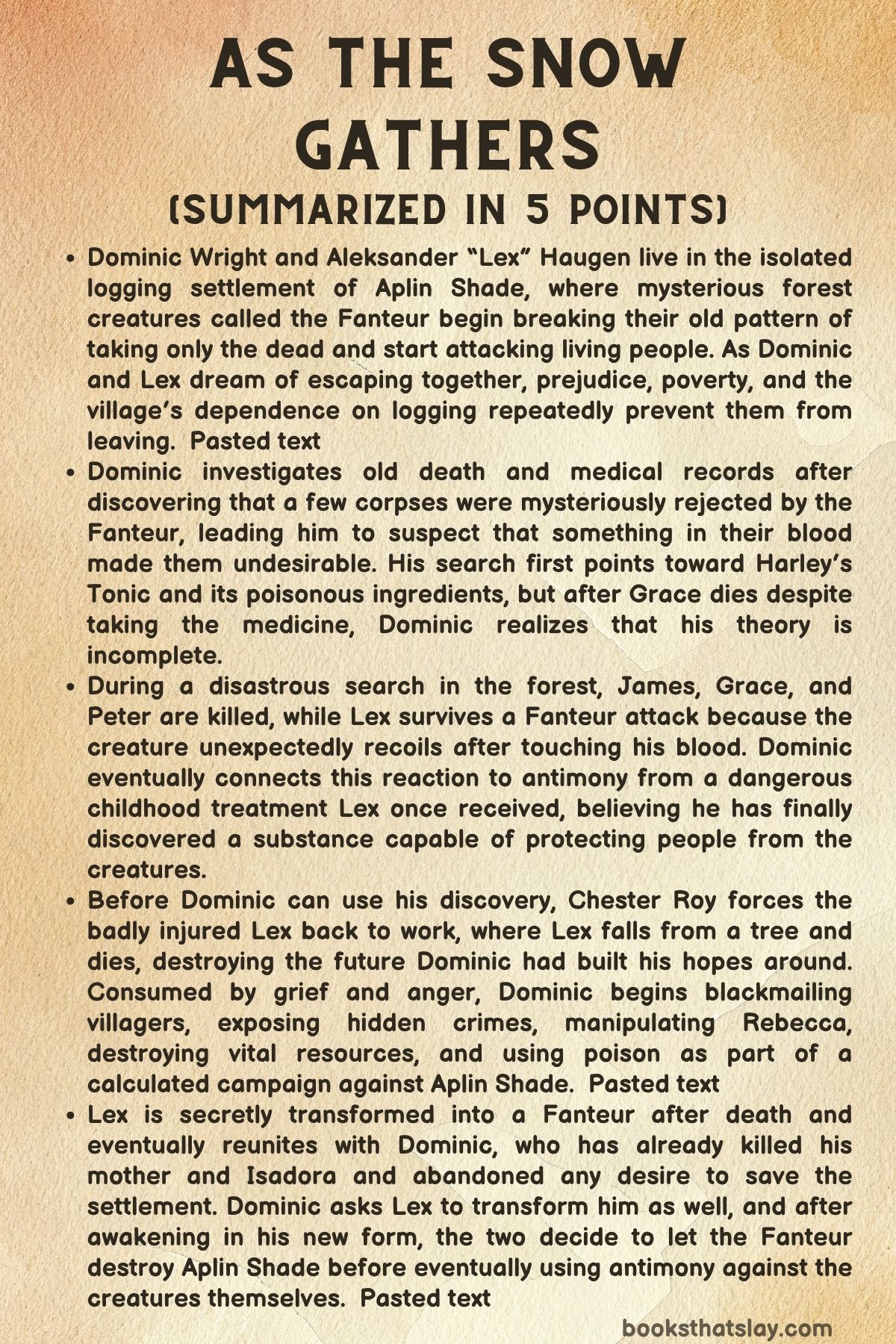
Set in the isolated logging settlement of Aplin Shade, the story follows young barrister Dominic Wright and logger Aleksander “Lex” Haugen as the forest creatures known as the Fanteur abandon their old rules and begin attacking the living. What initially appears to be a struggle against supernatural predators gradually becomes a darker examination of a community already damaged by cruelty, greed, secrets, and intolerance. Dominic’s search for a means of survival ultimately changes into a campaign of revenge after the future he hoped to share with Lex is destroyed.
Summary
Eighteen-year-old Dominic Wright lives in Aplin Shade, an isolated settlement surrounded by a forest inhabited by mysterious creatures called the Fanteur. For years, the creatures have followed an unsettling but predictable pattern: they take the bodies of people who have already died, drain their blood, and eventually return what remains, but that uneasy arrangement begins to collapse when logger Auguste disappears and fragments of his bones fall from a clear sky like snow.
Lex Haugen, Dominic’s secret lover, is among the men who recognize that something has changed. The possibility that the Fanteur have begun killing living people terrifies Dominic, especially because he and Lex have been planning to leave Aplin Shade and build a life together somewhere they can live openly, but poverty and responsibility for Dominic’s mother and traumatized sister Isadora have continually delayed their escape.
At a village meeting, Lex argues that the increased violence may be connected to the logging camp’s destruction of the forest. Foreman Chester Roy refuses to stop cutting trees because timber supports Aplin Shade’s economy, and the gathering quickly exposes the divisions already poisoning the settlement as frightened villagers attack the loggers and condemn Dominic and Lex’s relationship rather than seriously confronting the danger.
Dominic begins searching the abandoned village archives for answers. Aplin Shade itself contains an unresolved mystery because its present residents arrived roughly twenty years earlier and discovered an already built, prosperous settlement whose original inhabitants had vanished, leaving behind houses, supplies, and an operating logging camp as though everyone had disappeared at once.
The Fanteur’s behavior continues changing. Parkinson’s horses are horribly mutilated and later taken, an entire logging sleigh disappears, and the creatures move closer to inhabited areas, while Roy keeps sending workers into the forest and uses Dominic and Lex’s forbidden relationship to control Lex by repeatedly reducing his wages whenever he discovers Dominic staying in his cabin.
Dominic’s investigation becomes more focused when he studies the village death ledger and discovers that Lionel Pollett was buried intact even though almost every corpse available to the Fanteur had been taken. He later finds a second exception, Sheridan Crofthouse, whose dead infant was taken while Sheridan herself remained in the grave, suggesting that the creatures selectively rejected certain bodies rather than simply overlooking them.
When Sampson Rodin attempts to determine whether the southern road remains usable, the Fanteur kill him within hours. Dominic finds evidence of his death near the cemetery and also witnesses pieces of the iron fence vanishing, forcing him to understand that the creatures can approach unnoticed and that Aplin Shade may already be surrounded.
Lex suggests that the two rejected corpses may have contained something unusual in their blood. Since the Fanteur consistently drain blood from the dead, Dominic reasons that identifying whatever made Pollett and Sheridan undesirable might provide a way to protect himself, Lex, and perhaps others.
Medical records reveal that both Pollett and Sheridan had been “referred to H.T.,” which Dominic eventually learns means Harley’s Tonic. The old medicine contained turpentine, honey, salt, cloves, and arsenic, leading Dominic to suspect that one of its poisonous ingredients had altered their blood enough to repel the creatures.
His theory receives a terrible test after James Kealey disappears in the woods. Grace Kealey, James’s pregnant wife, joins the search, and Dominic gives her Harley’s Tonic in the hope that it will protect her; instead of taking a small amount, she drinks the entire bottle before entering the forest with Lex, Peter, and the other searchers.
Dominic eventually follows and becomes separated near the road where his father Jeremiah died years earlier in a carriage crash. Seeing a Fanteur clearly for the first time makes him reconsider that accident and understand that the creature may have frightened the horses, while its grotesque mixture of human flesh, tree matter, and tools also explains the strange tree-like figures Isadora has drawn ever since surviving the crash.
The search party soon confronts transformed versions of Parkinson’s dead horses pulling the stolen logging equipment. James has already been killed, Grace dies despite consuming the tonic, and Peter is slaughtered while attempting to escape, proving that Dominic’s arsenic-and-turpentine theory offers no meaningful protection.
Lex saves Dominic during the attack but receives a deep wound across his shoulder. When the Fanteur touches him, however, it suddenly recoils and retreats instead of killing him, giving Dominic a far more important clue than anything he has learned from the old medical records.
Back at camp, Dominic remembers that Lex survived yellow fever as a child and was treated with dangerous medicines that nearly killed him. One of those medicines contained antimony, a substance capable of killing parasites and pests, and Dominic theorizes that some lasting effect of that treatment has made Lex’s blood harmful to the Fanteur.
The discovery comes too late. Roy orders the seriously injured and exhausted Lex back to work, and Lex falls from a tree, crushing his skull; after Dominic spends hours grieving beside the body, the Fanteur take it, leaving him without even the comfort of a burial.
Lex’s death destroys Dominic’s original reason for investigating the creatures. He had wanted knowledge so that he and Lex could survive, escape, establish a farm, and rescue Dominic’s family, but without Lex he no longer sees survival as a meaningful goal and begins converting everything he has learned about Aplin Shade into weapons against the people he blames for destroying their future.
Unknown to Dominic, Lex has not vanished completely. The Fanteur transform his corpse by inserting bark into his shattered skull, and he awakens in a new state between human and creature; his unusual blood prevented the normal process, but his catastrophic head wound allowed the creatures to remake him in another form.
Dominic meanwhile begins forging Lex’s handwriting and sending blackmail letters to residents whose secrets he has learned during years of quiet observation. Rebecca Gagnesy, who is attracted to Dominic and equally desperate to leave the settlement, becomes useful to him, and he deliberately encourages her belief that the two of them will escape together.
Further examination of medical records suggests that Dr. Gagnesy and other practitioners may have deliberately caused numerous deaths through Harley’s Tonic. Dominic obtains a stronger arsenic preparation from the corrupt pharmacist Albert Grant and prepares to punish not merely individuals but the entire network of people and institutions that allowed exploitation, violence, and secrecy to flourish.
He blackmails Pastor Marrow over stolen church money while pretending to cooperate with Marrow’s planned marriage to Isadora. Dominic despises the pastor’s assumption that Isadora can simply be handed into marriage despite her trauma and limited ability to communicate her wishes, and he determines that the future others have selected for his sister will never happen.
Dominic then systematically dismantles parts of Aplin Shade. He destroys Grant’s medical stock, drugs Parkinson with a chemically treated silver tray, and exposes the buried bodies of two orphaned apprentices whose deaths Parkinson concealed years earlier, allowing long-hidden crimes to become visible at precisely the moment the settlement is already collapsing.
At the logging camp, Dominic lights candles inside the cabins of dead workers and terrifies Roy by imitating Lex’s distinctive knock. Roy discovers that something has carved a snowflake-shaped mark into his cheek while he slept, revealing that Dominic is no longer acting alone and that another presence is moving through the settlement.
Rebecca meets Dominic with a buggy believing they are finally escaping together. She has already poisoned her father at Dominic’s request, demonstrating how far she is prepared to go for freedom, but Dominic reveals that the money he collected through blackmail was never meant to finance their future and throws it into a fire in the forest.
The corpse burning there is Dominic’s mother. He admits that he poisoned her and later reveals that he strangled Isadora when she refused poisoned tea, placing his sister in lye so that the Fanteur could never consume or transform her; his supposed effort to save his family has become inseparable from his belief that death is preferable to allowing Aplin Shade or the creatures to control them.
Rebecca attempts to flee, but an unseen axe cuts the horses free before striking and decapitating her. Soon afterward, Dominic finally encounters the transformed Lex, whose damaged body now contains bark and other unnatural growth while retaining the identity, memory, and love that defined him in life.
Dominic realizes that the Fanteur plan to destroy Aplin Shade slowly by removing transportation, food, medicine, equipment, and security rather than simply killing everyone at once. He no longer wants to prevent the settlement’s destruction and asks Lex to transform him as well, choosing death and reunion over continuing a human existence in which every future he once valued has disappeared.
Lex kills Dominic by piercing his throat and places Fanteur bark into the wound. Dominic later awakens transformed, able to touch Lex again without causing him pain, while screams begin rising from Aplin Shade as the creatures continue their retaliation.
Their alliance with the Fanteur is only temporary. Dominic still possesses the antimony stolen from Grant’s shop, and the two men plan to let the creatures destroy the settlement before eventually turning their knowledge against the Fanteur themselves, replacing the peaceful escape they once imagined with an existence defined by devotion, vengeance, and the possibility of war against both the human community and the forest that remade them.
Characters
Dominic Wright
Dominic is the central consciousness of As the Snow Gathers, beginning as an intelligent but anxious young barrister who has inherited responsibilities far beyond his emotional or financial readiness. He wants to replace the security lost with his father’s death, support his mother and Isadora, earn enough money to escape Aplin Shade, and build a private future with Lex.
His greatest early limitation is fear rather than lack of intelligence. Dominic dislikes confrontation, hesitates when others act, and regularly undervalues his own ability to notice patterns, yet his investigation of the death ledger proves that his habit of carefully observing details is one of the most powerful abilities possessed by anyone in the village.
Lex’s confidence gradually gives Dominic permission to trust his own reasoning. The connection between the untouched corpses, Harley’s Tonic, the Fanteur’s feeding habits, and eventually antimony demonstrates a mind capable of turning scattered historical, medical, and physical clues into increasingly sophisticated theories.
Dominic’s transformation after Lex dies is moral as much as emotional. Grief releases the resentment he has accumulated toward Roy, Parkinson, Marrow, Grant, Rebecca, and a settlement that demanded silence from him while allowing cruelty to pass as normal social order.
His revenge therefore has both understandable and horrifying dimensions. Exposing Parkinson’s buried victims and destroying Grant’s corrupt business can resemble justice, but murdering his own mother, strangling Isadora, manipulating Rebecca into patricide, and arranging conditions that will make Aplin Shade’s destruction worse demonstrate that Dominic eventually stops distinguishing between liberation, punishment, and annihilation.
By the ending, his physical transformation into a Fanteur completes an internal process already underway. Dominic chooses a form of existence that preserves his bond with Lex while abandoning the moral boundaries that defined his earlier human life, leaving him simultaneously liberated from Aplin Shade and permanently shaped by everything the village took from him.
Aleksander “Lex” Haugen
Lex is the emotional center of As the Snow Gathers and the person who most consistently treats Dominic as capable, desirable, and worthy of a future. His physical size and strength make him appear formidable to outsiders, but his private relationship with Dominic reveals patience, tenderness, insecurity about reading, memories of childhood loss, and a deep desire to create a stable home.
His refusal to leave Aplin Shade without Dominic defines his loyalty. Dominic repeatedly urges him to save himself while escape still appears possible, but Lex refuses to treat survival as worthwhile if it requires abandoning the person with whom he wants to share his life.
Lex also possesses practical insight that complements Dominic’s intellectual habits. When Dominic discovers the unusual ledger entries, Lex does not dismiss them as clerical accidents and instead urges him to continue, later suggesting that the difference may lie in the victims’ blood.
His death is especially cruel because the Fanteur fail to kill him when given the opportunity. Roy’s exploitation succeeds where the monsters do not, since forcing an injured Lex back into dangerous labor leads directly to the fatal fall that destroys Dominic’s remaining faith in the village.
Transformation allows Lex to survive in a distorted sense without erasing his essential identity. He retains his love for Dominic, communicates with him through dreams, assists in the revenge taking shape around Aplin Shade, and ultimately gives Dominic the same unnatural continuation of life that he received.
Isadora Wright
Isadora is one of the most tragic figures in As the Snow Gathers because much of what others interpret as weakness or instability originates in trauma they never properly understand. The carriage accident that killed her father exposed her directly to the Fanteur, and her repeated tree-like drawings become an indirect record of what she saw but could not explain.
Her limited speech and violent responses to touch leave her dependent on relatives and vulnerable to decisions made without her meaningful consent. Dominic recognizes this more clearly than his mother, particularly when Pastor Marrow begins treating marriage to Isadora as an expected arrangement rather than a choice requiring her participation.
Isadora therefore embodies the consequences of being denied control over one’s own life. Even Dominic, who genuinely wants to protect her, eventually becomes another person who makes an irreversible decision on her behalf when he kills her rather than allow her to face the future he believes awaits the family.
Her death demonstrates the complete collapse of Dominic’s protective instincts. The brother who once dreamed of taking her somewhere safer convinces himself that murder is the final form of protection, exposing how thoroughly grief and despair have corrupted his understanding of love.
Rebecca Gagnesy
Rebecca occupies an increasingly ambiguous position in As the Snow Gathers, beginning as an intelligent young woman who shares Dominic’s dissatisfaction with Aplin Shade and helps him gain access to information he could not otherwise obtain. Her interest in medical matters and her connection to her father’s records make her essential to Dominic’s investigation.
She also longs for escape with an intensity similar to Dominic’s earlier desire to leave with Lex. That similarity initially creates a degree of understanding between them, although Rebecca’s romantic interest complicates matters once she realizes that Dominic and Lex are far more intimate than she believed.
After Lex’s death, Dominic deliberately exploits Rebecca’s attraction and desperation. He encourages her to imagine a shared future and eventually tests the limits of her loyalty by asking her to poison her father, which she does because she believes the murder will clear the way for their escape.
Rebecca is neither innocent nor entirely responsible for the role she plays in Dominic’s plan. Her willingness to kill reveals serious moral compromise, but Dominic consciously manufactures the circumstances in which her worst impulses become useful to him and then condemns her for actions he encouraged.
Her decapitation completes the destruction of the false future Dominic offered her. She becomes another example of the story’s bleak idea that desperation for escape can turn into self-destruction when people begin treating every moral boundary as an obstacle.
Chester Roy
Chester Roy represents institutional cruelty in As the Snow Gathers because his authority allows him to convert prejudice and economic dependence into practical control over other people. He repeatedly reduces Lex’s wages because of Dominic’s visits, knowing that the couple cannot resist without endangering their already limited chance of leaving.
Roy’s defining characteristic is his refusal to value human life above production. Even as the Fanteur escalate from taking corpses to killing living people and animals, he keeps the logging operation active because timber and profit remain his priorities.
His decision to send Lex back to work after the forest attack is the clearest expression of that mentality. Lex is wounded, exhausted, and medically unfit for dangerous labor, yet Roy ignores Rebecca’s recommendation that he rest, leading directly to Lex’s fatal fall.
Dominic therefore sees Roy as more than an unpleasant employer. He becomes proof that ordinary human systems can produce consequences as monstrous as anything in the forest, which explains why terrifying Roy becomes one of Dominic’s most personally satisfying acts of revenge.
Mrs. Wright
Dominic’s mother is a weary woman who has survived her husband’s death, financial instability, her daughter’s lasting trauma, and the growing supernatural danger surrounding Aplin Shade. She depends heavily on Dominic even while continuing to accept many of the village’s conventional assumptions.
Her response to Isadora’s proposed marriage illustrates this limitation. She treats marriage to Pastor Marrow as a reasonable future for her daughter without fully confronting Isadora’s inability to participate freely in that decision.
She is nevertheless not portrayed as malicious. Her failures arise largely from exhaustion, conformity, and a need to believe that ordinary social structures can still protect the family even after those structures have repeatedly failed them.
Dominic’s decision to poison her marks the point at which his protection becomes indistinguishable from domination. He convinces himself that death will spare her from the forest and from what Aplin Shade is becoming, but he denies her the same agency that he resents others for denying his family.
Henley Parkinson
Henley Parkinson is one of the clearest human antagonists in the novel. He exploits public fear by selling useless charms against the Fanteur, attacks the loggers through racist and homophobic abuse, and uses violence or intimidation whenever his authority is challenged.
His history with Peter and Dominic establishes that this behavior existed long before the supernatural crisis. Parkinson had already demonstrated brutality, greed, and a willingness to exploit vulnerable people, meaning the worsening danger simply gives him a larger audience for qualities he already possessed.
The discovery beneath his horse stalls reveals the full extent of his violence. Two orphaned apprentices died under his care, one through an accident and the second through Parkinson’s own actions, after which he concealed both bodies and invented a story that they had run away.
Dominic’s revenge against Parkinson differs from his treatment of several other targets. Rather than killing him immediately, he exposes the buried evidence and leaves him alive to face the public discovery of a crime he successfully concealed for years.
Peter
Peter is part of the small circle that gives Dominic and Lex an experience of chosen family. His humor, companionship, and willingness to accept their relationship provide a sharp contrast to the hostility found elsewhere in Aplin Shade.
His hatred of Parkinson has personal roots because Parkinson once assaulted him badly enough to cost him teeth. That history gives Peter’s anger a seriousness beneath the joking manner he often displays around the other loggers.
Peter’s death during the forest attack is devastating because it eliminates one of the few people with whom Dominic and Lex can live without disguise. The loss contributes to Dominic’s later conviction that nearly everything decent within Aplin Shade has already been destroyed.
James Kealey
James represents ordinary companionship and domestic possibility. His marriage to Grace is something Dominic quietly envies because James can openly show affection toward the person he loves without facing the punishment or secrecy imposed on Dominic and Lex.
His disappearance drives the group into the forest and begins the massacre that destroys Dominic and Lex’s chosen family. By the time the others find him, the Fanteur have already killed him, demonstrating how rapidly the creatures’ behavior has changed.
James also matters because his death destroys the future Grace was expecting with their unborn child. The tragedy turns the forest attack from a threat to individual workers into the destruction of an entire household.
Grace Kealey
Grace combines warmth, courage, practical intelligence, and fierce loyalty. She accepts Dominic and Lex without the judgment common elsewhere in the settlement, helping create the campfire community in which Dominic briefly experiences a sense of belonging.
Her pregnancy gives her decision to enter the forest particular weight, but she refuses to accept the argument that staying behind is automatically safer. If James dies, she knows she and her child could be left without economic security, making her decision an expression of how limited the choices available to working people in Aplin Shade have become.
Grace also becomes the tragic test case for Dominic’s first chemical theory. By drinking the entire bottle of Harley’s Tonic and dying anyway, she proves that arsenic and turpentine are not what caused the Fanteur to recoil from Lex.
Her death therefore has both emotional and investigative consequences. Dominic loses a friend while simultaneously being forced to abandon a theory he desperately hoped would save everyone.
Pastor Marrow
Pastor Marrow uses religion less as a source of compassion than as a means of reinforcing social authority. His earlier sermon condemning sexual behavior while deliberately focusing on Dominic demonstrates how easily spiritual language becomes a mechanism for humiliation.
His planned marriage to Isadora intensifies Dominic’s hostility. Marrow talks about the household he expects to establish without seriously considering whether Isadora has the emotional capacity or freedom to consent to the role he has designed for her.
The discovery that he has also misused church money exposes the gap between his public morality and his private conduct. Dominic’s blackmail succeeds because the pastor who condemns others is himself dependent on secrecy.
Marrow therefore helps explain Dominic’s rejection not merely of individuals but of Aplin Shade’s entire moral order. Institutions that claim to protect virtue repeatedly conceal selfishness, coercion, and hypocrisy.
Dr. Gagnesy
Dr. Gagnesy initially exists mostly through Rebecca’s comments and the old medical records, but his importance grows as Dominic uncovers the history of Harley’s Tonic. The repeated connection between suspicious deaths and treatments associated with him suggests that his medical authority may have concealed deliberate killing.
The possibility that as many as twenty-five deaths were connected to him and other practitioners changes the meaning of Aplin Shade’s past. The village’s danger did not begin when the Fanteur changed their behavior; human beings had already been capable of quietly killing the vulnerable behind respectable professional roles.
Rebecca eventually poisons her father at Dominic’s request. His death therefore becomes both punishment for suspected crimes and evidence of how thoroughly Dominic can manipulate another person’s desire for escape.
Albert Grant
Albert Grant is a corrupt pharmacist whose behavior demonstrates the dangers of indifference disguised as professional service. He dilutes medicines, overcharges customers, treats poor patients and loggers dismissively, and discusses powerful poisons with an astonishing lack of responsibility.
Grant provides Dominic with crucial information about Harley’s Tonic and later supplies concentrations strong enough to kill. He does not need to understand Dominic’s exact intentions because profit and personal detachment matter more to him than the possible consequences.
Destroying the apothecary is consequently both personal revenge and strategic sabotage. Dominic punishes Grant while also depriving the larger community of medical supplies at the worst possible moment.
Jeremiah Wright
Jeremiah Wright is dead before the central events begin, yet his absence shapes nearly every part of Dominic’s life. Dominic has inherited his legal responsibilities, his study, the burden of supporting the household, and unresolved memories of the carriage accident that killed him.
For years, Dominic understands the crash largely through Jeremiah’s drinking. Later evidence suggests that the Fanteur may have deliberately frightened the horses, transforming the accident from a purely human failure into an early sign of the conflict developing between the settlement and forest.
Jeremiah’s death also marks the beginning of Isadora’s severe trauma and Dominic’s premature adulthood. His legacy is therefore less about who he was personally than about the responsibilities and unanswered questions left behind.
Sampson Rodin
Sampson Rodin volunteers to test whether the road south remains open, making him one of the few residents willing to take direct action when the village debates without reaching useful solutions. His journey briefly represents the possibility that escape may still exist.
His rapid death destroys that hope. The discovery of his clothing among fresh Fanteur remains shows that the creatures can find and kill a traveler with frightening speed.
Sampson’s fate changes the psychological geography of Aplin Shade. The forest is no longer simply dangerous territory around the settlement; it has become a barrier capable of trapping everyone inside.
Auguste
Auguste functions as the first unmistakable sign that the old arrangement with the Fanteur has ended. His disappearance and the fragments of his body falling through the forest demonstrate that the creatures may now be killing healthy living people rather than waiting for natural or accidental death.
Although he has little direct presence, his fate begins the crisis that reorganizes the entire settlement. Every later argument about logging, escape, defense, and blame originates in the terrifying implication of what happened to him.
Lionel Pollett and Sheridan Crofthouse
Lionel Pollett and Sheridan Crofthouse are dead historical figures, yet their unusual medical histories become essential to Dominic’s search for survival. Both appear to have been available to the Fanteur after death but were left untouched.
Their cases teach Dominic that the creatures make choices based on some property of the body rather than following an absolute supernatural rule. That realization allows him to move from fear toward investigation.
The connection between both individuals and Harley’s Tonic initially leads Dominic toward arsenic and turpentine. Although that theory proves incomplete, their unexplained survival from postmortem consumption establishes the method of reasoning that eventually points him toward antimony.
The Benit Brothers
The Benit brothers occupy a relatively small role but help establish Dominic’s economic circumstances at the beginning of the story. Their property dispute represents the ordinary legal work from which he desperately hopes to earn enough money to support his household and finance an escape.
His inability to turn such cases into meaningful security shows how little power his profession actually gives him. Dominic may hold the title of barrister, but poverty continues to determine where he can live, what risks Lex must take, and how difficult leaving Aplin Shade remains.
Themes
Love, Devotion, and the Corruption of Protection
Love provides the strongest source of meaning in As the Snow Gathers, particularly through Dominic and Lex, whose private relationship offers both men a refuge from the hostility surrounding them. Their dream of owning a farm is modest, but it represents freedom from secrecy, wage exploitation, social judgment, and the constant need to justify their right to remain together.
That devotion also contains the possibility of destruction once grief removes the future toward which it had been directed. Dominic begins by trying to protect Lex, his mother, and Isadora, but after Lex dies he increasingly interprets protection as the right to make irreversible decisions for other people.
His murders of his mother and Isadora reveal the darkest version of that impulse. Dominic believes he is saving them from the Fanteur and the collapse of Aplin Shade, yet his actions deny them choice in exactly the way he condemns Pastor Marrow and others for denying Isadora control over her own future.
Lex’s love follows a different path but ultimately supports Dominic’s transformation. He returns to Dominic through dreams, helps facilitate revenge, kills him at his request, and gives him another existence, turning their romance from a hope of ordinary human freedom into a bond that survives through monstrosity.
The novel therefore refuses to present love as automatically moral. Love can give people courage, purpose, identity, and belonging, but when combined with grief, fear, and possession it can also become a justification for acts that would once have seemed unthinkable.
Prejudice, Power, and Social Hypocrisy
Aplin Shade is already dangerous before the Fanteur begin openly killing people because its social order depends upon unequal power. Dominic and Lex must hide much of their relationship, Roy can financially punish Lex for private behavior, Pastor Marrow can publicly shame Dominic through religious authority, and Parkinson can direct communal fear toward people who are already treated as outsiders.
These forms of prejudice are not merely offensive attitudes. They have material consequences because Lex loses wages, Dominic becomes more isolated, the loggers are treated as expendable, and meaningful cooperation becomes almost impossible at the precise moment when collective action is most necessary.
Hypocrisy repeatedly strengthens that pattern. Marrow presents himself as a guardian of morality while apparently stealing church money, Grant occupies a medical role while casually facilitating dangerous poisoning, and the historical evidence surrounding Dr. Gagnesy suggests that professional respectability may have concealed murder.
The community’s obsession with assigning blame also prevents it from responding intelligently to the forest. Instead of considering Lex’s warning that logging might be provoking the Fanteur, residents turn against outsiders and one another.
Dominic’s revenge grows from this environment because he has spent years watching respectable people hide ugly truths. Once he decides that Aplin Shade deserves destruction, the secrets he once kept become tools, showing how a culture sustained by silence eventually produces the knowledge used against it.
Environmental Destruction and Retaliation
The conflict at the center of As the Snow Gathers is inseparable from the destruction of the forest. Lex recognizes earlier than most residents that expanding logging may have transformed the Fanteur from creatures willing to tolerate human settlement into active enemies willing to kill, steal, transform bodies, and remove every means of escape.
The Fanteur are horrifying, but their violence is not completely random. They have existed beside the settlement for years under a disturbing but limited arrangement, taking blood from the dead while generally leaving the living alone until continued logging disrupts that balance.
Their later strategy resembles deliberate retaliation rather than uncontrolled predation. They steal tools, vehicles, animals, food-related resources, and transportation, gradually making Aplin Shade less capable of sustaining itself and suggesting an intelligence focused on dismantling the human occupation.
The transformed bodies of horses and people further collapse the separation between forest, machinery, animal life, and human industry. Creatures made from flesh, bark, metal, and tools visually reflect a conflict in which natural and manufactured forms have become violently fused.
Yet the story does not turn the Fanteur into simple defenders of nature. They kill innocent people along with the guilty and treat human bodies as resources, which prevents environmental retaliation from becoming moral purity.
Instead, the conflict shows what happens when a community assumes that economic need grants unlimited permission to consume its surroundings. Roy’s insistence on continuing production despite repeated warnings ensures that exploitation continues until both the forest and the settlement are transformed beyond recognition.
Grief, Revenge, and Moral Transformation
Dominic’s grief provides the dividing line between the person he hoped to become and the person he eventually chooses to be. Before Lex’s death, fear repeatedly limits Dominic, but his goals remain constructive: escape, safety, family stability, intellectual understanding, and a shared home.
Lex’s death destroys those goals at the exact moment Dominic believes he has discovered a means of protection. The cruelty lies not only in losing Lex but in understanding that Roy’s decision forced the death after the Fanteur themselves had failed to kill him.
Revenge consequently gives Dominic a replacement purpose. He begins forging handwriting, collecting secrets, blackmailing neighbors, manipulating Rebecca, poisoning people, exposing murders, destroying medical supplies, and cooperating with the same creatures he once hoped to resist.
Some of his actions genuinely expose wrongdoing. Parkinson’s hidden victims deserve recognition, Grant’s corruption is real, Roy’s treatment of Lex is indefensible, and the evidence surrounding the village’s medical history suggests serious crimes.
The moral difficulty comes from Dominic’s refusal to preserve distinctions between guilty and innocent once revenge becomes his organizing principle. He kills members of his own family, knowingly worsens conditions for the entire settlement, and accepts the deaths that will follow because suffering itself has become evidence of justice in his damaged understanding.
His eventual transformation into a Fanteur makes this psychological change literal. Dominic does not simply lose his humanity through supernatural means; he first abandons many of its moral restraints by deciding that pain gives him the authority to determine who deserves life, death, punishment, or transformation.
The ending leaves revenge deliberately unresolved rather than victorious. Dominic and Lex plan to turn against the Fanteur after Aplin Shade falls, suggesting that vengeance has become a continuing mode of existence in which each defeated enemy merely creates the conditions for another war.