Blue Jean Summer Summary, Characters and Themes
Blue Jean Summer by Maggie Gates is a contemporary romance about grief, family legacy, personal independence, and a marriage of convenience that gradually becomes genuine.
Hayes Wilder needs a wife to protect the family estate from his ambitious half brother, while Catherine Foster needs a secure future and a place to build the educational program she has long imagined. Their agreement appears practical at first, but living together forces both of them to confront old wounds, fears, and ideas about love. What begins as a legal arrangement becomes a story about choosing partnership freely rather than staying together because circumstances demand it. It’s the 1st book in the Wilder Estate series.
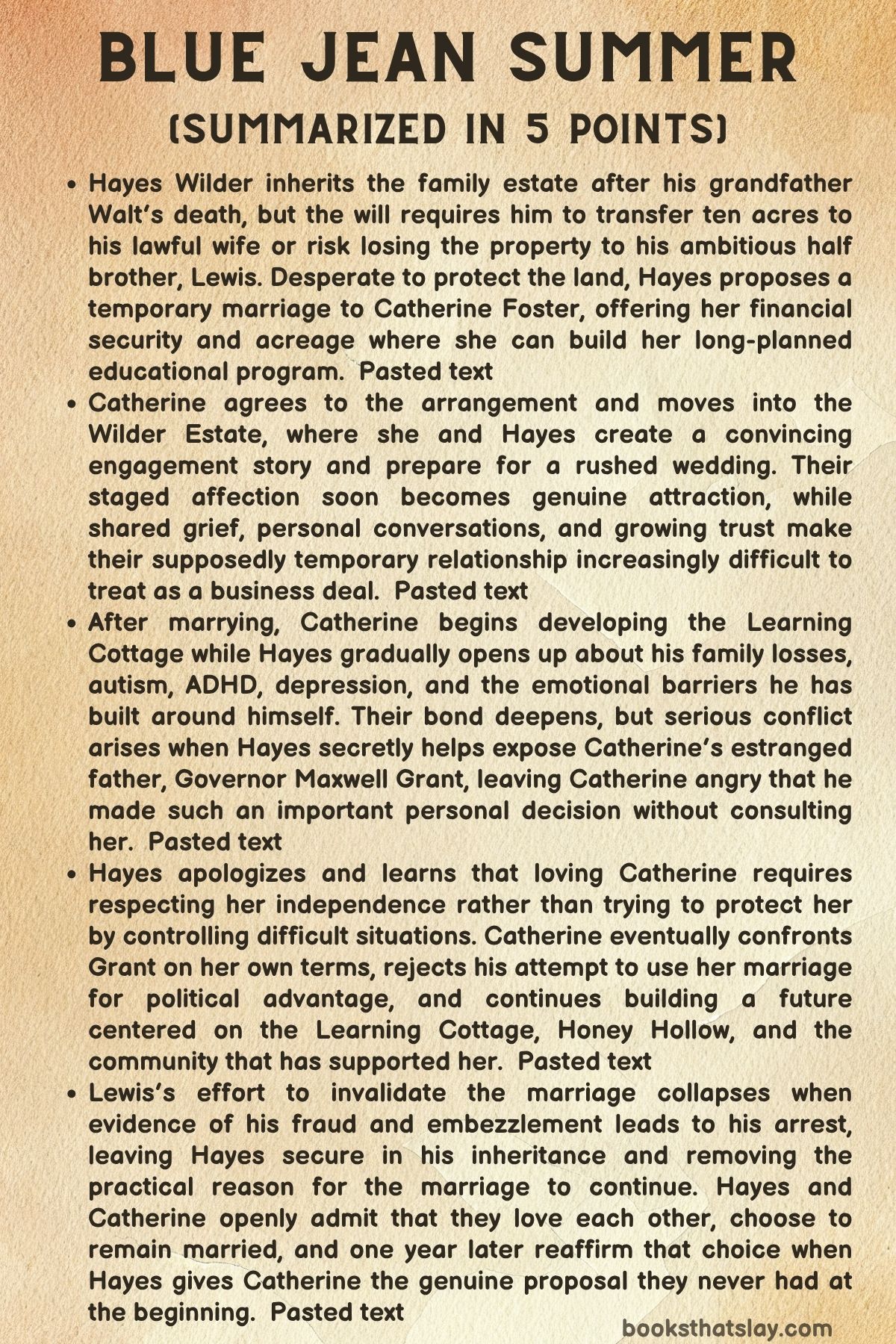
Summary
Hayes Wilder returns to the Wilder Estate for the funeral of his grandfather Walt carrying years of unresolved grief. His parents died when he was young, his grandmother is gone, and Walt represented the final surviving connection to the stable family life Hayes remembers, so the funeral leaves him confronting both loss and his longstanding belief that loving people eventually means losing them.
At the funeral, Hayes unexpectedly sees Catherine Foster, a childhood acquaintance who once visited the estate and remained close to Walt. Catherine is now Miss Virginia, and although years have passed since Hayes last saw her, her warmth immediately comforts him during a day he has otherwise spent trying to avoid his emotions.
Walt’s will creates an immediate crisis. Almost the entire estate passes to Hayes, but he can inherit it only if at least ten acres are transferred to his lawful wife, while failure to meet the conditions could allow Hayes’s half brother Lewis to obtain the property.
Lewis has already been appointed head of the Wilder Foundation and makes no attempt to conceal his resentment. Fearing that Lewis would eventually sell or misuse the land Walt spent his life protecting, Hayes impulsively announces that he is engaged even though he has no fiancée.
Catherine is facing difficulties of her own. Her mother has recently died, she has lost her nonprofit job, her finances have been badly damaged by medical expenses and pageant obligations, and a television opportunity she hoped might improve her situation has disappeared.
She still has one major ambition: creating an educational initiative that gives children practical experience with agriculture, gardening, ranching, animals, and rural life. Catherine had previously applied unsuccessfully for help from the Wilder Foundation, but she never asked Walt personally because she wanted her project to succeed on its own merits rather than through charity.
After considering his limited options, Hayes realizes Catherine may be the one person capable of making his invented engagement believable. He invites her to lunch and eventually proposes a contractual marriage in which she will receive monthly payments, live at the estate without expenses, remain married long enough for the inheritance to become secure, and later seek an annulment.
Catherine initially resists, but Hayes offers something far more meaningful than money. The ten acres required by Walt’s will can become Catherine’s permanent property, providing a home for her educational program and giving her the opportunity to turn an uncertain dream into a real institution.
Catherine eventually agrees and moves into the estate. Hayes gives her the engagement ring worn by generations of Wilder women, and together they invent a story explaining their supposed private proposal, but the intimacy required to convince Lewis quickly begins creating feelings neither of them expected.
Their engagement becomes public, photographs are taken, wedding preparations begin, and what should be an artificial courtship starts resembling a genuine relationship. A supposedly practical rehearsal kiss becomes passionate, ordinary wedding errands begin feeling like dates, and both Hayes and Catherine become increasingly aware that their attraction exists even when nobody is watching.
Catherine also insists that their arrangement must be a partnership rather than something Hayes controls. This becomes especially important because Hayes is accustomed to solving problems alone, while Catherine has spent much of her life having other people decide what she should become.
Her deepest source of emotional pain involves her father, Governor Maxwell Grant. Catherine is the product of his affair with her mother, and although her mother spent years hoping he would eventually acknowledge their daughter, Grant remained distant, leaving Catherine to believe that enough accomplishment might someday make her worthy of being publicly claimed.
Hayes contacts Grant about the wedding, and Grant initially agrees to participate. Catherine is thrilled because she interprets his decision as the acknowledgment she has wanted for most of her life, while Hayes privately knows that political calculation played a large role in convincing him.
At the same time, Hayes begins revealing more of himself. He explains the loss of his parents, his attachment to the landscape around the estate, and the ways grief has influenced his decisions, including his previous engagement to Lynn, which he now recognizes was based largely on fear and a desire for security.
As the wedding approaches, Catherine chooses a gown inspired by Hayes’s grandmother Mildred, and her growing emotions become harder to deny. Hayes likewise begins realizing that Catherine has transformed both his relationship with the estate and his beliefs about marriage, home, and emotional vulnerability.
On the wedding day, Hayes formally gives Catherine the ten acres, including an old cabin that can become the headquarters of her educational program. He also privately promises to support her ambitions, care for her interests, and treat her as an equal, even though neither of them is yet prepared to call their relationship love.
Catherine then learns that Grant has canceled and will not walk her down the aisle. Mason Bishop steps in to escort her, and the wedding proceeds despite Lewis publicly objecting to the marriage.
Hayes surprises Catherine with the expensive wedding band she had admired but refused to buy, and their ceremony increasingly feels like a real commitment rather than a performance. At the reception, Lewis reveals that he has married as well, hoping to satisfy the inheritance conditions if he can invalidate Hayes’s marriage.
Hayes gives Catherine a restored 1965 candy-apple-red Mustang, the car she once described as her dream vehicle. Lewis’s decision to remain at the estate then forces the newlyweds into closer quarters, but on their wedding night they finally admit that their desire for one another exists independently of appearances.
Their physical relationship is followed by deeper emotional trust. When Catherine later mistakes Hayes’s overwhelmed reaction for regret, he explains that he is autistic and also manages ADHD and depression, telling her how routines, medication, preparation, and masking help him navigate situations that can otherwise become exhausting.
Catherine responds with acceptance rather than judgment. Their relationship grows increasingly domestic as she develops the Learning Cottage on her property, rescues an abandoned calf named Dorothy, collaborates with educators and agricultural organizations, and begins imagining a permanent future at the estate.
Hayes becomes troubled by the possibility that Catherine’s project might remain while their marriage ends. During a private ride, he tells her that unlike the people he associates with grief and memory, Catherine is someone he has found without first losing, revealing in indirect language how deeply he has come to love her.
Their relationship suffers its greatest rupture when Hayes decides to expose Governor Grant. While attending a conference in Washington, he gathers evidence from women accusing Grant of coercion and misconduct and helps place that information where it can become public.
Hayes believes he is defending Catherine, but he never asks what she wants. Catherine is furious because, despite Grant’s failures, her relationship with him was hers to confront, and Hayes has repeated the same pattern she has struggled against throughout her life by making a life-changing decision on her behalf.
She removes her wedding band and leaves Hayes’s bedroom. When Hayes apologizes, Catherine makes clear that love cannot survive without autonomy, equality, and trust, and she tells him that being protective does not give him the right to control her choices.
Hayes finally admits that his feelings and wedding promises were genuine. Catherine discovers that he has even gotten a tiny tiara tattoo beneath his wedding ring, and although the gesture does not erase the conflict, they begin rebuilding their relationship with clearer boundaries.
Grant eventually calls Catherine and finally acknowledges her as his daughter, but his motives prove selfish. He wants Catherine and Hayes to appear publicly beside him so their reputation can help rescue his political career, and he even attempts to use financial support for her program as leverage.
This time Catherine makes the decision herself. She rejects Grant, tells him not to contact her again, and mourns not only the father she actually had but the father she spent twenty-five years hoping he might someday become.
Hayes simply supports her rather than directing her response, demonstrating that he has understood the lesson their conflict forced him to learn. Their reconciliation deepens, and they finally acknowledge that the marriage they invented now feels entirely real.
Meanwhile, Catherine’s Learning Cottage succeeds beyond her expectations. Grants, donations, community partnerships, rescued animals, and support from local businesses allow her vision to develop into a functioning program capable of teaching children about agriculture, animals, practical skills, and responsibility.
Hayes quietly pays Catherine’s remaining debts because he wants to remove financial pressure from her decision about their marriage. He wants her to remain only if she freely chooses him, particularly after she receives an attractive marketing position at a Richmond hospital.
The grand opening of the Learning Cottage brings another confrontation with Lewis. He reveals that he secretly recorded conversations at the estate and claims he can prove Hayes and Catherine originally married for financial reasons, but his triumph collapses when federal agents arrive.
Hallie has been investigating Lewis at Walt’s request and has uncovered fraud and embezzlement within the Wilder Foundation. Lewis is arrested, while the executor confirms that Hayes legally satisfied the will regardless of the marriage’s original motivation.
With the inheritance secure, Catherine and Hayes finally face the question they have postponed from the beginning: whether they still want to be married when there is no longer any legal necessity. Catherine also realizes that the Richmond position does not reflect the kind of work or life she wants.
Hayes tells Catherine plainly that he loves her, and she admits she loves him as well. Instead of ending their marriage, they decide to remain together while genuinely dating each other, giving themselves until their first anniversary to decide whether the commitment should become permanent.
Catherine eventually rejects the Richmond job and chooses Honey Hollow, the Learning Cottage, and Hayes. When Hayes offers her leadership of the Wilder Foundation, her professional aspirations become connected to the same community that has become her home.
One year later, Catherine is running the foundation, expanding the Learning Cottage, helping build youth programs, and sharing a genuinely lived-in home with Hayes. Their marriage has survived arguments, professional pressures, grief, family conflict, and difficult personal growth.
Hayes takes Catherine riding to a field filled with blue irises and gives her the proposal they never had the first time. With no will, inheritance requirement, financial arrangement, or public performance influencing the choice, he asks whether she wants to remain his wife, and Catherine says yes.
Characters
Hayes Wilder
Hayes Wilder is the emotional center of Blue Jean Summer, a man whose wealth and competence conceal an intense fear of attachment. Having lost his parents, grandmother, and eventually Walt, he has learned to associate love with eventual grief, which explains why he initially treats emotional control as a form of self-protection.
His response to Walt’s will reflects both loyalty and panic. Hayes does not want the estate merely because it is valuable; he views the land as a physical record of his family, and the possibility of Lewis selling or damaging it feels almost like losing his relatives again.
His proposed marriage to Catherine initially reflects the same habit of treating emotional problems as logistical ones. He creates terms, payment arrangements, housing plans, and legal strategies because structures are easier for him to manage than the uncertainty of depending on another person.
Catherine gradually disrupts that approach. Hayes begins asking what she wants, including her in decisions, changing his routines, spending more time outdoors, dressing less formally, and rediscovering parts of the estate he had emotionally separated himself from.
His disclosure that he is autistic and also manages ADHD and depression provides important context for his behavior. Hayes explains that routines, medication, advance preparation, and masking help him navigate social expectations, while sudden changes or unfamiliar situations can leave him overwhelmed.
This aspect of Hayes is not presented as something Catherine must repair. Instead, intimacy develops because she learns how he experiences the world, while he learns to trust her enough to communicate rather than hiding discomfort behind professional competence.
His greatest mistake is the campaign against Governor Grant. Hayes correctly recognizes Grant’s corruption and cruelty, but his desire to protect Catherine becomes controlling because he acts without her consent.
The resulting conflict forces Hayes to distinguish protection from partnership. His growth becomes visible when he later supports Catherine during her final rejection of Grant without directing her feelings or announcing that he was right.
Hayes eventually reaches a point where love no longer means preventing every possible loss. His final choice to propose again represents his willingness to accept uncertainty because a freely chosen life with Catherine matters more than the safety of emotional distance.
Catherine Foster
Catherine is the second central figure of Blue Jean Summer, and much of her development concerns learning that love does not have to be earned through achievement. Her childhood taught her the opposite because her mother encouraged her to become accomplished enough that Governor Grant might eventually consider her worthy of acknowledgment.
Her pageant success, polished public image, career ambitions, and disciplined manners therefore carry emotional history. Catherine has learned to perform competence even while privately experiencing grief, financial instability, loneliness, and deep uncertainty about what she wants after her term as Miss Virginia.
The Learning Cottage reveals the part of Catherine that exists outside those expectations. Her interest in connecting children with farming, animals, horticulture, and practical rural knowledge reflects genuine values rather than a desire to impress powerful people.
Her decision to marry Hayes is financially practical, but it is never purely transactional. The ten acres matter because they represent independence, allowing Catherine to build something that belongs to her rather than depending permanently on either Hayes or the Wilder Foundation.
Catherine’s strength lies partly in the boundaries she establishes. She refuses to let Hayes treat their agreement as something he controls simply because he owns the estate, and she repeatedly reminds him that a functional partnership requires mutual trust.
Her confrontation with Hayes over Governor Grant becomes crucial because she refuses to confuse good intentions with acceptable behavior. She recognizes that Grant may deserve exposure while still insisting that Hayes had no right to determine her personal relationship with her father.
Catherine’s eventual rejection of Grant is therefore more powerful because it is her own decision. She finally abandons the childhood belief that being chosen by him would prove her worth and instead chooses the people, work, and community that have already demonstrated genuine care.
By the end, Catherine is no longer designing her life around the approval of absent or powerful people. She becomes a wife, foundation leader, educator, community builder, and partner because those identities reflect what she wants rather than what she believes she must accomplish to deserve love.
Lewis Wilder
Lewis functions as the primary external antagonist in Blue Jean Summer, although his history with Hayes prevents him from being a completely impersonal villain. The brothers were once close, and their deterioration suggests that inheritance, resentment, family expectations, and money gradually transformed a genuine relationship into rivalry.
Lewis immediately sees Walt’s death as an opportunity. His frustration over Hayes receiving the estate reveals how strongly he connects family importance with ownership and institutional control.
His behavior at the Wilder Foundation demonstrates that his ambitions extend beyond sibling resentment. He removes established board members, reduces community support, creates fraudulent financial structures, and eventually diverts charitable funds.
Lewis repeatedly tries to prove that Hayes and Catherine’s marriage is false. His surveillance of the estate, secret recordings, insults toward Catherine, legal challenges, and his own rushed marriage show how far he is willing to go to gain access to Walt’s property.
His antagonism also exposes important qualities in the protagonists. Hayes’s determination to protect the land becomes clearer when contrasted with Lewis’s willingness to treat inheritance as an asset, while Catherine’s resilience becomes visible whenever Lewis attempts to reduce her to a woman who married for money.
Lewis’s arrest ultimately transforms the inheritance dispute into something larger than personal jealousy. His fall demonstrates what happens when stewardship is replaced by entitlement and when charitable institutions are treated as tools for private enrichment.
Hallie Campbell
Hallie is one of the strongest supporting figures in Blue Jean Summer, combining practical competence with an almost familial loyalty to the Wilder household. She knows when Hayes needs sympathy, when he needs food, and when he needs someone willing to challenge his avoidance.
Her importance becomes especially clear after Walt’s death. While Hayes is overwhelmed by grief and legal uncertainty, Hallie keeps the estate functioning and refuses to allow him to disappear completely into isolation.
She also recognizes the potential between Hayes and Catherine before either is ready to admit it. Her teasing never replaces serious judgment, however, and she repeatedly reminds Hayes that bringing Catherine into the inheritance arrangement creates responsibilities toward another human being.
Hallie’s loyalty to Walt carries a hidden institutional role as well. Walt trusted her to watch Lewis and protect the Wilder family’s interests, and her investigation eventually uncovers the financial misconduct that leads to Lewis’s arrest.
Her relationship with Zach shows a more vulnerable side. Hallie is trying to support a withdrawn teenager while managing her own complicated past, and her protectiveness toward him explains why Ricky’s unexpected return is so unsettling.
The developing attraction between Hallie and Mason adds another form of mature affection to the novel. Their relationship develops gradually through trust, familiarity, and shared responsibility, providing a quieter parallel to Hayes and Catherine.
Mason Bishop
Mason serves as one of Hayes’s most trusted friends in Blue Jean Summer, but his importance comes from his willingness to challenge Hayes rather than simply support whatever he decides. He understands Hayes well enough to recognize when loyalty is becoming control.
Before the wedding, Mason warns Hayes that protecting Catherine cannot mean deciding her future for her. That warning later proves accurate when Hayes acts against Governor Grant without consulting Catherine.
Mason also becomes especially important to Catherine on the wedding day. When Grant fails to appear, Mason steps into the role of escort without hesitation, giving Catherine the support her biological father refuses to provide.
His bond with Hallie develops quietly throughout the story. Their attraction grows through shared work, mutual respect, teasing, and emotional familiarity rather than dramatic declarations.
Mason’s presence reinforces the larger idea that family can be created through dependable action rather than blood alone. He repeatedly occupies emotional spaces abandoned by relatives who were technically supposed to fill them.
Walt Wilder
Walt remains one of the most influential characters despite dying before most of the central action occurs. The inheritance conditions he creates initiate the marriage arrangement, but his deeper influence lies in the values associated with the estate.
He purchased and protected the land partly to prevent destructive development, maintained its connection to the surrounding community, and built a legacy based on stewardship rather than simple ownership. Hayes’s determination to preserve the property grows from his understanding of what the estate meant to Walt.
Walt’s relationship with Catherine also matters. Their continued contact shows that he valued her independently of Hayes, strengthening the sense that Catherine’s eventual place at the estate is not entirely accidental.
Even his concern about a future Wilder wife receiving independent property reflects an effort to prevent economic dependence. The ten-acre condition eventually gives Catherine precisely the autonomy that allows her to choose Hayes freely.
Mildred Wilder
Mildred, Hayes’s grandmother, is another deceased family member whose influence remains visible. Her marriage to Walt represents the durable partnership Hayes has always admired but fears he may never be able to reproduce.
Catherine becomes connected to Mildred symbolically through the family engagement ring and through the wedding gown inspired by Mildred’s portrait. These details place Catherine within the Wilder family’s history before either she or Hayes is prepared to admit how permanent their relationship might become.
Mildred is also associated with the idea that the wife of an heir should possess financial security of her own. That principle prevents Catherine from entering marriage entirely dependent on Hayes and becomes one of the foundations of their eventual equality.
Governor Maxwell Grant
Governor Maxwell Grant represents the most painful source of Catherine’s insecurity. As her biological father, he has the power to provide the acknowledgment she has wanted since childhood, but he repeatedly treats that connection as something to conceal or exploit.
His refusal to build a relationship with Catherine contributes to the belief that she must become sufficiently impressive before she can deserve recognition. His eventual willingness to attend the wedding initially seems to offer the acceptance she has always wanted, making his later cancellation particularly cruel.
The misconduct allegations reveal Grant’s broader abuse of status and influence. Hayes is correct about his character, yet the conflict surrounding his exposure demonstrates that even an accurate moral judgment does not give one person ownership over another person’s choices.
Grant’s final call destroys Catherine’s remaining illusions. When he finally calls her his daughter, he does so because association with Catherine and Hayes might protect his career, proving that his acknowledgment remains transactional.
Catherine’s refusal therefore closes a long emotional chapter. She stops waiting for Grant to validate her existence and recognizes that parenthood without care, responsibility, or genuine presence carries very little meaning.
Catherine’s Mother
Catherine’s mother is deceased before the central events, but her influence on Catherine is profound. She endured a complicated relationship with Grant and then raised Catherine with the hope that exceptional achievement might eventually force him to acknowledge his daughter.
Her intentions appear partly protective and partly shaped by her own unresolved disappointment. By encouraging Catherine toward pageants, polished behavior, and public accomplishment, she unintentionally teaches her daughter to connect worthiness with performance.
Catherine’s grief for her mother is therefore complicated by the expectations she inherited from her. Her eventual independence requires honoring the love that existed between them while abandoning the belief that her life must remain organized around gaining Grant’s approval.
Levi Caldwell
Levi is a dependable member of the estate community and contributes to the sense that the Wilder property functions through relationships rather than wealth alone. His work with horses and farrier demonstrations also becomes useful to Catherine’s educational ambitions.
He supports Hayes during the conflict with Lewis and helps maintain order when Lewis disrupts the wedding. At the Learning Cottage, Levi becomes one of the adults capable of turning everyday agricultural work into something children can observe and learn from.
His character reinforces the value of practical knowledge throughout the novel. Catherine’s project succeeds partly because people such as Levi possess skills that can be shared with a younger generation.
Savannah Scott
Savannah becomes one of Catherine’s closest allies during the rushed wedding preparations. Her knowledge of fashion helps Catherine move beyond choosing a generic bridal dress and instead find something that reflects the significance of becoming Mrs. Wilder.
She quickly perceives that Catherine’s emotional investment in the marriage exceeds the original arrangement. Her observations often articulate what Catherine herself is still reluctant to acknowledge.
Savannah also becomes part of Catherine’s chosen community. She participates in celebrations, supports the Learning Cottage, joins Hallie in helping Catherine navigate personal changes, and extends kindness toward Zach.
Zach Campbell
Zach initially appears withdrawn and emotionally isolated. Through his growing connection to Catherine, the rescued animals, and the Learning Cottage, however, he gradually becomes more engaged with the people around him.
Catherine never treats him as a problem requiring correction. Instead, she gives him opportunities to participate at his own pace, and his eventual request for employment at the Learning Cottage shows increasing confidence and initiative.
Their playful job interview becomes significant because Catherine takes his request seriously enough to discuss wages and responsibilities. The moment shows how the Learning Cottage is already fulfilling a broader purpose by giving young people meaningful opportunities to develop practical skills and self-respect.
Warren Grey
Warren Grey leases part of the Wilder land for his cattle operation and initially enters the story through practical estate concerns. Catherine quickly recognizes that his knowledge and animals could contribute to her educational program.
Warren later brings an abused older cow to the property, where she forms a bond with Dorothy. The relationship between the animals becomes emotionally meaningful to Catherine because care and attachment emerge unexpectedly after abandonment.
Warren also helps remove Lewis when he disrupts the wedding. His involvement places him firmly within the network of community members who defend the estate’s values even though they are not part of the Wilder family.
Lynn
Lynn is Hayes’s former fiancée and is important primarily because her relationship with Hayes clarifies what he once believed marriage should look like. Their engagement developed from comfort, stability, and Hayes’s fear after Walt’s stroke rather than deep emotional intimacy.
Hayes and Lynn imagined a marriage in which they could live largely separate lives. His later comparison between that relationship and his marriage to Catherine shows how much his understanding of partnership has changed.
The fact that Hayes never gave Lynn the Wilder family ring also matters. His willingness to place it on Catherine’s hand indicates that some part of him recognized the difference between the relationships before he consciously understood it.
Robert Allen
Robert Allen serves as Walt’s attorney and later as an important legal authority during the inheritance dispute. His explanation of the will forces Hayes to confront the marriage condition and provides the legal framework around which the central arrangement develops.
Allen remains cautious and procedural rather than emotionally aligned with either brother. His presence at the wedding and confirmation of the marriage license help protect Hayes from later allegations that the legal requirements were not satisfied.
When Lewis produces evidence that the marriage began as a financial arrangement, Allen’s conclusion is decisive: Hayes is legally married, the required property has been transferred, and the terms of the will have been fulfilled. His role therefore emphasizes the distinction between the unusual reasons a marriage begins and its actual legal validity.
Ricky Campbell
Ricky appears late in the story, but his arrival creates immediate tension because he is Hallie’s former husband and Zach’s father. He is also connected to Mason through their rodeo past, meaning his return has the potential to disturb several relationships at once.
The novel does not fully resolve the consequences of his arrival within the main romantic arc. Instead, Ricky functions as a reminder that the lives of the supporting characters continue beyond Hayes and Catherine’s relationship and that Hallie and Zach possess unresolved family history of their own.
Themes
Love, Grief, and the Risk of Attachment
Love and grief remain closely connected throughout Blue Jean Summer because Hayes has spent most of his life believing that attachment inevitably creates future suffering. His parents’ deaths, followed by the loss of his grandmother and Walt, have taught him to experience closeness as something dangerous because everyone he loves eventually becomes another absence.
The Wilder Estate becomes a physical representation of that emotional history. Hayes sees his parents in the mountains, his grandmother in the roses, and Walt throughout the land, so returning home repeatedly places him in contact with memories he has tried to control from a distance.
Catherine changes this pattern because she becomes the first person Hayes associates with discovery rather than loss. His description of seeing her in flowers, birds, rain, mountains, and sky shows that the landscape gradually stops functioning only as a memorial and begins representing a possible future.
Catherine carries grief differently but no less significantly. She mourns her mother while simultaneously confronting the expectations her mother left behind, and she eventually has to grieve the imagined father she spent her childhood hoping Grant might become.
The relationship succeeds because neither character eliminates the other’s grief. Instead, love becomes the willingness to remain present beside pain without attempting to erase it, allowing both Catherine and Hayes to discover that vulnerability can create connection as well as loss.
Autonomy, Equality, and the Meaning of Partnership
Catherine repeatedly insists that partnership requires more than affection. From the beginning of the marriage arrangement, she challenges Hayes whenever his wealth, ownership of the estate, or instinctive need for control threatens to turn their relationship into a hierarchy.
The ten acres are therefore symbolically important. Catherine does not simply receive financial assistance from Hayes; she becomes the independent owner of the land on which she can build her future, reducing the possibility that staying married will become an economic necessity.
Their most serious conflict develops when Hayes exposes Governor Grant without consulting her. His motivation is protective, and his judgment about Grant is ultimately correct, but Catherine recognizes that good intentions cannot justify removing another person’s right to make decisions about her own relationships.
Her decision to leave Hayes’s bedroom and remove her wedding band forces him to reconsider what care actually requires. Hayes must learn that partnership means tolerating another person’s choices even when he fears those choices could lead to pain.
The debt payment later shows that he has begun understanding this distinction. He removes Catherine’s financial obligations not to purchase loyalty but to make certain that money cannot become the reason she remains married to him.
Their permanent relationship becomes possible only after Catherine is genuinely free to leave. Love gains meaning because both people choose it after the legal, financial, and inheritance pressures that originally forced them together have disappeared.
Family, Belonging, and Chosen Community
Family in Blue Jean Summer is repeatedly separated from biology. Catherine’s biological father provides almost none of the care traditionally associated with parenthood, while people with no blood relationship to her repeatedly offer protection, encouragement, honesty, and practical support.
The wedding demonstrates this contrast clearly. Grant promises to walk Catherine down the aisle and then abandons her, while Mason steps forward without hesitation and accompanies her through the rose garden.
Hayes experiences a similar redefinition of family. His closest relatives have died, and his relationship with Lewis has deteriorated into hostility, yet Hallie, Mason, Levi, and the wider Honey Hollow community give the estate the human connection that inheritance alone cannot provide.
The Learning Cottage strengthens this idea by turning Catherine’s private dream into a shared project. Local businesses provide food, agricultural workers contribute knowledge, donors offer support, friends solve last-minute problems, and children begin using the estate as a place of learning rather than merely viewing it as private property.
Zach’s development also reflects the importance of chosen belonging. His growing interest in the animals and eventual request for a job show how a supportive environment can help someone participate in community without demanding immediate emotional transformation.
By the end, the Wilder house itself changes from a formal, almost museum-like family residence into a lived-in home filled with ordinary evidence of shared life. Belonging is ultimately created through repeated acts of presence rather than through ancestry, reputation, or legal connection.
Purpose, Legacy, and Stewardship
The conflict over the Wilder Estate is fundamentally a conflict over what inheritance means. Hayes views the property as something entrusted to him, while Lewis increasingly treats family institutions as assets that can be controlled, exploited, and redirected toward personal gain.
Walt’s influence establishes a different model of legacy. He protected the valley from destructive development and maintained connections between the estate and the surrounding community, making ownership inseparable from responsibility.
Catherine’s Learning Cottage extends that philosophy into a new generation. The land she receives does not become a private symbol of wealth; it becomes a place where children can learn about agriculture, animals, food production, business, responsibility, and the practical systems that sustain rural communities.
Her eventual leadership of the Wilder Foundation expands the same principle. Rather than simply inheriting influence through marriage, Catherine uses the institution to repair damage, support community programs, and create opportunities that reflect values she developed independently.
Hayes also discovers a new understanding of stewardship. Preserving the estate does not mean freezing it exactly as Walt left it, because protecting a legacy also requires allowing new people and ideas to give that legacy continuing purpose.
The successful Learning Cottage, restored foundation, growing dairy programs, rescued animals, and newly active household all demonstrate that meaningful inheritance is not passive possession. Legacy survives when people use what they have received to create opportunities, security, and belonging for others.