Crown of Crimson and Crows Summary, Characters and Themes
Crown of Crimson and Crows by Tessa Hale is a supernatural fantasy romance centered on Rae, a young woman whose quiet human existence collapses when her hidden magical heritage begins forcing its way to the surface.
What initially appears to be a story about discovering another world quickly becomes a conflict over identity, inherited hatred, destiny, political power, and personal choice. Rae learns that she belongs to Lumaria, possesses dangerous abilities, and is connected by fate to four powerful Nocturnae kings. Her return also reopens old wounds between rival peoples, while demons, family expectations, and unstable relationships turn her awakening into a struggle for survival.
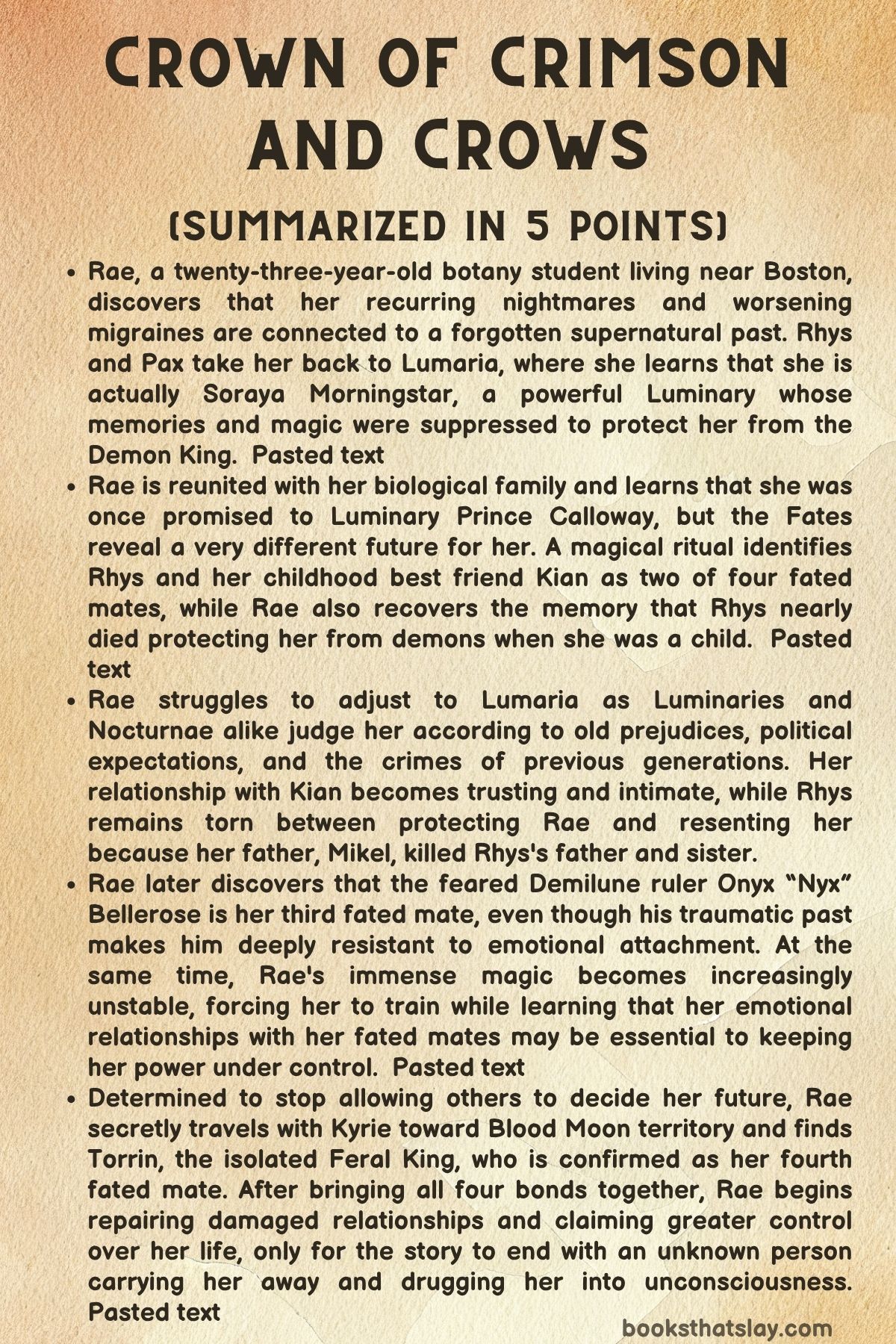
Summary
Fifteen years before the main events, Rhys Lockhart rules the Nocturnae House of Firelight while carrying deep resentment toward the Luminaries, especially the Morningstar family. His distrust is challenged when Olympia Morningstar approaches him with a vision revealing that a young Luminary named Soraya is in terrible danger from the Demon King and must be hidden in the human realm.
Rhys initially refuses to become involved until Olympia reveals that Soraya is his fated mate. Through Olympia’s visions, he sees both the adult woman Soraya will become and the terrified child pursued by demons, forcing him to acknowledge a supernatural connection he cannot dismiss even though Soraya is the daughter of Mikel, the man Rhys blames for killing his father and young sister.
In the present, Soraya lives as Rae, a twenty-three-year-old graduate student near Boston who studies botany and remembers almost nothing about her early childhood. Her adoptive parents were murdered, leaving her especially dependent on her close friend Pax, while recurring nightmares show fragments of a forgotten world filled with living fire, winged creatures, demons, and an older woman calling her Soraya.
Rae’s increasing migraines are actually the result of suppressed magic becoming too powerful to contain. Pax, who has secretly watched over her for fifteen years while disguising his Nocturnae identity, summons Rhys because Rae can no longer remain safely in the human realm.
Rhys begins watching Rae from a distance, but their fated bond quickly makes avoidance impossible. Rae notices a mysterious golden-eyed stranger on campus and experiences an unexplained physical pull toward him, while Rhys becomes violently protective when a student named Simon corners and threatens her in a greenhouse.
Their first physical contact intensifies the bond dramatically. Rae experiences heat, pain, desire, and burning sensations she cannot explain, while Rhys experiences her distress through their connection and realizes that remaining separated could seriously harm her.
When Rae’s condition worsens, Rhys and Pax reveal their wings and carry her through a portal into Lumaria. The world she enters resembles the place in her nightmares, immediately suggesting that memories she believed were imaginary are actually fragments of her forgotten childhood.
Rae’s arrival creates immediate conflict. Rhys’s brother Ayden resents her presence because she is a Luminary, while Rae learns that Rhys is the king of Firelight and that Pax has concealed his true identity throughout their friendship.
She then discovers that Rhys, Pax, and the others are Nocturnae, ancient supernatural beings related to vampires but considerably more powerful. Before Rae can process that revelation, another armed group approaches, and Rhys tells her that the newcomers are her biological family.
Among them are the Luminary rulers, Rae’s parents Imogen and Mikel, her sister Kyrie, her grandmother Olympia, Prince Calloway, and Kian, a Nocturnae prince who was Rae’s closest childhood friend. Rae learns that Soraya is her birth name and that she had been promised to marry Calloway before she disappeared.
Kian becomes one of the first people from Rae’s forgotten past whom she instinctively trusts. When the shock of everything around her triggers panic, he crosses political boundaries to calm her magically, telling her that they were once best friends and demonstrating a connection that exists even without Rae’s memories.
Olympia eventually reveals that Rae has been chosen by the Fates. In a celestial realm, one of the Fates named Lyra restores the magic and memories Olympia suppressed fifteen years earlier, forcing Rae to relive fragments of her childhood.
Rae remembers playing with Kian and Calloway, being prepared by her mother for a future political role, fleeing from demons, and being carried to safety by Rhys. Most importantly, she remembers Rhys using his own body to shield her from a demon attack, leaving him permanently scarred.
Olympia explains that Rhys did not abduct Rae for selfish reasons but helped hide her because the Demon King was specifically hunting her. Rae also learns why Rhys hates her family: Mikel killed Rhys’s father and sister, leaving Rhys unable to separate Rae completely from the people whose actions destroyed his family.
The Fates then determine Rae’s supernatural bonds. A blood ritual marks both Rhys and Kian as her fated mates, but the revelation does not stop there: Rae has four fated partners, something so rare that it signals the extraordinary magnitude of her magical power.
Kian accepts the bond openly and vows to remain with Rae, whereas Rhys promises only to honor her. Rae is surprised by how much his emotional distance hurts, especially because she notices that her connection to Kian already feels stronger and more secure.
Her biological family proves equally complicated. Imogen initially appears interested in reconnecting with Rae but soon argues that her Nocturnae bonds should be severed so that she can marry Calloway as originally planned.
Rhys reveals that severing or ignoring Rae’s fated connections could destabilize her immense magic and eventually kill her or people around her. Imogen’s willingness to accept even Rae’s death rather than see her connected to Nocturnae exposes the cruelty beneath the Luminary obsession with status and social purity.
Rae travels to Firelight with Rhys, Kian, and Pax, where Rhys’s people react furiously to their king being bound to a Luminary. Rhys nevertheless defends her publicly and forces his subjects to recognize his authority, although Rae understands that protection cannot erase generations of resentment.
Her position becomes even more dangerous when a Nocturnae attacks her inside the Firelight castle and begins draining her blood. Instead of remaining helpless, Rae draws on accumulated anger and awakens a powerful defensive force before Rhys arrives and kills the attacker.
Rhys saves Rae by making her drink his blood, creating an intimate moment that unsettles both of them. Kian later provides the emotional comfort Rhys refuses to give, allowing Rae to control the pace of their growing physical relationship and strengthening her trust in him.
Leaving Firelight, the group travels toward the House of Demilune, ruled by Onyx Bellerose, known as Nyx. He is a scarred and feared Nocturnae king shaped by years of demonic captivity, and he initially seems more likely to become an enemy than an ally.
After fighting Kian, however, Nyx reveals that he has developed a fated mark. Rae now knows three of her four destined partners, while the likely identity of the fourth becomes increasingly alarming: Torrin, the isolated ruler of the House of the Blood Moon, whose violent instability has earned him the name Feral King.
At Demilune, Rae’s magical problems become impossible to ignore. Power builds inside her faster than her body can contain it, and when Kian helps her release the excess energy into the earth, she produces explosive plant growth that overwhelms an entire conservatory.
Rae begins training to control her abilities, but her emotions repeatedly interfere. Anger, rejection, jealousy, fear, and family conflict cause dangerous surges, suggesting that her power cannot be separated from her psychological state or from the condition of her fated connections.
Kyrie secretly crosses into Demilune because she wants to know Rae as a person rather than accept the political judgments surrounding her. Their growing sisterly relationship gives Rae something she has badly lacked since returning to Lumaria: a family connection based on affection rather than obligation.
Olympia eventually arrives to assist Rae with magical training. She theorizes that Rae’s four fated partners exist because each provides part of the emotional and magical balance required to contain her exceptional power.
This theory explains why Rae’s stable bond with Kian helps her while the hostility surrounding Rhys and Nyx contributes to instability. It also makes locating Torrin increasingly urgent.
Meanwhile, Nyx struggles with his own attachment to Rae. Her blood becomes almost irresistible to him, yet he fears emotional dependence because everyone he once loved became a vulnerability that demons could exploit.
His actions nevertheless expose feelings he refuses to acknowledge. When he learns that Calloway and Izzy have discussed reclaiming Rae for the Luminaries, Nyx becomes prepared to kill anyone who tries to remove her against her will.
Rae’s conflict with Rhys grows especially painful. After she saves his life during a demon attack, Rhys admits that he desires her but cruelly tells her that wanting her only intensifies his hatred and that he will never love her.
The rejection drives Rae closer to Kian, who consistently treats fate as an opportunity rather than an entitlement. Rae finally chooses to deepen their physical and magical relationship, allowing Kian to feed from her and willingly accepting an intimacy that strengthens their bond.
Rhys witnesses them together and is devastated. Pax later forces him to confront the fact that he has been punishing Rae for Mikel’s crimes, making Rhys recognize that his treatment of her reproduces the same injustice he claims to despise.
Rae continues struggling with magical overload, and discussion repeatedly returns to Torrin. Tired of having powerful men debate her future while she waits, Rae decides to act without their permission.
With Kyrie’s help, she escapes Demilune and travels into Blood Moon territory. Her decision marks a major change in her character because she is no longer allowing other people to determine where she goes, whom she meets, or what risks she is permitted to take.
Rae eventually approaches Torrin’s abandoned castle alone except for her fox familiar, Bandit. Torrin appears more animalistic than civilized after years of isolation, but Rae immediately feels the familiar magical current that confirms her suspicion.
Torrin is her fourth fated mate.
Rhys, Kian, Nyx, and the others soon arrive, creating an explosive confrontation as Torrin instinctively tries to claim Rae and drive the other kings away. Rae prevents violence by explaining that all four men are connected to her and that harming any of them will also hurt her.
Inside Torrin’s ruined castle, Rae begins cautiously establishing trust with him while also confronting damage within her existing relationships. She reconciles with Pax, recognizes that their friendship became genuine despite beginning as an assignment, and starts viewing herself as someone capable of directing her own future.
Rhys finally gives Rae a sincere apology, admitting that accepting his desire for her still feels like betraying the family members Mikel killed. He nevertheless promises to stop making Rae pay for crimes she did not commit.
Kian, however, confronts Rae for secretly leaving Demilune and points out that independence does not excuse refusing to trust people who care about her. Rae realizes that taking control of her life also requires accepting responsibility for how her decisions affect others.
The story closes with all four fated mates finally identified but none of Rae’s central conflicts truly resolved. While she sleeps, an unknown person carries her away, apologizes, injects something into her neck, and renders her unconscious, leaving Rae’s newly claimed independence threatened by another abduction and suggesting that the forces competing for control of her are far from finished.
Characters
Rae / Soraya Morningstar
Rae is the emotional and narrative center of Crown of Crimson and Crows, and her development is defined by the struggle to become an active participant in a life that other people have planned for her. At the beginning, she is intelligent and independent within the human world, but she knows almost nothing about her real heritage, her suppressed abilities, or the political significance attached to her existence.
Her identity is deliberately divided between Soraya, the Luminary girl she once was, and Rae, the woman shaped by her adoptive parents and human experiences. Her insistence on being called Rae therefore matters because the name represents the self she consciously remembers rather than the identity her biological relatives expect her to resume automatically.
Much of Rae’s early experience in Lumaria involves other people explaining what she is supposed to be. Her family sees a Luminary daughter and potential queen, Calloway sees the girl once promised to him, the Fates identify her through supernatural bonds, and several Nocturnae initially respond to her through history or instinct rather than personality.
Her development gradually turns this external definition into self-definition. She begins fighting back physically, demanding information, choosing intimacy with Kian, protecting Kyrie, searching for Torrin independently, and refusing to accept that power gives other people the right to make her decisions.
Rae’s magic reinforces this internal struggle. Her enormous power responds to emotion, meaning every unresolved wound can become physically dangerous, and mastering that power requires her to confront the fear, anger, abandonment, prejudice, and confusion she has spent years carrying.
Her compassion is equally important. Rae worries about messengers, helps injured children, questions historical injustice against the Nocturnae, and repeatedly judges people by behavior rather than species, giving her the moral flexibility needed to challenge the prejudices of both societies.
Rhys Lockhart
Rhys is one of the most conflicted figures in Crown of Crimson and Crows because his relationship with Rae forces him to confront the difference between inherited identity and individual responsibility. He has legitimate reasons for hating Mikel and resenting Luminary power, but he initially allows that hatred to determine how he treats Mikel’s innocent daughter.
His first defining act toward Rae contradicts the hostility he later displays. Long before she remembers him, Rhys nearly dies protecting her from demons and then spends fifteen years avoiding the mate whose survival he helped secure.
That contradiction continues throughout the novel. Rhys repeatedly saves Rae, threatens anyone who harms her, defends her before his own people, gives her his blood when she is dying, and reacts intensely whenever another person threatens her safety, yet he remains emotionally cruel because accepting her would force him to loosen his loyalty to grief.
His kingship reveals a similar duality. Rhys can be brutally authoritarian when necessary, but his tenderness toward Firelight’s children and the loyalty of his people indicate that his severity exists alongside genuine responsibility and affection.
Pax eventually forces Rhys to recognize the moral failure in his behavior toward Rae. If Rae is guilty merely because of her father, then Rhys is reproducing the same collective punishment and prejudice that helped create the conflict between their peoples.
His eventual apology matters because it does not erase his grief. Instead, Rhys begins accepting that loving or wanting Rae would not mean forgiving Mikel, forgetting his sister, or betraying his father, and that emotional maturity requires him to stop turning another person’s crime into Rae’s punishment.
Kian
Kian serves as the strongest example in Crown of Crimson and Crows of how a fated bond can coexist with meaningful choice. Although the Fates confirm his connection to Rae, his devotion existed long before the mark because he loved her as a childhood friend and continued searching for her throughout the years of her disappearance.
His greatest strength is emotional attentiveness. Kian repeatedly notices when Rae is overwhelmed, helps control her panic and pain, allows her to direct their physical intimacy, and speaks to her as a person rather than a political symbol.
His relationship with Rae consequently develops faster than her other bonds because trust precedes desire. The magical connection may intensify their attraction, but Rae’s willingness to become intimate with Kian grows primarily from his consistency.
Kian is not without flaws. His protectiveness can become possessive, and his anger toward Rhys demonstrates that he carries his own assumptions about the past, especially when he blames Rhys for Rae’s disappearance before fully understanding why she was hidden.
He also reacts strongly when Rae secretly travels to Blood Moon territory. Unlike characters who simply resent her independence, however, Kian’s complaint is that she excluded someone who had repeatedly demonstrated his willingness to support her choices.
That distinction makes him important to Rae’s maturation. He respects her autonomy but also shows her that autonomy and trust must coexist if she intends to build lasting relationships rather than merely escape control.
Onyx “Nyx” Bellerose
Nyx represents trauma transformed into defensive cruelty in Crown of Crimson and Crows. His reputation as the Cruel King emerges from experiences of demonic captivity, torture, and profound loss that convinced him affection is simply another weakness an enemy can exploit.
Rae threatens that philosophy immediately. The fated mark makes her safety emotionally important to him before he is psychologically prepared to care about anyone again, which produces his characteristic combination of protectiveness and hostility.
His coldness is therefore less about genuine indifference than fear of dependency. He repeatedly insists that he does not want the vulnerability Rae represents, even while becoming furious at anyone who discusses removing her against her will.
Nyx’s relationship with Rae develops through confrontations rather than reassurance. She throws dirt at him, challenges his authority, protects Kyrie from his intimidation, and refuses to behave as though his reputation requires submission.
Instead of making Nyx despise her, this resistance earns his respect. Rae’s courage suggests that caring for her may not necessarily produce the helpless vulnerability he fears because she is capable of fighting beside him rather than simply becoming someone he must protect.
His dangerous response to Rae’s blood shows that his trauma has not made him fully controlled. Nyx is powerful precisely because he has learned to suppress himself, but Rae exposes instincts and desires that cannot simply be frozen beneath discipline.
Torrin
Torrin completes the central fated structure of Crown of Crimson and Crows while also presenting its most extreme version of trauma and isolation. Unlike Rhys or Nyx, whose emotional defenses remain socially functional, Torrin has withdrawn so completely that instinct often replaces ordinary communication.
His reputation as the Feral King initially makes him sound almost monstrous. Years of solitary survival and violence have stripped away many social habits, leaving him territorial, suspicious, and immediately aggressive toward the other kings.
Rae’s arrival introduces a sensation Torrin cannot interpret intellectually but recognizes instinctively. He scents her, remains physically close, and reacts to the bond as something fundamental before he fully understands what being one of four fated partners means.
The character becomes more sympathetic through small reactions. His gentleness toward Bandit and his ability to restrain himself after Rae explains that harming the other kings would hurt her show that he is not incapable of empathy or reason.
Torrin instead appears to be someone whose humanity has been buried beneath years of danger. Rae’s early attempts to teach him that she can walk away and still return establish the likely foundation of their relationship: rebuilding trust through repeated evidence that attachment does not always lead to abandonment.
Pax
Pax occupies a complicated position because he begins as Rae’s secret guardian but becomes genuine family. His friendship with her originated from Olympia and Rhys’s need to keep Rae safe, requiring him to alter his appearance, conceal his species, and live beside her under false circumstances.
That deception understandably wounds Rae when the truth emerges. Yet the years they spend together cannot be dismissed as artificial because Pax’s loyalty extends far beyond an assigned duty, particularly after he becomes the person most willing to challenge Rhys when Rhys’s behavior harms her.
Pax frequently functions as Rhys’s moral counterweight. He understands Rhys’s grief but refuses to accept grief as an excuse for cruelty, eventually comparing Rhys’s treatment of Rae to the injustice Rhys condemns in Mikel.
His friendship with Rae survives because both acknowledge its imperfect origins. Their reconciliation at Torrin’s castle recognizes that relationships can begin under dishonest circumstances and still become emotionally authentic through years of choice.
Kyrie Morningstar
Kyrie is one of Rae’s most positive discoveries after returning to Lumaria. Although she grew up beneath the shadow of the missing Soraya, she does not respond to Rae with the bitterness that might reasonably have developed from years of comparison.
Instead, Kyrie crosses dangerous political borders alone because she wants to understand the sister everyone else is discussing as a symbol. Her actions distinguish her from older Luminaries who continually treat Rae as a succession problem, magical anomaly, or political embarrassment.
Kyrie’s childhood has also been damaged by their parents. She was repeatedly measured against an idealized absent sister, leaving her with feelings of inadequacy that closely parallel Rae’s own difficulty belonging anywhere.
Their relationship therefore becomes mutually restorative. Rae gains a biological family member who accepts the person she became, while Kyrie gains a sister who does not demand perfection.
Kyrie also contributes directly to Rae’s growing independence by helping with magical training and accompanying her escape toward Blood Moon territory. She is young and reckless, but her loyalty is grounded in affection rather than ideology.
Olympia Morningstar
Olympia is responsible for one of the most consequential decisions in the story: suppressing Rae’s memories and magic and sending her into the human realm. From Rae’s perspective, this choice deprived her of her identity, but Olympia’s explanation establishes that concealment was intended to save her from the Demon King.
Unlike many Luminaries, Olympia respects the authority of the Fates even when their decisions undermine established political expectations. She accepts Rae’s multiple Nocturnae bonds instead of treating them as shameful and later becomes one of the few experienced figures genuinely interested in helping Rae survive her power.
Her past relationship with her deceased fated mate, Misha, also allows her to give Rae a more humane understanding of destiny. Olympia presents a fated bond not as compulsory romance but as something that can develop into centuries of chosen devotion.
Her major moral complication remains secrecy. Even compassionate decisions made without Rae’s consent have lifelong consequences, making Olympia another example of how protection can become a form of control when the protected person is denied knowledge.
Calloway
Calloway represents the future that Luminary society designed for Rae before she was old enough to choose it. He grew up expecting Soraya to become his wife, and her disappearance left him emotionally attached to a relationship that existed partly through childhood affection and partly through political arrangement.
His reaction to Rae’s return demonstrates how difficult it is for him to separate those elements. He appears to care about her, yet he repeatedly assumes that the old engagement should retain authority even after the Fates establish completely different bonds.
Calloway’s friendship with Kian exposes another limitation. He considers himself unusually accepting for befriending a Nocturnae, but that self-image still places Luminaries in the position of deciding which Nocturnae deserve tolerance.
His question about whether Kian would sever his bond with Rae is particularly revealing. Calloway expects loyalty to old arrangements to outweigh Rae’s new reality, while Kian’s immediate refusal shows the difference between loving Rae as she is and wanting her restored to a predetermined role.
Imogen Morningstar
Imogen embodies the damage produced when social expectation becomes more important than parental love. Rae initially approaches her biological mother with understandable hope, especially when Imogen recalls her childhood interest in flowers.
That hope collapses when Imogen reveals that reconnecting with Rae is secondary to restoring her proper Luminary future. Her willingness to consider severing Rae’s bonds despite the danger demonstrates that she values conformity above her daughter’s autonomy.
Her most disturbing moment comes when she implies that death could be preferable to the disgrace of Rae remaining connected to Nocturnae. The statement explains why returning memories of childhood produce fear rather than comfort in Rae.
Imogen is therefore important not because she lacks all feeling but because whatever maternal affection she possesses has been subordinated to ideology. She shows how prejudice can corrupt even relationships that are supposed to be unconditional.
Mikel Morningstar
Mikel’s importance lies largely in the consequences of his past actions. His killing of Rhys’s father and young sister created a wound that continues shaping Rhys long after Rae returns.
For Rae, discovering what her father did creates an impossible burden. She has no responsibility for his violence, yet she must live inside relationships damaged by it.
Mikel also represents the danger of inherited conflict because his actions become justification for hatred directed beyond himself. Rhys’s eventual growth depends partly on recognizing that condemning Rae for Mikel’s crimes is morally indefensible.
The character therefore influences the novel even when he is not physically central to a scene. The violence associated with him survives as memory, prejudice, and political mistrust.
Ayden Lockhart
Ayden is Rhys’s younger brother and one of the clearest voices of Firelight’s resentment toward Luminaries. His ambition, provocative personality, and willingness to use violence make him both a family complication and a political threat.
He openly opposes Rae’s presence and repeatedly warns that accepting her will destabilize Firelight. Because some of his fears are politically reasonable, Ayden is more interesting than a purely malicious rival.
His relationship with Rhys mixes affection and competition. They can attack each other with supernatural force and then embrace afterward, suggesting that physical conflict forms part of their unusual fraternal language.
Ayden also reflects the harsher values of Nocturnae society. Where Rae is shocked by brutality, he often regards displays of violent authority as useful or even entertaining.
Izzy Morningstar
Izzy represents adaptation through conformity. Unlike Kyrie, who rebels against family expectations, Izzy appears to survive within the Morningstar household by embracing the standards imposed on her.
Her interactions with Rae therefore reproduce their parents’ criticism. She judges Rae’s clothing, relationships, behavior, and suitability for leadership as though Luminary conventions were objective measures of personal worth.
This makes Izzy especially effective at triggering Rae because the criticism comes from a sister rather than an obvious enemy. Rae’s magical explosion against her shows how deeply family rejection affects the emotional instability tied to her powers.
Izzy’s behavior also suggests what Rae might have become had she never been hidden. Her conformity offers social acceptance, but it appears to require surrendering much of the independence Rae gained in the human world.
Queen Daphne
Queen Daphne embodies institutional Luminary authority. From the moment Rae returns, she treats personal circumstances as secondary to political order and shows little patience for emotional reunions or competing claims.
Her insistence that Rae should still marry Calloway even after the Fates identify other partners demonstrates her belief that established hierarchy should override supernatural evidence when that evidence threatens Luminary interests. She therefore represents not simply prejudice but the political structures that preserve it.
Daphne’s responses help Rae understand that returning to Luminary society would not automatically mean returning home. Blood connection and shared magic do not guarantee acceptance when belonging depends on obedience.
King Evander
Evander appears warmer toward Rae than Daphne, but he remains embedded within the same political system. His relative kindness therefore provides contrast without making him a clear opponent of Luminary expectations.
His role demonstrates that personal civility is not necessarily equivalent to challenging injustice. A ruler can appear reasonable while continuing to benefit from and uphold structures that limit another person’s freedom.
Zenia
Zenia serves primarily as a reminder that Rhys had a life during the years Rae spent in the human realm. Her familiarity with him creates jealousy in Rae and exposes feelings Rae would rather dismiss.
Rather than attacking Rae openly, Zenia uses social confidence and physical closeness to unsettle her. Rae’s magical response to that jealousy becomes significant because the appearance of silver sparks suggests that even emotions she has not consciously accepted can activate her power.
Rayne
Rayne acts as one of Nyx’s trusted companions and provides an outside perspective on the Cruel King’s emotional denial. He sees that Nyx’s attachment to Rae is already influencing his behavior even when Nyx insists that he wants no vulnerability.
His presence is valuable because Nyx rarely admits emotional truths voluntarily. Rayne can identify the contradiction between what Nyx says about Rae and what he is willing to do for her.
Trix
Trix is the formidable head of Rhys’s guard and represents the military discipline supporting Firelight’s monarchy. Her presence reinforces the idea that Rhys’s authority depends not merely on supernatural strength but on a functioning structure of loyal protectors.
Although her role is smaller than those of the central characters, she contributes to the broader image of Firelight as an organized kingdom rather than a collection of violent supernatural beings.
Bandit
Bandit, Rae’s Arctic fox familiar, emerges as her powers become more fully awakened. His immediate attachment to Rae suggests that her magical development is beginning to create relationships independent of politics, family arrangements, or the Fates’ romantic bonds.
Bandit is also instinctively protective and expressive in ways the human and Nocturnae characters often are not. His distrust of Rhys and comfort around Rae provide small but meaningful external reflections of the emotional atmosphere surrounding her.
Odin
Odin is Nyx’s enormous wolf-like familiar and provides an important contrast to his master’s reputation. His immediate acceptance of Rae suggests that instinct recognizes something trustworthy in her before Nyx is willing to admit his own attachment.
Odin also intervenes when Nyx loses control around Rae’s blood, demonstrating that loyalty to Nyx does not require allowing him to harm the person to whom he is becoming connected.
Themes
Identity, Memory, and the Right to Define Oneself
Identity in Crown of Crimson and Crows is never presented as a simple matter of discovering a hidden birthright. Rae does learn that she is Soraya Morningstar, a powerful Luminary with forgotten relatives and political obligations, but recovering those facts does not automatically make Soraya more authentic than the woman named Rae who grew up in the human world.
Her insistence on keeping the name Rae becomes an important assertion of agency. The people around her repeatedly define her through categories such as Luminary, daughter, future queen, promised bride, fated mate, magical anomaly, and political danger, while Rae increasingly demands recognition as someone whose experiences cannot be reduced to those labels.
Memory complicates this further because recovering childhood experiences does not erase the life she built afterward. Her adoptive parents remain her parents, Pax remains emotionally significant despite his deception, and her education and fascination with plants remain central parts of her personality.
The novel therefore treats identity as cumulative rather than replaceable. Rae does not need to choose between being the child once called Soraya and the adult called Rae; her challenge is to decide how both histories belong to the person she is becoming.
Her final determination to direct her own life shows the direction of this struggle. Discovering the truth matters, but truth becomes meaningful only when Rae gains the freedom to decide what she will do with it.
Fate, Choice, and Consent
The fated-mate system creates the novel’s central tension between predetermined connection and personal freedom. Rae is repeatedly told that four men are magically necessary to her, yet she resists the idea that supernatural compatibility should automatically determine emotional or sexual relationships.
Kian provides the clearest answer to this tension when he explains that fate creates potential rather than eliminating choice. His relationship with Rae strengthens because he consistently asks what she wants, gives her control during intimate moments, and accepts that a magical bond does not entitle him to her body or affection.
Rhys demonstrates the opposite danger. He cannot deny the bond, but his refusal to address his grief turns destiny into resentment, harming both himself and Rae.
Nyx presents another variation by fearing the vulnerability imposed by attachment, while Torrin responds to the bond almost entirely through instinct. Each man therefore forces Rae to confront a different question about what destiny can demand and what only consent can create.
Rae’s decision to find Torrin independently becomes especially important in this context. She cannot choose whether the magical bond exists, but she can choose how she meets it, whether she develops it, and what boundaries govern it.
The novel ultimately separates connection from relationship. Magic may establish the first, but trust, intimacy, loyalty, and love require repeated human choices.
Prejudice, Inherited Hatred, and Collective Guilt
The hostility between Luminaries and Nocturnae rests on centuries of exploitation, violence, fear, and selective historical memory. Luminaries once created the Nocturnae as defenders against demons and treated them as expendable, while later rebellions and retaliatory violence transformed exploitation into generations of mutual resentment.
Rae enters this conflict without consciously belonging to either side. Because she grew up outside Lumaria, she can recognize injustices that people raised within the conflict regard as normal.
Her position becomes especially significant because she is repeatedly blamed for actions committed by other Luminaries. Firelight citizens hate her because of what her people did, while Rhys initially transfers his hatred of Mikel directly onto Mikel’s daughter.
At the same time, several Luminaries judge Nocturnae as inherently inferior or corrupt. Imogen would rather risk Rae’s life than accept her bonds with them, while Calloway’s supposedly progressive friendship with Kian still contains assumptions of Luminary superiority.
Crown of Crimson and Crows therefore repeatedly asks whether historical suffering justifies present prejudice. The story does not dismiss Rhys’s grief or Nocturnae anger, but it distinguishes remembering injustice from making innocent individuals responsible for inherited crimes.
Rae’s relationships create a direct challenge to that worldview. Her existence connects groups that have built their identities around separation, forcing each side to decide whether history will remain an explanation for hatred or become a reason to stop repeating it.
Power, Emotional Control, and Vulnerability
Rae’s magic turns emotional conflict into physical danger. Anger can produce destructive energy, jealousy creates silver sparks, fear contributes to overload, and unresolved relationships seem to destabilize power that is already exceptional.
This makes magical control inseparable from emotional understanding. Rae cannot master herself simply by learning techniques because her abilities respond to wounds involving rejection, family expectations, abandonment, trauma, and uncertainty about her fated partners.
The same principle operates in the powerful men surrounding her. Rhys possesses immense physical and magical strength yet becomes cruel when grief overwhelms him, while Nyx’s frightening self-control begins collapsing when Rae awakens needs he has spent years suppressing.
Torrin represents what can happen when trauma and isolation strip away ordinary methods of emotional regulation almost completely. Kian, by contrast, demonstrates that strength can include reassurance, patience, and openly acknowledged affection.
Rae’s greatest progress therefore occurs when she stops treating vulnerability as equivalent to helplessness. She can choose Kian and still remain independent, forgive Pax without pretending his deception never mattered, challenge Rhys without denying his pain, and approach Torrin without surrendering control of herself.
True mastery in the story is consequently not the elimination of emotion. It is the ability to experience fear, desire, anger, grief, and attachment without allowing those feelings—or the people connected to them—to determine every action.