Escape Me Summary, Characters and Themes
Escape Me by Tahereh Mafi is a speculative romance and dystopian thriller centered on James and Rosabelle as personal loyalty collides with a renewed technological threat from the Ark.
The story combines political instability, advanced synthetic technology, damaged family bonds, and intense questions about what love requires from people conditioned to survive through sacrifice. James is forced to challenge the way others underestimate him, while Rosabelle confronts emotions she has spent most of her life suppressing. Around them, Warner, Kenji, Nazeera, and the wider resistance face security breaches that suggest the enemy has developed methods far more dangerous than ordinary military force.
Summary
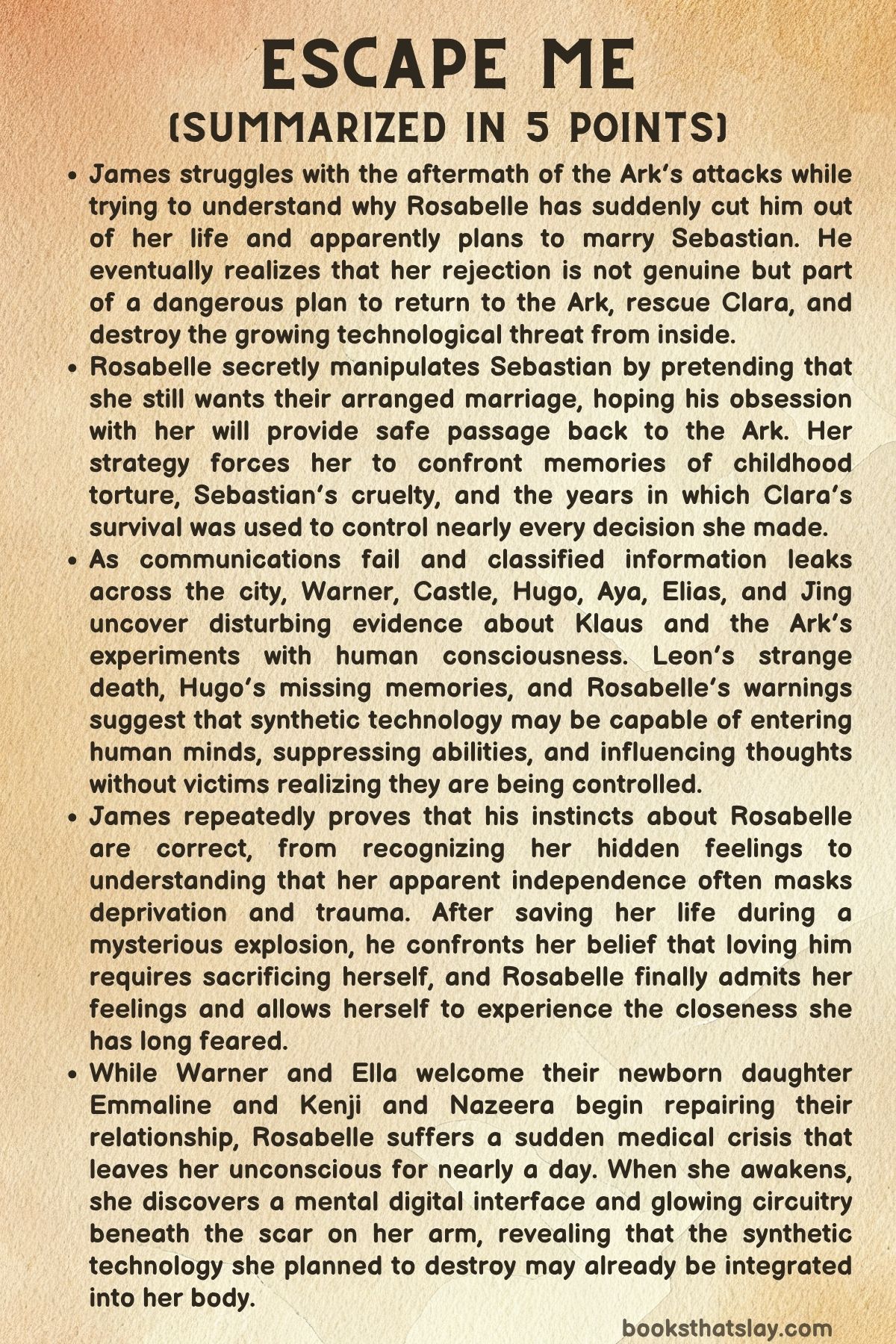
Escape Me begins in the aftermath of a devastating attack on the city. James, Kenji, Nazeera, Winston, and their allies are exhausted from responding to the destruction while trying to understand how extensively the Ark has infiltrated their territory through hidden agents, weapons, and surveillance.
James has another crisis occupying his thoughts: Rosabelle. After the warehouse confrontation in which Sebastian nearly killed her, Rosabelle negotiated an agreement with Warner that required James to remain completely away from her.
The separation devastates James because he cannot reconcile Rosabelle’s decision with what he witnessed between them. She protected him repeatedly, sacrificed opportunities for escape, cried in his arms, and made clear that his survival mattered deeply to her.
His confusion becomes worse when he overhears that Rosabelle apparently intends to marry Sebastian and return to the Ark with him. James initially feels humiliated, but his despair gradually becomes suspicion.
Sebastian nearly murdered Rosabelle and terrified her at the warehouse, making voluntary reconciliation seem impossible. James therefore reasons that Rosabelle must be planning something and has deliberately excluded him because she knows he would try to stop her from risking her life.
James is correct. Rosabelle is secretly manipulating Sebastian so that he will take her back to the Ark.
Her plan is to use their proposed wedding as a distraction. A ceremony involving the son of the Ark’s supreme commander would gather powerful people together and give Rosabelle an opportunity to penetrate the Ark’s internal systems, use a mysterious vial in her possession, attack Klaus, and rescue Clara.
The deception requires Rosabelle to pretend that she still trusts Sebastian. This is psychologically brutal because Sebastian has been part of her suffering since childhood.
When Clara was young and seriously ill, Sebastian dismissed her as useless, provoking Rosabelle to stab his hand. Rosabelle was punished horribly, and Clara’s survival was thereafter used to enforce her obedience.
Sebastian later participated in Rosabelle’s interrogations while interpreting domination as affection. Rosabelle now turns his obsession against him, presenting herself as willing to renew their engagement while quietly attempting to weaken his loyalty to his father and the Ark.
Meanwhile, James becomes increasingly disturbed by the conditions in which Rosabelle has been living. Nazeera’s largely empty house contains almost no food, clothing, furniture, or comforts.
The others assume Rosabelle can care for herself, but James recognizes something they overlook: she has been trained through deprivation to endure without asking for anything. Her silence therefore does not mean that her needs are being met.
His frustration erupts during a meeting with Warner, Kenji, and Nazeera. James accuses them of treating him as impulsive and unintelligent despite his successful infiltration of the Ark and his repeated accurate judgments about Rosabelle.
Warner reluctantly admits that James has been right several times, though he believes love has now compromised James’s judgment. The argument also exposes unresolved tension between Kenji and Nazeera.
James forces the two to confront their history, leading to the revelation that Kenji once proposed marriage. Nazeera eventually recognizes that she has expected Kenji to understand her feelings without giving him the apology and emotional openness he deserves.
Elsewhere, Rosabelle’s physical condition deteriorates. Aya, Elias, and Jing, three scientists confined within the rehabilitation facility, notice her injuries and begin treating her.
Rosabelle distrusts their kindness until they reveal information about Leon. Their investigation suggests that Leon did not die because Rosabelle attacked him; instead, his body appeared to destroy itself internally after something artificial had occupied or manipulated his mind.
Rosabelle confirms their suspicion by explaining Klaus. The Ark’s synthetic intelligence can apparently operate through human beings in ways that blur the line between biological life and technological control.
Warner arrives during this discovery and realizes that James’s instincts about Rosabelle have once again been correct. His own certainty about her motives begins to weaken.
James eventually enters the room Rosabelle has been using at Nazeera’s house and finds almost nothing there. What he does discover changes his understanding of her attempted rejection.
Rosabelle has carefully preserved his damaged jacket, his beanie, and a small kite-shaped pin that belonged to him. She keeps these objects beside the place where she sleeps, demonstrating that her separation from James is not emotional indifference.
The discovery causes James to reconsider his own emotional history. He realizes that much of his humor and apparent ease originated in childhood survival, when being pleasant, entertaining, and undemanding helped him feel safer and less likely to be abandoned.
Warner is confronting a different set of dangers. Communication systems throughout the city are behaving unpredictably, confidential information is leaking, and messages are appearing late or disappearing entirely.
He consults Castle and interviews Hugo Wolff, Rosabelle’s father. Hugo suffers from damaged and unreliable memories after an attempted killing by The Reestablishment, but his history with the Ark and Sebastian’s family may contain important information.
Hugo reveals details about Alastair Rivers and the arrangement that effectively promised Rosabelle to Sebastian from childhood. More disturbingly, Hugo admits that he sometimes loses entire stretches of time.
Warner notices unnatural dark veins extending across Hugo’s wrists and begins wondering whether his memory problems are connected to the same synthetic interference that affected Leon. The possibility suggests that the Ark’s technology may already be operating within their society.
James, meanwhile, is restored to his position as Captain and helps dismantle a hidden enemy depot near the docks. The discovery of weapons and supplies confirms that Ark operatives have maintained a concealed presence within resistance territory.
His private life becomes public as well. Citizens have somehow learned classified details about his infiltration of the Ark, another sign that information security is collapsing.
Before returning to active duty, James secretly buys clothes and basic necessities for Rosabelle. The errand is awkward and almost comic, but it demonstrates the practical form his love takes: he wants to provide the ordinary things she has never learned to request.
Warner eventually confronts Rosabelle directly about James. Through his ability to sense emotions, Warner has realized that her apparent emotional emptiness is partly constructed.
Rosabelle becomes almost emotionally dormant when James is absent, but thoughts of him create strong reactions. His physical presence destabilizes her control even further.
Warner therefore concludes that she loves James. Rosabelle does not deny that he has become dangerous to her emotional defenses; instead, she argues that this is exactly why she must remain separated from him.
She finally reveals more of the Ark’s larger threat. Its scientists have experimented with integrating organic and synthetic systems, and millions of people with supernatural mutations may be vulnerable.
Rosabelle fears the Ark may be developing technology capable of suppressing supernatural abilities, altering perception, and planting thoughts directly into people’s minds. Such a system could defeat entire populations without conventional warfare because victims might surrender while believing their decisions were their own.
Her solution remains the same: she must return to the Ark and destroy the system from within.
Before Warner can fully respond, James arrives after learning how badly Sebastian injured her. He is furious that Sebastian is still alive and accuses Warner of failing to protect Rosabelle.
Their confrontation is interrupted by a strange explosion. The blast shatters the house but produces none of the fire, smoke, or ordinary destruction expected from an explosion of such force.
Rosabelle is struck by broken glass, and a large shard becomes lodged in her throat. James finds her barely alive and uses his healing ability with reckless intensity to save her.
He succeeds, but the enormous transfer of energy leaves Rosabelle unconscious. Holding her afterward, James experiences the end of five unbearable days of separation: regardless of every unresolved conflict, she is alive and physically back in his arms.
At almost the same moment, Warner discovers that Ella has unexpectedly gone into labor. He rushes home terrified that her extraordinary power may make childbirth fatal.
Instead, he finds that Ella and their newborn daughter are safe. The baby is named Emmaline, and Warner is overwhelmed by the realization that he now possesses the family life he once believed impossible.
Back at James’s house, Rosabelle awakens. She is weak and exhausted, but instead of rejecting him she clings to him and asks him to stay.
Warner arrives with Sonya and Sara and then privately apologizes to James. He admits that separating James and Rosabelle was a mistake and gives James records documenting the systematic torture Rosabelle endured.
Once Rosabelle and James are alone, the emotional confrontation they have avoided finally happens. James refuses to accept her belief that she alone can decide whether loving her is too dangerous for him.
Having read about her past, he recognizes that Rosabelle has been conditioned to equate love with pain, sacrifice, obedience, and disappearance. He insists that choosing him should not require her to destroy herself for his protection.
Rosabelle’s control breaks. She cries, admits feelings she has tried to suppress, and allows herself physical and emotional intimacy with James.
For a brief period, she stops thinking entirely in terms of missions and survival. Yet that freedom frightens her because Clara remains in danger, Sebastian remains part of her plan, and Klaus remains active.
By morning, Rosabelle tries to leave again. James demands that she stop treating her possible death as an unavoidable outcome.
Their confrontation triggers a sudden medical crisis. Rosabelle’s damaged arm begins trembling violently, her body overheats, and electrical pain spreads through her.
James’s presence appears to worsen the reaction rather than soothe it. Warner arrives as her condition becomes catastrophic, and Rosabelle collapses believing that she is dying.
She remains unconscious for nearly a full day. When Rosabelle finally wakes, her fever is gone and even the tremor in her injured arm has disappeared.
James has stayed beside her throughout the ordeal. Although he is relieved, Rosabelle knows that the Ark, Clara, Sebastian, and Klaus remain unresolved.
Then she discovers something far more frightening than her previous injuries.
When Rosabelle closes her eyes, she sees a digital interface responding directly to her thoughts. It identifies her as an “Unfinished Profile” and offers system options.
Terrified, she tears away the bandage covering her damaged arm. Her old scar has changed shape, and beneath her skin are fine structures resembling circuitry.
They pulse with blue electrical light.
The discovery transforms the central danger of Escape Me. Rosabelle has spent the book preparing to infiltrate a system capable of merging human beings with synthetic technology, only to discover that the system may already have entered her body.
Characters
James
James is the emotional center of Escape Me, but much of his development comes from resisting the identity other people have assigned to him. His humor, impulsiveness, and tendency to provoke others cause even his closest allies to treat him as less serious than Warner, Nazeera, or Kenji.
The book gradually exposes the defensive purpose behind that personality. James learned when he was young that being funny, pleasant, and easy to love could become a method of survival, allowing him to reduce conflict and increase the chances that people would remain close to him.
His relationship with Rosabelle forces that strategy to stop working. He cannot joke his way out of separation from her, nor can he accept the explanations everyone else offers simply because accepting them would be easier.
James’s greatest strength is his ability to see needs that other people dismiss. He recognizes that Rosabelle’s refusal to ask for food, clothing, comfort, or help is evidence of conditioning rather than independence.
That understanding explains why he becomes furious about the emptiness of Nazeera’s house and later buys Rosabelle clothes himself. His care is emotional, but it is also practical and observant.
James also undergoes an important transformation in how he regards his own intelligence. In Escape Me, he finally demands recognition for infiltrating the Ark, identifying Rosabelle’s importance, and repeatedly noticing dangers that more experienced leaders overlook.
His love for Rosabelle can make him reckless, especially when he immediately wants to kill Sebastian after learning about her injuries. Yet the story repeatedly validates the deeper reasoning beneath his emotional reactions.
By the end, James becomes less willing to make himself agreeable for everyone else’s comfort. His insistence that Rosabelle cannot decide his future for him marks a crucial shift from a young man trying to remain lovable into an adult willing to define what he believes and defend it.
Rosabelle
Rosabelle has been conditioned to survive by separating emotion from action. Physical suffering barely registers in ordinary ways because torture, hunger, isolation, and fear have shaped her sense of normality since childhood.
Her apparent coldness is therefore not an absence of feeling. It is an extreme survival mechanism designed to keep those feelings from interfering with tasks that may determine whether Clara lives or dies.
Rosabelle’s devotion to Clara explains many of her most dangerous choices. She learned very young that obedience could protect her sister and that disobedience could cause Clara to suffer, creating a psychological bond between love and self-sacrifice.
That conditioning continues to govern Rosabelle even after she escapes the Ark. She instinctively assumes that protecting James requires removing herself from his life rather than allowing him to participate in the decision.
Her relationship with James becomes the central challenge to that worldview in Escape Me. He does not merely make her feel affection; he makes emotional suppression itself increasingly difficult.
This creates both freedom and terror for Rosabelle. Wanting another person for herself is unfamiliar because nearly every important choice she has made has been organized around duty, punishment, survival, or Clara.
Her plan involving Sebastian demonstrates her intelligence and strategic patience. She understands Sebastian’s obsession, identifies weaknesses in his loyalty to his father, and attempts to turn a forced childhood engagement into the mechanism that will return her to the Ark.
At the same time, her willingness to carry out the operation alone exposes one of her deepest flaws. Rosabelle understands sacrifice far better than cooperation, making self-destruction feel more natural to her than trusting others.
The final discovery of synthetic circuitry inside her body makes her conflict even more personal. She is no longer simply fighting the system that controlled her; she may now physically contain part of it.
Warner
Warner begins from a position of authority and skepticism. He distrusts Rosabelle, doubts James’s ability to judge her objectively, and believes respecting her autonomy means allowing her to make choices that James desperately wants to prevent.
His position is not entirely unreasonable. Warner understands that Rosabelle is a capable fighter who has killed resistance soldiers and survived conditions that would destroy most people, so he rejects James’s instinct to treat her only as someone requiring rescue.
Yet Warner’s certainty weakens as evidence accumulates. He repeatedly discovers that James has noticed important truths first, particularly concerning Rosabelle’s motives, her emotional attachment, and the seriousness of the Ark’s technological threat.
His ability to sense emotions gives him unusual insight into Rosabelle. Warner recognizes that her emptiness is constructed and that James creates responses in her that she cannot fully suppress.
In Escape Me, Warner’s relationship with James also becomes more mature. His eventual apology matters because Warner rarely concedes error, especially when doing so means recognizing that his younger brother understood a person and situation better than he did.
Fatherhood provides another important dimension to Warner. His reaction to Emmaline reveals how far he has traveled from the brutal world created by his own father.
The man who once defined himself through control and survival now becomes overwhelmed by the simple fact that he possesses a family he loves. His protectiveness remains intense, but it is increasingly directed toward preserving a life rather than dominating one.
Nazeera
Nazeera is highly capable, emotionally controlled, and accustomed to operating through competence rather than vulnerability. Those qualities make her effective in crises but much less effective when dealing with intimate relationships.
Her treatment of Rosabelle’s living situation exposes a blind spot. Nazeera assumes that because Rosabelle does not complain, she can manage without help, failing to recognize that deprivation has trained Rosabelle not to ask for basic necessities.
Nazeera’s relationship with Kenji reveals a similar problem. She expects emotional understanding without direct communication and hopes reconciliation can happen without fully acknowledging the hurt between them.
James forces her to confront this habit. Once she speaks honestly with Kenji, her entire emotional demeanor changes, suggesting that vulnerability offers something strategic control never could.
Nazeera’s arc in Escape Me therefore parallels Rosabelle’s in a quieter way. Both women are highly competent and emotionally guarded, but both must recognize that self-protection becomes damaging when it prevents genuine communication.
Kenji
Kenji retains his familiar humor and argumentative energy, but his relationship with Nazeera reveals considerable emotional pain beneath that surface. His earlier proposal demonstrates that his commitment to her was much deeper than their current distance might suggest.
He is hurt not merely because the relationship failed but because Nazeera has never adequately confronted what happened. James’s interference angers him because it exposes something Kenji has tried to keep private.
At the same time, Kenji remains one of the story’s most important expressions of chosen family. His arguments with James can be harsh, yet he restores James to active duty when his abilities are needed and continues functioning as part of the same tightly connected group.
His renewed communication with Nazeera offers one of the book’s more hopeful developments. Their relationship improves only after indirect assumptions are replaced by explicit honesty.
Sebastian Rivers
Sebastian represents love corrupted into possession. His obsession with Rosabelle is rooted in childhood and strengthened by a political arrangement that effectively promised her to him long before she possessed meaningful freedom.
He repeatedly interprets control, violence, and entitlement as evidence of devotion. Even his participation in Rosabelle’s interrogations appears compatible, in his own mind, with loving her.
That distortion makes him especially dangerous. He does not need to believe himself cruel in order to act cruelly because he has constructed a worldview in which Rosabelle belongs with him regardless of what she wants.
Rosabelle nevertheless identifies weakness inside his obsession. His attachment to her may be strong enough to override obedience to his father, giving her a way to manipulate him and potentially return to the Ark.
Sebastian is therefore both an antagonist and a vulnerable component of the enemy structure. His feelings make him violent, but they also make him less predictable and possibly easier for Rosabelle to turn against the system that created him.
Clara
Clara rarely controls the immediate action, yet she is one of the strongest forces shaping Rosabelle’s decisions. Rosabelle’s entire concept of duty developed around keeping her younger sister alive.
Their childhood relationship contains an especially revealing reversal of roles. Clara once believed Rosabelle was her mother because Rosabelle fed her, cleaned her, cared for her during illness, and protected her with a level of responsibility far beyond what a child should have carried.
Clara’s vulnerability became a weapon used against Rosabelle. Punishment was structured so that Rosabelle learned that resisting authority could endanger her sister.
As a result, Clara becomes both a beloved person and the emotional mechanism through which the Ark maintains power over Rosabelle. Rosabelle’s determination to return is therefore not simply loyalty; it is the continuation of conditioning established when she was still a child.
Juliette / Ella
Ella occupies less narrative space than James and Rosabelle, but her pregnancy represents the fragile ordinary life the resistance has fought to create. Her immense abilities make pregnancy and childbirth uniquely dangerous because moments of physical stress could trigger power she cannot fully control.
Her accidental damage to the house shows that even peaceful domestic life carries risks. James’s concern for her reinforces his tendency to notice danger even when others attempt to minimize it.
Ella’s successful delivery is one of the rare moments when fear produces uncomplicated joy rather than catastrophe. Her survival and Emmaline’s birth give Warner tangible proof that their world contains possibilities beyond war.
Within Escape Me, Ella therefore represents continuity and renewal. The future is not abstract political freedom; it is the possibility that children can be born into families radically different from the violent systems their parents inherited.
Adam
Adam primarily appears through his role within James’s family network. His arrival with Alia, Gigi, and Roman briefly interrupts the atmosphere of security failures, warfare, and emotional tension with ordinary domestic chaos.
His family also illustrates what James values beneath his jokes and recklessness. James’s affection for his niece and nephew shows how strongly he responds to children and how deeply he wants them to experience a safer childhood than his own.
Adam’s presence reinforces the larger idea that the resistance is no longer composed only of fighters. It has become a community containing parents, children, siblings, and relationships that give political survival personal meaning.
Klaus
Klaus is not an ordinary human antagonist, yet it functions as one of the most threatening presences in the novel. It represents the Ark’s ability to transform surveillance and control into something that can invade consciousness itself.
The evidence surrounding Leon suggests Klaus can occupy or interfere with a human mind while leaving observers uncertain about where the person ends and the synthetic intelligence begins. This makes traditional ideas of captivity almost inadequate.
Rosabelle fears that the technology associated with Klaus can go even further by suppressing abilities, manipulating perception, and planting thoughts. If people can be controlled while still believing themselves autonomous, resistance becomes vastly more difficult.
Klaus also changes the meaning of Rosabelle’s final discovery. Synthetic technology is no longer only an external enemy once circuitry becomes visible beneath her skin.
Hugo Wolff
Hugo is a damaged link between the current crisis and the political world that produced it. His earlier connections to powerful figures make his memories potentially valuable, but the attempted murder that left him brain-injured has made those memories unreliable.
His missing periods of time become increasingly disturbing because they may not be explained solely by old trauma. Warner’s observation of unnatural veins in his hands suggests that technological interference may have reached him as well.
Hugo’s role also complicates Rosabelle’s history. He possesses knowledge about Sebastian’s family, the Ark’s hierarchy, and the childhood arrangements that helped determine Rosabelle’s future before she had any meaningful choice.
Aya
Aya combines scientific intelligence with genuine concern for Rosabelle’s physical condition. Her insistence on evaluating injuries that Rosabelle dismisses reveals just how abnormal Rosabelle’s relationship with pain has become.
Aya is also important because she helps challenge the assumption that Rosabelle killed Leon. Her expertise gives scientific credibility to evidence of internal technological interference.
Her compassion initially frightens Rosabelle because kindness without an obvious price is unfamiliar. That reaction makes Aya’s relatively ordinary care significant within a story where trust has been repeatedly weaponized.
Elias
Elias helps create the protected environment in which Rosabelle first begins to understand what happened to Leon. His concern is understated, but his willingness to shield her from public attention reduces the risk she faces while injured.
Like Aya and Jing, Elias demonstrates that scientific knowledge can serve either control or liberation depending on who uses it. His presence contributes to a small network of people capable of interpreting the biological evidence the Ark leaves behind.
Jing
Jing delivers one of the scientists’ most disturbing conclusions: Leon appeared to have been displaced from his own consciousness. Her description gives language to something Rosabelle already understands from experience with Klaus.
She therefore helps create a bridge between observation and explanation. Rosabelle possesses knowledge of the Ark’s technology, while Jing and the other scientists possess enough technical expertise to recognize its physical consequences.
Castle
Castle represents continuity between the resistance’s past and its uncertain present. He helped build networks, protected people with supernatural abilities, constructed important parts of the underground movement, and became a parental figure to many of its members.
Warner’s decision to involve him shows that the crisis has reached a point where institutional memory matters again. Problems involving Hugo, the Ark, synthetic science, and old political relationships require someone who remembers how the resistance developed.
Castle also recognizes the group as a family, whether Warner likes the language or not. His perspective helps frame their conflicts as disagreements within a lasting bond rather than temporary alliances.
Kian
Kian has a comparatively small role but becomes important because of James’s jealousy. His previous interest in Rosabelle forces James to confront how emotionally possessive he has become despite having no recognized relationship with her.
Kian acts maturely by directly asking whether he crossed a boundary. His approach contrasts with the indirect communication that causes so many other problems in the story.
His accidental revelation about Rosabelle’s injuries also becomes the immediate catalyst for James’s fury toward Sebastian. A casual conversation therefore moves James from uncertainty into decisive action.
Liam
Liam challenges James at a moment when anger has made him increasingly hostile. He reminds James that betrayal has damaged everyone, particularly after Allie’s role as an enemy operative became known.
His confrontation is important because James has begun behaving as though his own fear and grief justify lashing out. Liam forces him to recognize that other people are carrying their own forms of loss.
Sonya and Sara
Sonya and Sara represent the medical stability the new society has managed to create. James trusts their expertise enough to insist that Juliette’s pregnancy should not be handled casually.
They later help care for Rosabelle after James transfers an enormous amount of healing energy into her. Their presence provides an important contrast to the Ark’s use of science as a means of experimentation and control.
Both sides possess advanced knowledge of the human body, but Sonya and Sara apply that knowledge to restoration. The Ark increasingly applies it to domination.
Emmaline
Emmaline is an infant and therefore has no independent role in the conflict, but her birth carries enormous symbolic importance. She represents a generation that might grow up without the systems of abuse that shaped Warner, Ella, James, Rosabelle, and their allies.
For Warner especially, holding his daughter challenges the inheritance of his father’s cruelty. Parenthood gives him the opportunity to continue a family line without continuing its violence.
Alastair Rivers
Alastair remains largely outside the immediate action but exerts considerable influence through Sebastian and the political structure surrounding the Ark. His power helped create the arrangement binding Sebastian and Rosabelle together from childhood.
Rosabelle’s growing suspicion that Sebastian has less authority than he believes suggests that Alastair may also manipulate his own son. This makes the Rivers family another example of how authoritarian systems reproduce themselves through intimate relationships.
Themes
Love Versus Possession
Love is repeatedly tested against control, obligation, and ownership in Escape Me. James and Rosabelle’s relationship becomes meaningful precisely because James eventually refuses both to control her decisions and to accept her attempt to control his decisions for him.
Rosabelle believes loving James requires disappearing before her dangerous life destroys him. Her position sounds self-sacrificing, but James recognizes that she is still deciding his future without his consent.
Their conflict contrasts sharply with Sebastian’s obsession. Sebastian treats Rosabelle as someone promised to him, interpreting violence and forced obedience as compatible with devotion.
His version of love eliminates Rosabelle’s autonomy. James’s developing version demands mutual choice even when that choice involves danger.
Kenji and Nazeera present a quieter variation of the same theme. Their relationship remains damaged while both rely on assumptions instead of explicit communication.
Nazeera’s eventual willingness to state what she feels creates a possibility of reconciliation because genuine intimacy requires vulnerability rather than silent expectation.
Warner and Ella add another perspective through marriage and parenthood. Their family represents love as protection without possession, especially in Warner’s realization that fatherhood gives him an opportunity to create something radically different from the family environment in which he was raised.
Across these relationships, love becomes healthiest when it allows another person to remain fully capable of choice.
Trauma and the Meaning of Survival
Survival has shaped both James and Rosabelle so thoroughly that many of their ordinary personality traits are revealed as adaptations to earlier danger. James learned to be funny, agreeable, and easy to love because these qualities once helped him feel safer in unstable circumstances.
Rosabelle developed the opposite defense. Instead of becoming emotionally accessible, she became almost impossible to read.
Pain, hunger, fear, and isolation were repeated so frequently that she learned to separate sensation from reaction. Her extraordinary tolerance for suffering is therefore not simple toughness; it is evidence of how profoundly her expectations have been damaged.
The difference between surviving danger and living freely becomes central to their relationship. James recognizes that Rosabelle can endure almost anything, but endurance alone should not define the rest of her existence.
Her empty room illustrates this distinction clearly. She can technically survive without proper food, clothing, furniture, or comfort, yet James refuses to interpret that ability as proof that she should have to.
Escape Me also shows trauma operating through relationships. Rosabelle was trained to associate Clara’s safety with her own obedience, while James’s childhood taught him to associate acceptance with emotional performance.
Their attraction forces both to confront defenses that once protected them but now restrict them. Healing therefore requires more than escaping the people who caused the original pain; it requires recognizing when old survival strategies have become new prisons.
Autonomy, Sacrifice, and Shared Responsibility
Rosabelle consistently believes that responsibility belongs to the person most capable of enduring the consequences. Because she sees herself as unusually resistant to pain and death, she assumes she should carry the danger alone.
This belief explains her plan to manipulate Sebastian, infiltrate the Ark, confront Klaus, and possibly die without allowing James meaningful involvement. To Rosabelle, excluding others is an act of protection.
The story challenges that reasoning through James. He argues that she cannot claim complete authority over consequences that affect people who love her.
If Rosabelle disappears or dies, James will still live with that outcome. Her attempt to protect him therefore becomes another form of unilateral decision-making.
Warner faces the opposite problem. He initially insists that respecting Rosabelle’s autonomy requires permitting her choices even when James considers those choices irrational.
Yet Warner gradually realizes that autonomy does not mean leaving someone completely isolated. Rosabelle’s history has taught her to normalize deprivation and self-destruction, so genuine respect sometimes requires challenging the assumptions beneath her decisions.
Nazeera and Kenji reinforce the importance of shared responsibility on a smaller scale. Their relationship cannot improve until Nazeera accepts responsibility for communicating rather than expecting Kenji to understand everything without explanation.
Across the story, mature relationships emerge when responsibility becomes mutual rather than when one person decides to carry everything alone.
Technology, Identity, and Control
The Ark’s technological development transforms political oppression into a threat against individual consciousness. Traditional authoritarian power can imprison bodies, restrict movement, censor information, and deploy violence, but the technology surrounding Klaus appears capable of reaching inside the mind itself.
Leon provides the first major indication of what this means. The scientists believe something effectively displaced him from his own consciousness before his body destroyed itself internally.
Hugo’s memory gaps and strange physical symptoms suggest that similar interference may already exist elsewhere. These details create uncertainty about whether a person’s thoughts, memories, and actions can still be trusted as fully their own.
Rosabelle’s warning raises the stakes further. If the Ark can suppress supernatural abilities, manipulate perception, or introduce thoughts that people mistake for their own, resistance becomes almost impossible to organize.
Freedom depends upon recognizing coercion. A system that makes coercion invisible attacks the very capacity required to oppose it.
The communication failures and information leaks reinforce this fear at the societal level. People cannot coordinate effectively when messages disappear, arrive late, or expose secrets to the public.
The final revelation inside Rosabelle’s body makes the theme intensely personal. The synthetic enemy she planned to attack from within the Ark has already crossed the boundary between machine and flesh, leaving her to confront the terrifying possibility that the struggle for control will now take place inside her own identity.