Incarnate by Alma Katsu Summary, Characters and Themes
Incarnate by Alma Katsu is a psychological horror novel that examines the dangerous relationship between artificial intelligence, online fame, personal identity, and supernatural manipulation.
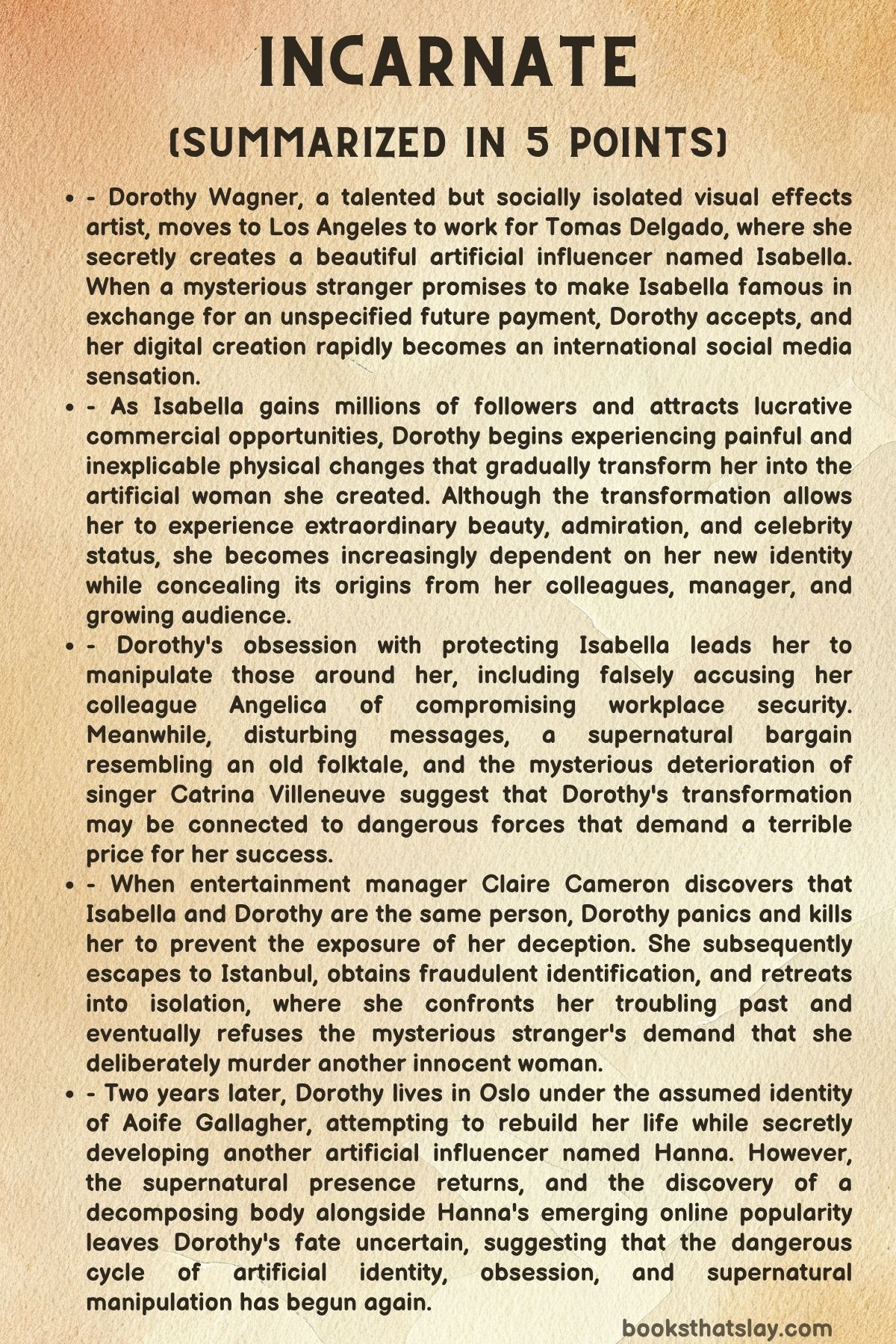
The story follows Dorothy Wagner, a talented but socially isolated visual effects artist who creates an exceptionally beautiful digital influencer named Isabella. When a mysterious stranger offers to make Isabella famous, Dorothy accepts without understanding the consequences. Her creation soon becomes an internet sensation, while Dorothy undergoes an impossible physical transformation that threatens to destroy her original identity. Combining technological anxiety with supernatural horror, the novel explores ambition, jealousy, deception, and the frightening consequences of allowing external validation to determine personal worth.
Summary
Dorothy Wagner grows up believing that the world rewards beauty, popularity, and social influence rather than intelligence or fairness. At twelve, she becomes the target of relentless bullying from three popular girls, Amber, Megan, and Hailey, whose cruelty leaves her isolated and humiliated.
During a psychiatric evaluation, Dorothy describes the harassment she has suffered, including messages allegedly encouraging her to commit suicide. However, her carefully controlled behavior suggests that she has manipulated the circumstances surrounding a disturbing incident involving Amber.
Dr. Gruber recommends transferring Dorothy to another school, apparently accepting her account of events. Dorothy believes she has successfully outsmarted the adults until she realizes that their sympathy may have more to do with the death of her younger brother, Jurgen, than with her explanations.
Ten years later, Dorothy moves to Los Angeles to pursue a career in visual effects. She has secured a position at Delgado Visual Effects, a studio founded by Tomas Delgado, whose remarkable digital recreations of celebrities have attracted considerable attention.
Dorothy initially stays with Marta, an aspiring actress who works as a hairstylist. Their uncomfortable interactions demonstrate Dorothy’s continuing difficulty establishing relationships and her tendency to interpret other people’s behavior negatively.
At the studio, Tomas recognizes Dorothy’s technical abilities and encourages her professional development. His approval becomes enormously important because she has rarely experienced recognition from someone whose judgment she respects.
Dorothy receives a significant opportunity when the studio undertakes a project involving famous singer Catrina Villeneuve. The assignment requires creating a convincing digital version of Catrina for advertising purposes.
Dorothy becomes fascinated by the possibilities of producing realistic human figures through advanced software. Inspired by the project, she secretly creates a beautiful artificial woman whom she names Isabella.
Unlike an ordinary digital character, Isabella is designed to possess the physical qualities Dorothy believes guarantee admiration. She is extraordinarily attractive, mysterious, and seemingly perfect.
Dorothy establishes social media accounts for Isabella, hoping to demonstrate her creative superiority and achieve independent recognition. The initial response is disappointing, with only modest attention from online audiences.
Everything changes when an unidentified stranger contacts Dorothy and offers to make Isabella extraordinarily successful. The stranger seems remarkably knowledgeable about her private ambitions and emotional insecurities.
Although suspicious of his intentions, Dorothy accepts his offer after convincing herself that an anonymous internet agreement cannot carry meaningful consequences. The stranger promises popularity in exchange for an unspecified future payment.
Dorothy subsequently produces another Isabella video featuring a fictional hairstylist named Adele. By the following morning, the video has attracted an astonishing number of views and reactions.
Isabella rapidly becomes an international social media phenomenon. Her beauty and mysterious background fascinate audiences, while journalists and technical specialists debate whether she is real.
Tomas also becomes interested in Isabella’s seemingly impossible realism. He assigns Dorothy to investigate the account, unaware that she secretly created the woman everyone is discussing.
Dorothy uses her professional position to conceal the truth while continuing to produce Isabella’s content. Her colleague Angelica becomes suspicious of Dorothy’s unusual working habits, creating tension within the studio.
As Isabella’s audience grows, Dorothy begins considering commercial opportunities. She approaches lawyer Herb Zeilman, concealing Isabella’s artificial nature while arranging ways to handle contracts and financial transactions.
Dorothy also secures the interest of influential entertainment manager Claire Cameron. Claiming to be Isabella’s intermediary, she constructs an elaborate fictional personality and invents excuses to explain why the mysterious celebrity cannot appear in person.
Meanwhile, Dorothy begins experiencing severe physical pain accompanied by changes in her appearance. Her facial structure gradually alters, her eyes become lighter, and her body grows taller.
Comparing her reflection with older photographs, Dorothy realizes that she is physically transforming into Isabella. Although frightened by the impossibility of the situation, she is also excited by the prospect of possessing the beauty she deliberately designed.
The mysterious stranger eventually confirms that the transformation is part of their arrangement. He suggests that Dorothy can become Isabella in reality, thereby gaining access to opportunities previously available only to her digital creation.
Dorothy increasingly welcomes the changes, despite their painful nature. However, her altered appearance attracts attention at work, particularly from Tomas and Angelica.
Determined to eliminate Angelica as a possible threat, Dorothy begins manipulating Tomas into believing his employee has compromised studio security. She eventually manufactures evidence by installing monitoring software and making Angelica appear responsible.
The accusation produces a confrontation that damages Angelica’s professional standing. Dorothy succeeds in protecting herself, but her actions demonstrate how readily she sacrifices another person’s livelihood to maintain control.
As her transformation progresses, Dorothy becomes almost indistinguishable from Isabella. Strangers begin recognizing her, forcing her to confront the possibility that her digital celebrity can now participate in ordinary public life.
She accepts a lucrative advertising assignment arranged by Claire and appears before cameras as Isabella. Although initially uncomfortable performing naturally, Dorothy gradually becomes more confident.
The experience is intoxicating. People admire her beauty, accommodate her demands, and treat her with the deference she has always associated with success.
Nevertheless, disturbing evidence begins suggesting that the stranger’s assistance carries terrifying consequences. An online account called cicada449 directs Dorothy toward a horror story about someone who accepted a similar supernatural bargain.
The story describes a mysterious figure known as Rollo3341, who grants extraordinary fame while concealing the price. Dorothy recognizes unsettling similarities between this account and her own experiences.
Her anxiety increases when she remembers the circumstances surrounding Jurgen’s death and the emotional devastation experienced by her family. The stranger’s apparent knowledge of her private history suggests that his influence extends far beyond internet algorithms.
Dorothy nevertheless attempts to establish Isabella within the existing community of successful influencers. She attends a gathering in San Diego, expecting her fame and beauty to guarantee acceptance.
Instead, she encounters rivalry, superficial friendships, and intense competition for attention. A controversy involving an influencer named Tony creates hostility, while another participant, Davey, secretly records Dorothy’s remarks.
The recording is released publicly, and Isabella becomes the target of online criticism. Dorothy responds by publishing her own evidence, convinced that the other influencers have deliberately misrepresented events.
The scandal revives memories of childhood bullying. Dorothy again believes that socially influential people can control public opinion regardless of the truth.
When Tony suffers a serious accident, Dorothy suspects that the mysterious stranger may have punished him on her behalf. Davey’s subsequent warning confirms that other people know about the supernatural figure and fear his power.
Although the controversy eventually becomes another challenge to manage, Isabella’s growing celebrity creates additional problems. Claire demands proper identification, legal documentation, and cooperation with professional obligations.
Dorothy cannot provide a legitimate personal history for a woman who never existed. Her deception becomes increasingly difficult to sustain.
At the same time, Catrina Villeneuve develops a mysterious illness. Her physical condition deteriorates dramatically, and Dorothy begins suspecting that her own transformation may somehow be connected to the singer’s suffering.
Because Isabella originated partly from digital material associated with Catrina, Dorothy wonders whether her newfound beauty has been obtained at another woman’s expense.
Despite these concerns, Dorothy continues protecting Isabella’s public identity. Her original life and invented persona become almost impossible to separate.
The crisis reaches its peak when Dorothy returns to Tomas’s studio during his business trip. Claire unexpectedly encounters her there and hears another employee address the woman she knows as Isabella by the name Dorothy.
Claire immediately recognizes that she has been deceived and demands an explanation. Dorothy struggles to invent a convincing response, revealing that her once-reliable ability to manipulate circumstances has begun deteriorating.
When Claire attempts to use her phone, Dorothy panics and attacks her. The confrontation ends with Claire’s death.
Recognizing that her crime could lead to exposure and imprisonment, Dorothy flees Los Angeles. She travels through Chicago before reaching Istanbul, where she obtains assistance from a document forger named Ger.
Ger provides false identification and guidance about disappearing. Dorothy realizes that preserving her freedom will require abandoning the very public identity she sacrificed so much to achieve.
She eventually retreats to an isolated cottage, where ordinary routines offer temporary relief from the pressures of celebrity. However, reports about Claire’s murder and Isabella’s disappearance continue threatening her fragile security.
A conversation with her mother, Teresa, brings another disturbing revelation. Teresa admits that she has long questioned whether Dorothy attempted to murder Amber during childhood and disguise the crime as suicide.
The revelation establishes that Dorothy’s capacity for calculated cruelty existed before the supernatural bargain. Her transformation has intensified dangerous tendencies rather than creating them.
The mysterious stranger eventually returns with another demand, apparently requiring Dorothy to murder an innocent woman. Unlike the killing of Claire, this would be a deliberate act carried out to satisfy the stranger’s wishes.
Dorothy refuses. She attempts to destroy Isabella’s public identity by arranging evidence suggesting that the influencer has died.
The stranger reacts furiously, threatening Dorothy for abandoning their arrangement. Nevertheless, she proceeds, hoping to reclaim control over her existence.
Two years later, Dorothy lives quietly in Oslo under the assumed name Aoife Gallagher. She supports herself through freelance visual effects work and believes that the investigation into Claire’s death may finally have faded.
Despite everything, she cannot abandon the creative process that originally brought her fame. She begins developing another artificial influencer named Hanna, promising herself that the project will remain modest.
Dorothy also retains Isabella’s digital files, unable to destroy the creation that once embodied her greatest ambitions. Soon, unexplained disturbances begin occurring, and the mysterious presence returns.
The stranger appears resentful of Dorothy’s abandonment and recognizes that Hanna has become Isabella’s replacement. Dorothy realizes that her attempt to escape the bargain has failed.
The novel then moves forward to Norwegian police officers investigating an apartment after neighbors report an unpleasant smell. Inside, they discover a badly damaged, decomposing body associated with Dorothy’s assumed identity.
Medical evidence raises troubling questions about the deceased woman’s identity, and investigators discover inconsistencies involving identification documents and DNA.
During the investigation, Freya encounters Hanna’s social media profile. The beautiful red-haired woman appears remarkably convincing, suggesting that another artificial celebrity is beginning to attract attention.
The ending leaves Dorothy’s ultimate fate uncertain while strongly suggesting that the supernatural influence has survived. Her efforts to abandon Isabella have not necessarily ended the dangerous relationship between digital creation, human identity, and the desire for recognition.
Characters
Dorothy Wagner
Dorothy Wagner is the central character of Incarnate, whose extraordinary intelligence, emotional insecurity, and hunger for recognition drive the novel’s events. She is a highly talented visual effects artist whose technical abilities contrast sharply with her difficulty developing meaningful personal relationships.
Her childhood experiences profoundly influence her understanding of society. Bullied by popular classmates and overshadowed by the emotional consequences of her brother’s death, Dorothy learns to associate social acceptance with power and physical attractiveness.
Rather than developing healthy ways of confronting these experiences, she becomes increasingly skilled at manipulating circumstances to protect herself. Her psychiatric evaluation demonstrates her ability to control narratives, exploit sympathy, and conceal her actual intentions.
As an adult, Dorothy remains intensely sensitive to rejection. She interprets criticism as deliberate hostility and frequently assumes that other people are attempting to undermine her professional or personal success.
Her relationship with Tomas provides an important exception because his recognition validates her genuine talent. Nevertheless, his approval is insufficient to satisfy her growing desire for public admiration.
Creating Isabella allows Dorothy to construct an idealized version of femininity that possesses everything she believes she lacks. Initially, she views the project as a demonstration of technical ability, but it gradually becomes a vehicle for escaping her original identity.
Her willingness to accept the stranger’s unexplained bargain reveals how readily ambition can overwhelm caution. Even when supernatural developments become undeniable, Dorothy focuses on the advantages of her transformation rather than the possible consequences.
Her moral deterioration becomes particularly evident in her treatment of Angelica. By fabricating evidence against an innocent colleague, Dorothy demonstrates that she considers other people’s suffering acceptable when it protects her interests.
Claire’s murder represents an even more serious revelation of Dorothy’s character. Faced with exposure, she resorts to violence rather than accepting responsibility for the deception she has constructed.
Yet Dorothy is not completely incapable of moral resistance. Her eventual refusal to murder another innocent woman suggests that some ethical boundaries remain, even after her considerable wrongdoing.
Her decision to create Hanna shows the persistence of her underlying desires. Despite losing her former life, Dorothy cannot abandon the possibility of creating another beautiful identity through which she might experience recognition.
Ultimately, Dorothy embodies the psychological danger of building personal worth entirely around external approval. Her tragedy arises not simply from supernatural manipulation but from the destructive choices she repeatedly makes while pursuing admiration.
Isabella
Isabella occupies a unique position in Incarnate because she begins as a digital creation rather than an independent human being. Nevertheless, she gradually acquires enormous influence over the characters and eventually becomes central to the novel’s supernatural mystery.
Dorothy designs Isabella to embody contemporary standards of extraordinary feminine beauty. Every physical characteristic is deliberately selected to attract attention and produce admiration.
Her lack of a conventional personal history initially contributes to her appeal. Online audiences interpret her secrecy as mystery, demonstrating how carefully controlled absence can become an effective form of celebrity branding.
Although Isabella initially possesses no independent consciousness or physical existence, her social influence becomes undeniably real. Millions of followers respond emotionally to her images, creating commercial opportunities and professional relationships.
Her transformation into a physical identity radically alters her significance. When Dorothy begins resembling Isabella, the artificial celebrity ceases to be merely a fictional persona and becomes a possible replacement for her creator.
Isabella represents the difference between external perfection and authentic personhood. Her beauty attracts admiration, but the elaborate identity surrounding her is built upon omissions, manipulation, and invented experiences.
The character also exposes the disturbing relationship between audience expectations and self-presentation. Dorothy must continuously expand Isabella’s fictional personality because online followers demand recognizable relationships, emotions, and personal experiences.
Isabella’s apparent survival after Dorothy attempts to abandon her suggests that artificial identities may acquire forms of existence beyond their creators’ control. Whether understood literally through supernatural forces or symbolically through digital permanence, she becomes a representation of identity escaping its original owner.
The Mysterious Stranger
The mysterious stranger serves as the principal supernatural antagonist, offering Dorothy extraordinary rewards while deliberately concealing the obligations attached to them. His ability to influence Isabella’s popularity and Dorothy’s body establishes him as a force operating beyond ordinary technological explanations.
He understands Dorothy’s psychological vulnerabilities with disturbing precision. Rather than threatening her immediately, he encourages her ambitions by promising the beauty, fame, and social influence she desperately desires.
His methods rely heavily on ambiguity. By refusing to specify the eventual payment, he allows Dorothy to imagine that the arrangement carries little genuine danger.
The stranger also possesses a manipulative understanding of human desire. He recognizes that Dorothy will become increasingly dependent on the rewards once she experiences their effects.
His apparent connection to online accounts and stories about supernatural bargains suggests that Dorothy is not his first victim. Davey’s fear further indicates that the stranger possesses a reputation among people who have encountered similar arrangements.
The possibility that he causes harm to Dorothy’s enemies demonstrates his frightening influence. Tony’s accident particularly raises questions about whether the stranger can transform private resentment into physical consequences.
His eventual demand that Dorothy commit murder reveals the true nature of his generosity. What initially appears to be assistance becomes an instrument of coercion.
When Dorothy attempts to abandon their agreement, he reacts with possessive anger, treating her independence as betrayal. His return through the surviving digital creation suggests that his power cannot easily be defeated through ordinary escape.
The stranger functions as an embodiment of predatory systems that exploit insecurity through promises of transformation. His supernatural nature intensifies the novel’s examination of the price people may pay for approval.
Tomas Delgado
Tomas Delgado is Dorothy’s employer, mentor, and one of the most important professional influences in Incarnate. A gifted visual effects artist, he achieves recognition through digital recreations of celebrities and establishes his own studio.
His enthusiasm for technology demonstrates genuine creative curiosity. Unlike Dorothy, whose ambitions increasingly become connected to status and personal validation, Tomas initially appears motivated by artistic achievement and innovation.
He recognizes Dorothy’s abilities before she becomes successful independently. His willingness to offer her opportunities gives her a sense of belonging that she has rarely experienced.
Nevertheless, Tomas is not entirely perceptive about his employees. His admiration for Dorothy’s technical accomplishments prevents him from recognizing the extent of her secretive behavior and manipulative tendencies.
His fascination with Isabella is especially ironic. He becomes determined to uncover the technology behind a digital celebrity created by someone working within his own company.
Tomas also represents the insecurity of professionals facing rapid technological change. Artificial intelligence threatens to make expensive visual effects techniques more accessible, placing his business under increasing competitive pressure.
His relationship with Angelica exposes weaknesses in his managerial judgment. When Dorothy manufactures accusations about computer security, he allows suspicion to disrupt an existing professional relationship.
Despite these failures, Tomas demonstrates concern for Dorothy’s health and well-being. His attempts to understand her transformation reveal a more compassionate side than Dorothy often acknowledges.
Through Tomas, the novel examines the tension between technical expertise and ethical responsibility. His professional knowledge allows him to recognize remarkable digital achievements, but it does not protect him from human deception.
Angelica
Angelica is Dorothy’s colleague at Delgado Visual Effects and becomes one of her principal perceived adversaries. Their relationship is characterized by suspicion, professional rivalry, and Dorothy’s determination to protect her secrets.
Angelica’s unfriendly manner immediately unsettles Dorothy. Because Dorothy already expects rejection, she interprets their early interactions as evidence of deliberate hostility.
As Isabella’s popularity increases, Angelica notices Dorothy’s unusual working habits and changing appearance. Her observations threaten Dorothy because they concern information she is desperate to conceal.
Dorothy eventually begins portraying Angelica as a workplace bully. This accusation draws upon Dorothy’s genuine childhood experiences while manipulating Tomas’s sympathy.
The situation becomes particularly serious when Dorothy plants evidence suggesting that Angelica has compromised the studio’s security. Angelica’s confrontation with Dorothy reveals her anger at being falsely accused and professionally endangered.
Although Angelica may be difficult or suspicious, her concerns are not entirely unreasonable. Dorothy is indeed concealing unauthorized activities and manipulating workplace information.
Angelica consequently becomes an example of how easily someone can be victimized by a convincing false narrative. Her reputation suffers because Dorothy understands how to exploit another person’s trust.
Her later public discussion of suspicious studio activities also contributes to the possibility that Dorothy’s crimes will be exposed. Angelica therefore represents an uncomfortable source of accountability for a protagonist who prefers controlling every account of her behavior.
Claire Cameron
Claire Cameron is an influential entertainment manager whose professional abilities help transform Isabella from an online curiosity into a potentially lucrative celebrity. She combines commercial intelligence with confidence and an understanding of the entertainment industry’s demands.
Dorothy initially admires Claire because she represents the kind of professional authority and social competence she wishes to possess. However, that admiration gradually becomes resentment when Claire begins asking difficult questions.
Claire’s interest in Isabella is understandable from a business perspective. The influencer possesses an enormous audience and substantial advertising potential, making her an attractive client.
Nevertheless, Claire’s experience also makes her increasingly attentive to the inconsistencies surrounding Isabella’s identity. She recognizes that commercial success requires legitimate documentation, reliable communication, and cooperation with professional obligations.
Her insistence on these requirements places Dorothy under considerable pressure. What Dorothy views as unnecessary interference is actually part of Claire’s responsibility as a manager.
Claire’s discovery of Dorothy’s deception at the studio becomes the catalyst for the novel’s most consequential violent confrontation. Her attempt to obtain an explanation threatens the entire identity Dorothy has constructed.
Her murder illustrates Dorothy’s willingness to eliminate obstacles rather than acknowledge wrongdoing. Claire becomes a victim precisely because she approaches the situation with the expectation that facts and professional accountability matter.
The character also demonstrates the limitations of commercial expertise when confronted with a fundamentally fraudulent identity. Claire can manage celebrity careers, but she cannot anticipate the supernatural and criminal circumstances underlying Isabella’s existence.
Catrina Villeneuve
Catrina Villeneuve is a successful singer whose professional collaboration with Tomas indirectly initiates Dorothy’s creation of Isabella. Her digital recordings provide important technical material for Dorothy’s experimental work.
Initially, Catrina appears as an established celebrity accustomed to commercial attention. Her endorsement campaign demonstrates how public figures increasingly allow their appearances to be reproduced artificially for business purposes.
Her questions about artificial intelligence reveal an awareness that technological progress may disrupt established creative industries. Although she participates in the process, she recognizes its broader implications.
Catrina later develops a mysterious and increasingly severe illness. Her physical deterioration occurs alongside Dorothy’s transformation into Isabella, suggesting a possible supernatural relationship between the two developments.
The possibility that Dorothy’s beauty comes at Catrina’s expense gives the character substantial moral importance. Catrina may be paying for a bargain she never knowingly accepted.
Her suffering also challenges the assumption that creating a digital likeness is harmless simply because it begins with technological reproduction. The novel raises questions about consent, ownership, and the consequences of manipulating another person’s image.
Catrina functions as a contrast to Dorothy. She possesses legitimate fame and professional achievements, yet becomes vulnerable to forces associated with someone else’s pursuit of recognition.
The uncertainty surrounding her condition contributes to the novel’s horror by leaving open the possibility that Dorothy’s success depends upon the destruction of another woman’s physical identity.
Herb Zeilman
Herb Zeilman is the lawyer Dorothy approaches when Isabella’s increasing popularity creates opportunities for commercial income. He becomes involved in constructing legal arrangements that allow a fictional individual to participate in business transactions.
His professional environment and willingness to consider unusual requests make him attractive to Dorothy. She believes he may be less likely than a more established attorney to investigate the circumstances surrounding Isabella.
Herb recognizes that Dorothy’s proposed arrangements contain suspicious elements. Nevertheless, he agrees to explore ways of representing the supposed influencer without requiring her direct participation.
His role reveals the practical difficulties of turning an artificial identity into a commercial entity. Even when online fame creates genuine economic value, contracts and financial institutions require documentation grounded in legal reality.
Herb also demonstrates how professional systems can become vulnerable when individuals accept incomplete explanations. Dorothy exploits his willingness to cooperate while carefully concealing the most significant fact about his supposed client.
Although he is not directly responsible for Dorothy’s supernatural predicament, his participation helps sustain the deception. He represents a legal structure that Dorothy attempts to manipulate for personal advantage.
Ric
Ric is another technician employed at Delgado Visual Effects and forms part of the professional environment in which Dorothy develops her skills. His presence emphasizes the competitive atmosphere surrounding specialized digital production.
Dorothy compares her abilities with those of Ric and Angelica, frequently interpreting professional differences through the lens of personal rivalry. Her desire to surpass her colleagues influences her determination to demonstrate exceptional technical talent.
As Dorothy’s secretive behavior becomes more pronounced, Ric grows uncomfortable around her. His reactions suggest that he may suspect something is wrong, particularly following the confrontation involving Angelica.
Unlike Tomas, who frequently gives Dorothy the benefit of the doubt, Ric appears less willing to dismiss the troubling circumstances surrounding her.
Although he is not a dominant figure in the narrative, he helps establish that Dorothy’s behavior is becoming increasingly visible. Her carefully constructed explanations cannot convince everyone indefinitely.
Marta
Marta is an aspiring actress who works as a hairstylist and temporarily accommodates Dorothy when she first arrives in Los Angeles. Her ordinary ambitions provide a contrast to Dorothy’s increasingly extreme pursuit of recognition.
Their interactions reveal Dorothy’s tendency toward social discomfort and judgment. Rather than viewing Marta simply as someone offering temporary assistance, Dorothy interprets their relationship through her own insecurities.
Marta also represents the difficult realities faced by people attempting to establish creative careers in Los Angeles. Her work and aspirations reflect the ordinary compromises required to survive in a competitive entertainment environment.
Her relatively small role remains important because she introduces Dorothy’s isolation before the supernatural events begin. Dorothy’s interpersonal difficulties are therefore established as preexisting characteristics rather than consequences of her bargain.
Jurgen Wagner
Jurgen is Dorothy’s younger brother, whose death casts a lasting shadow over her childhood and family relationships. Although he is deceased before the principal events unfold, his absence profoundly influences Dorothy’s emotional development.
His death devastates their parents, contributing to Teresa’s depression and her father’s anger. Dorothy grows up within a household struggling to manage grief and unresolved emotional pain.
Her school tormentors exploit this tragedy, using Jurgen’s death as another opportunity to humiliate her. Consequently, Dorothy associates one of her family’s most painful experiences with the cruelty of social exclusion.
Jurgen’s significance extends beyond providing background information. His death helps explain why Dorothy’s relationship with parental sympathy and attention becomes complicated.
The mysterious stranger’s apparent knowledge of this private history also increases Dorothy’s fear. The past she has tried to control or suppress becomes another area vulnerable to supernatural intrusion.
Through Jurgen, the novel demonstrates how unresolved family trauma can influence emotional development without necessarily determining a person’s moral choices.
Teresa Wagner
Teresa Wagner is Dorothy’s mother and an important connection to the protagonist’s troubled childhood. Her life is deeply affected by Jurgen’s death, which creates emotional distance and instability within the family.
Despite her grief, Teresa attempts to protect Dorothy during the investigation involving Amber. She supports her daughter’s version of events and helps prevent more serious consequences.
However, her later conversation with Dorothy reveals that this defense was not accompanied by complete certainty. Teresa admits that Amber accused Dorothy of attempting murder and disguising the crime as suicide.
The revelation suggests that Teresa has spent years living with unresolved doubts about her daughter’s behavior. Her maternal loyalty exists alongside an awareness that Dorothy may have committed something terrible.
Teresa’s role complicates Dorothy’s self-image as someone consistently mistreated by others. Her mother reveals that Dorothy has also benefited from protection and sympathy that may have concealed serious wrongdoing.
The character illustrates the difficulty of confronting disturbing truths about loved ones, particularly when a family is already burdened by profound grief.
Amber, Megan, and Hailey
Amber, Megan, and Hailey are the popular schoolgirls whose bullying shapes Dorothy’s early understanding of social power. Their behavior creates an environment in which Dorothy feels that popularity determines credibility and protection.
The girls humiliate and exclude Dorothy, reinforcing her belief that physical appearance and social status matter more than personal character. Their apparent ability to avoid punishment contributes to her resentment toward authority.
Amber occupies a particularly significant position because she becomes involved in the disturbing incident that leads to Dorothy’s psychiatric evaluation. Dorothy portrays herself as the victim, but later revelations suggest that Amber may have been endangered by Dorothy.
Megan and Hailey contribute to the social environment that makes Dorothy feel powerless. Together, the three girls symbolize the hierarchy Dorothy spends much of her adult life attempting to overcome.
Nevertheless, the novel does not present Dorothy’s childhood suffering as justification for her later violence. Instead, their treatment of her helps explain the origin of a resentment that develops into increasingly destructive behavior.
Dr. Gruber
Dr. Gruber is the psychiatrist who evaluates Dorothy after the troubling school incident. His conversations with her introduce the reader to the contrast between Dorothy’s outward behavior and her concealed intentions.
He recognizes that the circumstances are complicated and questions the reliability of her account. However, he ultimately recommends a school transfer rather than more serious intervention.
His decision allows Dorothy to believe that she has successfully manipulated the situation. She later realizes that her family’s tragedy may have influenced the sympathy she received.
Dr. Gruber represents the limitations of professional judgment when dealing with someone skilled at controlling appearances. His inability to establish the complete truth foreshadows Dorothy’s later success in deceiving employers, lawyers, and entertainment professionals.
Davey
Davey is an influencer Dorothy encounters during the San Diego gathering. His actions contribute significantly to the public controversy that damages Isabella’s reputation.
By recording remarks Dorothy believes are private, he demonstrates how social interactions within influencer culture can become material for public entertainment. His behavior reflects an environment in which attention often takes precedence over trust.
Davey’s later warning is more disturbing than the original controversy. He reveals that he knows Isabella is connected to a mysterious supernatural benefactor and would have behaved differently had he understood the danger.
This admission expands the novel’s supernatural world beyond Dorothy’s individual circumstances. It suggests that the stranger’s influence is recognized by others and that his protection inspires genuine fear.
Davey therefore serves two narrative purposes: exposing the manipulative practices of online celebrity culture and providing evidence that Dorothy is involved in a much larger supernatural system.
Tony
Tony is an influencer whose behavior during the San Diego gathering contributes to the conflict surrounding Isabella. Dorothy believes that other members of the group excuse his conduct because of his established social relationships.
Her anger toward Tony becomes especially intense when she feels that he is receiving protection from influential friends. The situation recalls her childhood experiences with popular classmates.
Tony subsequently suffers a serious accident, creating one of the novel’s most disturbing supernatural implications. Dorothy suspects that the mysterious stranger may have intervened to punish someone she resents.
His experience demonstrates that Dorothy’s private hostility may have consequences far beyond ordinary social conflict. Even without a confirmed explanation for the accident, its timing encourages Dorothy to fear the destructive potential of her bargain.
Charli, Shandybell, and TexasTwister
Charli, Shandybell, and TexasTwister represent the established influencer community Dorothy attempts to enter through Isabella. Their interactions expose the difference between carefully presented online friendships and complicated private relationships.
Charli helps organize the gathering that provides Dorothy with access to this exclusive social environment. The occasion initially seems to promise acceptance, but it eventually becomes a source of humiliation and conflict.
Shandybell contributes to the competitive atmosphere surrounding the event. The group’s constant attention to filming, content production, and reputation unsettles Dorothy, who has limited experience managing such social expectations.
TexasTwister becomes particularly important after the controversy escalates. By publishing criticism of Isabella, the influencer helps shape the public interpretation of events.
Together, these characters illustrate how online communities create hierarchies resembling the school environment Dorothy once hated. Her beauty and popularity provide access but do not guarantee genuine acceptance.
Ger
Ger is the clandestine document specialist Dorothy encounters after fleeing to Istanbul. His assistance allows her to obtain fraudulent identification and begin constructing a life beyond the reach of her former identity.
Although his occupation involves illegal activity, he treats Dorothy with a degree of kindness. This contrasts with her expectation that unfamiliar people are likely to exploit or threaten her.
Ger provides practical guidance through a booklet about disappearing. His advice emphasizes that escaping recognition requires changing behavior, limiting digital exposure, and abandoning familiar attachments.
His role creates an important irony. Dorothy once invested enormous effort in becoming visible to millions, but Ger helps her learn how to become almost invisible.
He represents the practical possibility of escape, even though Dorothy ultimately discovers that avoiding human investigators is easier than escaping her supernatural obligations.
Aoife Gallagher
Aoife Gallagher is the assumed identity Dorothy adopts while living in Norway. Rather than being a separate person, Aoife represents Dorothy’s attempt to replace her former existence with an ordinary, anonymous life.
Under this identity, Dorothy supports herself through freelance visual effects work and avoids the public attention that once defined her ambitions. Her apparent independence offers a temporary alternative to the demands of Isabella.
However, Aoife is still another constructed identity supported by false documentation and concealed history. Dorothy has not learned how to live openly with her original self.
The contrast between Aoife and Isabella is significant. One identity is designed to attract maximum attention, while the other exists to prevent recognition entirely.
Both identities demonstrate Dorothy’s continuing difficulty accepting herself without constructing an alternative persona. The disturbing circumstances surrounding Aoife’s apparent death suggest that changing names cannot erase the consequences of her previous choices.
Hanna
Hanna is the artificial influencer Dorothy develops after establishing her new life in Oslo. Her creation demonstrates that Dorothy’s fascination with digital identity survives even after the catastrophe involving Isabella.
Dorothy initially intends Hanna to remain a modest artistic project. She believes that avoiding extraordinary popularity will protect her from repeating earlier mistakes.
However, her renewed excitement suggests that the underlying psychological attraction remains unchanged. She still enjoys constructing beautiful personalities capable of receiving attention independently of her original identity.
Hanna’s existence also provokes the mysterious presence associated with Isabella. The stranger apparently interprets the new creation as a replacement and responds with resentment.
By the conclusion, Hanna possesses a convincing social media presence and attracts the attention of an investigator. Her appearance suggests that the dangerous process may be beginning again.
Hanna therefore represents both repetition and uncertainty. She may become another victim of the supernatural bargain, another vehicle for Dorothy’s ambitions, or something capable of escaping its creator’s control.
Einar, Aslaug, and Freya
Einar, Aslaug, and Freya are Norwegian authorities involved in the investigation of the disturbing death associated with Dorothy’s assumed identity. Their presence shifts the novel from Dorothy’s personal perspective toward the external consequences of her actions.
Einar and Aslaug enter the apartment after concerns arise about the missing occupant and an unpleasant smell. Their discovery of a severely damaged body creates immediate questions about violence and identity.
Freya becomes involved as forensic findings contradict the available identification documents. The deceased woman’s appearance and DNA evidence challenge straightforward explanations.
Her encounter with Hanna’s social media profile establishes the novel’s final disturbing connection between artificial identity and real-world consequences. Without knowing the significance of what she sees, Freya encounters another digital woman associated with Dorothy’s dangerous creative practices.
The investigators represent rational inquiry confronted with circumstances that resist ordinary explanation. Their inability to fully resolve the mystery reinforces the uncertainty surrounding Dorothy’s fate and the possible independence of her creations.
Themes
The Destructive Pursuit of Beauty, Fame, and Social Validation
Dorothy’s desire for admiration grows from years of humiliation and rejection. Her childhood experiences convince her that beauty and popularity determine who receives attention, sympathy, and protection.
Rather than rejecting these standards, she becomes determined to acquire the advantages they provide. Creating Isabella allows her to construct a woman who appears perfectly suited to society’s expectations.
In Incarnate, online popularity initially seems capable of correcting the emotional injuries Dorothy has experienced. Isabella’s success brings attention, professional opportunities, and eventual financial rewards.
However, Dorothy quickly discovers that admiration produces new insecurities. Every unfavorable comment threatens her confidence, while every competing influencer becomes a potential source of humiliation.
Her physical transformation intensifies this problem. Although she receives the beauty she once desired, she remains psychologically vulnerable to rejection because her underlying sense of inadequacy has not changed.
The San Diego controversy reveals the limitations of appearance and celebrity. Dorothy possesses extraordinary attractiveness and influence, yet she still struggles to form meaningful relationships or secure acceptance.
Her dependence on external approval ultimately contributes to increasingly destructive decisions. She frames Angelica, deceives Claire, and resorts to violence when her constructed identity is threatened.
The novel suggests that seeking recognition becomes dangerous when admiration replaces genuine self-respect. Dorothy’s achievements cannot satisfy her because she measures personal worth through the unstable judgments of strangers.
Even after escaping public life, she creates Hanna, demonstrating that the need for validation remains deeply rooted. Her inability to abandon artificial celebrity reflects the continuing psychological hold of the admiration she once experienced.
Identity, Artificial Intelligence, and the Loss of Authenticity
The distinction between authentic and manufactured identity gradually disappears as Dorothy’s relationship with Isabella develops. What begins as a technical experiment becomes a force capable of transforming her physical existence and psychological understanding of herself.
Digital technology allows Dorothy to create a convincing human appearance without producing an actual human being. Isabella possesses beauty, recognizable expressions, and an apparently independent personality, despite lacking a genuine personal history.
The public responds to Isabella as though she were real. Followers become emotionally invested in her life, while commercial organizations recognize her substantial economic value.
This reaction raises questions about authenticity in digital environments. If audiences develop genuine emotional attachments to a fictional personality, the consequences of that identity are real even when its origins are artificial.
Dorothy’s transformation makes these questions more disturbing. Her body gradually adopts Isabella’s appearance, creating uncertainty about whether the artificial identity is becoming human or the human creator is disappearing into her creation.
The practical difficulties of maintaining Isabella also expose the importance of personal history. Dorothy can manufacture images and performances, but she cannot easily invent legitimate documentation or a verifiable past.
Her eventual adoption of the name Aoife Gallagher continues the pattern of identity construction. Even after abandoning public celebrity, she depends upon another fabricated existence to survive.
Hanna’s emergence suggests that artificial identities may persist beyond their creators’ intentions. The supernatural influence surrounding these creations turns technological reproduction into a question of independent existence.
Through this uncertainty, the novel examines the danger of treating personal identity as something that can be endlessly redesigned without consequences. Dorothy’s outward transformations never resolve the unresolved conflicts within her original self.
Power, Manipulation, and Moral Responsibility
Dorothy frequently interprets power as the ability to control how other people perceive events. Her childhood psychiatric evaluation establishes this understanding long before she encounters the mysterious stranger.
By presenting carefully selected information, she learns that convincing narratives can influence authority figures even when important facts remain concealed. This lesson becomes central to her adult behavior.
Her treatment of Angelica demonstrates how deception can become a weapon against someone with less control over the situation. Dorothy exploits Tomas’s professional anxieties to make an innocent colleague appear responsible for a serious security violation.
In Incarnate, manipulation operates at both human and supernatural levels. Dorothy deceives colleagues and business associates, while the stranger manipulates Dorothy through promises tailored to her deepest insecurities.
This parallel is especially significant because Dorothy repeatedly experiences the kind of exploitation she inflicts upon others. She resents being controlled but rarely questions her own willingness to control people.
The mysterious bargain also challenges the meaning of consent. Dorothy agrees to an unspecified future payment without understanding the consequences, while the stranger uses her growing dependence to increase his influence.
Yet the supernatural arrangement does not eliminate Dorothy’s responsibility for her actions. Her decision to frame Angelica is deliberate, and Claire’s death results from her unwillingness to confront exposure.
The suggestion that Catrina may be suffering because of Dorothy’s transformation further complicates the moral consequences of ambition. The rewards Dorothy enjoys may involve costs imposed upon people who never agreed to participate.
Her eventual refusal to commit another murder introduces a limited possibility of resistance. Nevertheless, her previous actions remain unresolved, making her refusal an important moral boundary rather than complete redemption.
The novel ultimately questions whether extraordinary power reveals a person’s character more clearly than ordinary circumstances. Dorothy’s supernatural advantages intensify patterns of behavior that were already present throughout her life.
Trauma, Obsession, and the Repetition of Destructive Behavior
The emotional consequences of Dorothy’s childhood remain active throughout her adult life. Bullying, family grief, and unresolved questions about her behavior shape the assumptions through which she interprets other people’s intentions.
Her brother Jurgen’s death creates a household burdened by suffering. At school, the cruelty of her classmates reinforces her belief that vulnerability invites humiliation.
As Dorothy grows older, she develops an intense need to anticipate threats and control situations before anyone can embarrass or reject her. These habits become especially destructive when she gains professional independence.
Her creation of Isabella initially appears to offer an escape from past suffering. Through artificial beauty and public admiration, Dorothy imagines that she can become someone who will never again experience the powerlessness of her childhood.
However, her experiences with other influencers reveal that changing her appearance does not change her emotional responses. She continues interpreting disagreements as persecution and reacting to criticism with disproportionate anger.
The revelation concerning Amber demonstrates that Dorothy’s troubling behavior predates the supernatural bargain. Teresa’s uncertainty about the childhood incident suggests a long-standing pattern of manipulation and possible violence.
This continuity prevents the novel from presenting Dorothy merely as an innocent victim corrupted by an external force. Her history contains both genuine suffering and evidence of choices that have harmed others.
Her attempt to disappear provides a temporary opportunity for change. Living quietly allows her to experience ordinary routines without constantly competing for attention.
Nevertheless, she eventually creates Hanna, repeating the activity that originally exposed her to supernatural danger. She convinces herself that a smaller project will avoid the consequences of Isabella’s success.
The ending challenges that assumption by suggesting that the destructive cycle continues despite Dorothy’s intentions. Her failure to destroy Isabella’s files symbolizes her inability to release the emotional attachment to her former achievements.
The novel presents obsession as a pattern sustained by unresolved desires rather than a problem solved through external transformation. Until Dorothy confronts her need for admiration and control, changing her appearance, location, or identity cannot provide lasting freedom.