Kneel Before Me Summary, Characters and Themes
Kneel Before Me by Lindsay Straube is a dark fantasy romance that explores forbidden love, political ambition, obsession, and the struggle for power between humans and basilisks.
The story follows Daphne Verus, a young woman who wants nothing to do with the royal marriage competition, yet becomes involved with a basilisk named Kronos Seneca. Their relationship challenges centuries of hostility between their species and threatens the powerful Drakon family. Meanwhile, Prince Maximus struggles with jealousy and grief, while Caspen Drakon faces the destructive consequences of his family’s ambitions. Through competing loyalties, magical bonds, and devastating sacrifices, the novel examines the difference between genuine love and possession. It’s the 3rd book of the Split or Swallow series.
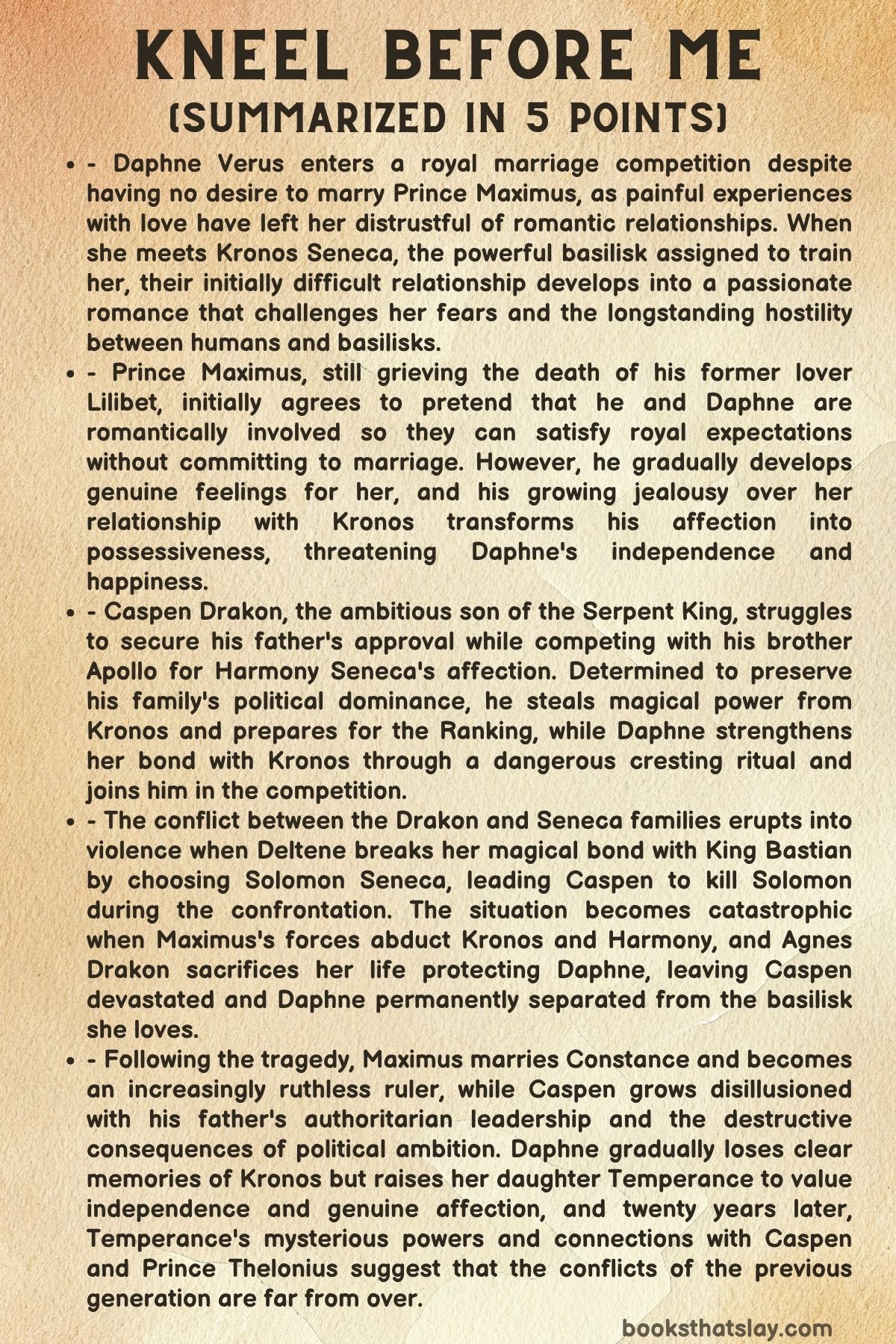
Summary
Kneel Before Me begins in a kingdom where humans and basilisks coexist under a fragile political arrangement shaped by generations of violence. The human monarchy holds considerable authority, while the basilisks maintain their own hierarchy beneath the mountain, ruled by the powerful Serpent King, Bastian Drakon.
Bastian’s eldest son, Caspenon Drakon, possesses exceptional strength but remains unable to achieve the supremacy his father expects. His ambitions are complicated by his attachment to Harmony Seneca, a basilisk who maintains relationships with both Caspen and his younger brother Apollo.
Caspen desperately wants Harmony’s exclusive affection, yet she repeatedly manipulates the rivalry between the brothers. His desire to become Serpent King is consequently driven by a mixture of political responsibility, paternal pressure, and emotional insecurity.
Meanwhile, human women enter a traditional marriage competition designed to select a wife for Prince Maximus. Each contestant receives training from a basilisk, whose performance contributes to the balance of power within basilisk society.
Daphne Verus enters this arrangement with little enthusiasm. Abandoned by her father and mistreated by a former lover named Benjamin, she distrusts romance and fears that genuine affection may be impossible for her.
Her assigned trainer, Kronos Seneca, initially appears intimidating. Daphne immediately declares that she does not want sexual intimacy, establishing boundaries that challenge the expectations surrounding the competition.
Although Kronos insists that she participate seriously, he respects her refusal to become physically involved with him. Their conversations gradually reveal his attentiveness and unexpected tenderness, allowing Daphne to reconsider her assumptions about basilisks.
At the first royal gathering, Daphne encounters Prince Maximus under unusual circumstances. Rather than competing for his attention, she comforts his crying daughter, Lilly, whose mother, Lilibet, has died.
Maximus is still grieving Lilibet and resents his father Augustus for pressuring him to remarry. Discovering that Daphne is equally uninterested in the competition, he proposes that they pretend to develop a romance.
Their agreement would satisfy royal expectations while allowing both to maintain some control over their futures. Daphne accepts, believing that this deception offers a way to avoid an unwanted marriage.
However, their arrangement creates complications when Maximus publicly selects Daphne during the Showing. His attention humiliates the other contestants and attracts the interest of Caspen, who recognizes Kronos’s unusually emotional reaction.
Caspen understands that genuine affection between a basilisk and a human may strengthen magical abilities. Consequently, Daphne’s growing importance to Kronos threatens the Drakon family’s political supremacy.
As Daphne continues meeting Kronos, their initial disagreements give way to attraction. Although his jealousy sometimes frightens her, she gradually discovers that he offers the emotional presence and consideration she has rarely experienced.
Their first kiss transforms the relationship, and subsequent encounters deepen their intimacy. Daphne begins trusting Kronos with feelings she previously concealed, particularly her fear of abandonment and her belief that she is unworthy of lasting love.
At the same time, Maximus begins developing genuine romantic feelings for Daphne. What began as a practical deception becomes a personal pursuit, despite her repeated insistence that she does not want a conventional royal marriage.
His attraction is complicated by his memories of Lilibet. He recognizes that Daphne has made his grief easier to bear, but he struggles to distinguish the possibility of renewed happiness from the desire to claim her affection.
The political conflict grows more dangerous as Caspen prepares for the Ranking, a competition that determines the distribution of authority among basilisks. His father demands victory, fearing that the Seneca family could threaten Drakon dominance.
Caspen discovers a way to steal Kronos’s power by biting him and establishing a magical connection. The attack allows him to drain Kronos repeatedly, leaving his rival vulnerable without immediately killing him.
Daphne witnesses Kronos suffering during one of these attacks and becomes determined to protect him. She asks him to crest her, an intimate magical process that creates a powerful connection between them.
Kronos initially resists because the procedure could seriously injure a human. Nevertheless, Daphne insists that protecting their relationship requires taking risks rather than remaining powerless.
The crest changes their bond permanently. Their physical and emotional connection grows stronger, but Daphne also begins experiencing unexplained weakness after intimate encounters with Maximus.
Meanwhile, the human kingdom’s treatment of basilisks becomes increasingly disturbing. Daphne learns that captured creatures are imprisoned because their blood can be transformed into gold, providing wealth and symbolic authority to the monarchy.
The royal crown itself represents this exploitation. Caspen’s resentment toward humanity is therefore rooted in actual suffering, even though his family also maintains an oppressive system within basilisk society.
Daphne’s relationship with Maximus deteriorates when he discovers affectionate letters from Kronos in her bedroom. He reads them without permission, becomes furious, and confronts her over her concealed relationship.
Daphne reminds him that their original arrangement never promised genuine romantic commitment. Nevertheless, Maximus treats her affection for Kronos as a personal betrayal and threatens her position in the competition.
Hurt by his accusations, Daphne seeks comfort with Kronos and agrees to accompany him to the Ranking as his guest. This decision represents a significant change from her earlier fear of basilisk customs.
During the Ranking, Daphne witnesses a society governed by elaborate rituals involving intimacy, magical power, and public judgment. She also develops a friendship with Agnes Drakon, Caspen’s younger sister, whose curiosity about humans challenges her family’s prejudices.
Daphne and Kronos perform exceptionally during the first challenge, winning despite the physical demands placed upon her. Kronos prioritizes her well-being over celebrating, reinforcing her belief that his affection is genuine.
However, the second challenge forces them to confront the conflict between political ambition and personal boundaries. Kronos chooses to forfeit rather than participate in something that would compromise their relationship.
Daphne worries that his sacrifice will cost him the throne, but his decision demonstrates that he values her more than victory.
The final challenge leaves the question of succession unresolved because the goddess Kora must ultimately determine the distribution of power. Her judgment is also connected to the outcome of the human marriage competition.
Kronos openly declares his love, but uncertainty continues surrounding their future together. Daphne returns to the human world, where Maximus attempts to reconcile with her.
Although the prince apologizes for his earlier behavior, his affection becomes increasingly possessive. He struggles to accept that Daphne can care for him without wanting to marry him.
Their conflict intensifies when Daphne discovers imprisoned basilisks inside the castle. Seeing their suffering strengthens her opposition to the monarchy’s traditions and deepens her commitment to Kronos.
Maximus eventually offers marriage, hoping that a formal proposal will secure the relationship he desires. Daphne, however, cannot accept a future built upon the imprisonment and exploitation of the person she loves.
Meanwhile, the Ranking reaches its final ceremony, where the Drakon family’s internal conflicts erupt. Deltene, Bastian’s wife, chooses Solomon Seneca, breaking the blood bond that has supported the Serpent King’s extraordinary strength.
Bastian responds violently, forcing Caspen to defend his mother. The confrontation escalates into a battle involving Caspen, Apollo, Solomon, and members of the rival basilisk families.
Caspen ultimately kills Solomon through the forbidden practice of cresting another basilisk. Although his actions prevent further immediate destruction, they permanently damage his reputation and deepen the hostility between the Drakons and Senecas.
During the ensuing chaos, Kronos and Daphne are attacked by powerful basilisks acting under royal authority. Despite drawing strength from their magical connection, Kronos cannot overcome the attackers.
Daphne is separated from him, while Harmony is also abducted. Caspen, Apollo, Agnes, and Daphne attempt to pursue the prisoners, discovering that the abductions are connected to the human monarchy.
Outside the mountain, Prince Maximus appears with armed guards and roosters whose cries weaken basilisks. His involvement reveals the extent to which jealousy and resentment have transformed his behavior.
As violence erupts, Daphne becomes the target of an attacking basilisk. Agnes intervenes to protect her and receives a fatal bite.
Caspen catches his dying sister while Apollo retaliates against her attacker. Agnes’s sacrifice devastates the family and prevents the brothers from rescuing Harmony.
Daphne confronts Maximus, accusing him of cruelty and warning that he is becoming like Augustus. She declares that his actions have taken away the love of her life and permanently rejects him.
The consequences continue across the following years. Maximus marries Constance, who dies while giving birth to their son, Thelonius.
Rather than learning from his mistakes, Maximus becomes an increasingly authoritarian ruler. He expands the exploitation of imprisoned basilisks and treats emotional vulnerability as weakness.
Caspen also suffers from the consequences of the conflict. Agnes is dead, Harmony remains absent, Apollo has become estranged from him, and Bastian grows more tyrannical.
Although Caspen once believed that acquiring power would resolve his problems, he discovers that victory has brought little satisfaction. He begins questioning his father’s authority and considers confronting the corruption within basilisk society.
Daphne’s life takes a different direction after her separation from Kronos. Unable to return safely to him, she gradually loses much of her conscious memory of their relationship, although the emotional absence remains.
She moves to a chicken farm, where roosters provide protection against basilisks, and eventually gives birth to a daughter named Temperance. Daphne raises her child with the determination that she should never confuse cruelty with love or accept humiliation as the price of affection.
Twenty years later, Caspen encounters Temperance during a new generation’s basilisk training. Her unusual presence and mysterious magical power immediately distinguish her from ordinary humans.
Their developing attraction raises questions about Temperance’s true nature and the unfinished conflict between the two species.
The story also introduces Thelonius, known as Leo, who faces a marriage competition similar to the one that shaped his father’s life. His complicated attraction to Temperance suggests that the political and romantic struggles of the previous generation may continue in unexpected ways.
The novel ends with love, political power, and family history remaining closely connected. Daphne and Kronos’s separation leaves a lasting legacy, while Temperance’s extraordinary abilities suggest the possibility of profound changes to the world her parents knew.
Characters
Daphne Verus
Daphne Verus is the emotional center of Kneel Before Me, a young woman whose transformation from distrustful independence to courageous devotion drives much of the novel. Her experiences with abandonment, humiliation, and romantic mistreatment have convinced her that love inevitably leads to disappointment.
At the beginning of the story, Daphne believes that avoiding intimacy is the safest way to protect herself. Her refusal to participate willingly in the royal marriage competition reflects both her desire for independence and her fear of becoming vulnerable to another man’s expectations.
Her relationship with Kronos fundamentally challenges these beliefs. Although she initially fears his authority, she gradually discovers that emotional closeness can exist without the loss of personal freedom.
Daphne’s courage becomes especially apparent when she agrees to undergo the crest and later participates in the Ranking. These decisions demonstrate her willingness to face extraordinary danger for someone she loves, even when she cannot guarantee a favorable outcome.
Her compassion also extends beyond her romantic relationship. Her friendship with Agnes and concern for imprisoned basilisks demonstrate her ability to reject prejudices she has inherited from human society.
Daphne’s final separation from Kronos represents the cruelest consequence of the political conflict. Nevertheless, her determination to raise Temperance with a healthier understanding of love demonstrates that suffering has not destroyed her capacity for hope.
Kronos Seneca
Kronos Seneca represents the possibility of genuine affection within a society where intimacy is frequently connected to status, competition, and political advantage. Although he initially appears commanding and intimidating, his relationship with Daphne reveals a more considerate personality.
His early insistence that Daphne participate in the competition creates tension because she interprets his authority through the experiences of her past. As their relationship develops, Kronos demonstrates that his concern extends beyond winning the prince’s marriage competition.
One of his defining qualities is his willingness to respect Daphne’s boundaries. Even when he strongly desires her, he repeatedly allows her to determine the nature and pace of their intimacy.
However, Kronos is not entirely free from possessiveness. His jealousy of Maximus and occasional difficulty controlling his anger expose the conflict between his protective instincts and his emotional vulnerability.
His decision to forfeit a challenge during the Ranking reveals the depth of his transformation. He willingly sacrifices an opportunity for power rather than compromise Daphne’s comfort and trust.
Kronos’s character in Kneel Before Me demonstrates that love is not measured simply by the intensity of desire but by the willingness to protect another person’s independence. His eventual captivity makes his relationship with Daphne one of the novel’s most tragic examples of affection destroyed by political ambition.
Caspenon Drakon
Caspenon Drakon, commonly called Caspen, is one of the most psychologically complicated figures in the novel. As the eldest son of the Serpent King, he possesses extraordinary magical strength and a prestigious position, yet his life is dominated by insecurity.
His father Bastian expects him to maintain the Drakon family’s supremacy, while Harmony Seneca repeatedly makes him compete with Apollo for her affection. These pressures create a man who associates personal worth with winning, dominance, and recognition.
Caspen initially regards humans as inferior and approaches his rivalry with Kronos primarily through political calculation. His decision to establish a power-draining connection with Kronos reveals how far he is willing to go to protect his family’s influence.
Nevertheless, his moral development becomes increasingly apparent through his relationship with Agnes. Her openness toward humans forces him to reconsider assumptions he previously accepted without question.
His intervention when Daphne faces danger demonstrates that compassion survives beneath his ambition. His later decision to protect Deltene against Bastian also reveals the growing conflict between loyalty to authority and loyalty to his conscience.
The death of Agnes becomes the defining tragedy of his life. Although he retains considerable power, he loses the relationships that once gave his ambitions meaning.
By the conclusion, Caspen begins recognizing that the greatest threat to basilisk society may come from its own rulers. His encounter with Temperance suggests that his emotional and political transformation remains unfinished.
Prince Maximus
Prince Maximus is a central antagonist whose gradual moral deterioration gives Kneel Before Me much of its psychological tension. Initially, he appears as a grieving father and reluctant royal heir who has lost the woman he loved.
His affection for Lilibet and devotion to Lilly reveal that he possesses a genuine capacity for tenderness. His opposition to the marriage competition also suggests that he understands the suffering caused by relationships imposed through royal authority.
However, his attraction to Daphne gradually exposes a darker aspect of his personality. Although their agreement begins as a mutually beneficial deception, Maximus eventually treats her affection as something he deserves to receive.
His decision to read Daphne’s private letters demonstrates his growing unwillingness to respect her independence. Instead of acknowledging his wrongdoing, he directs his anger toward her relationship with Kronos.
Maximus increasingly confuses rejection with humiliation and interprets Daphne’s refusal as a threat to his authority. His involvement in Kronos’s abduction demonstrates how personal jealousy becomes political violence.
After losing Daphne, he rejects emotional vulnerability and embraces the authoritarian principles of his father. His later treatment of Constance and the imprisoned basilisks demonstrates the destructive consequences of refusing personal responsibility.
Maximus is especially disturbing because his cruelty develops from recognizable human emotions. His character shows how grief and insecurity can become dangerous when combined with entitlement and unchecked power.
Harmony Seneca
Harmony Seneca is a powerful and influential basilisk whose relationships with Caspen and Apollo shape much of the Drakon family’s internal conflict. She enjoys maintaining the brothers’ attention and repeatedly encourages their competition for her affection.
Her behavior reflects a society where intimate relationships frequently function as demonstrations of status and influence. Rather than committing exclusively to either brother, Harmony uses uncertainty to preserve her control.
Caspen’s emotional dependence gives her considerable power over his ambitions. Her suggestion that becoming Serpent King might make him more desirable encourages him to pursue authority for reasons that extend beyond political responsibility.
Harmony is not presented merely as an object of competition, however. Her refusal to accept the expectations placed upon her demonstrates her independence, even when her methods are emotionally destructive.
Her eventual agreement to accompany Caspen during the Ranking temporarily suggests that their relationship might become more stable. Nevertheless, the underlying distrust remains unresolved.
Harmony’s abduction transforms her from a figure who manipulates power into someone directly threatened by the political violence surrounding her. Her disappearance also deprives Caspen of the relationship that once defined so much of his emotional life.
Apollo Drakon
Apollo Drakon is Caspen’s younger brother and romantic rival, whose relationship with Harmony contributes significantly to the tension within the Drakon family. His confidence and provocative behavior frequently intensify Caspen’s insecurity.
Apollo appears to enjoy demonstrating that Harmony continues to desire him despite Caspen’s superior political position. Their rivalry reveals how competition for affection has become inseparable from the family’s struggle over authority.
Although he often behaves selfishly, Apollo is not entirely disconnected from familial loyalty. The violent confrontation involving Solomon forces him and Caspen into a dangerous conflict that tests their relationship.
When Caspen intervenes during the fighting, Apollo acknowledges that his brother has spared him and promises to repay the debt. This moment briefly reveals the possibility of solidarity beneath their rivalry.
Agnes’s death profoundly affects Apollo. His retaliation against the basilisk responsible demonstrates both his loyalty to his sister and his tendency to express grief through violence.
In the years that follow, Apollo becomes increasingly estranged from Caspen. His character illustrates how unresolved jealousy and shared trauma can destroy relationships that might otherwise provide essential emotional support.
Bastian Drakon
Bastian Drakon, the Serpent King, embodies the authoritarian traditions governing basilisk society. His political identity depends upon preserving the supremacy of the Drakon family, regardless of the consequences for others.
He pressures Caspen to acquire greater strength and regards the Senecas as dangerous rivals. His expectations contribute to Caspen’s belief that failure to achieve dominance is equivalent to personal inadequacy.
Bastian’s relationship with Deltene reveals another dimension of his controlling personality. The blood bond connecting them sustains his extraordinary power, making their marriage inseparable from his political authority.
When Deltene chooses Solomon, Bastian responds with violence because he perceives the decision as both personal betrayal and an attack upon his supremacy.
His behavior eventually forces Caspen to oppose him, exposing the contradiction between Bastian’s claims of protecting his family and his willingness to threaten its members.
Even after the Ranking, Bastian becomes increasingly oppressive. His rule demonstrates how authority maintained through fear eventually destroys the loyalty and stability it claims to protect.
Agnes Drakon
Agnes Drakon is one of the most compassionate characters in Kneel Before Me, representing the possibility of friendship between humans and basilisks despite generations of hostility. Her curiosity and openness distinguish her from many members of her powerful family.
Unlike relatives who regard humans primarily as inferior creatures, Agnes approaches Daphne with genuine interest. Their friendship demonstrates that cultural prejudice is not inevitable, even among those raised within oppressive political structures.
Agnes also influences Caspen’s moral development. His protectiveness toward her exposes a gentler aspect of his personality and gradually encourages him to question his inherited assumptions.
Her courage becomes especially apparent during the violent confrontation involving Maximus and the royal guards. When Daphne is threatened, Agnes places herself between her friend and an attacking basilisk.
The resulting fatal injury makes her sacrifice one of the novel’s defining tragedies. Her death exposes the terrible human cost of the political conflict and permanently changes the lives of Caspen, Apollo, and Daphne.
Agnes represents innocence destroyed by the ambitions of those who possess far greater authority. Her actions also demonstrate that genuine moral courage may come from individuals who refuse to accept the divisions maintained by their societies.
Deltene Drakon
Deltene Drakon is the basilisk queen and mother of Caspen, Apollo, and Agnes. Her presence provides an emotional counterbalance to Bastian’s increasingly aggressive leadership.
Although she occupies a prestigious position, her marriage is shaped by a blood bond that contributes directly to her husband’s extraordinary magical power. This arrangement demonstrates how intimate relationships within basilisk society can become instruments of political control.
Deltene’s decision to choose Solomon Seneca challenges the established hierarchy and exposes the fragility of Bastian’s authority. Her actions trigger a violent confrontation that transforms the future of both dominant basilisk families.
The consequences demonstrate how deeply the political system depends upon controlling personal loyalty. By exercising her own choice, Deltene threatens structures that others have treated as permanent.
Her eventual absence leaves Caspen without an important source of compassion and stability. Through Deltene, the novel explores the dangerous consequences of a society in which marriage and affection are subordinated to the preservation of power.
Solomon Seneca
Solomon Seneca is a significant figure within the Seneca family whose involvement with Deltene precipitates the collapse of the existing political arrangement. Although he receives less attention than several other characters, his actions have enormous consequences.
Deltene’s choice of Solomon breaks the blood bond supporting Bastian’s strength, turning a personal decision into a direct challenge to the Serpent King’s authority.
Solomon’s position demonstrates the rivalry between the Senecas and Drakons. His relationship with the queen carries political implications that neither family can safely ignore.
During the ensuing confrontation, Caspen kills Solomon through the forbidden practice of cresting another basilisk. The act permanently damages Caspen’s reputation and intensifies the hostility between the families.
Solomon’s death also drives Rowe’s anger and contributes to the violence spreading through the gathering. His character illustrates how individual relationships can become catalysts for collective conflict when power is maintained through inherited rivalries.
Rowe Seneca
Rowe Seneca represents the hostile and retaliatory impulses that sustain the conflict between the basilisk families. His resentment toward Kronos and Daphne arises from concerns about their growing power and the disruption of established traditions.
Unlike characters who gradually reconsider their prejudices, Rowe appears increasingly willing to threaten others to preserve the existing balance of authority. His interest in harming Daphne demonstrates how human vulnerability can be exploited within basilisk political struggles.
Caspen’s intervention against Rowe is significant because it exposes a moral difference between two characters who otherwise share similar assumptions about humans.
Rowe’s anger becomes even more dangerous following Solomon’s death. Holding Caspen responsible, he confronts him violently and prevents him from pursuing Harmony’s abductors.
His actions demonstrate how revenge can interfere with the protection of those still in danger. Rowe’s character reinforces the novel’s criticism of political cultures that treat resentment and retaliation as legitimate expressions of loyalty.
King Augustus
King Augustus is the human monarch whose rigid expectations shape Maximus’s life. He believes that royal authority must be preserved through strength, obedience, and the careful management of political alliances.
His insistence that Maximus remarry demonstrates his tendency to prioritize succession over personal grief. Although his concerns about instability are politically understandable, his treatment of his son leaves little room for emotional independence.
Augustus also maintains the human kingdom’s exploitative relationship with imprisoned basilisks. The wealth extracted from their blood reflects a system in which suffering is justified as a necessary foundation of royal prosperity.
His influence becomes increasingly visible in Maximus’s later behavior. When the prince experiences rejection, he begins adopting his father’s belief that compassion and vulnerability are dangerous weaknesses.
Augustus therefore functions as both a political authority and a model of destructive masculinity. His legacy survives through the attitudes Maximus develops toward love, power, and punishment.
Lilibet
Lilibet is Maximus’s deceased lover and the mother of Lilly. Although much of her presence in the story emerges through memories and letters, her relationship with Maximus provides important insight into his earlier personality.
Their romance developed despite Augustus’s disapproval, demonstrating that Maximus once possessed the courage to challenge royal expectations for someone he loved.
The correspondence between them reveals genuine tenderness and mutual affection. Maximus’s determination to bring Lilibet into the castle after learning of her pregnancy also suggests his willingness to assume responsibility for their future.
Her death leaves him emotionally devastated and contributes to his resistance to another marriage. However, the grief he experiences eventually becomes entangled with possessiveness when he develops feelings for Daphne.
Lilibet’s significance therefore extends beyond her absence. She represents a form of love that Maximus once understood but becomes increasingly incapable of practicing.
Constance
Constance is the human contestant trained by Caspen and eventually chosen as Maximus’s wife. Initially, her importance comes from her participation in the marriage competition, where she represents the Drakon family’s opportunity to gain political advantage.
Her inability to attract Maximus’s interest as successfully as Daphne increases Caspen’s anxiety about Kronos’s growing influence.
Following the destruction of Daphne and Maximus’s relationship, Constance marries the prince and becomes part of the royal family. However, the marriage offers little emotional fulfillment because Maximus remains consumed by resentment and unwilling to form another meaningful attachment.
Constance’s death while giving birth to Thelonius emphasizes the sacrifices imposed upon women within the monarchy. Her position provides status but does not guarantee affection, security, or happiness.
Her character demonstrates how royal marriage can reduce individuals to their political and reproductive functions.
Ella
Ella is Daphne’s closest friend and an important connection to ordinary village life. As the mother of Gabriel, she occupies a world of practical responsibilities far removed from the elaborate political struggles of the basilisks and the royal family.
Her irreverent attitude toward royalty provides a contrast to the deference expected from most villagers. She is willing to question the prince’s intentions rather than assume that his attention must be beneficial.
Ella offers Daphne companionship during periods of uncertainty and emotional distress. Their friendship becomes particularly significant when Daphne’s relationships with Kronos and Maximus create pressures she cannot freely discuss.
Although Daphne frequently conceals information from her, Ella remains an important source of stability. She represents the enduring value of friendship in a story where romantic desire often becomes entangled with control and competition.
Benjamin
Benjamin is Daphne’s former lover, whose mistreatment has profoundly damaged her confidence in romantic relationships. Although his role is less extensive than those of the principal characters, his influence is visible throughout Daphne’s emotional development.
His behavior has taught Daphne to associate intimacy with humiliation, abandonment, and unequal power. As a result, she initially fears that allowing another man close to her will inevitably lead to similar suffering.
Benjamin’s public mistreatment during the marriage competition reinforces her existing insecurities. His actions also provide an opportunity for Maximus to demonstrate concern, although the prince later reveals his own troubling possessiveness.
Benjamin functions as an example of the emotional cruelty Daphne must learn to reject. His significance lies primarily in the lasting psychological consequences of his treatment rather than in his personal development.
Temperance
Temperance, often called Tem, is Daphne’s daughter and an important figure in the closing portion of the novel. Her appearance shifts attention toward the next generation and the consequences of the relationships that shaped her mother’s life.
Daphne raises Temperance with the hope that she will possess greater confidence and independence than Daphne herself had when she was younger. This upbringing reflects Daphne’s determination to transform painful experiences into a healthier emotional inheritance.
Twenty years after the Ranking, Temperance encounters Caspen during basilisk training. Her unusual presence and mysterious magical abilities immediately attract his attention.
Their developing connection suggests that Temperance possesses qualities that distinguish her from ordinary humans. Her possible supernatural heritage raises questions about the lasting consequences of Daphne’s relationship with Kronos.
Temperance’s encounters with Thelonius also introduce another complicated relationship between human royalty and an independent young woman. Her refusal to accept disrespect mirrors her mother’s determination to protect her dignity.
Her character offers the possibility that the next generation may challenge the destructive traditions inherited from its predecessors.
Thelonius (Leo)
Thelonius, commonly known as Leo, is the son of Maximus and Constance and the heir to the human throne. His experiences demonstrate how political expectations and family history continue influencing relationships long after the original conflict.
Like Maximus before him, Leo resents the marriage competition arranged to determine his future wife. His reluctance suggests that he recognizes the emotional limitations of a system designed primarily to preserve royal succession.
His relationship with Maximus is strained by his father’s authoritarian beliefs. Leo feels pressured to uphold traditions without being given sufficient freedom to determine what kind of ruler he wishes to become.
His attraction to Temperance creates further conflict because she openly challenges the values associated with his family. Rather than flattering him, she questions his behavior and refuses to accept humiliation.
Leo initially conceals his attraction by ranking Temperance last among the contestants. When she confronts him, he admits that he wants her to remain in the competition.
His character suggests that the next generation faces familiar problems of pride, uncertainty, and inherited authority. Whether he will overcome those limitations remains an open question.
Themes
Love, Possession, and the Meaning of Genuine Affection
The distinction between genuine love and possessive desire shapes the central relationships in Kneel Before Me. Daphne’s experiences with Kronos and Maximus demonstrate how two individuals can experience equally intense attraction while responding to another person’s independence in fundamentally different ways.
Kronos initially struggles with jealousy and authority, but his developing relationship with Daphne increasingly emphasizes respect. His willingness to accept her boundaries and sacrifice political success for her well-being demonstrates that affection requires more than desire.
Maximus, by contrast, gradually treats love as something he should receive because of his sincerity, suffering, and position. Although his feelings begin with genuine attraction, he becomes increasingly unwilling to accept that Daphne may choose someone else.
His decision to invade her privacy and later participate in Kronos’s abduction reveals how possession can disguise itself as devotion. Instead of recognizing Daphne as an independent person, he attempts to control the circumstances surrounding her choices.
Caspen’s relationship with Harmony offers another variation of this conflict. His obsession with securing her exclusive affection causes him to measure his personal worth through romantic victory.
The novel suggests that emotional intensity does not necessarily demonstrate the depth or health of a relationship. Love becomes meaningful when individuals remain willing to respect one another even when their desires conflict.
Daphne’s eventual commitment to raising Temperance with a stronger sense of self-worth reinforces this idea. She wants her daughter to understand that affection should never require surrendering personal dignity or accepting mistreatment.
Power, Political Ambition, and Corruption
Political authority determines almost every major conflict in the novel, from the royal marriage competition to the basilisk Ranking. Both human and basilisk societies maintain systems in which personal relationships become instruments for acquiring and preserving power.
The Drakon family’s supremacy depends heavily upon Bastian’s extraordinary abilities and his determination to prevent rival families from gaining influence. His treatment of Caspen demonstrates how authoritarian expectations can damage even those who benefit from privileged positions.
Caspen initially accepts the assumption that accumulating power will provide security and recognition. However, his actions against Kronos and Solomon gradually force him to confront the moral consequences of political ambition.
The human monarchy maintains a similarly exploitative system. Captured basilisks are imprisoned for their blood, which can be transformed into gold and used to support royal wealth and authority.
This arrangement exposes the hypocrisy of a kingdom that celebrates victory over dangerous creatures while depending upon their continued suffering. The symbolic crown becomes a reminder that political legitimacy has been constructed through exploitation.
Maximus’s eventual transformation demonstrates how readily personal resentment can become state-sanctioned cruelty. After losing Daphne, he uses royal authority to enforce the domination he could not achieve through affection.
Kneel Before Me therefore presents corruption as a recurring danger rather than a weakness belonging exclusively to one species or family. The problem arises whenever rulers begin treating power as a justification for controlling others instead of a responsibility requiring moral restraint.
Caspen’s eventual recognition of his father’s corruption offers a possible alternative. His development suggests that meaningful reform begins when individuals question the traditions that previously guaranteed their privilege.
Trauma, Emotional Vulnerability, and Healing
Daphne’s fear of intimacy emerges from experiences that have damaged her understanding of love and personal worth. Her father’s abandonment and Benjamin’s mistreatment have encouraged her to believe that romantic relationships inevitably involve rejection or exploitation.
Her initial refusal to participate in sexual training is therefore more than an expression of independence. It also reflects the protective habits she has developed to avoid repeating painful experiences.
Kronos gradually challenges these expectations by remaining emotionally present. His attentiveness after intimate encounters becomes especially significant because Daphne has learned to expect withdrawal once another person’s desires have been satisfied.
Healing in the novel does not occur through a single declaration of love. Daphne repeatedly experiences uncertainty, jealousy, and fear, even after she begins trusting Kronos.
Her decision to participate in the crest demonstrates that vulnerability can become a deliberate act of courage rather than an unavoidable weakness. Nevertheless, the dangers surrounding their relationship show that emotional growth cannot eliminate external suffering.
Maximus provides a contrasting response to trauma. His grief over Lilibet initially makes him sympathetic, but his unwillingness to confront feelings of rejection eventually encourages him to embrace emotional cruelty.
Caspen experiences a similar struggle following Agnes’s death. Unlike Maximus, however, he gradually begins questioning the beliefs that contributed to the violence surrounding his family.
These contrasting experiences suggest that suffering does not automatically make individuals compassionate or wise. People must choose how they respond to pain and whether they will allow it to justify harmful behavior.
Daphne’s hopes for Temperance ultimately represent the possibility of breaking destructive emotional patterns. Although Daphne cannot recover everything she loses, she can teach her daughter that vulnerability and self-respect are compatible.
Prejudice, Sacrifice, and the Consequences of Inherited Conflict
Human and basilisk societies have developed identities around mutual fear, resentment, and historical violence. Their hostility is sustained through political traditions that encourage each species to view the other as inherently dangerous.
Daphne initially accepts many of the frightening beliefs about basilisks that circulate throughout her village. Her relationship with Kronos challenges these assumptions by revealing emotional qualities she had been taught to associate primarily with humans.
Her friendship with Agnes extends this transformation beyond romance. Agnes approaches Daphne with curiosity and compassion, demonstrating that friendship can emerge despite deeply established social divisions.
The discovery of imprisoned basilisks further changes Daphne’s understanding of the conflict. She recognizes that the human kingdom’s prosperity depends upon treating living creatures as resources rather than individuals.
Caspen undergoes a related transformation from the opposite perspective. Although he initially considers humans inferior, his concern for Agnes and his encounters with Daphne encourage him to question the cruelty practiced by members of his own society.
Agnes’s death becomes the clearest demonstration of the consequences of inherited hatred. Her decision to protect Daphne proves that the division between the species can be overcome, but the surrounding violence destroys her before that possibility can develop further.
The tragedy also exposes how political conflicts extend beyond the individuals responsible for them. Caspen, Apollo, Daphne, and later generations all experience consequences arising from decisions made by powerful rulers.
Daphne and Kronos’s separation reinforces the same pattern. Their personal commitment cannot withstand institutions determined to maintain control through violence and fear.
The emergence of Temperance and Leo suggests that the conflict may continue across generations, but it also introduces the possibility of change. Their willingness to question established expectations offers hope that the next generation might challenge the prejudices and destructive loyalties inherited from its predecessors.