The Knave and the Moon Summary, Characters and Themes
The Knave and the Moon by Rachel Gillig is a fantasy romance that explores betrayal, resurrection, political ambition, and the struggle to build a better world after the collapse of an ancient religious order.
Set in the magical kingdom of Traum, the novel follows Sybil Delling, a former Diviner whose closest friend has become a ruthless king, and Rodrick Myndacious, a resurrected knight determined to reclaim his memories and the woman he loves. As their companions challenge a monarchy built upon supernatural exploitation, they uncover disturbing truths about the origins of their kingdom’s magic. The story examines love, sacrifice, power, and the possibility of renewal. It’s the 2nd book of the Stonewater Kingdom series.
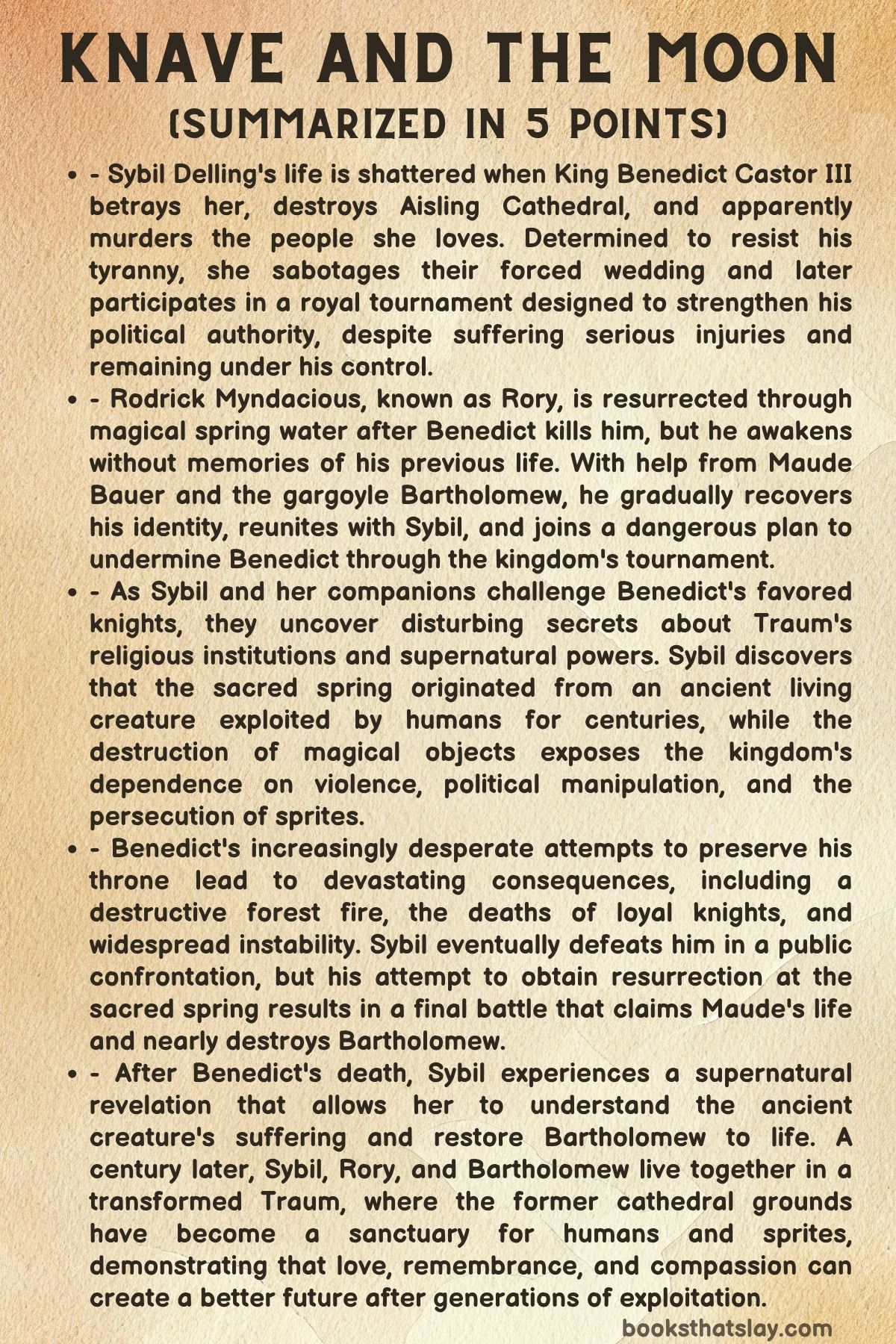
Summary
The story begins with an ancient account of a powerful creature whose existence predates the kingdom of Traum. Once living peacefully beneath the moon, this extraordinary being possessed tremendous strength and a natural connection to the world around her.
When humans discovered her, their admiration gradually became possessiveness. They wounded her, exploited her powers, and eventually transformed her existence into a source of magical resources, establishing a history of violence that would influence the kingdom for generations.
In the present, Sybil Delling finds herself imprisoned in Castle Luricht following the destruction of Aisling Cathedral. King Benedict Castor III, once her trusted friend Benji, has betrayed her, apparently murdered the people she loves, and destroyed the religious institution that shaped her life.
Sybil attempts to escape confinement and kill Benedict, but memories of their former friendship interfere with her determination. Benedict escapes using a magical coin belonging to the Artful Brigand, leaving Sybil furious and powerless.
Benedict has invented a public account blaming sprites for the cathedral’s destruction. He intends to exploit Sybil’s position as the last surviving Diviner to strengthen his political authority, ultimately deciding to marry her against her will.
Meanwhile, Rodrick Myndacious, known as Rory, awakens near the cathedral ruins without memories of his identity. Although his armor is covered in blood, he feels no pain from the injuries that apparently killed him.
He encounters Maude Bauer, a knight who has known him since childhood, and Bartholomew, a peculiar talking gargoyle with a damaged wing. Maude explains that Benedict murdered Rory and that she used magical spring water to resurrect him.
As the companions escape across Traum, Rory struggles with unfamiliar surroundings and fragments of forgotten experiences. Maude tells him about Sybil, the woman he loves, and promises to help restore his memories.
Their travels expose the kingdom’s troubled relationship with sprites. They discover the remains of enormous magical creatures slaughtered by knights, forcing Maude to confront her participation in generations of violence against beings traditionally regarded as enemies.
Maude believes that the Heartsore Weaver’s magical loom stone may restore Rory’s memories. Their search becomes connected to Benedict’s announcement of a kingdom-wide tournament intended to secure noble loyalty and celebrate his marriage to Sybil.
Meanwhile, Benedict forces Sybil into a royal wedding ceremony after administering ox-eye, a substance that weakens her body and clouds her mind. Refusing to accept the marriage, Sybil secretly acquires the Artful Brigand’s magical coin and uses it to destroy the wedding platform.
The explosion interrupts the ceremony but leaves Sybil severely wounded when a spear penetrates her abdomen. Although she survives, Benedict continues controlling her movements while presenting their relationship as essential to Traum’s stability.
Sybil gradually recognizes that Benedict’s tournament is designed to reward powerful noble families, distribute wealth, and reinforce his authority. Magical stone objects are assigned to favored knights, making the competitions instruments of political manipulation.
Determined to undermine his plans, Sybil insists upon competing despite her injuries.
Six weeks later, Rory and his companions arrive at Coulson Faire, where the tournament begins. Disguised to avoid recognition, they infiltrate Castle Luricht and investigate Benedict’s magical resources.
Rory eventually sees Sybil among the royal party. Although his memories remain incomplete, he immediately recognizes something deeply familiar about her, confirming that his emotional attachment has survived death.
During the jousting competition, Benedict demonstrates his cruelty by brutally defeating a young opponent. Rory uses the surrounding confusion to approach Tory Bassett, who possesses the Heartsore Weaver’s loom stone.
When Rory activates the stone, his lost memories return. He remembers growing up as an impoverished orphan, surviving through theft, and becoming involved with the Artful Brigand, one of Traum’s supposed gods.
He also recalls stealing sacred spring water from Aisling Cathedral and eventually finding security through the Castor family. At Petula Hall, he grew up alongside Maude and Benedict, developing relationships that once resembled a family.
Most importantly, he remembers Sybil and the love that developed between them.
The tournament continues with a melee arranged to benefit Dedrick Lange. Sybil attempts to interfere, but Dedrick viciously attacks her wounded abdomen and confines her to prevent participation.
Despite her suffering, Sybil reaches the competition and watches a mysterious armored fighter defeat opponents with remarkable skill. The knight carries a token associated with her Diviner robes, awakening hope she scarcely dares to acknowledge.
After defeating Dedrick, the mysterious champion removes his helmet. Sybil is astonished to discover that he is Rory, alive despite Benedict’s attempt to murder him.
Benedict immediately recognizes the threat Rory represents and orders him detained. Rory conceals his restored memories, claiming that he remembers little about his past and offering his service as the tournament’s champion.
Benedict permits Sybil to perform a Divination for him. During the ritual, Rory and Sybil communicate discreetly, allowing her to understand that he remembers their relationship.
When Sybil tastes Rory’s blood, she recognizes the qualities of Aisling’s sacred spring water. Its healing influence temporarily relieves her suffering, suggesting that his resurrection has permanently changed his body.
Their reunion continues through carefully concealed conversations and a dance at the tournament celebrations. Rory reassures Sybil that Maude and Bartholomew are alive, restoring her hope after weeks of grief.
When Sybil later falls into the Tenor River, Bartholomew rescues her, confirming another companion’s survival.
Maude subsequently reveals herself to Benedict and the royal court. Her respected family name and public reputation make it difficult for him to dismiss her without damaging his political standing.
The reunited companions work together to undermine Benedict through the tournament rather than assassinating him secretly. Maude argues that meaningful political change requires the nobles and ordinary people to witness the failure of his authority.
As they travel across Traum, the consequences of the kingdom’s magical upheaval become increasingly apparent. Earthquakes destroy roads, enormous cracks appear in the earth, and one of the kingdom’s mountains disappears.
Sybil investigates ox-eye and discovers connections between the substance, gowan flowers, and experiments conducted by earlier Castor rulers. Her visions suggest that the sacred spring contains secrets extending far beyond the religious teachings of Aisling Cathedral.
In the Fervent Peaks, Avice Fischer attempts to strengthen her family’s position through a proposed marriage involving Sybil and her son Hamelin. Sybil rejects the arrangement, recognizing another attempt to treat her religious identity as political property.
The next tournament event favors Hamelin, but Sybil refuses to withdraw. With Bartholomew’s assistance, she challenges the competition and helps destroy another magical stone object.
Their victory weakens Benedict’s alliances, although Bartholomew’s increasingly damaged body reveals the personal cost of their struggle.
At Petula Hall, Sybil becomes troubled by the possibility that eliminating the kingdom’s magical foundations might require further destruction. She begins considering whether her own death could become necessary for Traum’s transformation.
Bartholomew challenges this thinking, insisting that she must not treat her life as expendable.
Benedict, increasingly frustrated by his companions’ resistance, announces a final tournament event involving the hunting of sprites in the Chiming Wood.
The competition requires participants to kill a birke, turning the kingdom’s persecution of magical creatures into public entertainment. Sybil enters with the intention of destroying the Faithful Forester’s magical chime.
A confrontation involving Benedict and Samuel Eichel ignites a catastrophic forest fire. Tory Bassett is gravely injured, and the flames spread through the sacred grove.
Bartholomew rescues Sybil using his remaining wing, but his damaged stone body begins breaking apart during their escape. His injuries leave Sybil fearing that she will lose another beloved companion.
Back at Petula Hall, Sybil consumes ox-eye and experiences a revelation concerning Aisling Cathedral’s history. She witnesses generations of young Diviners being drowned and revived in the sacred spring.
She also sees Bartholomew’s kindness toward those frightened children, recognizing how his compassion influenced her own life.
The vision eventually transports her into the experiences of the ancient creature beneath the cathedral. Sybil discovers that the sacred spring originated from a living being who endured centuries of human exploitation.
The sprites’ return to the ruined cathedral represents an attempt to recognize and liberate this forgotten presence. Her awakening helps explain the catastrophic changes occurring throughout Traum.
This discovery transforms Sybil’s understanding of magic, religion, and sacrifice. Rather than accepting that destruction must continue indefinitely, she begins recognizing the possibility of rebuilding a world based upon respect instead of exploitation.
Bartholomew encourages her to seek happiness rather than surrender herself to despair. Sybil and Rory subsequently share an intimate reconciliation and openly acknowledge their love.
Rory confesses that his impoverished childhood made him afraid of attachment and loss. Sybil promises to remain beside him, finding renewed determination to survive.
Meanwhile, Benedict’s political position continues deteriorating. The tournament has caused financial disruption, destroyed valuable magical objects, and exposed the cruelty underlying his reign.
Maude and Rory reveal that they have returned tournament winnings to the nobles, undermining Benedict’s financial influence. The noble families increasingly recognize that his promises of security and prosperity have produced devastation.
A final public duel is arranged. Although Rory offers to confront Benedict, Sybil insists upon facing him herself.
Their battle unfolds along the Sighing Sea and eventually leads into dangerous underground passages. Benedict attempts to justify his betrayals, but Sybil refuses to excuse his violence.
She ultimately defeats and disarms him, proving that his royal authority cannot protect him from accountability. Nevertheless, Benedict escapes toward the sacred spring, hoping to obtain resurrection and avoid death.
Sybil, Rory, Maude, and Bartholomew pursue him to the ruined cathedral, now surrounded by sprites reclaiming their ancient home.
The final confrontation ends with Benedict’s death, but Maude suffers a mortal injury. Her sacrifice devastates the companions, who recognize how much of their survival depended upon her loyalty.
Bartholomew, his body close to destruction, enters the sacred spring and disappears beneath its surface. Sybil follows him and drowns while desperately searching for her friend.
In a dreamlike realm, she encounters the truth of the ancient creature’s history. She understands that this being seeks remembrance and freedom rather than revenge.
Returning from the vision, Sybil uses her connection to stone and the spring to restore Bartholomew. He awakens healed, with his memories intact, bringing an emotional resolution to their long struggle.
A century later, Traum has been transformed. The former cathedral grounds have become a sanctuary where humans and sprites coexist peacefully.
Sybil, Rory, and Bartholomew remain together, protecting magical creatures and sharing the history of the kingdom’s transformation.
When a young crowned woman visits the sanctuary, Bartholomew recounts the past, preserving the experiences that shaped their world.
Although Sybil and Rory have enjoyed unusually long lives, they recognize that death is a natural part of existence. Rather than seeking limitless power, they choose companionship, responsibility, and respect for the living world.
The story ends with Sybil surrounded by those she loves, accepting that even after immense suffering, a different and more compassionate future remains possible.
Characters
Sybil Delling
Sybil Delling is the central protagonist of The Knave and the Moon, representing the struggle to reclaim personal freedom from institutions that have defined her identity and exploited her abilities. As the last surviving Diviner, she carries enormous religious significance, but that importance repeatedly becomes a justification for others to control her.
Her journey begins in grief and anger following the destruction of Aisling Cathedral. Benedict’s betrayal devastates her because he was once a trusted friend, making his actions both a political crime and a deeply personal violation.
Sybil initially responds through direct confrontation, attempting to murder Benedict and later sabotaging their forced wedding. Her refusal to submit establishes her independence, although her anger sometimes makes it difficult for her to consider the consequences of her actions.
Her physical suffering becomes an essential part of her development. The wound inflicted during the wedding, together with the effects of ox-eye, leaves her vulnerable in ways that challenge her identity as a capable fighter.
Nevertheless, she repeatedly insists upon entering tournament competitions. Her determination demonstrates extraordinary courage, but it also exposes her tendency to measure her worth through endurance and sacrifice.
Her relationship with Rory reveals a more vulnerable side of her character. Although she is accustomed to confrontation and self-reliance, she gradually learns that accepting affection does not diminish her independence.
Bartholomew also plays an essential role in transforming her understanding of responsibility. Through his compassion, she recognizes the difference between willingly helping others and believing that she must destroy herself to ensure their survival.
Her discovery of the ancient creature beneath Aisling Cathedral fundamentally changes her understanding of divinity. She realizes that the religious traditions she served were built upon the suffering of a living being.
By the conclusion, Sybil rejects both Benedict’s domination and the expectation that she must become a martyr. Her development demonstrates that genuine freedom requires the courage to survive, love, and participate in rebuilding the world.
Rodrick Myndacious (Rory)
Rodrick Myndacious is one of the principal characters in The Knave and the Moon, and his resurrection creates a powerful examination of identity, memory, and emotional attachment. Known as Rory, he begins the novel without any recollection of his former life.
His memory loss separates his identity into two competing realities. His conscious mind cannot recognize his past, but his body continues remembering combat, survival instincts, and emotional connections.
Rory’s childhood explains much of his personality. Growing up as an impoverished orphan taught him to steal, improvise, and distrust security because everything he possessed could easily be taken away.
His encounters with the Artful Brigand introduce him to the magical structures governing Traum. These experiences also establish his complicated relationship with powerful figures who regard vulnerable people as useful instruments.
Finding a home at Petula Hall gives Rory his first meaningful experience of belonging. His relationships with Maude and Benedict become central to his understanding of friendship, loyalty, and family.
Benedict’s eventual betrayal therefore threatens more than Rory’s physical existence. It destroys the security Rory believed he had finally obtained after years of instability.
His love for Sybil survives even when his memories disappear. This suggests that identity is not exclusively determined by conscious recollection but also by emotional experience and enduring attachment.
Rory’s participation in the tournament demonstrates intelligence as well as physical courage. Rather than immediately attacking Benedict, he disguises his intentions and uses the king’s own competitions to weaken his authority.
His decision to offer Sybil his healing blood illustrates the depth of his devotion. However, his willingness to support her also contrasts with Benedict’s possessiveness because Rory ultimately respects her choices.
By the conclusion, Rory becomes more comfortable expressing affection and accepting vulnerability. His growth lies in understanding that loving someone requires trust rather than constant preparation for abandonment.
King Benedict Castor III
Benedict Castor III functions as the principal antagonist, representing the corruption that develops when political ambition becomes inseparable from personal entitlement. Once known affectionately as Benji, he shared close relationships with Sybil, Rory, and Maude before transforming into a ruthless monarch.
His betrayal is particularly disturbing because he understands the people he harms. He knows their weaknesses, memories, and loyalties, yet repeatedly uses that knowledge to manipulate them.
Benedict believes that political stability requires symbols capable of securing public obedience. After the destruction of the Omens, he attempts to replace their religious authority with a monarchy centered upon himself.
His forced marriage to Sybil demonstrates the consequences of this philosophy. He regards her connection to Aisling Cathedral as something that can legitimize his reign, treating her consent as irrelevant.
The tournament further exposes his methods. By distributing magical objects, arranging favorable competitions, and rewarding influential families, he attempts to purchase political support while maintaining the appearance of legitimate public celebration.
Benedict frequently justifies cruelty as necessary for the kingdom’s survival. His reasoning suggests that he has confused the preservation of political order with the preservation of his personal authority.
His insecurity becomes increasingly visible as Rory, Maude, and Sybil challenge him. Rather than reconsidering his actions, Benedict responds with greater aggression, revealing that his confidence depends upon unquestioned obedience.
His final attempt to obtain resurrection demonstrates his inability to accept the limits imposed upon ordinary existence. Even after causing widespread suffering, he believes that his royal importance entitles him to escape death.
Benedict’s downfall is therefore not simply a defeat in combat. It represents the collapse of a worldview in which power excuses violence and personal desire overrides the rights of others.
Maude Bauer
Maude Bauer occupies a central moral position in The Knave and the Moon, combining the discipline of a traditional knight with the difficult process of questioning the institutions she once defended. Her loyalty to Rory and Sybil provides essential protection throughout their struggle.
At the beginning, Maude demonstrates her devotion by resurrecting Rory using the sacred spring. She accepts responsibility for helping him recover his memories and protecting him from Benedict’s forces.
Her relationship with Rory carries the warmth of a lifelong friendship shaped by shared experiences. She understands his personality even when he cannot remember it himself, helping him reconstruct a sense of identity.
However, Maude’s importance extends beyond personal loyalty. Her experiences with the corpses of slaughtered sprites force her to recognize that the Bauer family contributed to Traum’s history of supernatural persecution.
This realization complicates her identity as an honorable knight. She must confront the possibility that obedience to established traditions can produce injustice even when participants believe they are fulfilling their duties.
Maude also demonstrates considerable political intelligence. She recognizes that secretly killing Benedict would do little to dismantle the noble alliances and religious assumptions sustaining his authority.
Instead, she advocates defeating him publicly through the tournament. Her strategy reflects an understanding that lasting reform requires more than removing an individual ruler.
Her willingness to reveal herself before the royal court demonstrates confidence in her reputation and determination to protect her companions. She accepts personal danger because her presence threatens Benedict’s carefully constructed account of past events.
Maude’s death near the sacred spring gives her character a tragic conclusion. Having devoted herself to protecting others, she ultimately sacrifices her life during the final confrontation.
Her legacy survives through the transformed kingdom and the companions she helped rescue. She represents a form of knighthood grounded in responsibility, courage, and the willingness to acknowledge past wrongdoing.
Bartholomew
Bartholomew is among the most emotionally significant characters in The Knave and the Moon, serving as a companion, protector, storyteller, and moral guide. His unusual existence as a living stone gargoyle allows him to connect the kingdom’s magical history with the personal experiences of its inhabitants.
His eccentric speech and humorous observations frequently provide relief from the novel’s violence. Beneath this unusual personality, however, lies an extraordinary capacity for compassion.
Bartholomew’s damaged wing and fractured body make his physical vulnerability increasingly apparent. Despite these limitations, he repeatedly exposes himself to danger to protect Sybil and the others.
His rescue of Sybil from the Tenor River establishes his determination to preserve her life. Later, his assistance during the tournament’s feats of strength demonstrates that his loyalty remains unchanged even as his body deteriorates.
His most significant act of protection occurs during the fire in the Chiming Wood. He carries Sybil away from the burning grove, although the strain causes his already weakened body to break further apart.
Bartholomew also challenges Sybil’s growing fascination with self-sacrifice. He recognizes that her willingness to die for Traum risks repeating the logic of institutions that treated Diviners as expendable resources.
His memories of comforting frightened children at Aisling Cathedral reveal the consistency of his kindness. Long before the present conflict, he offered compassion to people whose suffering had been normalized by religious practice.
His role as a storyteller becomes particularly important near the conclusion. By preserving the history of the ancient creature, he helps ensure that future generations understand the consequences of exploitation.
His restoration through Sybil’s power represents the possibility of repairing what violence has damaged. A century later, his continued presence at the sanctuary demonstrates that remembrance and compassion can become foundations for a better society.
Tory Bassett
Tory Bassett is a royal knight whose character illustrates the possibility of moral change within a corrupt political system. Initially, she serves Benedict and participates in enforcing his authority over Sybil.
Her possession of the Heartsore Weaver’s loom stone places her within the network of favored knights benefiting from the king’s tournament arrangements. At first, her position appears inseparable from obedience to royal commands.
However, Tory gradually becomes more complicated than a simple representative of Benedict’s cruelty. Her interactions with Sybil suggest that personal judgment can survive even within an oppressive institution.
During the final hunt, Tory accompanies Sybil into the Chiming Wood. Their uneasy cooperation demonstrates that former opponents can recognize shared responsibilities when confronted with greater injustice.
Her actions become significant because the hunt is specifically designed to encourage violence against sprites. By participating in an effort to challenge the event’s magical foundations, Tory moves away from unquestioned acceptance of the king’s agenda.
Her eventual death in the forest catastrophe highlights the destructive consequences of Benedict’s leadership. Even those who attempt to change their position remain vulnerable to the violence unleashed by the system they once served.
Tory’s character demonstrates that moral awakening does not guarantee survival or erase earlier complicity. Her fate contributes to the book’s examination of accountability and the human cost of political manipulation.
Hamelin Fischer
Hamelin Fischer represents aristocratic entitlement and the insecurity concealed beneath inherited privilege. As a member of a powerful noble family, he expects recognition, status, and political advantage through his connection to Benedict.
His family’s involvement in the tournament reflects the close relationship between wealth and royal authority. Hamelin’s expected victory in the feats of strength is intended to increase his family’s prestige.
His attitude toward Sybil is particularly revealing. He treats her as a desirable political possession rather than an independent person, reflecting the values that also guide Benedict’s behavior.
Avice Fischer’s proposed marriage arrangement reinforces this perspective. Sybil’s significance as the last Diviner makes her valuable to the family’s ambitions, regardless of her personal wishes.
Hamelin’s arrogance generates conflict with Rory, whose affection for Sybil is founded upon personal connection rather than social advantage. Their rivalry exposes the difference between possessiveness and genuine devotion.
The feats of strength eventually challenge Hamelin’s assumption of superiority. When Sybil competes successfully, the arrangements intended to guarantee his triumph are undermined.
Hamelin’s failures demonstrate that inherited status cannot replace courage, ability, or moral character. He functions as an example of the aristocratic culture Benedict attempts to preserve.
Dedrick Lange
Dedrick Lange embodies the violence and selfish ambition encouraged by Benedict’s political arrangements. His involvement in the tournament demonstrates how noble families exploit supposedly honorable competitions for financial and social advantage.
He expects the melee to produce an outcome favorable to his family. Rather than trusting his abilities, he relies upon political connections and manipulation.
His brutal assault upon Sybil reveals the cruelty underlying his ambition. By attacking her existing wound and imprisoning her, he attempts to eliminate a potential rival through violence rather than legitimate competition.
This behavior exposes his disregard for personal dignity and fairness. Sybil’s physical suffering matters to him only as an obstacle that can be exploited.
Dedrick’s defeat by Rory becomes an important symbolic moment. A fighter whose childhood was marked by poverty and social exclusion publicly overcomes a nobleman accustomed to privilege.
His interest in the possibility of resurrection also reveals the dangerous appeal of magical power. Like Benedict, he recognizes supernatural resources as opportunities for personal advancement.
Dedrick represents a broader aristocratic culture in which wealth and status are used to excuse exploitation. His humiliation demonstrates the instability of a social order founded upon inherited authority rather than merit.
Samuel Eichel
Samuel Eichel is a royal knight whose involvement in the tournament reveals the destructive relationship between magical privilege and political loyalty. His access to the Faithful Forester’s chime places him among those entrusted with supernatural resources by Benedict.
His position reflects the king’s dependence upon favored knights to reinforce his authority. Magical objects become rewards for obedience rather than responsibilities requiring careful judgment.
During the final hunt, Samuel uses the chime within a sacred grove. The competition transforms a place associated with supernatural life into a setting for organized violence.
His conflict with Benedict demonstrates that loyalty founded upon ambition and fear is inherently unstable. When the king begins distrusting him, their confrontation escalates into violence.
The resulting fire devastates the Chiming Wood and contributes to the deaths and injuries suffered by the participants. Samuel’s fate illustrates how power struggles among privileged individuals can destroy communities and environments far beyond their immediate conflict.
He functions as a reminder that the king’s system harms both its opponents and its supporters. Participation in an unjust structure offers no guarantee of protection from its eventual collapse.
Avice Fischer
Avice Fischer represents the political calculations of Traum’s aristocratic families. As a powerful noblewoman, she seeks to preserve her household’s influence during a period of instability.
Her hospitality toward Benedict and the royal party is closely connected to these ambitions. She recognizes that maintaining favorable relationships with the monarchy may protect her family’s privileges.
Her proposal concerning Sybil and Hamelin reveals how marriage functions as a political transaction within the kingdom’s ruling class. She considers Sybil’s religious importance an asset capable of strengthening the Fischer family’s position.
This attitude closely resembles Benedict’s treatment of Sybil. Both regard her symbolic authority as something that can be acquired and controlled through marriage.
Avice’s character demonstrates that exploitation is not limited to openly violent individuals. It can also emerge through respectable negotiations presented as practical arrangements.
Her ambitions expose the aristocracy’s dependence upon traditions that deny vulnerable people meaningful autonomy. Through her, the novel criticizes the ordinary social mechanisms that sustain unequal power.
The Artful Brigand
The Artful Brigand is one of Traum’s supernatural Omens, whose influence shapes Rory’s childhood and continues affecting the kingdom through his magical coin. His character reveals the complicated relationship between supposedly divine beings and the humans who worship them.
Rory encounters him while surviving through theft. The Brigand’s unusual stone coin immediately establishes his access to powers beyond those available to ordinary people.
Their association draws Rory into dangerous activities, including the theft of sacred spring water from Aisling Cathedral. These experiences expose how supernatural power can encourage manipulation rather than moral responsibility.
The Brigand’s coin later becomes important during Benedict’s confrontations with Sybil. Its destructive abilities demonstrate how objects associated with the Omens remain politically valuable even after their apparent defeat.
The Brigand challenges conventional distinctions between gods, rulers, and criminals. His behavior suggests that possessing extraordinary abilities does not automatically establish moral superiority.
Through this character, the story questions religious systems that treat power itself as evidence of legitimate authority.
The Ancient Creature Beneath Aisling Cathedral
The ancient creature is one of the most symbolically important presences in The Knave and the Moon, representing the natural world subjected to human domination. Although her history remains concealed for much of the novel, her suffering explains the origins of Traum’s magical institutions.
She originally existed freely beneath the moon, possessing extraordinary strength and a peaceful relationship with the surrounding environment. Her independence required neither human worship nor political recognition.
The arrival of humanity transforms her existence. Admiration gradually becomes possessiveness, and people begin exploiting her body and powers for their own benefit.
Her retreat into stone and dreams represents both a response to unbearable suffering and the beginning of a prolonged captivity. Generations later, the spring emerging from her remains becomes central to Aisling Cathedral’s religious practices.
The drowning and resurrection of young Diviners demonstrate how institutional exploitation extends from the ancient creature to vulnerable human beings. Both are treated as resources rather than living individuals.
Her awakening also changes the interpretation of Traum’s environmental catastrophes. The earthquakes and collapsing mountains become connected to the liberation of a being whose suffering helped sustain the old order.
Significantly, she does not demand revenge as the foundation of the future. Instead, she wants her experiences remembered so that similar atrocities are not repeated.
Her character transforms the novel’s understanding of divinity. True spiritual significance emerges not from domination or obedience but from respect for life, compassion, and the preservation of memory.
Brenna Bassett
Brenna Bassett appears during the political collapse of Benedict’s authority, bringing the consequences of his decisions into the gathering of noble families. Her grief over Tory’s death gives her opposition to the king a deeply personal foundation.
Unlike nobles concerned primarily with wealth or status, Brenna confronts the human consequences of the tournament. Her daughter’s death demonstrates that Benedict’s reckless pursuit of legitimacy has destroyed lives within the very families he hoped to secure as allies.
Her support for a final confrontation contributes to the erosion of the king’s political protection. She becomes part of the movement demanding that his actions face public judgment.
Brenna illustrates how personal loss can alter political allegiance. Through her grief, the suffering caused by royal ambition becomes impossible to dismiss as an unfortunate but necessary consequence of leadership.
King Benedict Castor I
King Benedict Castor I is an important historical figure whose influence survives through the kingdom’s magical research and political traditions. His records reveal that the Castor dynasty’s interest in supernatural power extends beyond the ambitions of the present monarch.
His investigations into ox-eye, gowan flowers, and the properties associated with Aisling Cathedral suggest an effort to understand and potentially reproduce extraordinary magical effects.
These experiments expose the monarchy’s longstanding desire to acquire powers controlled by religious institutions. They also suggest that the conflict between kingship and sacred authority existed before Benedict III’s reign.
The discoveries preserved in his records help Sybil investigate the origins of her visions and the changes occurring within her body.
His historical role demonstrates how attempts to control supernatural resources can become embedded within political systems across generations. Although the current king intensifies this ambition, he inherits a culture already fascinated by the possibility of mastering magic.
Themes
The Corruption of Power and the Manipulation of Faith
Political authority in Traum depends heavily upon the ability to control public belief. Kings, nobles, and religious institutions maintain their positions by persuading ordinary people that obedience is necessary for stability and protection.
Benedict recognizes this relationship and deliberately exploits it after destroying Aisling Cathedral. By presenting Sybil as the last remaining source of divine knowledge, he attempts to transfer the authority of the Omens into his monarchy.
His proposed marriage to Sybil demonstrates how faith becomes a political commodity. Rather than respecting her religious identity or personal independence, Benedict treats her symbolic importance as something he can possess through royal marriage.
The tournament extends this manipulation into public entertainment. Competitions presented as celebrations of skill become mechanisms for distributing wealth, rewarding loyal families, and reinforcing the king’s legitimacy.
The magical stone objects further demonstrate the relationship between supernatural power and political control. Their distribution allows Benedict to create dependencies among influential knights while maintaining the appearance of divine favor.
Yet The Knave and the Moon also exposes the weaknesses of authority founded upon manufactured belief. As the tournament’s arrangements collapse, the nobles recognize that Benedict’s promises conceal exploitation and instability.
The destruction of his political alliances demonstrates that genuine legitimacy cannot be sustained indefinitely through deception, coercion, and inherited privilege.
The novel ultimately distinguishes leadership from domination. Authority becomes morally meaningful only when those exercising it recognize their responsibility toward the people and living world affected by their decisions.
Love, Loyalty, and the Preservation of Identity
Rory’s resurrection raises questions about what makes an individual recognizable when memory disappears. His forgotten childhood, friendships, and romantic experiences initially seem to separate him from the person he once was.
Nevertheless, his body retains the instincts developed through years of struggle. More importantly, his emotional response to Sybil survives even before he consciously remembers their relationship.
This continuity suggests that personal identity extends beyond recollection. Love, habitual behavior, and emotional recognition remain meaningful parts of the self even when explicit memories are lost.
Sybil’s relationship with Rory also examines the difference between devotion and possession. Benedict attempts to claim her through marriage because he believes her importance entitles him to control her future.
Rory, by contrast, repeatedly demonstrates his willingness to support her decisions. Although he fears losing her, he gradually learns that genuine affection requires respect for another person’s independence.
Maude’s loyalty provides another expression of love. She protects Rory following his resurrection, helps restore his memories, and ultimately risks everything to oppose Benedict.
Bartholomew’s compassion broadens the theme beyond romantic and familial relationships. His kindness toward frightened Diviners and his repeated efforts to protect Sybil demonstrate the significance of care offered without demands for obedience.
The enduring companionship in The Knave and the Moon presents love as a force capable of surviving extraordinary disruption. Death, memory loss, political betrayal, and physical transformation threaten the characters’ relationships, but meaningful attachment allows them to rebuild their lives.
Their experiences suggest that identity is shaped not only by individual memory but also by the people who recognize, protect, and remember us.
Exploitation of Nature and the Consequences of Human Greed
Traum’s magical prosperity is founded upon a history of violence against beings whose existence humans fail to respect. The ancient creature beneath Aisling Cathedral provides the clearest example of this destructive relationship.
Originally living independently beneath the moon, she becomes an object of human fascination. Admiration eventually turns into exploitation as people begin treating her body and powers as resources they are entitled to consume.
The sacred spring emerges from this suffering and becomes central to the kingdom’s religious authority. Generations of Diviners are drowned and revived through a process that normalizes bodily exploitation in the name of spiritual necessity.
The persecution of sprites demonstrates the same mentality. Knights slaughter supernatural creatures because longstanding traditions characterize them as dangerous or inferior, allowing violence to appear honorable.
Maude’s growing awareness of her family’s participation in these practices reveals how injustice can continue through institutions whose members believe they are acting correctly.
The tournament’s final hunt exposes the cruelty of this worldview. Killing a birke becomes a public competition, transforming the destruction of supernatural life into entertainment and political advantage.
The subsequent forest fire and environmental catastrophes illustrate the consequences of disregarding the natural world’s independence. Humans cannot endlessly manipulate living systems without eventually confronting the damage they have caused.
The ancient creature’s awakening changes the moral direction of the story. Her desire for remembrance rather than revenge introduces the possibility of a different relationship between humanity and nature.
The transformed sanctuary in the conclusion represents an alternative founded upon coexistence. Instead of consuming supernatural life for power, people learn to protect it and acknowledge its inherent value.
Sacrifice, Mortality, and the Possibility of Renewal
Death occupies an unusual position in Traum because the sacred spring can restore life. Rory’s resurrection demonstrates that mortality can sometimes be interrupted, but it also raises questions about the consequences of possessing such extraordinary power.
For Benedict, resurrection becomes another privilege he believes he deserves. His desperate attempt to reach the spring after his defeat reveals a refusal to accept limitations or accountability.
Sybil approaches mortality differently. After enduring betrayal, physical suffering, and repeated losses, she begins considering whether sacrificing herself might be necessary to transform the kingdom.
Her willingness to die emerges partly from genuine concern for others. However, it also reflects the harmful lessons of an institution that treated Diviners as expendable instruments of sacred power.
Bartholomew challenges this belief by reminding her that survival has value beyond usefulness. His compassion encourages Sybil to recognize that she does not need to destroy herself to prove her devotion.
Maude’s death introduces an important distinction between chosen sacrifice and imposed suffering. Her final actions emerge from loyalty and responsibility, yet her loss remains devastating rather than becoming a simple celebration of martyrdom.
The destruction of the Chiming Wood offers a parallel image of mortality and renewal. Although the forest burns, Bartholomew reminds Sybil that damaged landscapes can recover and new life can emerge.
His eventual restoration reinforces the possibility of healing without suggesting that every loss can or should be reversed.
A century later, Sybil and Rory accept that their unusually prolonged lives will eventually end. Their peace comes from recognizing that existence is valuable because of relationships, responsibility, and experience rather than endless duration.
The conclusion presents renewal as a continuing process. A better future becomes possible when individuals acknowledge past suffering, reject unnecessary sacrifice, and choose to protect the lives still entrusted to their care.