Kiss Slay Replay Summary, Characters and Themes
Kiss Slay Replay by Rachel Harrison is a horror-comedy novel that combines a repeating-day mystery with supernatural violence, romantic disappointment, and personal transformation.
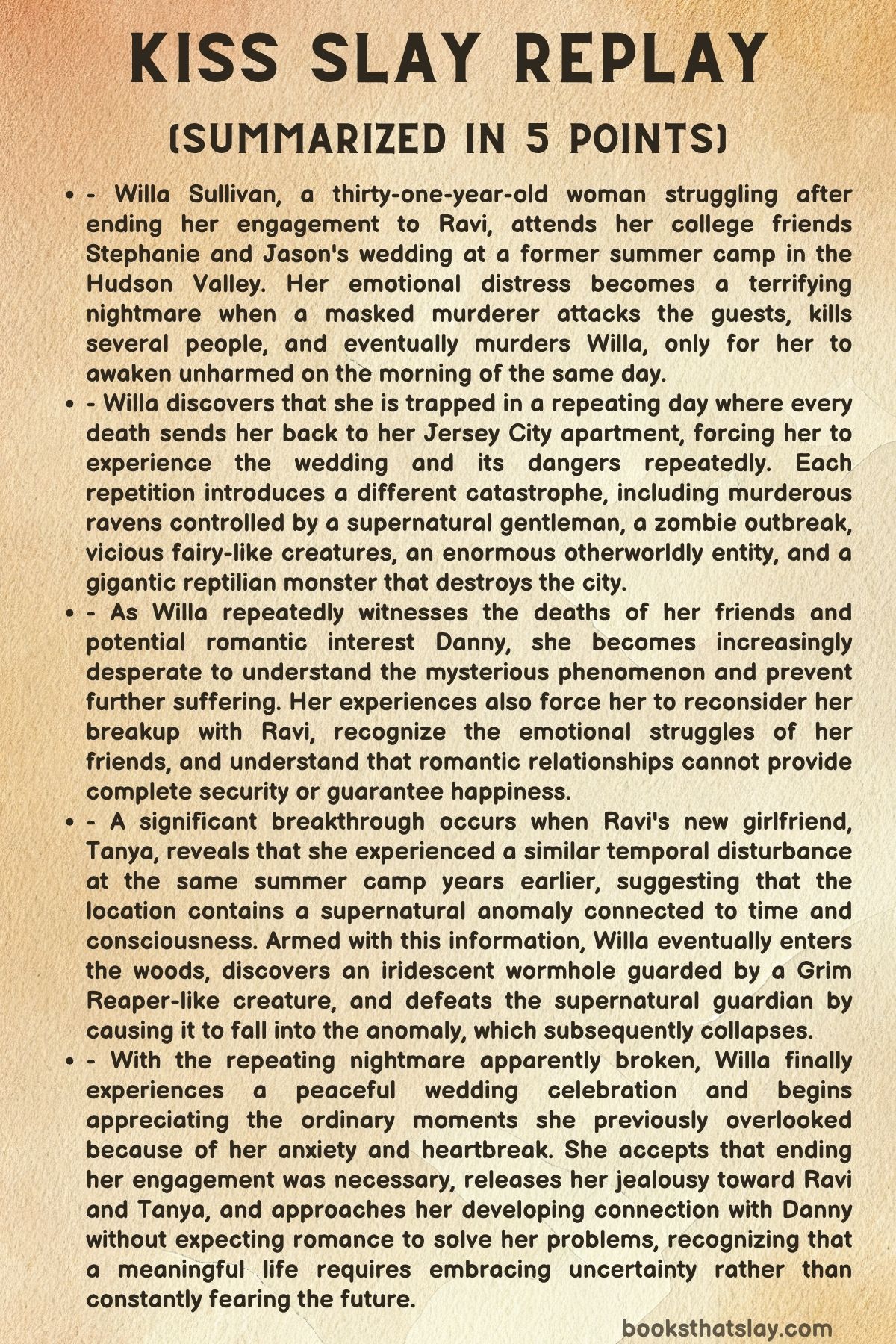
The story follows Willa Sullivan, a thirty-one-year-old woman struggling after ending her engagement, who attends a friend’s wedding and discovers that death sends her back to the beginning of the same day. Each repetition brings a different terrifying disaster, forcing her to confront threats that range from masked murderers to supernatural creatures. Beneath the outrageous horror scenarios, the novel examines heartbreak, anxiety, friendship, regret, and the difficulty of accepting an unpredictable future.
Summary
Willa Sullivan is thirty-one years old and struggling to rebuild her life after ending her engagement to Ravi, her partner of nearly eight years. Although she made the decision to leave, she cannot stop questioning whether she destroyed a relationship that might have survived with greater effort.
Their relationship had deteriorated after Ravi accepted a job in Washington, DC, leading Willa to sacrifice professional opportunities and abandon the life she had established in Manhattan. Disagreements about parenthood, communication, and their expectations for the future gradually convinced her that marriage would not solve their problems.
Now living alone in a Jersey City studio apartment with her temperamental cat, Archimedes, Willa feels disconnected from everything that once gave her stability. Her longtime friend Cassie encourages her to distract herself with horror movies, arguing that watching fictional characters endure terrible experiences might put ordinary heartbreak into perspective.
Willa soon faces another emotional challenge when she prepares to attend the wedding of her college friends Stephanie and Jason at a renovated summer camp in the Hudson Valley. Ravi will also attend, making the celebration her first significant opportunity to encounter him since their separation.
At the venue, Willa reunites with Cassie, Cassie’s husband Luke, her friend Evan, and Evan’s husband Wyatt. Their familiar humor temporarily comforts her, but she becomes devastated when she learns that Ravi has brought a new woman named Tanya.
Seeing Ravi and Tanya together overwhelms Willa, prompting her to flee into the surrounding woods. During a panic attack, she notices a mysterious masked figure lurking among the trees.
She subsequently encounters Danny, Jason’s charming childhood friend, whose flirtatious attention provides an unexpected distraction. Their attraction develops throughout the wedding festivities, eventually leading to a passionate kiss.
However, the evening transforms into a nightmare when Willa and Danny discover evidence of violence near the cabins. They find Stephanie gravely wounded and encounter a masked murderer dressed in black protective clothing.
The killer begins attacking the wedding guests, turning the celebration into a desperate struggle for survival. Willa and Danny attempt to warn everyone, but the murderer moves rapidly through the property, leaving bodies behind and setting the reception building ablaze.
As the guests scatter, Willa and Danny seek shelter in a cabin. Danny briefly comforts her by imagining that they might survive and travel to Tokyo together, but the murderer breaks inside, incapacitates Danny, and fatally stabs Willa.
Instead of remaining dead, Willa awakens in her Jersey City apartment on the morning of the wedding.
Initially convinced that she experienced a particularly realistic nightmare, she gradually recognizes conversations, locations, and events from the previous day. Her memories are too precise to dismiss, and she becomes terrified that the massacre might happen again.
Returning to the venue, Willa attempts to alter her behavior while searching for evidence that the future can change. Although some circumstances unfold differently, she remains unable to determine whether she is experiencing a supernatural phenomenon or a psychological crisis.
She reconnects with Danny, and their attraction leads to a sexual encounter. During their conversation afterward, however, Danny admits that he prefers casual relationships and is not interested in serious commitment.
The evening soon brings another disaster when enormous flocks of ravens descend upon the property. A mysterious gentleman dressed in old-fashioned clothing appears, accompanied by an ominous ticking pocket watch.
The birds attack the guests while the strange figure apparently exercises supernatural control over death and decay. Danny suffers serious injuries, and Willa attempts to help him escape with Ravi.
Their efforts fail when the mysterious man announces that Danny’s time has expired. As the survivors desperately seek safety, the supernatural forces continue destroying everyone around them.
Willa is eventually captured and killed, only to awaken once again on the morning of the wedding.
Realizing that she is trapped in a repeating day, Willa investigates possible explanations, including temporal anomalies and neurological conditions. She visits an urgent care clinic, but the medical evaluation provides no definite answer.
Despite her growing terror, she returns to the wedding, hoping to recognize the warning signs before another catastrophe begins.
This time, the danger emerges through a diseased deer that behaves aggressively and displays signs of unnatural decay. The infection spreads to people, creating a zombie outbreak that turns the ceremony into chaos.
Willa and Ravi flee together, and their attempts to survive expose the unresolved conflicts surrounding their breakup. Ravi challenges her assumptions about his relationship with Tanya, while Willa explains why their engagement had become emotionally damaging.
Their conversation forces Willa to acknowledge that Ravi also suffered after their separation. Nevertheless, reconciliation becomes impossible as infected guests invade their hiding place.
An armed response team eventually arrives, but the intervention creates further tragedy when Danny is mistakenly shot. Gunfire also ends Willa’s life, triggering another return to the beginning.
Exhausted by repeated violence, Willa decides to avoid the wedding altogether.
She stays home with Archimedes, watches horror movies, and attempts to enjoy an ordinary day. Unfortunately, the catastrophe follows her to Jersey City, where an enormous otherworldly entity appears above the city.
The creature possesses an immense eye and seems capable of perceiving Willa directly. It seizes her before dropping her from a tremendous height, killing her once again.
Willa now understands that remaining away from the venue does not guarantee safety.
During another repetition, she returns to the wedding with a different attitude. Conversations with Evan help her reconsider her breakup, particularly his observation that regretting the consequences of a decision does not necessarily make the decision wrong.
She also pays greater attention to Cassie’s responsibilities and emotional exhaustion. Willa begins recognizing that her friends have personal struggles beyond their responsibility to reassure her.
At the wedding, she approaches Ravi more honestly, acknowledging their shared pain without expecting their relationship to resume.
Meanwhile, the floral decorations begin behaving strangely. Their overpowering fragrance and unnatural movements suggest another developing threat.
Willa encounters Tanya in the bathroom, where an unexpectedly important conversation changes her understanding of the repeating day.
Tanya explains that she attended the summer camp years earlier and experienced a similar temporal phenomenon involving a boy named Noah. Her experience included an apparent reset during which events repeated while she retained memories of the previous version.
She suggests that the property contains a temporal anomaly, possibly involving a wormhole and the relationship between consciousness and death.
Before Willa can fully investigate this possibility, the flowers begin releasing grotesque, vicious creatures resembling monstrous fairies. The creatures swarm the reception hall, attacking guests and transforming the entire property into a hostile environment.
Willa attempts to protect Ravi and Tanya, but the creatures overwhelm her and drag her into the water, where she drowns.
Another repetition begins with Willa determined to face the day more courageously. However, before she even reaches the wedding, a gigantic reptilian monster emerges from the harbor and begins destroying the city.
Military aircraft prove incapable of stopping the creature, which unleashes a devastating attack that burns Willa alive.
When she awakens again, the sheer absurdity of her repeated deaths causes her to laugh.
Instead of surrendering to despair, she decides that she must confront the source of the nightmare directly.
Returning to the wedding venue, Willa embraces the opportunity to appreciate her friends while recognizing that she cannot control everything that happens to them. She then enters the woods, searching for the location where she first encountered the masked murderer.
There, a horrifying creature resembling the Grim Reaper begins pursuing her.
Despite injuring her ankle, Willa reaches a clearing containing an iridescent opening suspended in the air. She realizes that the opening is probably the wormhole responsible for the repeating day.
The Reaper appears to guard the phenomenon, and Willa engages the creature in a desperate confrontation.
At first, she fights for control of its scythe. However, she eventually realizes that trying to possess or control the anomaly might only perpetuate the danger.
She releases her grip, causing the Reaper to fall backward into the wormhole.
The opening collapses in an explosion of unnatural energy, apparently ending the repeating nightmare.
Danny finds Willa in the woods, unaware of what she has experienced. She returns to the wedding, uncertain whether the supernatural phenomenon has been permanently destroyed.
For the first time, however, the celebration continues without catastrophe.
As midnight approaches, Willa enjoys dancing and spending time with her friends. Rather than anxiously waiting for the day to end, she wishes she could preserve its happiness.
She also sees Ravi and Tanya preparing to leave together. Their apparent happiness no longer produces the crushing jealousy she experienced earlier.
Willa finally recognizes that ending her engagement was painful but necessary, and that a relationship does not become meaningless merely because it ends.
When Danny approaches her beside the lake, their attraction remains, but Willa no longer imagines that a new romance must rescue her from loneliness.
The novel concludes with Willa accepting that the future cannot be predicted or controlled. After repeatedly experiencing death and uncertainty, she finally becomes willing to live without demanding guarantees about what happens next.
Characters
Willa Sullivan
Willa Sullivan is the protagonist of Kiss Slay Replay, and her emotional development provides the foundation for the novel’s combination of supernatural horror and personal reflection. At thirty-one, she is struggling to establish an independent identity after ending an engagement that had shaped nearly eight years of her adult life.
Her decision to leave Ravi reflects genuine dissatisfaction with their relationship, but she finds it difficult to separate the necessity of that decision from the grief that follows. She repeatedly interprets loneliness as evidence that she made a mistake, revealing how strongly she associates emotional security with romantic partnership.
Willa’s anxiety influences nearly every aspect of her behavior. She compulsively revisits conversations, anticipates rejection, worries about other people’s opinions, and attempts to prepare for situations that remain beyond her control.
The repeating-day phenomenon intensifies these tendencies by placing her in circumstances where preparation seems essential to survival. However, each new disaster demonstrates the limitations of anticipation, since the threats change from one repetition to another.
Her encounters with masked killers, murderous ravens, zombies, monstrous fairies, and enormous creatures gradually force her to distinguish between reasonable precautions and the impossible desire for complete certainty. She discovers that knowing more does not necessarily mean suffering less.
Willa also develops a greater appreciation for the people around her. Initially preoccupied with her breakup, she gradually recognizes Cassie’s exhaustion, Evan’s loyalty, Ravi’s grief, and the fragility of her friendships.
Her willingness to confront the Grim Reaper represents the culmination of this development. Rather than seeking another temporary escape, she acts decisively while accepting that the outcome remains uncertain.
By the conclusion, Willa has not eliminated sadness, romantic vulnerability, or the possibility of future disappointment. Her achievement lies in understanding that she can experience those feelings without allowing them to determine the direction of her life.
Ravi
Ravi serves as Willa’s former fiancé and one of the most significant emotional influences in her life. Their nearly eight-year relationship represents a shared history that Willa struggles to reconcile with the reality of their separation.
His decision to accept employment in Washington, DC, contributed to the deterioration of their relationship, particularly because Willa sacrificed professional opportunities and personal stability to follow him. Their disagreements about communication, parenthood, and lifestyle eventually exposed expectations that marriage could not resolve.
Although Willa initially experiences Ravi’s new relationship as an act of rejection, the novel gradually establishes that he possesses an emotional perspective independent of hers. He has suffered through the separation and is attempting to move forward according to his own needs.
His decision to bring Tanya to the wedding seems insensitive from Willa’s perspective, but his later conversations reveal that he is not simply trying to punish her. Ravi reminds Willa that she encouraged him to continue living his life after their breakup.
His behavior during the supernatural disasters also demonstrates courage and concern for others. He repeatedly attempts to assist frightened guests and cooperates with Willa when immediate survival becomes more important than their disagreements.
Nevertheless, their arguments during the zombie outbreak reveal that affection cannot automatically repair incompatible expectations. Both characters retain legitimate frustrations that cannot be dismissed merely because they once loved each other.
Ravi’s importance lies in challenging Willa’s tendency to view their relationship exclusively through her own regret. By the ending, his apparent happiness with Tanya helps Willa understand that both of them can move forward without denying the significance of their past.
Danny
Danny is Jason’s charismatic childhood friend and Willa’s principal new romantic interest in Kiss Slay Replay. His confidence, adventurous personality, and easy flirtation offer a striking contrast to Willa’s emotional uncertainty.
Their initial encounter occurs when Willa has fled into the woods after seeing Ravi with Tanya. Danny’s attention temporarily restores her confidence, allowing her to feel attractive and desirable despite the emotional consequences of her breakup.
He subsequently becomes an important companion during the first massacre. His willingness to listen to Willa’s warnings and help her escape demonstrates a capacity for compassion beneath his relaxed personality.
Their conversations also introduce the possibility of a different future, particularly when Danny imagines traveling to Tokyo with her. This fantasy briefly allows Willa to consider experiences beyond her failed engagement.
However, a later repetition complicates her perception of him when he admits that he prefers casual relationships. His honesty reveals that attraction and companionship do not necessarily imply the kind of long-term commitment Willa previously sought.
Danny’s repeated deaths make their relationship particularly unusual. Willa carries memories of intimacy, fear, and grief that he cannot share, creating an emotional imbalance in which she knows him through experiences he has never consciously lived.
By the conclusion, Danny remains a potential romantic partner rather than a guaranteed solution to Willa’s loneliness. His character helps demonstrate that a new relationship can be valuable without becoming the foundation of a person’s entire identity.
Cassie
Cassie is Willa’s longtime friend and one of the strongest sources of emotional support throughout the book. Her humor, practical advice, and familiarity with Willa’s personality establish a friendship rooted in years of shared experiences.
At the beginning, Cassie encourages Willa to watch horror films as a distraction from her breakup. Her suggestion reflects a broader philosophy that painful emotions cannot always be avoided and that surviving difficult experiences requires continuing through them.
Although Cassie genuinely cares for Willa, she also experiences frustration with the emotional demands placed upon her. Her responsibilities as a wife and mother limit the attention she can provide, particularly while caring for her young son, Theo.
When Willa overhears Cassie discussing these frustrations, she initially interprets the conversation as evidence that she has become a burden. Later, however, she begins understanding that Cassie’s exhaustion does not invalidate their friendship.
Cassie’s willingness to offer reassurance while expressing her own needs makes her a realistic portrayal of adult companionship. She is neither endlessly available nor indifferent to Willa’s suffering.
Her repeated appearances during the supernatural disasters also emphasize the emotional cost of the time loop. Willa must repeatedly witness the vulnerability of someone who has remained central to her life.
Cassie’s influence becomes especially meaningful when Willa remembers her advice about moving through suffering rather than avoiding it. Their relationship ultimately demonstrates that genuine friendship requires mutual understanding, emotional boundaries, and the ability to accept that another person’s life contains difficulties of its own.
Evan
Evan is one of Willa’s closest college friends and provides much of the novel’s emotional clarity through humor, affection, and thoughtful advice. His marriage to Wyatt also represents a stable partnership that Willa initially compares unfavorably with her own circumstances.
He immediately notices Willa’s distress upon her arrival at the wedding venue. Rather than dismissing her feelings, he encourages her to recognize that recovery is possible even when she cannot imagine what happiness might look like.
Evan’s conversations frequently combine teasing with genuine concern. This balance allows Willa to discuss painful subjects without feeling that every interaction must become an examination of her emotional condition.
His greatest contribution occurs when he challenges her constant reconsideration of her breakup. He explains that regretting the consequences of a decision does not necessarily mean the decision itself was incorrect.
This observation helps Willa distinguish between missing Ravi and genuinely believing that their relationship should have continued. Evan recognizes that people can experience grief over changes they nevertheless needed to make.
During the disasters, his vulnerability becomes apparent through his fear for Wyatt. The possibility of losing his husband exposes the depth of his attachment and reminds Willa that seemingly stable relationships are not immune to suffering.
Evan ultimately represents the kind of friendship that offers perspective without attempting to dictate another person’s choices. His importance comes from helping Willa trust her own judgment rather than continually seeking external confirmation.
Wyatt
Wyatt is Evan’s husband and one of the most practically minded characters in Kiss Slay Replay. During moments of crisis, he frequently attempts to organize the survivors, secure buildings, and identify possible escape routes.
His composure contrasts with the panic that spreads among the wedding guests. Even when confronted with violence that defies rational explanation, he focuses on immediate problems rather than allowing fear to prevent action.
Wyatt’s relationship with Evan also gives his character considerable emotional significance. Their marriage represents an established partnership built upon affection, responsibility, and shared experience.
However, the supernatural disasters repeatedly threaten that stability. During the zombie outbreak, Wyatt begins showing signs of infection, forcing Evan to confront the possibility that the person he loves is becoming someone unrecognizable.
This transformation gives their relationship a tragic dimension, demonstrating how quickly security can disappear when circumstances change. The horror is particularly effective because Wyatt is ordinarily associated with competence and protection.
His efforts during the attacks involving the monstrous fairies further reinforce his concern for others. He helps direct survivors toward possible exits even as the environment becomes increasingly dangerous.
Although Wyatt does not undergo the same psychological transformation as Willa, he plays an important role in demonstrating courage as a practical activity. His character suggests that bravery often involves making useful decisions while remaining fully aware of danger.
Luke
Luke is Cassie’s husband and an important member of Willa’s longtime friendship group. His personality is characterized by casual humor, spontaneity, and an occasionally careless approach to situations that require greater sensitivity.
An early example occurs when he throws a canned cocktail toward Willa, accidentally causing it to burst and ruin her carefully chosen outfit. The incident becomes particularly frustrating because she is already anxious about encountering Ravi.
Although Luke’s actions are not malicious, they reveal how easily ordinary behavior can intensify another person’s distress. During a later repetition, Willa successfully prevents the accident, demonstrating her growing ability to influence smaller events.
Luke’s character becomes more serious when the supernatural disasters begin. He attempts to help the group escape using the family van and participates in discussions about protecting the guests.
His decisions also create tension with Cassie, who fears that he might expose himself to unnecessary danger. Their interactions reveal the difficulty of balancing responsibility toward others with obligations to one’s immediate family.
As Cassie’s partner and Theo’s father, Luke represents the domestic responsibilities that have transformed the college friendship group over time. His presence reminds Willa that the lives of her friends have developed in directions different from her own.
Luke’s contribution to the novel lies in his ordinary human imperfections. He is neither consistently heroic nor intentionally harmful, but a familiar person trying to respond to extraordinary circumstances.
Stephanie
Stephanie is Willa’s college friend and the bride whose wedding provides the central setting for Kiss Slay Replay. Her celebration brings the old friendship group together and creates the circumstances through which Willa repeatedly confronts her past and future.
Stephanie initially represents the kind of romantic certainty Willa believes she has lost. Watching her prepare to marry Jason intensifies Willa’s awareness of her own canceled wedding and the expectations she once attached to marriage.
Despite Willa’s emotional struggles, Stephanie behaves with consideration toward her. When she realizes that Ravi has brought Tanya without Willa’s knowledge, she apologizes and attempts to explain the situation.
Her kindness makes her violent death during the first massacre especially disturbing. The destruction of what should have been one of the happiest occasions of her life establishes the contrast between celebration and horror.
As the day repeats, Willa becomes increasingly conscious of Stephanie’s vulnerability. Ordinary moments such as helping her prepare for the reception become precious because Willa remembers what happened during previous versions of the wedding.
Stephanie also functions as a reminder that Willa’s pain exists alongside other people’s happiness. Initially, Willa struggles to participate in the celebration because her own failed engagement dominates her attention.
By the ending, however, Willa can genuinely appreciate Stephanie’s marriage without interpreting it as evidence of her own inadequacy. Stephanie therefore represents the possibility of celebrating someone else’s future while accepting uncertainty about one’s own.
Jason
Jason is Stephanie’s husband-to-be and Danny’s childhood friend. His wedding provides the occasion for the reunion that initiates Willa’s extraordinary experiences.
Although Jason receives less individual attention than several other characters, his presence contributes to the atmosphere of familiarity surrounding the celebration. He belongs to the network of friendships through which Willa understands her college years and the passage into adulthood.
His relationship with Stephanie also serves as a contrast to Willa’s broken engagement. Their public commitment initially reminds her of the future she expected to share with Ravi.
Jason’s cheerful attitude before the ceremony becomes especially significant during the repeated timelines. Willa remembers the violence that has occurred during previous versions of the day and finds ordinary conversations with him emotionally difficult.
The decision to allow Ravi to bring Tanya to the wedding indirectly contributes to Willa’s distress. However, the arrangement is not presented as an intentional attempt to hurt her, illustrating how ordinary social decisions can have unforeseen emotional consequences.
As one of the people whose future depends on the survival of the wedding day, Jason helps establish what Willa is fighting to preserve. The peaceful completion of his wedding ultimately represents the restoration of ordinary human possibilities.
Tanya
Tanya initially appears to be Willa’s romantic rival, but she eventually becomes one of the most important characters in explaining the supernatural mystery. As Ravi’s new partner, she embodies Willa’s fear that her former fiancé has replaced her.
Willa initially judges Tanya primarily through appearances and her relationship with Ravi. Her apparent confidence and beauty intensify Willa’s insecurity, making their interactions emotionally uncomfortable.
The repeated disasters gradually change this perspective. Willa witnesses Tanya’s vulnerability and begins recognizing that she is an individual rather than simply an obstacle to reconciliation.
Their conversation in the bathroom marks a major turning point. Tanya reveals that she previously attended the summer camp and experienced a strange repeating event involving a boy named Noah.
Her account establishes that Willa’s experiences may be connected to a preexisting phenomenon rather than her emotional condition alone. Tanya also introduces theoretical explanations involving wormholes, unusual matter, and the relationship between consciousness and time.
Although these explanations remain speculative, they provide Willa with information that eventually helps her investigate the source of the repetitions.
Tanya’s transformation from perceived rival to unexpected ally is essential to the novel’s emotional development. Willa learns that understanding another person requires looking beyond romantic jealousy and recognizing experiences that may be surprisingly similar to her own.
Archimedes
Archimedes is Willa’s temperamental cat and an important symbol of her ordinary responsibilities. His apparent preference for Ravi initially reinforces Willa’s fear that she has lost not only her relationship but also the affection and stability associated with their shared life.
His unfriendly behavior creates moments of humor during the emotionally difficult opening. Nevertheless, he remains a consistent presence whenever Willa awakens in her apartment.
Across the repeated timelines, Archimedes represents a connection to ordinary existence that supernatural violence cannot completely erase. Feeding him, arranging his food and water, and worrying about his welfare provide Willa with recognizable responsibilities.
During the first massacre, Willa thinks about what would happen to Archimedes if she died. This concern reveals her capacity to think beyond her own suffering even at a moment of extreme danger.
When she later decides to remain home, spending time with him briefly provides comfort and familiarity. His presence emphasizes the value of simple experiences that Willa previously overlooked.
Archimedes therefore contributes to the book’s larger understanding of survival. Life is not composed entirely of dramatic decisions or romantic relationships, but also of small obligations, familiar companions, and daily routines that provide continuity.
Vicky Moldando
Vicky Moldando is a wedding guest who belongs to the broader social circle surrounding Stephanie and Jason. Evan’s dislike of her introduces her as a subject of casual conversation and humor before the violence begins.
Her importance increases through the repeated disasters, particularly because Willa remembers witnessing her death during an earlier version of the wedding.
Seeing Vicky alive again creates an unsettling contradiction between Willa’s memories and the reality everyone else experiences. For Willa, a person who appears perfectly healthy may already be associated with an unforgettable death.
During the zombie outbreak, Vicky becomes a victim of the infected deer, demonstrating how quickly ordinary guests can be overwhelmed by threats they cannot anticipate.
Vicky’s character illustrates the wider human consequences of the supernatural events. The violence does not remain limited to Willa’s closest friends but affects individuals whose lives she knows less intimately.
Her repeated vulnerability also reinforces the burden of Willa’s unusual memories. Every person at the wedding becomes someone whose possible death Willa must consider, even when she possesses no reliable means of preventing it.
The Masked Killer
The masked killer is the first major antagonist Willa encounters during the repeating wedding day. Dressed in black protective clothing and wearing a disturbing mask decorated with multiple eyes, he embodies the recognizable conventions of slasher horror.
His sudden appearance transforms Willa’s ordinary emotional crisis into a struggle for physical survival. The danger becomes especially frightening because she initially doubts her own perception after seeing him in the woods.
His attacks are brutal and apparently indiscriminate, although Danny suspects that he may possess a particular interest in Willa. This possibility introduces uncertainty about whether she has been deliberately selected as a target.
The killer also establishes the novel’s recurring pattern of false security. Cabins, reception halls, and temporary hiding places repeatedly prove incapable of protecting the guests.
His murder of Willa initiates the supernatural repetition that defines the rest of the story. Although later disasters replace him with different threats, his appearance remains significant because it marks the beginning of Willa’s confrontation with death.
Symbolically, he represents the limitations of Willa’s attempts to prepare for danger. Recognizing the conventions of a horror story does not guarantee that she will survive one.
The Raven Master
The mysterious gentleman accompanied by ravens is the principal supernatural antagonist of another repetition. His old-fashioned clothing, glowing red eyes, and ticking pocket watch distinguish him from the physical brutality of the masked murderer.
His apparent ability to command birds and manipulate decay associates him with death as an unavoidable passage rather than a sudden act of violence.
The ravens attack guests and spread disturbing changes through their victims, while the gentleman’s presence creates an atmosphere of approaching mortality.
His declaration that Danny’s time has expired makes his symbolic function particularly clear. He behaves as though death follows a schedule that cannot be negotiated or postponed.
This figure also reflects Willa’s growing fear of time itself. Having spent years questioning her relationship and worrying about her future, she becomes trapped in a nightmare where time repeatedly controls her fate.
The Raven Master therefore represents more than another frightening adversary. He gives supernatural form to Willa’s anxiety about aging, wasted opportunities, and the possibility that important experiences may end before she is ready.
The Grim Reaper
The Grim Reaper serves as the final supernatural adversary and the apparent guardian of the temporal anomaly. Its skeletal features, decaying flesh, dark robe, and scythe create a recognizable embodiment of mortality.
Unlike earlier threats, this creature appears near the location where Willa’s repeating experiences began. Its connection to the iridescent wormhole makes it central to the resolution of the mystery.
The confrontation differs from the earlier massacres because Willa deliberately approaches danger rather than becoming trapped by it unexpectedly.
Although she initially attacks the Reaper and struggles for its weapon, her decisive action involves releasing her grip. This choice causes the creature to fall into the anomaly, destroying the apparent mechanism behind the repeating day.
The Reaper consequently becomes a representation of Willa’s struggle against uncertainty and her desire to control what happens next.
Defeating it does not require Willa to obtain complete knowledge of the supernatural phenomenon. Instead, she succeeds when she abandons the assumption that safety depends upon controlling every possible outcome.
Themes
The Fear of Uncertainty and the Need for Control
Uncertainty governs Willa’s emotional life long before the supernatural events begin. Following her breakup with Ravi, she repeatedly examines the past, searching for evidence that she made the correct decision and imagining different futures that might have followed if she had stayed.
This habit reflects her belief that sufficient thought and preparation should make it possible to avoid emotional pain. Instead, her constant reconsideration increases her anxiety because no amount of analysis can establish what an alternative life would have been like.
In Kiss Slay Replay, the repeating-day phenomenon transforms this psychological struggle into a literal nightmare. Willa receives multiple opportunities to anticipate danger, but every repetition introduces new circumstances that defeat her expectations.
The masked murderer appears during the first version of the wedding, while supernatural ravens, zombies, monstrous flowers, and otherworldly creatures dominate subsequent versions. Her growing knowledge does not provide dependable protection because the rules continually change.
Even remaining home fails to guarantee safety, demonstrating that avoiding situations associated with fear cannot eliminate the possibility of suffering.
The novel gradually distinguishes responsible action from the impossible desire for certainty. Willa can influence individual decisions, protect others, and investigate suspicious events, but she cannot predict every danger.
Her confrontation with the Grim Reaper represents the moment when this distinction becomes clear. Releasing her grip on the scythe allows her to defeat the creature without claiming ownership over the supernatural force.
By the conclusion, Willa understands that uncertainty is not evidence of an approaching disaster. It is an unavoidable condition of living, and accepting it allows her to experience possibilities that fear previously prevented her from appreciating.
Heartbreak, Regret, and Emotional Independence
Willa’s separation from Ravi forms the emotional foundation of the narrative. Although their engagement ended because of genuine incompatibilities, she continues interpreting her sadness as evidence that leaving him was a mistake.
The relationship had required significant compromises, including her relocation and professional sacrifices. Their disagreements about parenthood and communication revealed problems that a wedding ceremony could not automatically resolve.
Nevertheless, Willa struggles to distinguish the loss of a familiar life from the loss of a healthy partnership. Seeing Ravi with Tanya intensifies this confusion because she interprets his apparent happiness as proof that she has become replaceable.
Her repeated encounters with death gradually change the importance she assigns to romantic rejection. After experiencing several supernatural catastrophes, she begins recognizing that her worth cannot depend entirely upon another person’s affection.
Danny initially seems to offer an escape from loneliness. His flirtation restores Willa’s confidence, but his preference for casual relationships challenges her tendency to imagine romantic attraction as the beginning of guaranteed emotional security.
Evan’s advice provides another important perspective. He encourages Willa to recognize that regretting the consequences of a decision does not necessarily invalidate the decision itself.
This distinction allows her to acknowledge that ending her engagement caused genuine suffering while still accepting that continuing the relationship might have caused different forms of unhappiness.
Ravi’s emotional perspective also becomes increasingly important. Willa realizes that he has his own grievances and is entitled to pursue another relationship without making his choices a judgment of her value.
By the ending, she can observe Ravi and Tanya together without experiencing their happiness as a personal defeat.
Her developing connection with Danny remains meaningful, but she no longer expects another person to resolve her uncertainty. Emotional independence emerges through her willingness to accept both companionship and solitude without treating either condition as proof of success or failure.
Mortality, Repetition, and the Value of Everyday Life
Death becomes both an extraordinary horror and a repeated experience throughout the novel. Willa suffers numerous violent endings, yet each awakening restores her physical body while preserving the emotional consequences of everything she remembers.
This distinction creates an unusual exploration of mortality. Although death repeatedly proves reversible for Willa, the suffering preceding it remains genuine, and the people she loses become emotionally significant even when they return in another version of the day.
The repeated catastrophes also undermine the assumption that unlimited second chances would necessarily create happiness. Willa initially hopes that additional knowledge will help her prevent disaster, but repetition gradually becomes another form of imprisonment.
Her inability to progress beyond the wedding day reflects a life dominated by regret and anticipation. Just as she repeatedly revisits her engagement, she becomes trapped in circumstances that force her to relive the same emotional and physical conflicts.
In Kiss Slay Replay, ordinary experiences gain importance precisely because the supernatural events continually threaten to destroy them. Conversations with friends, caring for Archimedes, preparing for a celebration, and enjoying familiar jokes become increasingly precious.
Willa’s memories also change how she perceives other people. Having witnessed their deaths, she understands that their continued presence cannot be taken for granted.
Her decision to avoid the wedding demonstrates that merely protecting herself from immediate discomfort is not equivalent to living meaningfully. Isolation offers temporary relief but cannot eliminate danger or replace human connection.
The peaceful conclusion gives time a radically different meaning. Instead of wishing the day would end, Willa wants its happiness to continue.
This reversal suggests that awareness of mortality need not produce constant fear. Recognizing life’s fragility can also encourage gratitude, attention, and a greater willingness to participate in ordinary experiences.
Friendship, Empathy, and Personal Growth
Willa begins the novel feeling isolated despite possessing several longstanding friendships. Her breakup has become so central to her emotional experience that she struggles to recognize the independent responsibilities and difficulties of the people around her.
Cassie provides a particularly important example. Although she repeatedly comforts Willa, she is also managing marriage, motherhood, exhaustion, and the ordinary pressures of adulthood.
When Willa overhears Cassie expressing frustration, she initially experiences the conversation as rejection. Her response reveals how anxiety can cause someone to interpret another person’s limitations as evidence of personal inadequacy.
Over time, however, Willa begins understanding that genuine friendship does not require constant availability. Cassie’s exhaustion can coexist with affection, and her need for boundaries does not diminish the value of their relationship.
Evan contributes another dimension through his combination of humor and emotional insight. Rather than simply reassuring Willa that everything will improve, he encourages her to reconsider the assumptions underlying her regret.
The repeated disasters also encourage Willa to appreciate Wyatt’s courage, Luke’s efforts to protect others, and Stephanie’s happiness. She becomes increasingly aware that the people around her possess meaningful lives beyond their connections to her.
Her changing relationship with Tanya provides an especially revealing example of empathy. Initially viewing Tanya as a romantic competitor, Willa eventually discovers that she possesses knowledge, vulnerabilities, and unusual experiences that deserve independent recognition.
Their conversation about the temporal anomaly becomes possible only when Willa moves beyond jealousy and treats Tanya as another person rather than a symbol of replacement.
By the conclusion, Willa’s relationships have not become perfect or free from disagreement. Instead, she has developed a healthier understanding of connection as something sustained through mutual consideration, honesty, and acceptance.
Her growth demonstrates that personal healing does not require abandoning other people or demanding that they fulfill every emotional need. It requires recognizing their humanity while developing the confidence to take responsibility for her own future.