Kiss of the Black Flame Summary, Characters and Themes
Kiss of the Black Flame by Helen B. Scheuerer is a dark fantasy romance that combines ancient magic, dangerous bargains, political rivalries, and the complicated relationship between a mortal bookbinder and an immortal warrior.
The story follows Saige Grayson, a woman struggling with mysterious chronic pain and mounting debts, whose life changes when she encounters Archer, the legendary Black Flame. Bound together by an agreement involving a powerful magical book, they must confront an ancient enemy while navigating their growing attraction. Through their experiences, the novel explores emotional vulnerability, personal identity, betrayal, forgiveness, and the devastating consequences of choices made long ago.
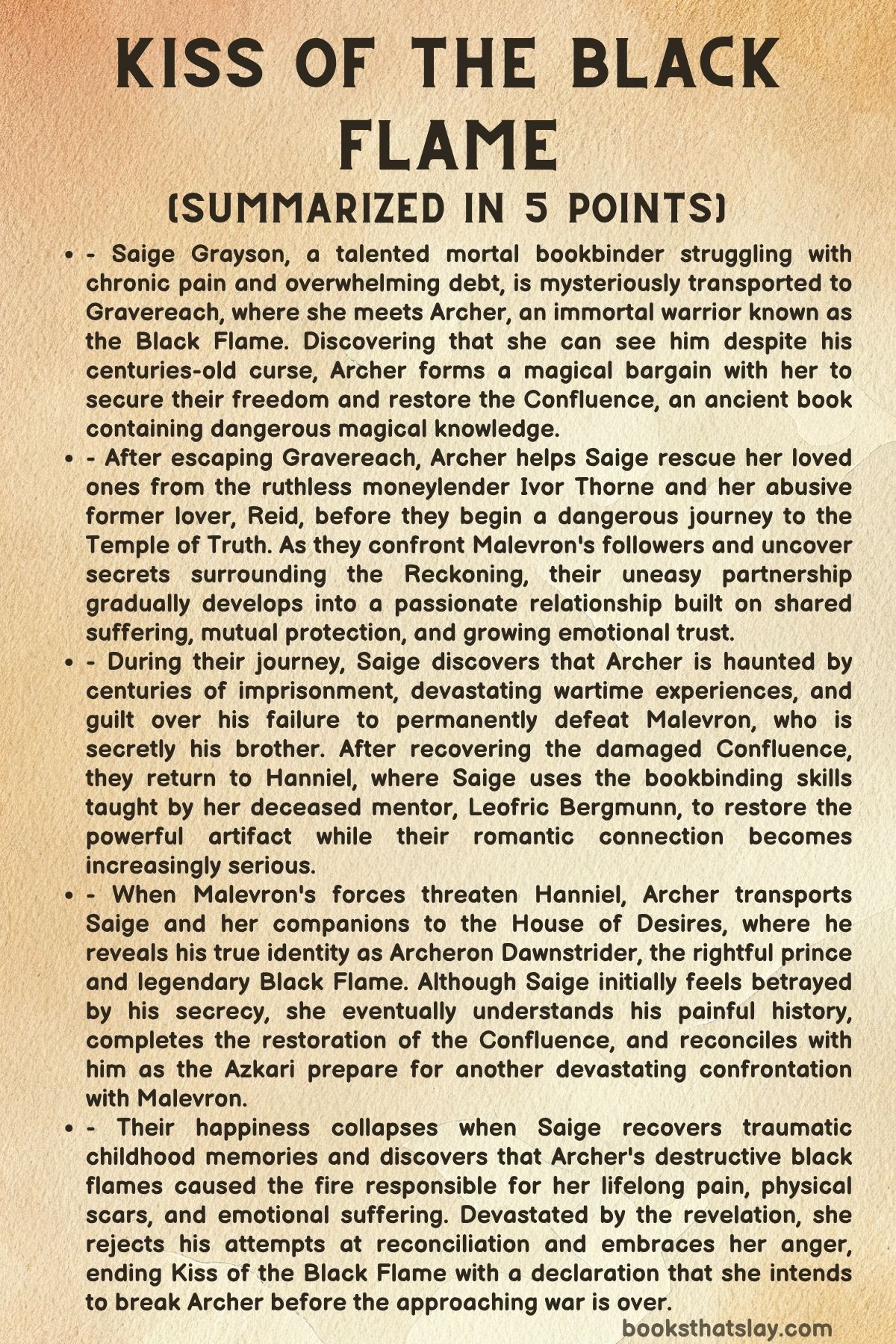
Summary
Centuries before the main events, the magical realm of Lorevael is devastated by a terrible conflict known as the Reckoning. An extraordinarily powerful Azkari warrior called the Black Flame battles Malevron, the Silver-Tongued Deceiver, whose ambition threatens the foundations of Azkari existence.
Although the war supposedly ends with Malevron’s defeat, both warriors become trapped in a supernatural curse. The Black Flame, whose real name is Archer, loses his physical existence and spends centuries imprisoned in Gravereach, becoming a shadow who can temporarily regain substance only under particular magical conditions.
Malevron remains dangerous despite suffering from the same curse. His followers continue searching for the Confluence, an ancient book containing knowledge of the Weave, the magical force underlying Azkari existence.
The Confluence could enable Malevron to regain his power and destroy the existing order. Archer therefore becomes determined to recover and restore the book before his enemy can use it.
In the mortal city of Hanniel, Saige Grayson struggles to maintain the Awl and Cradle, the bookbinding workshop inherited from her deceased mentor, Leofric Bergmunn. Years of medical expenses have left her deeply indebted to the ruthless moneylender Ivor Thorne.
Saige also experiences agonizing episodes of unexplained pain that have troubled her for decades. Despite countless attempts to find treatment, she remains without answers, carrying physical scars and emotional insecurities that influence nearly every part of her life.
Her closest companions, Raven Lockhart and Yevna, encourage her to seek happiness beyond the workshop. However, her circumstances deteriorate when mysterious Azkari visitors begin investigating Leofric’s work and asking about his successor.
During a Reclaiming celebration, Saige, Raven, and Yevna are abducted by Thorne’s men. Saige discovers that her captors intend to exploit her bookbinding abilities for purposes connected to the ancient magical conflict.
Before she can understand their plans, supernatural chains seize her and transport her into Gravereach.
There, Saige encounters Archer, an intimidating prisoner who recognizes her as the mysterious woman who saw his invisible form ten years earlier. Their previous encounter briefly restored his physical presence, suggesting that Saige possesses an extraordinary connection to his curse.
Archer quickly realizes that Malevron has made an unexpected mistake. By placing Leofric’s successor inside Gravereach, his enemy has provided him with someone who might help restore the Confluence and secure his freedom.
Their relationship begins with suspicion and reluctant cooperation. Saige distrusts Azkari bargains, while Archer refuses to explain his true identity or motivations.
Nevertheless, when the prison’s monstrous enforcers threaten Saige, Archer willingly accepts torture in her place. His sacrifice changes her understanding of him, and she begins recognizing the suffering concealed beneath his formidable exterior.
Eventually, they form a magical bargain sealed with a kiss. Saige agrees to help restore the Confluence, while Archer promises to free her and assist in rescuing Raven and Yevna.
Their escape returns them to Hanniel, where Archer helps confront Thorne’s criminal organization. During the rescue, Saige must face Reid, a former lover whose exploitation and emotional cruelty contributed significantly to her shame and financial desperation.
Archer protects her from an attack, defeats Thorne’s men, and destroys the compound with his terrifying black flames. However, Reid escapes after revealing that the Confluence may be hidden inside the Temple of Truth.
With Raven and Yevna rescued, Saige prepares to accompany Archer into Azkari territory. Their journey gradually transforms their relationship from a practical alliance into an increasingly intimate partnership.
Archer reveals that the Confluence contains dangerous knowledge concerning the creation of the Azkari and the structure of the Weave. The book was damaged when the High King and Queen attempted to prevent Malevron from using its secrets.
Saige’s exceptional craftsmanship makes her essential to restoring it.
As they travel through landscapes damaged by the Reckoning, Saige learns more about Archer’s traumatic history. His botanical tattoos commemorate plants capable of surviving hostile environments, representing the endurance he struggled to preserve during centuries of imprisonment.
Although Archer frequently withdraws whenever she offers emotional support, Saige refuses to accept his cruelty or allow his suffering to diminish her own worth.
Their connection deepens after encounters with Malevron’s followers and the unexpected arrival of Archer’s younger brother, Daemos. The brothers’ reunion reveals that Archer has surviving family members who believed him dead for centuries.
Daemos also warns Saige that his brother’s love can be as dangerous and consuming as his magic.
Saige subsequently discovers that Archer has a fiancée named Isindrel, leaving her hurt and confused about their growing attraction. Her distress becomes another obstacle as they approach the Temple of Truth.
Inside the sanctuary, ancient enchantments force them to answer difficult questions honestly.
Archer confesses that he protected Saige in Gravereach because she was the first person in centuries who could truly see him. Saige, meanwhile, reveals painful experiences involving debt, exploitation, and the desperate compromises she made to survive.
Their honesty allows them to understand each other’s emotional wounds more deeply.
As they reach the Confluence, their magical connection exposes Saige to memories of the Reckoning’s catastrophic final battle. She witnesses the enormous destruction caused by Archer’s confrontation with Malevron before collapsing under a surge of magical energy.
Archer retrieves the damaged book and carries her to safety, defending her against monstrous creatures before returning to Hanniel.
Back at the Awl and Cradle, Saige begins the difficult restoration. The work requires the specialized knowledge and delicate craftsmanship she developed under Leofric’s guidance.
Their time together in the workshop creates opportunities for domestic intimacy. Archer experiences ordinary kindness, learns about her craft, and gradually accepts affection without interpreting every gesture as an obligation.
Saige gives him flowers, a simple gift that deeply affects a warrior accustomed to being treated as a weapon rather than a person. Their physical relationship also develops, allowing Saige to reclaim pleasure and confidence after experiences that damaged her relationship with her body.
However, their peace does not last.
Thorne and Reid return to threaten Saige, and Malevron’s monstrous servants launch another attack. Recognizing that Hanniel is no longer safe, Archer transports Saige and her companions to Ignizar, the seat of the House of Desires.
There, he publicly confronts the ruler occupying the throne and reveals his true identity: Archeron Dawnstrider, the rightful Prince of Desires.
The revelation shocks Saige, who believed she was developing a relationship with a former soldier rather than a royal heir. She feels betrayed by Archer’s decision to conceal information that could have changed her understanding of their relationship.
Archer explains that he wanted someone to know him without the burden of his royal position or legendary reputation. Although Saige understands his desire for an ordinary identity, she cannot immediately excuse his secrecy.
He eventually shows her the truth about the Reckoning’s final battle.
Malevron is revealed to be Archer’s brother, making their ancient conflict a devastating family betrayal. During their confrontation, Malevron exploited a moment of hesitation and used mirror magic to sever Archer’s physical connection to the Weave.
Because their magical threads were connected, the curse affected both brothers.
Archer has blamed himself for centuries, believing his failure condemned his companions and prevented Malevron’s permanent defeat. Saige challenges this interpretation, reminding him that his sacrifice also protected countless lives and granted Lorevael two centuries of peace.
Meanwhile, Saige completes her restoration of the Confluence in the royal workshop. Her achievement demonstrates the extraordinary value of her mortal skills, even as Azkari nobles question her involvement in their political affairs.
Archer assembles the realm’s leaders and warns that Malevron’s return is approaching. He explains that the Confluence’s magical forces can be separated during the Triad’s Ascension, a celestial alignment that will strengthen the Weave.
Political disagreements intensify, and preparations begin for a renewed confrontation.
Amid these dangers, Archer finally acknowledges his love for Saige. He apologizes for concealing his identity and confesses that she has become more important to him than he ever expected.
Saige chooses to forgive him, and their reconciliation allows both to experience a sense of emotional security that once seemed impossible.
For a brief period, Archer believes that his centuries of loneliness, punishment, and regret might finally be ending.
However, their happiness collapses when Saige begins recovering traumatic memories from her childhood.
She remembers being trapped inside a burning building, surrounded by flames, broken glass, and collapsing structures. The devastating incident left the scars and chronic pain that have shaped her entire adult life.
As the memories become clearer, she discovers that the fire was caused by Archer himself.
The revelation destroys her understanding of their relationship. The warrior who helped her accept her scars and offered comfort during her pain is also responsible for the suffering she has endured for thirty years.
Archer is horrified by the discovery and recognizes that his supposedly necessary acts of destruction harmed an innocent child. His guilt becomes unbearable, but he understands that explanations cannot erase the consequences.
Saige refuses to forgive him again.
Her grief transforms into anger as she recognizes how profoundly his actions altered her life. At the same time, the restored Confluence displays extraordinary magical power, suggesting that her importance to the coming conflict extends beyond her professional abilities.
Instead of retreating into shame or helplessness, Saige embraces her rage.
The novel ends with her confronting Archeron and declaring her intention to break him before the approaching war is over. Their love has become a source of devastating conflict, leaving their relationship and Lorevael’s future uncertain.
Characters
Saige Grayson
Saige Grayson is the central female protagonist of Kiss of the Black Flame, a skilled mortal bookbinder whose extraordinary courage emerges through years of physical suffering, financial hardship, and emotional exploitation. Her journey centers on reclaiming control over her life while discovering that her personal history is connected to a much larger magical conflict.
Her chronic pain profoundly affects her identity, shaping her confidence, relationships, and understanding of her body. The mystery surrounding her condition also makes her deeply vulnerable to those who exploit her desperation for relief and financial security.
Despite these difficulties, Saige possesses an independent spirit, sharp humor, and considerable determination. Her ability to challenge Archer’s intimidating behavior demonstrates that she refuses to surrender her judgment simply because someone possesses greater physical or magical power.
Her profession is essential to understanding her character because bookbinding represents stability, intellectual discipline, and personal achievement. Leofric’s mentorship gave her a meaningful vocation, allowing her to build an identity beyond the suffering that has dominated her life.
Saige’s relationship with Archer gradually challenges her understanding of intimacy and trust. Through their growing affection, she begins recognizing that her scars do not diminish her worth and that she deserves tenderness without sacrificing her independence.
However, her emotional development does not follow a straightforward path toward forgiveness. When she discovers that Archer caused the childhood fire responsible for her lifelong suffering, her sense of betrayal overwhelms the security she had begun experiencing.
Her final declaration against Archer represents an important transformation. Rather than accepting suffering as something she must endure quietly, Saige claims the right to express anger and demand accountability, establishing herself as a formidable presence in the coming conflict.
Archeron Dawnstrider / Archer / The Black Flame
Archeron Dawnstrider is the central male protagonist of Kiss of the Black Flame, a legendary Azkari warrior whose fearsome reputation conceals centuries of loneliness, guilt, and psychological suffering. As the rightful Prince of Desires, he possesses extraordinary magical abilities, including the devastating black flames that earned him his legendary title.
His history is dominated by the Reckoning, during which his confrontation with Malevron resulted in a supernatural curse and centuries of imprisonment. His physical scars, emotional withdrawal, and difficulty accepting kindness all reflect the lasting consequences of that experience.
Archer’s greatest internal struggle concerns his belief that he deserves punishment for failing to defeat Malevron permanently. Although the world celebrates him as a hero, he views himself as someone whose actions brought destruction and death to countless people.
His fascination with flowers and resilient plants reveals a gentleness that contradicts his reputation. The botanical tattoos covering his body preserve reminders of survival, suggesting that some part of him continued searching for hope even during his darkest years.
His relationship with Saige gradually changes his understanding of affection. Initially viewing their connection through the practical demands of a magical bargain, he eventually learns to appreciate companionship, generosity, and love without expecting repayment.
Nevertheless, Archer’s secrecy demonstrates how deeply he fears being known. By concealing his royal identity and painful history, he attempts to protect himself from rejection while unintentionally creating the conditions for betrayal.
His final confrontation with Saige exposes the contradiction at the center of his character. He has repeatedly protected the woman he loves, yet his own destructive powers are responsible for the suffering that has defined her life, forcing him to confront the true consequences of his past.
Malevron / The Silver-Tongued Deceiver
Malevron is the principal antagonist of Kiss of the Black Flame, an immensely powerful Azkari whose ambition and manipulation threaten the existence of his own people. As Archer’s brother, he transforms what might otherwise have been a conventional conflict between good and evil into a devastating struggle rooted in family betrayal.
His desire to control the Confluence demonstrates his determination to acquire power over the fundamental structures of magic. Rather than accepting the limitations imposed by the Weave, he seeks knowledge capable of transforming or destroying the established order.
Malevron’s mirror magic reflects his deceptive personality. He manipulates appearances, exploits psychological weaknesses, and turns his enemies’ fears against them, making his influence dangerous even when he cannot act directly.
His confrontation with Archer during the Reckoning exposes his willingness to sacrifice familial bonds for personal ambition. By severing Archer’s connection to physical existence, he condemns his brother to centuries of torment, although the curse also rebounds upon himself.
Even after the war, Malevron remains a persistent threat through his followers and corrupted servants. His continuing influence demonstrates that apparent military defeat does not necessarily eliminate the ambitions or structures responsible for conflict.
Malevron also functions as a disturbing counterpart to Archer. Both possess extraordinary power and remain connected through magic, but their contrasting responses to suffering reveal the moral significance of how individuals choose to exercise power.
Daemos Dawnstrider
Daemos is Archer’s younger brother and one of the most important supporting characters in Kiss of the Black Flame. His unexpected reunion with Archer restores a family connection that both brothers believed permanently lost.
Unlike Archer, Daemos frequently relies on humor, charm, and playful provocation. His teasing behavior introduces a lighter dimension to their interactions while revealing the familiar affection that survives beneath centuries of separation.
However, Daemos is considerably more perceptive than his relaxed manner initially suggests. He quickly recognizes Archer’s attraction to Saige and understands the danger of becoming emotionally attached during a conflict in which loved ones may be exploited.
His warnings arise from concern rather than hostility toward Saige. Having witnessed the effects of war and loss on his brother, he fears that another devastating personal tragedy could destroy Archer’s fragile emotional recovery.
Daemos also provides Saige with valuable insight into Archer’s earlier personality. Through his recollections, she learns that the stern warrior once possessed a more spontaneous, passionate, and openly affectionate nature.
His guilt over Archer’s imprisonment adds emotional complexity to their relationship. Although he believed his brother dead, Daemos struggles with the knowledge that someone he loved endured unimaginable suffering without assistance.
Beyond his familial importance, Daemos connects the central characters to Azkari political structures. His knowledge of noble houses, royal customs, and political rivalries becomes increasingly valuable as the threat of renewed war approaches.
Raven Lockhart
Raven Lockhart is Saige’s closest friend and one of the strongest sources of emotional stability in her life. Her loyalty provides an important counterbalance to the uncertainty, exploitation, and fear surrounding Saige’s circumstances.
Raven understands that Saige frequently conceals her suffering behind humor and determination. Rather than accepting her friend’s reassurances without question, she encourages Saige to seek companionship and remember that she has people willing to help her.
Her involvement in the abduction by Thorne’s men demonstrates the dangers created by Saige’s financial situation. However, Raven’s experience also reinforces the strength of their relationship because neither woman abandons the other when circumstances become dangerous.
Raven is particularly cautious about Archer and the magical bargain binding him to Saige. Her skepticism reflects a practical understanding that powerful individuals may offer assistance while withholding information that alters the meaning of an agreement.
As Saige’s relationship with Archer develops, Raven remains attentive to her friend’s emotional wellbeing. She recognizes that affection does not automatically eliminate questions about honesty, consent, or unequal power.
Her practical assistance during the restoration of the Confluence further establishes her significance. By helping Saige obtain equipment, maintaining her wellbeing, and staying beside her through exhausting work, Raven demonstrates that extraordinary accomplishments often depend upon ordinary acts of loyalty.
Yevna
Yevna is a protective, outspoken figure whose tavern, the Copper Kettle, serves as an important gathering place for Saige and her companions. Her relationship with Saige resembles that of an adopted family member, offering affection and security beyond biological ties.
Her commanding personality allows her to confront dangerous individuals without becoming excessively intimidated by their reputations. Even Archer’s legendary status does little to discourage her sharp observations or humorous criticism.
Yevna’s understanding of people makes her particularly important to Archer’s emotional development. She recognizes his love for Saige before he feels comfortable acknowledging it and challenges his tendency to interpret affection as an exchange of obligations.
Her explanation that love must be freely offered rather than negotiated through debt or bargains provides Archer with a radically different perspective. For someone who has spent centuries surrounded by violence and manipulation, this understanding is especially significant.
Yevna also possesses useful knowledge about Azkari magic and celestial events. Her explanation of the Triad’s Ascension demonstrates that she contributes more than emotional comfort to the approaching conflict.
Through her courage, humor, and unwavering loyalty, Yevna represents the protective community that Saige has built around herself despite years of hardship.
Leofric Bergmunn
Leofric Bergmunn is Saige’s deceased mentor and the former owner of the Awl and Cradle. Although he is absent from the central events, his influence remains visible in Saige’s professional identity, personal values, and determination to continue her work.
His reputation as an exceptional bookbinder makes him an important figure in the conflict surrounding the Confluence. Both Malevron and Archer understand that his specialized knowledge could have been essential to restoring the damaged magical book.
For Saige, however, Leofric’s importance extends far beyond his craftsmanship. He offered her stability and purpose when physical suffering and difficult personal circumstances threatened to overwhelm her.
His teaching emphasizes patience, perseverance, and the acceptance of mistakes as part of developing expertise. These principles become especially valuable when Saige confronts the intimidating responsibility of restoring the Confluence.
The Awl and Cradle therefore represents his continuing presence in her life. Preserving the workshop becomes an expression of gratitude and a means of protecting the identity she developed under his guidance.
Leofric’s legacy also demonstrates how mentorship can influence events long after a person’s death. The knowledge he passed to Saige eventually places her at the center of a struggle involving the survival of an entire magical civilization.
Ivor Thorne
Ivor Thorne is a ruthless moneylender whose exploitation of Saige’s financial desperation establishes him as one of the novel’s principal mortal antagonists. His power comes not from extraordinary magic but from controlling people through debt, intimidation, and economic vulnerability.
Thorne understands that Saige’s medical expenses have left her with limited options. Rather than treating her circumstances with compassion, he uses her obligations as a means of exerting pressure and threatening the people she loves.
His decision to abduct Raven and Yevna reveals the extent of his cruelty. By targeting Saige’s emotional attachments, he attempts to force her cooperation without regard for the suffering his actions create.
Thorne also demonstrates an opportunistic relationship with the Azkari conflict. When he discovers that powerful individuals are searching for a skilled bookbinder, he views Saige as a valuable commodity rather than an independent person.
His later return shows that exploitation does not necessarily end when a victim escapes immediate physical danger. Financial obligations, intimidation, and psychological control can continue threatening freedom long afterward.
Through Thorne, the novel examines how ordinary social structures can become instruments of cruelty when power operates without accountability.
Reid
Reid is Saige’s former lover and another significant representative of the exploitation she has endured. His relationship with her involved emotional cruelty, manipulation, and experiences that contributed to her lasting shame and insecurity.
Unlike Thorne, whose interest is primarily financial, Reid possesses intimate knowledge of Saige’s fears and vulnerabilities. He uses this information to humiliate her and undermine the confidence she has struggled to rebuild.
His reappearance during the Reclaiming celebration forces Saige to confront memories she would prefer to leave behind. His involvement with Thorne subsequently demonstrates how personal exploitation and financial coercion can reinforce one another.
Reid’s behavior exposes the damaging effects of relationships in which affection or intimacy becomes a mechanism of control. His attempts to make Saige feel powerless are particularly disturbing because he once occupied a position of personal trust.
Archer’s reaction to Reid reveals his increasingly protective feelings for Saige, but Reid’s significance is not limited to provoking the Black Flame’s anger.
He also provides a contrast that highlights Saige’s development. Where she once struggled to resist humiliation, she gradually becomes more willing to confront Reid and reject his authority over her identity.
Bryn
Bryn is one of Archer’s trusted companions from the Reckoning and an important connection to the life he lived before his imprisonment. Her friendship preserves memories of the warrior who existed before centuries of suffering transformed him.
Their relationship is characterized by loyalty, familiarity, and mutual respect. Having fought beside Archer during the war, Bryn understands the enormous responsibilities he carried and the sacrifices demanded of ordinary soldiers.
Her reunion with him helps restore a sense of continuity between his past and present identities. Rather than viewing him exclusively as the legendary Black Flame, she recognizes the individual behind his reputation.
Bryn also provides valuable emotional perspective when Archer confesses his feelings for Saige. She challenges his decision to conceal his royal identity, reminding him that his position remains part of who he is even if he wishes to escape its burdens.
Her refusal to support his uncle’s claim to authority demonstrates that her loyalty has survived Archer’s prolonged absence. She represents the possibility that relationships founded on genuine trust can endure extraordinary separation.
Cahir
Cahir is one of Archer’s fellow prisoners in Gravereach, sharing the isolation and suffering imposed by Malevron’s forces. His companionship provides an important source of stability during Archer’s centuries of captivity.
His work tattooing botanical designs across Archer’s scarred body carries considerable symbolic importance. The images preserve Archer’s fascination with plants that survive under difficult conditions, helping him maintain a connection to life beyond the prison.
Cahir’s presence also shows that Gravereach has not completely destroyed the prisoners’ capacity for companionship. Despite their terrible circumstances, small acts of care remain possible.
When Saige arrives, Cahir understands the dangers surrounding her presence and attempts to prevent her from attracting the guards’ attention. His warnings demonstrate practical knowledge gained through prolonged exposure to the prison’s cruelty.
Although his role is comparatively limited, Cahir helps establish the emotional significance of Archer’s captivity and the relationships that allowed him to endure it.
Rook
Rook is another of Archer’s companions in Gravereach and an important source of information about the prison and Malevron’s followers. His presence contributes to the atmosphere of shared endurance among prisoners who have little reason to expect freedom.
He informs Archer of Leofric Bergmunn’s death, delivering news that appears to destroy the warrior’s remaining hope of restoring the Confluence. The conversation demonstrates how thoroughly Archer’s plans depend on knowledge of events beyond the prison.
Rook also identifies the terrifying souldren elite, helping Saige and the other prisoners understand the danger posed by the corrupted warriors serving Malevron.
His character emphasizes the collective suffering of Gravereach’s inhabitants. While Archer’s experiences receive the greatest attention, Rook reminds readers that the prison contains others whose lives have likewise been devastated by prolonged captivity.
Isindrel
Isindrel is a figure from Archer’s past whose significance becomes apparent when Daemos reveals that she is Archer’s fiancée. Although her direct characterization is limited in the provided account, her relationship with Archer creates an important conflict between him and Saige.
The revelation unsettles Saige because she has begun developing serious romantic feelings for someone who appears to remain committed to another woman. It also exposes the consequences of Archer’s reluctance to discuss his history.
Isindrel’s importance therefore lies partly in what her existence reveals about secrecy and trust. Saige cannot determine the meaning of Archer’s affection without understanding the relationships and obligations he has concealed.
The Temple of Truth forces Archer to address these questions, challenging him to explain the circumstances surrounding his former engagement.
Isindrel consequently represents the unresolved past that Archer must confront before establishing an honest future with Saige.
Prince Eryx
Prince Eryx is the ruler of the House of Reveries and an important figure within the wider political structure of Azkari society. His territory contains the Temple of Truth, placing his authority near a location central to Archer’s mission.
Although he does not receive extensive direct characterization, his position demonstrates the division of power among the ruling Azkari houses. These competing authorities create political complications at a time when unity is essential to opposing Malevron.
Archer’s resentment toward Azkari royalty also provides context for understanding figures such as Eryx. The warrior believes that many rulers escaped the suffering experienced by ordinary soldiers during the Reckoning.
Eryx therefore contributes to the broader political tensions surrounding the return of the Black Flame and the approaching war.
Grim
Grim is Yevna’s enormous dog and a recurring companion whose presence provides both humor and loyalty throughout the story. His connection to Saige and Yevna makes him part of the close community that the central characters seek to protect.
His escape from Thorne’s attack and subsequent reunion with Saige demonstrate his attachment to his companions. His persistence also helps preserve a familiar element of Saige’s previous life during her dangerous travels.
Grim’s antagonistic interactions with Archer provide comic relief, especially because the formidable warrior struggles to earn the animal’s affection. These moments make Archer appear less intimidating and reveal his difficulties adjusting to ordinary companionship.
Although Grim does not determine the larger magical conflict, his presence reinforces the importance of loyalty, familiarity, and affection amid threatening circumstances.
Themes
Love, Trust, and the Consequences of Betrayal
Love in Kiss of the Black Flame develops through the gradual dismantling of emotional barriers that have protected Saige and Archer from further suffering. Their relationship begins as a bargain based on mutual necessity, but repeated sacrifices and moments of vulnerability eventually create genuine affection.
Archer initially understands relationships through obligation and exchange, an attitude shaped by centuries of imprisonment and conflict. Saige challenges this perspective by offering companionship and kindness without demanding an equivalent reward.
Their connection becomes particularly meaningful because both have experienced circumstances that damaged their understanding of trust. Saige has endured exploitation and humiliation, while Archer associates attachment with loss, guilt, and vulnerability.
As their relationship develops, intimacy allows both characters to reconsider these beliefs. Saige gradually becomes more comfortable expressing desire and accepting affection, while Archer begins imagining a future in which he might be valued independently of his power.
However, love does not eliminate the consequences of dishonesty. Archer’s concealment of his royal identity demonstrates that withholding information can damage trust even when the underlying motivation is understandable.
The final revelation creates a far more devastating conflict because Archer’s destructive actions are directly responsible for Saige’s lifelong suffering. Their affection cannot erase the physical and emotional consequences of what occurred.
This development challenges the assumption that romantic love necessarily leads to forgiveness. Saige’s refusal to excuse Archer reveals that genuine affection can coexist with anger, betrayal, and the demand for accountability.
The novel consequently presents love as a powerful but morally complicated experience, one that requires honesty and respect rather than automatic absolution.
Trauma, Chronic Pain, and Reclaiming Personal Identity
Physical suffering shapes the lives of both protagonists, although their experiences emerge from different circumstances. Saige’s chronic pain influences her daily activities, professional responsibilities, financial security, and relationship with her own body.
Her condition has remained unexplained for decades, leaving her vulnerable to frustration and self-doubt. Repeated medical expenses contribute to her debt, demonstrating how physical suffering can produce economic and social consequences that extend beyond the symptoms themselves.
Saige’s attempts to conceal her pain reveal the pressure she feels to appear capable and independent. She frequently minimizes her suffering because she fears being perceived as weak or becoming a burden to others.
Archer experiences a different form of trauma through centuries of torture, confinement, and magical punishment. His scars preserve evidence of violence, while his emotional withdrawal shows how prolonged suffering can alter someone’s ability to trust and accept kindness.
Their developing relationship creates opportunities for mutual recognition. Rather than treating each other’s injuries as sources of disgust or inadequacy, they begin understanding the people beneath those physical marks.
However, neither character possesses the ability to repair the other’s suffering simply through affection. Their experiences demonstrate that emotional recovery requires more than reassurance, particularly when the causes of trauma remain unresolved.
Saige’s identity also depends upon her craftsmanship and personal relationships. Her commitment to bookbinding allows her to recognize accomplishments unrelated to her medical condition, while Raven and Yevna reinforce her value as a person.
The final revelation gives her scars an entirely new meaning. By embracing anger rather than suppressing it, Saige begins asserting ownership over a history that others have repeatedly tried to control or define.
Power, Responsibility, and the Cost of War
The consequences of extraordinary power dominate Kiss of the Black Flame, particularly through Archer’s destructive abilities and Malevron’s determination to control the Confluence. Their conflict demonstrates how individual choices can affect entire civilizations when magic operates on an immense scale.
Malevron represents power pursued without adequate moral restraint. His ambition leads him to manipulate magical foundations, exploit vulnerable individuals, and sacrifice familial relationships for personal dominance.
Archer initially appears to offer a contrasting model of power because he fights to protect Lorevael. Nevertheless, the destruction associated with his black flames complicates the distinction between heroic intentions and harmful consequences.
The Reckoning leaves damaged landscapes, dead soldiers, shattered political relationships, and generations affected by violence. Even after two centuries of relative peace, the conflict continues shaping the lives of those who survived it.
Archer’s imprisonment further demonstrates that victory can carry enormous personal costs. Although his sacrifice prevents Malevron from immediately continuing the war, he experiences the outcome as failure because his enemy remains alive.
His return to the House of Desires introduces another dimension of responsibility. As a prince, he must confront political disputes, question established authorities, and persuade divided factions to prepare for renewed conflict.
The restored Confluence also raises questions about whether potentially catastrophic knowledge should belong to any single individual. Its ability to affect the Weave makes it both a possible instrument of salvation and a source of tremendous danger.
The discovery that Archer’s flames injured Saige as a child makes the moral implications of power intensely personal. His actions may have served a larger military purpose, but that purpose cannot invalidate the suffering of innocent individuals.
Through this conflict, the novel challenges the idea that noble intentions automatically justify destructive methods and suggests that genuine responsibility requires acknowledging harm even when it was unintended.
Hope, Survival, and the Search for Belonging
Small acts of kindness and ordinary experiences acquire extraordinary significance for characters who have spent much of their lives surrounded by suffering. Archer’s fascination with flowers offers one of the clearest expressions of this idea.
During his imprisonment, plants growing through cracks in Gravereach’s walls become symbols of endurance. Their ability to survive in hostile conditions reminds him that life can persist even when circumstances appear hopeless.
The botanical tattoos covering his body preserve that belief. Rather than commemorating military victories, these images celebrate fragile forms of existence that survive without possessing overwhelming strength.
Saige expresses a similar philosophy through her humor, craftsmanship, and loyalty to her chosen family. Although chronic pain and financial hardship repeatedly threaten her stability, she continues searching for moments of happiness and personal accomplishment.
Her relationship with the Awl and Cradle demonstrates how belonging can emerge through meaningful work. Leofric’s guidance provides her with a vocation and a place where she can develop confidence through patience and skill.
Raven and Yevna reinforce this sense of belonging through their continuing support. Their loyalty establishes that family can be created through shared experiences and freely offered affection rather than biological relationships alone.
Archer gradually encounters this understanding as he becomes part of Saige’s everyday life. Simple experiences such as receiving flowers, sharing meals, reading books, and being cared for during illness begin changing his expectations of the future.
His reunion with Daemos and Bryn further demonstrates that connections believed permanently lost may sometimes be restored. These relationships allow him to recognize that his identity extends beyond the warrior and prisoner he has become.
Yet the novel does not portray hope as a guarantee of lasting happiness. The painful revelation at the conclusion threatens the belonging Archer and Saige have begun building together.
Instead, hope emerges as the difficult decision to continue living, seeking meaning, and asserting personal dignity despite unresolved suffering and an uncertain future.