Firstborn by M.J. Hastings Summary, Characters and Themes
Firstborn by M.J. Hastings is a dystopian fantasy centered on Bryn Ruelle, an elite soldier raised inside a nation whose rigid social order has defined every part of her identity.
Born into the oppressed Bastard class but elevated after surviving a childhood Culling, Bryn has spent her life proving that she belongs among Durst’s Firstborn warriors. Her certainty begins collapsing when her younger sister Wren disappears and evidence suggests that the government Bryn serves is responsible. What begins as a desperate rescue becomes an examination of manufactured enemies, political control, family loyalty, stolen magic, and the painful process of deciding who to become after discovering that almost everything one believed was built on deception.
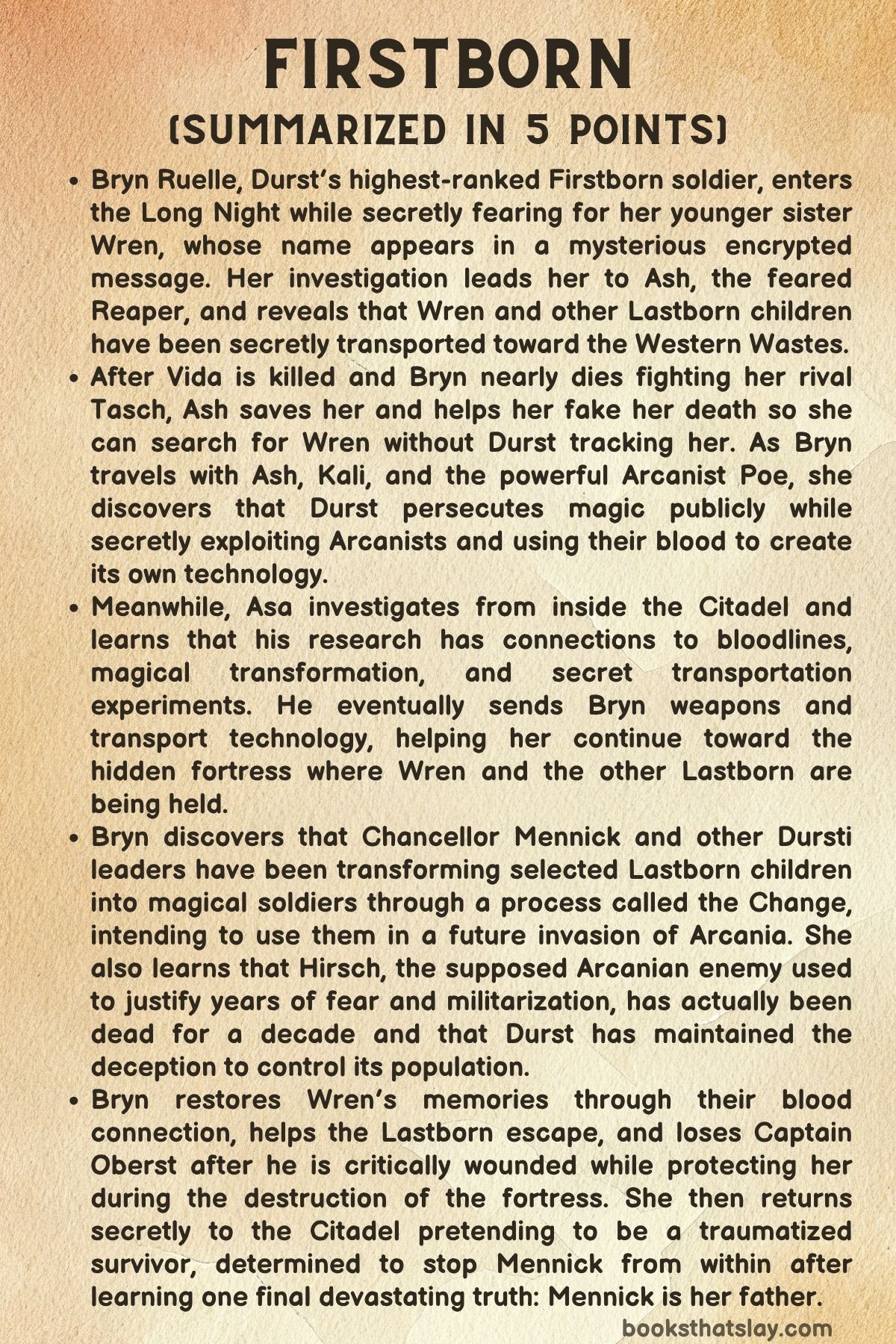
Summary
Bryn Ruelle approaches the Trial of the Long Night as Durst’s highest-ranked Firstborn and the young soldier everyone expects to dominate the ceremonial hunt. The Trial requires graduating warriors to enter the Oval and kill imprisoned Bastards, but beneath Bryn’s fearsome reputation lies a secret: despite years of training and public expectations, she has never deliberately killed anyone, while her thoughts are increasingly occupied by her younger sister Wren, a Lastborn child who will soon be taken away for a mysterious national purpose.
Shortly before the Trial, Bryn discovers a coded message containing references to Arcania, its supposedly dangerous leader Hirsch, and Wren’s full name. Chancellor Arlo Mennick, Durst’s revered ruler, tells Bryn that the Lastborn will play an important role in ending the nation’s conflict, while his attempt to read Bryn’s future produces the Black Cross, which he interprets as death; unable to determine whether her government can be trusted, Bryn secretly turns to her disgraced former friend Vida and then to a mysterious Bastard named Ash, who tells her that answers about Wren may lie with her brother Asa.
Asa is studying at Midborn University, where his remarkable intelligence has led him into research involving healing, runes, blood, and fragments of Old Arcanic knowledge. Bryn approaches him after years of emotional separation and demands to know whether his research could somehow endanger Wren, but Asa, hurt by the accusation and by Bryn’s long absence from his life, refuses to help before she can fully explain what she has discovered.
Bryn enters the Long Night still torn between her suspicion that Wren is in danger and her lifelong desire to prove herself worthy of Durst. Once inside the Oval, however, she refuses to hunt helpless Bastards and instead follows a secret message from Vida, finding her mortally wounded; Vida dies in Bryn’s arms, and Bryn soon encounters Tasch, her longtime rival, who admits that he followed Vida in order to reach Bryn and reveals that Lastborn children have been dying as part of a larger hidden operation.
Tasch attacks Bryn and nearly kills her, but even after gaining the advantage Bryn cannot bring herself to execute him. Her hesitation allows Tasch to recover and prepare a fatal strike, only for Ash to appear and kill him; Ash then helps Bryn recover Vida’s completed cipher, which confirms that Wren and other children are being transported toward the Western Wastes under circumstances apparently involving Arcania.
Ash heals Bryn with genuine magic and reveals that he is the infamous Reaper, the Arcanist outlaw Durst has taught Bryn to fear. Although Bryn initially attacks him out of loyalty to everything she has been taught, Ash persuades her to consider that the government may have deliberately shaped her idea of who her enemies are, and together they fake Bryn’s death by disguising Vida’s corpse so Bryn can abandon the Trial without being tracked.
Asa and Captain Erik Oberst both become suspicious of the official account of Bryn’s death. Asa recognizes physical inconsistencies in the corpse he is forced to burn and concludes that his sister is alive, while Oberst—Bryn’s harsh former instructor and a powerful covert operative—begins following evidence that she deliberately disappeared.
Bryn and Ash return secretly to the Citadel but discover that Wren has already been removed. Wren, meanwhile, has been transported with other Lastborn children through a blood-activated magical circle, while Bryn escapes Durst with Ash and undergoes an agonizing process to break the tracking runes embedded in her body at a hidden refugee camp operated by the Arcanist Kali.
Kali exposes Bryn to realities she was never taught to see, including Durst’s trafficking networks and the fear ordinary Bastards feel toward Firstborn soldiers. Bryn gradually witnesses evidence that her nation’s institutions are not morally superior to the enemies described in official propaganda, while her relationship with Ash changes from hostile necessity into trust and attraction.
Their journey takes them to a heavily protected military armory, where Bryn pretends to be a loyal Firstborn who has captured the Reaper. Deep inside the facility they discover Poe, a powerful Arcanist prisoner who calls himself the Book and reveals that Durst’s celebrated Craft technology was developed by extracting and reproducing magic from his blood, meaning the state that publicly condemns Arcanists secretly depends upon stolen Arcanic power.
Poe further suggests that the Ruelle bloodline is unusually significant and that Asa’s research may have been used to identify or manipulate children capable of surviving magical experimentation. Bryn refuses to believe her brother knowingly harmed anyone, while Asa independently discovers that teleportation technology may explain how large numbers of children have been transported west without conventional convoys and begins secretly preparing equipment that might help Bryn.
Bryn’s loyalty to Durst continues deteriorating when she witnesses soldiers seize a young child merely because his magic has awakened. At the same time, Oberst follows Bryn west, eventually admitting to himself that his interest in finding her is no longer simply professional, while Bryn and Ash grow emotionally closer after she saves Ash from a magical poison by attempting a dangerous runebreak herself.
Their relationship is nearly destroyed when Bryn overhears Ash meeting secretly with Oberst and assumes he intends to betray her. The truth is more complicated: Ash originally approached Bryn because he suspected Asa’s research was connected to the missing children, and he concealed information from her to push her into abandoning the Long Night, but Oberst is also Ash’s long-lost brother, making the captain’s involvement deeply personal.
With Poe’s help, Bryn eventually crosses the Black River into Arcania and is disturbed to discover an ordinary society rather than the monstrous land she had imagined. Entering the Western Wastes through a hidden route, Bryn finds a secret battlefield occupied by mysterious soldiers and discovers that Ash, who followed after her, has been captured; Asa’s magically transported package of weapons and runic devices allows Bryn and Poe to rescue him.
Bryn, Ash, and Poe finally locate a hidden fortress containing the Lastborn children. While infiltrating it, Bryn overhears Mennick meeting supposedly vanished Dursti leaders and learns the truth: the Lastborn are being deliberately subjected to a process called the Change, transforming selected children into magicians whose inherited bloodlines make them capable of surviving the procedure.
The conspiracy reaches far beyond Wren. Asa’s research has unknowingly helped the government identify viable bloodlines, many children have died during the experiments, and Durst intends to create magically enhanced soldiers for a future invasion of Arcania; even Hirsch, the enemy leader whose continued existence has justified years of fear and militarization, has actually been dead for a decade, while Mennick has used preserved blood and fabricated appearances to maintain the illusion that the threat remains alive.
Bryn’s remaining faith in Durst collapses. Recognizing that her own upbringing, Asa’s intelligence, Wren’s bloodline, and the suffering of countless Bastards were all exploited by the same political system, she decides that rescuing Wren is no longer enough and resolves to free every child being turned into a weapon.
When Bryn finally reaches Wren, she discovers that her sister has already undergone the Change and can wield extraordinary magic. Wren has also been conditioned to regard the fortress and its Sisters as her true family, and when Bryn tries to approach her, Wren attacks with fire, wind, stone, and other powers.
Unable to defeat Wren without harming her, Bryn uses their shared blood as a way to restore her sister’s memories. She deliberately joins their wounds and forces memories of childhood, family, laughter, and their final goodbye into Wren’s consciousness, continuing even as Wren nearly kills her; when Bryn wakes, Wren recognizes her again.
The fortress erupts into chaos as the rescue begins, and Oberst unexpectedly appears to protect Bryn. He reveals that he was the person who originally left the encrypted message in her room because he suspected a conspiracy but could not trust anyone inside the Citadel, yet moments later he shields Bryn from an explosion and is critically wounded.
As Arcanian forces attack the facility, Bryn finds Wren among the escaping Lastborn. Instead of controlling her sister in the name of protection, Bryn finally allows Wren to choose for herself, accepting Wren’s decision to remain with the other children long enough to help them escape and secretly giving her Asa’s transport circlet as a possible route back.
During the escape, Oberst falls into a collapsing chasm while Ash carries him, leaving him lost and presumed dead. Bryn and Ash grieve together, but Bryn decides she must return to Durst rather than remain with him, because what she has learned gives her a new mission inside the Citadel.
Bryn reappears near Durst’s Three Pools, where Kir discovers the supposedly dead Firstborn and carries her back toward safety. She deliberately adopts the role of a traumatized survivor supposedly kidnapped by the Reaper, intending to penetrate Mennick’s government while hiding everything she now knows.
Her transformation is complete: she returns not as the obedient weapon Durst created but as a soldier prepared to betray the regime in order to stop its war. The final revelation makes the struggle even more personal when Bryn remembers Ash’s warning that Chancellor Mennick, the architect of the system that controlled her entire family, is her biological father.
Characters
Bryn Ruelle
Bryn is the central figure of Firstborn, and her character is built around the conflict between the identity imposed upon her and the conscience she has never been able to eliminate. Durst celebrates her as its finest young Firstborn soldier, yet the fact that she has never intentionally killed anyone exposes the distance between the symbol the government has created and the person living beneath it.
Her childhood explains why achievement matters so intensely to her. Born a Bastard and spared from the Culling only because flamewolves refused to attack her, Bryn grows up knowing that acceptance is conditional and can disappear the moment she fails to prove useful.
Her devotion to Wren becomes the force capable of overriding that conditioning. Bryn repeatedly makes mistakes—choosing the Trial before fully acting on the cipher, distrusting Ash, rejecting Asa, and clinging too long to assumptions about Durst—but those mistakes make her transformation convincing because she does not abandon a lifetime of belief in a single moment.
By the conclusion, Bryn has learned that protection cannot simply mean controlling the people she loves. Her decision to let Wren choose her own path and her return to the Citadel as a secret opponent of Mennick show that she has retained her discipline while replacing obedience with moral judgment.
Ash
Ash begins Firstborn as a figure Bryn has been trained to classify immediately: Bastard, Arcanist, criminal, Reaper, enemy. His importance lies in steadily demonstrating that every one of those labels is incomplete, because his behavior repeatedly contradicts the monstrous image produced by Dursti propaganda.
He saves Bryn from Tasch, heals her, helps her stage her death, accompanies her toward the Wastes, rescues her after she is kidnapped, and repeatedly risks himself for people whom Durst has abandoned. At the same time, he is not morally uncomplicated, since he initially investigates Bryn as a path toward information about Asa and deliberately withholds the fact that Wren had already disappeared.
His relationship with Bryn therefore develops through attraction, suspicion, confession, anger, and renewed trust rather than immediate romance. The revelation that Oberst is his missing brother gives Ash another emotional dimension, connecting his political fight against Durst to a deeply personal history of family separation.
His grief after losing Oberst also mirrors Bryn’s, leaving the two characters connected by a love neither was able to resolve with the captain before his disappearance.
Asa Ruelle
Within Firstborn, Asa represents intelligence caught inside a system that controls how knowledge is produced and used. His research begins with healing and runes, but the government’s interest in his work gradually reveals that discoveries made with benevolent intentions can become tools of violence when powerful institutions control their application.
Asa’s relationship with Bryn is marked by genuine love buried beneath years of resentment. Her emotional withdrawal after his punishment leaves him feeling abandoned, while Bryn believes distance is the only way to protect him from being hurt because of her.
Once Asa realizes Bryn is alive, his response reveals both loyalty and courage. Rather than confronting the regime openly, he uses the skills available to him—research, deduction, Felix’s teleportation technology, and carefully assembled equipment—to support his sisters from inside the Citadel.
His relationship with Jal and friendship with Annet also give him emotional connections outside the Ruelle family, showing that his life cannot be reduced solely to his usefulness as a researcher.
Wren Ruelle
Firstborn makes Wren both the person Bryn is trying to rescue and an individual whose identity cannot ultimately be reduced to Bryn’s need to protect her. Her strange perceptions, connection to rhythm, unusual magical potential, and ability to sense Bryn suggest from early on that she possesses qualities the adults around her understand more fully than Bryn does.
Her experience in the fortress demonstrates the psychological as well as physical violence of the Change. Wren is altered through blood, runes, magic, instruction, and conditioning until she regards the other transformed children as her true family and attacks Bryn without hesitation.
Yet memory remains the point through which her earlier identity survives. Bryn restores Wren not by overpowering her but by reconnecting her to shared experiences, and the recovered Wren immediately shows concern for the other Lastborn rather than thinking only of herself.
Her decision to help the other children escape confirms that she is not simply Bryn’s vulnerable younger sister but a developing moral agent capable of choosing responsibility for herself.
Captain Erik Oberst
Oberst gives Firstborn one of its most morally difficult relationships because he is simultaneously Bryn’s tormentor, trainer, protector, secret ally, and object of unresolved love. He has committed acts that caused Bryn lasting trauma, especially ordering Asa’s whipping, and his belief that cruelty was necessary cannot erase the harm he inflicted.
At the same time, his private perspective reveals that much of his severity came from an obsessive desire to make Bryn capable of surviving Durst’s brutal world. His fear before the Long Night, his refusal to accept her supposed death, and his pursuit across the country expose emotions he kept concealed behind military authority.
His decision to plant the cipher in Bryn’s room proves that he had begun investigating Mennick’s conspiracy independently. Yet even this action repeats one of the book’s central problems: Oberst manipulates Bryn rather than trusting her with the full truth.
The revelation that he is Ash’s lost brother connects two men who seemed to belong on opposite sides of the conflict. His disappearance after protecting Bryn from an explosion leaves both Ash and Bryn grieving a relationship that had only begun to reveal its full meaning.
Chancellor Arlo Mennick
Mennick embodies the danger of authority supported by carefully manufactured narratives. Publicly he appears calm, paternal, informed, and devoted to Durst’s survival, which makes Bryn’s early willingness to trust him understandable.
His private actions reveal something very different. He participates in the exploitation of Bastard children, the artificial creation of magical Lastborn soldiers, the manipulation of Asa’s research, and preparations for a war against Arcania.
The revelation that Hirsch has been dead for years demonstrates the scale of Mennick’s political deception. Rather than merely exaggerating an enemy, he maintains the appearance of an enemy leader’s continued existence so that fear can justify militarization and secrecy.
The final claim that Mennick is Bryn’s biological father transforms his political role into a personal threat. If true, the regime has not merely shaped Bryn institutionally; its central architect is connected directly to the circumstances of her birth.
Poe
Poe first appears as a prisoner hidden inside the Baddat armory, but his significance quickly expands when he identifies himself as the Book. His blood and magical abilities have been exploited as the foundation for technologies Durst presents as evidence of its independence from Arcanian magic.
His personality is arrogant, provocative, and often deliberately irritating. That behavior gives him an unusual presence beside Bryn and Ash, but it also reflects someone who has survived being treated as a resource rather than as a person.
Poe regularly challenges Bryn’s assumptions and refuses to soften difficult truths for her. He also proves capable of extraordinary loyalty, particularly when he gives Bryn his own blood after the collapse in the Wastes, weakening himself enough that he cannot attempt to recover Oberst.
His knowledge of old magic and history makes him a bridge between suppressed Arcanic traditions and the modern political conflict.
Vida
Vida serves as one of Bryn’s earliest connections to a reality outside Firstborn privilege. Once a Firstborn herself and later reduced to Bastard status, she understands how quickly Durst can redefine a citizen’s value and therefore challenges Bryn’s belief that success within the system offers true security.
She helps Bryn investigate the encrypted message even though doing so places her in extraordinary danger. Her willingness to enter the Oval and continue searching for answers ultimately costs her life when Tasch follows her as a means of reaching Bryn.
Vida’s death is especially important because Bryn carries her body and experiences the loss directly rather than encountering it as an abstract casualty. The later use of Vida’s corpse to fake Bryn’s death also creates a disturbing inversion in which the woman cast down by Durst enables its celebrated Firstborn to escape the identity the government constructed for her.
Tasch
Tasch represents the destructive consequences of a culture that turns competition, violence, and approval into measures of personal worth. His obsession with defeating Bryn has grown so powerful that the Long Night becomes less an institutional ritual to him than an opportunity to finally dominate the person against whom he has measured himself.
His cruelty is genuine, particularly in his willingness to exploit Vida and attack Bryn. Yet Bryn’s hesitation when she has the opportunity to kill him suggests that she still remembers the insecure boy beneath the violent adult, especially his desperate need for paternal approval.
That recognition does not excuse him. Instead, it explains why Bryn’s compassion repeatedly puts her in danger: she can see how abusive systems create damaged people even when those people remain responsible for the harm they choose to cause.
Kali
Kali represents resistance shaped by direct experience of institutional cruelty. Trafficked as a child, sold to an abuser, and eventually awakened to magic, she has every reason to distrust Durst and especially a highly trained Firstborn such as Bryn.
Her hostility toward Bryn is therefore practical rather than arbitrary. She knows exactly what Firstborn uniforms represent to the children she rescues, and she refuses to confuse Bryn’s personal intentions with the violence associated with the institution that trained her.
Kali nevertheless helps Bryn by performing the painful runebreak that removes Durst’s tracking magic. Her refugee network demonstrates another model of power: rather than using magical knowledge to dominate people, she uses it to move endangered children toward safety.
Her history forces Bryn to confront forms of suffering that the Dursti system either permits or hides.
Jal
Jal is important primarily through Asa’s personal life and the vulnerability their relationship creates. As Asa’s professor and secret partner, Jal understands that the state may eventually claim Asa’s abilities for purposes neither of them can control.
Jal’s concern for Asa is genuine, particularly after Bryn’s supposed death. At the same time, the secrecy surrounding their relationship demonstrates how thoroughly institutional expectations reach into private life.
Jal also becomes part of Asa’s small circle of trust once he begins questioning the official account of Bryn’s death. That trust matters because Asa’s investigation would be nearly impossible if he remained entirely isolated.
Annet
Annet begins as someone who accidentally discovers Asa and Jal’s relationship but chooses discretion rather than exploitation. That decision establishes her as one of the few people Asa can gradually trust.
She later becomes an active participant in the investigation surrounding Bryn, Wren, and the Western Wastes. Her contribution of information about continuing government shipments into a region supposedly too dangerous to inhabit helps expose the contradiction between Durst’s public claims and its secret activity.
Annet’s role may be quieter than those of the central figures, but she represents the importance of ordinary loyalty in a world where information can place people in mortal danger.
Felix
Felix initially appears eccentric and absorbed in experimental transport technology, but his work becomes essential to the resistance developing around the Ruelle siblings. His paired rune rings demonstrate that space can be crossed in ways that explain the disappearance of children and the secret movement of resources.
When Asa finally reveals enough of the truth to show that his sisters are in danger, Felix refuses to declare himself a traitor openly. Instead, he gives Asa his laboratory access code and explains the possibilities of the transport system in a way that allows him to help without formally admitting what he is doing.
His understated assistance becomes crucial when Asa sends Bryn weapons and the runic door that enables Ash’s rescue.
Kir Blythe
Kir represents the ordinary friendship Bryn leaves behind when she stages her death. Before the Long Night, he recognizes that something is wrong and attempts to persuade her to accept help, but Bryn’s fear of exposing the people she loves prevents her from trusting him fully.
His return at the end gives Bryn’s homecoming emotional weight. Kir does not encounter a political conspirator or secret rebel; he sees the friend he believed murdered and immediately embraces her.
That reaction helps make Bryn’s return believable to the people around her. It also reminds Bryn that the Citadel contains people she genuinely cares about even though the government controlling it has betrayed her.
Rana
Rana functions as one of the practical links connecting Bryn’s small group to the wider smuggling and resistance networks operating beyond Durst’s official control. Rana helps explain Poe’s importance and the necessity of carrying him toward Arcania and the Wastes.
This role is significant because Bryn’s journey repeatedly teaches her that resistance is larger than any single heroic figure. Smugglers, refugees, Arcanists, researchers, and ordinary citizens all contribute pieces of knowledge or transportation that make the rescue possible.
Eugenie
Eugenie is one of the rescued children Bryn encounters in Kali’s camp. Her fear of Bryn’s Firstborn markings initially confronts Bryn with the effect her uniform and social position have on people who associate Firstborn soldiers with danger.
When Eugenie asks Bryn to teach her to fight, Bryn refuses to define strength simply through weapons. Teaching her to throw a knife while emphasizing judgment reveals that Bryn is beginning to reconsider what being a soldier should mean.
Eugenie therefore becomes part of Bryn’s moral education: she is a child Bryn has no blood obligation to protect, yet Bryn begins responding to her with responsibility rather than institutional contempt.
Captain Geoff
Captain Geoff is a supporting figure who helps Bryn and Poe cross the Black River aboard the Merry Mary. His participation illustrates the existence of established smuggling routes connecting people across political boundaries that Durst presents as nearly absolute.
Through Geoff’s vessel, Bryn experiences one of the most symbolically important moments of her journey. She crosses into the country she was taught to fear and discovers that no supernatural transformation occurs simply because she has passed from Durst into Arcania.
Hirsch
Hirsch exists for most of the story less as a present individual than as a political image. Durst presents him as the dangerous leader of Arcania whose continued aggression proves that constant military readiness is necessary.
The discovery that he has been dead for a decade radically changes the meaning of his role. Mennick’s preservation of Hirsch’s blood and the creation of false public appearances turn him into a manufactured enemy whose image continues serving political purposes after his death.
Hirsch therefore demonstrates how a government can transform a person into a symbol powerful enough to shape national policy even when the reality behind that symbol no longer exists.
Colonel Rennard
Colonel Rennard appears only briefly through his interest in Asa’s research, but that interest helps establish the growing military importance of academic work at Midborn University. Asa initially thinks of his research in terms of healing and discovery, whereas Rennard’s attention suggests that people inside the state are already considering broader applications.
His presence reinforces Asa’s realization that researchers do not completely control the uses of the knowledge they create. The attention of military authorities becomes an early warning that Asa’s work has entered a political system capable of converting medical or magical discoveries into instruments of state power.
Sickle
Sickle, identified by Ash as his father’s name, remains largely mysterious within the material provided. His importance comes from the way the name connects Ash’s fragmented memories to secret networks and a family history that Ash himself does not fully understand.
Because Ash knows so little about his origins, Sickle represents absence as much as identity. The uncertainty surrounding him reinforces the damage caused when children are separated from families and grow into adults forced to reconstruct their histories from incomplete clues.
Bryn, Asa, and Wren’s Mother
The siblings’ mother remains physically absent from the main events, yet her influence shapes Bryn’s decisions throughout the story. Her dying instruction that Bryn protect Wren becomes almost a personal commandment, encouraging Bryn to believe that her value as an older sister depends upon preventing harm from reaching Wren.
Later revelations complicate Bryn’s understanding of her mother’s life by suggesting that she was coerced within a system interested in bloodlines and reproduction. This transforms Bryn’s family history from private tragedy into another consequence of Durst’s political exploitation.
Her memory therefore motivates Bryn while also contributing to the burden Bryn eventually must reconsider: loving Wren cannot mean possessing complete authority over Wren’s choices.
Themes
Identity, Conditioning, and the Recovery of Moral Choice
Firstborn repeatedly asks how much of a person’s identity remains genuinely their own when institutions shape them from childhood. Bryn has been trained to understand herself through Durst’s categories: Bastard by birth, Firstborn by survival, soldier by education, and national symbol by achievement, so almost every ambition she possesses has developed inside a structure that decides which lives deserve value.
Her transformation does not occur simply because she learns that Mennick is corrupt. The deeper change comes from recognizing that her instincts, prejudices, fears, and ideas about honor were deliberately cultivated, forcing her to examine each belief rather than replacing loyalty to Durst with automatic loyalty to Arcania.
Wren experiences a more concentrated version of the same struggle when the Change alters both her magical abilities and her sense of belonging. Her recovery depends upon memory because memories allow her to recognize a self that existed before the fortress attempted to redefine her.
Bryn ultimately reaches a similar point without magical intervention. By returning to the Citadel while secretly opposing Mennick, she keeps the discipline and courage she learned there but rejects the government’s claim to determine how those qualities must be used.
Family, Love, and the Difference Between Protection and Control
Bryn understands love for much of the story as a responsibility to prevent harm, even if protection requires secrecy, distance, or control. Her experiences with Asa reinforce this belief after Oberst uses Asa’s suffering to influence her, convincing Bryn that emotional attachment gives enemies a weapon and that withdrawing from the people she loves may keep them safer.
This logic shapes her obsession with Wren. Bryn does not initially imagine that Wren might have desires separate from rescue because she treats saving her sister as a duty established by their mother’s dying command, making Wren the object of protection before Bryn learns to recognize her as someone capable of choosing.
Other relationships expose the weakness in that approach. Ash hides information because he believes manipulating Bryn toward the correct decision will protect people, while Oberst leaves the cipher for Bryn rather than trusting her with his suspicions; both men care for Bryn, yet both repeat the same habit of controlling what she knows.
The later rescue reverses this pattern. When Wren chooses to help the other Lastborn escape, Bryn experiences the terror of allowing someone she loves to take a risk, but she finally recognizes that protection without respect for autonomy can become another form of domination.
Propaganda, Manufactured Enemies, and Political Power
The political structure of Firstborn depends upon controlling what citizens believe is possible, dangerous, and true. Durst teaches that Arcania represents an existential threat, Arcanists are inherently dangerous, the Western Wastes are effectively uninhabitable, Bastards deserve their subordinate position, and the state’s violence is necessary for national survival.
Each stage of Bryn’s journey dismantles one of these assumptions. Arcanists save her life, refugees reveal abuses Durst ignores, Arcania contains ordinary families rather than monsters, the Wastes conceal a major state operation, and Dursti technology itself depends upon magic extracted from Poe.
The revelation concerning Hirsch exposes the full structure of propaganda. By maintaining the illusion that a dead enemy leader is still alive, Mennick ensures that fear never loses its central object and that militarization can always be presented as defensive rather than aggressive.
This theme also shows that propaganda succeeds not merely because leaders lie but because institutions organize everyday life around those lies. Education, ceremonies, laws, military rituals, social classes, information controls, and public spectacle all reinforce the same worldview until citizens such as Bryn experience obedience as common sense rather than political conditioning.
Blood, Inheritance, and the Ethics of Using Human Beings as Resources
Blood functions throughout the story as family connection, magical inheritance, scientific material, political currency, and memory. Bryn initially understands blood largely through military and familial ideas, but she gradually discovers that Durst has converted bloodlines into something measurable and exploitable.
Poe provides the clearest example. His blood becomes the foundation for Dursti Craft, allowing a nation that condemns magic to build technological power by extracting magical abilities from an imprisoned person and reproducing them for institutional use.
The Lastborn extend this violation to children. Asa’s research helps authorities identify bloodlines capable of surviving the Change, after which selected children are transported, altered, and trained as weapons while those who die are treated as acceptable losses.
Yet blood also contains possibilities the regime cannot fully control. Bryn uses shared blood not to dominate Wren but to restore the memories that conditioning attempted to erase, transforming the same concept the government uses for classification into an instrument of connection.
The contrast establishes the ethical question beneath the magical system: inherited abilities are not wrong, but reducing people to those abilities is. The government sees bodies as military resources, while Bryn eventually learns to see power as inseparable from the freedom of the person who possesses it.