I Am the Monster Under the Bed Summary, Characters and Themes
I Am the Monster Under the Bed by Emily Zinnikas is a supernatural horror novel that combines psychological trauma, murder mysteries, and the unsettling possibility that childhood monsters are real.
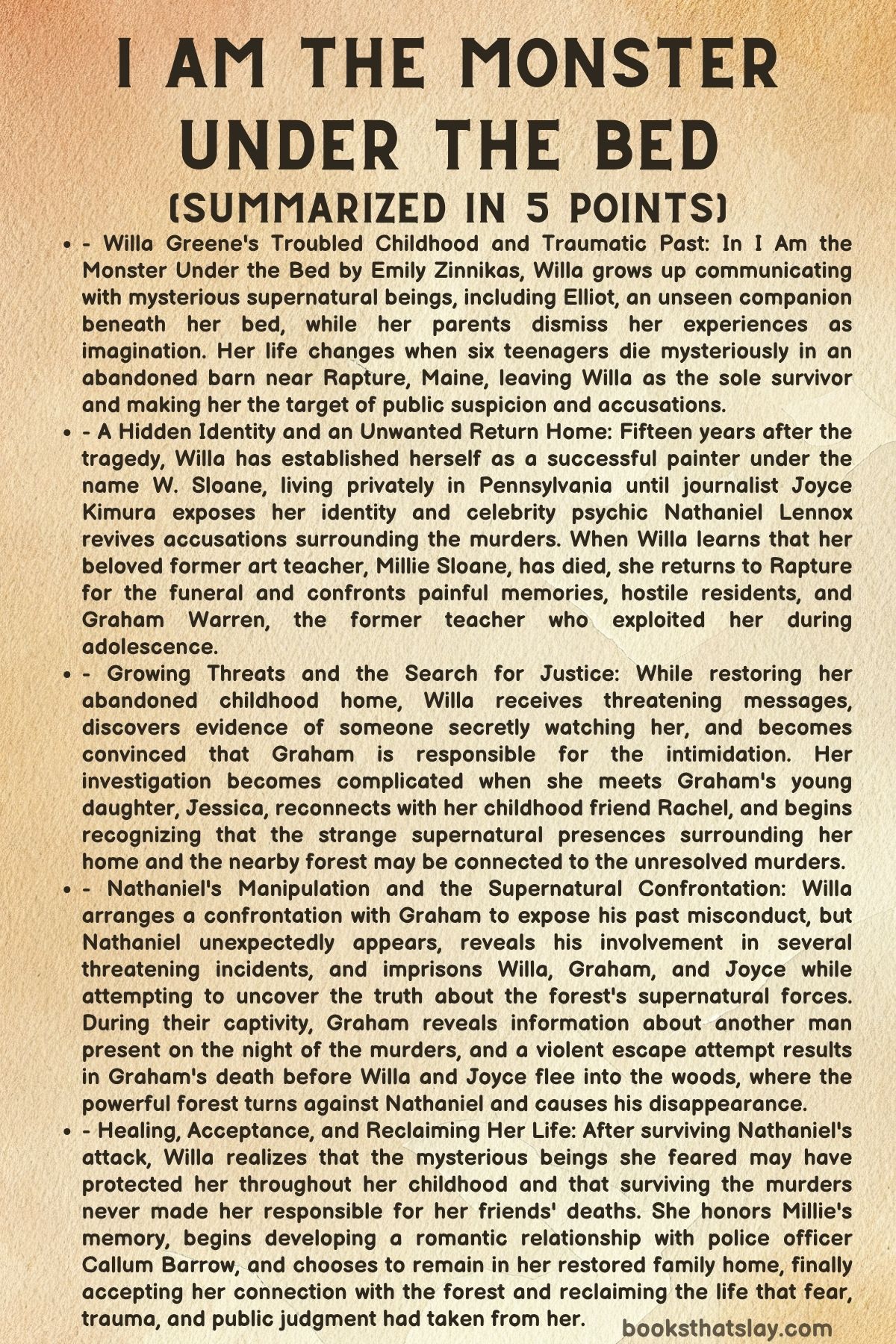
The story follows Willa Greene, a successful but reclusive painter whose carefully constructed adult life collapses when journalists expose her connection to six teenage deaths that occurred fifteen years earlier. Forced to return to the hometown she abandoned, Willa confronts a predatory former teacher, a manipulative celebrity psychic, and mysterious beings that have followed her since childhood. The novel examines survival, public judgment, exploitation, and the difficult process of accepting a past that others have repeatedly distorted.
Summary
Willa Greene grows up believing that mysterious creatures inhabit her childhood home in Rapture, Maine. While her parents insist that monsters do not exist, Willa hears voices beneath her bed and discovers a strange companion who responds when she speaks to him.
She names this unseen presence Elliot and develops a friendship with him. Rather than fearing the darkness, she finds reassurance in it, although her mother, Amelia, becomes increasingly troubled by her daughter’s unusual behavior.
Willa’s childhood experiences extend beyond Elliot. She sees strange humanlike figures in the basement, senses presences throughout the house, and believes the nearby forest communicates with her.
Her parents dismiss these experiences as imagination, creating an atmosphere in which Willa learns that adults are unlikely to believe her. Her friendship with Rachel Glassberg provides some companionship, but even Rachel finds Willa’s connection to the woods unsettling.
As a teenager, Willa becomes involved with Graham Warren, a twenty-three-year-old physical education teacher at her high school. Graham exploits his authority over sixteen-year-old Willa, encouraging an inappropriate relationship whose consequences fall disproportionately upon her.
When their involvement becomes known, Willa experiences humiliation and suspicion. Her art teacher, Millie Sloane, becomes one of the few adults willing to defend her, emphasizing that Graham was responsible for maintaining professional boundaries.
An even greater tragedy follows when Willa and six other teenagers gather at an abandoned barn in the woods. Something terrifying happens that night, leaving six young people dead and Willa as the sole survivor.
The police cannot reconcile her account with the circumstances surrounding the deaths. Police Chief Landon, whose nephew is among the victims, subjects Willa to aggressive interrogations, and the community gradually begins treating her survival as evidence of guilt.
Unable to escape the hostility, Willa eventually leaves Rapture. She builds a successful career as a painter under the name W. Sloane, adopting the surname of the teacher who helped her survive her adolescence.
Fifteen years later, Willa lives alone in a secluded Pennsylvania house, creating disturbing paintings dominated by darkness. Her privacy disappears when journalist Joyce Kimura arrives under the pretense of interviewing her about her work.
Joyce instead reveals that she knows Willa’s original identity and questions her about the murders. When the journalist secretly releases their conversation, Willa’s history becomes national entertainment.
News programs dissect her paintings, revisit the deaths, and suggest that the surviving teenager may have concealed important information. Celebrity psychic Nathaniel Lennox exploits the controversy by claiming to communicate with the victims.
Nathaniel announces that the spirits are directing him toward Willa, intensifying public suspicion. Although Willa openly questions his credibility, his accusations attract widespread attention.
Her situation worsens when disturbing packages and threatening messages begin arriving. One contains an old soccer trophy from her school years, making her suspect that Graham Warren is attempting to intimidate her.
Willa contacts Rachel and learns that Graham has returned to Rapture, where he works as a personal trainer. She also discovers that Millie Sloane has died of cancer.
The news devastates Willa, who regrets never properly thanking her former teacher. When reporters begin gathering outside her Pennsylvania home, she decides to return to Rapture for Millie’s funeral.
The journey forces Willa to revisit memories of her childhood, the murders, and the mysterious forest. She rents a lakeside cabin and encounters residents who respond to her return with varying degrees of kindness and hostility.
Her landlord, Mr. Greenley, treats her sympathetically but warns her against entering the nearby woods. Willa also meets police officer Callum Barrow, whose friendly manner challenges her expectation that everyone associated with law enforcement will condemn her.
At Millie’s funeral, Willa encounters mourners who still believe she murdered her friends. She listens to Arthur Sloane speak about his late wife and realizes how deeply Millie’s kindness affected numerous lives.
The occasion becomes especially difficult when Willa sees Graham Warren standing among the mourners. His apparently comfortable existence angers her because he has managed to rebuild his reputation while she remains trapped by the consequences of his misconduct.
Willa visits her abandoned family home, intending to prepare it for sale. However, the neglected building awakens memories of Elliot, her parents, and the unsettling figures she once saw in the basement.
She hires a contractor named Joe to restore the property and begins spending increasing amounts of time there. She also resumes the peculiar practice of leaving raw meat near the woods, maintaining a custom associated with Elliot.
Meanwhile, Willa visits Arthur and discovers that he has preserved a sunflower painting she created as a teenager. The discovery confirms how much Millie valued her artistic development and encourages Willa to create another painting in her honor.
Willa’s suspicion of Graham intensifies when she sees him interacting with young children. Although he presents himself as a respectable man involved in youth sports, his behavior reminds her of the authority he once exercised over vulnerable students.
After someone enters her rented cabin and damages a sentimental possession, Willa becomes convinced that Graham is responsible. She begins following him, observing his routines and watching his house.
Her surveillance leads to an unexpected encounter with Jessica, Graham’s young daughter. Finding the child alone inside his home, Willa prepares food for her and helps fix her hair.
The encounter complicates Willa’s perception of Graham. She discovers that Jessica’s mother, Christina Glen, died in a road accident and wonders whether fatherhood has changed the man who once exploited her.
Threats against Willa continue. Someone photographs her secretly through the cabin window, a brick is thrown through her family home’s window, and Joe discovers a knife marked with Graham’s initials embedded in the back door.
Meanwhile, several residents openly express their hostility toward Willa. These incidents convince her that the town has never fully abandoned its belief in her guilt.
Willa also begins reconnecting with Elliot and visiting the graves of her dead friends. When a young girl named Molly disappears near the forest, Willa ventures into the trees, fearing that the mysterious forces responsible for the earlier tragedy have returned.
Rachel becomes concerned about her safety and gives her a handgun. Willa eventually moves into her restored childhood home, where inexplicable movements and sounds suggest that the strange presences remain.
Determined to confront Graham without resorting to violence, Willa contacts Joyce Kimura. She proposes exposing Graham’s relationship with her when she was a minor, hoping to make him acknowledge the harm he caused.
Willa arranges a private meeting with Graham at her house while Joyce secretly witnesses their conversation. Graham attempts to minimize their past relationship, but Willa challenges his excuses and reminds him of his responsibility.
Their confrontation is interrupted by Nathaniel Lennox, who unexpectedly enters the property with a gun.
Nathaniel reveals that he has manipulated Willa’s circumstances and engineered several incidents intended to make her suspect Graham. His obsession extends beyond television publicity: he believes Willa possesses genuine knowledge about supernatural beings and wants to exploit it.
He attacks Willa, inflicting a serious head injury, and imprisons her, Graham, and Joyce in the basement. There, Willa sees the dark humanlike figures that frightened her throughout childhood.
Nathaniel later forces Willa into the forest and takes her to the abandoned barn where her friends died. He demands that she explain the supernatural events connected to the murders, hoping to gather evidence that will transform his reputation as a psychic.
The confrontation becomes violent, and Nathaniel shoots Willa in the arm. He returns her to the basement, where Joyce and Graham attempt to help her despite their own captivity.
As the prisoners struggle to escape, Graham admits that he followed Willa into the woods on the night of the murders and saw another man there. His revelation suggests that the original investigation overlooked significant evidence.
Nathaniel also possesses photographs connected to the mysterious man. However, his determination to use everything for personal advancement prevents him from responding rationally to the danger surrounding them.
The supernatural disturbances become increasingly severe. Dark figures move around the basement, unexplained footsteps echo through the house, and Nathaniel discovers that his supposed expertise provides little protection against genuine supernatural forces.
Willa eventually attempts to retrieve the handgun Rachel gave her. A violent struggle follows, resulting in Graham’s death.
Joyce manages to incapacitate Nathaniel temporarily, allowing her and Willa to escape into the snowy forest. Although Joyce believes they are fleeing toward safety, Willa deliberately leads them deeper into the woods.
Willa has begun recognizing that the forest may never have intended to harm her. Its unusual behavior throughout her childhood may have represented communication and protection rather than aggression.
When Nathaniel pursues them, Willa confronts him among the trees. The forest responds violently, moving its roots and branches and swallowing him into its supernatural fury.
Joyce witnesses the impossible events, confirming that Willa’s extraordinary experiences were real. Willa finally understands that surviving the deaths of her friends does not make her responsible for them.
In the aftermath, Nathaniel disappears, leaving investigators unable to establish precisely what happened. Joyce uses her experiences to develop a documentary examining his manipulation and misconduct.
Willa remains in Rapture and publicly honors Millie at a memorial celebration. She also reflects on Graham’s death and the consequences for Jessica, who must now live without her father.
Her relationship with Callum develops into a possible romance, and she begins imagining a future without constant isolation.
Eventually, Willa decides to keep her restored childhood home and sell her Pennsylvania property. She resumes leaving meat near the forest, accepting the strange bond she has maintained with its inhabitants since childhood.
The novel ends with Willa finding a sense of belonging in the place that once represented everything she feared, no longer willing to let public accusations determine how she understands herself.
Characters
Willa Greene / W. Sloane
Willa Greene is the central character of I Am the Monster Under the Bed, and her development is shaped by childhood isolation, public condemnation, and the lasting consequences of surviving a traumatic event. Her unusual ability to perceive supernatural presences makes her different from the people around her long before the murders establish her reputation as an outsider.
As a child, Willa interprets the darkness as a source of companionship rather than danger. Her relationship with Elliot demonstrates her curiosity, emotional openness, and willingness to accept experiences that other people dismiss.
Her parents’ refusal to believe her gradually teaches her to distrust her own place within ordinary society. Their reactions also contribute to her growing reluctance to seek assistance when she encounters genuine threats.
The relationship with Graham Warren represents an especially damaging experience because it involves the exploitation of Willa’s youth and vulnerability. The community’s response compounds the abuse by encouraging her to feel responsible for the conduct of an adult who possessed authority over her.
The deaths of her six classmates fundamentally change her life. Although she survives, the suspicion surrounding the tragedy prevents her from experiencing survival as something uncomplicated or fortunate.
Her decision to become W. Sloane demonstrates both determination and avoidance. Through her artistic career, Willa creates an independent identity, but she also distances herself from the history that continues to trouble her.
Her paintings reveal how deeply the past remains embedded in her imagination. Their darkness reflects her fascination with unseen beings while also communicating emotions that she struggles to articulate directly.
Returning to Rapture exposes Willa’s contradictory impulses. She wants to escape her past, yet she increasingly feels compelled to confront Graham, restore her family home, and investigate the circumstances surrounding the murders.
Her surveillance of Graham reveals how the desire for justice can become entangled with obsession. Although her anger is understandable, her willingness to invade his privacy demonstrates that trauma has sometimes weakened her ability to establish healthy boundaries.
Willa’s eventual confrontation with Nathaniel forces her to recognize that she cannot control every danger through isolation or retaliation. Her survival depends partly on trusting Joyce and accepting the strange connection she shares with the forest.
By the conclusion, Willa has begun separating her identity from the accusations directed against her. Her decision to remain in Rapture represents a significant emotional transformation because she chooses to reclaim the place that once rejected her.
Elliot
Elliot is one of the most mysterious figures in I Am the Monster Under the Bed, functioning as Willa’s childhood companion and an important connection between her personal experiences and the supernatural world. Although his appearance and complete nature remain unclear, his influence extends throughout the novel.
Willa first encounters Elliot as a presence beneath her bed. Their friendship begins when she asks whether he wants to be her companion and receives a response from the darkness.
His willingness to communicate with Willa gives her reassurance at a time when her parents dismiss her unusual experiences. Rather than interpreting his unfamiliar nature as threatening, she considers him someone who understands her.
Elliot also helps establish Willa’s relationship with the surrounding forest. Her continuing practice of leaving food near the trees originates from what he taught her during childhood.
His significance becomes clearer as Willa begins reconsidering whether the mysterious forces around her were always dangerous. Elliot represents the possibility that beings described as monsters may possess intentions that differ from conventional assumptions.
Although the novel does not fully explain his identity, his enduring importance demonstrates that companionship does not always conform to familiar human expectations.
Graham Warren
Graham Warren is a central antagonist whose conduct exposes the destructive consequences of authority being used for personal gratification. His relationship with Willa begins when he is a young physical education teacher and she is a sixteen-year-old student.
His attractive appearance and comparatively young age make him popular among students. However, his willingness to pursue an inappropriate relationship with Willa reveals a serious disregard for the responsibilities attached to his position.
Graham exploits Willa’s emotional vulnerability while encouraging expectations that he does not adequately honor. When their relationship becomes known, Willa suffers lasting reputational damage, while Graham eventually manages to reconstruct a respectable public identity.
His later life as a personal trainer and father complicates Willa’s understanding of him. Jessica’s presence demonstrates that Graham possesses relationships and responsibilities outside the wrongdoing that defines Willa’s memories.
Nevertheless, his apparent transformation does not erase his earlier conduct. His attempts to minimize their relationship during their eventual confrontation reveal how unwilling he remains to accept its full consequences.
Graham also contributes to the unresolved murder investigation by concealing his presence in the forest and failing to report seeing another man. His silence allows damaging assumptions about Willa to remain unchallenged.
His death during the confrontation with Nathaniel introduces moral complexity because it affects Jessica, an innocent child who depended upon him. Graham’s fate illustrates that acknowledging someone’s wrongdoing does not require denying the humanity of the people connected to that person.
Nathaniel Lennox
Nathaniel Lennox serves as the principal human antagonist of I Am the Monster Under the Bed, representing the exploitation of grief, public fascination, and supernatural uncertainty for personal advancement. His career depends upon convincing audiences that he possesses extraordinary spiritual abilities.
When Willa’s identity becomes public, Nathaniel immediately recognizes an opportunity to increase his influence. He uses the unresolved deaths of six teenagers to attract attention while presenting himself as someone capable of delivering answers to their families.
His public confidence conceals an increasingly obsessive personality. After Willa challenges his credibility, he becomes determined to establish control over her and the information associated with the murders.
Nathaniel’s manipulation extends into physical intimidation and elaborate deception. By manufacturing incidents intended to implicate Graham, he demonstrates his willingness to endanger others to achieve his objectives.
His kidnapping of Willa, Graham, and Joyce removes any remaining uncertainty about his moral character. He treats human beings as instruments for obtaining evidence that might enhance his reputation.
His behavior becomes especially revealing when he encounters apparently genuine supernatural activity. Although he has built a career claiming expertise in the spirit world, authentic manifestations terrify him because they do not respond to his authority.
Nathaniel’s disappearance in the forest represents the destruction of his illusion of control. His downfall suggests that seeking power over forces one does not understand can become fatal when ambition replaces caution and respect.
Joyce Kimura
Joyce Kimura begins the novel as an intrusive journalist whose determination to uncover Willa’s identity causes considerable harm. By disguising the purpose of her interview and releasing a secretly recorded conversation, she exposes Willa to national scrutiny.
Her initial conduct demonstrates how professional ambition can encourage reporters to overlook the consequences of their work. Joyce treats Willa’s painful history as a story to be uncovered rather than an experience belonging to a vulnerable individual.
However, Joyce becomes increasingly complex as the narrative progresses. Her later interactions with Willa suggest that she is capable of listening and reconsidering her assumptions.
When Willa decides to expose Graham’s misconduct, Joyce becomes an unexpected collaborator. Their cooperation is initially practical rather than affectionate, but the circumstances eventually force them to rely upon one another.
Being imprisoned by Nathaniel transforms Joyce’s relationship with Willa. She witnesses Willa’s injuries, fears, and determination firsthand, gaining an understanding that sensational television coverage could never provide.
Her experience in the forest further changes her perspective because she witnesses supernatural events that challenge ordinary explanations. She becomes one of the few people capable of confirming that Willa’s extraordinary claims have a basis in reality.
Joyce’s later documentary about Nathaniel suggests a movement toward more responsible investigative work. Nevertheless, the novel leaves room to question whether her professional ambitions have been completely separated from her personal experiences.
Millie Sloane
Millie Sloane is one of the most influential supporting characters in I Am the Monster Under the Bed, despite dying before Willa returns to Rapture. Her presence remains significant through memories, preserved artwork, and the influence she has had on other people.
As Willa’s art teacher, Millie recognizes both her artistic talent and the emotional difficulties she experiences. Unlike many adults in Willa’s life, she offers encouragement without requiring her to justify every unusual aspect of her personality.
Millie’s response to Graham’s misconduct is particularly important. She tells Willa that an adult teacher bears responsibility for respecting boundaries, directly challenging the blame Willa has internalized.
Her classroom becomes a place where Willa can develop her abilities without constant judgment. Through access to materials and genuine encouragement, Millie helps her imagine a future beyond the circumstances that have damaged her reputation.
Willa’s adoption of the Sloane surname demonstrates the lasting importance of this relationship. Millie becomes associated not merely with artistic instruction but with the possibility of creating a different life.
The sunflower painting preserved in Arthur’s home reveals that Millie continued valuing Willa long after their separation. Her influence demonstrates how one compassionate adult can provide meaningful stability during a young person’s most vulnerable years.
Rachel Glassberg
Rachel Glassberg is Willa’s childhood friend and one of the few people with personal knowledge of her life before the murders. Their relationship reflects both the familiarity of shared history and the difficulties created by Willa’s unusual experiences.
As children, Rachel accompanies Willa into the woods but becomes frightened by her descriptions of supernatural presences. Her discomfort reveals how difficult it can be for Willa to maintain ordinary friendships when her understanding of reality differs from that of her peers.
During Willa’s return to Rapture, Rachel provides information about Graham and attempts to understand the threatening incidents surrounding her former friend. She does not automatically accept every suspicion Willa expresses.
Rachel’s willingness to question Willa is important because it introduces a perspective that is neither openly hostile nor entirely unquestioning. She recognizes that Willa’s fear may influence her interpretation of events.
Her concern becomes more direct when she provides Willa with a handgun for protection. The gesture demonstrates loyalty, although it also illustrates how dangerous their circumstances have become.
Rachel represents the complicated possibility of reconnecting with someone who remembers both the person Willa was and the tragedy that transformed her life.
Callum Barrow
Callum Barrow provides an alternative image of law enforcement in a novel where Willa’s earlier experiences with the police were deeply damaging. His relatively friendly treatment challenges her expectation that authority figures will automatically regard her with suspicion.
As a police officer without the same personal involvement in Rapture’s tragedy, Callum approaches Willa with fewer established prejudices. Their conversations allow moments of ordinary humor and attraction amid the tension surrounding her return.
Callum also demonstrates concern for Willa’s safety when threatening incidents occur. His attempts to help are complicated by her reluctance to involve the police, a reluctance rooted in her traumatic adolescence.
His occasional attention to the forest suggests that he may understand more about Rapture’s unusual atmosphere than he initially reveals. However, the available narrative does not establish the full extent of his knowledge.
The developing romantic connection between Callum and Willa represents the possibility of a future based on trust rather than accusation. His importance lies partly in showing that Willa can establish new relationships without being permanently defined by her past.
Arthur Sloane
Arthur Sloane is Millie’s widower and an important source of kindness during Willa’s return to Rapture. His grief reveals the depth of the marriage he shared with Millie and the personal life that existed beyond her role as a teacher.
Arthur welcomes Willa without demanding explanations about the murders or questioning her right to return. His generosity contrasts with the suspicion she encounters elsewhere in town.
The sunflower painting displayed in his home becomes particularly meaningful because it demonstrates how much Millie valued Willa’s work. Through Arthur, Willa discovers that her former teacher’s encouragement continued even after they lost contact.
Arthur’s request that Willa teach a holiday art class also creates an opportunity for her to continue Millie’s influence. The experience encourages Willa to participate in community life rather than remain completely isolated.
His character represents the preservation of kindness through memory, personal relationships, and meaningful acts of remembrance.
Jessica Warren
Jessica Warren is Graham’s young daughter, whose presence complicates the novel’s treatment of wrongdoing, responsibility, and punishment. Willa encounters her unexpectedly while secretly investigating Graham’s house.
Jessica responds to Willa with ordinary childhood trust, asking for food and accepting help with her hair. Her innocence briefly interrupts Willa’s obsessive attention to Graham.
The discovery that Jessica’s mother died in a road accident adds another dimension to her vulnerability. She depends on Graham, making his eventual death devastating regardless of his earlier misconduct.
Jessica reminds Willa that people who cause harm can also occupy important roles in the lives of others. Her character prevents Graham’s death from becoming a simple moment of revenge or satisfaction.
Her later circumstances highlight how the consequences of adult actions frequently extend to children who had no part in the original wrongdoing.
Amelia Greene
Amelia Greene is Willa’s mother, whose relationship with her daughter is characterized by concern, confusion, and an inability to accept experiences she cannot explain. She repeatedly assures Willa that monsters do not exist.
Her reactions become increasingly anxious when Willa speaks about Elliot and the figures in the basement. Amelia interprets these claims as evidence that her daughter requires intervention rather than recognizing them as potentially genuine experiences.
The disagreement creates emotional distance between mother and daughter. Although Amelia’s concern appears connected to a desire for Willa’s wellbeing, her inability to listen without judgment contributes to Willa’s isolation.
Amelia represents the limitations of parental protection when fear and conventional expectations interfere with understanding a child’s experiences.
Chief Landon
Police Chief Landon embodies the damaging consequences of allowing personal grief to influence an investigation. Because his nephew is among the six murdered teenagers, his involvement in the case is emotionally charged.
His interrogation of Willa reflects his determination to obtain answers, but his methods place enormous psychological pressure upon a seventeen-year-old survivor. Sleep deprivation, disturbing photographs, and repeated accusations contribute to her lasting distrust of law enforcement.
Landon’s conduct demonstrates how institutional authority can reinforce community prejudice. By treating Willa as a likely suspect despite the uncertainty surrounding the murders, he helps establish the suspicion that follows her into adulthood.
His role illustrates the danger of confusing emotional certainty with reliable evidence.
Joe
Joe is the contractor responsible for restoring Willa’s neglected family home. His practical approach provides a contrast to the supernatural uncertainty and emotional tension surrounding the property.
He evaluates the building’s structural problems and organizes repairs that gradually make it habitable again. His work enables Willa to reconsider the house as a possible home rather than an unwanted reminder of childhood.
Joe also discovers evidence of threatening activity, including the knife marked with Graham’s initials. His concern emphasizes that the danger surrounding Willa has become tangible and cannot simply be dismissed as imagination.
His appreciation of Willa’s painting introduces a small but meaningful moment of ordinary recognition. Joe’s character contributes to the idea that rebuilding a life may begin with practical changes as well as emotional ones.
Mr. Greenley
Mr. Greenley owns the lakeside cabin that Willa rents after returning to Rapture. His sympathetic response to her identity contrasts with the hostility she expects from longtime residents.
He recognizes the difficulty of her return and speaks kindly about Millie Sloane. His treatment suggests that Rapture’s community is not entirely united in condemning Willa.
His warning about the nearby forest introduces an important sense of uncertainty. Although the extent of his knowledge remains unclear, his concern suggests that the woods possess a disturbing reputation independent of Willa’s experiences.
Mr. Greenley helps establish the possibility that ordinary residents may recognize the forest’s dangers even without understanding their supernatural origins.
Esme Granger
Esme Granger is the older sister of Kaylee, one of the teenagers killed in the abandoned barn. Her hostility toward Willa reflects the lasting devastation experienced by the victims’ surviving families.
At Millie’s funeral, Esme silently communicates her belief that Willa was responsible for the deaths. Her accusation demonstrates that fifteen years have not resolved the anger surrounding the tragedy.
Esme’s character illustrates how grief can become attached to a particular explanation when definitive answers remain unavailable. Although her suffering is understandable, her certainty contributes to the social punishment endured by someone whose guilt was never established.
Through Esme, the novel acknowledges the emotional pain surrounding the deaths while questioning the fairness of directing that pain toward Willa.
Molly
Molly is the younger sister of one of the teenagers who died in the forest tragedy. Her disappearance near the woods raises fears that the mysterious events of the past may be repeating themselves.
Willa’s alarm demonstrates how strongly she continues to associate the forest with the deaths of her friends. Molly’s connection to one of the victims makes the incident especially disturbing.
Although Molly occupies a comparatively small role, her experience renews the novel’s concern with vulnerable young people encountering dangers that adults cannot adequately explain.
She also provides an occasion for Willa to confront the woods directly rather than remain entirely controlled by fear.
Shane
Shane is Joyce Kimura’s editor and professional associate. He accompanies her during the initial interview that exposes Willa’s identity and later remains connected to the investigation surrounding the murders.
His presence emphasizes that Joyce’s actions occur within a larger media environment where sensational information possesses professional value. The exposure of Willa’s past is therefore not merely a private confrontation but part of an organized journalistic undertaking.
During Nathaniel’s captivity of Willa, Joyce, and Graham, Shane becomes significant because Joyce believes he may notice her disappearance. His role illustrates how professional relationships can become potential sources of assistance during a crisis.
Themes
Trauma, Survival, and the Burden of Guilt
Surviving a tragedy does not necessarily provide freedom from its consequences, particularly when others interpret survival as evidence of wrongdoing. Willa’s experiences demonstrate how an individual can remain psychologically imprisoned by an event long after the immediate danger has ended.
The deaths of six teenagers leave Willa with enormous emotional pain, yet her community refuses to recognize her primarily as a survivor. Instead, residents repeatedly question why she remained alive when her companions did not.
This suspicion changes the meaning of survival for Willa. Rather than feeling fortunate to have escaped death, she becomes consumed by the belief that her continued existence requires justification.
Her earlier experiences with Graham make the situation even more destructive. Having already been blamed for an inappropriate relationship with an adult teacher, Willa has learned to associate personal vulnerability with public condemnation.
The resulting trauma influences nearly every aspect of her adult life. Her isolation, reluctance to cooperate with police, and obsessive desire to control threatening situations all reflect the lasting influence of these experiences.
In I Am the Monster Under the Bed, the burden of guilt operates on both personal and social levels. Willa struggles with her own memories while also carrying accusations imposed upon her by people unwilling to accept uncertainty.
Her eventual recognition that surviving did not make her responsible for the deaths represents a crucial emotional development. Recovery becomes possible when she begins separating what actually happened from the guilt others have encouraged her to feel.
The novel ultimately presents healing as a gradual process of reclaiming personal truth rather than obtaining universal forgiveness or approval.
The Abuse of Power and the Exploitation of Vulnerability
Graham Warren and Nathaniel Lennox demonstrate different forms of exploitation, but both use their positions to manipulate people whose circumstances make them vulnerable. Their actions reveal how power becomes destructive when individuals prioritize personal desires over the wellbeing of others.
Graham’s authority as a teacher gives him access to Willa during adolescence. Rather than respecting the boundaries of that position, he encourages a relationship that benefits him while exposing her to emotional and social consequences.
His conduct is particularly damaging because the community fails to distribute responsibility fairly. Willa experiences condemnation while Graham eventually rebuilds his reputation and establishes a new professional life.
Nathaniel exercises a different kind of influence through celebrity and media exposure. His claims of supernatural expertise allow him to exploit grieving families and present speculation as privileged knowledge.
When Willa challenges him, Nathaniel begins manipulating her circumstances to reinforce his own authority. His eventual use of kidnapping, threats, and violence reveals the coercion underlying his public performance.
Even the original police investigation demonstrates the dangers of unchecked institutional power. Chief Landon’s grief contributes to interrogations that place extraordinary pressure on a teenage survivor.
These examples establish a pattern in which vulnerable individuals are repeatedly expected to bear the consequences of decisions made by people with greater authority.
The novel also examines why abusive behavior can remain hidden beneath respectable appearances. Graham’s professional success and Nathaniel’s television popularity demonstrate that public approval does not necessarily indicate moral integrity.
Accountability therefore requires more than exposing individual wrongdoing. It also requires questioning the social assumptions that allow powerful people to avoid responsibility while their victims experience lasting punishment.
Fear of the Unknown and the Nature of Monstrosity
The distinction between monsters and human beings becomes increasingly uncertain as Willa reexamines the supernatural experiences of her childhood. The beings that frighten others are not always malicious, while people who appear ordinary frequently demonstrate cruelty.
As a child, Willa considers Elliot a friend despite his existence beneath her bed. Her acceptance challenges the conventional assumption that darkness necessarily conceals danger.
Her parents respond differently because they interpret unfamiliar experiences through fear. Their inability to understand Elliot and the other presences causes them to dismiss Willa’s perspective rather than investigate it.
The forest initially appears threatening because of its connection to the murders. Its darkness, unexplained movements, and strange inhabitants contribute to Willa’s belief that she may be confronting the same danger that destroyed her friends.
However, the eventual revelation that the woods may have protected her changes the meaning of those earlier experiences. What appeared hostile may have been communicating in ways she did not fully understand.
In I Am the Monster Under the Bed, this reversal encourages readers to reconsider the meaning of monstrosity. Nathaniel, who claims to understand supernatural beings, becomes dangerous precisely because he attempts to dominate something beyond his control.
Graham similarly demonstrates that harmful intentions can exist behind an attractive appearance and respectable reputation.
The supernatural forces remain mysterious, and the novel does not suggest that everything unfamiliar is automatically safe. Instead, it distinguishes appearance from intention and emphasizes the importance of examining actions before assigning moral judgments.
Willa’s eventual acceptance of the forest demonstrates her growing ability to confront uncertainty without allowing fear to determine every conclusion.
Identity, Belonging, and Reclaiming the Past
Willa’s transformation into the painter W. Sloane represents an attempt to construct an identity independent of the suffering associated with her hometown. By changing her professional name and living in isolation, she creates distance between her adult achievements and the reputation imposed upon her during adolescence.
Her artistic success demonstrates considerable personal determination. Nevertheless, the secrecy surrounding her identity reveals that the past continues to influence her life even when she appears to have escaped it.
The public exposure of her original name destroys the separation she has carefully maintained. Once journalists connect W. Sloane with Willa Greene, her professional accomplishments become inseparable from public curiosity about the murders.
Returning to Rapture initially feels like surrendering the independence she has achieved. Every familiar location reminds her of childhood experiences, lost friendships, and the town’s hostility.
However, the return also creates opportunities for her to reconsider relationships that were overshadowed by trauma. Arthur’s kindness, Millie’s preserved painting, and her developing connection with Callum demonstrate that her hometown contains possibilities beyond rejection.
Restoring her childhood home becomes an important expression of this transformation. Rather than destroying or selling a place associated with painful memories, she gradually makes it suitable for a new life.
Her relationship with the forest undergoes a similar change. Accepting its presence allows her to recognize that the unusual experiences of her childhood were not necessarily evidence that something was wrong with her.
The decision to remain in Rapture does not erase the deaths, the accusations, or the suffering she experienced. Some residents continue to distrust her, and unresolved questions remain.
Instead, belonging becomes a personal choice rather than something granted by unanimous community approval. Willa discovers that reclaiming her identity does not require denying her history, but accepting that her life contains more possibilities than the tragedy that once defined it.