Ignite the Infernos Summary, Characters and Themes
Ignite the Infernos by Ivy Asher is a fantasy romance centered on Ever Tenebrae, a surviving member of a supposedly destroyed royal dragon bloodline who is determined to restore the freedom and power of her people.
After breaking a devastating curse, Ever discovers that reclaiming her dragon nature is only the beginning of a much larger struggle involving political deception, family secrets, and a dangerous bond with Aeson Noctis. As the surviving Syphons prepare to reclaim their place in the world, Ever must balance her loyalty to her people against her growing attachment to a dragon prince whose family represents the authority she has spent her life resisting. It’s the 2nd book in the Secret of the Syphon series.
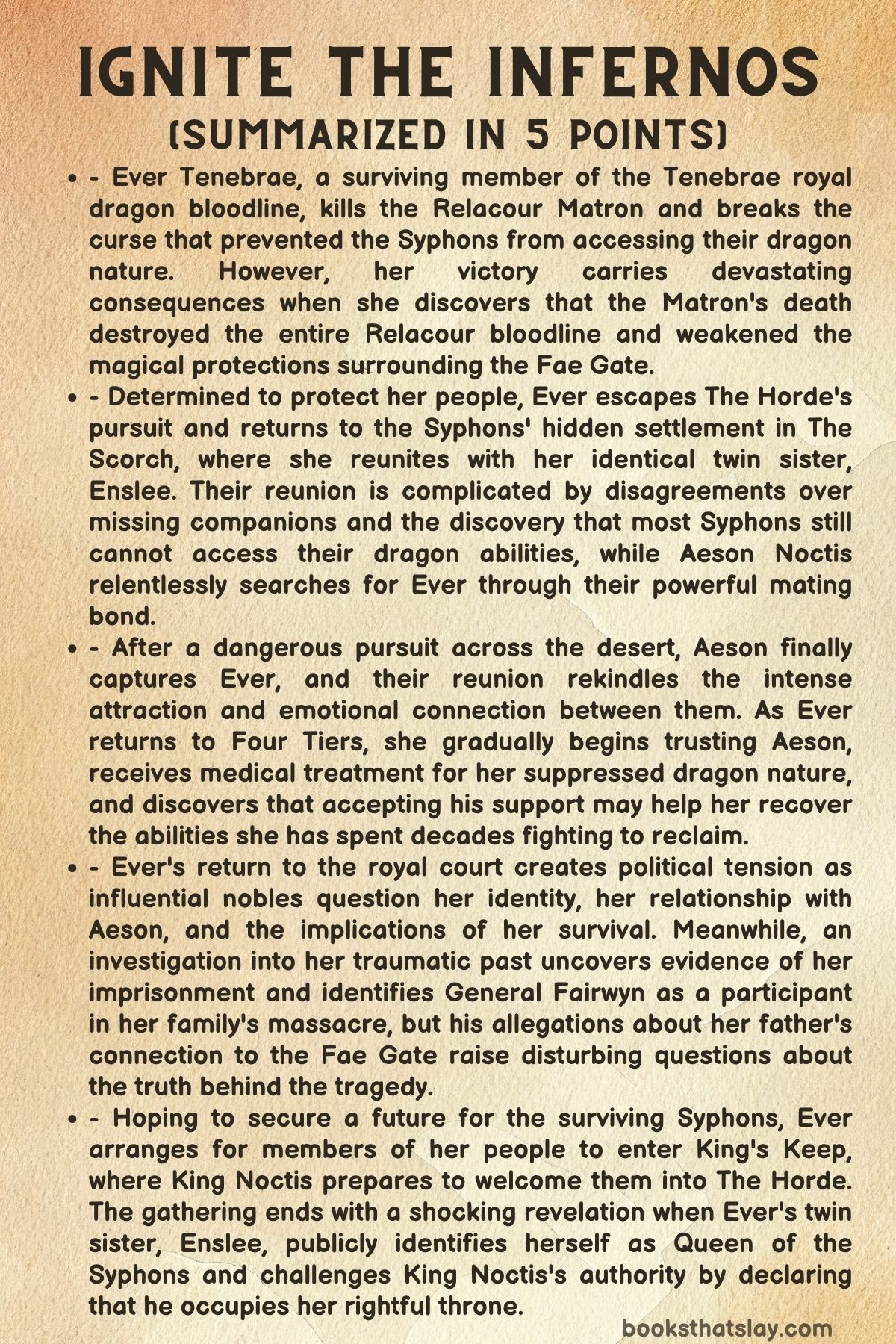
Summary
Ever Tenebrae begins her journey in the dangerous border city of Temmeh, where she is hiding after killing the Relacour Matron and breaking the curse that prevented the Syphons from accessing their dragon nature. Although she now possesses a dragon mark and can sense her awakened magic, she cannot yet complete the transformation she has desired for sixty-two years.
Determined to finance the next stage of the Syphons’ operations, Ever collects vials of her valuable dragon blood and arranges deposits through several financial institutions. She understands that registering her blood could alert The Horde, particularly Aeson Noctis and his Wing, who are searching for her.
Using disguises, hired intermediaries, and strategically placed blood samples, Ever creates false leads across multiple cities. When Aeson storms a blood bank expecting to capture her, he discovers that the woman waiting there is an impersonator, while identical dragon blood samples have appeared elsewhere.
Meanwhile, Aeson attends an emergency meeting at King’s Keep, where he learns that every identified member of the Relacour bloodline has died. His father, King Noctis, reveals the existence of magical Conduits, individuals whose deaths cause the destruction of everyone connected to their bloodline.
The Relacour Matron was one such Conduit, meaning Ever’s actions unintentionally eliminated an entire magical lineage. Her death has also weakened the protections surrounding the Fae Gate, creating a potentially catastrophic security crisis.
Aeson is furious about Ever’s disappearance and the consequences of her decisions, yet his anger is complicated by their bond. He considers Ever his Bonded Mate and cannot forget the abuse she suffered during her captivity.
His determination to capture her increasingly reflects a desire to ensure her safety rather than simply punish her.
Ever eventually escapes Temmeh and crosses The Scorch, an unforgiving desert concealing the Syphons’ secret settlement. There, she reunites with her identical twin sister, Enslee Tenebrae, who rules their surviving people.
Their reunion is emotional but strained because Ever blames Enslee for sending her Flight into an ambush that left several companions missing. Ever is also devastated to discover that Enslee and the other Syphons still lack dragon marks despite the destruction of the curse.
The sisters confront their disagreements and gradually reaffirm their love, although the consequences of Enslee’s decisions remain unresolved. Ever hopes that revealing her dragon will demonstrate that the suffering endured by their people has finally achieved something meaningful, but her transformation remains inaccessible.
While spending time with Enslee, Ever accidentally opens her bond with Aeson. Their brief magical connection allows him to sense her presence and provides a crucial clue about her hiding place.
Aeson investigates a remote area distinguished by three enormous dunes and becomes suspicious of inconsistencies in previous surveillance reports. He directs his Wing toward the location, unaware that the Syphons have constructed a concealed settlement protected by sophisticated magical wards.
When dragons begin gathering near the refuge, Ever realizes that the community’s secrecy is endangered. Enslee addresses her people, reminding them of their struggle to reclaim their stolen heritage and urging them to proceed with the next phase of their plans.
The Syphons prepare to evacuate, disperse, and eventually infiltrate The Horde. Their departure becomes urgent when Karis, a member of Aeson’s Wing, comes into contact with the settlement’s defensive barrier and suffers a devastating magical attack.
Aeson risks himself attempting to save Karis, revealing how his determination to find Ever has begun compromising his judgment.
Once the evacuation begins, Aeson and his Wing pursue the fleeing Syphons across the desert. However, Ever’s people have prepared elaborate traps involving scarafids, enormous dangerous insects attracted through chemicals and explosions.
The resulting attacks disrupt the dragons’ pursuit, allowing several Syphons to escape. Ever nevertheless refuses to abandon the area until she knows Aeson has survived.
She eventually enters a network of caves, considering whether she might persuade him to help locate her missing companions.
Aeson follows her into the caves and corners her behind a crystal barrier. By using rapid changes in temperature, he shatters the obstacle and reaches her.
Instead of immediately restraining Ever, he kisses her, and their bond responds with overwhelming intensity. Their reunion demonstrates that neither can easily dismiss the attachment between them, regardless of their political differences.
After an uncomfortable confrontation with Aeson’s Wing, Ever agrees to return to Four Tiers.
At King’s Keep, she learns the full consequences of killing the Relacour Matron. Although she had dismissed the Matron’s warnings as manipulation, the revelation about the Conduit and the weakened Fae Gate forces her to reconsider her actions.
Ever insists that she never intended to threaten the kingdom, while also challenging Aeson and King Noctis over their assumptions about her motives.
Eventually, she makes a significant concession by admitting that other Syphons survived. This disclosure creates the possibility of cooperation between the royal family and the people who have hidden from them for decades.
Aeson brings Ever into his private quarters and attempts to assure her that she is neither a prisoner nor someone whose future will be decided without her consent. He tells her that she will always have a home with him, a promise that unsettles her because she has endured years without security.
As their relationship develops, Aeson begins recognizing how Ever’s captivity has shaped her habits. She prefers sleeping on the floor, resists ordinary comforts, and struggles when kindness makes her feel vulnerable.
A medical examination with Healer Ramirez provides hope concerning her inability to transform. Ramirez explains that Ever’s body has suffered prolonged deprivation and magical suppression, leaving her dragon nature unable to develop normally.
With nourishment, rest, and time, her powers may recover.
Ever immediately considers what this discovery could mean for Enslee and the other Syphons. She begins thinking seriously about bringing her people into Four Tiers, where they might gain access to the healing and magical resources they need.
She also begins evaluating warriors who might serve in her own Wing. Her unusual assessment methods emphasize judgment, restraint, and character rather than conventional military qualifications.
During the selection process, Ever suddenly becomes feverish and collapses, initially believing she has been poisoned. The symptoms instead signal a major development in her dragon nature.
Aeson encourages her to open their bond so he can help her manage the magical changes overwhelming her body.
Although Ever resists depending on someone else, she eventually accepts his assistance. Their growing intimacy allows her to access new abilities, including greater control over her affinity and the ability to summon scale armor.
For the first time, Ever begins believing that she will eventually reveal her dragon.
Their progress does not eliminate their disagreements. Aeson wants her to share more information about the Syphons, while Ever fears that complete honesty could expose her people to danger.
Despite their conflicts, they prepare to confront The Horde’s nobility together.
Ever’s formal appearance at King’s Keep attracts considerable attention because her survival threatens established assumptions about royal succession and political legitimacy.
The gathering also triggers memories of the massacre that destroyed her childhood home. Aeson helps her recover from a traumatic flashback before being called away to investigate an urgent security breach.
The investigation uncovers disturbing recordings of Ever’s captivity, including evidence of the torture she endured and her desperate attempts to reach Ren.
Aeson and his Wing are horrified by the cruelty documented in the footage. The discoveries deepen their understanding of Ever’s suffering and intensify their determination to identify those responsible.
The investigation leads Ever to General Fairwyn, whom she recognizes as a participant in the destruction of the Tenebrae family.
Fairwyn is detained and subjected to interrogation, but his testimony creates further uncertainty. He claims that Ever’s father intended to open the Fae Gate, an accusation that challenges everything she believes about her family.
He also mentions Zariell, suggesting a connection between the massacre and secrets Ever has concealed.
Ever rejects the implication that her father was a traitor, but the allegations leave her shaken. She begins fearing that discovering the truth may destroy her understanding of her family’s history.
Aeson reassures her that she belongs in Four Tiers and that they will continue searching for answers together.
Meanwhile, arrangements are completed for the surviving Syphons to enter King’s Keep. King Noctis prepares to welcome them through ancient traditions, expecting their arrival to represent an opportunity for reconciliation.
Five cloaked figures enter the throne room, and Ever suddenly apologizes to Aeson before closing their bond.
She approaches their leader, bows, and embraces the mysterious visitor. When the figures remove their hoods, Aeson and Lorn are astonished to discover that the woman standing before them looks identical to Ever.
The newcomer identifies herself as Enslee Tenebrae, Queen of the Syphons.
Rather than accepting King Noctis’s authority, Enslee declares that he is occupying her throne.
The revelation transforms what appeared to be a historic reconciliation into a direct challenge to the existing monarchy. The novel ends with the future of The Horde, the legitimacy of its rulers, and Ever’s loyalties thrown into uncertainty.
Characters
Ever Tenebrae
Ever Tenebrae is the central protagonist of Ignite the Infernos, a fiercely independent survivor whose personality has been shaped by persecution, captivity, and the destruction of her family. As a member of the Tenebrae royal bloodline and one of the surviving Syphons, she carries the expectations of an entire people while struggling with the emotional consequences of her past.
Her sharp intelligence, sarcastic humor, and extraordinary resourcefulness make her a formidable opponent. She manipulates financial tracking systems, arranges elaborate distractions, and repeatedly escapes situations in which stronger adversaries believe they have trapped her.
Ever’s determination to reclaim her dragon nature reflects her desire to recover an identity that was stolen from her. Although breaking the Relacour curse restores her magical potential, her inability to transform initially leaves her feeling that freedom remains incomplete.
Her relationship with Aeson exposes the conflict between her longing for companionship and her fear of surrendering control. Years of imprisonment have taught her to associate vulnerability with danger, making even his genuine attempts at kindness difficult for her to accept.
Ever’s loyalty to the Syphons is equally defining. She refuses to abandon her missing Flight and continues protecting her people even when withholding information damages her relationship with Aeson.
Her greatest development comes through recognizing that accepting support does not necessarily undermine her independence. As she gradually learns to trust Aeson, she also begins to understand that recovering from trauma requires more than defeating her enemies.
However, the discovery that General Fairwyn participated in her family’s destruction, followed by accusations against her father, threatens the foundations of her identity. By the conclusion, Ever remains caught between her growing connection to The Horde and her allegiance to the Syphons, making her both a powerful individual and a symbol of the conflict surrounding the royal bloodlines.
Aeson Noctis
Aeson Noctis is the principal male protagonist and Ever’s Bonded Mate, whose transformation from relentless pursuer to increasingly compassionate partner forms a central emotional journey in Ignite the Infernos. As a royal dragon and leader of his Wing, he possesses considerable authority, formidable magical abilities, and a strong sense of duty toward The Horde.
Initially, Aeson views Ever’s disappearance and killing of the Relacour Matron as serious betrayals. Her actions have endangered the kingdom, undermined his trust, and placed him in the impossible position of pursuing someone to whom he is magically bound.
His behavior during the desert search exposes a significant weakness: his emotions can overwhelm his judgment. When Karis is injured by the Syphons’ defensive wards, Aeson must confront the consequences of allowing personal desperation to influence military decisions.
Despite his anger, his concern for Ever never disappears. His memories of her injuries and his fear that she might suffer further abuse repeatedly challenge his determination to hold her accountable.
Aeson’s emotional growth becomes particularly visible after Ever returns to Four Tiers. Rather than relying exclusively on royal authority, he attempts to understand her habits, respect her choices, and provide the security she has lacked.
His decision to sleep on the floor offers a particularly revealing example of his developing empathy. Instead of simply demanding that Ever accept unfamiliar comforts, he attempts to understand the experiences behind her behavior.
Nevertheless, Aeson continues struggling with the difference between emotional intimacy and genuine trust. He wants Ever to confide in him completely, but his expectations sometimes overlook the danger she believes such openness would create for her people.
The discovery of recordings documenting Ever’s torture profoundly affects him, reinforcing his determination to identify her tormentors. By the ending, his devotion is tested by the revelation that Ever has concealed an identical twin whose claim to the throne directly threatens his family.
Enslee Tenebrae
Enslee Tenebrae is Ever’s identical twin sister and the queen of the surviving Syphons, making her one of the most politically significant characters in the novel. Although she shares Ever’s appearance and childhood trauma, her responsibilities have shaped her into a leader whose priorities do not always align with her sister’s wishes.
Enslee has guided the Syphons through decades of concealment, hardship, and strategic preparation. Her authority rests upon the community’s determination to reclaim the dragon heritage stolen from them.
Her relationship with Ever reveals the emotional cost of leadership. Enslee’s decision to send Ever’s Flight into an ambush has created a painful division between the sisters, demonstrating how political calculations can damage deeply personal relationships.
Rather than dismissing Ever’s anger, Enslee eventually acknowledges the suffering caused by her decisions and expresses her desire to repair their bond. Their reconciliation shows that their affection has survived even serious disagreements about responsibility and trust.
Enslee’s inability to acquire a dragon mark despite the destruction of the curse also complicates her position. She leads a people whose freedom has supposedly been restored but who remain unable to access the full powers associated with their heritage.
Her determination becomes especially visible when The Horde approaches the hidden settlement. She organizes her community, reinforces its collective purpose, and advances plans that extend beyond simple survival.
Enslee’s defining moment occurs in the final confrontation at King’s Keep. By openly identifying herself as Queen of the Syphons and declaring that King Noctis occupies her throne, she reveals that her ambitions involve a fundamental challenge to the established political order.
Her actions suggest that she regards the restoration of her people’s rights as inseparable from reclaiming the authority she believes belongs to her family.
King Noctis
King Noctis represents the established royal authority of The Horde, a position that places him at the center of the novel’s political and historical conflicts. His decisions reveal the difficulties of governing a kingdom whose security depends on secrets, magical alliances, and competing aristocratic interests.
He possesses knowledge about the Conduits that even his sons have not been given. His explanation of the Relacour bloodline’s destruction demonstrates both the complexity of the kingdom’s magical foundations and the dangers created by withholding essential information.
Although he negotiated with Ever, he did not know that the Relacour Matron was the true Conduit. This failure exposes the limits of his knowledge and raises questions about the reliability of the alliances supporting his rule.
King Noctis generally approaches political problems through caution and negotiation. When influential nobles question Ever’s survival and royal identity, he attempts to preserve stability while allowing the situation to develop without immediate confrontation.
His willingness to welcome the surviving Syphons represents an important gesture toward reconciliation. He recognizes that their history deserves investigation and that injustices committed against them cannot simply be ignored.
However, his authority becomes vulnerable when Enslee reveals herself as a rival sovereign. Her declaration that he occupies her throne transforms his position from that of a ruler offering recognition into that of a monarch whose legitimacy has been publicly challenged.
King Noctis therefore embodies the tension between maintaining political stability and confronting historical claims that could undermine the institutions he governs.
Lorn Noctis
Lorn Noctis, Aeson’s brother and another member of the royal family, provides an important perspective on the growing crisis surrounding Ever and the surviving Tenebrae bloodline. Although he occupies a less prominent role than Aeson, his presence reinforces the consequences Ever’s return may have for the monarchy.
Like Aeson, Lorn is surprised by his father’s revelation about the Conduits and the destruction of the Relacour bloodline. His reaction demonstrates how closely guarded information can leave even senior members of the royal family unprepared for重大 developments.
Lorn is also involved in the political environment surrounding the royal court. Jesamyn Warrik’s attempts to attract his attention reveal how relationships involving members of the monarchy can become part of broader aristocratic maneuvering.
His reaction to the appearance of Enslee is particularly significant. Discovering that Ever has an identical twin who claims royal authority introduces an entirely new complication into his understanding of the kingdom’s history.
Although his personal motivations receive less attention, Lorn represents a royal insider whose assumptions about legitimacy, family, and political stability are challenged by the revelations surrounding the Syphons.
Ogdan
Ogdan is a dependable member of Aeson’s Wing whose operational responsibilities make him an important participant in the search for Ever. His role emphasizes the value of intelligence gathering, coordination, and disciplined investigation within The Horde’s military structure.
He helps identify the multiple blood-bank registrations used in Ever’s elaborate deception, revealing that the searchers have been deliberately manipulated. His findings force Aeson to recognize the sophistication of Ever’s efforts to remain hidden.
Ogdan also assists with tracking operations in The Scorch, where technological surveillance, unusual terrain, and magical concealment create substantial difficulties.
His steady participation contrasts with Aeson’s increasingly emotional determination. While Aeson is driven by his personal connection to Ever, Ogdan’s responsibilities remain tied to collecting information and helping the Wing function effectively.
He later becomes involved in the arrangements surrounding Ever’s selection of warriors for her own Wing. This places him within the transition from treating Ever as a fugitive to acknowledging her royal status and military needs.
Ogdan’s importance lies primarily in his reliability and practical contribution to the group rather than a separate personal storyline.
Karis
Karis is a member of Aeson’s Wing whose experiences expose both the dangers of the Syphons’ defenses and the lasting consequences of broken trust. He represents the perspective of a warrior who cannot easily overlook Ever’s previous actions merely because she is Aeson’s Bonded Mate.
During the investigation of the hidden settlement, Karis becomes trapped by powerful defensive magic. The attack leaves him seriously injured and forces Aeson to recognize the risks created by his relentless pursuit.
Karis’s suffering demonstrates that the confrontation between the Syphons and The Horde affects more than the principal characters. Loyal companions can become casualties of decisions motivated by personal grievances and political uncertainty.
Later, Karis openly questions Ever when the medical diagnostic system malfunctions. Because she previously manipulated his affinity, he finds it difficult to accept her denial of responsibility.
His suspicion is not presented as entirely unreasonable, since Ever has repeatedly relied on deception to protect herself and her people. At the same time, his accusations illustrate how difficult reconciliation becomes when past injuries continually influence present judgments.
Karis’s eventual involvement in investigating Ever’s captivity places him in a situation where his understanding of her suffering can deepen. He contributes to the novel’s examination of how loyalty, resentment, and compassion can exist together.
Tove
Tove is another member of Aeson’s Wing whose fierce loyalty to its leader creates immediate hostility toward Ever. Her character demonstrates the obstacles Ever faces when attempting to establish relationships with individuals who believe she has repeatedly endangered someone they love.
Following the confrontation in the caves, Tove challenges Ever over her treatment of Aeson. She holds Ever responsible for causing him distress and exposing him to unnecessary risks.
Ever refuses to accept this accusation without qualification, arguing that Aeson made his own decisions. Their disagreement becomes heated enough that other members of the Wing must intervene.
This conflict highlights the different assumptions surrounding the mating bond. Tove places considerable emphasis on Ever’s obligations toward Aeson, while Ever insists that the bond does not erase individual responsibility.
Although Tove’s participation is limited compared with the central characters, her reactions reveal the protective instincts and strong emotional connections within the Wing.
She also helps establish that Ever’s acceptance into Aeson’s life will require more than his personal approval. The people closest to him must confront their existing suspicions before meaningful trust can develop.
Gable
Gable is a trusted member of the Syphons’ hidden community whose behavior illustrates the discipline and caution required for survival in The Scorch. His initial failure to recognize Ever demonstrates how seriously the settlement’s guards approach potential intrusions.
The encounter becomes especially meaningful because Ever has returned with a changed magical identity. Her newly awakened dragon nature makes even familiar security arrangements more complicated.
Gable later participates in the Syphons’ escape from The Horde. When Ever refuses to leave the area until she knows whether Aeson has survived, he urges her to continue moving.
His warnings reflect a practical understanding of the risks associated with remaining near pursuing dragons. From his perspective, protecting the community must take precedence over Ever’s personal attachment to an apparent enemy.
Gable therefore represents the concerns of ordinary Syphons whose lives depend on disciplined cooperation. His exchanges with Ever expose the difficulty of balancing individual emotions against collective survival.
Iker
Iker is a wyvern whose interactions with Ever complicate the assumptions she has developed about dragons, wyverns, and their historical conflicts. His presence provides an opportunity to examine prejudice and the possibility of understanding across supposedly hostile groups.
While Ever trains at the Syphons’ settlement, Iker discusses the suffering she endured during captivity. His questions show concern, but they also place Ever in the uncomfortable position of confronting memories she prefers to avoid.
When he asks whether her captors hurt her, Ever redirects the conversation toward Ren. This exchange reveals both her instinct to conceal personal vulnerability and her continuing guilt over the suffering of someone she loves.
Iker’s role is particularly meaningful because Ever’s experiences have made her suspicious of entire groups associated with past violence.
Through their interactions, the story suggests that inherited hostility does not always reflect the character or intentions of individuals. Iker represents the possibility that relationships across traditional divisions may develop through shared experience and compassion.
Ren
Ren is an emotionally significant figure in Ever’s life, even though the supplied account focuses primarily on the consequences of Ren’s disappearance and suffering rather than direct participation in present events.
Ever’s concern for Ren is closely connected to her anger toward Enslee and her determination to recover the missing members of her Flight. These unresolved losses continue influencing the choices she makes throughout the novel.
Recordings uncovered during the investigation reveal that Ever repeatedly attempted to reach Ren while enduring torture. Her desperation demonstrates the importance of their relationship and the cruelty of captors who exploited her concern for others.
Ren therefore functions as a reminder of everything Ever has been unable to protect. The possibility of locating Ren and the other missing companions becomes a powerful motivation behind her willingness to consider cooperation with Aeson.
Although Ren’s complete circumstances remain unresolved, the character’s importance lies in the emotional and moral responsibility Ever continues to feel.
General Fairwyn
General Fairwyn is one of the most disturbing figures in Ignite the Infernos, representing a direct connection between The Horde’s present military establishment and the violence that destroyed Ever’s family.
Ever identifies him as a participant in the massacre of the Tenebrae household. According to her recollections, he used his abilities to protect the attackers while they slaughtered members of her family.
His recognition creates a major breakthrough because it challenges assumptions about who was responsible for the destruction of the royal bloodline. Rather than confirming a simple conflict between dragons and wyverns, his involvement suggests betrayal from within dragon society.
During his interrogation, Fairwyn claims that Ever’s father intended to open the Fae Gate. This allegation introduces uncertainty into a history that Ever has understood largely through the experience of childhood trauma.
His knowledge of Zariell creates further concern, suggesting connections to secrets Ever has not disclosed.
Fairwyn’s testimony is not independently established as truthful within the supplied account, but it changes the direction of the investigation. His character represents the possibility that familiar institutions conceal perpetrators and that uncovering historical crimes may reveal uncomfortable truths about those previously regarded as innocent.
The Relacour Matron
The Relacour Matron is a crucial figure whose death initiates many of the novel’s central conflicts. Although she has already been killed when the story begins, her magical importance continues shaping events across The Horde and the Syphon community.
She was responsible for maintaining the curse that prevented the Syphons from accessing their dragon nature. For Ever, eliminating her represented the opportunity to reverse decades of injustice and recover the power stolen from her people.
However, the Matron was also the Conduit for the Relacour bloodline. Her death therefore caused the destruction of everyone linked to that lineage and weakened the protections surrounding the Fae Gate.
The consequences reveal that her position involved responsibilities extending far beyond the curse itself.
Ever initially interpreted the Matron’s warnings as attempts to manipulate her into granting mercy. Learning that some warnings concerned genuine magical consequences complicates Ever’s understanding of their confrontation.
The Matron’s character illustrates how entrenched systems of magical power can connect oppression, political dependency, and potentially catastrophic consequences.
Healer Ramirez
Healer Ramirez serves an important restorative role in Ignite the Infernos, providing medical insight that changes Ever’s understanding of her developing dragon nature.
Ever fears that her inability to transform indicates permanent damage or an incomplete reversal of the curse. Ramirez approaches the problem through examination rather than assumption.
The healer identifies prolonged deprivation, trauma, and magical suppression as factors that have interfered with Ever’s recovery. Rather than treating her condition as irreversible, Ramirez explains that adequate nourishment, rest, and time may allow her dragon abilities to develop naturally.
This assessment is emotionally significant because it challenges Ever’s fear that her body has been permanently damaged.
The examination also creates complications when diagnostic equipment behaves unexpectedly, causing other members of the Wing to suspect Ever of interference.
Despite this disturbance, Ramirez provides one of the book’s clearest sources of hope. The healer’s conclusions suggest that restoring the Syphons’ powers may require sustained care and access to resources, not merely the removal of a magical curse.
Trank
Trank is a sorcai porter whose involvement in Ever’s escape highlights the dangerous practical realities of operating outside The Horde’s authority. He initially believes that Ever has placed him at considerable risk by paying him with dragon blood.
Because dragon blood possesses extraordinary value, attempting to exchange it without proper authorization could attract dangerous attention. Trank fears that his business and personal safety have been jeopardized.
His confrontation with Ever changes when she reveals that the blood belongs to her and proves that she is a dragon.
Although his role is comparatively brief, the encounter illustrates Ever’s ability to exploit the resources available to her while navigating dangerous commercial networks.
Trank also demonstrates the uncertainty experienced by individuals who become involved in larger political conflicts without fully understanding the identities or intentions of their customers.
Wistan
Wistan is associated with the brutal imprisonment and abuse Ever endured before the events of the novel. Although his present activities receive little attention in the supplied account, his influence remains significant through Ever’s memories and Aeson’s fears.
Aeson remembers the injuries inflicted upon Ever and becomes increasingly concerned that she could fall into her tormentor’s hands again.
Wistan therefore represents the continuing threat of those who exercised violent control over Ever when she was unable to protect herself.
His importance is psychological as well as physical. The suffering associated with him helps explain Ever’s difficulty trusting authority, her resistance to confinement, and her determination never again to surrender control over her life.
The character demonstrates how an antagonist can continue shaping events even without appearing directly in the principal action.
Jesamyn Warrik
Jesamyn Warrik appears within the aristocratic environment of Four Tiers, where her attempts to attract Lorn’s attention illustrate the social and political maneuvering surrounding the monarchy.
Although she has a relatively minor role, her behavior helps establish the atmosphere of calculation and competition that Ever encounters among The Horde’s nobility.
Ever observes these interactions while dealing with far more urgent concerns involving the Syphons, her missing companions, and the dangers threatening her future.
The contrast highlights Ever’s unfamiliarity with, and impatience toward, the ordinary rituals of aristocratic society.
Jesamyn represents a social world in which influence can be pursued through personal connections, public appearances, and proximity to royal power.
Zariell
Zariell is a mysterious figure whose significance emerges during General Fairwyn’s interrogation. The revelation that Fairwyn knows the name shocks Ever and suggests that concealed aspects of her past may be connected to the destruction of the Tenebrae family.
The supplied account does not establish Zariell’s complete identity, motives, or relationship to the wider conflict. Nevertheless, Ever’s reaction indicates that the name carries considerable personal and strategic importance.
Zariell functions as a marker of unresolved secrets, suggesting that the massacre, the Fae Gate, and Ever’s concealed knowledge may be connected in ways that have not yet been explained.
The character’s importance lies in expanding the mystery surrounding Ever’s family and challenging the idea that the history she remembers contains the entire truth.
Themes
Identity, Freedom, and the Recovery of Stolen Power
The struggle to recover a stolen identity shapes the experiences of Ever Tenebrae and the surviving Syphons throughout Ignite the Infernos. For decades, their inability to access their dragon nature has denied them an essential part of their existence, leaving them physically restricted, politically marginalized, and separated from their ancestral heritage.
Ever’s determination to break the Relacour curse reflects a desire for more than personal power. She believes that restoring the Syphons’ dragon abilities will allow her people to reclaim their dignity and escape the circumstances that have forced them into secrecy.
However, removing the curse does not immediately restore everything that was taken. Ever possesses a dragon mark but initially cannot transform, while Enslee and the other Syphons continue struggling with the absence of their marks.
This complication demonstrates that liberation is not necessarily completed when an oppressive restriction disappears. The damage produced by prolonged deprivation may continue affecting individuals long after the original source of oppression has been eliminated.
Healer Ramirez’s explanation strengthens this idea by connecting magical recovery to nourishment, rest, and physical rehabilitation. Ever must recognize that reclaiming her nature requires patience and care rather than relentless determination alone.
The Syphons’ political ambitions extend the theme from individual identity to collective recognition. Their return to Four Tiers raises questions about royal legitimacy, historical injustice, and the right of a displaced community to reclaim its former position.
Enslee’s declaration that King Noctis occupies her throne demonstrates that freedom and power have become inseparable in the Syphons’ understanding of justice. Their struggle is no longer limited to regaining lost abilities; it also involves deciding who has the authority to shape their future.
Trust, Love, and the Fear of Vulnerability
Ever and Aeson’s relationship develops through a persistent conflict between emotional attachment and the fear of betrayal. Their magical bond creates an undeniable connection, but it cannot eliminate the distrust produced by their opposing loyalties and painful experiences.
Aeson initially interprets Ever’s secrecy as evidence that she is unwilling to respect him or acknowledge her responsibilities. Ever, meanwhile, believes that revealing too much could expose the Syphons to danger and undermine everything she has sacrificed to protect.
Neither perspective is entirely without justification. Aeson must consider the consequences of Ever’s actions for The Horde, while Ever has legitimate reasons to fear placing her people’s future in the hands of an authority that has historically failed them.
Their relationship becomes particularly revealing when Aeson attempts to provide Ever with a comfortable home. His intentions are affectionate, but her preference for sleeping on the floor shows how deeply captivity has influenced her understanding of safety.
The emotional importance of their bond emerges when Ever experiences the painful development of her dragon nature. Aeson encourages her to accept his help, challenging her belief that independence requires enduring suffering alone.
By allowing him to share the burden, Ever discovers that support can strengthen rather than diminish her autonomy.
Nevertheless, their growing physical intimacy does not automatically resolve their disagreements. They continue arguing about honesty, loyalty, and the limits of their responsibilities toward each other.
The novel distinguishes between being connected to someone and building a relationship based on mutual respect. Love offers possibilities for healing, but trust requires sustained effort, accountability, and the willingness to recognize another person’s fears.
Trauma, Memory, and the Difficult Process of Healing
Past violence continues shaping the present lives of characters who have survived persecution, imprisonment, and devastating personal losses. Ever’s memories of the destruction of her childhood home remain powerful enough to disrupt her daily life, even decades after the original events.
Her traumatic responses become particularly visible when familiar circumstances trigger memories of the massacre. During the formal gathering at King’s Keep, the surrounding environment and falling snow cause her to relive fragments of the terror she experienced alongside Enslee.
Ever’s defensive humor and reluctance to discuss her captivity are similarly connected to her history. Rather than openly acknowledging her pain, she often redirects conversations, challenges those expressing concern, or insists on handling difficulties without assistance.
These behaviors have helped her survive, but they also complicate her ability to accept ordinary affection and care.
The discovery of recordings documenting her torture reveals the extent of the cruelty inflicted upon her. For Aeson and his Wing, witnessing this evidence transforms their understanding of her behavior and gives them a more complete picture of the experiences she has attempted to conceal.
The novel also explores trauma through Ever’s physical condition. Her delayed transformation reflects the lasting consequences of deprivation and magical suppression, showing that psychological and bodily recovery are closely connected.
Healer Ramirez’s recommendations suggest that healing requires circumstances in which the body can recover without constant danger.
Aeson’s growing patience provides a parallel emotional foundation. His efforts to understand Ever’s habits show that genuine support involves respecting the survival strategies someone developed during periods of suffering.
Yet the story does not suggest that affection instantly erases traumatic memories. Ever’s progress remains uneven, and new revelations about her father threaten to reopen the wounds associated with her family’s destruction.
Healing emerges as an ongoing process involving safety, understanding, restored agency, and the gradual rebuilding of trust.
Political Power, Historical Injustice, and the Search for Truth
Political authority in Ignite the Infernos rests upon fragile arrangements involving magical bloodlines, concealed histories, and institutions whose legitimacy has rarely been questioned openly. Ever’s survival destabilizes this system because her existence contradicts the belief that the Tenebrae royal family was completely destroyed.
The death of the Relacour Matron exposes another weakness in the existing order. Her position as a Conduit means that the destruction of one individual can eliminate an entire lineage and undermine protections surrounding the Fae Gate.
This revelation demonstrates how political and magical security can depend upon knowledge controlled by a small number of powerful individuals. Even King Noctis lacks essential information about the precise nature of the Conduit, suggesting that secrecy creates dangers for rulers as well as their subjects.
The investigation into the Tenebrae massacre further challenges accepted assumptions about the past. Ever’s recognition of General Fairwyn indicates that individuals associated with The Horde may have participated in crimes previously understood through a different historical account.
Fairwyn’s accusation that Ever’s father intended to open the Fae Gate complicates matters even further. Although his claims remain unverified, they force Ever to consider the possibility that her family history contains concealed political motives and morally troubling decisions.
The surviving Syphons embody the consequences of these unresolved injustices. Their years of exile and magical deprivation have created a community determined to reclaim power rather than simply request protection.
Enslee’s final declaration transforms the conflict into a dispute about sovereignty. By challenging King Noctis’s claim to the throne, she questions whether established authority can remain legitimate when its foundations involve contested histories and the exclusion of another royal lineage.
The story ultimately presents political truth as something that must be confronted, even when its discovery threatens powerful institutions and cherished personal beliefs.