Our Cut of Salt Summary, Characters and Themes
Our Cut of Salt by Deena Helm is a supernatural historical novel that explores Palestinian displacement, inherited trauma, family memory, and the enduring meaning of home.
Moving between Haifa in 1948 and the lives of Palestinian Americans in 2002, the story follows three generations of women whose relationships have been shaped by a tragedy that remained unspoken for decades. At its center is a haunted family house that refuses to forget the people who were forcibly removed from it. Combining historical violence with ghostly encounters, the novel examines how the past survives through places, bodies, and family relationships, and whether confronting painful memories can create the possibility of healing.
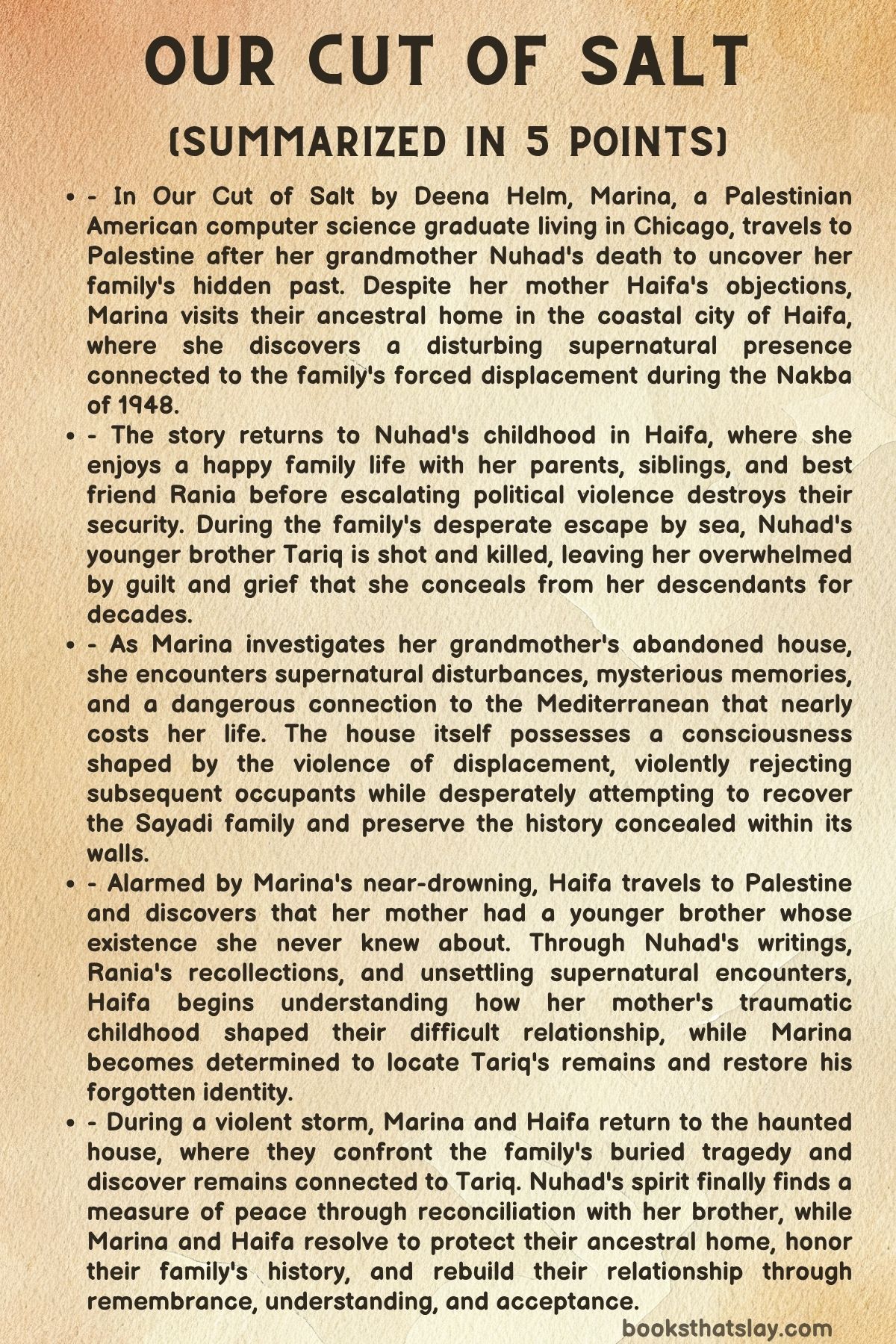
Summary
The story begins in suburban Chicago in 2002, where Marina, a recent computer science graduate, feels uncertain about her future. Unable to find suitable employment and increasingly disconnected from her surroundings, she becomes interested in discovering the Palestinian heritage that has remained largely unexplained throughout her childhood.
Her grandmother, Nuhad Sayadi, has recently died, leaving behind belongings and memories that Marina barely understands. When Marina prepares to travel to Palestine to collect family possessions from relatives in Nazareth, she decides to visit Haifa, the coastal city where Nuhad lived before her family was displaced during the Nakba of 1948.
Marina’s mother, Haifa, strongly opposes the additional journey. She worries about her daughter’s safety and remains uncomfortable discussing the family’s history, partly because Nuhad herself refused to share much about her childhood.
Their disagreement exposes a deeper division between them. Marina wants to understand where she comes from, while Haifa has spent most of her life accepting the silence surrounding her mother’s past.
The approaching separation forces Haifa to confront memories of Nuhad’s death and their difficult relationship. Strange supernatural encounters complicate her grief, particularly when she sees an apparition of her mother covered in blood and apparently attempting to communicate a warning.
Meanwhile, Marina remembers her own childhood experiences with drowning, which have left her deeply afraid of water. During an outing near Lake Michigan, she injures her foot on broken glass, and Haifa treats the wound with salt, repeating a remedy Nuhad once taught her.
This ordinary gesture establishes an important connection between the family’s generations. Salt, water, blood, and memory will become increasingly significant as Marina approaches the place her grandmother lost.
The narrative then moves to Haifa in 1948, where sixteen-year-old Nuhad enjoys a relatively happy adolescence. She lives with her parents, Basel and Victoria, and her siblings in a family residence above a fishing-supply shop operated by her father.
Basel takes great pride in the Sayadi family’s history, particularly its longstanding connection to the Mediterranean. He frequently tells Nuhad stories about their ancestors and believes the sea has always protected their family and their home.
Nuhad shares a close friendship with Rania, and the girls spend their time exploring Haifa, visiting the shoreline, and observing the changing atmosphere of their city. During one outing, Nuhad purchases a painting of a fisherman silhouetted against the setting sun, a possession that will later become an important link between her childhood and Marina’s investigation.
Although political tensions and the presence of British soldiers disturb ordinary life, Nuhad’s family initially retains a sense of security. Their home represents continuity, affection, and the expectation that future generations will remain connected to the same place.
However, the house possesses an unusual consciousness, and the reader gradually learns that its peaceful existence will be transformed by violence. After the Sayadi family is forcibly removed, the building develops a supernatural sickness that spreads through its rooms and foundations.
Salt gathers along its windowsills, seawater appears where it should not exist, and its physical structure seems to respond to memories of suffering. The house becomes hostile toward subsequent occupants, eventually killing people it believes have no rightful place within its walls.
When Marina reaches Palestine, her journey immediately exposes her to political realities she has previously understood only from a distance. Airport questioning about her Palestinian ancestry and Arabic name demonstrates that her American citizenship cannot entirely protect her from discrimination.
In Haifa, she begins investigating the Sayadi family’s history and meets people who recognize the significance of her grandmother’s name. Hassan’s reaction to Nuhad Sayadi suggests that the abandoned family property has acquired a disturbing reputation.
Marina also reconnects with Rania, now an elderly woman who remembers Nuhad’s childhood and the family’s displacement. Rania agrees to take Marina to the house but refuses to enter it herself.
The property has been placed on the real estate market, allowing Marina to explore the rooms where her grandmother once lived. Inside, she discovers the painting of the fisherman Nuhad purchased decades earlier.
Finding the painting makes Marina feel that her grandmother’s lost life has suddenly become tangible. She experiences vivid impressions of Nuhad and Rania enjoying their youth, as though the house itself is showing her fragments of the past.
Following an unusual trail of water, Marina investigates a room where moisture has gathered near a floor tile. She suspects that the house is attempting to direct her toward something hidden.
As Marina continues exploring Haifa, she becomes increasingly aware of the contrast between the lives of Palestinians and Israelis. Gunfire in Palestinian neighborhoods, restrictions on movement, and conversations with local residents demonstrate that the consequences of displacement remain present.
Her investigation soon takes a dangerous supernatural turn when she is drawn into the Mediterranean and nearly drowns. Despite surviving, she experiences severe breathing difficulties and awakens in a hospital struggling with the sensation that she cannot obtain enough air.
Khaled, a Palestinian man who becomes an important source of assistance, visits Marina and expresses concern about her treatment. His experiences illuminate the distrust many Palestinians feel toward institutions that have failed their communities.
Marina increasingly believes that the supernatural disturbances extend beyond her grandmother’s former residence. The city itself seems burdened by unresolved violence, and the house appears desperate to recover the family removed from it.
Back in Chicago, Haifa learns about Marina’s near-drowning and decides to travel to Palestine. Her friend Sara supports her departure, although Haifa remains frightened by her mother’s ghostly appearances and the possibility of discovering a painful family secret.
The narrative returns to 1948, revealing the circumstances that destroyed Nuhad’s childhood. As armed conflict intensifies, gunfire and explosions transform Haifa into a dangerous environment.
Basel and Victoria attempt to protect their children while desperately seeking safety. Their former confidence in their home and their connection to the sea becomes increasingly powerless against the violence surrounding them.
During the family’s attempted escape by water, Nuhad becomes separated from her younger brother, Tariq. She struggles through the sea searching for him, only to discover that he has been shot.
Tariq’s death becomes the defining tragedy of Nuhad’s life. Although she could not control the violence that killed him, she believes she failed to protect her younger brother and carries this guilt throughout her adulthood.
The family’s displacement compounds her suffering. Their ancestral home is lost, the security Basel once provided disappears, and their attempts to establish a new life are overshadowed by uncertainty, restrictions, and continuing hostility.
Nuhad maintains connections with her older sister, Siham, and other relatives, but those relationships cannot restore what has been destroyed. She eventually becomes unwilling to discuss the events of her childhood, concealing Tariq’s existence even from her daughter.
As Marina’s investigation progresses, she experiences increasingly intimate encounters with the house’s supernatural consciousness. In one extraordinary experience, she discovers that she can swim without the fear that has dominated her life.
The experience suggests a temporary restoration of her ancestral connection to the Mediterranean. Yet it also exposes the dangerous intensity of the house’s attachment to her.
The building recognizes Marina as a descendant of its original family and wants her to remain within its walls. Its desire to recover the past threatens Marina’s freedom and survival.
When Haifa arrives, Rania reveals the existence of Tariq, shocking her with the discovery that Nuhad had a younger brother. Haifa had believed her mother possessed only one sibling, Siham, and now understands how completely Nuhad buried the tragedy.
Haifa begins reading Nuhad’s writings, which reveal the depths of her sorrow, anger, and desire for revenge. She gradually realizes that her mother’s emotional distance was connected to a devastating childhood experience rather than simply an inability to express affection.
Photographs discovered through relatives in Nazareth offer further evidence of Tariq’s life. Seeing her uncle’s face gives Haifa a personal connection to someone whose existence had been erased from the family’s spoken history.
Marina becomes convinced that Tariq’s remains may lie near the sea or within the concealed history of the house. She decides that discovering what happened to him is necessary to restore dignity to his memory.
Meanwhile, the house’s new occupants encounter increasingly violent supernatural disturbances. Its anger intensifies as a powerful storm approaches Haifa, producing dangerous flooding and unnatural activity.
Despite her weakened physical condition, Marina feels compelled to return to the building. Khaled follows her through the worsening weather, helping her confront the danger.
Haifa also approaches the residence, now carrying a fuller understanding of her mother’s suffering. Inside, the house unleashes its accumulated grief through rising water, shifting stones, and attacks against those it perceives as intruders.
Marina discovers remains connected to Tariq, uncovering the physical evidence of the tragedy that haunted her grandmother. The discovery brings together the family’s suppressed memories and the supernatural force residing within the house.
Haifa experiences a remarkable encounter with a younger version of Nuhad. Seeing her mother as a frightened adolescent rather than the emotionally distant woman she knew allows Haifa to reconsider their relationship.
The haunting reaches its emotional resolution when Nuhad confronts the pain of losing Tariq and achieves a measure of reconciliation through their supernatural reunion. The house, no longer compelled to express its suffering through violence, begins to recover its peace.
Rania finally enters the Sayadi residence again, overcoming the fear that has kept her away for decades. Marina and Haifa resolve to protect the property and arrange a proper burial for Tariq.
By the conclusion, mother and daughter have established a stronger relationship grounded in a more complete understanding of their family history. Their return to the house represents both personal reconciliation and a refusal to allow the memory of Palestinian displacement to disappear.
Characters
Marina
Marina is the central contemporary protagonist of Our Cut of Salt, representing a generation of Palestinians raised outside their ancestral homeland who must construct an understanding of identity from incomplete family memories. Her journey begins with uncertainty about her professional future, but her deeper dissatisfaction concerns the absence of a meaningful connection to her heritage.
As a recent computer science graduate living in suburban Chicago, Marina possesses educational opportunities and freedoms that distinguish her experiences from those of her grandmother. Nevertheless, these advantages cannot satisfy her desire to understand the circumstances that shaped her family.
Her decision to visit Haifa demonstrates determination and independence, especially because her mother strongly opposes the journey. Marina recognizes that the silence surrounding Nuhad’s childhood has created an important absence in her own life, and she refuses to accept that absence as permanent.
Marina’s fear of drowning introduces a physical vulnerability that becomes central to her development. The Mediterranean, which once symbolized safety and belonging for the Sayadi family, becomes a threatening presence through which she must confront both inherited memories and supernatural danger.
Her near-drowning demonstrates that searching for the past carries consequences beyond emotional discomfort. The house’s attachment to her suggests that reclaiming family history can become dangerous when remembrance turns into an inability to release what has been lost.
Marina’s relationships with Rania and Khaled also expand her understanding of Palestinian identity. Through them, she recognizes that her grandmother’s experiences cannot be separated from the continuing political conditions affecting Palestinians.
Her determination to discover what happened to Tariq marks an important development in her character. Initially motivated by personal curiosity, she eventually accepts responsibility for preserving the memory of a family member whose existence was concealed for decades.
By the conclusion, Marina has transformed her search for belonging into a commitment to historical remembrance. She no longer sees her ancestry as an unanswered question but as a responsibility connecting her to people, places, and experiences that must not be forgotten.
Haifa
Haifa occupies a crucial position in Our Cut of Salt because she stands between the generation that directly experienced displacement and the generation attempting to recover its history. As Nuhad’s daughter and Marina’s mother, she inherits emotional wounds whose origins she does not initially understand.
Her relationship with Nuhad was shaped by silence, emotional distance, and an absence of explanations. Although she recognizes her mother’s suffering, she cannot fully understand why Nuhad remained unwilling to discuss her past or offer the emotional openness Haifa desired.
Haifa’s opposition to Marina’s journey arises partly from maternal protectiveness, but it also reflects her own fear of confronting the history that her mother concealed. Her anxiety reveals how inherited trauma can influence decisions even when the events responsible for that trauma remain unknown.
Following Nuhad’s death, Haifa struggles with grief complicated by unresolved resentment. The ghostly appearances of her mother force her to acknowledge that their relationship remains psychologically unfinished.
Her decision to travel to Palestine marks a significant change in her character. Rather than attempting to protect Marina by keeping her away from danger, Haifa begins recognizing that understanding their family history may be necessary for both of them.
The revelation that Nuhad had a younger brother named Tariq fundamentally changes Haifa’s understanding of her childhood. Discovering that such an important family member was deliberately excluded from their shared history demonstrates the extent of Nuhad’s psychological suffering.
Haifa’s encounter with the younger Nuhad allows her to see her mother as a vulnerable person damaged by circumstances beyond her control. This understanding does not erase their difficult relationship, but it enables Haifa to interpret her mother’s behavior with greater compassion.
By the end, Haifa becomes an active participant in preserving the Sayadi family’s past. Her reconciliation with Marina suggests that emotional openness can interrupt the transmission of silence between generations.
Nuhad Sayadi
Nuhad Sayadi is the emotional and historical center of the novel. Although she has died before Marina’s contemporary journey begins, her childhood, displacement, and unresolved grief influence nearly every significant relationship and supernatural event in the story.
As a teenager in Haifa, Nuhad is energetic, affectionate, and closely connected to her surroundings. Her friendship with Rania, relationship with Basel, and enjoyment of swimming establish her as a young woman who expects a future rooted in familiar people and places.
Her father’s stories about the sea reinforce her confidence in the security of her family home. Before the catastrophe, the Mediterranean represents freedom, continuity, and a protective connection to her ancestors.
The violence of 1948 destroys this understanding of the world. Forced to flee her home, Nuhad experiences the death of her younger brother Tariq during the family’s desperate escape.
Her inability to save Tariq becomes a source of overwhelming survivor’s guilt. Although she is herself a child confronted by armed violence, she assumes personal responsibility for her brother’s death.
This guilt transforms her relationship with memory. Instead of sharing stories about her childhood, she suppresses the most painful details and attempts to continue living without openly acknowledging the loss.
Her silence shapes her relationship with Haifa, who grows up without understanding the source of her mother’s emotional distance. Nuhad demonstrates how a survivor’s attempt to protect herself from painful memories can unintentionally cause suffering for the next generation.
Yet the novel does not reduce Nuhad to her trauma. Her love for her family, attachment to home, and longing for justice remain essential parts of her character.
Her supernatural reunion with Tariq offers a form of reconciliation that was impossible during her lifetime. Through this encounter, the novel allows Nuhad to confront the guilt that had prevented her from finding peace.
Rania
Rania serves as a living bridge between the historical and contemporary narratives of Our Cut of Salt. As Nuhad’s childhood best friend, she possesses firsthand knowledge of the Sayadi family’s life before displacement and the violence that transformed their community.
During their adolescence, Rania and Nuhad share an affectionate friendship characterized by curiosity, humor, and ordinary youthful experiences. Their visits to the shoreline and explorations of Haifa emphasize the everyday life that existed before the catastrophe.
Rania’s later experiences demonstrate that displacement affects not only individuals but entire communities. Her family’s property is taken, and their attempts to recover it fail amid political upheaval and continuing injustice.
Unlike Nuhad, who responds to trauma through silence, Rania remains willing to discuss Palestinian history openly. She challenges distorted accounts of the past and insists that the suffering of displaced families cannot be ignored.
Her relationship with Marina reveals both protectiveness and responsibility. Although she fears the Sayadi house and refuses initially to enter it, she understands Marina’s need to know what happened.
Rania also plays an essential role in revealing Tariq’s existence. By sharing memories that Nuhad concealed, she provides Haifa and Marina with information necessary to understand the family’s emotional history.
Her eventual return to the house represents a personal confrontation with decades of fear and loss. Through Rania, the novel emphasizes the importance of witnesses who continue preserving memories when others are unable to speak.
Tariq Sayadi
Tariq is Nuhad’s younger brother, whose death becomes the defining tragedy of the Sayadi family’s history. Although his direct presence in the contemporary narrative is limited, his absence shapes the lives of three generations.
As a child caught in the violence surrounding the family’s displacement, Tariq represents the vulnerability of ordinary people confronted by political and military forces beyond their control. His death during the escape from Haifa destroys Nuhad’s belief that she can protect the people she loves.
Tariq’s disappearance from family conversations demonstrates the destructive effects of suppressed grief. Haifa grows into adulthood without knowing that her mother had another brother, revealing how trauma can erase someone from a family’s spoken history.
The supernatural presence associated with Tariq complicates this erasure. His memory survives through the house and the unexplained experiences that guide Marina toward discovering the truth.
The eventual recovery of remains connected to him gives Marina and Haifa an opportunity to acknowledge his existence publicly. Their intention to provide him with a proper burial restores the dignity denied to him through violence and decades of silence.
Tariq’s significance extends beyond individual tragedy. He represents the children whose lives were interrupted by displacement and whose stories remain vulnerable to historical forgetting.
Basel Sayadi
Basel is Nuhad’s father and the owner of a fishing-supply business in Haifa. His character represents the family’s rootedness in its community and the sense of continuity that existed before displacement.
He takes pride in the Sayadi family’s ancestral relationship with the Mediterranean and frequently shares stories about the sea’s supposed protection. These accounts provide Nuhad with a sense of identity grounded in family tradition.
Basel’s affection for his daughter is apparent when he admires the painting she purchases. Their interaction reveals a household where ordinary acts of encouragement and storytelling strengthen family relationships.
The catastrophe of 1948 challenges Basel’s belief in the security of their home. As violence escalates, he attempts to protect his children but cannot prevent the family from suffering devastating losses.
His inability to preserve the family’s former life illustrates how displacement strips parents of the ability to provide stability, regardless of their intentions. Through Basel, the novel depicts the destruction of both material security and inherited cultural continuity.
Victoria Sayadi
Victoria, Nuhad’s mother, represents the parental effort to preserve family unity amid escalating violence. Her role becomes especially significant as the Sayadi household’s ordinary existence is disrupted by the events of 1948.
Alongside Basel, Victoria attempts to protect her children while navigating the dangers surrounding their displacement. Her situation reflects the emotional and practical burdens imposed on parents during forced migration.
The family’s loss of its home destroys the stability that once supported Victoria’s responsibilities. She must confront the uncertainty of survival while witnessing the suffering experienced by her children.
Her presence also establishes an important generational connection. The struggle to protect children from danger reappears decades later through Haifa’s relationship with Marina, suggesting that maternal fear can persist across different historical circumstances.
Although the supplied narrative provides fewer details about Victoria’s independent experiences, her significance lies in the family’s collective attempt to survive. She helps illustrate that displacement fundamentally changes the everyday responsibilities and emotional security of family life.
Siham
Siham is Nuhad’s older sister and an important connection to the family’s life after displacement. Her continued relationship with Nuhad provides a degree of stability when many elements of their previous existence have disappeared.
As Nuhad struggles with Tariq’s death, Siham and her family represent the surviving relationships through which the Sayadis attempt to establish a new life. Their connection suggests that familial continuity can remain possible even after the destruction of a shared home.
Siham’s importance also emerges through what later generations know about her. Haifa grows up believing that Siham was Nuhad’s only sibling, demonstrating how Tariq’s absence from family history distorts the next generation’s understanding of its origins.
Although Siham receives less narrative attention than Nuhad, her presence helps distinguish the family’s surviving relationships from the history that has been deliberately concealed. She represents endurance and continuity amid irreversible loss.
Khaled
Khaled provides Marina with practical assistance and a contemporary Palestinian perspective that broadens the political dimensions of her investigation. His experiences demonstrate that the consequences of displacement remain active rather than belonging exclusively to the past.
During Marina’s hospitalization, Khaled expresses concern about the treatment Palestinians receive within Israeli medical institutions. His distrust reflects experiences of institutional inequality and the vulnerability that can accompany restricted access to services.
His conversations with Marina also expose the limitations on Palestinian movement and the difficulties created by borders and political control. Through him, Marina recognizes differences between her experiences as an American citizen and the lives of Palestinians who remain in the region.
Khaled’s willingness to support Marina becomes particularly significant during the approaching storm. He follows her toward the haunted house and helps her navigate the dangerous conditions.
His role demonstrates solidarity through action rather than simply through shared identity. He provides Marina with both a better understanding of contemporary Palestinian life and assistance when her determination places her in danger.
Hassan
Hassan is a supporting character whose response to Marina’s family name reveals the troubling reputation surrounding Nuhad’s former residence. His reaction becomes one of Marina’s early indications that the house possesses a history beyond ordinary abandonment.
When Marina identifies herself as a descendant of the Sayadi family, Hassan’s demeanor changes. This response suggests that the house’s disturbing associations are familiar to people within the surrounding community.
Although his role is comparatively brief, Hassan helps establish the connection between private family history and public knowledge. The property has become a place whose past continues influencing how others perceive it.
His reaction also strengthens Marina’s determination to investigate. Through Hassan, the novel demonstrates that some histories survive through local memory even when descendants have been deprived of that knowledge.
Sara
Sara is Haifa’s friend and an important source of emotional support during the period following Nuhad’s death. She provides Haifa with an opportunity to express anxieties that remain difficult to discuss within her family.
As Marina prepares to travel, Sara encourages Haifa to recognize her daughter’s need for independence. Her perspective helps Haifa distinguish genuine maternal concern from the fear created by unresolved family experiences.
Sara’s support becomes particularly important when Marina nearly drowns and Haifa decides to travel to Palestine. By accompanying her toward the airport, she helps Haifa move from emotional paralysis toward action.
Her character illustrates the importance of relationships outside the immediate family. While Haifa must ultimately confront her inherited trauma herself, Sara provides the reassurance necessary for her to begin that process.
The Haunted House
The Sayadi family house functions as a supernatural character in Our Cut of Salt, possessing memory, desire, anger, and the capacity to act upon the world. Rather than serving merely as a frightening setting, it becomes an active participant in the family’s struggle over belonging and remembrance.
Before 1948, the house represents domestic safety and continuity. It shelters Nuhad’s childhood and contains the ordinary objects, routines, and relationships that give the Sayadi family its sense of identity.
Following their forced removal, the house develops a violent consciousness shaped by abandonment. Its walls, floors, and foundations respond to displacement through unnatural moisture, salt deposits, flooding, and attacks against subsequent occupants.
Its hostility reflects an inability to accept the separation from its original family. The building treats new residents as intruders and repeatedly attempts to preserve or recover what history has taken away.
Its attachment to Marina introduces moral complexity into the supernatural narrative. Although its desire to recognize a Sayadi descendant arises from loyalty and grief, that desire threatens Marina’s freedom and survival.
The house also functions as a keeper of evidence. Its strange activity directs attention toward concealed memories and ultimately toward the remains associated with Tariq.
Through the house, the novel personifies historical trauma as something physically embedded within a place. Its eventual peace suggests that acknowledgement and remembrance can change the relationship between the living and the past, even when the original injustice cannot be undone.
Themes
Displacement, Homeland, and the Right to Belong
The experience of displacement in Our Cut of Salt extends beyond the physical loss of property. It represents the destruction of a family’s relationship with its surroundings, its community, and the future it once expected to inhabit.
Before 1948, the Sayadi family’s home is inseparable from ordinary experiences of belonging. Basel’s business, Nuhad’s friendship with Rania, and the family’s relationship with the Mediterranean establish a sense of continuity rooted in everyday life.
When violence forces the family to abandon Haifa, their displacement destroys more than their domestic security. They lose the ability to determine where they will live, how their traditions will continue, and whether future generations will inherit the place that shaped their identity.
The house’s supernatural anger gives physical expression to this loss. Its violent rejection of new occupants represents the unresolved contradiction between legal possession and the historical belonging of those who were forcibly removed.
Marina’s return demonstrates how displacement continues influencing descendants who never personally experienced the original catastrophe. Although raised in the United States, she feels an absence that cannot be explained solely through her immediate circumstances.
Her search reveals that belonging is not guaranteed by citizenship or residence. It can also arise from inherited relationships, cultural memory, and the knowledge that one’s family once occupied a place from which it was excluded.
The novel ultimately presents remembrance as an essential part of resisting erasure. Marina and Haifa’s determination to protect the house demonstrates that reclaiming history can become a meaningful form of return, even when the losses caused by displacement remain irreversible.
Intergenerational Trauma and the Consequences of Silence
Nuhad’s refusal to discuss her childhood establishes a pattern of emotional silence that affects both Haifa and Marina. Her experiences demonstrate how a traumatic event can continue shaping family relationships long after the immediate danger has passed.
The death of Tariq leaves Nuhad burdened by survivor’s guilt. Unable to forgive herself for failing to protect her younger brother, she attempts to contain her suffering by suppressing the memories associated with his death.
However, this silence does not eliminate the pain. Instead, it transforms the way Nuhad relates to her daughter, creating emotional distance that Haifa experiences without understanding its origins.
Haifa consequently inherits the effects of events she never witnessed. Her uncertainty about Palestinian identity, fear of separation, and difficulty communicating openly with Marina all reflect the unresolved emotional environment in which she was raised.
Marina represents the generation that challenges this pattern. Rather than accepting the boundaries established by silence, she actively investigates family history and insists upon discovering the experiences that shaped her grandmother.
The supernatural elements reinforce the argument that suppressed memories do not simply disappear. Nuhad’s ghost continues appearing, while the family house physically manifests the suffering that earlier generations attempted to contain.
When Haifa discovers Tariq’s existence and encounters her mother as a frightened teenager, she gains an understanding that changes her interpretation of their relationship. Nuhad’s behavior becomes recognizable as a response to trauma rather than merely a personal failing.
The movement toward healing begins when the characters acknowledge painful truths and share what they have learned. Although understanding cannot reverse the original tragedy, it creates the possibility of relationships no longer controlled entirely by unspoken suffering.
Memory, Haunting, and Historical Justice
The supernatural events in Our Cut of Salt transform haunting into an expression of historical memory. Ghosts and unexplained disturbances do not exist simply to frighten the characters; they expose the consequences of violence that has never been adequately acknowledged.
The Sayadi house remembers its original inhabitants with an intensity that exceeds ordinary human recollection. Its structures retain evidence of displacement, while its supernatural activity makes the past impossible for new occupants to ignore.
Water appearing within the building and salt gathering across its surfaces symbolize the persistence of historical suffering. These disturbances suggest that physical spaces can preserve traces of injustice even when ownership changes and official accounts attempt to establish a different narrative.
The house’s violence also raises questions about the relationship between justice and revenge. Its anger arises from a genuine historical injury, but its attacks upon occupants reveal how unresolved suffering can produce further destruction.
Marina’s investigation provides an alternative response to the past. Rather than seeking to repeat the house’s violence, she attempts to discover the truth, identify Tariq’s remains, and restore dignity to the family members whose experiences were concealed.
Rania’s testimony is equally important because it demonstrates the role of living witnesses. Her memories challenge the disappearance of Palestinian experiences from public accounts of the city’s history.
The eventual reconciliation of the spirits suggests that peace depends upon confronting what happened rather than pretending the past has ended. The novel does not suggest that remembering alone can repair political injustice, but it presents accurate remembrance as a necessary condition for meaningful recognition.
Historical justice therefore begins with refusing erasure. By recovering Tariq’s identity and protecting the family’s home, Marina and Haifa preserve evidence that their ancestors lived, loved, suffered, and belonged.
The Sea, Salt, and the Relationship Between Life and Death
The Mediterranean occupies a complex symbolic position throughout the novel, representing protection, ancestry, displacement, and death. Its changing meaning reflects the transformation of the Sayadi family’s relationship with the place they once regarded as home.
During Nuhad’s childhood, the sea offers freedom and reassurance. Basel’s stories describe an ancestral connection to the water, encouraging the belief that the Mediterranean has historically protected the family.
Nuhad’s remarkable swimming ability reinforces this relationship. Her confidence in the water reflects the security she feels within her family and community before political violence destroys that stability.
Tariq’s death transforms the sea into a reminder of unbearable loss. The waters associated with childhood pleasure become inseparable from Nuhad’s inability to save her brother during the family’s desperate escape.
Marina inherits a different relationship with water through her lifelong fear of drowning. Although she does not initially know the details of Nuhad’s tragedy, her fear creates a symbolic connection between her body and the unresolved experiences of previous generations.
Her near-drowning in the Mediterranean demonstrates the danger of confronting inherited trauma without fully understanding it. Later, her supernatural ability to swim suggests the possibility of recovering a connection to ancestry that fear had previously obstructed.
Salt also operates through contrasting meanings. It appears in the sea, in tears, within the haunted house, and in the family remedy Haifa uses to treat Marina’s injured foot.
These associations connect suffering with preservation and care. Salt can sting an open wound, but it can also become part of the treatment that allows healing to begin.
The storm that accompanies the final confrontation brings these images together through flooding, danger, and supernatural upheaval. As the family acknowledges Tariq’s death and confronts Nuhad’s unresolved grief, water becomes associated not only with destruction but also with the possibility of release.
By the conclusion, the sea and salt retain their painful historical meanings while also suggesting continuity between generations. The novel presents healing not as the disappearance of suffering but as the ability to recognize loss, preserve memory, and establish a more honest relationship with the past.