Our Strange Duet Summary, Characters and Themes
Our Strange Duet by Erin A. Craig is a Gothic romance and psychological drama that reimagines the story of the Phantom of the Opera through Christine Daaé’s perspective.
Set in nineteenth-century Paris, the novel follows an aspiring singer whose extraordinary talent attracts the attention of a mysterious musical genius living beneath the Opéra Populaire. What begins as an artistic partnership develops into a dangerous relationship shaped by admiration, desire, jealousy, and obsession. As Christine struggles between the enigmatic Erik and her childhood companion Raoul de Chagny, she confronts difficult questions about freedom, ambition, love, and the sacrifices demanded by artistic greatness.
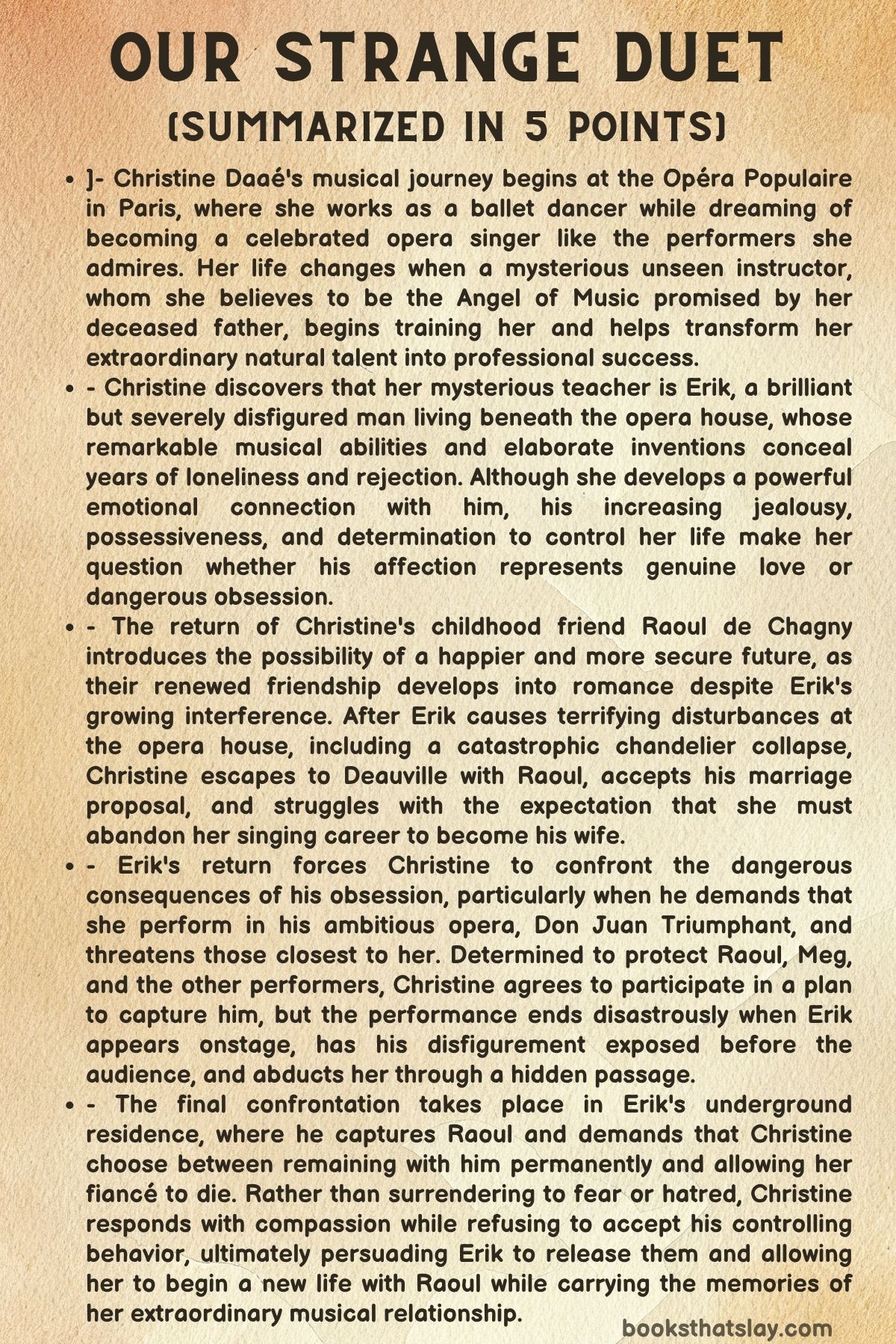
Summary
In March 1896, Christine Daaé secretly returns to the Opéra Populaire in Paris, searching for evidence of the mysterious man who once dominated her life. Beneath the theater, she discovers his underground residence in ruins, with shattered automatons, damaged machinery, and abandoned musical compositions scattered throughout the rooms.
Among the wreckage, she finds pages of a duet and an illustration of a rare crimson rose, the Rosa Joséphine. These discoveries bring back memories of her extraordinary relationship with Erik, the man she once believed was the Angel of Music.
The story returns to March 1895, when Christine is an inexperienced ballet dancer working at the Opéra Populaire. Orphaned after the death of her father, a traveling Swedish violinist, she has been raised under the protection of Madame Giry and shares a close friendship with her daughter, Meg.
Although Christine works diligently as a dancer, her greatest ambition is to become an opera singer. Her father had nurtured her love of music and told her stories about an Angel of Music who would someday guide her.
During rehearsals for Gounod’s Faust, Christine’s beautiful singing attracts the attention of Carlotta Giudicelli, the company’s celebrated but temperamental soprano. Believing that Christine intends to replace her, Carlotta angrily confronts the young performer.
A mysterious intervention results in Christine receiving a private dressing room associated with the legendary Opera Ghost. The room contains an enormous gilded mirror, an old piano, and an atmosphere that seems strangely alive.
Following a backstage accident in which Christine saves Carlotta from falling scenery, she discovers an open musical score on her piano. As she practices, an unseen masculine voice begins correcting her technique.
Christine initially suspects a cruel deception because the voice appears familiar with her father’s promise concerning the Angel of Music. However, its extraordinary beauty and musical knowledge gradually overcome her suspicions.
The mysterious instructor offers to develop her abilities, provided she dedicates herself completely to her training and avoids distracting relationships. Christine agrees, beginning a secret apprenticeship that transforms her voice.
Under the Angel’s demanding guidance, Christine develops remarkable control, range, and emotional expression. His praise becomes increasingly important to her, while his unpredictable anger makes her fearful of disappointing him.
Their relationship becomes more personal as they discuss stories, mythology, and love. Christine grows curious about the man behind the voice, but her request to see him provokes a distressed reaction.
An unexpected opportunity eventually allows Christine to demonstrate her abilities before the opera company’s leaders. Her performance astonishes the musicians, securing her advancement from the ballet to important operatic roles.
Her first major public appearance is a tremendous success. Audiences applaud enthusiastically, and Christine experiences the artistic recognition she has dreamed of since childhood.
Amid the celebrations, she encounters Raoul de Chagny, an aristocratic childhood friend whom she knew during summers in Deauville. Their reunion awakens affectionate memories, and Raoul eagerly attempts to renew their relationship.
Christine appreciates his attention but fears violating the Angel’s strict conditions. Her instructor soon reveals his jealousy, questioning Raoul’s presence and insisting that Christine’s musical future belongs exclusively to their partnership.
He also reveals that he has composed an opera especially for her. When Christine begs to see him, he finally opens a concealed passage behind her dressing-room mirror.
The mysterious man guides her through secret corridors and across an underground lake to his elaborate residence beneath the opera house. There, Christine discovers mechanical inventions, magnificent furnishings, and countless musical compositions.
She also learns that her instructor wears a white mask concealing part of his face. Their musical collaboration deepens her attraction, and she begins imagining a romantic future with him.
After an intensely realistic dream of intimacy, Christine awakens to discover that her feelings have become more complicated than she anticipated. Her curiosity about the mask leads her to see the facial disfigurement it conceals.
The revelation devastates her teacher, who believes his appearance makes him unworthy of affection. Christine attempts to reassure him, but his anguish and anger expose the profound insecurity beneath his brilliance.
He reveals himself as Erik, a man whose extraordinary gifts have been overshadowed by years of rejection. Although he returns Christine to the surface, their emotional connection remains unresolved.
Back in Paris, Christine reconnects with Raoul and begins spending time with him. Their outings introduce her to a world of companionship, luxury, and ordinary pleasures that contrasts with Erik’s secrecy.
Raoul also reveals that the Opera Ghost has been manipulating the theater’s management through threatening letters and demands. Christine begins questioning whether the opportunities that transformed her career were partly arranged through intimidation.
As her relationship with Raoul develops, Erik becomes increasingly possessive. During a performance of Il Muto, a mysterious voice humiliates Carlotta, whose singing deteriorates into ridiculous croaks.
The managers replace Carlotta with Christine, but the evening descends into catastrophe when Erik appears near Box Five and the enormous chandelier crashes into the auditorium. Fire and panic follow, leaving Christine injured and terrified.
Raoul cares for her during her recovery and proposes leaving Paris. Recognizing that Erik’s conduct has become dangerous, Christine agrees to escape the theater’s influence.
After an emotional farewell to Meg and Madame Giry, Christine accompanies Raoul to Deauville. Their days together restore some of the happiness they knew during childhood.
During a storm by the sea, Raoul proposes marriage, and Christine accepts. Their engagement promises a peaceful future far removed from the violence and uncertainty surrounding Erik.
However, difficulties emerge when Raoul introduces Christine to his aristocratic family. His mother disapproves of Christine’s modest upbringing and theatrical profession, believing that an opera singer cannot fulfill the expectations placed upon a vicomtesse.
Christine becomes increasingly conscious of the sacrifices marriage may demand. Eventually, she announces her intention to abandon her singing career, believing that her relationship with Raoul must take precedence.
Although Raoul reassures her, the decision creates an unresolved conflict between her love for him and the artistic identity she has spent years developing.
In December, the couple returns to Paris and attends a masquerade at the restored Opéra Populaire. Christine approaches the celebration apprehensively, uncertain whether Erik survived the chandelier disaster.
Her fears prove justified when Erik appears in an elaborate costume resembling Death. He confronts the theater managers and publicly demonstrates his continued influence.
Approaching Christine, he tears away the necklace holding her engagement ring, revealing his anger over her relationship with Raoul.
After Erik disappears, Christine confronts Madame Giry, who finally reveals part of his history. As a child, Erik was imprisoned and publicly exhibited because of his disfigured face.
Madame Giry rescued him from his captors, recognizing the frightened and gifted boy behind the spectacle. Her account helps Christine understand his isolation and resentment, although it cannot excuse his later violence.
Soon afterward, the theater managers receive instructions concerning Erik’s opera, Don Juan Triumphant. He demands that Christine perform in the production, and the authorities propose using the occasion to capture him.
Raoul supports the plan, but Christine initially refuses because she fears the danger to herself and everyone involved.
Seeking comfort at her father’s grave, she encounters Erik in the fog. When Raoul arrives, Erik violently attacks him, leaving Christine horrified by the increasing brutality of his obsession.
Raoul survives, but the incident strengthens Christine’s determination to escape. Her plans change when Meg asks for access to the mysterious teacher responsible for Christine’s extraordinary career.
Christine refuses, knowing that Erik might endanger her friend. Meg interprets the refusal as selfishness, forcing Christine to recognize that fleeing with Raoul would leave others vulnerable to Erik.
She consequently agrees to perform in Don Juan Triumphant, hoping to help the authorities end his control over the theater.
Rehearsals are emotionally exhausting. Erik’s complex music demonstrates his brilliance, but it also reminds Christine how completely his teaching has shaped her understanding of herself.
Despite her fear, Christine returns to the dressing-room mirror and asks Erik for assistance. This time, she attempts to establish boundaries, insisting that their renewed musical partnership must occur on her terms.
As opening night approaches, Christine experiences nightmares involving automatons and people controlled like puppets. These visions reflect her anxiety about surrendering her choices to the expectations of others.
An unexpected conversation with Carlotta offers another perspective on artistic identity. The aging soprano reveals her intention to retire rather than endure the humiliation of gradually declining importance.
Christine recognizes the vulnerability beneath Carlotta’s arrogance and begins understanding the emotional cost of a career defined entirely by performance.
During the opening of Don Juan Triumphant, Erik unexpectedly replaces the intended male performer and appears onstage opposite Christine. Their duet becomes an intensely personal confrontation, with the opera’s romantic tensions reflecting their unresolved relationship.
Overwhelmed by anger, Christine tears away Erik’s mask before the audience. His exposed face provokes panic, and he escapes through a trapdoor, taking Christine with him.
Back in his underground residence, Erik demands that Christine remain permanently by his side. When Raoul arrives to rescue her, Erik captures him and forces Christine into an agonizing choice between surrendering herself and allowing Raoul to die.
Christine responds not simply with hatred but with compassion. She recognizes the lonely, suffering man behind Erik’s cruelty while refusing to accept that love gives him the right to imprison or threaten anyone.
Her unexpected tenderness finally reaches him. Erik realizes that genuine affection cannot be obtained through force, and he releases Raoul and Christine.
Their separation is painful because Christine acknowledges the extraordinary influence Erik has had upon her life. Nevertheless, she understands that gratitude and affection cannot justify remaining with someone whose love has become destructive.
Raoul leads her through the underground waterways toward the surface. As morning approaches, they reaffirm their commitment, and Raoul restores her engagement ring.
Months later, Christine prepares for their wedding with Meg beside her. She looks toward a future built on companionship and personal choice, while recognizing that Erik’s music and their troubled relationship will always remain part of her history.
The novel concludes with Christine accepting the complexity of her past without allowing it to determine her future.
Characters
Christine Daaé
Christine Daaé is the central character of Our Strange Duet, and her development provides the novel with its emotional and psychological foundation. Her journey follows a young woman whose longing for artistic recognition brings her into a relationship that challenges her independence, identity, and understanding of love.
Christine begins as an orphaned ballet dancer whose greatest ambition is to sing professionally. Her father’s death has left her emotionally vulnerable, and the promise of an Angel of Music represents one of her strongest remaining connections to him.
Her initial willingness to believe in the mysterious instructor emerges from grief as much as ambition. She wants to become an extraordinary singer, but she also wants reassurance that her father remains connected to her life.
Christine possesses genuine artistic talent, considerable determination, and an instinctive willingness to help others. Her rescue of Carlotta during the scenery accident demonstrates that compassion is an important part of her character, even when directed toward someone who mistreats her.
However, Christine’s generosity sometimes makes her susceptible to manipulation. Erik recognizes her ambitions and emotional needs, offering precisely the encouragement and guidance she has desperately wanted.
Under his instruction, Christine becomes a remarkable singer, but her growing dependence on his approval reveals her difficulty distinguishing gratitude from obligation. She begins measuring her abilities through his responses rather than through her own developing confidence.
Her feelings toward Erik are complicated by fascination, attraction, pity, and fear. She recognizes his extraordinary intelligence and musical genius, yet gradually discovers the possessiveness and cruelty beneath his devotion.
Christine’s relationship with Raoul introduces a contrasting possibility: affection associated with childhood security, ordinary companionship, and an imagined future beyond the opera. Nevertheless, her willingness to abandon singing for marriage demonstrates that even a loving relationship can influence her choices in troubling ways.
Her recurring nightmares reveal her fear of becoming powerless. Whether imagining Erik controlling mechanical performers or Raoul occupying a similar position, Christine recognizes the danger of allowing another person to determine her identity.
Her decision to participate in Don Juan Triumphant marks a significant change. Rather than hiding from Erik, she accepts personal danger to protect Meg and the people remaining at the opera house.
The final confrontation demonstrates Christine’s growing emotional maturity. She refuses to excuse Erik’s behavior, but she also refuses to reduce him entirely to his cruelty.
By offering compassion without surrendering her freedom, she establishes a distinction between understanding another person’s suffering and accepting responsibility for satisfying their desires. Her eventual departure represents a deliberate assertion of her right to choose the direction of her life.
Erik / The Phantom of the Opera
Erik is the most psychologically complicated figure in Our Strange Duet, embodying the relationship between extraordinary creativity, emotional suffering, and destructive obsession. His musical genius creates opportunities for beauty and intimacy, while his insecurity transforms those opportunities into instruments of control.
His childhood provides essential context for his behavior. Born with a severe facial disfigurement, Erik experiences cruelty, humiliation, and imprisonment, eventually becoming a spectacle exhibited for the entertainment of others.
These experiences damage his ability to trust people and convince him that his appearance makes him inherently unlovable. Although Madame Giry rescues him, the emotional consequences of his mistreatment remain central to his adult identity.
Erik compensates for his exclusion through extraordinary achievement. His underground residence, complicated mechanical inventions, concealed passageways, and ambitious compositions demonstrate an intelligence capable of creating an entire private world.
The Opéra Populaire becomes both his sanctuary and his kingdom. Within its hidden architecture, he possesses the authority and security denied to him in ordinary society.
His relationship with Christine initially reveals his capacity for generosity. He recognizes her exceptional talent, teaches her difficult musical techniques, and devotes himself to developing her abilities.
Nevertheless, his generosity is inseparable from possessiveness. Erik considers Christine’s success proof of their unique connection and gradually treats her artistic development as something that gives him authority over her personal life.
His jealousy toward Raoul exposes his inability to distinguish love from ownership. He regards Christine’s affection for another man not as an independent choice but as a personal betrayal.
Erik’s cruelty intensifies through threats, theatrical sabotage, and physical violence. The chandelier catastrophe and his attack on Raoul demonstrate that his emotional suffering has become dangerous to innocent people.
His mask carries substantial symbolic importance. It conceals the appearance that society has condemned, allowing Erik to create an identity defined by mystery, mastery, and artistic brilliance.
When Christine removes it, his controlled persona collapses. The exposure forces him to confront the insecurity he has attempted to conceal beneath elaborate performances of power.
The final confrontation brings his contradictions into sharp focus. Erik threatens Raoul’s life while demanding Christine’s love, revealing how completely his longing for affection has become confused with domination.
Christine’s compassion ultimately reaches the vulnerable person beneath his obsessive behavior. By releasing the couple, Erik demonstrates a capacity for moral change, although the decision cannot erase the suffering he has caused.
His tragedy lies in possessing the imagination to create magnificent beauty without developing the emotional freedom necessary to share it without control.
Raoul de Chagny
Raoul de Chagny represents affection, familiarity, and the possibility of stability beyond the oppressive world Erik has created beneath the opera house. His relationship with Christine begins during childhood, giving their adult romance a foundation of shared memories and emotional familiarity.
As a wealthy aristocrat, Raoul occupies a privileged position far removed from Christine’s modest circumstances. His confidence and generosity initially make him seem capable of protecting her from the uncertainties surrounding her professional life.
His reunion with Christine demonstrates his romantic nature. He remembers their childhood experiences with affection and immediately begins imagining a future in which they can recover the closeness they once shared.
Raoul’s kindness is evident in his concern following the chandelier disaster. Rather than abandoning Christine when her association with the Opera Ghost becomes dangerous, he supports her recovery and helps her escape Paris.
Their time in Deauville reveals his sincere desire for companionship. His marriage proposal represents an effort to transform their renewed affection into a lasting commitment.
However, Raoul is not entirely free from the limitations of his privileged upbringing. He sometimes assumes that wealth, social position, and personal determination can resolve difficulties that Christine experiences more painfully.
His willingness to support the managers’ plan to trap Erik demonstrates this limitation. Although Raoul wishes to protect Christine, he initially fails to appreciate how terrifying it would be for her to become the central figure in a dangerous confrontation.
His reaction to Christine’s decision to abandon singing also raises questions about his understanding of her artistic identity. He appreciates her sacrifice but does not fully recognize the loss it may represent.
Nevertheless, Raoul’s devotion becomes particularly evident when he confronts Erik despite the danger. His willingness to risk injury and death demonstrates that his affection extends beyond romantic declarations.
The ending also reveals a more mature dimension of his character. Raoul accepts that he may never completely understand Christine’s feelings about Erik, allowing her a degree of emotional privacy.
His restoration of her engagement ring represents reconciliation, commitment, and the possibility of building a future without demanding that she erase her complicated past.
Meg Giry
Meg Giry provides an important emotional connection between Christine and the ordinary world of the Opéra Populaire. As Christine’s closest friend and fellow ballet dancer, she represents companionship, loyalty, and the familiarity of shared professional experiences.
Meg initially appears cheerful, sociable, and enthusiastic about the pleasures of youth. Her interest in friendships, dancing, romance, and social gatherings contrasts with Christine’s increasing preoccupation with her mysterious instructor.
She is genuinely pleased when Christine’s talent receives public recognition. Her excitement during Christine’s early triumphs shows that their friendship contains sincere affection rather than simple professional competition.
However, Meg also experiences the insecurity associated with remaining an ordinary dancer while Christine becomes an acclaimed singer. Their changing circumstances introduce an imbalance into a relationship that once seemed uncomplicated.
Meg’s curiosity about the Angel of Music gradually becomes more intense. She recognizes that Christine’s remarkable advancement must have an explanation and begins wondering whether the same opportunity could transform her own future.
Her confrontation with Christine exposes feelings of resentment and entitlement. Because her family helped Christine after her father’s death, Meg believes that Christine should share the secret responsible for her success.
She interprets Christine’s refusal as selfishness, unaware that the mysterious teacher is capable of terrible violence. The disagreement illustrates how easily protective decisions can be misunderstood when essential information remains hidden.
Meg’s importance extends beyond her own ambitions. Her desire to meet Erik forces Christine to recognize that leaving Paris would not necessarily protect the people she loves.
By the conclusion, Meg returns as a supportive friend during Christine’s wedding preparations. Their renewed companionship suggests that affection can survive jealousy, separation, and the changes associated with adulthood.
Madame Giry
Madame Giry is an important guardian figure whose knowledge of the opera house connects its everyday operations to the mysterious world Erik inhabits. Her disciplined manner and reserved personality make her appear stern, but her actions repeatedly reveal a capacity for compassion.
She assumes responsibility for Christine following the death of her father, providing the young orphan with stability and an opportunity to enter the ballet company. This generosity establishes her as an influential figure in Christine’s development.
Her professional authority also gives her unusual access to the theater’s internal workings. She understands traditions and hidden arrangements that other performers dismiss as ghost stories.
Her connection with Erik began long before Christine encountered him. By rescuing him from imprisonment and public exploitation, Madame Giry demonstrated that she could recognize humanity where others saw only physical deformity.
This history explains her complicated loyalty toward him. She remembers the mistreated child whose suffering inspired her sympathy, even as the adult Erik becomes increasingly threatening.
Madame Giry’s secrecy is therefore morally ambiguous. Her protection of Erik arises partly from compassion, but withholding information also leaves others vulnerable to his manipulation.
When she finally tells Christine about his childhood, she provides crucial insight into the origins of his resentment. Her account does not excuse his behavior, but it complicates the simple distinction between monster and victim.
Madame Giry represents the difficult responsibilities that accompany knowledge. Her character raises questions about when loyalty becomes dangerous and whether protecting someone from society can eventually mean protecting society from that person.
Carlotta Giudicelli
Carlotta Giudicelli initially functions as Christine’s professional antagonist, representing the competitive atmosphere of the opera and the insecurity surrounding artistic reputation. As an established soprano, she possesses the recognition and authority Christine longs to achieve.
Her arrogance emerges most clearly when she hears Christine singing during rehearsals. Rather than encouraging the younger performer, Carlotta interprets her talent as a threat to her own standing.
Her mistreatment of Christine continues even after Christine saves her from a dangerous backstage accident. Carlotta’s unwillingness to acknowledge the rescue demonstrates how jealousy can distort her judgment.
Nevertheless, Carlotta’s hostility gradually becomes more understandable as the story develops. Her career depends upon maintaining exceptional vocal ability and securing prominent roles in an environment where younger singers continually emerge.
Erik’s interventions deepen her insecurity by publicly humiliating her. The disastrous performance of Il Muto strips away the dignity she has built through years of professional achievement.
Carlotta’s final conversation with Christine transforms her characterization. She admits that aging threatens the artistic identity around which she has organized her life.
Her decision to retire rather than accept increasingly insignificant roles reveals pride, self-awareness, and a determination to control the manner of her departure.
By wishing Christine success, Carlotta briefly abandons the competitive hostility that has defined their relationship. The gesture acknowledges a shared understanding of the sacrifices demanded by professional singing.
Carlotta ultimately represents a possible future Christine must consider: a life in which artistic achievement offers extraordinary fulfillment but also creates dependence upon public admiration.
Philippe de Chagny
Philippe de Chagny, Raoul’s brother, contributes to the novel’s portrayal of aristocratic society and the privileged environment into which Christine enters through her relationship with Raoul. His presence emphasizes the social distance separating Christine’s theatrical background from the world of the Chagny family.
Through Philippe and Raoul’s fashionable acquaintances, Christine encounters the elaborate social customs and entertainments associated with wealth. These experiences initially appear exciting, offering pleasures far removed from the discipline of ballet rehearsals and secret musical instruction.
However, Philippe’s social position also reminds readers that Raoul belongs to an established family with expectations extending beyond individual romantic preferences. Christine’s prospective marriage involves entry into an entire social structure rather than simply a relationship with one man.
Although Philippe receives less attention than the central characters, his presence helps establish the wider social environment influencing Raoul’s understanding of status, obligation, and respectability.
Madame de Chagny
Madame de Chagny, Raoul’s mother, embodies the rigid social expectations of nineteenth-century aristocratic life. Her disapproval of Christine introduces a conflict that cannot be resolved through affection alone.
The dowager vicomtesse views marriage primarily through the responsibilities and standards associated with noble rank. Christine’s modest upbringing and theatrical profession make her an unsuitable prospective daughter-in-law in the older woman’s judgment.
Her cold reception at the Château de Chagny reveals how social prejudice can be expressed through etiquette and seemingly ordinary conversation. Rather than openly acknowledging Christine’s personal qualities, she focuses upon the differences separating her from the family.
Madame de Chagny’s objections place considerable pressure on Christine, who begins questioning whether her professional ambitions are compatible with marriage.
Her influence is therefore significant even without direct control over Christine’s decisions. Christine eventually announces her intention to abandon singing partly because she has absorbed the expectations surrounding her future social position.
The character demonstrates that control does not always require threats or violence. Social tradition, family disapproval, and the fear of exclusion can also persuade individuals to surrender important aspects of themselves.
Monsieur Lefèvre
Monsieur Lefèvre represents the professional authority governing Christine’s early life at the Opéra Populaire. As a theater manager, he must negotiate the competing demands of performers, stage workers, artistic ambitions, and the mysterious forces influencing the building.
His response to Carlotta’s hostility reveals the unequal power relationships within the company. Although he recognizes Christine’s abilities and courage, he understands that challenging an established star may threaten the theater’s stability.
When Christine saves Carlotta during the scenery accident, Lefèvre privately acknowledges her bravery while warning her against further conflict. His reaction illustrates the compromise often required of individuals responsible for maintaining institutional order.
The mysterious instructions he receives also demonstrate Erik’s influence over the management. Lefèvre’s position is complicated by threats that undermine his authority and force him to make decisions shaped by fear.
His character helps establish the opera house as an institution in which professional achievement depends not only upon talent but also upon hierarchy, reputation, and hidden influence.
Monsieur Firmin and Monsieur André
Monsieur Firmin and Monsieur André represent the managerial interests of the Opéra Populaire during the increasingly dangerous conflict with Erik. Their primary responsibilities involve maintaining performances, managing the company’s reputation, and protecting the theater’s operations.
Firmin becomes particularly important during the disastrous performance of Il Muto. When Carlotta can no longer continue, he must respond immediately to the demands of an audience expecting a professional production.
His decision to appoint Christine as her replacement reveals both practical judgment and the pressure placed upon management by extraordinary circumstances.
The managers’ relationship with Erik demonstrates the vulnerability of institutional authority. Although they formally control the theater, Erik’s knowledge of its architecture and ability to threaten its operations repeatedly undermine their decisions.
Their involvement in the proposed trap during Don Juan Triumphant reveals their determination to restore control. However, their plan also exposes Christine to significant danger, raising questions about the sacrifices institutions may demand from individuals.
André’s presence during the restored theater’s masquerade further emphasizes the management’s attempt to reestablish prestige after catastrophe.
Together, the managers show how professional responsibility can become complicated when financial interests, public safety, and personal ambition collide.
Ubaldo Piangi
Ubaldo Piangi is an established opera performer whose presence helps depict the professional environment surrounding Christine’s advancement. His position within the company places him among the experienced singers Christine must eventually work alongside.
During Carlotta’s disastrous performance, Piangi assists her when humiliation leaves her unable to continue. This response demonstrates professional concern within an environment otherwise characterized by rivalry and theatrical tension.
His participation in Don Juan Triumphant also highlights the demanding nature of Erik’s composition. The unusual musical structures challenge experienced performers as well as Christine, emphasizing the work’s technical ambition.
When Erik replaces the intended male performer during the climactic production, the substitution demonstrates his ability to disrupt even carefully organized theatrical performances.
Although Piangi is not developed as extensively as the principal characters, he represents the professional musicians whose careers become endangered by conflicts originating beyond their control.
Joseph Buquet
Joseph Buquet, the chief flyman at the Opéra Populaire, represents the backstage workers who experience the theater’s mysteries through practical accidents and unexplained disturbances. His familiarity with stage machinery gives him an important perspective on the building’s dangers.
Following the collapse of scenery during rehearsals, Buquet attributes the accident to the Opera Ghost. Christine challenges his explanation, pointing instead toward improperly secured equipment.
Their disagreement establishes a tension between superstition and practical reasoning. Where Buquet sees evidence of supernatural interference, Christine initially recognizes a failure of ordinary theatrical precautions.
Buquet’s characterization also illustrates the extent to which stories about the Phantom have become embedded in the company’s culture. Workers interpret strange events through the legend even when more straightforward explanations may exist.
His contribution is therefore especially important to the novel’s early atmosphere, before Christine discovers the human intelligence operating behind the theater’s supposedly supernatural mysteries.
Themes
The Difference Between Love and Possession
Love becomes dangerous when affection is treated as a claim of ownership rather than a relationship between independent people. In Our Strange Duet, Erik’s relationship with Christine demonstrates how longing for emotional connection can deteriorate into manipulation when one person’s desires take precedence over another’s freedom.
Erik initially expresses his attachment through musical instruction and creative generosity. He recognizes Christine’s talent, develops her voice, and promises opportunities she could scarcely have imagined before meeting him.
However, his generosity gradually acquires conditions unrelated to artistic development. He demands her undivided attention, discourages relationships, and reacts angrily when Raoul reenters her life.
Erik’s jealousy emerges from profound insecurity. Having experienced rejection throughout childhood, he believes that Christine’s affection represents an opportunity to escape the loneliness that has defined his existence.
Rather than trusting her capacity to choose him freely, he attempts to remove competing possibilities. His threats and acts of violence reveal the consequences of confusing devotion with entitlement.
Raoul offers a contrasting model of affection, emphasizing companionship, protection, and shared memories. Nevertheless, his assumptions about Christine’s future occasionally reveal how even loving relationships can unintentionally limit personal independence.
Christine’s eventual decision is therefore not simply a choice between two men. It is a growing recognition that affection must allow room for individual identity, disagreement, and freedom.
The final confrontation expresses this distinction most clearly. Christine acknowledges Erik’s suffering and offers him compassion, but she refuses to accept that his pain gives him authority over her life.
Erik’s decision to release her demonstrates his first meaningful recognition that genuine love cannot be compelled. The novel ultimately presents freedom as an essential condition of affection rather than something that must be sacrificed to prove devotion.
Artistic Ambition, Identity, and Sacrifice
Christine’s extraordinary singing ability shapes her understanding of who she is and what she hopes to become. Music is more than a profession for her; it preserves her connection to her deceased father and provides an opportunity to build an identity beyond the limitations of her upbringing.
At the beginning, Christine possesses talent without the resources or confidence necessary to develop it fully. Her position in the ballet company gives her access to the theatrical world but leaves her greatest ambition frustratingly distant.
Erik’s instruction transforms that situation. His technical knowledge and relentless expectations help Christine discover vocal abilities that would otherwise have remained largely unexplored.
Nevertheless, her artistic growth becomes complicated by emotional dependence. The same relationship that develops her talent also threatens her freedom to determine how that talent should be used.
Erik regards Christine’s voice as an instrument through which his own musical ambitions can be realized. His proposed opera represents a magnificent creative opportunity, but he repeatedly fails to distinguish collaboration from control.
Raoul’s world presents a different threat to Christine’s artistic identity. Marriage promises affection and security, yet social expectations encourage her to abandon the professional career she has struggled to establish.
Her willingness to resign from the opera raises an uncomfortable question about whether personal happiness can be achieved through suppressing an essential ambition.
Carlotta provides another perspective on the subject. Her anxiety about aging demonstrates the vulnerability of people whose self-worth depends upon professional recognition.
Together, these experiences establish art as both a source of personal liberation and a potential instrument of confinement. Creativity can help individuals discover their capabilities, but it can also become inseparable from ambition, public approval, and the demands of others.
Christine’s development suggests that genuine artistic fulfillment requires more than technical excellence. It also demands the freedom to determine the meaning and place of creativity within one’s own life.
Appearance, Social Rejection, and the Desire for Acceptance
Erik’s disfigurement provides the foundation for the novel’s examination of prejudice and social exclusion. His childhood demonstrates how cruelly a society can treat individuals whose physical appearance differs from accepted standards.
As a young boy, Erik is imprisoned and displayed for public entertainment. His extraordinary intelligence and creativity are ignored because spectators see his appearance before recognizing his humanity.
The experience teaches him to expect rejection and humiliation. His belief that he is unworthy of affection becomes deeply rooted, influencing his relationships long after he escapes captivity.
The mask he wears as an adult represents an attempt to control how others perceive him. By concealing his face, Erik creates an identity centered upon mystery, artistic brilliance, and apparent supernatural power.
Beneath that persona, however, he remains terrified of being seen without protection. Christine’s curiosity about his appearance consequently threatens the emotional defenses he has constructed around himself.
When she discovers his disfigurement, Erik interprets her shock as confirmation that nobody can truly love him. His reaction reveals how thoroughly social prejudice has shaped his expectations.
Madame Giry’s earlier compassion provides an alternative response. By recognizing the frightened child beneath the spectacle, she demonstrates the possibility of seeing a person’s humanity beyond their appearance.
Christine eventually develops a similarly compassionate understanding, although she refuses to excuse Erik’s harmful actions.
This distinction is essential to the novel’s moral complexity. Erik deserves dignity and acceptance regardless of his appearance, but the suffering caused by discrimination does not justify violence against others.
The story also extends its examination of prejudice through Christine’s experiences with Raoul’s aristocratic family. Her modest background and theatrical profession expose her to social judgment based upon status rather than individual character.
By placing these experiences alongside Erik’s rejection, the novel demonstrates how societies create boundaries around belonging. Physical appearance, profession, and social class become arbitrary measures through which individuals are accepted or excluded.
Freedom, Control, and the Struggle for Self-Determination
The tension between personal freedom and external control shapes Christine’s development throughout Our Strange Duet. Her life is repeatedly influenced by people who believe they understand what is best for her, even when their expectations conflict with her own desires.
Erik exercises control through secrecy, emotional dependence, and the extraordinary power he possesses over the opera house. His hidden passages and mechanical inventions allow him to observe events and interfere with other people’s decisions.
His musical instruction initially appears liberating because it gives Christine access to opportunities previously denied to her. Gradually, however, his demands reveal that he expects obedience in exchange for artistic advancement.
Christine’s dependence on his approval demonstrates how control can operate without constant physical coercion. Her fear of disappointing him becomes powerful enough to influence her friendships, professional decisions, and romantic relationships.
Raoul’s influence is less openly threatening, but his aristocratic circumstances introduce another set of expectations. Christine begins preparing for a marriage that may require abandoning the career through which she has discovered her abilities.
The pressure exerted by Madame de Chagny makes these expectations particularly clear. Christine is encouraged to understand her future through the responsibilities attached to her husband’s social position.
Her nightmares provide a striking symbolic expression of these anxieties. Images of mechanical performers and human beings controlled like puppets reveal her fear that her choices have become subordinate to someone else’s direction.
The presence of both Erik and Raoul in these disturbing visions suggests that Christine’s struggle extends beyond escaping a single dangerous relationship. She must also learn to recognize the subtle ways affection, gratitude, and social responsibility can influence her independence.
Her decision to participate in Don Juan Triumphant marks an important development because it emerges from her own moral judgment. Although she faces considerable danger, she chooses to act in order to protect others.
During the final confrontation, Christine refuses to surrender herself even while recognizing Erik’s pain. Her compassion becomes an expression of strength because it does not require obedience.
The ending affirms her desire to build a future through conscious choice rather than coercion. By leaving Erik and renewing her commitment to Raoul, Christine attempts to reclaim authority over her relationships and personal identity.
Her journey ultimately suggests that self-determination does not require emotional isolation. Instead, genuine freedom depends upon relationships in which love, responsibility, and individuality can exist without one person possessing the right to control another.