Reign by Bethan Croome Summary, Characters and Themes
Reign by Bethan Croome is a fantasy novel set in the kingdom of Lyonesse, where magic has been outlawed and those suspected of practicing it face execution.
The story follows Niamh Smith, a talented young blacksmith whose ambitions are restricted by the expectations placed upon women. When her compassion for an injured magical creature changes her life, she becomes involved in a conflict between an established monarchy and an exiled sorceress determined to reclaim her inheritance. Combining political struggles, forbidden magic, personal relationships, and dangerous battles, the novel explores identity, prejudice, loyalty, and the difficult choices involved in challenging an unjust society.
Summary
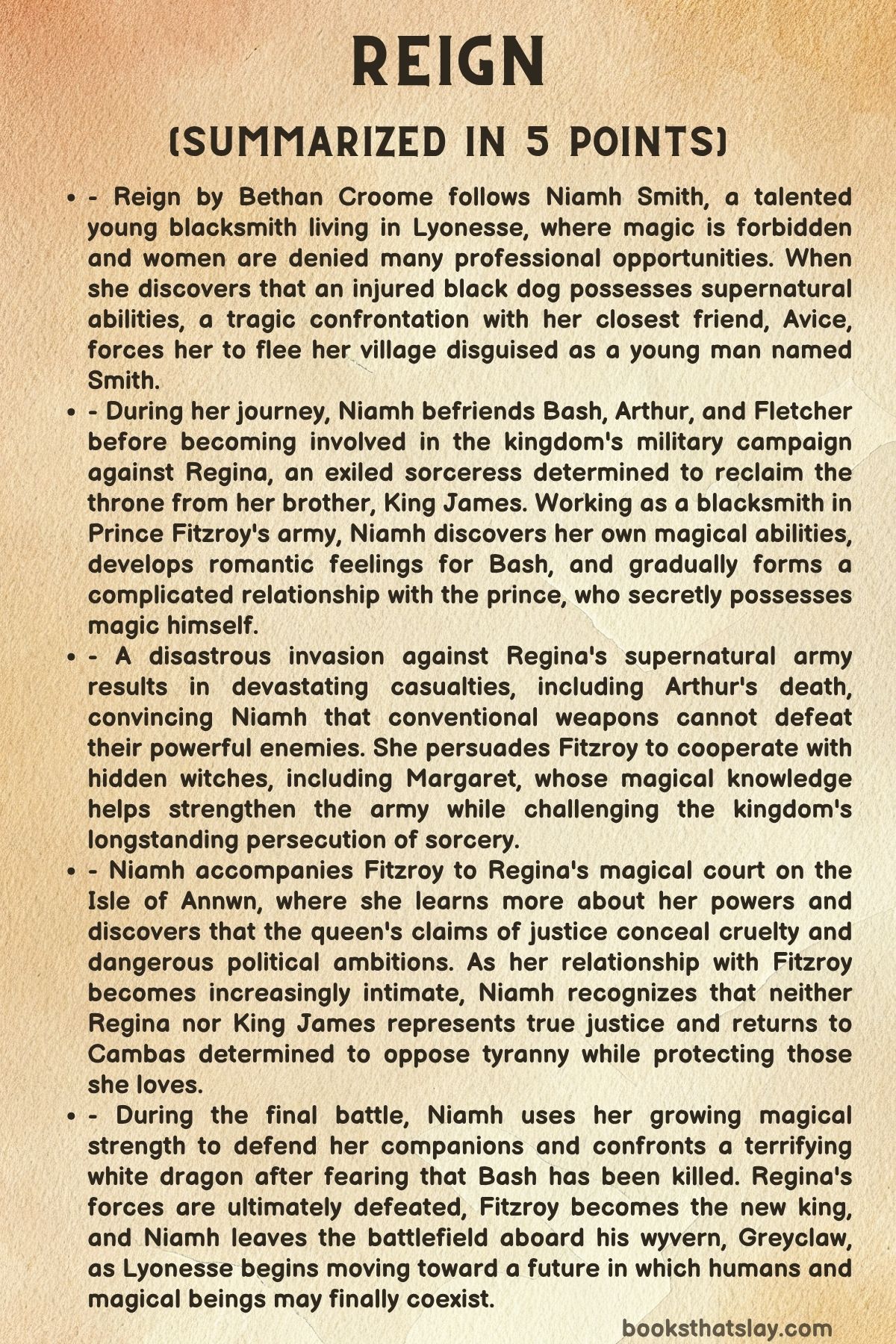
Niamh Smith lives in Green Vale, a village in the Wetlands of Lyonesse, where she works in her father’s smithy despite being forbidden from becoming a professional blacksmith because she is a woman. Her exceptional craftsmanship frequently goes unrecognized, with her elder brother Finn receiving credit for weapons and metalwork that she produces.
The kingdom is governed by King James, whose laws prohibit magic following a violent historical period known as the Dark Days. Anyone accused of witchcraft risks execution, creating a society in which fear and suspicion influence ordinary relationships.
Despite these dangers, Niamh secretly cares for an injured black dog that she discovers in the forest. Her closest friend, Lady Avice, warns her against associating with unusual creatures, but Niamh refuses to abandon an animal that appears helpless.
Avice is expected to marry Prince Fitzroy, King James’s son, although she secretly loves Finn. Their personal circumstances reflect the restrictions imposed by a society where family obligations, political arrangements, and gender determine much of an individual’s future.
As rumors of war spread, Niamh learns disturbing details about the kingdom’s history from an elderly villager named Todd. He explains that Regina, the king’s exiled sister, was originally entitled to inherit the throne before their father altered the succession in favor of James.
Regina was subsequently banished, and James established his campaign against magic. Now she has returned with an army of supernatural creatures, apparently determined to reclaim the inheritance that was denied to her.
The conflicting accounts of Regina’s past trouble Niamh, especially because some villagers remember her as a generous woman who helped ordinary people. Niamh begins questioning whether the official portrayal of all magical beings as dangerous enemies can be trusted.
Her life changes when Finn is summoned to serve in the war and she seeks comfort from the black dog. The creature unexpectedly speaks Yfelle, the forbidden language associated with magic, revealing its supernatural nature and awakening Niamh’s connection to sorcery.
Avice witnesses the encounter and becomes convinced that her friend is a witch. Their confrontation ends in Avice’s death, leaving Niamh devastated and vulnerable to the kingdom’s brutal anti-magic laws.
Recognizing that her daughter cannot remain safely in Green Vale, Niamh’s mother urges her to escape. Niamh disguises herself as a young man named Smith and leaves her home, while the black dog demonstrates frightening supernatural powers during the dangerous events surrounding her departure.
Traveling across the moorlands, Niamh meets three young men from the Headlands: Sebastian, known as Bash, Arthur, and Fletcher. Their friendliness gradually earns her trust, although maintaining her masculine identity makes every conversation potentially dangerous.
Niamh develops a particular affection for Bash, whose kindness and willingness to listen distinguish him from many people she has encountered. However, she cannot reveal her feelings without exposing the deception on which her survival depends.
The group reaches the Walled City, where Niamh hopes to establish herself through her blacksmithing abilities. Instead, she discovers overcrowding, disease, poverty, and widespread inequality, while a violent robbery deprives her of possessions essential to her independence.
Still disguised as Smith, she becomes caught in the kingdom’s military recruitment system and is sent with her companions to Cambas. Her dream of escaping society’s restrictions is replaced by the dangerous reality of serving in an army preparing to fight Regina.
At the military encampment, Niamh is assigned to the forge, where she meets Red, an experienced blacksmith who once knew her father. Red unknowingly reveals that her father has been searching for his missing daughter, forcing Niamh to conceal her identity and emotional reaction.
Niamh quickly demonstrates that she understands metalworking better than many of the soldiers responsible for producing weapons. Her ability earns respect, although that recognition remains dependent upon everyone believing that she is a man.
Meanwhile, Bash reveals an unexpected connection to magic when Niamh discovers that he understands Yfelle. He introduces her to a wyvern and takes her flying, giving her an extraordinary experience that challenges the frightening stories she has heard about supernatural creatures.
Bash also refers to her as the Silver Witch, suggesting that her abilities may have greater significance than she realizes. Their shared secret strengthens their relationship and encourages Niamh to investigate the magical identity she has spent so much effort concealing.
Niamh also attracts the attention of Prince Fitzroy, the commander of the army. Their early conversations are argumentative, with Niamh criticizing his privileged position and military decisions while Fitzroy recognizes the unusual intelligence and resourcefulness of the young blacksmith.
She discovers that Fitzroy is King James’s illegitimate son and that his position within the royal family is more complicated than his arrogant manner suggests. More surprisingly, purple markings on his palm indicate that he possesses magical abilities, exposing the hypocrisy of a royal household that condemns sorcery while secretly benefiting from it.
Fitzroy learns important details about Niamh’s past, and the two agree to protect each other’s secrets. Their relationship develops through disagreements, shared responsibilities, and a growing awareness of their similarities.
During a military training exercise, Niamh defeats Fitzroy in a sword-fighting demonstration by pretending to be injured and taking advantage of his lowered guard. Her unconventional victory embarrasses the prince but establishes her ability to succeed through intelligence rather than physical superiority.
Before the invasion, Niamh visits an establishment called the Anchor with Bash and other soldiers. There, she encounters Margaret, a woman who speaks Yfelle and is violently threatened by Red for suspected witchcraft.
Niamh and Bash intervene to protect Margaret, reinforcing their belief that the kingdom’s persecution of magical people causes needless suffering. The encounter later becomes crucial when Niamh searches for allies capable of helping the army.
The invasion begins with approximately two thousand soldiers confronting Regina’s forces along the coast of Cambas. Their commanders have underestimated the enemy, whose army includes ogres, goblins, terrifying supernatural creatures, and an enormous white dragon.
Conventional weapons prove inadequate against the attackers, and the battlefield becomes a scene of widespread destruction. Niamh notices mysterious spellcasters apparently protecting the human soldiers, suggesting that not every magical person supports Regina.
Dog unexpectedly returns to defend her, but their reunion is interrupted by the violence. Although Niamh eventually finds Bash and Fletcher alive, she discovers that Arthur has been killed.
The defeat leaves the surviving army devastated and exposes the weaknesses of Fitzroy’s leadership. Red openly blames the prince for the casualties, while hostility toward suspected witches threatens to divide the already weakened soldiers.
Niamh argues that the army cannot defeat magical enemies without accepting magical assistance. Fitzroy gradually acknowledges her reasoning and demonstrates his own abilities by using Yfelle to heal an injury on her face.
Recognizing that the kingdom needs a different strategy, Fitzroy asks Niamh to identify hidden magical practitioners who might support his forces. She and Bash approach Margaret and other women at the Anchor, discovering that they possess valuable magical knowledge and an inherited grimoire containing powerful enchantments.
Their assistance creates the possibility of strengthening weapons and protecting soldiers through sorcery. Niamh also learns more about the kingdom’s suppressed magical history and discovers that Finn himself possesses forbidden abilities.
However, their shared connection to magic cannot overcome Finn’s grief over Avice. He blames Niamh for her death, and their confrontations expose the bitterness that has developed between them.
Niamh’s personal life becomes increasingly complicated as her relationships with Bash and Fitzroy grow more intimate. Fitzroy appoints her to oversee the forge, while both men gradually become important emotional companions during the preparations for another military campaign.
A dangerous encounter with selkies leaves Niamh seriously injured, and Fitzroy again uses magic to help save her. Soon afterward, he takes her on a secret journey to the Isle of Annwn, where Regina has established her court.
Traveling aboard Fitzroy’s wyvern, Greyclaw, Niamh learns that Regina gave the creature to her nephew years earlier. This revelation demonstrates that Fitzroy’s relationship with his aunt has continued despite their apparent positions on opposing sides of the war.
The Isle of Annwn introduces Niamh to a society where magic is practiced openly. Regina’s court contains extraordinary beings, elaborate traditions, and evidence that the exiled sorceress once helped ordinary citizens.
Regina welcomes Niamh and encourages her to develop her powers, offering her a grimoire and access to magical knowledge. For the first time, Niamh can study sorcery without immediately fearing execution.
Yet the queen’s attitude toward violence gradually troubles her. Regina argues that individual sacrifices can be justified for the benefit of a larger cause, particularly when discussing Avice’s death.
Niamh also discovers that Regina’s court maintains its own inequalities and that the queen is capable of cruelty toward those beneath her. When Regina brutally punishes Herla, an elf serving in her household, Niamh recognizes that the queen’s supposed commitment to justice does not prevent her from exercising tyrannical authority.
During their stay, Niamh and Fitzroy grow closer, and their romantic relationship becomes physical. Nevertheless, Niamh remains emotionally connected to Bash, making her uncertain about the future she wants.
Recognizing Regina’s dangerous ambitions, Niamh and Fitzroy decide that they cannot support her campaign. They secure the cooperation of Billy the Blind, one of Regina’s advisers, and escape the island with information about her military plans.
Returning to Cambas, they prepare for a final confrontation. Niamh continues enchanting weapons, learns that magical abilities are more widespread among the soldiers than she previously believed, and struggles to repair her relationship with Finn.
She also reunites with Bash and finally reveals that Smith is a woman. Rather than destroying their relationship, the truth allows them to acknowledge their romantic feelings openly, and Bash invites her to imagine a future with him in the Headlands.
The decisive battle begins when Regina’s forces attack, bringing powerful creatures and destructive spells against Fitzroy’s army. This time, however, ordinary soldiers fight alongside witches and other magical allies, demonstrating the strength of cooperation.
Niamh uses her developing powers to protect those around her, while Jane saves Finn from a potentially fatal fall through magical intervention. When Bash disappears during the fighting, Niamh desperately searches for him and fears that she has lost another person she loves.
Her anguish contributes to an extraordinary display of sorcery as she confronts the enormous white dragon threatening the army. The dragon’s defeat becomes a turning point, and Regina’s forces are overcome.
Following the battle, Fitzroy emerges as the new king, suggesting that Lyonesse may finally move beyond the policies of persecution established under James. The surviving soldiers and magical beings acknowledge his authority, symbolizing the possibility of a more inclusive kingdom.
Niamh’s journey has transformed her from an unrecognized village craftswoman into a powerful witch whose decisions have helped determine the future of her country. The novel closes with Fitzroy offering her his hand as he prepares to leave aboard Greyclaw, and Niamh joining him as they move toward an uncertain future.
Characters
Niamh Smith
Niamh Smith is the central protagonist of Reign, a young woman whose journey from an overlooked blacksmith’s daughter to an exceptionally powerful witch forms the foundation of the novel. Her character is defined by intelligence, independence, compassion, stubbornness, and an unwillingness to accept the limitations society places upon her.
Growing up in Green Vale, Niamh possesses remarkable metalworking abilities but cannot receive proper recognition because women are prohibited from becoming professional blacksmiths. Her frustration reflects a deeper desire for independence and respect rather than simple dissatisfaction with her circumstances.
Her decision to protect an injured black dog demonstrates her instinctive compassion, particularly toward beings that others might fear or reject. Although she understands the danger of being associated with magic, she refuses to abandon a vulnerable creature merely because her society considers it suspicious.
Avice’s death becomes one of the defining tragedies of Niamh’s life. The incident forces her to abandon her home and identity, while the guilt surrounding her friend’s death continues influencing her decisions long after she escapes Green Vale.
Disguising herself as Smith allows Niamh to experience freedoms unavailable to her as a woman. She receives recognition for her abilities, travels independently, and gains professional responsibilities, exposing the injustice of the restrictions she previously faced.
Niamh’s understanding of magic evolves throughout the story. Initially frightened by her supernatural connection, she gradually recognizes that magical abilities are not inherently evil and that their moral significance depends upon how they are used.
Her relationships with Bash and Fitzroy reveal conflicting emotional desires. Bash offers companionship and acceptance, while Fitzroy challenges her intellectually and introduces her to a different world of political responsibility and personal ambition.
Her refusal to support either James’s persecution or Regina’s cruelty demonstrates an increasingly independent moral judgment. Rather than allowing powerful figures to determine her beliefs, she learns to evaluate their actions against her own understanding of justice.
By the end of the novel, Niamh has become a capable sorceress whose craftsmanship and courage contribute to the kingdom’s transformation. Her character represents the struggle to claim authority over one’s identity while remaining accountable for the consequences of personal choices.
Prince Fitzroy
Prince Fitzroy is one of the most complex characters in Reign, combining royal privilege, personal insecurity, concealed magical abilities, and an evolving understanding of leadership. Initially presented as an arrogant and inexperienced commander, he gradually becomes a figure capable of challenging the political system that has shaped his life.
As King James’s illegitimate son, Fitzroy occupies an uncertain position within the royal family. His eventual recognition follows the death of an older brother, leaving him conscious that his value has often depended upon circumstances beyond his control.
This background helps explain his pride and need to demonstrate authority. His confidence frequently conceals a fear of inadequacy, particularly when his decisions affect soldiers whose lives depend upon his judgment.
His relationship with Niamh begins through arguments and mutual suspicion. She refuses to flatter him because of his title, and her willingness to challenge his decisions initially unsettles someone accustomed to obedience.
However, Fitzroy increasingly respects her intelligence and craftsmanship. Their developing relationship forces him to reconsider assumptions about gender, class, and the responsibilities of a ruler.
His secret magical abilities expose the contradictions within his family’s government. Although he serves a monarchy that condemns sorcery, he possesses powers capable of healing injuries and maintains a close relationship with a magical creature.
His connection to Regina further complicates his political identity. The gift of Greyclaw demonstrates that his aunt has influenced his life, while his eventual rejection of her cruelty establishes his willingness to place moral judgment above family loyalty.
Fitzroy’s growth is particularly visible in his changing military strategy. Following the disastrous invasion, he gradually recognizes that defeating Regina requires cooperation with the magical people his father’s government has persecuted.
His romantic connection with Niamh also reveals vulnerability beneath his commanding exterior. The intimacy between them develops from intellectual rivalry into genuine affection, although their relationship remains complicated by his royal position and her feelings for Bash.
His emergence as king represents a potential turning point for Lyonesse. Although the ending does not establish exactly how he will govern, his experiences suggest that he has begun understanding leadership as a responsibility rather than merely an inherited privilege.
Sebastian (Bash)
Sebastian, commonly known as Bash, provides one of the strongest emotional connections in Reign. His warmth, curiosity, humor, and willingness to question conventional beliefs distinguish him from many characters raised within Lyonesse’s fearful political culture.
Bash first meets Niamh while traveling with Arthur and Fletcher from the Headlands. His friendliness makes her dangerous journey more bearable, even though she must conceal her gender and the circumstances surrounding her escape.
Unlike characters who immediately condemn anything associated with magic, Bash possesses knowledge of Yfelle and maintains connections to the supernatural world. His decision to introduce Niamh to a wyvern demonstrates both trust and an awareness that magic can offer extraordinary experiences rather than simply destruction.
His reference to Niamh as the Silver Witch suggests that he recognizes something unusual about her abilities. He becomes an important companion in her gradual acceptance of the identity that her upbringing has taught her to fear.
Bash also carries unresolved grief over his father’s disappearance at sea. His memories reveal a sensitive individual whose kindness exists alongside personal loss and uncertainty.
His participation in the war exposes him to further suffering, particularly through Arthur’s death. Nevertheless, he continues supporting his companions and assisting Niamh during moments of physical injury and emotional distress.
The development of his relationship with Niamh is complicated by her disguise. Their attraction grows through friendship and shared danger, but their intimacy cannot become fully honest until she reveals the truth about herself.
When Bash learns that Smith is a woman, their relationship changes from concealed attraction into openly acknowledged romance. His invitation for Niamh to accompany him to the Headlands demonstrates a desire for lasting companionship beyond the war.
Bash represents the possibility of building relationships through trust rather than social expectations. His importance lies not only in his romance with Niamh but also in the acceptance and emotional security he offers during a period when nearly every part of her life is unstable.
Queen Regina
Queen Regina is the central political antagonist of Reign, although her motivations initially appear connected to genuine injustice. Her struggle to reclaim the throne raises questions about rightful inheritance, persecution, political power, and the moral limits of resistance.
Regina was originally entitled to inherit Lyonesse before her father changed the succession in favor of her brother James. Her banishment and the subsequent persecution of magic provide understandable reasons for her resentment toward the established monarchy.
The kingdom’s official portrayal of Regina as a dangerous sorceress is complicated by villagers who remember her helping ordinary people. These conflicting accounts initially suggest that her reputation may have been deliberately distorted by those who benefited from her removal.
Her court on the Isle of Annwn reveals an intelligent, powerful, and politically sophisticated ruler. She has gathered magical creatures and practitioners into a society where they can live more openly than under James’s authority.
However, her apparent sanctuary contains its own inequalities. Regina’s treatment of servants and subordinate beings demonstrates that freedom from one oppressive government does not necessarily produce a just society.
Her relationship with Fitzroy reveals a calculating political mind. By giving him Greyclaw during his childhood, she establishes a connection that may later serve her ambitions, suggesting that even acts of generosity can contain strategic motives.
Her encouragement of Niamh’s magical education initially appears benevolent. Yet her willingness to justify Avice’s death as an acceptable sacrifice reveals a disturbing readiness to subordinate individual lives to political objectives.
The punishment of Herla exposes the violence underlying her authority. At that moment, Niamh recognizes that Regina’s commitment to restoring magical rights does not prevent her from becoming an oppressor herself.
Regina represents the danger of allowing legitimate grievances to justify unlimited power. Her character demonstrates that suffering injustice does not automatically make someone morally qualified to govern others.
Finn Smith
Finn Smith is Niamh’s elder brother and one of the most emotionally conflicted figures in Reign. His relationship with his sister combines familial affection, resentment, grief, secrecy, and conflicting expectations about loyalty.
Before the war, Finn benefits from a society that allows him to receive recognition for metalwork actually produced by Niamh. Although his position is shaped by established customs, this imbalance highlights the privileges he possesses simply because he is male.
Finn’s romantic attachment to Lady Avice creates a personal conflict because she is expected to marry Prince Fitzroy. Their affection exists within a political and social system that places family arrangements above individual desires.
Avice’s death devastates Finn and permanently changes his relationship with Niamh. Rather than viewing the tragedy through the dangers created by the kingdom’s persecution of magic, he directs much of his anger toward his sister.
His discovery that Niamh has survived and joined the army does not immediately resolve their differences. Their confrontations become increasingly painful as he criticizes her decisions and struggles to acknowledge the circumstances that forced her to flee.
Finn’s own magical abilities introduce a significant contradiction into his character. He belongs to the very group persecuted by the laws that shaped his upbringing, yet his grief prevents him from easily reconsidering his judgment of Niamh.
His criticism of her romantic relationships also reflects traditional expectations about female behavior. Niamh’s refusal to accept his authority exposes the tension between family loyalty and personal independence.
Finn’s experiences reveal how grief can distort affection into blame. Although his relationship with Niamh remains damaged, his survival through Jane’s magical intervention offers the possibility that their shared experiences might eventually encourage greater understanding.
Lady Avice
Lady Avice is Niamh’s closest childhood friend and the daughter of the Lord of the Wetlands. Her character demonstrates how affection and loyalty can be undermined by political beliefs, social obligations, and deeply established prejudices.
Although she enjoys a close friendship with Niamh, Avice strongly supports the eradication of magic. Her convictions reflect the influence of a society that portrays magical creatures and practitioners as threats to ordinary life.
Avice’s personal circumstances also reveal the restrictions placed upon women of noble birth. She is expected to marry Prince Fitzroy despite loving Finn, demonstrating how political arrangements can take precedence over emotional attachments.
Her confrontation with Niamh after witnessing the use of Yfelle exposes the limits of their friendship. Avice’s fear of witchcraft becomes stronger than her trust in someone she has known throughout her life.
Her death has consequences extending far beyond the immediate tragedy. It forces Niamh into exile, creates a lasting division between the Smith siblings, and becomes a painful example of the destruction caused by prejudice and fear.
Avice is particularly significant because she is neither an obvious villain nor an entirely sympathetic victim. Her genuine relationships coexist with beliefs that make it impossible for her to accept the truth about her closest friend.
Dog (The Black Shuck)
Dog is the mysterious black creature whose relationship with Niamh initiates her transformation from an ordinary village girl into a participant in the kingdom’s magical conflict. Initially appearing vulnerable and injured, Dog becomes the recipient of Niamh’s compassion.
The creature’s ability to speak Yfelle reveals that she belongs to the supernatural world outlawed by King James. Her unusual powers also suggest that her apparent helplessness conceals an extraordinary capacity for violence and protection.
Dog’s loyalty becomes evident when she intervenes during the dangerous events surrounding Niamh’s escape. Her actions contribute to the frightening reputation that develops around the creature, demonstrating how protective behavior can be interpreted differently by those who do not understand its circumstances.
Her later appearances during the war reinforce her connection to Niamh. Even when separated by violence, the bond between them remains important.
Dog represents the difference between outward appearances and actual character. The animal that society might immediately condemn as monstrous becomes one of Niamh’s most faithful companions, while supposedly respectable people repeatedly expose her to danger.
Margaret
Margaret is a magical practitioner associated with the Anchor, where she and other women must conceal their supernatural abilities to survive. Her character reveals the vulnerability of individuals who face persecution because of qualities they cannot safely acknowledge.
When Red discovers her speaking Yfelle, his violent reaction demonstrates how easily suspicion can threaten the lives of magical people. Niamh and Bash’s intervention creates an important connection between Margaret and the emerging resistance to Regina.
Margaret possesses access to an inherited grimoire containing spells preserved across generations. This knowledge becomes especially valuable when Fitzroy’s army recognizes the need for enchanted weapons and supernatural protection.
Her willingness to consider assisting the soldiers is significant because those same soldiers belong to a society that has persecuted witches. She must decide whether helping the kingdom defend itself is worth the danger of exposing her identity.
Margaret’s eventual cooperation demonstrates courage and practical judgment. She represents magical individuals whose knowledge survives through secrecy and whose contributions become essential when established institutions prove incapable of protecting their people.
Red
Red is the senior blacksmith working at the military encampment in Cambas. His rough personality, professional experience, and intense hostility toward magic make him an important source of conflict in Niamh’s new surroundings.
He initially doubts Smith’s abilities but gradually recognizes the young recruit’s exceptional craftsmanship. His changing professional opinion shows that he can appreciate genuine skill even when it challenges his expectations.
Red’s connection to Niamh’s father creates additional tension because he does not recognize the missing daughter working directly beside him. This misunderstanding reinforces the importance of Niamh’s disguise and the risks attached to revealing her identity.
His violent treatment of Margaret demonstrates the destructive influence of anti-magic prejudice. He considers suspected witchcraft sufficient justification for harsh punishment, making him dangerous to the very individuals who might help save the army.
Following the disastrous invasion, Red also expresses anger toward Fitzroy’s leadership. His criticism reflects genuine frustration over military losses, although his hostility toward magical practitioners prevents him from understanding the broader causes of the army’s weakness.
Red illustrates how practical competence can coexist with destructive beliefs. His character demonstrates that individuals may possess admirable abilities while remaining unwilling to question the prejudices governing their behavior.
Fletcher
Fletcher is one of the young travelers from the Headlands who befriends Niamh during her journey toward the Walled City. Alongside Bash and Arthur, he helps provide companionship at a time when she has lost her home and familiar relationships.
His involvement in the military campaign exposes him to the same dangers as the other recruits. He survives the initial invasion, although Arthur’s death changes the emotional circumstances of their friendship.
Fletcher also notices the growing connection between Bash and Niamh. His observations encourage Niamh to consider whether Bash’s behavior reflects romantic affection rather than ordinary friendship.
His continuing presence creates a sense of stability within the soldiers’ social group. Bash’s suggestion that Niamh accompany them to the Headlands after the war further establishes Fletcher as part of a possible life beyond military conflict.
Although Fletcher receives less individual development than the principal characters, his loyalty and companionship reinforce the importance of friendship amid political violence.
Arthur
Arthur is a young man from the Headlands who travels alongside Bash and Fletcher before joining the military campaign. He becomes part of the friendship group that helps Niamh adjust to life outside Green Vale.
His participation in the army reflects the experiences of ordinary individuals drawn into a political struggle over which they possess little control. Like many recruits, he must confront threats for which conventional military preparation offers limited protection.
Arthur is killed during the disastrous invasion of Cambas. His death profoundly affects Niamh and the surviving companions, turning the war from an abstract national emergency into an immediate personal loss.
The significance of his character lies partly in the ordinary future that his death prevents him from experiencing. He represents the young people sacrificed when rulers make decisions without adequately understanding the dangers facing their soldiers.
King James
King James is the ruler of Lyonesse whose policies establish the oppressive political environment in which the novel begins. His prohibition of magic shapes the fears, relationships, and opportunities of nearly every significant character.
James receives the throne after his father changes the succession, displacing Regina despite her earlier claim to the inheritance. This decision creates the political conflict that eventually develops into open warfare.
His anti-magic laws permit extreme punishments against suspected practitioners and encourage ordinary citizens to regard supernatural abilities with hostility. The consequences extend beyond magical people themselves, damaging friendships, families, and communities.
James’s treatment of Fitzroy also reveals the influence of legitimacy and royal expectations within his household. His initial refusal to recognize his illegitimate son contributes to the insecurity that Fitzroy later struggles to overcome.
The discovery that Fitzroy possesses magic demonstrates the contradictions surrounding James’s regime. The royal family is not entirely separate from the supernatural powers that the king has attempted to eliminate.
Although James does not receive the same personal attention as Niamh or Fitzroy, his influence remains central to the story. He represents institutional oppression and the dangers of allowing a ruler’s ideology to become the foundation of an entire legal system.
Billy the Blind
Billy the Blind is an adviser associated with Regina’s court on the Isle of Annwn. His position places him close to the political decisions and military plans of the exiled queen.
Initially introduced as part of Regina’s magical household, Billy becomes important when Niamh and Fitzroy begin planning their escape. His discovery of their intentions threatens to expose them to a ruler whose punishment can be severe.
The pair restrain him and compel him to consider cooperation. Billy eventually provides information concerning Regina’s military strategy, making him a valuable source of intelligence.
His involvement demonstrates the importance of individuals who possess knowledge rather than simply physical or magical strength. By helping Niamh and Fitzroy escape with strategic information, he influences the preparations for the final confrontation.
Greyclaw
Greyclaw is Fitzroy’s wyvern and one of the most significant magical creatures associated with the prince. Given to him by Regina during his childhood, the creature represents a lasting connection between Fitzroy and his aunt.
Greyclaw’s existence contradicts the anti-magic principles promoted by Fitzroy’s father. The prince’s attachment to the creature reveals that his private life has never completely followed the ideology of the kingdom he serves.
The wyvern also enables Fitzroy and Niamh to travel to the Isle of Annwn, bringing them directly into Regina’s political and magical world. Without this journey, they would not gain the same understanding of the queen’s ambitions.
Greyclaw’s appearance near the conclusion reinforces the continuing significance of magic in Fitzroy’s future. Rather than abandoning his supernatural companion after becoming king, he departs with the creature and Niamh, suggesting a break from the restrictive traditions of the previous monarchy.
Todd
Todd is an elderly villager whose recollections introduce Niamh to important details about Lyonesse’s disputed history. Although his stories are presented during a tavern conversation, they challenge the official version of events surrounding Regina’s exile.
He explains that Regina was initially entitled to inherit the throne before the succession was changed in favor of James. This information encourages Niamh to question whether the conflict can be understood through the kingdom’s simple division between lawful rulers and dangerous sorcerers.
Todd represents the importance of personal memory in a society where political authorities influence historical understanding. His contribution demonstrates how apparently ordinary conversations can undermine beliefs that people have accepted throughout their lives.
Adder
Adder is a villager whose confrontational behavior demonstrates the prejudices governing life in Green Vale. His belief that women are incapable of exercising authority directly conflicts with Niamh’s intelligence, ambition, and professional abilities.
Their argument reveals the hostility that Niamh encounters when she openly challenges established gender expectations. Finn’s intervention prevents the dispute from becoming physically violent, showing how easily disagreements over social roles can escalate.
Adder later becomes involved in the suspicions surrounding Niamh’s disappearance and the events connected to Dog. His character reflects the dangers posed by individuals who aggressively enforce conventional beliefs without adequately questioning them.
Although he is not a major participant in the war, his behavior helps establish why Green Vale becomes an impossible place for Niamh to remain.
Jane
Jane is a magical ally whose intervention during the decisive battle demonstrates the life-saving potential of sorcery. Her most significant action occurs when Finn falls from a dangerous height and faces almost certain death.
By using magic to save him, Jane provides a direct contradiction to the belief that supernatural abilities exist only to cause destruction. Her actions also show how cooperation between magical practitioners and soldiers can produce outcomes that conventional methods cannot achieve.
Jane’s importance is primarily demonstrated through this courageous intervention rather than an extensively explored personal history. She represents the numerous magical individuals whose contributions help transform the military struggle.
Herla
Herla is an elf serving within Regina’s court whose treatment reveals the darker reality of the queen’s authority. Although Regina presents herself as a defender of magical beings, Herla’s vulnerability demonstrates that members of her society do not necessarily enjoy equal rights or protection.
Regina’s brutal punishment of Herla becomes a decisive moment in Niamh’s assessment of the queen. The incident exposes the contradiction between claiming to fight oppression and exercising cruel, unchecked power over subordinates.
Herla’s suffering carries significance beyond the immediate confrontation. The character demonstrates that belonging to a supposedly liberated community does not guarantee freedom when its ruler remains capable of arbitrary violence.
Godwin
Godwin contributes to Niamh’s developing understanding of Lyonesse’s magical and political history. Through their conversations, she learns more about previous rulers, supernatural traditions, and the persecution that followed James’s rise to power.
His knowledge helps establish that the official account of the Dark Days is incomplete and that magic has remained present in the kingdom despite efforts to eliminate it.
Godwin’s importance lies in his role as a source of historical understanding. His conversations encourage Niamh to evaluate contemporary political conflict in relation to events that the kingdom has concealed or distorted.
Bronwyn
Bronwyn is one of the goblin servants who attends to Niamh during her stay at Regina’s castle. Her assistance helps Niamh adjust to the unfamiliar expectations of royal life, including the elaborate clothing and preparations required for appearing at court.
Through Bronwyn and the other servants, Niamh encounters the everyday organization of a society where supernatural beings live openly. Their presence also reveals distinctions in status and responsibility within Regina’s supposedly welcoming magical community.
Although Bronwyn’s individual background receives limited attention, her role contributes to the contrast between the freedom Niamh experiences on the island and the hierarchies that continue to exist there.
Wolver
Wolver is a wolf-like man whom Niamh encounters after arriving on the Isle of Annwn. His appearance helps establish the extraordinary diversity of creatures living within Regina’s territory.
He demonstrates that the magical world contains many forms of life unfamiliar to people raised under Lyonesse’s restrictive laws. His presence challenges the tendency to treat all supernatural beings as a single threatening category.
Wolver is primarily presented through his role within Regina’s magical environment, with limited information about his individual motivations. Nevertheless, he contributes to Niamh’s recognition that the world beyond her upbringing is more varied than she previously understood.
Elizebeth
Elizebeth is among the figures Niamh encounters during her introduction to Regina’s Unseelie Court. Her presence contributes to the social and political environment of the queen’s magical household.
The available account does not provide extensive information about Elizebeth’s personal history or independent ambitions. Her significance is therefore connected primarily to the courtly society that Niamh must learn to navigate.
Through characters such as Elizebeth, the novel establishes that Regina’s realm possesses its own customs, relationships, and distinctions of status rather than existing merely as a collection of supernatural soldiers.
Isobel
Isobel is another figure introduced within Regina’s court during Niamh’s visit to the Isle of Annwn. She belongs to the wider community surrounding the exiled queen and contributes to the impression of an established magical society.
Although Isobel’s personal motivations are not developed in the supplied account, her inclusion helps show that Regina governs a community with social relationships extending beyond military allegiance.
Her role supports the contrast between the kingdom’s fearful imagination of magical beings and the structured society Niamh actually encounters.
Mabina
Mabina appears among the members of Regina’s Unseelie Court whom Niamh meets during her stay on the island. Like several other court figures, she helps establish the breadth of the queen’s household.
The available material offers little individual characterization of Mabina, so her personal loyalties and intentions cannot be determined with confidence. Her importance lies mainly in contributing to the elaborate courtly setting and the distinct social world established by Regina.
Her presence also emphasizes that supernatural communities possess their own political and social structures rather than existing solely as enemies of humanity.
Niamh’s Mother
Niamh’s mother represents the influence of traditional family expectations on women growing up in Lyonesse. She believes that marriage will eventually determine her daughter’s future, reflecting a society in which women’s opportunities remain closely tied to domestic roles.
Although her expectations frustrate Niamh, she also demonstrates a powerful protective instinct. When Avice’s death places the family in danger, she recognizes that her daughter cannot safely remain in Green Vale.
Her insistence that Niamh flee becomes essential to the protagonist’s survival. This decision demonstrates that her commitment to established customs does not prevent her from acting decisively when her child’s life is threatened.
Niamh’s mother embodies the tension between accepting society’s restrictions and resisting them when those restrictions threaten someone she loves. Her character helps establish the emotional cost of Niamh’s departure from home.
Niamh’s Father
Niamh’s father is a blacksmith whose profession shapes her exceptional craftsmanship and early ambitions. His smithy provides the environment in which she develops abilities that later become indispensable to Fitzroy’s military campaign.
The traditions surrounding his occupation also expose the restrictions placed upon his daughter. Although Niamh possesses the necessary skills, the society in which the family lives does not permit her to receive the professional status available to men.
His connection to Red provides an important reminder of Niamh’s former life. When Red explains that her father has gone searching for his missing daughter, the revelation demonstrates that her disappearance has affected the family she left behind.
Although his personal perspective receives limited exploration, he represents Niamh’s professional origins and the family connections that remain important even after she assumes a new identity.
Themes
Fear, Prejudice, and the Persecution of Magic
Fear influences nearly every aspect of life in Lyonesse, shaping political laws, personal relationships, and the assumptions people make about those who are different. In Reign, the prohibition of magic demonstrates how prejudice becomes particularly destructive when institutional authority gives it the force of law.
King James’s policies encourage citizens to believe that supernatural abilities are inherently dangerous. The threat of execution forces magical practitioners to conceal their identities, even when their abilities could be used to help others.
Niamh’s relationship with Dog challenges these assumptions from the beginning. Her decision to care for a strange creature reflects compassion rather than fear, allowing her to discover a loyalty and intelligence that society’s stereotypes would otherwise prevent her from recognizing.
The tragedy involving Avice illustrates how deeply prejudice can affect intimate relationships. Despite their lifelong friendship, Avice’s fear of witchcraft becomes stronger than her willingness to understand Niamh, producing consequences that neither can reverse.
Red’s hostility toward Margaret provides another example of the dangers of unquestioned beliefs. His readiness to punish a woman merely for speaking Yfelle demonstrates how suspicion can become an excuse for violence.
The contradiction between the kingdom’s ideology and its actual dependence upon magic becomes increasingly apparent during the war. Conventional weapons cannot adequately resist Regina’s supernatural forces, while hidden witches possess abilities capable of protecting soldiers and saving lives.
Fitzroy’s secret magical powers further undermine the distinction between supposedly respectable citizens and dangerous practitioners. His position within the royal family demonstrates that the qualities condemned by the government are not confined to the people it persecutes.
The eventual cooperation between magical beings and ordinary soldiers challenges the foundations of the kingdom’s discriminatory system. Through these developments, the novel argues that fear becomes most destructive when people allow inherited beliefs to replace personal judgment and moral responsibility.
Gender Inequality, Identity, and Personal Freedom
Niamh’s experience as a gifted blacksmith exposes the limited opportunities available to women in a society organized around rigid gender expectations. Although her craftsmanship frequently exceeds that of men who receive official recognition, she cannot establish an independent professional identity because her society considers blacksmithing unsuitable for women.
Her work is attributed to Finn, illustrating how systems of inequality can deny people recognition even when their achievements are undeniable. The problem is not a lack of ability but the unwillingness of others to acknowledge ability that challenges established social roles.
Disguising herself as Smith gives Niamh access to freedoms that previously seemed impossible. She travels independently, joins military activities, gains employment in the forge, and eventually receives responsibility for protecting and enchanting weapons.
The contrast between her treatment as Niamh and as Smith reveals the arbitrary nature of the restrictions governing her life. Her intelligence and craftsmanship remain unchanged, yet the respect she receives increases because people believe she is male.
Her experiences also demonstrate that freedom obtained through deception carries emotional consequences. Maintaining her disguise requires constant vigilance, prevents complete honesty with her companions, and complicates her growing romantic feelings.
Niamh’s encounter with noblewomen’s clothing on the Isle of Annwn presents another aspect of gender expectations. She enjoys rediscovering her femininity while questioning why women’s appearances must be governed by impractical garments and elaborate social requirements.
Avice’s arranged marriage introduces a parallel form of restriction among the nobility. Although her circumstances differ from Niamh’s, she also faces a future shaped by expectations that conflict with her personal desires.
Niamh’s eventual acceptance of her identity as both a woman and a powerful witch represents a rejection of the categories through which others have attempted to define her. Her development suggests that genuine independence requires more than gaining permission to participate in existing institutions; it also requires the freedom to determine one’s own ambitions, relationships, and values.
Political Power, Legitimacy, and Moral Responsibility
The struggle between King James and Regina raises fundamental questions about what gives a ruler the right to govern. In Reign, hereditary claims, military power, personal suffering, and promises of justice all compete as possible foundations of political legitimacy.
Regina’s original claim to the throne gives her rebellion an understandable historical justification. Her removal from the succession and subsequent banishment suggest that the established monarchy rests partly upon decisions designed to exclude her from authority.
James’s persecution of magic further weakens the moral legitimacy of his government. His authority is maintained through laws that deny basic protections to people because of their supernatural abilities, creating widespread suffering.
However, Regina’s experiences do not automatically make her a just alternative. Although she claims to protect magical creatures and restore what was taken from her, her treatment of subordinates reveals a willingness to reproduce the same patterns of oppression she condemns.
Her punishment of Herla exposes the contradiction at the center of her political ambitions. She presents herself as a defender of persecuted beings while exercising power without adequate concern for the lives of those who depend upon her.
Niamh’s changing judgment of Regina is essential to the novel’s treatment of political morality. She learns to distinguish between the legitimacy of a grievance and the morality of the actions undertaken to correct it.
Fitzroy’s development offers a different understanding of leadership. Initially concerned with authority, status, and military success, he gradually learns that effective government requires listening to others and reconsidering established beliefs.
His recognition of Niamh’s abilities demonstrates an increasing willingness to value competence beyond social position. His eventual cooperation with magical practitioners also indicates that protecting the kingdom matters more than preserving every policy inherited from his father.
The final transfer of authority to Fitzroy suggests the possibility of political renewal, although his future decisions remain uncertain. The novel ultimately presents legitimate leadership as something that must be demonstrated through justice, restraint, and responsibility rather than secured through bloodline or military victory alone.
Love, Grief, Loyalty, and the Human Cost of War
Personal relationships give emotional significance to a conflict that might otherwise appear primarily concerned with royal succession and supernatural warfare. The experiences of Niamh and those closest to her demonstrate how political violence affects families, friendships, romantic attachments, and the ability to imagine a peaceful future.
Avice’s death creates consequences that extend far beyond the immediate loss of a young woman. Niamh must live with guilt and exile, while Finn’s grief transforms his relationship with his sister into one marked by anger and accusations.
Their conflict demonstrates that shared suffering does not always bring people closer together. Although both are devastated by the same event, they interpret its causes differently and struggle to recognize each other’s pain.
Bash’s memories of his missing father introduce another form of unresolved loss. His experiences reveal how uncertainty can prolong grief, leaving individuals unable to achieve the emotional closure that might follow a confirmed death.
Arthur’s death during the invasion further demonstrates the personal cost of military decisions. His loss affects the surviving companions and reminds Niamh that the soldiers fighting for Lyonesse are individuals with relationships, memories, and futures that may never be realized.
Romantic love also becomes complicated by the instability of wartime life. Niamh’s attraction to Bash grows through trust and friendship, while her connection with Fitzroy develops through rivalry, shared secrets, and an increasing understanding of his vulnerabilities.
Her feelings for both men resist an easy resolution because each relationship offers something different. Bash represents the possibility of companionship beyond the kingdom’s political struggles, while Fitzroy is closely connected to the responsibilities and uncertainties of Lyonesse’s future.
Loyalty is repeatedly tested as characters confront situations in which affection conflicts with personal convictions. Niamh must challenge Finn, resist Regina despite receiving her assistance, and question Fitzroy even as her feelings for him become stronger.
The concluding battle brings these emotional concerns into direct contact with physical danger. Bash’s disappearance exposes Niamh to the possibility of another devastating loss, intensifying her determination to protect those she loves.
Through these relationships, the novel presents love as a source of both vulnerability and courage. Its treatment of grief emphasizes that surviving a conflict does not erase its consequences, while its treatment of loyalty suggests that genuine devotion sometimes requires challenging the people and institutions to which one feels most deeply connected.