Sorrow and Strangers Summary, Characters and Themes
Sorrow and Strangers by Jeanette Rose and Alexis Rune is a dark paranormal romance that explores grief, forbidden desire, supernatural power, and the complicated process of rebuilding a life after devastating loss.
Set in a world inhabited by angels, demons, fae, vampires, and other supernatural beings, the novel follows Summer as she struggles to survive the death of her fiancé, Connor Morningstar. Her attempts to recover become increasingly complicated when a mysterious, possessive stranger enters her life. As dangerous secrets emerge and ancient supernatural conflicts threaten those she loves, Summer must confront painful truths about loyalty, identity, destiny, and the difference between love and control.
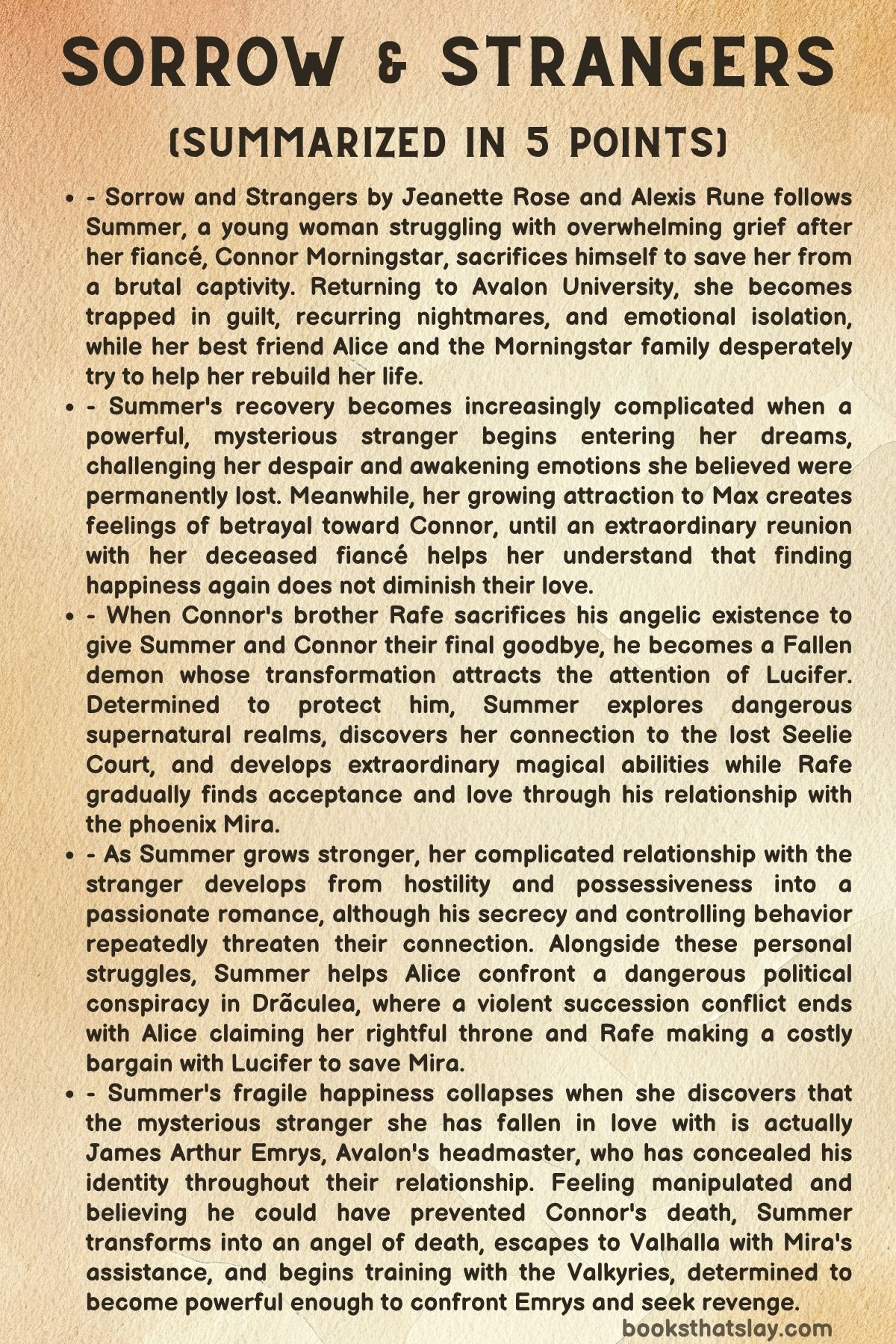
Summary
Summer’s life has been shattered by the death of her fiancé, Connor Morningstar, who sacrificed himself to save her from Aqua’s brutal captivity. Three months after his murder, she remains consumed by grief, convinced that her survival came at the expense of the person she loved most.
Returning to Avalon University with her best friend, Alice, offers little comfort because nearly everything reminds her of Connor. Morningstar House, once filled with laughter and affection, has become a painful reminder of the future they will never share.
Alice attempts to care for Summer, who has stopped eating properly, suffers recurring nightmares, and struggles to perform ordinary activities. Headmaster Emrys confronts her about the promise she made to Connor, but his harsh criticism only reinforces her belief that she has failed everyone.
Summer’s nightmares take an unexpected turn when a mysterious stranger begins entering her dreams. He recognizes that she deliberately recreates Connor’s death as a form of self-punishment and attempts to disrupt the nightmares by provoking her anger.
The stranger is an ancient, extraordinarily powerful being known as the Hand of Life and Death, whose existence has been shaped by centuries of suffering and violence. He becomes fixated on Summer, believing that awakening her anger and magical strength will prevent her from surrendering to despair.
Although his interference occasionally produces results, Summer resents his invasions of her privacy and his insistence that she belongs to him. Their increasingly hostile encounters reveal an attraction neither can easily dismiss.
A turning point arrives when Connor’s father, Uriel Morningstar, visits Summer and reassures her that his family does not blame her for Connor’s death. He gives her Connor’s halo, now resembling a golden bangle, and invites her to spend time with the family in Eden.
Summer discovers that the Morningstars are struggling with their own grief. Farrah has withdrawn emotionally, Zach and Zane have become distant, Luke is searching for ways to preserve Connor’s memory, and Rafe has nearly abandoned contact with everyone.
Her presence gradually helps the family reconnect, particularly when she begins spending time with Rafe. Both understand the pain of losing Connor, and their conversations allow them to acknowledge feelings they have avoided sharing with others.
After returning to Avalon, Summer starts exercising, attending classes, and becoming more attentive to Alice’s emotional needs. She also discovers that Connor’s halo can communicate through vibrations, allowing her to experience a continuing connection with her deceased fiancé.
An evening at a nightclub brings another unexpected development when Summer encounters Max, with whom she shares a complicated friendship. Their attraction leads to a sexual encounter, but afterward Summer becomes overwhelmed by guilt, believing she has betrayed Connor.
Alice reassures her that wanting affection does not invalidate her love for Connor. Nevertheless, Summer struggles to reconcile her emerging desires with the future she once imagined.
Meanwhile, Headmaster Emrys intensifies Summer’s magical training, revealing that she possesses abilities far greater than she understands. Her emotional repression has prevented her from controlling this strength, and powerful magical outbursts demonstrate how dangerous her untapped potential may be.
One night, Connor’s halo guides Summer into his bedroom, where she falls asleep and experiences an extraordinary reunion with him. Connor explains that he has been watching over her and that his death should not prevent her from experiencing happiness again.
When Summer confesses her relationship with Max, Connor refuses to condemn her. He tells her that their love remains meaningful, but she must accept the possibility of another romantic future.
Connor shows Summer a vision of herself happily marrying someone else and asks her to promise that she will continue living. He also makes her promise to protect his brother Rafe, whose emotional suffering concerns him.
Their farewell becomes possible because Rafe has arranged an extraordinary sacrifice with the Almighty, his grandmother. Shortly afterward, he Falls from Heaven, suffering devastating injuries as his angelic body transforms into that of a demon.
Summer and Alice rescue Rafe, while Emrys helps stabilize him. His transformation attracts Lucifer’s attention because an ancient prophecy suggests that Rafe may become the heir to Hell’s throne.
Summer refuses to surrender Rafe to Lucifer and dedicates herself to helping him recover. She learns about his unfamiliar physical needs, including his dependence on brimstone, while trying to reassure him that becoming a demon has not made him unworthy of love.
At the same time, revelations about Summer’s own identity raise disturbing questions. Emrys believes she may be the last surviving light fae of the Seelie Court, a civilization supposedly destroyed during an ancient celestial conflict.
Summer’s magical abilities grow as she learns to manipulate runes, defend herself, and develop mental protections. An encounter with dangerous supernatural fog reveals her extraordinary connection to nature when her power destroys the threat and causes the surrounding forest to flourish.
The stranger becomes increasingly involved in her development, sometimes protecting her and sometimes attempting to control her. Their journey into Hell to obtain brimstone for Rafe reveals a more considerate side of his personality, although he continues refusing to disclose his identity.
Summer also discovers evidence of his painful past when he allows her to touch his scarred arm. His vulnerability complicates her feelings, especially as she begins recognizing that his cruelty and possessiveness are connected to centuries of suffering.
Their relationship remains unstable because Summer continues seeing Max, whose affection provides familiar comfort without demanding complete emotional commitment. The stranger’s jealousy repeatedly leads to confrontations that challenge Summer’s determination to preserve her independence.
Life becomes more complicated after a dangerous forest party leaves Summer and Alice disoriented and vulnerable. Rafe accidentally injures Summer during a confrontation afterward, reinforcing his fear that his demonic instincts make him dangerous.
Despite these difficulties, Rafe gradually regains confidence and begins participating in ordinary activities. Summer continues her training, while Alice’s humor and companionship help restore some normality to their lives.
A visit to Atlantis for the All Souls celebration brings several important developments. Summer and the stranger explore extraordinary supernatural environments, share increasingly intimate moments, and begin acknowledging the seriousness of their attraction.
During the celebration, Rafe meets Mira, a phoenix whose acceptance of his demonic nature transforms his understanding of himself. Their relationship quickly becomes meaningful, although circumstances eventually force Mira to return to Pyrrhos.
Summer gives the stranger a handmade bracelet representing their shared experiences, but their romantic progress remains limited by his secrecy. She insists that genuine commitment requires honesty, while he claims that revealing his identity could have serious consequences.
Back at Avalon, Summer attempts to establish healthier boundaries and develop their relationship beyond physical attraction. Their progress collapses when Max unexpectedly kisses her and the stranger responds to Summer’s honest account with threatening jealousy.
The stranger subsequently attacks Max, leaving him seriously injured. Furious, Summer confronts him and unleashes enough magical power to destroy the avatar through which he appears, ending their relationship.
The stranger eventually recognizes the damage caused by his behavior and offers an apology. Their communication slowly resumes, allowing them to develop greater emotional intimacy through ordinary conversations rather than constant confrontation.
Meanwhile, Mira returns to Avalon and reunites with Rafe, complicating his developing relationship with Annabeth, a kitsune. Rafe must confront the emotional consequences of his decisions, while Mira helps him accept his transformed identity.
Summer eventually ends her casual arrangement with Max and agrees to pursue an exclusive relationship with the stranger. She gives him one year to reveal his true identity and establishes boundaries concerning their physical relationship until he fulfills that promise.
Their growing happiness is interrupted when Alice learns that her father, the ruler of Drãculea, has died. As the potential successor to his throne, she faces political hostility from powerful figures who have spent years portraying her as dangerous and unworthy.
Summer and the stranger secretly investigate the kingdom and uncover a coordinated campaign involving influential members of the Proviso. Determined to protect Alice, Summer organizes preparations for the funeral and anticipated succession conflict.
When Alice arrives in Drãculea with Summer, Rafe, and Mira, their enemies launch a violent attack. Dimstraeux and his supporters attempt to prevent Alice from taking the throne, while hostile vampires and dark fae threaten the group’s survival.
Mira suffers catastrophic injuries during the battle, prompting Rafe to summon Lucifer and bargain for his assistance. Lucifer destroys their enemies, while Summer and the stranger work to save Mira.
With the immediate threat defeated, Alice claims the crown and becomes queen of Drãculea. Her transformation from a rejected daughter into a ruler determined to reform her kingdom represents a significant victory for the group.
However, Rafe’s bargain requires him to spend his summer break serving Lucifer in Hell, where time moves much more slowly. Hoping to protect his relationship with Mira, Summer offers Connor’s halo as a means of allowing her to visit him.
As the academic year ends, Summer appears to have rebuilt a meaningful life through friendship, family, education, and renewed romantic commitment. That fragile happiness collapses when she discovers evidence revealing that the mysterious stranger is actually James Arthur Emrys, the headmaster who has been supervising her education.
Summer realizes that Emrys concealed his identity throughout their relationship and begins reconsidering his involvement in Connor’s death. Convinced that he possessed the power to intervene more effectively, she interprets his secrecy and manipulation as a profound betrayal.
Determined to escape his influence, Summer confides in Alice and Mira before using Connor’s halo to undergo an extraordinary transformation. Black wings emerge from her back, and she becomes an angel of death, combining her fae abilities with celestial power.
With Mira’s assistance, Summer escapes Avalon through a series of magical portals and finds sanctuary among the Valkyries in Valhalla. Three weeks later, she is training relentlessly under Lena’s supervision, hoping to become powerful enough to confront Emrys.
Although she remains connected to Alice and receives news about the Morningstars, Summer refuses to return to Avalon. The novel ends with her examining the bracelet associated with the stranger, now a symbol of deception, and resolving to make him pay for the suffering she believes he caused.
Characters
Summer
Summer is the central protagonist of Sorrow and Strangers, and her development is shaped by the conflict between overwhelming grief and the necessity of continuing her life. Connor’s death destroys her sense of security, leaving her convinced that she has no right to experience happiness when he sacrificed himself to protect her.
Her early behavior demonstrates the destructive consequences of survivor’s guilt. She neglects her health, withdraws from university, and deliberately recreates traumatic memories because she believes that suffering is the only appropriate response to her loss.
Despite her emotional vulnerability, Summer possesses an extraordinary capacity for loyalty and compassion. Her determination to help the Morningstars recover reveals that caring for others offers her a reason to reconnect with the world.
Her relationship with Rafe becomes particularly important because she recognizes the same self-hatred and isolation that have damaged her own life. However, her willingness to risk everything for those she loves also exposes her difficulty recognizing the value of her own safety.
Summer’s romantic relationships demonstrate her internal conflict between longing for affection and fearing betrayal of Connor’s memory. Her physical connection with Max helps her rediscover desire, while her involvement with the stranger challenges her understanding of trust, personal freedom, and emotional attachment.
Her supernatural development parallels her psychological recovery. As she learns to acknowledge anger, grief, and desire rather than suppressing them, her powerful Seelie magic becomes increasingly accessible.
The revelation of Emrys’s identity transforms Summer’s developing confidence into a new source of fury. By the ending, she has become a formidable supernatural being, but her commitment to revenge suggests that genuine emotional freedom remains beyond her reach.
The Stranger / James Arthur Emrys
James Arthur Emrys is one of the most psychologically complicated characters in Sorrow and Strangers, occupying the roles of mysterious romantic interest, powerful protector, demanding headmaster, and ultimately the person Summer considers responsible for a devastating betrayal.
For most of the story, the stranger and Headmaster Emrys appear to be separate individuals. The headmaster supervises Summer’s education and magical training, while the stranger enters her dreams, monitors her movements, and pursues an increasingly intense romantic relationship with her.
The stranger’s history reveals centuries of torture, violence, and emotional isolation. Known as the Hand of Life and Death, he has become an exceptionally dangerous supernatural being whose immense power often substitutes for genuine emotional connection.
Summer awakens feelings he believed were permanently lost. However, his fear of losing her produces possessiveness, jealousy, magical surveillance, and repeated violations of her boundaries.
His attack on Max exposes the most destructive aspects of his character. Rather than respecting Summer’s independence, he acts as though his attachment grants him authority over her relationships.
Nevertheless, he demonstrates the capacity for remorse and emotional development. His apologies and growing willingness to enjoy ordinary conversations suggest that he is beginning to understand the responsibilities accompanying genuine affection.
The discovery that he is actually Emrys radically changes the meaning of his previous actions. His concealment of their shared identity creates a serious imbalance of knowledge and power, making Summer question whether their relationship was ever founded on informed trust.
His character ultimately illustrates how unresolved suffering can distort affection into control. Although his feelings for Summer appear sincere, sincerity cannot erase the consequences of deception and coercion.
Connor Morningstar
Connor Morningstar remains one of the most influential characters in the novel despite having died before the central events begin. His sacrifice establishes the emotional foundation of Summer’s story and continues shaping the decisions of nearly every member of his family.
Connor represents unconditional love, generosity, and emotional security. His relationship with Summer offered her the belonging she had always wanted, making his death particularly devastating.
His surviving presence through the golden halo introduces an unusual dimension to the exploration of grief. The halo allows Summer and others to experience reassurance that Connor’s affection continues beyond physical death.
His extraordinary reunion with Summer is especially significant because he refuses to allow their relationship to become an obstacle to her future. Rather than demanding eternal romantic loyalty, he encourages her to discover happiness and accept the possibility of loving again.
Connor’s concern for Rafe also reveals his awareness of his brother’s emotional vulnerabilities. By asking Summer to protect him, Connor strengthens a relationship that becomes essential to both their recoveries.
His character embodies love that seeks another person’s well-being rather than ownership. This distinction becomes particularly meaningful when contrasted with the stranger’s controlling behavior.
Alice
Alice provides the emotional stability that makes Summer’s survival possible during the opening stages of Sorrow and Strangers. Her devotion is evident in the practical assistance she provides, from ensuring Summer eats to remaining beside her during nightmares and emotional breakdowns.
Although Alice frequently uses humor and teasing to maintain a cheerful atmosphere, she carries considerable emotional pain herself. Her mother’s death, Connor’s murder, and the departure of the Morningstar brothers have intensified her fear of abandonment.
Her relationship with Summer is therefore more complicated than that of a consistently strong caretaker. Alice also needs reassurance, companionship, and permission to acknowledge her own suffering.
Her growing interest in alchemy represents an important step toward establishing a future independent of her responsibility for Summer. She gradually learns that friendship should involve mutual emotional support rather than one person continually sacrificing their needs.
Alice’s inheritance of the throne of Drãculea introduces another dimension to her development. Having grown up facing rejection and political hostility, she doubts her ability to command the loyalty of a kingdom that has been taught to distrust her.
The discovery of organized propaganda against her helps distinguish genuine personal rejection from calculated political manipulation. Her coronation demonstrates that she can overcome inherited prejudice and exercise authority on her own terms.
By the ending, Alice has transformed from a frightened young woman into a queen prepared to pursue meaningful reforms. Despite her increasing responsibilities, her friendship with Summer remains central to her identity.
Rafe Morningstar
Rafe undergoes one of the most substantial transformations in Sorrow and Strangers, moving from an emotionally isolated angel to a Fallen demon who gradually learns to accept affection, responsibility, and his own worth.
Before his Fall, Rafe believes himself fundamentally different from his brothers. His defensive anger and withdrawal conceal years of emotional suffering, insecurity, and the conviction that he is undeserving of love.
Connor’s death intensifies these feelings because Rafe remembers occasions when he rejected his brother’s attempts at closeness. His guilt becomes another reason to avoid the family members who desperately want to support him.
His decision to Fall from Heaven demonstrates remarkable self-sacrifice. By accepting terrible physical and spiritual consequences, he makes it possible for Summer and Connor to share their final goodbye.
However, becoming a demon creates new struggles concerning identity and self-control. His horns, claws, unfamiliar physical needs, and dangerous instincts reinforce his fear of becoming a threat to those he loves.
Summer’s refusal to abandon him provides the acceptance he has difficulty extending to himself. Their sibling relationship becomes a central source of emotional security, especially as they learn to recognize one another’s destructive tendencies.
Meeting Mira further transforms Rafe’s understanding of love. Her willingness to accept his demonic nature helps him recognize that his transformation has not deprived him of tenderness, desire, or the ability to form meaningful relationships.
His bargain with Lucifer during the conflict in Drãculea demonstrates both courage and a continuing tendency toward reckless sacrifice. By the ending, Rafe has gained greater emotional confidence, although his obligations to Hell threaten the stability he has only recently discovered.
Max
Max occupies an important position in Summer’s emotional recovery because he offers companionship, physical attraction, and practical support during a period when she struggles to reconnect with ordinary life.
Initially, his blunt manner and difficult history with Connor complicate their interactions. Summer associates him with the devastating moment when she learned of Connor’s death, making his presence painful.
As their relationship develops, Max demonstrates a more considerate personality. He recognizes Summer’s panic attacks, helps her regulate her breathing, and supports her physical combat training.
Their sexual relationship allows Summer to rediscover desire, but it also exposes her unresolved guilt about Connor. Max becomes a person with whom she can experience physical intimacy without immediately assuming the responsibilities of another serious romance.
His own emotional difficulties emerge through references to his sister’s suffering and his protective instincts. These experiences suggest that his aggressive behavior sometimes conceals vulnerability and concern.
Max also becomes the target of the stranger’s jealousy, suffering serious injuries after an uninvited kiss. Summer’s defense of him reinforces her belief that friendship and personal safety must be respected regardless of romantic complications.
Their eventual decision to end their casual arrangement allows their friendship to continue without the same emotional confusion.
Mira
Mira enters Sorrow and Strangers during the All Souls celebration in Atlantis, where she immediately attracts Rafe’s attention. As a phoenix, she possesses extraordinary supernatural abilities and a fiery temperament that responds unexpectedly well to his demonic nature.
Her greatest influence comes from treating Rafe as an individual rather than defining him through his Fall. She neither fears his appearance nor assumes that his emotional struggles make him incapable of forming a healthy relationship.
Mira’s confidence challenges Rafe’s defensive behavior and encourages him to communicate more openly. Their intimacy gradually develops into a relationship built on affection, acceptance, and shared vulnerability.
Her difficulties in Pyrrhos, particularly those involving her stepmother, reveal that she also experiences restrictions and struggles with personal freedom. These circumstances complicate her attempts to maintain contact with Rafe.
When she returns to Avalon, her relationship with Rafe creates painful consequences for Annabeth. Mira’s willingness to acknowledge that suffering demonstrates a capacity for emotional accountability.
Her near-fatal injuries during the conflict in Drãculea become the immediate motivation for Rafe’s bargain with Lucifer. Although she fears their separation, she remains committed to him and eventually helps Summer escape to Valhalla.
Uriel Morningstar
Uriel is Connor’s father and a powerful celestial figure whose relationship with Summer demonstrates the importance of family bonds beyond biological connections. His decision to visit her after Connor’s death becomes a turning point in her emotional recovery.
Despite losing his son, Uriel refuses to blame Summer for the tragedy. He recognizes that Connor willingly sacrificed himself and insists that his son’s love should not become a source of permanent punishment.
His paternal affection provides Summer with the security she desperately needs. By presenting Connor’s halo and welcoming her into Eden, he confirms that she remains a member of the Morningstar family.
Uriel also struggles with his responsibilities as a grieving husband and father. His relationship with Farrah becomes strained after Connor’s death, demonstrating that even powerful celestial beings cannot escape ordinary human sorrow.
His fear for Summer’s safety reveals the limits of his authority and protection. Ultimately, he must respect her decision to return to Avalon despite knowing that danger remains.
Farrah Morningstar
Farrah is Connor’s mother and an important source of maternal affection for Summer. Her grief after losing her son becomes so overwhelming that she struggles to eat and participate in ordinary family life.
Summer’s arrival helps Farrah reconnect with the household and begin restoring familiar domestic routines. Their shared activities, including cooking and gardening, allow both women to experience companionship without constantly focusing on tragedy.
Farrah’s account of her early relationship with Uriel reveals her strength and determination. Their romance survived prejudice surrounding their different celestial backgrounds, demonstrating her willingness to challenge social expectations for love.
Her relationship with Summer also provides an important example of acceptance. She does not regard the younger woman as responsible for Connor’s death but embraces her as a daughter whose presence remains valuable.
Farrah represents the possibility of rebuilding family life without denying the reality of permanent loss.
Zach Morningstar
Zach is one of Connor’s brothers and a member of the family struggling to recover from his death. His response to grief includes emotional withdrawal and increasing distance from Ashley.
Although he attempts to maintain a degree of composure, the absence of his brother disrupts his relationships and the familiar structure of family life. His behavior suggests that he finds emotional vulnerability difficult to express directly.
Zach’s gratitude toward Summer reveals how much her presence matters to the household. He recognizes that her return helps reconnect family members who have become increasingly isolated.
His character demonstrates how bereavement can damage existing relationships even when affection remains.
Zane Morningstar
Zane copes with Connor’s death by immersing himself in intensive physical training. His approach suggests that constant activity provides an alternative to confronting emotions he cannot easily manage.
Rather than withdrawing completely, he attempts to create structure through discipline and physical exertion. However, the intensity of his training also suggests an effort to avoid the helplessness associated with his brother’s murder.
Zane’s behavior contrasts with Rafe’s isolation and Zach’s emotional distance. Together, the brothers demonstrate how members of the same family can respond very differently to an identical tragedy.
Although Zane receives less individual attention than Rafe, his presence reinforces the collective suffering of the Morningstars.
Luke Morningstar
Luke is one of Connor’s younger brothers and expresses his grief through attempts to preserve memories of their time together. His decision to recover photographs from Connor’s damaged phone becomes an important emotional activity.
By assembling a photographic album, Luke creates something tangible that allows the family to remember Connor beyond the circumstances of his death. The project also offers opportunities for Summer to share stories about their relationship.
His developing interest in combat training indicates that losing Connor has changed his understanding of danger and responsibility. He appears increasingly determined to become capable of protecting himself and others.
Luke’s eventual laughter during a conversation with Summer marks a small but significant change. His character illustrates how remembering a deceased loved one can gradually become a source of warmth instead of exclusively causing suffering.
Lucifer
Lucifer is the ruler of Hell and one of the most politically influential supernatural figures in the story. His interest in Rafe emerges after the young angel Falls and becomes connected to a prophecy concerning the succession of Hell’s throne.
Rather than approaching Rafe exclusively as a vulnerable family member, Lucifer regards him as a potential heir whose existence could determine the realm’s political future. His attention introduces dangerous obligations into Rafe’s already difficult recovery.
Lucifer’s overwhelming power becomes evident during the conflict in Drãculea, when Rafe summons him to protect Mira and the others. His intervention saves lives but comes at the cost of a binding agreement.
His willingness to negotiate demonstrates a calculating personality that understands the value of power, obligation, and emotional desperation. He recognizes Rafe’s devotion to his loved ones and uses that devotion as leverage.
Lucifer’s character represents the dangers of agreements made under extreme pressure. His involvement suggests that even apparently beneficial supernatural assistance can create lasting consequences.
Aqua
Aqua is one of the principal sources of Summer’s psychological trauma because of her role in Connor’s murder. Her torture of Summer and the events surrounding Connor’s death become the foundation of the protagonist’s recurring nightmares.
Although Aqua’s direct involvement belongs largely to events preceding the central storyline, her influence persists through Summer’s memories. She represents the violence that destroyed Summer’s anticipated future and caused her to associate survival with guilt.
The repeated recreation of Aqua’s attacks demonstrates how trauma can remain psychologically present long after the immediate danger ends. Summer’s eventual ability to interrupt these nightmares becomes an important measure of her recovery.
Aqua’s character functions as a reminder of the suffering Summer must learn to confront without allowing it to determine the rest of her life.
Torin
Torin is associated with the earlier violence and suffering inflicted upon Summer. His role becomes particularly significant when the stranger reveals that he hunted down and tortured individuals responsible for harming her.
Torin represents the cruelty against which the stranger directs his extraordinary capacity for revenge. However, the stranger’s treatment of him also raises difficult questions about whether punishment motivated by love necessarily produces justice.
Summer’s reaction to learning about this revenge is complicated. She understands the desire to punish those who abused her, yet the brutality of the stranger’s methods forces her to confront the darker qualities of someone she is beginning to love.
Through Torin, the story examines the relationship between victimization, retaliation, and the moral consequences of violence.
Annabeth
Annabeth is a kitsune who becomes romantically involved with Rafe during the period when his future with Mira appears uncertain. She offers companionship and affection while he continues recovering from his transformation.
Her relationship with Rafe reveals his growing willingness to accept intimacy, but it also exposes his limited understanding of the emotional responsibilities that accompany romantic commitment.
When Mira returns, Annabeth becomes the person most directly hurt by Rafe’s unresolved feelings. His rapid return to Mira leaves her feeling rejected and disregarded.
Annabeth’s suffering prevents Rafe and Mira’s reunion from being presented as entirely uncomplicated. Her character demonstrates that following personal desires does not remove the obligation to consider how decisions affect others.
The Almighty
The Almighty is Rafe’s grandmother and a celestial authority whose decisions have extraordinary consequences. Her role becomes especially significant when Rafe requests the opportunity for Summer and Connor to share a final farewell.
Her willingness to consider his request introduces the possibility of supernatural mercy within a world governed by strict celestial boundaries. However, the arrangement also involves a devastating sacrifice that transforms Rafe’s existence.
The Almighty’s conversation with Rafe reveals his difficulty expressing personal needs or recognizing his own worth. His determination to help someone else contrasts with his inability to ask for meaningful comfort for himself.
Her character represents the immense authority of the celestial order and the complicated relationship between sacrifice, compassion, and consequence.
Morrigan
Morrigan is a powerful supernatural figure who becomes involved with the stranger during the events surrounding the Atlantis celebration. Her presence suggests that his concealed identity carries implications extending beyond Summer’s personal relationships.
Her interactions with him reinforce the existence of ancient loyalties, obligations, and dangers that Summer does not fully understand. She therefore contributes to the mystery surrounding his reluctance to reveal his true identity.
Although Morrigan receives relatively limited attention, she helps establish that the stranger operates within a much larger supernatural political environment.
Her role reinforces the possibility that romantic decisions involving exceptionally powerful beings can produce consequences far beyond the individuals directly involved.
Dimstraeux
Dimstraeux emerges as a significant political antagonist during the succession crisis in Drãculea. He represents the influential figures determined to prevent Alice from claiming the throne after her father’s death.
His contempt toward Alice reflects the prejudice and hostility that powerful political institutions have encouraged against her. Rather than accepting her legitimate claim, he attempts to maintain control through intimidation and organized resistance.
During the funeral and succession confrontation, his opposition develops into a violent struggle. The resulting battle exposes the extent to which political ambition can endanger an entire kingdom.
Dimstraeux represents institutional corruption and the use of public prejudice to preserve established power.
Professor Ziven
Professor Ziven teaches advanced magical subjects involving hieroglyphic runes at Avalon University. His lessons challenge Summer intellectually because they require more precise understanding than the ordinary rune work she already knows.
His acknowledgment of Summer’s potential helps establish that her abilities extend beyond uncontrolled magical strength. She possesses genuine academic talent that can be developed through careful study.
Ziven also contributes to the broader importance of Avalon’s educational environment. His character demonstrates that supernatural power requires knowledge, concentration, and sustained discipline.
Rick
Rick is an alpha shifter whom Summer and Alice encounter at a gathering in the forest. His attention toward Summer initially appears to be part of an ordinary social interaction.
However, the evening becomes disturbing when both women experience severe disorientation and subsequently struggle to remember what happened. Summer awakens beside Rick, raising serious concerns about the circumstances surrounding the gathering.
The uncertainty about the evening emphasizes how vulnerable Summer and Alice can become outside familiar environments. Rick’s involvement contributes to the threatening atmosphere of an incident whose full circumstances remain unclear in the supplied account.
Lena
Lena is the leader of the Valkyries who provide Summer with sanctuary after her escape from Avalon. Her role becomes important during the epilogue as Summer attempts to develop sufficient combat skills to confront Emrys.
Lena recognizes that Summer’s extraordinary abilities are undermined by uncontrolled anger. Her decision to introduce additional meditation training demonstrates an understanding that emotional discipline is essential to effective supernatural combat.
Unlike characters who attempt to control Summer through intimidation or romantic attachment, Lena concentrates on developing her practical capabilities. She represents a form of mentorship rooted in preparation, self-control, and personal strength.
Her presence also establishes Valhalla as a place where Summer may begin rebuilding her independence, even while remaining consumed by thoughts of revenge.
Themes
Grief, Survivor’s Guilt, and Emotional Recovery
Grief in Sorrow and Strangers is presented as an experience that affects nearly every aspect of identity, relationships, and ordinary existence. Summer’s response to Connor’s death demonstrates how the loss of a loved one can destroy not only emotional security but also an individual’s understanding of the future.
Her suffering becomes especially destructive because she believes that Connor died as a direct consequence of loving her. Rather than recognizing his sacrifice as an expression of his own choices, she interprets her survival as evidence that she failed him.
This guilt influences her physical health, academic responsibilities, and relationships. Her refusal to eat properly and her deliberate recreation of traumatic nightmares suggest that she views suffering as an obligation rather than an unfortunate consequence of loss.
The Morningstar family’s experiences expand the exploration of grief beyond Summer’s perspective. Farrah withdraws from domestic life, Rafe becomes isolated, Zach distances himself from personal relationships, and Zane seeks refuge in exhausting physical activity.
Their contrasting reactions demonstrate that bereavement does not follow a predictable pattern. Even individuals who lose the same person may experience different forms of guilt, anger, emotional withdrawal, and helplessness.
Connor’s supernatural reunion with Summer provides a decisive challenge to her belief that recovery constitutes betrayal. His encouragement to pursue happiness establishes that remembering a loved one and accepting new experiences are not mutually exclusive.
The novel also refuses to portray recovery as a permanent escape from suffering. Summer’s eventual sense of betrayal by Emrys awakens another period of emotional turmoil, demonstrating that healing requires continuing effort rather than a single transformative experience.
Through these experiences, grief becomes a process of learning how to preserve love without allowing loss to consume the possibility of living.
Found Family, Loyalty, and the Responsibilities of Love
Summer’s relationship with the Morningstars demonstrates that belonging can emerge through affection, shared experiences, and deliberate commitment rather than biological connections. After Connor’s death, she initially fears that his family will reject her because she associates herself with the circumstances of his murder.
Uriel and Farrah challenge these expectations by welcoming her as their daughter. Their acceptance gives Summer something she has desperately needed: a family whose affection does not depend upon her relationship with Connor continuing in its original form.
Alice provides another example of chosen family through her unwavering practical and emotional support. However, her exhaustion also reveals that genuine loyalty cannot require one person to sacrifice their well-being indefinitely.
As Summer begins recovering, she recognizes that Alice needs companionship rather than simply the responsibility of keeping her alive. Their friendship becomes healthier when support develops into a mutual exchange rather than a permanent caretaker-patient relationship.
Rafe’s transformation gives this theme additional complexity. His fear of becoming dangerous challenges Summer to demonstrate that accepting someone involves acknowledging their difficulties without abandoning them.
Nevertheless, his objections to Summer’s reckless decisions reveal the limitations of self-sacrifice. Her willingness to enter Hell for his benefit may arise from genuine affection, but it also risks causing another devastating loss to the people who love her.
Mira’s acceptance of Rafe reinforces the importance of relationships that allow individuals to exist without shame. She encourages him to acknowledge his frightening instincts while understanding that those instincts do not define his entire identity.
The novel ultimately presents loyalty as a combination of affection, accountability, emotional honesty, and respect for personal well-being. Meaningful relationships require people to protect one another without making suffering the measure of devotion.
Love, Possession, and Personal Autonomy
Romantic attachment in Sorrow and Strangers repeatedly raises questions about the difference between protecting someone and attempting to control their life. The mysterious stranger’s relationship with Summer becomes the clearest example of this conflict because his affection is inseparable from jealousy, secrecy, and extraordinary supernatural power.
His initial determination to prevent Summer from destroying herself appears motivated by concern. However, his methods frequently involve entering her dreams without consent, monitoring private activities, and provoking emotional responses against her wishes.
These behaviors demonstrate how protective intentions can become harmful when one person’s desires are treated as more important than another’s freedom. The stranger repeatedly assumes that his knowledge, strength, and emotional attachment justify decisions Summer has not authorized.
His jealousy toward Max exposes the consequences of this attitude. Instead of respecting Summer’s ability to choose her relationships, he treats Max as a rival whose existence threatens something he believes already belongs to him.
The subsequent violence against Max reveals the destructive potential of possessiveness disguised as devotion. Summer’s decision to confront the stranger becomes an important assertion that romantic attachment cannot excuse intimidation or physical harm.
Their attempted reconciliation suggests that emotional growth remains possible, but it also establishes that apologies do not automatically restore trust. Summer begins demanding honesty, boundaries, and meaningful changes rather than accepting affection as sufficient compensation for mistreatment.
Connor provides an important contrast because he explicitly encourages Summer to discover love after his death. Rather than attempting to preserve exclusive emotional ownership, he values her happiness beyond their ability to remain together.
The eventual revelation of Emrys’s concealed identity makes the relationship’s central imbalance impossible to ignore. Summer discovers that she entered an intimate relationship without knowing essential information about the other person’s identity and authority over her life.
Through these conflicting representations of affection, the novel questions whether love can be genuine when it denies personal autonomy. It suggests that desire and emotional intensity must be accompanied by honesty, accountability, and the freedom to make informed choices.
Identity, Power, and the Struggle for Self-Determination
Summer’s developing supernatural abilities reflect her gradual discovery that her identity extends far beyond the trauma that initially defines her. For much of the story, she understands herself primarily through her relationship with Connor and the guilt surrounding his death.
Her possible connection to the lost Seelie Court introduces a different understanding of her existence. The suggestion that she belongs to an ancient civilization raises questions about her origins, history, and the limits of her extraordinary abilities.
Her magic often responds most intensely when she experiences powerful emotions. This connection suggests that suppressing grief, fear, and anger has also prevented her from recognizing and developing important aspects of herself.
Training at Avalon requires Summer to move beyond instinctive reactions. Emrys, Max, and the stranger teach different forms of control, demonstrating that natural strength alone cannot guarantee safety or effective decision-making.
Rafe experiences a parallel struggle after his Fall transforms him from an angel into a demon. He initially interprets his new physical appearance and instincts as evidence that he has become fundamentally unacceptable.
His relationship with Mira gradually challenges that assumption. By accepting his changed nature without denying its dangers, he begins understanding that identity cannot be reduced to supernatural classification or inherited expectations.
Alice’s rise to the throne of Drãculea introduces a political dimension to the same conflict. Having been taught that her people despise her, she must distinguish the identity imposed upon her by political enemies from the leader she might become through her own decisions.
Summer’s transformation into an angel of death brings these questions to their most dramatic point. She acquires another extraordinary source of power, yet her desire for revenge threatens to replace the emotional dependence from which she previously struggled to escape.
Her circumstances demonstrate that gaining strength does not automatically produce freedom. Genuine self-determination also requires the ability to understand personal motivations, question inherited beliefs, and resist allowing fear or anger to dictate every choice.
The ending leaves Summer in an uncertain position between empowerment and emotional destruction. Her new abilities may eventually allow her to establish an independent identity, but whether she can exercise that power without being governed by resentment remains unresolved.