Sophie, Standing There Summary, Characters and Themes
Sophie, Standing There by Meg Mason is a contemporary novel about loneliness, emotional dependence, romantic disappointment, and the difficult process of rebuilding a life after profound personal loss.
The story follows Sophie Pattison, a thirty-eight-year-old literary festival technician whose marriage has ended and whose future feels uncertain. When she develops an intense attachment to a celebrated novelist named Lilac Dunne, her fascination offers temporary relief from her unhappiness but eventually forces her to confront uncomfortable truths about love, self-worth, and her past. Through humor, psychological observation, and complicated relationships, the novel examines how people mistake admiration for intimacy and gradually discover the value of genuine human connection.
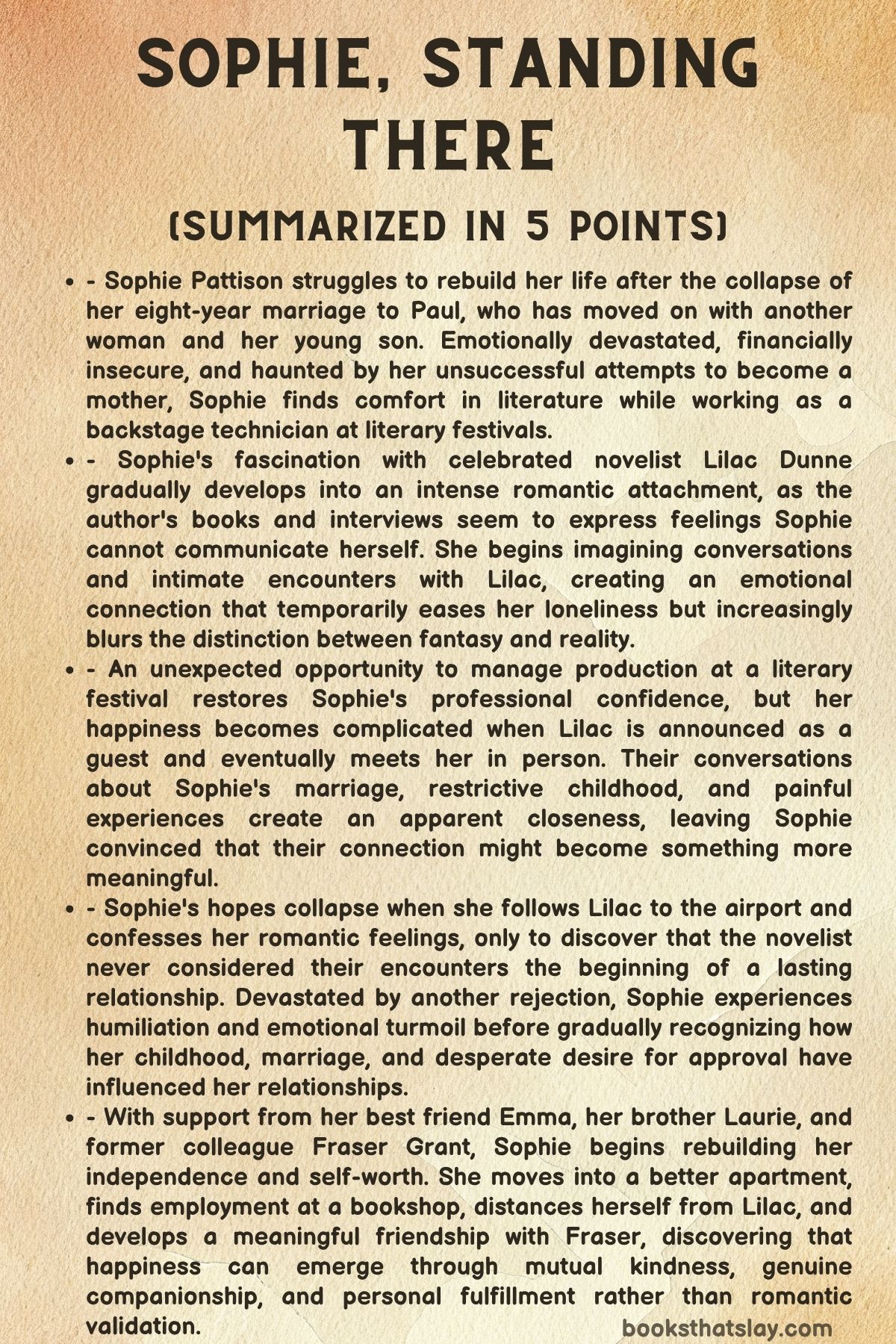
Summary
Sophie Pattison works behind the scenes at literary festivals, preparing microphones, arranging furniture, and ensuring that authors can perform comfortably before audiences. Although she loves literature and possesses considerable technical expertise, her job requires her to remain largely invisible, making her particularly sensitive to the distinction between celebrated writers and the ordinary people who support their appearances.
Her professional competence contrasts with the disorder of her personal life, which has deteriorated since the breakdown of her eight-year marriage to Paul. At thirty-eight, Sophie lives alone in a small apartment, struggles financially, and finds even ordinary activities exhausting because of the sadness and uncertainty surrounding her separation.
Her difficulties extend beyond her marriage, since the death of her mother exposed financial problems involving a fraudulent investment scheme and the family’s property. With little inheritance and no reliable source of emotional security, Sophie increasingly feels that the stable future she once imagined has disappeared.
After a successful literary festival, Sophie attends a dinner with her colleagues and unexpectedly recommends a famous novelist named Lilac Dunne for a future event. Later, while searching for information about Lilac, she discovers passages from the author’s novels that appear to describe her own feelings of rejection, loneliness, and emotional suffering with remarkable accuracy.
The discovery initiates an attachment that gradually occupies an extraordinary amount of Sophie’s emotional life. She begins researching Lilac’s interviews, photographs, public appearances, and literary achievements, finding comfort in the possibility that someone so accomplished might understand feelings she cannot adequately communicate to those around her.
Sophie’s fascination strengthens when she visits a local independent bookshop managed by Cass and Rob, two acquaintances whose company briefly relieves her isolation. Cass gives her an advance copy of Lilac’s forthcoming novel, Human Beings, and Sophie treats the unexpected gift as something precious, finding renewed pleasure in reading and imagining a connection with its author.
Meanwhile, her brother Laurie reveals that Paul has established a serious relationship with another woman, Minette, who has a young son named Lester. The news is especially painful because Paul resisted having children with Sophie, yet now appears prepared to marry Minette and become a legal father to her child.
Sophie struggles to understand how the man who rejected parenthood with her can so readily embrace a family with someone else. Her devastation is intensified by memories of how abruptly Paul ended their marriage, announcing his decision while she was showering and offering her accommodation in a rental property he owned.
Even contacting Paul to retrieve her books from his garage becomes emotionally overwhelming because Sophie fears inconveniencing or displeasing him. She repeatedly rewrites a simple message, revealing how accustomed she has become to placing his comfort above her legitimate needs.
As her fascination with Lilac deepens, Sophie begins listening to recordings of the author’s interviews and conversations. Lilac’s voice becomes a constant presence in her apartment, offering companionship, reassurance, and an imagined intimacy that makes ordinary solitude easier to endure.
The novelist’s reflections on rejection and the necessity of confronting pain eventually encourage Sophie to retrieve some of her books from Paul’s garage. During the visit, she discovers a child’s car seat in his vehicle and realizes that Lester already occupies a place in Paul’s everyday life that Sophie herself was never permitted to imagine for their marriage.
Although this discovery hurts her, returning home with her books provides a modest sense of independence. She begins organizing her apartment and developing routines that make life feel more manageable, even as Lilac increasingly becomes the central figure in her private emotional world.
An unexpected professional opportunity offers Sophie another source of purpose when Philip, the literary festival’s artistic director, asks her to replace Annaliese, the head of production, who has become ill. Sophie accepts the demanding position and discovers that coordinating technicians, schedules, equipment, and performances gives her satisfaction and restores confidence she believed she had lost.
Her colleagues appreciate her organizational abilities and considerate leadership, and Laurie notices that she sounds happier. Nevertheless, her emotional recovery remains precarious, and when she feels threatened or overwhelmed, she still retreats into imagined conversations with Lilac.
Sophie gradually realizes that her attachment has become more than admiration for a talented writer. She believes she is genuinely in love with Lilac, imagining romantic encounters and physical intimacy despite having always understood herself as heterosexual.
These fantasies create confusion because Sophie cannot reconcile her powerful desires with the knowledge that Lilac does not know she exists. She also finds it difficult to imagine the famous novelist choosing someone in her position, revealing how deeply her marriage has damaged her sense of personal worth.
Everything changes when Elizabeth Strout withdraws from the festival because of illness and Lilac Dunne is announced as her replacement. The possibility of meeting the woman Sophie has imagined as her companion produces overwhelming anxiety, and she briefly considers abandoning her responsibilities to avoid confronting the difference between fantasy and reality.
Instead, Sophie attempts to improve every aspect of the backstage environment before Lilac arrives, addressing neglected equipment, uncomfortable stage furniture, and microphones unsuitable for different skin tones. Her determination demonstrates both her professional consideration and her excessive desire to make everything perfect for someone whose approval she desperately wants.
Her happiness at work is disrupted when Annaliese returns and resumes the leadership position, leaving Sophie feeling discarded despite her excellent performance. Philip’s inability to acknowledge her disappointment makes the situation worse, reminding her of earlier experiences in which other people avoided confronting her grief.
A chance encounter with Paul, Minette, and Lester introduces another change in Sophie’s understanding of her marriage. Minette treats her with unexpected kindness and openly challenges Paul’s unpleasant behavior, allowing Sophie to recognize that his treatment of her was neither normal nor deserved.
When Lilac finally arrives for her festival appearance, Sophie is almost incapacitated by nervousness. Their anticipated backstage encounter takes place when Sophie attaches the author’s microphone, but a publicist accidentally spills tomato soup over Lilac’s trousers, forcing Sophie to surrender her expensive new pair.
Left without suitable clothing, Sophie initially misses the event she has anticipated for months. She eventually returns backstage and must cross the stage to deliver a replacement microphone, catching Lilac’s attention through her unexpectedly confident movement before the audience.
Afterward, Lilac returns to retrieve a forgotten bracelet and begins speaking with Sophie. When the novelist decides to avoid an unwanted dinner with Philip, Sophie offers to show her another exit, unexpectedly beginning a personal encounter that extends far beyond their professional responsibilities.
Their attempt to leave discreetly is complicated by security arrangements, admirers, and heavy rain, but Lilac eventually insists that Sophie share her transportation. During the journey, their conversation about literature becomes increasingly natural, and Lilac invites Sophie to dinner despite Sophie’s protest that she is nobody important.
At the restaurant, Lilac expresses genuine interest in Sophie’s reading habits, childhood, and failed marriage. She challenges Sophie’s tendency to defend Paul and suggests that Sophie deserves relationships in which she is treated with consideration rather than expected to accept continuous disappointment.
The evening leaves Sophie exhilarated but also frightened because her imagined companion has become a real woman who may soon disappear from her life. Yet their association continues when Lilac arranges for Sophie to visit the house where she is staying, initially under the pretext of returning the trousers.
During their conversations, Sophie reveals increasingly painful details about her childhood in a restrictive religious community and her marriage to Paul. Lilac becomes interested in Sophie’s upbringing because she is writing a novel involving a woman escaping a similar environment, giving their developing acquaintance both personal and professional dimensions.
Sophie also describes the difficulties surrounding Paul’s troubled brother Adam, whose addiction required extensive emotional support. She explains how she became responsible for helping him while Paul prioritized his career, often leaving her to manage situations that neither spouse could control.
Her marriage deteriorated further during their unsuccessful attempts to have children, including expensive fertility treatments that Sophie largely financed herself. She experienced a brief pregnancy that ended after nine weeks, and the loss contributed to her growing despair and sense of failure.
Adam’s subsequent disappearance and murder devastated the family and effectively destroyed Sophie’s remaining hopes of continuing fertility treatment. Paul’s grief became increasingly hostile, and Sophie came to believe that he blamed her for decisions connected to Adam’s life.
Lilac listens attentively and encourages Sophie to recognize that she was not responsible for everything that went wrong. Their conversations provide genuine emotional relief, and Sophie begins to imagine that the novelist might regard her as someone uniquely important.
However, their relationship becomes complicated when Lilac asks Sophie to accompany her to the religious community where she grew up. Although Sophie initially considers agreeing, she eventually refuses because returning to that environment would violate boundaries she is not prepared to abandon.
Lilac responds by explaining that she has reconsidered her manuscript and may pursue an entirely different premise. Sophie nevertheless worries that she has disappointed the author and damaged the intimacy she believed they were developing.
At the same time, Sophie unexpectedly reunites with Fraser Grant, a former sound technician whose intelligence and literary interests once made him an especially enjoyable colleague. Fraser explains that he had withdrawn from professional life while caring for his injured mother, who subsequently died, and he appears genuinely pleased to see Sophie again.
Although Fraser offers companionship, Sophie remains preoccupied with Lilac and does not immediately recognize the significance of his attention. Her feelings intensify when Lilac leaves a personally inscribed copy of Human Beings at Cass and Rob’s bookshop, praising Sophie’s unusual determination to make others happy through kindness.
Interpreting this message as evidence of a special connection, Sophie rushes to the airport to see Lilac before her departure. She finds the author at the British Airways counter and initially offers an explanation involving their disagreement about the religious community, but eventually admits that she simply wanted to say goodbye.
Lilac recognizes the romantic nature of Sophie’s attachment and confronts her directly. Sophie confesses that she believes herself to be in love, only to learn that Lilac never considered their encounters the beginning of a lasting personal relationship.
Although Lilac acknowledges that their conversations mattered, she insists that providing attention does not constitute a promise of romantic intimacy. She advises Sophie to stop reading her books temporarily, concentrate on her existing relationships, and accept that their association must end.
The confrontation devastates Sophie, especially because Lilac’s conduct has sometimes seemed intimate and affectionate. A later revelation that Lilac kissed Sophie on the mouth at the airport makes the emotional contradiction even more difficult to understand.
Sophie returns to the festival feeling humiliated and abandoned, and after the closing celebration she drinks heavily despite having little experience with alcohol. Her intoxication produces a frightening night of physical illness and emotional desperation, during which she nearly attempts to contact Paul for comfort.
The following morning, she angrily discards reminders of Lilac and deletes the recordings that once provided reassurance. Yet even as she tries to reject the attachment, she discovers that she has unconsciously reached toward Fraser, having telephoned him during the night.
During the final festival cleanup, Sophie encounters an unexpectedly vulnerable side of Annaliese, who reveals that she is separated from her young daughter and struggling with canceled visits. Annaliese also acknowledges Sophie’s excellent professional performance, allowing the two women to find some understanding despite their previous resentment.
Fraser helps Sophie return the unused stage chairs she purchased, and they spend a pleasant afternoon talking, eating, and singing together. For the first time since Lilac’s departure, Sophie experiences genuine happiness without constantly thinking about the novelist.
Her recovery continues when she attends a gathering at Emma’s house and finally confesses the truth about her feelings for Lilac. Emma responds with compassion, suggesting that Sophie’s attraction to powerful, confident people may be connected to her restrictive childhood and her lifelong habit of earning affection through usefulness.
Sophie gradually understands that love should not require constant submission, self-sacrifice, or the abandonment of personal boundaries. Her growing friendship with Fraser offers a different experience of affection, characterized by shared interests, reliability, laughter, and a comfortable sense of equality.
Eventually, Sophie moves into a better apartment, establishes a new working life at the bookshop, and returns the keys to Paul’s property. She also chooses not to contact Lilac after the novelist receives a literary award, recognizing that reopening their connection would threaten the independence she has begun to establish.
The novel concludes without confirming that Sophie and Fraser become romantically involved, although their affection suggests that such a future remains possible. More significantly, Sophie discovers that happiness does not depend on being chosen by a celebrated person or finding another romantic partner, but on developing self-respect, accepting genuine friendship, and creating a life that belongs to her.
Characters
Sophie Pattison
Sophie Pattison is the protagonist of Sophie, Standing There, a thirty-eight-year-old literary festival technician whose emotional life has been profoundly affected by the collapse of her marriage. Intelligent, observant, compassionate, and unusually sensitive to the feelings of others, Sophie possesses considerable professional ability but struggles to recognize her own worth outside the approval she receives from other people.
Her childhood in a restrictive religious environment has shaped her understanding of authority, obedience, and affection. Having learned to avoid conflict and suppress negative emotions, she frequently apologizes for reasonable requests, excuses inconsiderate behavior, and assumes responsibility for situations beyond her control.
Her marriage to Paul reinforces these tendencies, leaving her unable to recognize how unfairly she has been treated until considerable damage has already occurred. Even after their separation, she remains frightened of inconveniencing him, and her difficulty requesting access to her own books demonstrates the extent to which she has accepted a subordinate position.
Sophie’s attachment to Lilac Dunne exposes her intense need for emotional recognition. She initially admires Lilac’s writing because it expresses feelings she cannot articulate, but this admiration gradually develops into romantic obsession, allowing her to imagine being understood and cherished by someone whose achievements she considers extraordinary.
Her greatest contradiction lies in her ability to care deeply for other people while neglecting herself. She demonstrates exceptional consideration toward colleagues, relatives, acquaintances, and even strangers, yet repeatedly interprets kindness as an obligation rather than a choice.
Despite her emotional vulnerability, Sophie is neither incapable nor entirely passive. Her success as head of production reveals impressive leadership skills, while her eventual refusal to take Lilac to her childhood community demonstrates a developing ability to establish personal boundaries.
Her transformation becomes especially meaningful when she begins accepting ordinary affection without treating it as something she must earn. Through renewed friendship with Emma, growing closeness with Fraser, and practical changes to her living and working arrangements, Sophie gradually discovers that independence involves valuing herself even when nobody else is offering approval.
Lilac Dunne
Lilac Dunne is the celebrated novelist whose influence dominates much of Sophie, Standing There, functioning simultaneously as an object of admiration, an imagined romantic partner, and a complicated real person. A former actress with considerable literary success, Lilac possesses the confidence, intelligence, humor, and social authority that Sophie finds almost impossible to resist.
Initially, readers encounter Lilac primarily through Sophie’s fascination, which transforms ordinary interviews, photographs, and literary observations into evidence of an extraordinary personal connection. This imagined version of Lilac appears endlessly wise, reassuring, and emotionally available, reflecting Sophie’s desperate desire to escape loneliness.
When Lilac eventually appears in person, she demonstrates qualities that support Sophie’s admiration. She is perceptive, articulate, interested in literature, and capable of identifying the unfairness within Sophie’s marriage more readily than Sophie can recognize it herself.
Nevertheless, Lilac also possesses considerable emotional distance and a powerful sense of personal independence. She enjoys meaningful conversations but does not necessarily consider them the beginning of enduring relationships, creating a fundamental difference between her understanding of intimacy and Sophie’s expectations.
Her professional interest in Sophie’s restrictive childhood complicates their association because she approaches intensely personal experiences partly as material for a developing novel. Although she appears genuinely curious about Sophie, the overlap between literary research and personal affection makes her intentions difficult to interpret.
Lilac’s confrontation with Sophie at the airport reveals her capacity for firm boundaries, but it also exposes the unsettling contradictions in her behavior. Her intimate gestures, including the kiss Sophie later describes, make her insistence on emotional separation especially confusing.
She is not simply a cruel figure who deliberately exploits Sophie, nor is she the idealized companion Sophie imagines. Rather, Lilac demonstrates how charisma, authority, and emotional perceptiveness can produce unequal relationships when two people assign radically different meanings to the same experiences.
Paul
Paul is Sophie’s estranged husband and one of the central sources of emotional suffering in Sophie, Standing There. Financially established, professionally focused, and accustomed to controlling practical arrangements, he initially attracts Sophie through the confidence and certainty that she has been conditioned to admire.
As their marriage progresses, however, his behavior reveals increasing selfishness, emotional distance, and an unwillingness to acknowledge Sophie’s needs. His abrupt announcement that their marriage is over demonstrates how little consideration he gives to the emotional consequences of his decisions.
Paul’s attitude toward parenthood is particularly damaging because he resists having children with Sophie while later preparing to become a father to Minette’s son. This contrast forces Sophie to confront the possibility that the rejection she experienced was specific to their relationship rather than an unavoidable consequence of Paul’s general preferences.
His handling of their fertility difficulties further exposes his lack of emotional generosity. Sophie assumes substantial financial and psychological responsibility for treatment while Paul complains about expenses and pressures her to pursue more stable employment.
Paul’s relationship with his troubled brother Adam also reveals his inability to manage grief without directing frustration toward someone else. After Adam’s murder, he appears to transfer some of his suffering onto Sophie, contributing to the hostility that eventually destroys their marriage.
His unpleasant conduct toward Sophie in Minette’s presence allows readers to observe his behavior without depending entirely on Sophie’s interpretation. By the conclusion, Paul represents a relationship in which emotional dependence has been confused with loyalty, and Sophie’s decision to leave his property becomes an important expression of independence.
Fraser Grant
Fraser Grant represents the possibility of a healthier emotional relationship in Sophie, Standing There, offering a significant contrast to the intensity surrounding Paul and Lilac. An accomplished sound technician with a strong interest in literature, Fraser initially attracts Sophie’s attention through shared intellectual interests and the ease of their professional conversations.
His affection is expressed through practical kindness rather than dramatic declarations or demands for admiration. He remembers their earlier connection, helps Sophie when she encounters difficulties, and allows companionship to develop without requiring her to perform a particular version of herself.
Fraser’s personal history introduces emotional depth to his character. His disappearance from professional life results from his responsibility for caring for his seriously injured mother, whose eventual death leaves him dealing with grief and considerable practical changes.
Unlike the powerful figures Sophie previously admired, Fraser does not present himself as someone who possesses all the answers. His vulnerability, humor, and ordinary human difficulties make him approachable, allowing Sophie to experience a relationship based on mutual understanding.
Their shared trip to return the unused festival chairs becomes especially meaningful because Sophie spends several enjoyable hours without thinking about Lilac. Their conversation, laughter, and spontaneous singing demonstrate that emotional closeness can emerge from everyday experiences rather than extraordinary gestures.
Fraser subsequently helps Sophie move into a better apartment, further establishing his reliability and consideration. Although the novel leaves the romantic future of their relationship unresolved, his importance lies in showing Sophie that affection can exist without humiliation, submission, or constant fear of abandonment.
Emma
Emma is Sophie’s longtime best friend and one of the most emotionally generous characters in Sophie, Standing There. Although their friendship becomes strained after Sophie’s separation, Emma continues providing practical assistance and emotional support even when Sophie withdraws from her.
Her stable domestic circumstances initially become a source of resentment for Sophie, who struggles to celebrate another person’s happiness while her own life feels unsuccessful. Emma’s comfortable home and family relationships unintentionally remind Sophie of the security she has lost.
Nevertheless, Emma refuses to interpret Sophie’s withdrawal as a permanent rejection. Her willingness to offer space without abandoning the friendship demonstrates a mature understanding of emotional suffering.
Emma also possesses valuable insight into destructive relationships, partly informed by her own experience with alcoholism. When Sophie finally admits that she fell in love with Lilac, Emma responds with compassion rather than surprise or moral judgment.
Her observations about Sophie’s childhood and attraction to authoritative personalities provide one of the novel’s clearest explanations of the protagonist’s recurring relationship patterns. She recognizes that Sophie attempts to become indispensable by making herself useful and that this habit leaves her vulnerable to emotionally unequal attachments.
Emma’s importance extends beyond offering advice because her companionship gives Sophie a direct experience of unconditional acceptance. Through their reconciliation, the novel demonstrates that genuine friendship can provide greater emotional security than an idealized romantic connection.
Laurie Pattison
Laurie is Sophie’s brother and one of the most consistent sources of concern and practical support throughout the novel. Having shared her unusual childhood and the difficulties surrounding their parents’ deaths, he understands aspects of Sophie’s emotional history that other characters cannot fully appreciate.
He regularly contacts Sophie, asks about her well-being, and attempts to help her confront unpleasant information about Paul. His discovery of Paul’s new relationship is painful for Sophie, but Laurie recognizes that withholding the truth would ultimately be less helpful than allowing her to understand her circumstances.
Laurie’s conversations with Sophie frequently combine sibling affection, humor, and shared memories. Their reflections on childhood emotional repression and the social awkwardness surrounding their father’s death reveal how both siblings learned to conceal vulnerability from others.
Although Laurie cannot solve Sophie’s problems, his continued presence challenges her belief that she has been abandoned by everyone who matters. His support illustrates the lasting importance of family relationships even when individuals struggle to communicate their feelings directly.
Jo
Jo is Laurie’s wife and a perceptive supporting character whose observations contribute to the examination of Sophie’s childhood. She recognizes the unusual emotional restraint displayed by Sophie and Laurie, particularly in their childhood photographs, where their apparently consistent happiness conceals an environment that discouraged open expressions of distress.
Her comments demonstrate that people outside a family can sometimes recognize unhealthy patterns more readily than those who experienced them. Although she occasionally embarrasses Sophie through innocent remarks about her fascination with Lilac, Jo generally participates in the family’s efforts to provide companionship and reassurance.
She represents a stable family presence whose importance lies less in dramatic intervention than in the ordinary continuity of domestic relationships.
Annaliese
Annaliese is the festival’s established head of production, whose absence temporarily allows Sophie to assume a leadership position. Her unexpected return becomes a major professional disappointment for Sophie, particularly because she reclaims her responsibilities without initially acknowledging how successfully Sophie has performed.
At first, Annaliese appears dismissive, demanding, and insensitive to Sophie’s emotional investment in the role. Her criticism and unpleasant assignments reinforce Sophie’s growing sense of professional invisibility.
However, the discovery that Annaliese is separated from her young daughter introduces a more vulnerable dimension to her character. Her distress over canceled visits demonstrates that her professional severity exists alongside private suffering that her colleagues know little about.
Her eventual acknowledgment of Sophie’s competence complicates their antagonistic relationship. Annaliese’s efforts to secure proper compensation for Sophie suggest that professional rivalry does not necessarily eliminate respect or consideration.
Through Annaliese, the novel challenges the tendency to judge people exclusively by their least sympathetic behavior. Her difficulties demonstrate that emotional pain can remain concealed beneath authority, efficiency, and apparent confidence.
Philip
Philip is the literary festival’s artistic director and an important figure in Sophie’s professional development. By appointing her acting head of production, he provides an opportunity that restores her sense of competence and introduces the possibility of a more satisfying career.
However, Philip fails to manage the consequences of Annaliese’s return with appropriate sensitivity. Instead of recognizing Sophie’s achievements and disappointment, he avoids uncomfortable conversations and behaves as though their earlier professional collaboration has little significance.
His conduct resembles the social avoidance Sophie experienced after her father’s death, when people preferred distance to acknowledging another person’s grief. This connection makes Philip’s behavior especially painful because he possesses the authority to address the situation fairly.
Philip is not portrayed as wholly incapable, but his shortcomings demonstrate that professional seniority does not guarantee emotional maturity. His character illustrates the damage caused when people with institutional power refuse to acknowledge the consequences of their decisions.
Minette
Minette is Paul’s new partner and Lester’s mother, initially appearing to Sophie as the woman who has inherited the future she desperately wanted. Her relationship with Paul intensifies Sophie’s sense of rejection because it suggests that he is prepared to embrace domestic responsibilities he resisted during their marriage.
When Sophie finally meets her, however, Minette proves considerably kinder than expected. Her willingness to clean Sophie’s apartment before she moved into it reveals consideration for someone who might reasonably have resented her.
Minette also challenges Paul’s unpleasant behavior rather than automatically defending him. This response allows Sophie to recognize that another woman can see Paul’s shortcomings without sharing the emotional dependence that once prevented Sophie from confronting them.
Rather than becoming a conventional romantic rival, Minette emerges as a compassionate individual whose circumstances complicate Sophie’s initial jealousy. Her presence helps Sophie separate resentment toward Paul from hostility toward people who have not deliberately harmed her.
Lester
Lester is Minette’s young son, whose developing relationship with Paul becomes an especially painful symbol of Sophie’s unsuccessful attempts to have children. His car seat in Paul’s vehicle and the ordinary accommodations made for his comfort expose the contrast between Paul’s behavior in his new relationship and the restrictions Sophie experienced during their marriage.
Lester himself is not responsible for these contradictions and is not presented as an antagonist. Instead, he represents an innocent child whose presence forces Sophie to confront a painful truth about the future she has lost.
Sophie’s eventual compassion for him demonstrates her ability to distinguish between her personal suffering and the needs of someone who has played no part in causing it.
Adam
Adam is Paul’s brother, whose struggles with addiction and instability exert a profound influence on Sophie’s marriage. Although much of his story emerges through Sophie’s recollections, his experiences form an essential part of the emotional history that eventually destroys her relationship with Paul.
Sophie becomes extensively involved in supporting Adam, offering attention and encouragement while Paul remains preoccupied with professional and financial concerns. Her willingness to help reflects genuine compassion but also illustrates her tendency to assume excessive responsibility for other people’s difficulties.
Adam’s disappearance and murder become devastating turning points in the family’s history. His death intensifies Paul’s hostility, contributes to the collapse of Sophie’s remaining hopes for fertility treatment, and leaves Sophie burdened by guilt she does not deserve.
He represents the consequences of vulnerability within relationships where care, responsibility, and blame are distributed unequally. His tragedy also complicates the novel’s examination of grief because it affects several characters in profoundly different ways.
Cass
Cass works at the independent bookshop that becomes one of Sophie’s few reliable sources of comfort during her separation. Her friendly relationship with Sophie demonstrates the importance of casual social connections that gradually develop into genuine affection.
By giving Sophie an advance copy of Human Beings, Cass unknowingly contributes to the attachment that will dominate the following months. Nevertheless, the gesture itself is generous and confirms that Sophie is valued as a friend rather than merely a customer.
Cass later becomes enthusiastic about Lilac’s work and helps Sophie feel connected to others who share her literary interests. Her decision to leave the bookshop also creates the opportunity for Sophie to establish a new professional life surrounded by books.
Rob
Rob is Cass’s colleague at the bookshop and another important presence in Sophie’s everyday social world. His lively conversations and affectionate teasing provide companionship without requiring Sophie to explain her private difficulties.
Initially less familiar with Lilac’s writing than Sophie and Cass, Rob eventually develops an appreciation for the novelist and becomes excited about attending her festival appearance. His enthusiasm briefly provokes Sophie’s jealousy, revealing how possessive her attachment to Lilac has become.
Rob’s significance lies in the contrast between authentic friendship and Sophie’s imagined exclusivity with a celebrated author. Through him and Cass, the novel shows that genuine belonging can develop through shared interests, repeated encounters, and ordinary generosity.
Jannie Dziedzic
Jannie Dziedzic is the experienced moderator responsible for interviewing Lilac during her festival appearance. Friendly, composed, and attentive, she immediately makes Sophie feel more comfortable despite the tension surrounding the event.
Her concern about Sophie’s stomach pain reflects a consideration that Sophie frequently offers to others but does not always receive herself. Jannie’s professional competence also demonstrates how the public success of a literary event depends on collaborative work performed by people with different responsibilities.
Although her appearance is relatively brief, she contributes to the more humane atmosphere that allows Sophie to complete her duties during an emotionally overwhelming evening.
Clive
Clive is a senior production administrator whose resistance frustrates Sophie’s attempts to improve the festival environment. When she raises concerns about uncomfortable stage furniture and microphones unsuitable for diverse skin tones, he emphasizes financial limitations rather than recognizing the practical significance of these problems.
His behavior illustrates how institutional habits can survive simply because people with authority prefer familiar arrangements. Clive represents a professional culture in which budgetary convenience sometimes takes precedence over accessibility and thoughtful preparation.
Through their disagreements, Sophie demonstrates a stronger commitment to the experiences of performers, particularly those whose needs have traditionally been overlooked.
Simeon
Simeon is the hairdresser whose kindness provides Sophie with an unexpectedly meaningful experience during her emotional isolation. His careful attention and gentle manner make her aware of how little physical affection or consideration she has received since her marriage ended.
The haircut becomes significant not because it transforms her appearance dramatically, but because it allows her to experience ordinary human care without humiliation or obligation. Simeon’s brief role highlights how seemingly minor interactions can provide comfort to someone who has been deprived of tenderness.
He also demonstrates that emotional relief need not come from an extraordinary relationship or a person of exceptional social status.
Matilda
Matilda is the festival’s travel agent, whom Sophie contacts while attempting to discover Lilac’s departure arrangements. Although she is on maternity leave, Matilda answers Sophie’s call and begins discussing the emotional difficulties of caring for her baby.
Her experiences challenge idealized assumptions about motherhood by revealing loneliness, exhaustion, and a lack of adequate support. These complaints are especially significant given Sophie’s history of infertility and her painful desire to become a mother.
Sophie listens patiently despite desperately wanting to ask about Lilac’s flight, demonstrating her instinctive concern for someone else’s distress. Matilda therefore helps expose both the generosity and the self-denying habits that define Sophie’s relationships.
Harriet
Harriet appears in connection with Lilac’s visit to Cass and Rob’s bookshop during the closing stages of the festival. Although the available account provides limited information about her personal characteristics, her presence establishes that Lilac continues moving through ordinary professional and social arrangements beyond Sophie’s private encounters with her.
This detail matters because Sophie has imagined herself occupying a uniquely important position in the novelist’s life. Harriet’s appearance subtly reinforces the reality that Lilac possesses an independent world of relationships and commitments that Sophie does not fully understand.
Marcus
Marcus manages the festival bookstall and becomes involved in a frustrating administrative problem when a large shipment of books arrives too late to be useful. His discovery of the delayed stock exposes the mismatch between the festival’s ambitious public presentation and its imperfect backstage organization.
The arrival of numerous copies of Lilac’s books after her appearance has already ended is especially absurd because their availability would have been valuable earlier. Marcus represents the practical workers who must deal with the consequences of organizational mistakes without receiving much public recognition.
His interactions with Sophie reinforce the professional reality that the festival depends on employees solving problems that audiences rarely notice.
Rhiannon
Rhiannon is a member of the festival production team whose developing sore throat becomes one of several small difficulties affecting staff during the final days. Her brief appearance contributes to the realistic portrayal of an exhausted workplace where ordinary discomforts continue despite the importance attached to public events.
Although she does not receive an extensive individual storyline, she belongs to the collective professional environment that provides Sophie with both responsibility and a sense of community.
Eliot
Eliot is another member of the festival team whose misplaced sunglasses become a minor concern during the exhausted closing period. This ordinary inconvenience contributes to the understated humor surrounding the technicians’ demanding work.
His presence helps establish that Sophie’s colleagues are not merely supporting figures in her emotional crisis, but individuals occupied with their own concerns and responsibilities. Their collective everyday difficulties contrast with the enormous symbolic significance Sophie assigns to Lilac.
Blake
Blake is a festival colleague whose apartment becomes the setting for the technicians’ closing celebration. By hosting the gathering, Blake provides an opportunity for Sophie to participate in the social life of her coworkers rather than immediately retreating into isolation.
However, the celebration becomes the setting for Sophie’s excessive drinking and emotional collapse following her confrontation with Lilac. Blake’s role is primarily situational, helping establish the contrast between ordinary workplace celebration and Sophie’s private devastation.
Dom
Dom is Emma’s partner and part of the stable domestic environment Sophie initially finds difficult to face. His presence at Emma’s home reinforces the contrast between Sophie’s uncertain circumstances and the settled relationships surrounding her best friend.
Although Dom does not receive extensive individual development, he contributes to the atmosphere of ordinary companionship that Sophie gradually learns to appreciate. His role belongs to the broader representation of established relationships that continue even when Sophie has withdrawn from them.
Sophie’s Mother
Sophie’s mother remains influential after her death because the financial consequences of her decisions continue affecting the family. Her losses through a fraudulent investment scheme, combined with problems involving the family property, leave Sophie and Laurie without the inheritance they might reasonably have expected.
The mother’s role also belongs to Sophie’s complicated family history, which shaped her attitudes toward security, responsibility, and emotional expression. Although the available account offers little direct evidence about her personality, the consequences of her financial circumstances contribute to Sophie’s vulnerability after her marriage ends.
Sophie’s Father
Sophie’s father is remembered principally through the emotional consequences of his death during Sophie and Laurie’s childhood. His loss exposes the siblings to an uncomfortable social reality in which people initially express sympathy but eventually withdraw because they do not know how to respond to continuing grief.
These experiences become part of Sophie’s understanding of abandonment and emotional isolation. Her memories of classmates avoiding her after her father’s death return when Philip behaves similarly following her professional disappointment.
His significance therefore extends beyond the immediate loss of a parent. His death helps explain why Sophie is especially sensitive to people who disappear or become distant when her feelings are inconvenient.
Hayley
Hayley is Annaliese’s three-year-old daughter, whose separation from her mother introduces an important emotional dimension to Annaliese’s character. Living with her father and grandmother, Hayley remains at the center of Annaliese’s private distress when planned visits are repeatedly canceled.
Although Hayley does not function as an extensively developed independent character, her circumstances challenge Sophie’s assumptions about her colleague. Through her, the novel reveals how parental separation and inaccessible family relationships can produce profound suffering beneath an apparently composed professional identity.
David Nicholls
David Nicholls appears as a participating novelist whose professionalism helps resolve a major scheduling problem during the festival’s opening gala. When international authors fail to arrive because of missed connections, he agrees to provide an extended presentation that successfully sustains the event.
His contribution illustrates the adaptability required in literary festivals and briefly expands Sophie’s attention beyond her overwhelming fascination with Lilac. After watching his appearance, Sophie becomes interested in reading One Day, suggesting that her literary curiosity still exists independently of the writer who has dominated her imagination.
Elizabeth Strout
Elizabeth Strout is the scheduled festival guest whose withdrawal because of COVID-19 creates the opportunity for Lilac to appear as her replacement. Her absence is the practical event that transforms Sophie’s private fascination into the possibility of a real encounter.
Although Strout does not participate directly in Sophie’s emotional experiences, her unexpected unavailability has enormous consequences for the protagonist’s life. The delayed shipment of her books also contributes to the novel’s portrayal of the unpredictable and sometimes absurd realities of literary festival management.
Themes
Loneliness, Idealization, and the Difference Between Fantasy and Reality
Loneliness gradually changes Sophie’s relationship with literature from an intellectual pleasure into a means of emotional survival. In Sophie, Standing There, her fascination with Lilac Dunne illustrates how an imagined relationship can become more compelling than reality when someone feels rejected, isolated, and uncertain of their personal worth.
Following the collapse of her marriage, Sophie struggles to find meaning in ordinary activities and increasingly avoids situations that remind her of what she has lost. Lilac’s novels provide an unexpected source of comfort because their descriptions of emotional suffering appear to reflect feelings Sophie cannot communicate to the people around her.
This sense of recognition develops into an imagined intimacy as Sophie listens to interviews, studies photographs, and constructs elaborate conversations with the novelist. Because Lilac exists primarily through carefully presented public appearances, Sophie can interpret her personality according to her own emotional needs without confronting the unpredictable demands of a genuine relationship.
The imagined version of Lilac offers affection, understanding, and confidence without requiring Sophie to risk another rejection. Consequently, Sophie’s attachment temporarily makes her isolation easier to endure while discouraging her from rebuilding relationships with people who are actually available.
The difference between fantasy and reality becomes increasingly apparent when Sophie finally meets Lilac. Although the novelist proves intelligent, considerate, and genuinely interested in her experiences, she also possesses independent ambitions, professional responsibilities, and boundaries that Sophie has difficulty accepting.
Their airport confrontation exposes the fundamental inequality between their expectations. Sophie considers their conversations evidence of an extraordinary personal bond, whereas Lilac understands them as meaningful but temporary encounters.
The novel also complicates the distinction between innocent admiration and unhealthy emotional dependence. Lilac’s warmth and intimate gestures contribute to Sophie’s confusion, but Sophie’s decision to pursue her at the airport demonstrates how longing can lead someone to disregard another person’s boundaries.
Ultimately, Sophie’s recovery requires her to distinguish being deeply affected by someone’s work from actually knowing that person. Her eventual willingness to stop seeking Lilac’s attention allows her to rediscover relationships based on mutual knowledge, continued presence, and genuine emotional responsibility.
Self-Worth, People-Pleasing, and the Struggle for Personal Independence
Sophie’s tendency to make herself useful emerges from a childhood in which obedience, emotional restraint, and respect for authority were treated as essential virtues. Having learned that disagreement can threaten acceptance, she enters adulthood believing that affection must be earned through cooperation, self-sacrifice, and the careful management of other people’s feelings.
This conditioning becomes particularly destructive within her marriage to Paul. Rather than questioning his unfair demands, Sophie repeatedly modifies her behavior to accommodate his preferences, eventually losing confidence in her right to express dissatisfaction.
Even after their separation, she struggles to send a straightforward message requesting access to her own belongings. Her excessive apologies reveal how deeply she has internalized the idea that asserting a legitimate need may make her undeserving of kindness.
The same pattern reappears in her relationship with Lilac, although it takes a more idealized form. Sophie attempts to become important to the novelist by demonstrating extraordinary helpfulness, offering professional assistance, sharing painful memories, and considering requests that violate her personal comfort.
Her willingness to reveal private experiences about her childhood illustrates the complicated relationship between generosity and self-erasure. She wants Lilac to understand her, but she also fears that withholding anything might destroy the affection she imagines receiving.
Sophie’s refusal to revisit her childhood religious community therefore marks an important development. For once, she chooses to protect her emotional well-being even though she believes the decision may disappoint someone whose approval she values.
Her professional experiences reinforce this developing independence by revealing abilities that exist regardless of her romantic relationships. As head of production, she demonstrates leadership, initiative, and consideration, receiving genuine recognition from colleagues who appreciate her competence.
Emma’s later observations help Sophie understand that her relationships with Paul and Lilac reflect a recurring attraction to confident personalities who appear capable of defining her value. Recognizing this pattern allows her to question the assumption that love requires making herself indispensable.
By the conclusion, personal independence does not mean rejecting affection or refusing to help others. It means discovering that generosity becomes healthier when it originates from genuine choice rather than fear, and that a person’s worth does not depend on remaining useful to someone else.
Grief, Rejection, and the Lasting Influence of Emotional Trauma
Grief shapes Sophie’s experiences long before Lilac becomes important to her. The deaths of her parents, the collapse of her marriage, her unsuccessful attempts to have a child, and Adam’s murder create overlapping experiences of loss that influence how she understands attachment and abandonment.
Her father’s death is particularly significant because it teaches her that other people often become uncomfortable when sadness continues beyond what they consider an acceptable period. The gradual withdrawal of sympathy from her classmates encourages Sophie to conceal distress rather than risk becoming an emotional burden.
This childhood experience helps explain why Philip’s avoidance after her professional disappointment causes such intense pain. His behavior repeats a familiar pattern in which people distance themselves from someone whose suffering might require an uncomfortable conversation.
The loss of her marriage also involves more than separation from Paul. Sophie loses a familiar home, financial stability, imagined parenthood, and the expectation that her adult life will follow a recognizable direction.
Her fertility difficulties intensify this grief because they represent the disappearance of a future she desperately wanted. Paul’s subsequent willingness to become a father to Lester makes her suffering especially complicated, forcing her to confront not only loss but the painful possibility that her desires were rejected rather than merely impossible.
Adam’s murder introduces another dimension of grief through guilt and responsibility. Sophie invested considerable energy in supporting him, yet the circumstances surrounding his death leave her vulnerable to Paul’s resentment and her own tendency to blame herself.
Lilac initially appears to offer a way of understanding these experiences because her writing gives emotional suffering a coherent language. However, the collapse of their imagined relationship creates another rejection that temporarily intensifies Sophie’s existing wounds.
Her excessive drinking after the airport encounter demonstrates how unresolved grief can overwhelm someone who has relied on avoidance and emotional suppression. The episode reveals that intellectual insight and temporary happiness do not necessarily eliminate the deeper effects of accumulated trauma.
Recovery begins when Sophie becomes willing to discuss her experiences openly with Emma and to recognize how much she has endured. The novel suggests that healing involves acknowledging losses without allowing them to determine every future relationship, while accepting that sadness may continue even after life becomes more hopeful.
Friendship, Ordinary Kindness, and the Possibility of a Different Happy Ending
The contrast between extraordinary romantic longing and ordinary companionship gives Sophie, Standing There its eventual sense of hope. Sophie spends much of the novel imagining that happiness will arrive when someone exceptional recognizes her, yet her recovery develops through relationships that already exist within her everyday life.
Emma’s friendship is central to this transformation because it survives Sophie’s withdrawal, jealousy, and unwillingness to communicate. Rather than demanding constant attention or proof of affection, Emma allows Sophie space while remaining available when she is finally ready to discuss her difficulties.
Their reconciliation demonstrates the importance of being accepted without having to perform a particular identity. When Sophie confesses her love for Lilac, Emma responds not by questioning her worth or criticizing her sexuality, but by recognizing the loneliness and emotional confusion underlying the experience.
Laurie’s continued support offers another example of dependable affection. Although he cannot protect Sophie from disappointment, his concern provides a sense of continuity that challenges her belief that losing a romantic partner means losing the possibility of belonging.
Cass and Rob contribute to this theme through their friendship at the bookshop. Their conversations, enthusiasm for literature, and ordinary generosity help Sophie reconnect with an interest that eventually becomes part of her new professional identity.
Fraser represents an especially important alternative to Sophie’s earlier relationships because he offers kindness without demanding admiration. Their shared interests and practical cooperation gradually create emotional intimacy that feels comfortable rather than overwhelming.
His willingness to help Sophie move, return the unwanted chairs, and establish a more pleasant home contrasts with Paul’s indifference and Lilac’s limited availability. Through Fraser, Sophie experiences affection that develops naturally through repeated acts of consideration rather than dramatic declarations.
The novel deliberately refuses to guarantee that Fraser will become Sophie’s romantic partner. This uncertainty challenges the assumption that a woman’s recovery is complete only when another person falls in love with her.
Sophie’s new apartment, employment at the bookshop, repaired friendships, and growing ability to establish boundaries are meaningful achievements independent of any future romance. They demonstrate that a satisfying life can emerge through stability, purpose, intellectual curiosity, and relationships based on mutual care.
The ending therefore presents happiness as an ongoing process rather than a final reward for suffering. Sophie remains someone who has experienced tremendous disappointment, but she is no longer waiting for another person to grant her permission to build a life she can enjoy.