So It Grows Summary, Characters and Themes
So It Grows by Andie Burke is a contemporary romance novel that explores love, emotional recovery, second chances, and the importance of finding a place to belong.
Set in a close-knit Kansas neighborhood, the story follows Felicity Gallagher, a former nurse struggling to preserve her late aunt’s plant shop, and Nic Holm-Bozic, a successful chef whose restaurant creates unexpected complications in her life. What begins as an antagonistic relationship gradually becomes a powerful connection rooted in a forgotten encounter from their past. Through humor, personal struggles, family relationships, and a shared determination to protect their community, the novel examines how people can grow beyond painful experiences without forgetting them.
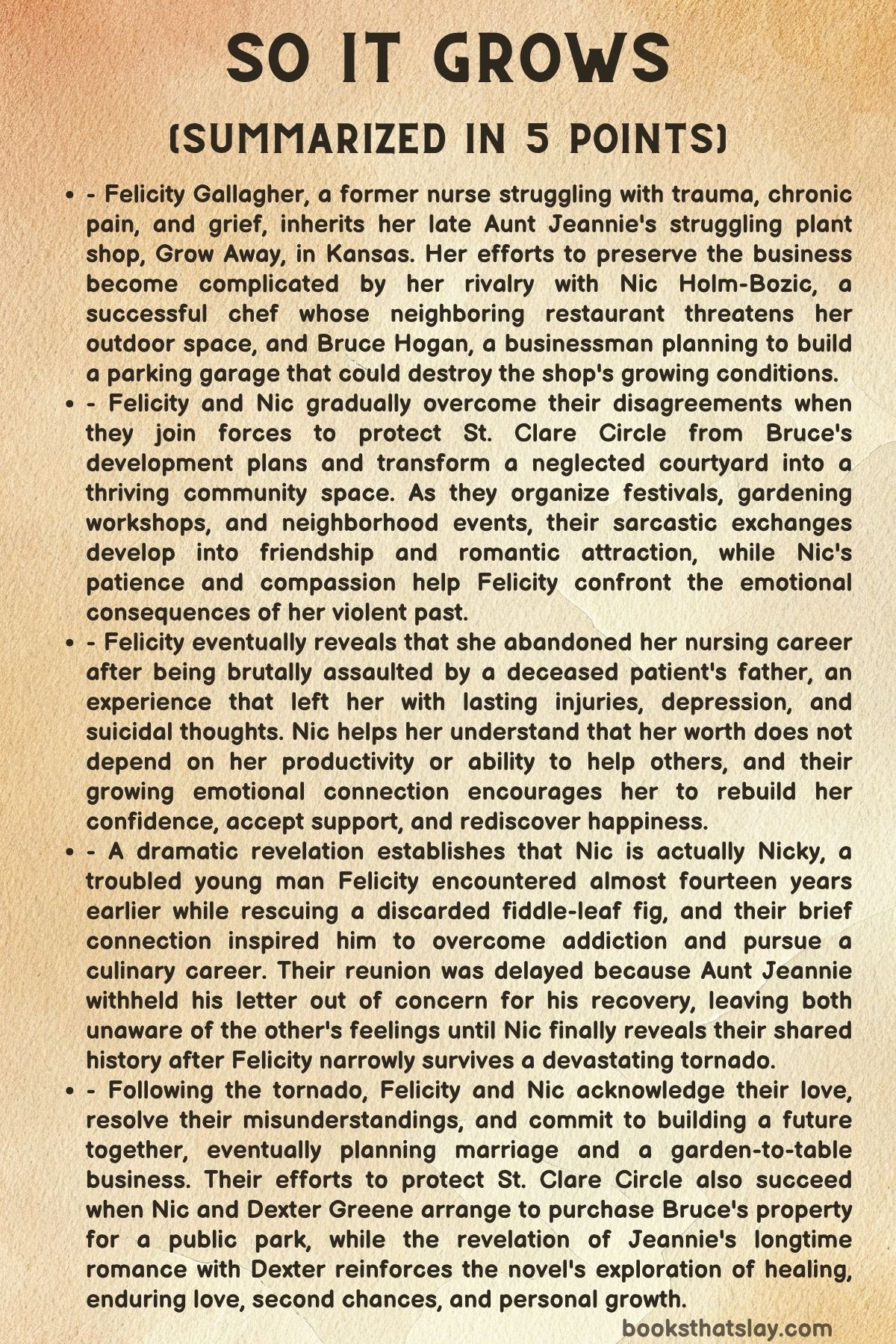
Summary
Felicity Gallagher returns to Kansas after inheriting Grow Away, a plant shop established by her beloved Aunt Jeannie in a converted church building. Although the inheritance offers her an opportunity to rebuild her life, the business faces financial difficulties, and Felicity struggles with chronic pain, grief, and emotional difficulties following a traumatic incident during her former nursing career.
Her problems become more complicated because the neighboring restaurant, C’est la Vache, has become exceptionally popular under the direction of chef Nic Holm-Bozic. Felicity resents the restaurant’s crowded surroundings and particularly dislikes Nic, whom she overheard discussing plans to take over the outdoor patio traditionally used by her shop.
Their first direct encounters are filled with sarcastic exchanges and disagreements over property rights. Although Felicity finds Nic physically attractive, she considers him arrogant and believes his commercial ambitions threaten everything her aunt worked to establish.
A greater danger appears when influential businessman Bruce Hogan proposes constructing a four-story parking garage on the vacant property adjoining Grow Away. The building would obstruct sunlight entering the shop and threaten the greenhouse, nursery, and gardens that are essential to its survival.
Bruce presents his development as beneficial to the neighborhood, but Felicity recognizes that the project prioritizes financial gain over environmental preservation and community interests. Nic unexpectedly opposes Bruce’s plans, although his disagreement with Felicity concerning the patio continues to make cooperation difficult.
During one confrontation, Felicity becomes startled and nearly falls from her apartment balcony, but Nic catches her before she can suffer a serious injury. His concern briefly challenges her negative opinion of him, yet their arguments continue when he insists that the restaurant deserves greater access to the patio.
Felicity eventually discovers that Nic has consulted lawyers and property owners about the outdoor space, leaving her feeling betrayed by people she considers family. However, she uses her knowledge of the patio’s construction and ownership arrangements to negotiate a compromise that allows the restaurant to expand while preserving essential space for her gardening classes.
In exchange, Nic agrees to help fight Bruce’s development proposal and support a campaign to transform the neighborhood’s neglected communal courtyard into a recognized pocket park. Their agreement establishes an uneasy partnership that gradually becomes a genuine friendship.
Felicity begins reconnecting with Samantha Powell, Courtney, Thea, Abbott, and other neighborhood residents who share her concerns about the proposed garage. Together, they research property regulations, gather signatures, and prepare arguments demonstrating the historical and environmental importance of St. Clare Circle.
At a public forum, Felicity delivers a convincing presentation explaining how Bruce’s project would damage the surrounding businesses and green spaces. Council member Cynthia Dale acknowledges the seriousness of the concerns but points out that the existing courtyard has been neglected for years.
Cynthia offers the community an opportunity to prove its commitment by restoring the courtyard and demonstrating its public value over the following nine months. Felicity accepts the challenge, and she and Nic begin organizing improvements and community events to strengthen their application for official protection.
As their partnership develops, Nic becomes increasingly attentive to Felicity’s physical and emotional needs. When her chronic pain becomes severe and medication leaves her disoriented, he helps her safely return to bed and refuses to take advantage of her vulnerability.
Felicity discovers that Nic is Courtney’s cousin and that Thea, whom she mistakenly believed to be romantically involved with him, is actually Courtney’s wife. These revelations force her to reconsider several assumptions, and she gradually recognizes that Nic possesses more kindness and emotional understanding than his argumentative personality initially suggests.
The neighborhood’s Halloween celebration becomes an important turning point in their friendship. When Felicity forgets the event’s ocean theme and feels embarrassed about disappointing everyone, Nic surprises her with elaborate decorations, activities, and a Viking boat, helping her participate without feeling inadequate.
Over the following months, they repair drainage problems, organize seasonal festivities, and collaborate on projects that benefit their businesses. Nic accompanies Felicity to an assisted living facility, where she teaches residents about orchid care and discovers that helping others still gives her satisfaction despite leaving nursing.
Their growing closeness also reveals shared experiences of emotional hardship. Felicity discusses the strategies she uses to manage ADHD and maintain her mental health, while Nic gradually reveals that his childhood involved an abusive father, emotional neglect, family instability, and a troubled relationship with his privileged upbringing.
During Thanksgiving and New Year’s celebrations, Felicity becomes increasingly comfortable with the friendships she previously avoided. Her brother Dylan and his husband Derek visit, and Nic becomes a familiar presence in her daily life through gardening, business planning, shared meals, and affectionate teasing.
Despite their obvious attraction, neither is initially willing to confront the possibility of romance. Felicity worries that Nic has feelings for someone else, particularly after overhearing mysterious conversations concerning his past and noticing that he regularly disappears on Tuesday evenings.
When Nic becomes ill around his birthday, Felicity cares for him, prepares meals, and attempts to make the occasion special. Her efforts reveal how deeply she has come to care for him, while his discomfort with receiving affection exposes the lingering consequences of his difficult childhood.
The Valentine’s Day celebration brings them even closer as they cooperate to organize a community fundraiser. Their growing intimacy is interrupted by practical problems, including a plumbing emergency that Felicity resolves using skills learned from her father.
Later, while resting together in Felicity’s apartment, Nic witnesses a nightmare connected to her traumatic past. His gentle response encourages her to discuss experiences she has concealed from most people, although the conversation becomes emotionally difficult when he discovers an old note associated with her depression.
Felicity eventually explains that she was violently assaulted while working as an emergency department nurse. After a critically injured patient died, the patient’s intoxicated father blamed the medical staff and later attacked her with a broken bottle, causing serious injuries and lasting psychological trauma.
Although she survived and received support from her family, Felicity struggled with post-traumatic stress, chronic pain, and the expectation that she should eventually become the same person she had been before the attack. Her depression became so severe that she considered ending her life, and the note Nic discovered came from that period of hopelessness.
Nic listens without judgment and assures Felicity that her existence has value regardless of her accomplishments, productivity, or ability to recover. His acceptance helps her recognize that she does not need to regain every aspect of her former identity to deserve happiness, and she begins making meaningful progress toward rebuilding her life.
Their relationship grows more affectionate as spring approaches, but Nic hesitates when Felicity suggests becoming physically intimate. His reluctance comes from unresolved personal circumstances, although Felicity mistakenly interprets it as rejection and continues believing that another woman might occupy his heart.
Meanwhile, the campaign to protect St. Clare Circle faces a serious setback when officials move the decisive land-use hearing to an earlier date. Felicity fears that months of community work will be wasted and that losing Grow Away would also mean losing the independence and emotional stability she has gradually regained.
During a conversation beneath the historic bur oak tree, Dexter Greene shares memories of Aunt Jeannie and explains that she never intended the inheritance to become an obligation that controlled Felicity’s life. Learning about Jeannie’s quiet acts of love helps Felicity understand that her aunt wanted her to find happiness rather than sacrifice herself to preserve a business.
As the relationship between Felicity and Nic becomes increasingly intimate, they finally share a passionate kiss during an approaching tornado. The moment confirms their mutual feelings, but the dangerous weather quickly transforms their happiness into an emergency.
When Felicity learns that Samantha’s medical supplies have been left behind during the evacuation, she ventures into the storm despite the risks. As the winds intensify, she remembers her earlier suicidal thoughts and recognizes how dramatically her feelings about life have changed.
Rather than welcoming death or considering herself valuable only when saving others, Felicity desperately wants to survive. Before she can reach shelter, however, a heavy wrought-iron table is carried through the air by the tornado and strikes her, leaving her unconscious.
The narrative then reveals a previously concealed history beginning almost fourteen years earlier. A troubled young man called Nicky, struggling with addiction and the consequences of childhood abuse, encountered a younger Felicity while she was attempting to rescue a discarded fiddle-leaf fig from a dumpster.
Despite their sarcastic exchanges, the strangers developed an immediate connection. Felicity challenged Nicky’s assumptions about wealth and privilege, while he found himself unexpectedly comfortable with someone who judged him according to his behavior rather than his family’s status.
They spent the night talking beneath the star jasmine near Grow Away, discussing family, relationships, ambitions, and their hopes for the future. Felicity encouraged Nicky to pursue cooking, the one activity that made him feel at home, and promised to restore the damaged plant.
Before leaving, Nicky wrote a note promising to return after a year. Their brief encounter profoundly influenced him, motivating him to confront his addiction, pursue a culinary career, and establish a different life.
When Nicky returned, however, he encountered Aunt Jeannie rather than Felicity. Concerned that the young man had made her niece the foundation of his recovery, Jeannie persuaded him to continue developing independently before beginning a romantic relationship.
Jeannie withheld a later note he wrote for Felicity and arranged for the restored fiddle-leaf fig, named Fanny, to be sent to him. Nicky interpreted the plant as a rejection, while Felicity remained unaware that he had returned.
Over the years, Nicky developed a meaningful friendship with Jeannie, visiting her, discussing their respective histories, and learning about gardening. He built a successful restaurant business, maintained his recovery, and gradually learned to value his own life instead of depending on the possibility of reuniting with Felicity.
Jeannie’s experiences with her late husband’s addiction had influenced her decision to keep the two apart, although she eventually recognized that her interference had caused considerable pain. Shortly before her death from cancer, she admitted withholding Nicky’s letter, but her death prevented her from helping them resolve the misunderstanding.
Nicky, now known as Nic Holm-Bozic, eventually moved to Kansas and established his restaurant beside Grow Away. Although he immediately recognized Felicity, she failed to recognize the young man from their earlier encounter because his appearance, accent, and circumstances had changed significantly.
Nic initially assumed Felicity remembered him and deliberately wanted to avoid him. By the time he understood that she genuinely did not recognize him, their developing friendship had become too precious for him to risk through a revelation he feared might destroy her trust.
Returning to the present, Nic rushes to rescue Felicity after the tornado strikes. He and Abbott carry her into shelter, where Nic desperately attempts to control her bleeding while fearing that he may lose the woman he has loved for years.
Felicity survives and awakens in the hospital after undergoing surgery for her injured wrist and treatment for other wounds. Her recovery is difficult, but she refuses her family’s suggestion that she return to Maryland because Kansas has finally become her home.
She moves into Nic’s house while recovering, and their relationship becomes openly romantic. A misunderstanding about his Tuesday disappearances is finally resolved when Nic explains that he attends a Dungeons and Dragons group rather than secretly meeting another woman.
Their affection deepens as Felicity regains physical strength and confidence. After traveling to Texas, Nic returns with Fanny and the wooden box containing years of letters he wrote to Felicity, finally giving her the complete account of their first meeting and the circumstances that separated them.
Felicity is stunned to discover that Nic and Nicky are the same person. Although she feels hurt by the secrecy and the years of missed opportunities, she recognizes that her love belongs to the man Nic has become rather than merely the young stranger she once remembered.
They confront their misunderstandings in the tornado-damaged courtyard and reaffirm their desire to build a future together. Their relationship eventually culminates in mutual declarations of love, while the community’s campaign also succeeds in securing a promising future for the neighborhood.
Nic and Dexter arrange to purchase Bruce Hogan’s vacant property and donate it for permanent public use, protecting the historic bur oak and preventing the construction of the parking garage. Felicity and Nic also plan a garden-to-table business that combines their professional talents.
Five months after the tornado, Felicity unexpectedly proposes marriage, and Nic reveals an antique engagement ring he has treasured for years. Their future represents not an escape from their painful histories but a decision to build something meaningful from everything they have experienced.
The closing episodes reveal Jeannie’s long relationship with Dexter Greene, whose friendship eventually became a private romance after years of personal hardship and loss. Their history provides a parallel to Felicity and Nic’s relationship, showing how love can endure through complicated circumstances and how opportunities for happiness can arrive long after people expect them.
Characters
Felicity Gallagher
Felicity Gallagher is the central protagonist of So It Grows, a woman whose intelligence, independence, sarcasm, and fierce loyalty conceal considerable emotional suffering. A former emergency department nurse, she returns to Kansas after inheriting Aunt Jeannie’s plant shop, hoping that a change of environment will allow her to regain some control over her life.
Her personality is defined by an unusual combination of practical competence and emotional insecurity. She possesses extensive knowledge of plants, construction, and medical care, yet she frequently doubts her ability to manage relationships, maintain her business, and satisfy the expectations of those who love her.
Felicity’s experiences with assault, chronic pain, PTSD, and depression have profoundly influenced her understanding of herself. She struggles with the belief that she must remain useful to justify her existence, often responding to emotional difficulties by working excessively or withdrawing from other people.
Her relationship with Nic challenges these destructive beliefs because he recognizes her strengths without expecting her to conceal her vulnerabilities. Through their growing connection, she discovers that receiving care does not diminish her independence and that emotional recovery involves accepting herself rather than attempting to reconstruct her former personality.
Felicity’s determination to protect Grow Away also demonstrates her loyalty to Jeannie’s memory and her commitment to the community. However, her character development requires her to understand that honoring someone she loves does not mean sacrificing her own happiness to preserve everything that person left behind.
Her transformation becomes especially apparent during the tornado, when she realizes that she genuinely wants to survive. By the conclusion, Felicity has regained a sense of belonging, accepted a romantic future with Nic, and developed a more compassionate understanding of her own worth.
Nic Holm-Bozic (Nicky)
Nic Holm-Bozic serves as the romantic male lead in So It Grows, and his complicated history gives his confident, sarcastic personality considerable emotional depth. Initially introduced as an ambitious chef competing with Felicity over shared business space, he gradually emerges as a compassionate man whose adult life has been shaped by addiction recovery, childhood abuse, and an enduring connection to a woman he never forgot.
Born into a wealthy but emotionally unstable family, Nic experienced neglect, frequent relocation, and violence from his father. His privileged circumstances provided material comfort but failed to offer the affection, security, and stability he needed.
As a young man, he turned toward alcohol and drugs while struggling to establish an identity separate from his family’s expectations. His chance encounter with Felicity helped him recognize the possibility of a different future, particularly through his interest in cooking.
His eventual recovery becomes meaningful because he learns to value sobriety for himself rather than treating Felicity as the sole reason to change. Through his friendship with Jeannie, professional achievements, and relationships with chosen family members, Nic develops a stronger foundation for his identity.
His decision to conceal his previous connection with Felicity reveals that personal growth has not eliminated his fears. Although he is capable of confronting professional challenges, he struggles with emotional honesty because he believes revealing the past might cost him the relationship he treasures.
Nic’s most admirable quality is his willingness to provide care without demanding control. He respects Felicity’s boundaries, supports her during traumatic episodes, and repeatedly demonstrates that love can involve patience, practical assistance, and accepting another person’s decisions.
His journey concludes when he finally reveals his history and allows Felicity to choose their future with complete knowledge of the past. The relationship succeeds because he learns that genuine intimacy requires honesty as well as devotion.
Aunt Jeannie
Aunt Jeannie is one of the most influential characters in So It Grows, despite having died before much of the central narrative unfolds. Her personality, decisions, relationships, and lasting influence shape the emotional journeys of both Felicity and Nic.
As the founder of Grow Away, Jeannie devoted herself to plants, community relationships, and creating a welcoming environment for people who needed companionship. Her practical generosity becomes apparent through the numerous ways she quietly supported others, including protecting Felicity while she climbed the bur oak tree as a child.
Jeannie’s relationship with Nic reveals her ability to recognize emotional suffering beneath difficult behavior. She provides him with guidance, friendship, and honest criticism, helping him develop an identity independent of addiction and romantic longing.
However, her protective instincts also lead her to make harmful decisions. Having suffered through her husband’s addiction and betrayal, she fears that Nic’s relationship with Felicity might reproduce the destructive emotional patterns she experienced.
By withholding Nic’s letter, Jeannie denies both young people the opportunity to make their own decisions. Her eventual admission demonstrates that love and good intentions do not automatically justify controlling someone else’s future.
Her long relationship with Dexter further complicates her characterization by revealing her own experiences with love, disappointment, and second chances. Jeannie emerges as a generous but imperfect woman whose legacy includes both the lives she helped improve and the mistakes that others must eventually confront.
Samantha Powell
Samantha Powell is Felicity’s close friend and one of the strongest representatives of friendship and community in So It Grows. Her determination to remain involved in Felicity’s life provides an important counterbalance to the protagonist’s tendency toward isolation.
Samantha recognizes that Felicity’s withdrawal is connected to grief and emotional suffering rather than a genuine desire to abandon her relationships. Instead of accepting every excuse Felicity offers, she gently challenges her and encourages her to participate in the neighborhood’s activities.
Her practical contributions to the campaign against Bruce Hogan demonstrate intelligence, loyalty, and organizational ability. Alongside Abbott, she helps gather information and develop arguments that allow the community to present a credible challenge to the proposed garage.
Samantha’s pregnancy and the birth of her daughter, Ani, introduce another dimension to her personality. She strongly resists being treated as helpless, even when her determination to remain independent becomes comically excessive during labor.
Her friendship with Felicity shows that genuine support can involve both emotional sensitivity and a willingness to challenge someone when necessary. She contributes to Felicity’s recovery by maintaining the expectation that their friendship can remain meaningful despite changed circumstances.
Abbott Powell-Carmichael
Abbott is Samantha’s husband and an important member of the neighborhood’s circle of friends. His relationship with Samantha demonstrates a supportive partnership built on shared responsibilities, affection, and an understanding of each other’s distinctive personalities.
He contributes research and practical assistance to the campaign for St. Clare Circle, helping turn the residents’ concerns into organized arguments against Bruce Hogan’s development. His involvement reflects the importance of collective action throughout the novel.
Abbott’s anxious response when Samantha unexpectedly goes into labor reveals his devotion to his wife and their growing family. Although the situation creates considerable confusion, his concern comes from a genuine desire to protect the people closest to him.
During the tornado, Abbott also assists Nic in rescuing Felicity before turning his attention toward Samantha and their daughter. His actions establish him as someone who responds to emergencies with responsibility, even when frightened.
Courtney
Courtney is Felicity’s friend, Nic’s cousin, and Thea’s wife, placing her at the center of several important relationships. Her familiarity with both protagonists allows her to recognize their growing attraction long before they openly acknowledge it.
She helps Felicity reconsider her assumptions about Nic by explaining their family connection and correcting misunderstandings concerning his personal life. Her conversations also encourage Felicity to address the emotional difficulties she has been avoiding.
Courtney’s personality combines directness, warmth, and an ability to recognize when someone needs reassurance. She does not treat Felicity as incapable, but she also refuses to ignore obvious signs of distress.
Her musical performance in the old recording studio has particular significance because it helps Felicity reconnect with emotions that depression had suppressed. Through Courtney, the novel shows how friendship and artistic expression can restore a person’s connection to ordinary pleasure.
Thea
Thea is Courtney’s wife and a member of the close-knit community surrounding Grow Away and C’est la Vache. Although she receives less individual attention than several other supporting characters, her presence contributes to the sense of acceptance and companionship that defines St. Clare Circle.
Felicity initially mistakes Thea for Nic’s romantic partner, demonstrating how incomplete information can produce unnecessary jealousy and resentment. Learning the truth helps Felicity reconsider the assumptions she has made about the people around her.
Thea and Courtney’s marriage also provides a stable example of partnership within the story. Their home becomes a gathering place for celebrations, friendships, and important conversations.
Through her participation in community events and her support for those around her, Thea contributes to the welcoming social environment that eventually helps Felicity feel at home.
Dexter Greene
Dexter Greene is a significant supporting figure in So It Grows, particularly because of his longstanding connection to Aunt Jeannie and the history of St. Clare Circle. His character represents patience, loyalty, and the emotional significance of relationships that develop over many years.
As an older member of the community, Dexter possesses valuable knowledge concerning the neighborhood, its businesses, and the people who shaped it. He helps Felicity understand Jeannie’s intentions and provides reassurance when she fears that failing to preserve Grow Away would constitute a betrayal.
His revelation that Jeannie arranged protections for the bur oak tree demonstrates his understanding of her affectionate but practical nature. By sharing these memories, he helps Felicity recognize expressions of love she had previously overlooked.
Dexter’s relationship with Jeannie reveals another side of his personality. Following the death of his wife, Donna, their longstanding friendship gradually developed into a private romance that lasted thirteen years.
His devotion to Jeannie during her illness demonstrates a love grounded in companionship, acceptance, and mutual understanding. His eventual collaboration with Nic to protect the vacant property also ensures that their shared concern for the neighborhood continues after her death.
Bruce Hogan
Bruce Hogan functions as the principal external antagonist, embodying the conflict between commercial development and community preservation. His proposed parking garage threatens the physical survival of Grow Away and the natural spaces that give St. Clare Circle its distinctive identity.
As an influential businessman, Bruce presents his plans as economically beneficial improvements. However, his arguments consistently prioritize profitability and convenience over environmental concerns, historical continuity, and the interests of smaller businesses.
His willingness to dismiss the importance of sunlight, trees, and communal areas reveals a narrow understanding of what makes a neighborhood valuable. He regards the land primarily as an opportunity for development rather than a place associated with memories, livelihoods, and relationships.
Bruce’s presence provides Felicity and Nic with a common purpose that gradually transforms their antagonistic relationship into cooperation. His eventual failure demonstrates the power of collective resistance when residents organize around a shared understanding of their community’s future.
Cynthia Dale
Cynthia Dale is a city council member whose involvement becomes essential to the campaign for neighborhood preservation. Unlike Bruce Hogan, she approaches development concerns through questions of public responsibility and measurable community benefit.
She recognizes the legitimacy of Felicity’s arguments against the parking garage but refuses to overlook the neighborhood’s poorly maintained courtyard. Her decision to challenge residents to restore the space demonstrates that she expects practical commitment rather than promises.
Cynthia’s approach helps transform the community’s campaign from opposition to a construction project into a positive effort to create something valuable. Her involvement in neighborhood events also reinforces the importance of cooperation between local residents and public officials.
By the conclusion, she becomes associated with the institutional support that helps secure the neighborhood’s future. Her character illustrates how responsible public leadership can recognize grassroots efforts and provide opportunities for them to succeed.
Dylan Gallagher
Dylan is Felicity’s brother and one of the most consistent sources of family support in her life. His concern for her physical and emotional health reflects the lasting effects of the assault on the entire Gallagher family.
He frequently checks on Felicity and worries about her tendency to ignore pain, overwork, or attempt difficult tasks without assistance. Although these interventions sometimes irritate her, they originate in genuine affection and an awareness of how much she has suffered.
Dylan also contributes practical assistance to the courtyard’s reconstruction and visits Kansas during important celebrations. His presence connects Felicity’s new life with the family relationships that remained important throughout her recovery.
His character demonstrates the difficulty of supporting someone who values independence while recognizing that they may sometimes require substantial help.
Derek
Derek is Dylan’s husband and another supportive member of Felicity’s extended family. His relationship with Dylan provides an additional example of affectionate partnership and shared responsibility.
Together, they maintain contact with Felicity, offer reassurance, and contribute to practical work when visiting Kansas. Their interactions with her include teasing and humor, helping preserve a sense of ordinary family life despite the seriousness of her experiences.
Derek’s presence becomes particularly important during Felicity’s recovery because he participates in the wider network of people who want her to feel safe and supported. He helps establish that her return to Kansas does not mean abandoning the family connections she developed elsewhere.
Toby Keegan
Toby Keegan, Felicity’s stepcousin, provides comic relief through his exaggerated confidence and questionable professional ambitions. He repeatedly presents himself as a capable entrepreneur despite demonstrating little evidence of the practical expertise his businesses require.
His attempts at contracting and plumbing create unnecessary complications for Felicity and Nic. His involvement in the patio renovations and restaurant repairs exposes the difference between professional competence and simply claiming to possess it.
Toby’s personality contrasts strongly with Felicity’s resourcefulness and Nic’s professional dedication. While they rely on experience and responsibility, Toby often substitutes marketing language and self-promotion for genuine skill.
Although his actions create frustration, his appearances also reinforce the novel’s comedic tone and provide opportunities for Felicity and Nic to demonstrate their growing ability to cooperate.
Maude and Ethel
Maude and Ethel are elderly married women who work for Grow Away’s plant maintenance service. Their importance comes primarily from the personal responsibilities Felicity associates with inheriting the business.
Felicity does not view Grow Away simply as a source of income or a sentimental reminder of her aunt. She recognizes that its survival also affects employees who depended on Jeannie and now depend on her.
Maude and Ethel therefore represent the human consequences of financial instability and neighborhood development. Their presence strengthens Felicity’s determination to protect the shop and preserves the connection between business ownership and community responsibility.
Saj
Saj is one of Nic’s friends from culinary school and a person familiar with the difficulties he experienced earlier in life. Although his appearances are relatively limited, he provides important insight into Nic’s emotional history.
When Felicity learns that Nic has traditionally struggled with birthdays, Saj helps her understand why an occasion associated with celebration can be painful for someone with a history of family neglect. His information encourages her to approach Nic with greater sensitivity.
Saj also participates in Nic’s birthday celebration and helps reveal that the confident chef carries unresolved feelings connected to his past. His friendship represents continuity between Nic’s earlier struggles and the stable life he has gradually established.
Paul Keegan
Paul Keegan is Jeannie’s late husband, whose addiction and betrayal caused lasting damage to her emotional and financial security. Although much of his story emerges through recollections, his actions significantly influence the decisions Jeannie makes later in life.
Paul’s destructive behavior leaves Jeannie cautious about relationships involving addiction and emotional dependency. When she discovers Nic’s history, she fears that Felicity could experience suffering similar to her own.
This connection helps explain, though not excuse, Jeannie’s decision to interfere with Nic and Felicity’s relationship. Paul therefore remains an important influence even after his death because the consequences of his behavior affect people who never directly experienced his marriage.
Donna Greene
Donna Greene is Dexter’s late wife and an important figure in the history of his relationship with Jeannie. During the difficult years of Jeannie’s marriage, Donna and Dexter offered friendship and support.
Her death later becomes a major turning point in Dexter’s emotional life. Jeannie helps him endure the resulting grief, and their longstanding relationship gradually develops into romantic love.
Donna’s place in the narrative is not simply that of an obstacle to a later relationship. She represents an earlier period of genuine companionship and the lasting importance of relationships that continue to influence survivors after loss.
Themes
Healing, Trauma, and the Rediscovery of Self-Worth
Emotional recovery forms the foundation of Felicity’s transformation in So It Grows, particularly through her experiences with physical injury, PTSD, depression, and the loss of her nursing career. Her suffering does not disappear when she moves to Kansas, because changing her circumstances cannot erase the psychological consequences of the violence she experienced.
Felicity initially measures her value through productivity and service to others. Having once worked in a profession devoted to saving lives, she struggles to accept that chronic pain and psychological trauma have changed what she can accomplish.
Her determination to preserve Grow Away becomes connected to this belief. She feels responsible not only for the shop’s survival but also for honoring Jeannie’s memory, protecting employees, preserving the neighborhood, and preventing everyone around her from experiencing disappointment.
Nic challenges this understanding of self-worth by insisting that Felicity’s life matters independently of what she accomplishes. His acceptance helps her recognize that needing assistance does not make her inadequate and that emotional suffering does not erase her right to happiness.
The novel also emphasizes that recovery does not follow a predictable schedule. Felicity experiences progress alongside nightmares, physical limitations, insecurity, and moments when her previous fears return.
Her realization during the tornado represents a decisive shift in her understanding of survival. Rather than seeing her continued existence as an obligation to other people, she recognizes that she wants to live because her own future contains possibilities worth experiencing.
The story ultimately treats healing as an ongoing process of developing self-compassion. Felicity does not become the person she was before the assault, but she discovers that the person she has become deserves love, freedom, and fulfillment.
Love, Second Chances, and Emotional Honesty
The relationship between Felicity and Nic demonstrates how love can survive separation and personal transformation while still requiring honesty, trust, and individual choice. Their first encounter creates an extraordinary emotional connection, but neither is prepared for the responsibilities of a lasting relationship.
Nicky’s early fascination with Felicity initially becomes closely associated with his desire to escape addiction and his destructive family environment. Jeannie correctly recognizes the danger of making another person responsible for recovery, even though her decision to intervene eventually causes unnecessary suffering.
Years later, Nic’s success and emotional maturity demonstrate that meaningful change must come from personal conviction. He becomes capable of loving Felicity without expecting her to provide the entire foundation for his identity.
However, his continuing silence about their shared history reveals that personal improvement does not eliminate fear. His desire to preserve their developing relationship prevents him from offering Felicity the complete truth, creating another form of emotional distance.
Felicity also contributes to their misunderstandings through assumptions and reluctance to express vulnerability. Her belief that Nic loves another woman prevents her from recognizing opportunities for an honest conversation about their feelings.
Their eventual reconciliation depends on recognizing that affection cannot replace communication. Nic must acknowledge the consequences of withholding information, while Felicity must decide whether their connection is strong enough to survive the revelation.
The novel presents their second chance as meaningful because they have changed since their original encounter. Their relationship succeeds not because time has preserved them unchanged, but because they have become people capable of building a healthier partnership.
Community, Belonging, and the Meaning of Home
St. Clare Circle represents far more than the physical setting of So It Grows, functioning as a community whose relationships gradually restore Felicity’s sense of belonging. The converted church, plant shop, restaurant, courtyard, and historic trees possess emotional significance because they connect generations of residents through shared experiences.
Bruce Hogan’s proposed parking garage threatens this sense of continuity by treating land exclusively as a financial asset. His plans disregard the importance of natural light, communal spaces, and the small businesses that have developed alongside one another.
Felicity’s campaign against the development begins as an attempt to preserve Jeannie’s legacy. However, the effort gradually becomes a collective project that allows residents to demonstrate what the neighborhood means to them.
The restoration of the courtyard transforms an overlooked space into a gathering place for festivals, workshops, celebrations, and charitable activities. These events demonstrate that public spaces acquire value through the relationships and experiences they make possible.
The community also becomes essential to Felicity’s personal recovery. Samantha, Courtney, Thea, Abbott, Dexter, and other residents encourage her to participate in life rather than remain isolated by grief and trauma.
Nic experiences a similar transformation because his difficult family history has prevented him from developing a stable understanding of home. Through Jeannie, his friendships, and his relationship with Felicity, he discovers belonging among people who accept him because of his character rather than his wealth or family connections.
The destruction caused by the tornado reinforces the distinction between physical structures and community identity. Although buildings and gardens can be damaged, the relationships established through their restoration survive and provide the foundation for rebuilding.
Growth, Grief, and the Acceptance of Change
Plants and gardening provide a continuing metaphor for the ways people respond to loss, adversity, and change. Felicity’s ability to rescue damaged plants reflects her practical understanding that survival often requires patience, attention, and the willingness to remove what prevents healthy development.
The discarded fiddle-leaf fig becomes the clearest expression of this idea. When Felicity and Nicky discover the damaged plant, both are struggling with different forms of disappointment and uncertainty, yet Felicity believes that careful treatment can give it another opportunity to flourish.
The plant’s eventual recovery parallels Nic’s journey from addiction and instability toward professional accomplishment and emotional independence. Its survival demonstrates that difficult beginnings do not determine the entire course of a life.
Jeannie’s death introduces a more complicated understanding of growth because her absence cannot be corrected through effort or devotion. Felicity initially attempts to preserve everything associated with her aunt, fearing that change will diminish the importance of their relationship.
Dexter helps her recognize that Jeannie’s true legacy lies not only in the plant shop but also in the opportunities, affection, and confidence she gave others. Accepting this distinction allows Felicity to imagine a future that honors her aunt without remaining completely governed by the past.
The tornado extends this theme by destroying much of the courtyard that the community spent months restoring. Its devastation demonstrates that meaningful work does not guarantee permanent results, but temporary loss does not make previous efforts worthless.
By the conclusion, Felicity and Nic accept that happiness does not require a life free from grief or difficulty. Their plans for marriage, a new business, and a protected public garden reflect the belief that people can carry their histories forward while continuing to change, love, and grow.