Something of a Calling Summary, Characters and Themes
Something of a Calling by Zoje Stage is a supernatural horror novel that explores humanity’s destructive relationship with nature, the consequences of environmental exploitation, and the possibility of an extraordinary uprising within the animal kingdom.
The story follows Andy Cooper, a veteran police detective approaching retirement, whose investigation into a series of horrifying deaths reveals that animals are developing unexpected abilities and turning against humans. As the mystery expands, Andy encounters a woman whose connection to wildlife challenges everything she believes about justice, morality, and human responsibility. Combining ecological horror with personal grief and ethical conflict, the novel examines what happens when nature begins fighting back.
Summary
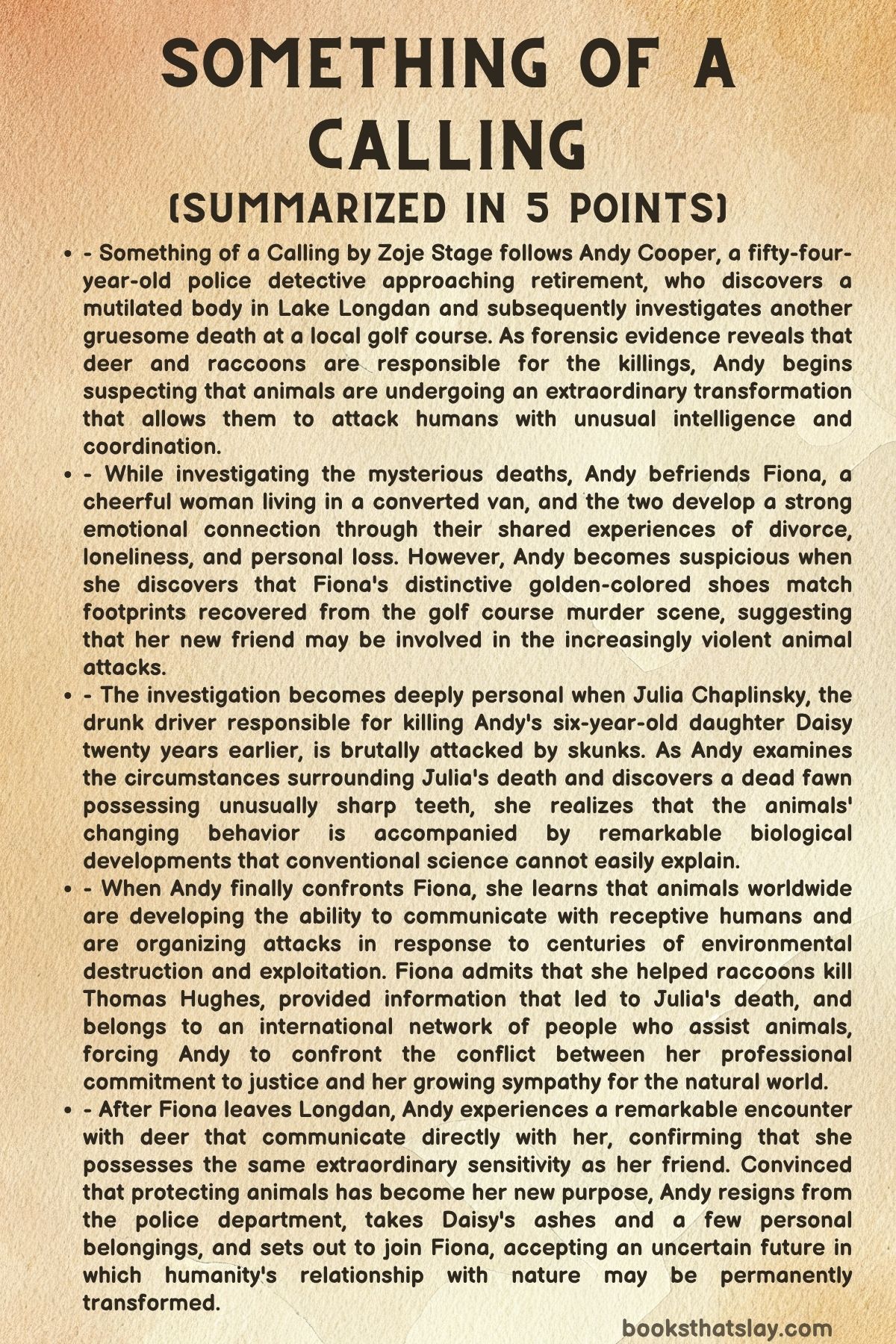
Detective Andy Cooper has spent thirty years serving the Longdan Police Department in Pennsylvania, but at fifty-four, she is increasingly eager to retire. Her experiences with violence, injustice, and human cruelty have left her exhausted, and she finds little satisfaction in the work that once gave her life direction.
Her personal life is equally marked by suffering. Twenty years earlier, her six-year-old daughter, Daisy, was killed by a drunk driver, a tragedy that eventually destroyed Andy’s marriage to Quentin and left her living alone.
While kayaking on Lake Longdan, Andy discovers a badly decomposed body floating near the wooded shoreline. The corpse has a rope around its neck, severe injuries to its legs, and extensive damage caused by animals feeding on it.
Although she reports the discovery, Andy hopes to avoid another disturbing investigation. Before leaving, she notices a deer standing motionless on the shoreline, watching her with an unnerving intensity that she cannot explain.
At home, Andy finds herself increasingly troubled by the destruction of the natural environment surrounding her neighborhood of Heath Hen. Construction and urban development have eliminated wildlife habitats, while a cable company’s recent excavation has left an ugly trench through her backyard.
These changes remind her of the insects, fireflies, and other creatures that once flourished in the area. She begins reflecting on how casually people destroy the environments that sustain other forms of life.
Meanwhile, Thomas Hughes, a wealthy corporate employee, arrives at a local golf course hoping to escape his responsibilities. His wife, Jill, has recently given birth to triplets following fertility treatments, and Thom secretly resents the demands of fatherhood.
During his game, Thom hears strange noises and discovers what appears to be an elderly woman lying helplessly on the ground. When he approaches to assist her, she suddenly grabs his ankle, and unidentified creatures attack him from the surrounding trees.
Andy is assigned to investigate the resulting death alongside Mira Patel, an ambitious young detective recently transferred to Major Crimes. At the golf course, they discover Thom’s horribly mutilated body, surrounded by blood, disturbed vegetation, and evidence suggesting that his attackers escaped into the woods.
The wounds are unlike those typically caused by human weapons. Large portions of flesh have been torn away, and Thom’s hands are missing, leading Andy to suspect that animals may have killed him.
Medical examiner Dr. Kaitlyn Henry provides equally disturbing information about the corpse found in Lake Longdan. The victim, fisherman Gregory Weaver, suffered crushing injuries, trampling, and bites apparently inflicted by deer.
Tests reveal no evidence of rabies, leaving investigators unable to explain the extraordinary aggression. Andy becomes increasingly convinced that the two deaths are connected, even though different animal species appear responsible.
The detectives inform Jill Hughes of her husband’s death, leaving the exhausted mother confronting grief, financial uncertainty, and the prospect of raising three infants alone. Andy recognizes the devastating consequences of the killing, making it impossible to treat the victim merely as evidence in a strange case.
Their investigation also leads them to Jeffrey Myers, an environmental protester known as the Doomsday Dad. He condemns corporate greed, habitat destruction, and animal suffering, but the detectives discover no convincing evidence connecting him to Thom’s death.
Back in her neighborhood, Andy encounters Fiona, a silver-haired woman living in a converted van that has attracted complaints from Andy’s neighbor Carol. Rather than treating Fiona suspiciously, Andy approaches her with curiosity and offers food, laundry facilities, and a place to sleep.
The women quickly discover unexpected similarities in their experiences. Fiona explains that unemployment and the collapse of her marriage led her into vehicle-based living, while Andy speaks about the loneliness that followed Daisy’s death.
For the first time in years, Andy feels comfortable discussing her daughter and the circumstances surrounding her death. Fiona responds with understanding, and their friendship develops into an unusually strong emotional connection.
Fiona also explains her asexual identity and her preference for meaningful platonic relationships. Andy recognizes similar feelings in herself, making their companionship especially valuable during a period when she feels uncertain about her future.
Elsewhere, wildlife begins behaving in increasingly disturbing ways. Groups of foxes demonstrate what appears to be collective intelligence, communicating silently and considering humans as possible prey.
In California, peacocks cooperate with a bearded man to attack a female jogger. The birds deliberately disable her before killing her and feeding on her flesh, suggesting that animals are developing coordinated hunting strategies with assistance from certain humans.
As Andy researches animal attacks around the world, she discovers reports involving birds, monkeys, bears, wild boars, and other species displaying extraordinary aggression. She begins suspecting that the incidents represent a widespread transformation rather than isolated abnormalities.
Her superior and longtime friend, Lieutenant Kelvin Harrison, initially struggles to accept the theory. Nevertheless, he trusts Andy’s experience and contacts other police departments to determine whether similar incidents are occurring elsewhere.
Forensic evidence provides another breakthrough when investigators discover human fingerprints and a distinctive shoeprint at Thom’s murder scene. The footprint belongs to someone wearing a European size thirty-eight shoe, suggesting that a person may have helped the animals.
During another visit, Fiona brings Andy flowering plants obtained from her friend Juniper’s nursery. Together, they restore the damaged strip of backyard soil, planting flowers that may eventually attract butterflies and bees.
Their peaceful activity becomes unsettling when deer emerge from the woods and watch them. Andy remembers Weaver’s death and grows nervous, but Fiona confidently assures her that the animals will not hurt them.
Later, Andy notices that Fiona’s golden-colored booties are marked as size thirty-eight. When forensic investigators identify the exact footwear model associated with the golf course footprint, Andy realizes that Fiona may have been present during Thom’s killing.
Her growing affection for Fiona now conflicts with her professional responsibilities. Although she wants to believe her new friend is innocent, the evidence is increasingly difficult to dismiss.
Another death makes the situation intensely personal. Julia Chaplinsky, the drunk driver responsible for Daisy’s death, is attacked by a swarm of skunks while walking to her night shift at a restaurant.
Julia has struggled with addiction and instability since leaving prison, but she has recently maintained sobriety and begun rebuilding a relationship with her young daughter, Jessa. Her death abruptly destroys that fragile opportunity for redemption.
Because Andy previously told Fiona about Julia, she fears that her friend might have arranged the killing. She travels with Mira to Great Auk, where they examine Julia’s remains and investigate the circumstances of the attack.
During the journey, Andy discovers a dead fawn beside the highway and moves it away from traffic. The small animal reminds her of Daisy, but an examination reveals something extraordinary: the fawn possesses sharp teeth resembling those of a carnivore.
Kaitlyn later confirms that the abnormal teeth suggest a biological change that conventional evolution cannot readily explain over such a short period. The discovery provides physical evidence that wildlife may be undergoing a dramatic transformation.
At Great Auk, Andy learns that Julia was killed during a period when Fiona was apparently with her. Although this seems to rule out Fiona’s direct involvement, it does not eliminate the possibility that other people participated.
Andy eventually confronts Fiona beside a pond at Heath Hen Gardens. Rather than denying her involvement, Fiona explains that animals are developing new abilities, including the capacity to communicate their thoughts to receptive humans.
Fiona describes how the accidental drowning of a shrew in her birdbath awakened her awareness of the suffering humans inflict on other creatures. Afterward, she gradually began sensing animal communication and accepted their requests for assistance.
She admits that she served as bait during Thom’s murder, pretending to be injured so that raccoons could attack him. She insists that she did not personally inflict the wounds and regards the killing as part of nature’s response to centuries of exploitation.
Fiona also acknowledges that she provided Julia’s identity to other collaborators, allowing the information to reach someone who arranged the skunk attack. Another associate, a young man named Chip, had helped deer kill Gregory Weaver by restraining him with a lasso.
These revelations establish that an organized network of humans is cooperating with the changing animals. Fiona explains that participants communicate through encrypted messages and that similar attacks are occurring internationally.
Andy is horrified by Fiona’s admissions, especially her involvement in Julia’s death. Yet she also understands Fiona’s anger toward humanity and shares many of her concerns about the destruction of the natural world.
Fiona offers Andy an opportunity to join the movement, suggesting that her police experience could help collaborators avoid detection. The invitation forces Andy to reconsider whether her deepest loyalty belongs to human institutions or to the wider community of living creatures.
After Fiona leaves Longdan, Andy spends an evening contemplating her future. When several deer approach her backyard, she unexpectedly hears their collective thoughts asking for assistance.
The experience confirms that she has developed the same sensitivity Fiona possesses. Rather than responding with fear, Andy accepts the animals’ request and decides that her remaining years should serve a different purpose.
She returns to the police station, where news reports show cattle escaping a Nebraska slaughterhouse and stampeding along a highway. The incident suggests that the transformation now affects domesticated animals as well as wildlife.
Andy says goodbye to Mira and Kelvin, surrendering her badge and service weapon. Although her colleagues do not fully understand her decision, Andy recognizes that her new convictions may eventually place her against the profession she has served for decades.
With Daisy’s ashes, a few personal belongings, camping supplies, and her kayak, Andy leaves Longdan. She contacts Fiona, who enthusiastically shares her location, and begins driving toward an uncertain future.
The story ends with Andy accepting both the danger and the possibility of renewal that accompany humanity’s changing relationship with nature. Her decision represents a profound transformation from a detective committed to defending human society into someone prepared to answer the call of the natural world.
Characters
Andy Cooper
Andy Cooper is the central protagonist of Something of a Calling, a fifty-four-year-old police detective whose personal suffering and professional disillusionment shape her understanding of humanity. After thirty years in law enforcement, she has become increasingly frustrated with the violence, selfishness, and injustice that characterize much of human society.
Her daughter Daisy’s death remains the defining tragedy of her life. Although twenty years have passed, Andy continues to experience powerful grief, and the loss has influenced her marriage, relationships, career, and expectations for the future.
Andy’s compassion extends beyond human beings to animals and the natural environment. She mourns the destruction of wildlife habitats, worries about creatures injured by human activity, and feels increasingly disturbed by humanity’s apparent indifference toward other species.
Her investigation into the animal attacks creates a difficult conflict between professional responsibility and personal conviction. Although she recognizes that innocent people are being killed, she also begins questioning whether the animals’ aggression represents a response to longstanding human cruelty.
Her relationship with Fiona becomes especially influential because it offers companionship and introduces a radically different understanding of justice. Andy initially suspects Fiona of participating in murder, but their connection makes it difficult for her to dismiss the woman’s arguments.
The dead fawn symbolizes Andy’s emotional transformation. Its vulnerability reminds her of Daisy, while its unusual teeth demonstrate that the natural world is changing in ways humanity cannot easily control.
By the end of the novel, Andy abandons her police career and chooses to assist the animals. Her decision reflects both a renewed sense of purpose and a troubling willingness to accept violence as part of a broader ecological transformation.
Andy is a morally complicated protagonist because her genuine compassion gradually leads her toward actions that may conflict with the values she once defended. Her development challenges the assumption that empathy necessarily produces choices that are universally compassionate.
Fiona
Fiona is one of the most influential and morally ambiguous characters in Something of a Calling, functioning as both Andy’s closest companion and the person who introduces her to the extraordinary transformation occurring among animals. Her cheerful personality, generosity, and apparent openness initially make her seem like an unlikely participant in a series of violent killings.
Before meeting Andy, Fiona experienced the collapse of a long marriage and the loss of stable employment. Financial difficulties forced her into living in a converted van, but she eventually discovered that traveling offered freedom from many conventional expectations.
Her emotional awakening begins when a small shrew drowns in her decorative birdbath. Although the death is accidental, Fiona experiences overwhelming guilt and becomes increasingly conscious of the suffering humans cause through ordinary actions.
This awareness develops into an extraordinary ability to communicate with animals. Fiona interprets their growing intelligence and predatory behavior as nature’s attempt to correct the imbalance created by humanity’s exploitation of other species.
Despite her compassionate treatment of Andy, Fiona willingly helps animals kill humans. She serves as bait during Thomas Hughes’s death and supplies information that leads to Julia Chaplinsky’s murder.
Her justification rests on the belief that animals deserve the opportunity to defend themselves and develop new survival strategies. However, her reasoning raises serious questions about whether environmental injustice can justify deliberately targeting individuals.
Fiona’s asexual identity and preference for platonic companionship also distinguish her character. Her relationship with Andy demonstrates that affection and emotional intimacy do not require romantic or sexual attraction.
She ultimately becomes a catalyst for Andy’s transformation, offering her companionship and a new purpose. Fiona represents the dangerous intersection of compassion, ideological certainty, and the belief that extraordinary circumstances demand extraordinary actions.
Mira Patel
Mira Patel is a thirty-two-year-old detective recently transferred to Major Crimes who becomes Andy’s investigative partner. Her enthusiasm, ambition, and professional curiosity contrast sharply with Andy’s exhaustion and desire to retire.
Within Something of a Calling, Mira represents a younger generation of investigators who still believe that careful police work can uncover the truth and produce meaningful results. Her excitement about difficult cases initially seems inappropriate to Andy, but it also demonstrates her commitment to learning.
Mira proves capable of handling challenging situations beyond examining evidence. When Jill Hughes becomes overwhelmed after learning of her husband’s death, Mira calmly takes responsibility for the triplets, allowing Andy to support their grieving mother.
Her practical response reveals emotional intelligence that complements her investigative abilities. Rather than functioning solely as an inexperienced partner, she contributes meaningfully to the investigation.
Mira also challenges Andy’s emotional isolation. When she learns about Daisy’s death, she recognizes that Andy’s personal history is influencing her reactions to the animal attacks.
Although Mira does not experience Andy’s supernatural transformation, she remains an important connection to the conventional world of law enforcement. Andy’s final advice encourages her to trust evidence and question assumptions rather than simply accepting established explanations.
Kelvin Harrison
Lieutenant Kelvin Harrison is Andy’s longtime colleague, former partner, and one of her most trusted friends. His professional experience and familiarity with Andy allow him to recognize her investigative abilities even when her conclusions seem improbable.
Kelvin initially struggles to accept that different animal species may be coordinating attacks against humans. Nevertheless, he respects Andy enough to contact other police departments and investigate whether similar incidents have occurred elsewhere.
His leadership is characterized by caution and practicality. When Andy proposes publicly warning residents about the attacks, Kelvin worries that frightened people may begin shooting animals indiscriminately, creating additional danger.
This response establishes him as someone concerned with maintaining public safety rather than merely protecting the department’s reputation. He understands that an extraordinary crisis requires restraint as well as action.
Kelvin also provides Andy with emotional stability during her final days at the department. Their friendship survives professional disagreements, and he allows her to leave without demanding explanations she is unwilling to provide.
His character represents institutional responsibility at its most thoughtful. Although he cannot fully understand Andy’s decision, he recognizes that something significant has changed within her.
Daisy Cooper
Daisy Cooper is Andy and Quentin’s daughter, whose death at six years old continues to influence the events of Something of a Calling despite occurring twenty years before the central investigation. Her absence is one of the strongest emotional forces shaping Andy’s personality.
Daisy was imaginative, playful, and fascinated by the natural world. Her habit of pretending to fly like a bird or butterfly remains among Andy’s most treasured memories.
Her death occurred when Julia Chaplinsky, driving while intoxicated, struck her as she rode her scooter. The sudden loss destroyed the ordinary future Andy had imagined for her family and permanently altered her relationship with Quentin.
Daisy’s memory becomes closely associated with vulnerable animals, especially the dead fawn Andy discovers beside the highway. Both deaths result from vehicles, highlighting the fragility of innocent lives exposed to human carelessness.
Andy repeatedly imagines how Daisy might have understood the animals’ growing resistance. These reflections allow her to connect her daughter’s remembered compassion with her own changing beliefs.
However, Daisy’s actual views remain unknowable because she died so young. Andy’s interpretation of what her daughter might have wanted therefore reveals as much about Andy’s emotional needs as it does about Daisy.
Julia Chaplinsky
Julia Chaplinsky is the woman responsible for Daisy’s death and one of the novel’s most morally complicated supporting characters. Her history of alcoholism, addiction, imprisonment, and unstable relationships establishes the destructive consequences of her earlier decisions.
After killing Daisy while driving intoxicated, Julia receives an eight-year prison sentence but is released after serving six years. Her punishment never satisfies Andy, whose daughter’s death remains an irreversible loss.
Julia’s subsequent life is filled with further difficulties. She develops drug problems, struggles to maintain healthy relationships, and experiences repeated setbacks while attempting to rebuild her life.
By the time the story returns to her, however, Julia has maintained sobriety for six months. She works at a Waffle House and hopes to establish a meaningful relationship with her daughter, Jessa.
Her decision to investigate a woman’s apparent cries for help before the skunk attack reveals a willingness to assist someone in distress. The incident becomes especially tragic because an attempt to act compassionately places her directly in danger.
Julia’s death raises questions about forgiveness, punishment, and whether people should remain permanently defined by their worst actions. Although she caused irreparable suffering, her recent efforts suggest that personal change remains possible.
Thomas Hughes
Thomas Hughes, commonly called Thom, is a financially successful corporate employee whose death initiates Andy’s main investigation. His character is defined by professional ambition, material comfort, and a strong desire to escape unwanted domestic responsibilities.
Although Thom and Jill spent years pursuing fertility treatments, he becomes deeply resentful after the birth of their triplets. He regards the children as exhausting burdens and feels frustrated by the changes in his marriage.
His preference for golf reflects his desire to preserve a lifestyle organized around personal satisfaction and competition. Rather than confronting his responsibilities as a father, he seeks opportunities to avoid them.
Despite these selfish qualities, Thom attempts to help the woman he believes is injured at the golf course. His final action complicates any simplistic interpretation of him as someone deserving punishment.
The animals kill him with extraordinary violence, leaving investigators to confront evidence that initially seems impossible to explain. His death establishes the novel’s central contradiction: imperfect human beings may become victims of a movement claiming to defend compassion and life.
Jill Hughes
Jill Hughes is Thomas’s wife and the mother of their newborn triplets. After years of fertility treatments, she finally achieves the family she wanted, only to find herself overwhelmed by the practical demands of caring for three infants.
Her husband’s death transforms an already difficult situation into a devastating personal crisis. She must confront grief while worrying about financial security, childcare, and the possibility of raising her children without adequate support.
Jill’s immediate concern for the practical consequences of Thom’s death does not indicate emotional indifference. Instead, it demonstrates how responsibilities can prevent a grieving person from experiencing loss in a straightforward way.
Her character also exposes the unequal burden of parenthood within her marriage. While Thom escapes into work and recreation, Jill carries much of the responsibility for their children’s daily survival.
Through Jill, the novel emphasizes that violent deaths affect entire families rather than only the individuals who are killed.
Dr. Kaitlyn Henry
Dr. Kaitlyn Henry is the medical examiner whose scientific findings become essential to understanding the unusual deaths. Her professional expertise provides Andy with evidence that conventional investigative methods cannot adequately explain.
Kaitlyn identifies signs of deer-related injuries on Gregory Weaver’s body and later establishes that raccoons caused the fatal wounds suffered by Thomas Hughes. These discoveries gradually shift the investigation away from familiar explanations involving human weapons.
Her examination of the dead fawn becomes particularly important because its sharp teeth suggest biological changes accompanying the animals’ unusual behavior. Kaitlyn recognizes that such developments cannot easily be explained through ordinary evolutionary processes.
Beyond her professional role, Kaitlyn is a compassionate colleague who notices Andy’s emotional exhaustion. She understands the detective’s distress over animal suffering and agrees to respect her wish to bury the fawn after its examination.
Kaitlyn represents the value of scientific curiosity and intellectual honesty when existing knowledge no longer explains observable events.
Jeffrey Myers
Jeffrey Myers, known as the Doomsday Dad, is an outspoken environmental activist whose beliefs closely resemble some of the ecological concerns explored in Something of a Calling. His public demonstrations criticize corporate greed, habitat destruction, and human cruelty toward animals.
His unconventional behavior makes him an early suspect in the investigation into Thomas Hughes’s death. However, Andy discovers no substantial evidence supporting the accusations against him.
Jeffrey’s character demonstrates how society often responds suspiciously to individuals whose beliefs challenge dominant values. His environmental arguments may be dismissed because of his unusual presentation rather than assessed on their merits.
Although he advocates strongly for animals, the supplied events do not establish that he participates in the organized attacks. His position therefore remains distinct from Fiona’s willingness to facilitate lethal violence.
When Andy encounters him near the novel’s conclusion, his declaration that he is a child of Earth reflects an identity she has begun to embrace herself.
Carol
Carol is Andy’s neighbor in Heath Hen and represents the conventional attitudes of the residential community. She is particularly suspicious of the unfamiliar van parked near their homes and repeatedly asks Andy to investigate its occupant.
Her discomfort reflects concerns about neighborhood security, unfamiliar people, and lifestyles that fall outside accepted social expectations. Although she does not behave with deliberate cruelty, she initially judges Fiona without understanding her circumstances.
Carol’s relationship with Andy remains friendly despite their different responses to the van. Her presence provides a contrast between the everyday routines of suburban life and the extraordinary changes occurring beyond them.
When Andy decides to leave Longdan, she gives Carol a house key in case of emergencies. This gesture reveals that Andy has not rejected every part of her former life, even as she prepares to abandon its familiar structure.
Scout
Scout is Carol’s Labrador and one of the familiar domestic animals appearing throughout Andy’s ordinary life. Initially, he represents companionship, affection, and the comfortable relationship humans often develop with household pets.
As reports of animal violence spread, Andy becomes momentarily suspicious even of Scout. Her hesitation demonstrates how quickly an extraordinary threat can disrupt trust in previously harmless creatures.
Scout’s presence also reminds Andy of her desire to adopt a dog after retirement. He represents the emotional support animals can provide, even as the wider story questions humanity’s assumptions about animal behavior.
Dinosaur
Dinosaur is Andy’s deceased family cat, remembered with affection during her reflections on retirement and companionship. Although the cat does not participate directly in the main events, its memory demonstrates Andy’s longstanding capacity to form meaningful bonds with animals.
Her reluctance to adopt another pet partly reflects her fear of experiencing further loss. Dinosaur therefore connects Andy’s affection for animals with the grief that has made her hesitant to establish new attachments.
Quentin
Quentin is Andy’s former husband and Daisy’s father. His character is primarily understood through Andy’s memories of their family life and the devastation that followed their daughter’s death.
Before the tragedy, Quentin shared an ordinary domestic existence with Andy and Daisy. Their visits to local gardens remain associated with a period when Andy still experienced happiness and familial stability.
Daisy’s death eventually destroys their marriage, demonstrating how profound grief can separate people who have suffered the same loss. Although both parents lose their daughter, their relationship cannot withstand the emotional consequences.
Quentin’s helplessness during the tragedy remains especially vivid in Andy’s recollections. His limited presence emphasizes that he continues to exist in her memories even after their marriage has ended.
Gregory Weaver
Gregory Weaver is the fisherman whose body Andy discovers floating in Lake Longdan. Although readers learn relatively little about his personal life, his death provides the first evidence that animals may be attacking people in extraordinary ways.
His injuries include crushing damage, trampling, and bites that investigators eventually associate with deer. The lasso around his neck initially suggests conventional human involvement, but the examination of his body reveals a more disturbing explanation.
Gregory’s death demonstrates how the attacks combine familiar methods of human restraint with unfamiliar forms of animal aggression. His role is significant because it introduces the possibility that humans and animals are cooperating.
Gordon
Gordon is a detective investigating Gregory Weaver’s death while Andy handles the Thomas Hughes case. His presence establishes that multiple investigations are unfolding within the same police department.
He provides Andy with updates concerning the unexplained lasso and the difficulties of tracing its origin. Their professional exchanges reveal the familiar camaraderie that exists among experienced investigators.
Gordon also represents the ordinary institutional structure Andy eventually leaves behind. His surprise at her abrupt departure emphasizes how dramatically her priorities have changed.
Aziz
Aziz is a forensic evidence technician whose work provides one of the investigation’s most important breakthroughs. He identifies the distinctive footwear associated with the print recovered from Thomas Hughes’s murder scene.
By establishing that the shoe is a golden-colored Rieker L7132 Eike bootie, Aziz supplies the information that allows Andy to connect Fiona directly to the golf course.
Although his role is limited, it demonstrates the importance of precise forensic analysis. Without this evidence, Andy might never have confronted Fiona about her participation in the attack.
Chip
Chip is a twenty-two-year-old apprentice from Montana who assists animals in the killing of Gregory Weaver. According to Fiona, he uses a lasso to restrain the fisherman so that deer can attack him.
His mistake in leaving the rope behind provides investigators with evidence suggesting human involvement. This detail distinguishes him as a relatively inexperienced participant in the larger network.
Chip demonstrates that Fiona is not an isolated individual acting on unusual beliefs. Other humans are actively participating in the attacks, using practical skills to help animals overcome their physical limitations.
Although little is revealed about his personality, his participation illustrates the organized and increasingly widespread character of the movement.
Jessa
Jessa is Julia Chaplinsky’s ten-year-old daughter and the central motivation behind Julia’s recent attempts to rebuild her life. She lives with Julia’s brother and sister-in-law, who have gradually permitted her mother to reconnect with her.
Jessa represents the possibility of renewal after a history of destructive choices. Julia’s determination to maintain sobriety and employment is closely connected to her desire to become a responsible parent.
The girl’s importance also lies in the consequences of Julia’s death. Just as Andy lost Daisy through Julia’s actions, Jessa loses the possibility of rebuilding her relationship with her own mother.
This parallel complicates the notion of revenge by showing that violence can reproduce suffering across generations.
Dr. McBreen
Dr. McBreen is the coroner who examines Julia Chaplinsky’s remains in Great Auk. His findings establish that Julia experienced extensive biting injuries and was likely attacked by skunks.
He recognizes the unusual defensive spray surrounding the body and considers how the animals’ attacks may have contributed to her death. His examination provides Andy with information needed to compare the case with those in Longdan.
McBreen also responds seriously when the detectives describe similar incidents involving different species. His willingness to consider contacting medical professionals and public health authorities demonstrates the growing recognition that the crisis may require a coordinated scientific response.
Juniper
Juniper is Fiona’s friend and the owner of a nursery who provides the flowering plants used to restore Andy’s damaged backyard. Although she does not appear prominently, her contribution supports one of the story’s gentler examples of environmental responsibility.
The flowers obtained through Juniper allow Andy and Fiona to repair a small area harmed by construction. This act of restoration contrasts with the violence associated with the broader animal uprising.
Juniper’s indirect involvement demonstrates that caring for the natural environment can take ordinary, constructive forms rather than requiring confrontation or destruction.
Jason
Jason is one of six friends spending an evening together when a group of foxes gathers outside their house. Initially, he treats the strange noises as an ordinary wildlife disturbance.
His curiosity leads him to observe the animals more closely, but their growing numbers and unusual behavior eventually convince him that something is wrong. He leads Heather indoors and locks the door before the foxes can attack.
Jason represents an ordinary person confronted with the sudden collapse of familiar assumptions about wildlife. His survival depends on recognizing danger before curiosity becomes recklessness.
Heather
Heather is Jason’s girlfriend and one of the people who witnesses the gathering foxes. Like Jason, she is initially fascinated by the animals’ mysterious appearance and behavior.
Her response illustrates how wildlife can attract human curiosity even when it becomes threatening. Her eventual retreat into the house demonstrates the transition from fascination to fear.
Heather’s presence also reinforces the importance of human companionship when familiar environments become dangerous.
Keith, Lucy, Nikki, and Paul
Keith, Lucy, Nikki, and Paul are the remaining members of the group gathered with Jason and Heather. Their evening begins as an ordinary social occasion before strange animal sounds interrupt the atmosphere.
When the foxes appear outside, the group becomes increasingly concerned about the number of watching creatures. Their retreat demonstrates how a familiar setting can suddenly become threatening.
Although the supplied events provide little individual characterization, these four characters establish the collective human reaction to increasingly coordinated animal behavior. They also show that the attacks threaten ordinary social life, not merely isolated individuals in remote places.
Barbra
Barbra is a hospital nurse working on a surgical ward who encounters an extraordinary gathering of frogs outside her home’s bay window. Her demanding job and ordinary morning routine establish a familiar domestic setting before the disturbing discovery.
Initially, she assumes that the unusual darkness in the kitchen results from weather conditions or closed window shades. She eventually discovers that numerous frogs have attached themselves to the glass.
Barbra’s fear comes from the animals’ unnatural gathering rather than an actual attack. Her experience illustrates that the transformation affecting animals is not limited to openly aggressive behavior.
Naomi
Naomi is Barbra’s wife, whom Barbra calls upon after discovering the frogs covering their window. Although the source provides few details about her, she belongs to the domestic life interrupted by the strange incident.
Her presence reinforces the contrast between an ordinary shared household and the extraordinary changes occurring outside. Barbra’s instinct to call Naomi also emphasizes the human tendency to seek reassurance from loved ones when confronted with something inexplicable.
Clementine
Clementine is a young girl playing in her backyard when a large group of rabbits begins emerging from beneath the hedge. Her initial reaction is delight rather than fear because she associates rabbits with harmlessness and affection.
Her imagination leads her to interpret the animals as if they have emerged from her dreams. This response demonstrates the difference between a child’s understanding of wildlife and an adult’s awareness of the growing danger.
When her mother becomes alarmed, Clementine struggles to understand why the attractive animals should be treated as threatening. Her innocence emphasizes how profoundly the changing relationship between humans and animals may alter childhood experiences.
Max
Max is Clementine’s young friend, who visits her home and plays with her in the sandbox. His reluctance to share a toy creates an ordinary childhood disagreement before the rabbits interrupt their game.
Like Clementine, Max becomes fascinated by the growing group of animals. He does not recognize their possible danger and relies on the adults to protect him.
His character helps establish the vulnerability of children in a world where previously harmless animals can no longer be trusted to behave predictably.
The Bearded Man
The unidentified bearded man assists a group of peacocks in attacking a jogger in Pasadena. He guides the birds through the neighborhood and uses the woman’s curiosity to bring her within reach.
His actions resemble Fiona’s methods because he makes himself appear harmless and allows the animals to perform the actual killing. By positioning himself behind the woman, he also helps prevent her escape.
The man’s role demonstrates that human collaboration with the changing animals extends beyond Pennsylvania. His participation suggests an organized pattern of attacks in which certain people deliberately exploit social trust to create opportunities for violence.
Themes
Environmental Destruction and Nature’s Retaliation
Human exploitation of the natural world provides the foundation for the extraordinary events in Something of a Calling. The changing animals appear to be responding to centuries of habitat destruction, industrial activity, pollution, and the widespread assumption that human interests should take precedence over every other form of life.
Andy encounters evidence of this destruction in her own backyard, where construction damages the land and disrupts the habitats of smaller creatures. Her memories of once-abundant insects and fireflies emphasize that environmental decline can occur gradually, becoming noticeable only after significant losses have accumulated.
The violent animal attacks present a terrifying reversal of humanity’s usual position within the natural hierarchy. Species commonly regarded as harmless or subordinate begin treating people as prey, displaying abilities that challenge the idea of human superiority.
The escape of cattle from a Nebraska slaughterhouse intensifies this reversal. Animals normally destined for human consumption suddenly resist captivity, transforming an established system of exploitation into an unexpected confrontation.
However, the novel does not portray nature’s retaliation as uncomplicated justice. The animals’ attacks kill individuals whose personal responsibility for environmental destruction varies considerably, raising questions about the fairness of collective punishment.
The contrast between Fiona’s violent activism and the peaceful restoration of Andy’s backyard offers another perspective. Planting wildflowers demonstrates that people can acknowledge ecological harm and attempt to repair it without deliberately causing suffering.
The theme ultimately challenges readers to reconsider the consequences of treating nature as an endlessly available resource. It suggests that environmental destruction creates relationships of conflict whose consequences humanity may eventually lose the power to control.
Grief, Motherhood, and the Value of Life
Andy Cooper’s grief over Daisy’s death influences nearly every significant decision she makes. Twenty years after the accident, her daughter’s absence continues to shape her relationships, emotional responses, and understanding of the suffering experienced by vulnerable creatures.
The dead fawn becomes particularly meaningful because its death resembles Daisy’s in several ways. Both are young, defenseless beings killed by vehicles, and Andy cannot separate the animal’s suffering from the memories of her own child’s death.
Her decision to move the fawn away from the road expresses the care she wishes someone had been able to provide Daisy. When she later requests its remains for burial, the act becomes a symbolic attempt to restore dignity to a life that ended prematurely.
Motherhood also connects Andy with characters whose circumstances differ significantly from her own. Jill Hughes faces the sudden loss of her husband while caring for three infants, demonstrating that grief can be intensified by responsibilities that leave little space for emotional recovery.
Julia Chaplinsky introduces an especially complicated parallel. Although she caused Daisy’s death, she is also Jessa’s mother and has begun making serious efforts to rebuild their relationship.
Julia’s murder therefore reproduces aspects of the suffering she once inflicted upon Andy. Jessa loses the possibility of growing closer to her mother, showing that revenge can create new victims rather than simply resolving old injuries.
The novel extends these concerns to animal motherhood, particularly through Andy’s observations of deer and their fawns. By recognizing the vulnerability of animal offspring, she begins to question the boundaries people establish when deciding whose suffering deserves compassion.
Ultimately, grief becomes both a source of moral awareness and a potential source of distorted judgment. Andy’s love for Daisy deepens her concern for animals, but it also influences her willingness to accept a movement responsible for additional human deaths.
Justice, Revenge, and Moral Ambiguity
The distinction between justice and revenge becomes increasingly uncertain as Andy discovers the truth behind the animal attacks. In Something of a Calling, the central conflict involves determining whether resistance to longstanding oppression can justify violence against individuals.
Fiona believes that animals have endured centuries of exploitation and are finally developing the ability to defend themselves. From her perspective, assisting their attacks represents a moral responsibility rather than a criminal act.
However, Fiona’s participation in the killings creates contradictions within this argument. Although she condemns human cruelty, she deliberately helps animals kill people who may have shown little direct hostility toward wildlife.
Thomas Hughes illustrates this conflict because his selfishness and emotional neglect do not establish that he deserves to die. His final attempt to assist an apparently injured woman makes the circumstances of his death especially disturbing.
Julia Chaplinsky’s murder creates an even more complicated ethical question. She is responsible for Daisy’s death, but she has served a prison sentence, struggled with addiction, and begun attempting to repair her life.
Fiona’s decision to share Julia’s identity with collaborators suggests that personal revenge can become disguised as participation in a supposedly greater cause. Her apology to Andy does not erase the consequences for Julia or her daughter.
Andy’s transformation is equally ambiguous because she gradually accepts reasoning that conflicts with her professional commitment to protecting human life. Her decision to leave law enforcement does not merely represent retirement but a rejection of some principles that previously defined her.
The novel does not provide a simple division between innocent animals and guilty humans. Instead, it explores how a justified concern about suffering can develop into an ideology that excuses further suffering.
Through this uncertainty, the story asks whether justice should be measured by the cause being defended or by the methods used to defend it. The consequences of Fiona’s actions suggest that noble intentions cannot automatically absolve individuals of responsibility for violence.
Friendship, Transformation, and the Search for Belonging
Loneliness shapes the lives of both Andy and Fiona long before the animal uprising brings them together. Each woman has experienced the collapse of a marriage and reached a stage of life in which conventional expectations no longer provide a satisfying sense of identity.
Andy has spent decades organizing her existence around police work while privately carrying the pain of Daisy’s death. As retirement approaches, she struggles to imagine a future that offers purpose beyond familiar routines and responsibilities.
Fiona’s unconventional lifestyle initially appears to reflect instability and economic hardship. However, her experiences traveling in a van have also allowed her to reconsider the importance of possessions, employment, and socially approved ways of living.
Their friendship develops because neither woman demands that the other conform to ordinary expectations. Fiona’s understanding of platonic attachment offers Andy a form of closeness that does not require romance or the emotional pressures she has previously encountered.
The concept of a squish becomes significant because it provides language for the strong companionship they experience. Their relationship challenges the assumption that romantic partnerships must occupy the highest position within a person’s emotional life.
The backyard planting scene expresses this companionship through an act of restoration. As Andy and Fiona cultivate flowers together, they create something hopeful in a place damaged by human activity.
Yet the relationship also changes Andy’s moral outlook in increasingly dangerous ways. Fiona offers her not only friendship but a new identity and a movement that promises belonging within a transforming natural world.
Andy’s decision to travel with Fiona therefore represents more than an escape from loneliness. It marks her willingness to abandon a familiar social identity and build her future around a different understanding of responsibility.
The ending preserves uncertainty about whether this transformation will bring liberation or destruction. Andy has found companionship and purpose, but the future she chooses remains inseparable from the violence and ethical contradictions of the movement she has joined.