Tempest by Victoria Aveyard Summary, Characters and Themes
Tempest by Victoria Aveyard is a seafaring fantasy novel that follows Catrine Rose, a woman whose desperate search for independence draws her into a dangerous world of pirates, imperial ambitions, and forbidden love.
Set across the politically divided Lyrian Sea, the story explores the complicated relationship between Cat and the charismatic pirate captain Valerian Kane. Moving between their shared past and the consequences of a devastating betrayal, the novel examines freedom, loyalty, survival, and the destructive nature of power. As political conflicts intensify and mysterious forces emerge from the sea, Cat must confront her past and decide what kind of future she is willing to fight for. It’s the 1st book in the Lyrian Sea series.
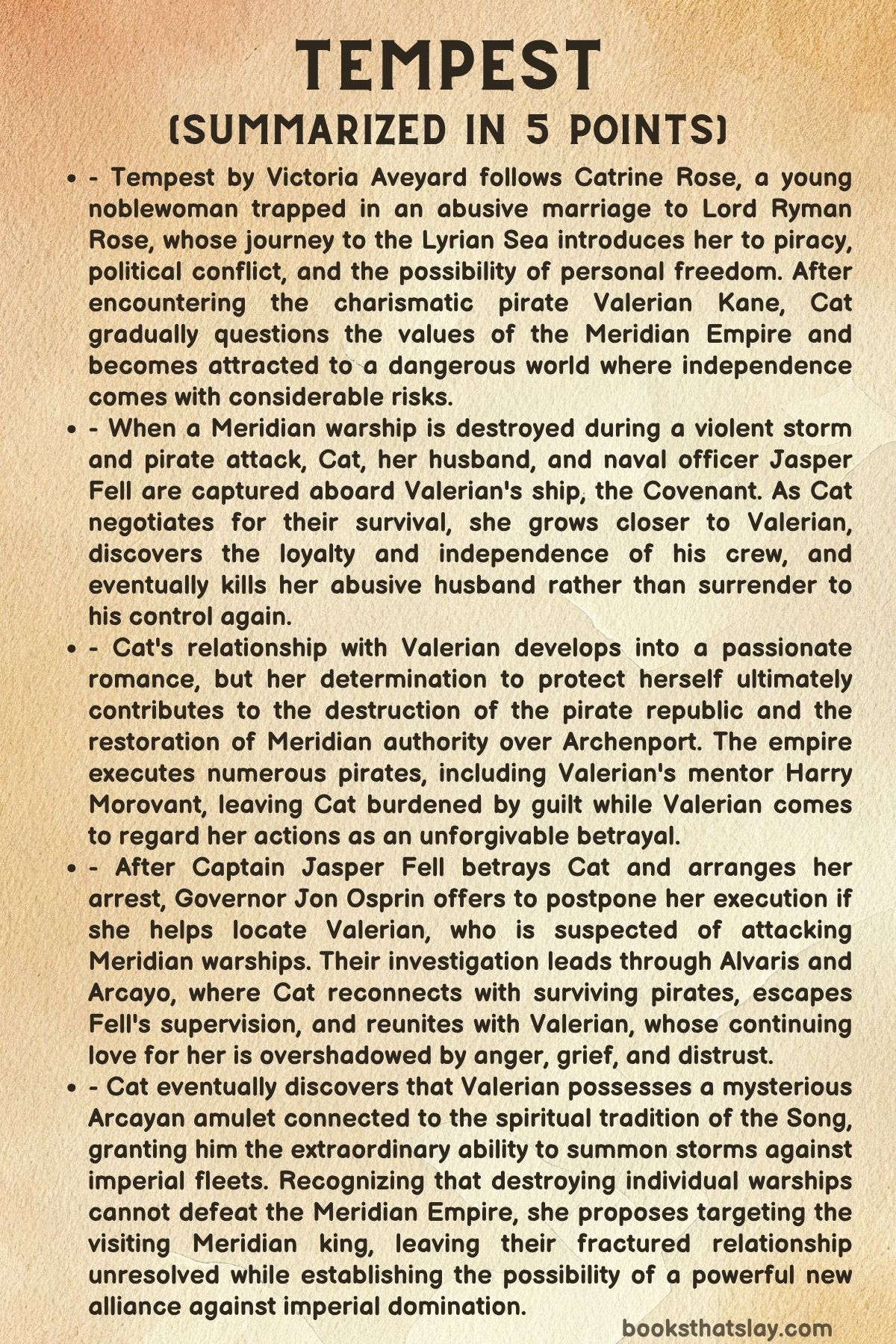
Summary
Catrine Rose lives in Archenport, a once-thriving pirate stronghold that has fallen under the control of the Meridian Empire. The streets are filled with reminders of the empire’s victory, including the bodies of executed pirates displayed as warnings to anyone considering resistance.
Among the dead is Captain Harry Morovant, a powerful pirate leader whose brutal execution troubles Cat because she knows that her own actions contributed to the destruction of the pirate republic. Although she repeatedly tells herself that betrayal was necessary for survival, her guilt remains impossible to escape.
Cat owns the Widow Rose tavern, an establishment that previously prospered under pirate rule but now struggles financially. Her loyal employee, Ms. Moseley, attempts to reassure her, yet the declining business and the empire’s increasingly oppressive presence make Cat desperate to leave Archenport.
Her circumstances become even more dangerous when Captain Jasper Fell, a Meridian naval officer with whom she shares a complicated history, arrives at her home. Cat expects him to fulfill an agreement that promised payment for her assistance in bringing down the pirates, but instead he presents an order for her arrest.
To understand Cat’s predicament, the story returns to her earlier life as Lady Catrine Rose, a nineteen-year-old woman trapped in an unhappy marriage to Lord Ryman Rose. Her husband is a financially ruined nobleman who has sold his estate and decided to rebuild his fortune on Rosby Island, a remote colonial possession in the Lyrian Sea.
Ryman is controlling, selfish, and abusive, leaving Cat with little authority over her own circumstances. Their voyage aboard the Credence introduces her to the colonial territories, the powerful empires competing for influence, and the independent island of Arcayo, whose people follow a spiritual tradition known as the Song.
During the crossing, the Credence encounters the Seadragon, a pirate vessel commanded by Captain Harry Morovant. The pirates board the ship and confiscate valuable possessions, but Cat discovers that they are far more organized and disciplined than the murderous criminals described in imperial accounts.
Among Morovant’s men is Valerian Kane, a striking young pirate with golden hair, storm-colored eyes, and a gold tooth. Their first encounter is confrontational, but Valerian becomes fascinated by Cat’s refusal to behave like a frightened, obedient noblewoman.
Before departing, Valerian takes a cracked turquoise prayer bead from Cat, leaving her with an unexpected memory of a man who appears to possess the independence she desperately desires. Although their meeting is brief, it establishes an attraction that will eventually transform both their lives.
Months later, Cat finds herself increasingly miserable on Rosby Island, where Ryman’s incompetence has failed to improve their finances. The arrival of Meridian naval officers creates an opportunity for her to escape the island temporarily and travel to Archenport.
Among the visitors is Lieutenant Jasper Fell, an ambitious officer who recognizes Cat’s intelligence and encourages her to use charm and careful judgment to improve her position. Cat begins to see that her future need not depend entirely on her husband’s authority.
She boards the Venerable, a Meridian warship commanded by Captain Quine, and experiences a brief period of freedom among its officers and sailors. However, the voyage becomes increasingly dangerous as news arrives of an Esperese attack on Allisport, revealing the growing conflict between the rival empires.
A violent storm eventually strikes the Venerable, and an enemy vessel attacks under cover of the terrible weather. The warship is destroyed, leaving Cat stranded among the wreckage until she discovers that Fell has also survived.
Their relief is short-lived when pirates rescue and capture them, bringing them aboard the Covenant, now commanded by Valerian Kane. Cat initially attempts to conceal her identity by pretending to be a servant, but Valerian immediately recognizes her.
The situation becomes even more complicated when her husband, Ryman, is discovered alive among the survivors. Valerian imprisons Ryman and Fell, leaving Cat to negotiate their release through a supposed ransom arrangement.
Although Cat claims that her husband possesses considerable wealth, she knows that his fortune is largely imaginary. She attempts to manipulate Valerian into sailing toward Meridian-controlled waters, hoping that the navy will intercept the Covenant and secure their freedom.
Valerian proves equally capable of deception. Cat gradually discovers that his ship is not traveling toward Archenport and that he has no intention of allowing himself to be captured merely to collect a ransom.
During her captivity, Cat begins to understand the pirate world more clearly. Valerian’s cabin contains books, maps, and navigational charts, while his crew operates according to established rules and recognizes the authority of captains chosen through collective consent.
She also develops a relationship with Anamina, known as Ana, a capable and independent pirate who challenges Cat’s understanding of what women can achieve outside conventional society. Through Ana and the other sailors, Cat experiences a community that recognizes practical ability rather than inherited rank.
Her growing attraction to Valerian strengthens during their conversations and competitive card games. Both possess sharp intelligence and a talent for understanding their opponents, making their relationship an ongoing contest of wit, pride, and mutual fascination.
Their connection deepens when Valerian reveals that he once served in the Meridian navy before abandoning imperial service. His past forces Cat to reconsider her assumptions about criminality, loyalty, and the institutions that claim to represent civilization.
However, Cat’s growing affection for the pirate captain becomes complicated when she witnesses the Covenant attack the Meridian warship Victorious. The violence horrifies her, particularly because the sailors she has begun to consider friends participate enthusiastically in the killing.
Cat realizes that freedom aboard a pirate ship carries serious consequences and that Valerian’s charm cannot erase the brutality of his profession. Nevertheless, she becomes increasingly attached to him and the unconventional existence he represents.
Their journey eventually brings them to Rosby Island, where Ryman expects to reclaim his authority over Cat. His demands and insults finally push her beyond endurance, and she shoots him in front of Valerian and the assembled pirates.
Ryman’s death releases Cat from her abusive marriage, although she recognizes that killing a Meridian nobleman could expose her to execution. Fell agrees to conceal the circumstances surrounding the incident, while Cat offers Valerian access to Rosby as a shelter and supply station for the Covenant.
For the first time, Cat begins making meaningful decisions about her own future. Her relationship with Valerian develops into love, and her association with the pirates eventually places her at the center of their struggle against imperial power.
The story then returns to the aftermath of the pirate republic’s destruction, when Cat is imprisoned at Fort Morden following Fell’s betrayal. She discovers that Governor Jon Osprin has postponed her execution because he believes her knowledge of the pirates may prove useful.
Three Meridian warships have mysteriously disappeared near Favor Island, apparently destroyed by storms, although evidence suggests pirate involvement. Osprin suspects that Valerian Kane is still alive and demands that Cat help locate him.
The revelation leaves Cat shaken because she believed that Valerian might have died during the empire’s victory. Although she still cares deeply for him, she also fears their reunion because her cooperation with the Meridian authorities helped bring about the republic’s destruction.
Osprin orders Cat to accompany Fell aboard the merchant vessel Fledge, allowing them to investigate pirate movements without attracting attention. Their journey takes them to Alvaris, where Cat exploits her knowledge of taverns, brothels, and informal commercial networks to gather information.
She secretly visits Ana, who has survived the imperial campaign and remains connected to the remaining pirates. Ana regards Cat with hostility, blaming her for the deaths of their companions and warning that neither the empire nor the pirates will ever fully trust her again.
Cat also visits the Paradise Quarter, where a powerful madam known as the Key Keeper reveals that many refugees from Archenport have traveled to Arcayo. The information convinces Cat that the surviving pirates may be rebuilding their networks around the independent island.
When Cat and Fell arrive in Arcayo’s capital, Nera, she finally escapes his supervision by appealing to pirates gathered in a local tavern. Their intervention results in Fell’s capture, allowing Cat to separate herself temporarily from the imperial expedition.
Cat attempts to accumulate enough money to leave the region through gambling, but her plans collapse when Valerian unexpectedly appears at a card game. Their reunion revives the competitive attraction that once defined their relationship, although their affection has been replaced by anger and suspicion.
Valerian blames Cat for the execution of Morovant and the destruction of the pirate republic. He takes her aboard the Covenant, where Fell and his sailors are also being held prisoner, and refuses to reveal his plans for continuing the struggle against the Meridian Empire.
While examining Valerian’s possessions, Cat discovers an Arcayan document and a drawing associated with a mysterious golden amulet. Combined with the unexplained destruction of the Meridian warships, these clues suggest that Valerian possesses an extraordinary connection to the sea.
Cat eventually confronts him and realizes that he has gained the ability to summon storms through a power associated with the Arcayan Song. His supernatural advantage explains how the surviving pirates can challenge imperial warships despite their greatly reduced numbers.
Nevertheless, Cat argues that destroying individual vessels will never be enough to defeat the Meridian Empire. Remembering that the Meridian king intends to visit the colonies, she proposes a far more ambitious strategy: the pirates should target the monarch himself.
The novel concludes from Valerian’s perspective as he considers Cat’s extraordinary proposal. Although he remains furious about her betrayal and uncertain whether he can ever trust her again, he recognizes that her intelligence could help transform the pirates’ resistance into a direct challenge against imperial authority.
Their romantic future remains unresolved, but the possibility of cooperation offers a new beginning. Cat and Valerian stand at the threshold of a conflict that could change the political future of the entire Lyrian Sea.
Characters
Catrine Rose (Cat)
Catrine Rose is the central protagonist of Tempest, a resourceful and morally complicated woman whose determination to survive drives much of the story. Her transformation from an unhappy noblewoman into an independent tavern owner and influential figure within the pirate world forms the emotional foundation of the novel.
Initially, Cat possesses little control over her life because her marriage to Ryman Rose places her under the authority of a selfish and abusive husband. Although she has intelligence, courage, and considerable social awareness, the restrictions of Meridian society prevent her from exercising these qualities freely.
Her encounters with pirates gradually challenge her assumptions about status, morality, and freedom. She discovers that individuals condemned as criminals sometimes possess greater respect for personal autonomy than the supposedly respectable aristocrats and imperial officers she has known.
Cat’s intelligence becomes particularly evident in her negotiations with Valerian and her remarkable skill at gambling. She understands human behavior, recognizes weaknesses in her opponents, and uses conversation strategically to influence people who possess greater physical or institutional power.
However, Cat’s abilities also contribute to her moral difficulties. Her instinct for self-preservation can lead her to manipulate others, conceal important information, and make decisions that protect her personally while exposing her companions to danger.
Her involvement in the destruction of the pirate republic represents the darkest consequence of this survival instinct. Although she insists that she attempted to warn Valerian, she cannot escape responsibility for cooperating with the empire that subsequently executed people she once considered friends.
The murder of Ryman marks a crucial turning point in her development. By refusing to return to an abusive marriage, Cat asserts control over her body and future, although her liberation comes through an act of irreversible violence.
Her relationship with Valerian exposes another dimension of her personality because love demands a vulnerability that she finds difficult to accept. She desires intimacy and belonging but fears surrendering the independence she has struggled to obtain.
By the novel’s conclusion, Cat demonstrates that her greatest strength is not simply her ability to survive danger but her capacity to recognize possibilities others overlook. Her proposal to target the Meridian king reveals a woman who has progressed from reacting to powerful institutions to imagining how they might be challenged.
Valerian Kane
Valerian Kane is the principal romantic figure and one of the most compelling personalities in Tempest, embodying both the promise of freedom and the destructive consequences of rebellion. His identity as a pirate captain contrasts sharply with his earlier service in the Meridian navy, revealing a man who has consciously rejected the political system that once commanded his loyalty.
He first appears as a confident young pirate serving under Captain Harry Morovant. His golden hair, distinctive gold tooth, and storm-colored eyes contribute to his memorable appearance, but his intelligence and unconventional behavior make a greater impression on Cat.
Valerian’s leadership is based on practical competence and the confidence of his crew rather than inherited privilege. He commands the Covenant with considerable skill, understands maritime tactics, and recognizes that surviving against powerful imperial fleets requires deception, careful planning, and cooperation.
His relationship with Cat reveals his capacity for affection, humor, and emotional generosity. He appreciates her intelligence and independence, encouraging qualities that her husband attempted to suppress.
Nevertheless, Valerian is not an idealized romantic hero. His attacks on Meridian ships involve considerable bloodshed, and his willingness to use violence exposes the contradiction between his commitment to freedom and the suffering caused by his methods.
The death of Morovant and the destruction of the pirate republic profoundly affect his personality. Grief hardens into resentment, leaving him unable to separate his continuing love for Cat from his conviction that she betrayed their companions.
His acquisition of the Arcayan amulet introduces another dimension of responsibility. The ability to summon storms gives him an advantage against imperial power, but it also raises questions about whether extraordinary strength will make him more reckless.
Valerian’s development remains unfinished at the conclusion. He must decide whether his commitment to revenge will dominate his future or whether he can accept Cat’s strategic vision and begin rebuilding the trust they have lost.
Jasper Fell
Jasper Fell is one of the most morally ambiguous figures in Tempest, occupying a position between companion, betrayer, and determined servant of the Meridian Empire. His relationship with Cat changes repeatedly as political circumstances shift, making him both an important influence on her development and a direct threat to her survival.
When Cat first encounters him on Rosby Island, Fell appears intelligent, capable, and considerably more perceptive than her husband. He recognizes her abilities and encourages her to navigate difficult situations through social intelligence rather than passive obedience.
His behavior during the destruction of the Venerable also demonstrates courage and resilience. After surviving the wreck, he remains concerned about Cat’s safety and attempts to preserve his dignity even when captured by pirates.
However, Fell’s devotion to professional advancement gradually exposes his willingness to compromise his principles. His ambition makes him susceptible to the demands of superior officers, particularly when cooperation promises greater recognition and authority.
His betrayal of Cat represents the clearest example of this weakness. Despite their shared history and the assistance she provided in restoring imperial control over Archenport, he participates in her arrest instead of fulfilling their agreement.
Yet Fell cannot be reduced to an entirely selfish opportunist. When Valerian captures him, he offers himself in exchange for his sailors, demonstrating that he understands leadership as a responsibility extending beyond personal advancement.
His complicated relationship with Cat is rooted partly in their similarities. Both rely on intelligence and compromise to survive, but whereas Cat increasingly questions imperial institutions, Fell remains invested in achieving success within them.
Fell represents the consequences of attaching personal identity to a political hierarchy. His ambition gives him purpose and direction, but it repeatedly leads him to sacrifice relationships and moral independence.
Lord Ryman Rose
Ryman Rose is Cat’s abusive husband and one of the principal sources of her early suffering. As an older, financially ruined nobleman, he believes his inherited social position entitles him to authority even when his behavior demonstrates incompetence and selfishness.
His decision to sell his estate and relocate to Rosby Island reflects both desperation and an unrealistic belief that colonial property will restore his fortune. Rather than accept responsibility for his failures, he complains about his circumstances and expects others to accommodate his demands.
Ryman’s treatment of Cat exposes the oppressive nature of their marriage. He regards her obedience as something he can demand rather than a matter of mutual respect, leaving her frightened, isolated, and increasingly desperate for independence.
His behavior contrasts with the relationships Cat encounters aboard pirate vessels. Even men who operate outside the law often recognize practical ability and personal courage more readily than Ryman does.
The collapse of the Venerable briefly creates the possibility that Cat has escaped her marriage through his death. His unexpected survival therefore becomes another reminder of the power he continues to exercise over her future.
When he attempts to reassert his authority on Rosby, Cat finally refuses to submit. His death becomes a defining moment of liberation while also demonstrating the extreme consequences of a relationship in which one person has denied the other’s autonomy.
Captain Harry Morovant
Harry Morovant is a powerful pirate captain whose influence extends across both the personal and political conflicts of Tempest. He initially appears as the commander of the Seadragon, the vessel that intercepts Cat’s ship during her first voyage into the Lyrian Sea.
Morovant possesses a formidable reputation, but his behavior reveals that successful piracy depends upon discipline, calculation, and established relationships. He understands the commercial value of captured ships and cargo, preferring profitable operations to unnecessary destruction.
His relationship with Valerian resembles that of a father and son. He regards the younger captain with pride while remaining willing to criticize tactical decisions that place lives or valuable resources at risk.
Morovant also recognizes Cat’s intelligence, particularly when she defeats him at cards. His willingness to accept her abilities helps demonstrate why pirate society sometimes provides opportunities unavailable within conventional aristocratic structures.
His execution following the fall of the pirate republic becomes one of the story’s defining tragedies. The display of his mutilated remains illustrates imperial brutality and transforms him into a symbol of the community the empire has destroyed.
For Valerian, Morovant’s death represents a personal loss that cannot be separated from his hatred of Cat’s betrayal. Although the older captain disappears from the later action, his influence continues to shape Valerian’s decisions and emotional conflicts.
Anamina (Ana)
Anamina, generally known as Ana, is a formidable pirate whose independence and loyalty challenge Cat’s expectations of women in the Lyrian Sea. In Tempest, she represents a form of female authority founded upon competence, courage, and the respect of her companions rather than marriage or inherited rank.
Ana serves aboard the Covenant and possesses considerable experience with weapons, maritime life, and the practical responsibilities of piracy. Her direct manner initially unsettles Cat, who is accustomed to the restrictive expectations of Meridian society.
Despite her intimidating personality, Ana becomes an important influence on Cat’s development. She encourages Cat to acquire useful abilities and recognize that participating in the pirate community requires more than enjoying its freedom.
Ana also understands the cruelty of Cat’s marriage. Her sympathy demonstrates that she can distinguish between Cat’s personal suffering and the larger political divisions separating them.
Following the destruction of the pirate republic, Ana remains active through connections involving the Arcayan religious network. Her presence in Alvaris suggests that the surviving pirates retain sources of intelligence and communication beyond conventional military systems.
Her reunion with Cat exposes the depth of resentment caused by the republic’s fall. Ana cannot easily forgive someone whose decisions helped destroy their companions, regardless of the explanations Cat provides.
Through Ana, the novel presents loyalty as something earned through shared experience and maintained through difficult choices. Her refusal to restore trust immediately emphasizes that friendship carries responsibilities that personal affection cannot erase.
Governor Jon Osprin
Governor Jon Osprin is the principal representative of Meridian imperial authority during the later events of Tempest. A former admiral, he combines military experience with political ambition, making him a particularly dangerous opponent for the surviving pirates.
Osprin governs Archenport following the destruction of the pirate republic. His administration uses imprisonment, public executions, and intimidation to establish control over a population that previously lived under an entirely different political order.
His methods demonstrate that imperial authority depends on fear as much as military strength. The bodies displayed throughout the city are intended to discourage resistance while reminding the population that the empire controls their lives.
Osprin is also an intelligent political strategist. He recognizes the importance of Cat’s knowledge and postpones her execution because her relationships with the pirates may help locate Valerian.
His determination to eliminate resistance is intensified by the approaching visit of the Meridian king. The governor understands that his career and reputation depend upon presenting the colonies as peaceful territories firmly under imperial control.
This pressure exposes the personal motivations underlying his official duties. Although Osprin claims to defend imperial stability, his decisions are also shaped by the desire to protect his position and satisfy the expectations of his superiors.
He represents institutional power without meaningful accountability to the people it governs. His authority provides the principal political threat against which Cat and Valerian must eventually develop their resistance.
Ms. Moseley
Ms. Moseley is Cat’s loyal employee at the Widow Rose tavern and an important source of stability during the difficult period following the empire’s return. Her practical nature contrasts with the uncertainty surrounding Cat’s finances, political future, and personal safety.
She understands the realities of running a business and attempts to reassure Cat even as declining trade threatens the establishment. Her concern suggests a relationship extending beyond the formal obligations of employment.
Moseley also represents the ordinary citizens whose livelihoods suffer when political power changes hands. The collapse of the pirate republic does not simply affect captains and naval officers; it damages the businesses and communities that depended upon maritime commerce.
Her response to Cat’s imprisonment and subsequent departure reveals genuine affection beneath her restrained manner. Although she cannot control the larger political conflict, she offers Cat a sense of continuity and belonging.
Derry
Derry is Cat’s maid in Archenport, a supporting character whose loyalty becomes especially important when Fell arrives to arrest her employer. Her nervous behavior alerts Cat that something is wrong before the confrontation develops.
When imperial soldiers take Cat into custody, Derry remains one of the few people Cat can trust to communicate with Ms. Moseley. This responsibility demonstrates the importance of personal relationships when official institutions become threatening.
Derry possesses little influence over the political forces surrounding her, but her presence provides a reminder of Cat’s domestic life beyond piracy and warfare. She represents ordinary loyalty expressed through practical acts of assistance.
Captain Vex
Captain Vex is one of the surviving pirate leaders encountered during Cat’s return to Nera. His participation in high-stakes gambling places him within the social network that continues to connect pirate captains after the republic’s destruction.
His presence establishes that imperial victory has not eliminated organized piracy from the Lyrian Sea. Instead, surviving captains remain in contact and appear increasingly prepared to cooperate against their common enemy.
Vex’s interactions with Valerian also demonstrate that the remaining pirates operate through relationships of mutual recognition rather than complete dependence on a single commander. Although his personal history receives limited attention, he contributes to the sense that a broader resistance movement is emerging.
The Key Keeper
The Key Keeper is an influential madam operating within Alvaris’s Paradise Quarter. Her importance comes from her access to information, which makes her establishment a valuable resource for people seeking knowledge about sailors, merchants, and displaced communities.
When Cat approaches her under a false identity, the Key Keeper initially considers whether she might be looking for employment. Her cautious questioning demonstrates an ability to assess unfamiliar visitors without revealing information too quickly.
She eventually provides Cat with crucial details about women leaving Archenport for Arcayo and other possible pirate refuges. This knowledge helps redirect Cat’s investigation toward Nera.
The Key Keeper illustrates how women working outside official political structures can possess considerable informal influence. Her authority depends upon information, commercial relationships, and an understanding of the people who pass through her establishment.
Garedo
Garedo is a pirate associated with the surviving networks Cat encounters in Nera. His recognition of her reflects her former position within the pirate community and the reputation she continues to carry after the republic’s collapse.
His questions about Valerian reveal the uncertainty surrounding the movements and intentions of the surviving captains. He also helps establish that Cat cannot simply return to pirate society without confronting suspicion.
Garedo’s presence contributes to the scene in which Cat breaks away from Fell’s supervision. He represents the collective memory of a community that has suffered defeat but has not entirely lost its identity.
Captain Quine
Captain Quine commands the Meridian warship Venerable during Cat’s journey from Rosby toward Archenport. His professional authority contrasts with Ryman’s inherited arrogance, demonstrating that practical competence carries considerable importance aboard a naval vessel.
When the storm strikes, Quine and his officers struggle to maintain control of the ship under increasingly dangerous conditions. His efforts illustrate the vulnerability of even well-equipped imperial vessels against violent weather and unexpected attack.
Although the destruction of the Venerable limits his role in the story, Quine helps establish the military environment in which Cat first develops a meaningful connection with Fell.
Captain Meedy
Captain Meedy commands the Credence, the vessel carrying Cat and Ryman toward the Lyrian Sea at the beginning of their colonial journey. His encounter with Morovant’s pirate ship establishes the practical limitations of imperial protection.
Recognizing that resistance would likely lead to unnecessary deaths, Meedy chooses surrender rather than an unwinnable confrontation. His decision frustrates Cat, who initially expects the captain to defend the passengers and their possessions.
Nevertheless, Meedy’s actions demonstrate an experienced sailor’s understanding of danger. He values survival over pride, introducing a principle that Cat will repeatedly confront throughout her own development.
Sara
Sara is Cat’s maid during the earlier voyage aboard the Venerable. Her fear during the violent storm helps communicate the danger faced by passengers who have little knowledge of maritime warfare or navigation.
Cat’s later decision to use the name Sara Cove while disguising herself as a servant is significant because it demonstrates her understanding of social assumptions. By presenting herself as a woman of lower status, she hopes to become less recognizable and less valuable to her captors.
Sara’s limited presence nevertheless highlights the vulnerability of servants during conflicts initiated by rulers, officers, and pirates.
Mr. Greer
Mr. Greer is a servant traveling with the Roses aboard the Credence who unexpectedly chooses to join Morovant’s pirates. His decision surprises Cat because she has been taught to regard piracy as a dangerous and dishonorable occupation.
By abandoning imperial employment, Greer reveals that the conventional social order does not satisfy everyone living within it. The prospect of greater independence can outweigh the security offered by established positions.
His choice provides an early indication that piracy may represent a deliberate rejection of restrictive circumstances rather than merely a criminal pursuit.
Ned Dalton
Ned Dalton is an elderly printer imprisoned at Fort Morden because of his association with the former pirate republic. Cat recognizes him while being escorted through the fortress, and his condition reinforces her guilt over the empire’s return.
Dalton is significant because he demonstrates that imperial punishment extends beyond armed pirates. People who participated in the republic’s civilian and commercial life are also vulnerable to arrest and persecution.
His imprisonment exposes the empire’s inability or unwillingness to distinguish between violent resistance and ordinary association with a defeated political order.
Horace
Horace is a pirate involved in the boarding of the Credence. His threatening behavior toward Cat represents the immediate physical danger she faces during her first encounter with piracy.
Cat’s refusal to surrender to his intimidation attracts Valerian’s attention, making Horace an important figure in establishing the initial connection between the two central characters.
His brief appearance also prevents the novel from presenting pirates as uniformly sympathetic. The threat he poses reminds readers that the pirate community contains individuals capable of cruelty as well as those who demonstrate loyalty and respect.
Elisabeth
Elisabeth is a woman Cat encounters while investigating the service areas of Alvaris’s Paradise Quarter. She directs Cat toward the Key Keeper, enabling her to reach someone with valuable knowledge about movements throughout the Lyrian Sea.
Although Elisabeth has a limited role, her assistance demonstrates how information travels through informal relationships among women working in commercial establishments. Her actions help Cat obtain evidence that conventional naval investigations have failed to uncover.
Captain Carley
Captain Carley is a Meridian officer who participates in the investigation into the mysterious destruction of imperial ships. His presence during Cat’s interrogation establishes the seriousness with which the navy regards the possibility of renewed pirate activity.
Carley represents the professional military structure supporting Governor Osprin’s campaign. Although his individual motivations are not explored in depth, his role reinforces the organized institutional power confronting the pirates.
Lieutenant Groust
Lieutenant Groust participates alongside the other Meridian officers in discussions about the remaining pirate threat. His presence emphasizes that the investigation into Valerian’s activities involves an established military hierarchy rather than Fell acting independently.
Groust contributes to the atmosphere of official scrutiny surrounding Cat. As someone required to provide information about people she once trusted, she must remain conscious of how her statements may be interpreted by the officers.
Lieutenant Whisten
Lieutenant Whisten accompanies Cat and Fell during their investigation in Alvaris. His presence helps establish the supervision under which Cat travels after her conditional release from imprisonment.
However, his participation also highlights the limitations of military surveillance in unfamiliar civilian environments. Cat’s knowledge of markets, religious sites, and local social networks eventually allows her to escape the officers and pursue her own investigation.
Themes
Freedom, Personal Autonomy, and the Cost of Independence
Freedom is a constantly contested condition in Tempest, where individuals struggle against the authority of spouses, governments, social classes, and military institutions. Cat’s experiences demonstrate that independence is not simply something a person receives by escaping a particular situation; it must be defended through choices that can carry serious consequences.
Her marriage to Ryman establishes the personal dimension of this struggle. Despite her intelligence and courage, Cat possesses little control over her own body, movements, or future because the society surrounding her recognizes her husband’s authority.
Her arrival in the Lyrian Sea initially appears to exchange one form of confinement for another. Rosby Island isolates her geographically, while the empire’s colonial arrangements provide few meaningful opportunities for her to challenge the restrictions imposed upon her.
The pirate community introduces a competing understanding of freedom. Captains depend upon the confidence of their crews, women such as Ana exercise practical authority, and individuals like Mr. Greer can abandon established positions in pursuit of different lives.
However, the pirates’ independence is complicated by the violence required to protect it. Valerian’s attacks on imperial ships expose Cat to suffering that challenges her belief that freedom necessarily makes people morally superior.
The killing of Ryman represents the most extreme expression of Cat’s demand for personal autonomy. Although she finally breaks his control, the act creates new dangers and forces her to recognize that liberation can involve consequences she cannot easily undo.
Her subsequent association with the pirates and the empire reveals that freedom remains vulnerable to betrayal, coercion, and political ambition. Even after escaping her marriage, she must negotiate with powerful men who attempt to determine her future.
Ultimately, the novel treats independence as a continuing responsibility rather than a permanent achievement. Cat’s development suggests that genuine freedom requires not only the courage to reject oppression but also the wisdom to recognize how personal decisions affect other people’s lives.
Loyalty, Betrayal, and the Difficulty of Rebuilding Trust
Cat and Valerian’s relationship demonstrates how love can survive betrayal without immediately overcoming its consequences. Their emotional connection begins through curiosity, mutual respect, and shared experiences, but political conflict eventually transforms those qualities into sources of pain.
During their earlier relationship, Cat discovers that Valerian appreciates her intelligence rather than expecting obedience. His recognition allows her to imagine a future in which affection does not require surrendering personal independence.
Valerian likewise becomes attached to Cat because she challenges him. Their card games and negotiations establish a relationship between individuals who recognize similar qualities in one another, even when their immediate interests conflict.
However, their ability to understand each other’s weaknesses also makes betrayal especially destructive. When Cat cooperates with the Meridian authorities, Valerian interprets her decision as a rejection not only of him but of the community that had accepted her.
The execution of Morovant intensifies this sense of betrayal. Because the older captain served as a paternal figure to Valerian, his death becomes inseparable from the collapse of the pirate republic and Cat’s involvement in that disaster.
Cat’s explanations cannot easily restore Valerian’s confidence. Although she insists that she attempted to warn him, her actions had consequences that cannot be reversed through declarations of good intentions.
Jasper Fell provides a parallel examination of compromised loyalty. His relationship with Cat contains genuine respect and moments of concern, yet his pursuit of professional advancement leads him to betray her when doing so benefits his career.
The contrast between personal affection and institutional obligation becomes especially significant because characters repeatedly justify harmful decisions as necessary for survival or duty. Such justifications may explain their behavior without entirely excusing it.
By the conclusion, Cat and Valerian remain emotionally connected but deeply uncertain about each other. Their willingness to discuss a shared political strategy suggests that rebuilding trust may begin through cooperation, although forgiveness remains a difficult and unfinished process.
Imperialism, Resistance, and the Abuse of Political Power
The political conflict in Tempest centers on competing claims to authority over the Lyrian Sea. The Meridian Empire considers colonial control an expression of legitimate government, while the pirates and independent island communities challenge the assumption that foreign rulers possess the right to determine their future.
Archenport provides the clearest illustration of imperial domination. After the pirate republic falls, Governor Osprin establishes authority through executions, imprisonment, and public displays designed to discourage opposition.
The severity of these measures exposes the contradiction between the empire’s claims of maintaining order and its willingness to employ extreme violence. Political stability becomes associated with obedience rather than justice or meaningful public consent.
The imprisonment of Ned Dalton reinforces this criticism. His association with the former republic is enough to make him vulnerable to punishment, demonstrating that imperial repression affects civilians as well as armed opponents.
Governor Osprin embodies the relationship between institutional authority and personal ambition. His determination to eliminate piracy is intensified by the Meridian king’s approaching visit, which creates pressure to demonstrate that the colonies have been fully subdued.
The pirates offer an alternative political organization through leaders whose authority depends upon the approval of their crews. Their relationships suggest a more participatory system, although their dependence on raiding and violence prevents them from representing an uncomplicated moral ideal.
Arcayo provides another form of resistance by maintaining its political independence and preserving the spiritual tradition of the Song. Its prosperity challenges the assumption that the islands require foreign imperial control to sustain civilization or commerce.
The spreading influence of Arcayan religious networks also reveals that resistance can develop through culture, communication, and mutual assistance rather than military confrontation alone. These connections help preserve relationships among people displaced by imperial expansion.
Cat’s final proposal to target the Meridian king reflects her growing understanding that individual naval victories cannot necessarily dismantle an oppressive political system. By confronting the symbolic center of imperial power, she hopes to change the broader conditions that make colonial domination possible.
The novel ultimately questions whether governments acquire legitimacy through military success or through the consent and welfare of those they govern. Its portrayal of competing political structures suggests that authority becomes destructive when power is treated as sufficient justification for its own exercise.
The Sea, Spiritual Belief, and the Relationship Between Humanity and Nature
The Lyrian Sea functions as more than the geographical setting of the novel. Its storms, islands, currents, and unpredictable conditions shape political ambitions, personal relationships, and the boundaries of human control.
For the Meridian Empire, the sea is primarily a territory to dominate. Naval fleets, colonial settlements, and commercial routes reflect an effort to transform a complex natural environment into a system governed by imperial authority.
Valerian approaches the same environment through a different understanding. His connection to the sea is personal and spiritual, shaped by experiences that lead him to regard its power as something deserving respect.
The Arcayan tradition of the Song introduces the possibility that nature possesses a significance beyond material resources. Its religious practices, ancient towers, and sacred symbols suggest a relationship between human communities and forces that cannot be controlled through ordinary military strength.
Cat initially encounters these beliefs as an outsider. Her upbringing within Meridian society has encouraged her to view foreign traditions with curiosity and uncertainty rather than as sources of genuine spiritual knowledge.
However, the destruction of the Venerable challenges the assumptions upon which her earlier worldview depends. Surrounded by a violent storm and confronted with death, she instinctively turns toward the sea itself in search of protection.
Valerian’s mysterious golden amulet transforms the spiritual dimension of the story into a decisive political force. His ability to summon storms suggests that the natural world can actively challenge empires that believe their military technology guarantees supremacy.
Yet the power to command storms also introduces a moral problem. Although Valerian uses this ability against an oppressive empire, the destruction of ships necessarily exposes sailors and other individuals to deadly consequences.
The sea therefore represents both freedom and danger, offering escape from restrictive institutions while refusing to guarantee safety. Its unpredictability reflects the emotional and political uncertainty experienced by the central characters.
By connecting spiritual belief with the conflict over colonial authority, the novel suggests that conquering territory does not necessarily mean understanding the cultures and forces that sustain it. The mysteries of the Lyrian Sea remain larger than the ambitions of any individual ruler, pirate captain, or empire.