The Commons by Rebecca Ihim Summary, Characters and Themes
The Commons by Rebecca Ihim is a dystopian science fiction novel that explores the dangerous consequences of unchecked institutional power, social inequality, and the pursuit of excellence at any cost.
Set in a technologically advanced future, the story follows Shantavia Lerogaski, an eighteen-year-old determined to uncover the truth behind her older sister’s disappearance at the world’s most prestigious educational institution. What begins as a personal rescue mission develops into a struggle against an organization that controls the lives of countless individuals. Combining suspense, romance, political corruption, and family relationships, the novel questions whether a society built on extraordinary achievement can truly be considered successful when its progress depends on exploitation. It’s the 1st book in the Commons World series.
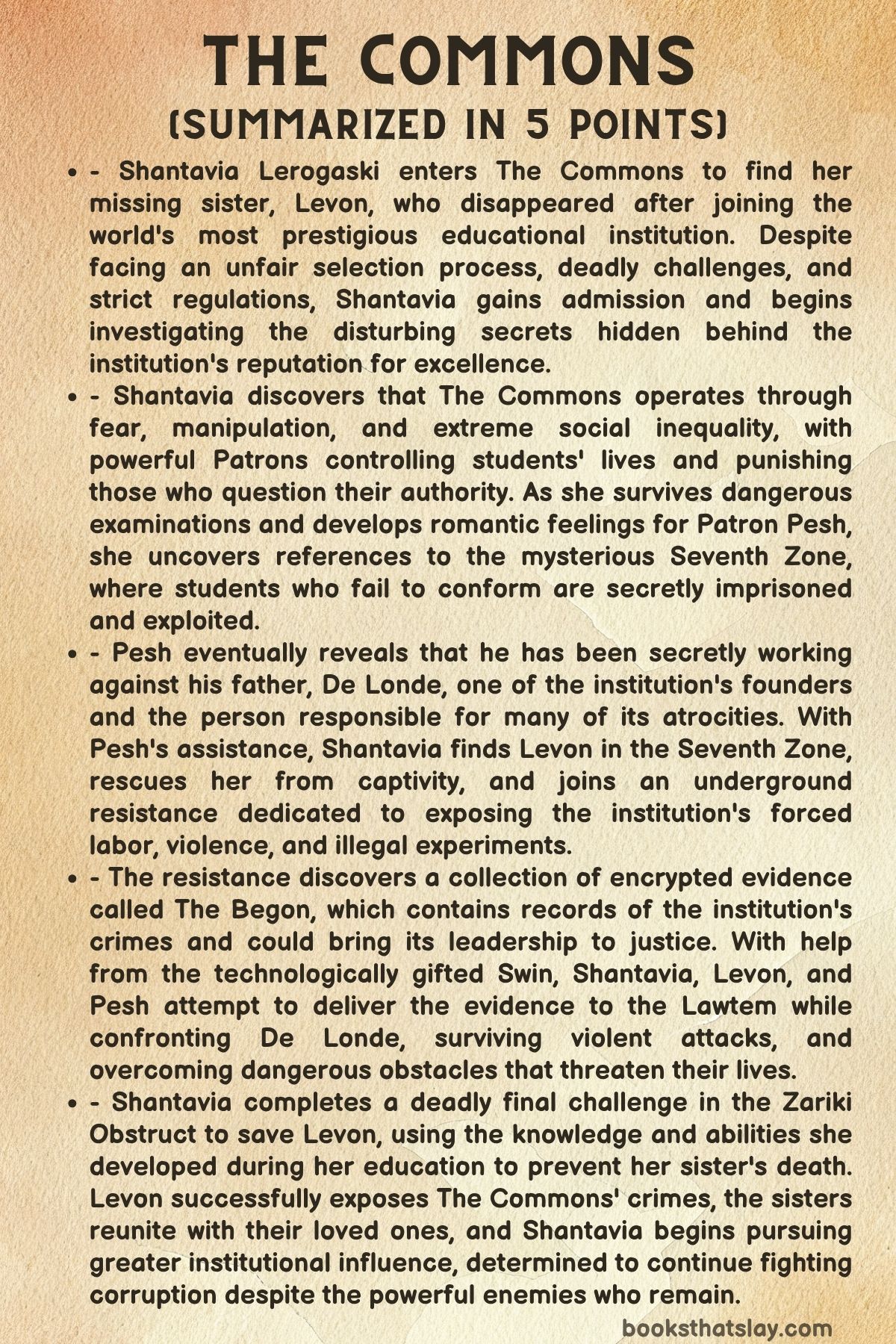
Summary
In the year 2126, The Commons stands as the world’s most powerful educational institution, possessing influence over governments, corporations, and international affairs. Admission is considered an extraordinary privilege, but behind its reputation for excellence lies a system governed by wealthy families, powerful Patrons, and disturbing secrets.
Eighteen-year-old Shantavia Lerogaski desperately wants to enter the institution, although her motivation differs from that of most applicants. Her older sister, Levon, disappeared after enrolling there, and Shantavia believes that becoming a student is her only opportunity to discover what happened.
Despite her outstanding academic qualifications, Shantavia faces an unfair selection process that favors wealthy and politically connected applicants. Her situation becomes more dangerous when she encounters Patron Pesh, an influential authority who reacts strangely upon learning her name.
Pesh sends Shantavia into Oblivion, a deadly competition where rejected applicants compete for a final admission opportunity. There, she witnesses terrifying violence, including the death of her former classmate Xexe, and encounters a monstrous dragon that seems mysteriously connected to Levon.
Although Shantavia survives, she initially believes that her application has failed. To her surprise, a golden messenger subsequently delivers an acceptance letter, allowing her to begin the investigation she has planned for years.
Shantavia travels with her parents to Commonda Island, a technologically advanced location off the California coast. The magnificent campus contains extraordinary buildings, automated transportation, surveillance technology, and strict regulations governing nearly every aspect of student life.
Her parents celebrate her admission, unaware of the full extent of her intentions. Shantavia, however, remembers Levon’s disturbing warnings about the institution and the emotional distance within their family that made her sister her primary source of comfort.
During orientation, Doctor Val explains that The Commons prepares exceptional individuals to regulate society for the common good. Students must complete demanding assessments across six academic fields, including Cognitive, Oratory, Math and Science, Meaning and Memory, Observation, and Nature.
Shantavia reunites with her former classmate Zia and meets Beatrice, a strict supervisor responsible for enforcing institutional discipline. She quickly recognizes that even minor violations can result in severe punishment.
Her first major obstacle is the Cognitive Test, which examines unconscious thoughts and psychological vulnerabilities. Fearing that the institution will discover her secret investigation, Shantavia studies meditation and mental control in the enormous library.
There, she learns about a restricted book called The Tragedy of The Commons, which might contain information about the institution’s origins. She also encounters the wealthy, arrogant Zavish Lumiere, whose privileged upbringing reflects the inequalities surrounding her.
During the Cognitive Test, Shantavia relives painful childhood memories involving her emotionally unavailable parents. One particularly traumatic experience concerns her deliberately injuring herself in the hope of receiving her mother’s attention, only to discover that professional obligations still take precedence.
These memories explain Shantavia’s fear of rejection and her extraordinary attachment to Levon, who consistently provided the emotional support she needed.
Her subsequent Oratory examination requires her to deliver a speech while computerized mirrors create distractions. Speaking about power, Shantavia gradually reveals her personal insecurities, family disappointments, and fear of emotional vulnerability.
Pesh witnesses her distress and responds with unexpected compassion, complicating her opinion of him. Although she suspects that he knows something about Levon’s disappearance, Shantavia begins developing romantic feelings for him.
Meanwhile, Patron Lenon’s cruel treatment of students exposes the institution’s reliance on humiliation and intimidation. Shantavia considers deliberately provoking him to gain access to restricted disciplinary areas.
During Chemistry studies, she discovers a hallway where students can approach Patrons romantically. An unexpected encounter results in Pesh kissing her, apparently to protect her from punishment by his colleagues.
Their growing connection allows Shantavia to learn about Pesh’s troubled childhood and his mother’s supposed suicide. She also discovers references to a mysterious Seventh Zone, which Pesh refuses to discuss.
Determined to uncover the truth, Shantavia continues her demanding examinations while attempting to complete the library’s nearly impossible reading challenge. She survives dangerous scientific experiments, encounters crocodiles during an Observation assessment, and confronts morally disturbing situations involving simulated life-and-death decisions.
One assessment requires her to choose how to respond when a mother and child face a deadly shark. Rejecting the limited options presented, she sacrifices her simulated life to protect them.
Her unusual decision attracts the attention of Patron De Londe, one of the institution’s founders. During their conversation, he reveals disturbing beliefs about suffering, morality, and conformity, while criticizing Shantavia’s natural hair.
Shortly afterward, Shantavia learns that De Londe has ordered other Patrons to injure her without killing her. She realizes that someone within the institution has deliberately marked her as a target.
Despite failing the library challenge, Shantavia eventually obtains the restricted book through Pesh’s secret assistance. Its contents reveal an institutional philosophy suggesting that the advancement of privileged individuals depends on the suffering and depletion of others.
Convinced that Levon is imprisoned in the Seventh Zone, Shantavia investigates Pesh’s office and discovers classified information about secret military resources and concealed routes.
Her investigation also damages her friendship with Zia, who admits to betraying her confidence out of jealousy. Meanwhile, Pesh discovers Shantavia’s escape plans and confronts her.
Their confrontation unexpectedly becomes a moment of emotional honesty. Pesh admits that he knew about Shantavia before her admission and had tried to prevent her enrollment because he feared for her safety.
Recognizing that their feelings are mutual, the two begin a romantic relationship. Pesh invites Shantavia to a private dinner at the Porch of Grindoria, promising to explain the truth afterward.
During their meeting, Pesh finally reveals that students who fail to conform are transported to the Seventh Zone, where they endure imprisonment and forced labor. Before Shantavia can react, guards restrain her, and Pesh announces that she is being sent there.
He also reveals that De Londe is his father, making his apparent betrayal especially devastating.
While traveling toward the Seventh Zone, Shantavia discovers a hidden message explaining that Pesh’s actions are part of a secret rescue operation. He has been working against the institution while pretending to remain loyal to its leadership.
Inside the forbidden zone, Shantavia witnesses enormous industrial facilities, experimental laboratories, surveillance systems, and imprisoned students subjected to brutal working conditions.
Pesh eventually reunites her with Levon, whose injuries and psychological suffering reveal the severity of her imprisonment. The sisters escape with his assistance, accompanied by a young prisoner named Swin.
Their escape takes them through the ocean into a concealed underwater refuge housing former Commoners whom Pesh has secretly rescued. The survivors belong to a resistance movement dedicated to exposing the institution’s crimes.
The resistance possesses an encrypted collection of evidence called The Begon, containing financial records, surveillance footage, and information about forced labor and unlawful deaths.
However, the evidence cannot be presented to the independent judicial institution known as the Lawtem until its encryption is broken.
Swin, whose real name is Erelevant, proves exceptionally skilled with technology. He discovers that The Begon’s security is connected to a sensor implanted in De Londe’s head and begins developing a method of accessing its contents.
Meanwhile, Levon finally tells Shantavia about the sexual violence, coercion, and medical exploitation she experienced during captivity. Shantavia reassures her that the responsibility for those crimes belongs to her abusers rather than to her decision to pursue an education.
As the resistance prepares its evidence, De Londe discovers suspicious activity and initiates a process that will destroy The Begon. Pesh creates a duplicate to distract his father while Swin attempts to recover the genuine records.
During this period, Pesh reveals that De Londe murdered his mother and falsely presented her death as suicide. Shantavia understands more fully the suffering that motivated Pesh to oppose his father.
Pesh confronts De Londe alone, but the confrontation becomes disastrous when De Londe reveals that Levon unknowingly carries a tracking device. He also discloses that her investigations into the mysterious Common Gene contributed to her imprisonment.
De Londe attacks Pesh with an experimental poison. Shantavia attempts to rescue him while sending Levon and Swin toward the Lawtem with the evidence.
Captured by the institution’s guards, Shantavia fights desperately against Beatrice and several Patrons. She eventually helps Pesh obtain a dagger, allowing him to stab De Londe.
Although Pesh collapses from the poison, Doctor Val manages to develop a treatment that saves his life.
The struggle continues when Levon becomes trapped in the Zariki Obstruct, a deadly region filled with natural hazards and technological traps. Shantavia learns that the environment inspired the institution’s six major examinations.
To save her sister, she must survive the dangerous territory and activate a specific water mechanism before an approaching destructive sequence reaches Levon.
Shantavia confronts chemical hazards, volcanic activity, a dragon-like creature, deceptive simulations, and nearly fatal environmental traps. She survives by applying the scientific knowledge, courage, and unconventional reasoning developed throughout her education.
At one point, she becomes trapped beneath mud and water, escaping only after remembering Pesh’s lesson about the importance of relaxing rather than resisting blindly.
Finally reaching the control room, Shantavia discovers thousands of switches and recognizes that the chemical formula for water, H2O, provides a possible solution. She activates the correct mechanism just as the destructive sequence begins.
The resulting flood allows Levon to escape and continue toward the Lawtem, where she successfully uploads The Begon’s evidence.
The revelations expose the institution’s exploitation, forced labor, and concealed crimes, ending its ability to maintain an unquestioned reputation.
Shantavia also reconciles with her parents, who acknowledge their emotional failures and apologize for the loneliness she experienced. Swin is discovered alive, and Levon begins rebuilding her life.
Two months later, Shantavia participates in the Sachiselection, hoping to gain enough institutional influence to continue reforming The Commons.
However, her confrontation with the institution remains unfinished. Lenon reveals himself as another son of De Londe and threatens her, suggesting that powerful opponents still intend to preserve the existing order.
Shantavia’s journey has transformed her from a young woman searching for her sister into someone determined to challenge systemic exploitation. Although she has helped expose terrible crimes, the novel ends with her recognizing that genuine justice requires a much longer struggle.
Characters
Shantavia Lerogaski
Shantavia Lerogaski is the central protagonist of The Commons, an eighteen-year-old whose intelligence, determination, and emotional vulnerability shape the novel’s events. Her decision to enter the world’s most powerful educational institution is motivated not by ambition or social recognition, but by her unwavering desire to find her missing older sister, Levon.
Shantavia demonstrates exceptional academic abilities, yet her greatest strength lies in her capacity to question situations that others accept without resistance. From the unfair selection process to the institution’s cruel examinations, she repeatedly refuses to believe that established authority necessarily represents justice.
Her childhood experiences explain many of her emotional difficulties. Growing up with parents who prioritized their careers, Shantavia developed a profound fear of rejection and came to believe that her achievements determined whether she deserved affection.
Levon’s love provided the security that Shantavia could not find elsewhere, making her sister’s disappearance especially devastating. Her willingness to risk her life for Levon reflects both genuine loyalty and an intense fear of losing the person who has always understood her.
Her relationship with Pesh challenges her instinct to avoid emotional vulnerability. Although she initially distrusts his authority, their shared experiences of family suffering gradually allow her to recognize that love requires openness and mutual respect.
Shantavia’s unconventional reasoning becomes increasingly important throughout the story. Rather than accepting predetermined solutions, she repeatedly discovers alternatives, particularly when confronting moral dilemmas and life-threatening challenges.
By the conclusion, Shantavia’s motivations have expanded beyond her personal circumstances. She recognizes that saving Levon is only one part of confronting a system responsible for exploiting countless students.
Her transformation into a determined advocate for institutional reform establishes her as a character whose courage comes from compassion, intellectual independence, and the refusal to surrender her principles.
Levon Lerogaski
Levon Lerogaski is Shantavia’s older sister and one of the most emotionally significant characters in The Commons. Although her disappearance motivates much of the novel’s action, her experiences also expose the institution’s most disturbing practices.
Before entering the institution, Levon served as Shantavia’s emotional protector. Their close relationship developed partly because their parents were frequently unavailable, leaving the sisters dependent on one another for reassurance and understanding.
Levon initially pursued education with ambitions for personal advancement, but her experiences revealed that intellectual curiosity could become dangerous when directed toward forbidden knowledge. Her investigation into the Common Gene attracted the attention of powerful authorities who considered her a threat.
Her imprisonment in the Seventh Zone transforms her life. She experiences sexual violence, coercion, forced medical labor, and repeated exposure to the suffering of other prisoners.
These experiences leave Levon struggling with shame, guilt, and psychological trauma. She begins blaming herself for pursuing an education, revealing how prolonged abuse can cause victims to internalize responsibility for actions committed against them.
Her reunion with Shantavia provides an opportunity for emotional recovery. Shantavia’s refusal to blame her becomes especially meaningful because Levon has spent so long believing that her suffering resulted from her own decisions.
Despite her injuries and fear, Levon eventually assumes an active role in exposing the institution’s crimes. Her successful delivery of The Begon’s evidence demonstrates that her intelligence and determination have survived even the most degrading circumstances.
Her developing connection with Swin suggests the possibility of renewed trust, although the novel does not present romance as an immediate solution to her trauma.
Levon represents both the human cost of institutional exploitation and the possibility of reclaiming personal agency after suffering.
Patron Pesh
Patron Pesh is one of the most complicated figures in The Commons, occupying the conflicting positions of feared institutional authority, romantic partner, and secret revolutionary. His behavior initially appears contradictory because he alternates between intimidating Shantavia and protecting her from danger.
As the son of De Londe, Pesh possesses extraordinary social influence and access to the institution’s most closely guarded secrets. However, his privileged position also traps him within a family structure dominated by violence, manipulation, and emotional cruelty.
His childhood is marked by the death of his mother, initially described as suicide. The eventual revelation that De Londe murdered her exposes the psychological abuse underlying Pesh’s relationship with his father.
Pesh’s apparent loyalty to the institution conceals his efforts to rescue imprisoned students and collect evidence of its crimes. His ability to operate within the system allows him to establish a hidden refuge and organize resistance without immediately attracting suspicion.
His relationship with Shantavia reveals a more vulnerable side of his personality. Although he initially attempts to control her decisions, he gradually recognizes that genuine affection cannot exist without respecting her independence.
The moment when he kneels before her becomes especially meaningful because it reverses the power relationship normally associated with Patrons and ordinary students. Nevertheless, his secrecy and apparent betrayal at the Porch of Grindoria demonstrate that his protective instincts can also undermine trust.
Pesh’s willingness to confront De Londe establishes his commitment to justice despite the danger involved. His resistance is motivated by both personal suffering and recognition of the institution’s broader abuses.
He ultimately represents the possibility of rejecting an inherited system of power and choosing moral responsibility over family loyalty.
Patron De Londe
Patron De Londe serves as the principal antagonist of The Commons, embodying the institution’s corruption, authoritarian philosophy, and willingness to sacrifice human lives for power. As one of its founders, he possesses enormous influence over its operations and the individuals who depend upon it.
De Londe presents cruelty as an intellectual and moral necessity. His account of killing his suffering parents during wartime reveals his disturbing tendency to justify violence through arguments about mercy and practical outcomes.
His treatment of students demonstrates that he regards individuals primarily according to their usefulness. Those who challenge institutional expectations become disposable, while their suffering is concealed behind the language of progress and discipline.
His criticism of Shantavia’s natural hair exposes another dimension of his authoritarianism. He believes that institutional advancement requires submission not only in behavior and thought but also in personal appearance.
De Londe’s treatment of his family reveals that his desire for control extends beyond professional authority. By murdering Pesh’s mother and manipulating his son into believing she committed suicide, he establishes a relationship based on fear and emotional domination.
His involvement in the Seventh Zone demonstrates the consequences of allowing power to operate without accountability. Forced labor, medical exploitation, surveillance, and unlawful deaths continue because he believes the institution’s reputation places him beyond ordinary judgment.
His decision to destroy The Begon illustrates his desperation when confronted with the possibility of exposure. Rather than acknowledge wrongdoing, he attempts to eliminate the evidence and protect his position.
De Londe represents the danger of intelligence separated from compassion and authority separated from moral responsibility.
Swin / Erelevant
Swin, whose real name is Erelevant, emerges as a particularly resourceful supporting character in The Commons. Initially appearing as a desperate young prisoner attempting to escape the Seventh Zone, he gradually reveals exceptional technical abilities and a personal history connected to the institution’s powerful families.
His decision to pursue Pesh and the escaping sisters demonstrates considerable courage. Despite the danger posed by armed guards, he recognizes that joining the fugitives may provide an opportunity to challenge the organization responsible for his suffering.
Swin possesses advanced technological knowledge that becomes indispensable to the resistance. His ability to analyze surveillance systems, understand security mechanisms, and investigate The Begon’s encryption allows the group to make progress against obstacles that previously appeared impossible.
His background reveals that his parents were connected to the Aristocrats but were murdered after becoming financially indebted to powerful members of the institution. This personal tragedy explains his determination to infiltrate the Seventh Zone and expose those responsible.
His relationship with Doctor Val adds another emotional dimension to his character. Having been presumed dead by his aunt, Swin represents a lost family member whose survival creates the possibility of reunion.
His growing attraction toward Levon reveals a gentler side of his personality. Although he sometimes attempts to approach her romantically, her emotional guardedness reflects the complicated circumstances surrounding their developing relationship.
Swin contributes to the novel’s broader argument that courage and intelligence are not restricted to people holding official positions of authority. His practical knowledge and willingness to act become essential to exposing an institution that considers itself intellectually superior to everyone else.
Zia
Zia is Shantavia’s former classmate and one of her earliest companions at the institution. Initially, their friendship appears to offer emotional support within an intimidating environment where students face constant pressure to outperform one another.
However, Zia struggles with profound insecurity about her academic abilities and social standing. Her parents’ demanding expectations make her particularly sensitive to comparisons with other students, especially Shantavia.
Her fascination with wealthy individuals such as Zavish Lumiere reflects her belief that social connections and financial privilege can provide security. This outlook contrasts with Shantavia’s conviction that personal value should not depend upon wealth or institutional recognition.
Zia eventually betrays Shantavia’s confidence by revealing private information about her reasons for attending the school. Her confession that jealousy motivated the betrayal exposes the destructive effects of continuous competition.
Rather than functioning as a purely malicious character, Zia illustrates how institutional pressure can damage otherwise meaningful relationships. Her insecurity makes her vulnerable to resentment, even toward someone who has treated her as a friend.
Her role emphasizes that systems built around ranking and comparison can encourage individuals to view another person’s achievements as evidence of their own inadequacy.
Doctor Val
Doctor Val initially appears as an institutional representative responsible for explaining the school’s regulations and educational philosophy. Her position suggests that she accepts the system’s stated purpose of preparing exceptional individuals to govern society.
As the story progresses, however, her conduct reveals important distinctions between institutional membership and unquestioning loyalty. She demonstrates reservations about the treatment of students and eventually becomes involved in efforts to oppose the most abusive authorities.
Her connection to Swin adds a personal dimension to her decisions. As his aunt, she believes that he has died, making his eventual survival significant for both characters.
Doctor Val also possesses valuable scientific and medical knowledge. When Pesh is poisoned during his confrontation with De Londe, she plays a decisive role in developing the treatment that saves his life.
Her willingness to assist the resistance demonstrates that meaningful reform requires cooperation from people who understand the institution’s internal operations. She represents the possibility that individuals working within a corrupt organization can reject its abuses and contribute to change.
Patron Lenon
Patron Lenon is a powerful and frequently intimidating authority figure whose treatment of students reveals the institution’s culture of humiliation. His Oratory classes demonstrate how education can become a mechanism for psychological domination rather than intellectual development.
His public mistreatment of Tin and Ciaro illustrates his willingness to exploit students’ emotional vulnerabilities. Rather than encourage confidence or improvement, Lenon uses embarrassment to demonstrate his authority.
His relationship with Shantavia is characterized by suspicion and hostility. She considers provoking him because she believes punishment might provide access to restricted areas connected to Levon’s disappearance.
Lenon’s role becomes more complicated during the confrontation involving Pesh’s poisoning, when he alerts Doctor Val to the emergency. This action suggests that his behavior cannot be reduced to hostility toward every individual in every circumstance.
However, the revelation that Lenon is another son of De Londe establishes his direct connection to the institution’s ruling family. His subsequent threats against Shantavia suggest that the struggle against authoritarian power will continue.
Lenon represents the persistence of entrenched authority even after the exposure of major institutional crimes.
Beatrice
Beatrice is the strict residential supervisor responsible for regulating Shantavia’s daily life. She embodies the institution’s emphasis on obedience, discipline, and the suppression of independent behavior.
Her enforcement of regulations begins almost immediately after Shantavia’s arrival. Students are expected to obey instructions without hesitation, and minor violations can result in serious consequences.
Beatrice’s authority extends beyond ordinary educational supervision. Her involvement in De Londe’s secret activities connects her to the concealed operations that sustain the institution’s power.
During the confrontation near the novel’s conclusion, Beatrice attempts to restrain and kill Shantavia. Their physical struggle demonstrates how institutional obedience can develop into active participation in violence.
Her character illustrates the importance of subordinate officials in maintaining oppressive systems. Powerful leaders depend upon individuals willing to enforce their decisions, even when those decisions violate basic moral principles.
Shantavia’s Mother
Shantavia’s mother is a professionally accomplished woman whose emotional distance profoundly influences her daughter’s development. Although she appears committed to providing financial stability and opportunities, she fails to recognize Shantavia’s need for direct affection and reassurance.
One of the most disturbing memories from Shantavia’s childhood involves deliberately injuring herself in an attempt to attract her mother’s concern. Her mother’s decision to prioritize a political engagement leaves Shantavia feeling that her emotional needs are less important than professional responsibilities.
This experience contributes to Shantavia’s belief that she must continually demonstrate exceptional achievement to deserve love. Her mother’s dismissive response to concerns about Levon’s disappearance further damages their relationship.
Their eventual reconciliation reveals that her mother did not fully understand how her actions had affected her daughters. Her apology represents an acknowledgment that providing opportunities cannot replace emotional presence.
Shantavia’s Father
Shantavia’s father occupies a similarly distant position within the family, contributing to the emotional isolation experienced by his daughters. Although he is not portrayed as intentionally cruel, his limited involvement leaves important emotional responsibilities largely to Levon.
When Shantavia expresses concerns about her sister’s disappearance, her father provides little practical assistance. His inability to respond meaningfully reinforces her conviction that she must undertake the investigation independently.
His behavior reflects a family environment in which professional achievement and independence are treated as substitutes for emotional connection. From Shantavia’s perspective, this creates the impression that her parents are unavailable when their support matters most.
His eventual participation in the family’s reconciliation suggests that his distance results partly from misunderstanding rather than a complete absence of affection. The character emphasizes that good intentions cannot erase the consequences of prolonged emotional neglect.
Zavish Lumiere
Zavish Lumiere is a wealthy student whose family enjoys enormous social and financial influence. His arrogant behavior reflects the advantages available to individuals born into privileged circumstances.
His encounters with Shantavia highlight the contrast between inherited status and personal achievement. While Zavish benefits from his family’s connections, Shantavia must demonstrate exceptional determination simply to receive opportunities others take for granted.
Although he initially appears primarily interested in impressing others, his participation in a dangerous Chemistry examination reveals that privilege does not entirely protect students from institutional hazards. Shantavia’s attempt to help him demonstrates that she can act compassionately even toward people whose attitudes she dislikes.
Zavish represents the class hierarchy promoted by the institution and the assumption that wealth naturally confers superiority.
Patron Suzandrick
Patron Suzandrick is a formidable Chemistry instructor who embraces the institution’s philosophy of improvement through pressure and hardship. Her use of diamonds as an example of valuable materials created under extreme conditions reflects this worldview.
Her examinations require students to apply scientific knowledge in dangerous physical environments. Shantavia’s ability to survive these challenges earns reluctant acknowledgment from Suzandrick, suggesting that she recognizes genuine intellectual ability.
However, Suzandrick’s involvement in discussions about De Londe’s instructions to injure Shantavia exposes her complicity in institutional abuse. She demonstrates how intellectual expertise can become dangerous when professional authority is exercised without ethical independence.
Her character raises questions about the distinction between demanding education and deliberately harmful treatment.
Patron Brik
Patron Brik supervises dangerous Observation assessments, including an examination involving crocodiles. His approach emphasizes awareness, anticipation, and the ability to remain composed under extreme pressure.
However, his authority also reveals the absence of meaningful protections for students. After Shantavia suffers injuries, medical treatment depends upon his authorization, demonstrating how institutional power extends into basic matters of health and safety.
His involvement in De Londe’s instructions to harm Shantavia indicates that he is willing to participate in the targeting of individual students. He later becomes one of the opponents she must confront during her effort to save Pesh.
Brik represents the misuse of specialized authority when obedience to powerful superiors becomes more important than professional responsibility.
Patron Colo
Patron Colo is associated with Nature training and emphasizes survival, adaptation, and synchronization with challenging environments. The instruction provided under Colo’s authority prepares students for physical confrontations and unpredictable natural hazards.
These lessons acquire additional significance when Shantavia enters the Zariki Obstruct. Her ability to adapt under pressure becomes essential to surviving the environment and rescuing Levon.
Colo’s role illustrates the practical value of education even within an institution whose governing philosophy is deeply flawed. The knowledge taught by its instructors can become a tool for resisting the very authority that controls its distribution.
Gihard
Gihard is one of the most disturbing representatives of the Seventh Zone’s experimental operations. His treatment of Levon exposes the institution’s exploitation of prisoners and the vulnerability of individuals deprived of legal protection.
He subjects Levon to sexual violence and coercion while she is imprisoned. His actions contribute significantly to the trauma and self-blame she experiences after her rescue.
His authority also extends into the institution’s abusive medical operations, where prisoners are forced to perform work under dangerous conditions. The contrast between the institution’s claims of scientific progress and Gihard’s conduct highlights the moral failures concealed beneath its reputation.
When Levon later confronts him while attempting to deliver evidence to the Lawtem, she demonstrates that he no longer exercises the same absolute control over her future.
Tin
Tin is a student who suffers public humiliation during Patron Lenon’s Oratory class. His treatment demonstrates the dangers students face when powerful instructors use personal degradation as a disciplinary method.
The additional pressure placed on his girlfriend, Ciaro, intensifies the cruelty of the episode. Tin becomes an example through which Lenon communicates the consequences of failing to satisfy institutional expectations.
He later experiences another public punishment during a simulated fire emergency. Although the event ultimately proves to be a deception, the psychological terror inflicted on him remains real.
Tin’s experiences illustrate how repeated humiliation can be normalized when institutions treat fear as an acceptable educational tool.
Ciaro
Ciaro is associated with Tin and becomes involved in Lenon’s humiliating classroom exercise. Her forced participation in publicly criticizing someone close to her illustrates how the institution manipulates personal relationships to enforce obedience.
Her later decision to approach the Patrons in the Chemistry Hallway demonstrates the pressure students experience to seek approval from influential authorities. Despite witnessing the cruelty of the system, she remains exposed to its social expectations.
Ciaro’s character highlights the difficult position of students who must navigate an environment where authority figures control both academic opportunities and personal dignity.
Quan
Quan is a student who confronts Shantavia during a Nature combat exercise. His aggressive behavior creates a situation in which she must decide whether deliberately losing will help her investigation.
Shantavia initially considers accepting defeat because she hopes disciplinary consequences might provide access to restricted areas. However, Quan’s attacks force her to recognize that sacrificing her physical safety is not a reliable strategy.
Her successful use of martial arts against him demonstrates abilities that the institution has underestimated. Quan functions primarily as a catalyst for this revelation rather than as a fully developed independent character.
Xexe
Xexe is Shantavia’s former classmate whose death during the Oblivion selection demonstrates the psychological consequences of institutional rejection. Terrified of her parents’ reaction to failure, she fatally stabs herself.
Her death reveals how students come to associate admission with personal worth, family acceptance, and the possibility of a meaningful future. The institution’s prestige has become so dominant that rejection appears unbearable to vulnerable applicants.
Although Xexe’s role is brief, her experience establishes the emotional stakes of the educational system before Shantavia even begins her studies. She represents the tragic consequences of a culture that treats academic selection as a judgment on an individual’s entire existence.
Pesh’s Mother
Pesh’s mother is an important figure in his personal history, despite having died before the central events of the novel. Her supposed suicide shapes his understanding of family, grief, and emotional security.
The eventual revelation that De Londe murdered her transforms the significance of Pesh’s childhood memories. His father not only deprived him of his mother but also manipulated his understanding of her death.
Her absence contributes to Pesh’s emotional guardedness and his complicated relationship with authority. Her story demonstrates that De Londe’s violence is not confined to the institution’s prisoners but has also devastated his own family.
Justice Emmanuel Reeyes
Justice Emmanuel Reeyes is associated with the Lawtem, an independent judicial institution capable of challenging the authority of the powerful educational establishment. His potential involvement provides the resistance with a legal avenue for exposing crimes that have remained concealed.
His daughter disappeared after entering the institution, giving him a personal reason to question its activities. His circumstances also demonstrate that even families connected to respected public institutions are not immune to the consequences of the school’s secrecy.
Although his direct participation is limited in the supplied narrative, his position carries considerable significance. He represents the possibility of independent legal accountability in a society dominated by an organization that has long considered itself untouchable.
Mr. Pitagura Malon
Mr. Pitagura Malon is an instructor encountered during Shantavia’s Mathematics studies. His presence contributes to the depiction of an educational program characterized by demanding academic expectations and intense competition.
The mathematics curriculum forms part of the intellectual preparation that later helps Shantavia survive the Zariki Obstruct. Although Malon receives relatively little individual development, his instructional role helps establish the relationship between academic learning and practical problem-solving.
He represents the conventional educational responsibilities operating within a much larger institutional structure whose secret activities undermine its legitimate purpose.
Shay
Shay appears among the opponents Shantavia confronts during her desperate attempt to protect Pesh from De Londe. The character’s involvement reinforces the physical danger surrounding the struggle against institutional leadership.
Although the available account provides limited information about Shay’s background or personal motivations, the confrontation demonstrates that Shantavia faces opposition from multiple individuals acting in defense of the existing power structure.
Shay’s role is therefore primarily connected to the resistance’s immediate struggle for survival rather than to an extensively developed personal storyline.
Themes
Power, Privilege, and Institutional Corruption
The concentration of political, educational, and economic authority within a single institution creates a society where individual rights depend upon the decisions of powerful authorities. In The Commons, the institution’s reputation for producing exceptional leaders allows its governing figures to operate with little meaningful external oversight.
Its influence extends across governments and corporations, creating an environment in which academic excellence becomes closely associated with political power. Admission promises extraordinary opportunities, but the selection process favors applicants from wealthy and influential backgrounds.
This inequality demonstrates that the institution’s claims of rewarding exceptional ability are undermined by favoritism. Shantavia’s academic accomplishments receive little recognition until she attracts the personal attention of powerful Patrons.
The Patrons exercise authority over almost every aspect of student life, including appearance, personal relationships, emotional expression, and access to medical treatment. Their ability to impose punishment without meaningful accountability transforms the educational environment into a system of coercion.
De Londe represents the most extreme consequences of this arrangement. He uses the institution’s prestige to conceal forced labor, medical exploitation, unlawful deaths, and the imprisonment of students who threaten its authority.
The Seventh Zone exposes the economic foundations of this corruption. While successful graduates enjoy social influence, imprisoned students are forced to contribute through dangerous labor and commercial operations.
The contrast reveals that the prosperity of privileged individuals depends partly upon the suffering of people whose experiences are deliberately hidden from public attention. Educational prestige becomes a convenient justification for practices that would otherwise provoke widespread condemnation.
The novel also examines how corruption survives through collective participation. Instructors, supervisors, and security officials enforce harmful policies because their positions depend upon obedience to institutional leadership.
Even after De Londe’s crimes are exposed, the continuing threat posed by Lenon suggests that removing one powerful individual cannot automatically eliminate a deeply established system. Lasting reform requires challenging the structures that allow authority to become absolute.
Family Relationships, Emotional Neglect, and the Need for Love
Shantavia’s relationship with her family demonstrates how emotional neglect can shape an individual’s identity even when material needs are adequately provided for. Her parents believe that professional achievement, financial security, and independence represent responsible parenting, but their limited emotional availability leaves her feeling unwanted.
As a child, Shantavia becomes convinced that affection must be earned through exceptional performance. Her attempt to injure herself to attract her mother’s attention reveals the desperation created by her belief that ordinary emotional needs are insufficient to deserve care.
Levon becomes the person who compensates for this absence. Through reassurance and consistent emotional support, she provides Shantavia with a sense of belonging that her parents have failed to establish.
Consequently, Levon’s disappearance threatens more than a sibling relationship. It removes the person upon whom Shantavia has depended for emotional security, explaining why her rescue mission becomes more important than personal safety.
The sisters’ eventual reunion allows the novel to examine love from another perspective. Levon’s traumatic experiences have damaged her ability to view herself without shame, but Shantavia’s reassurance helps her distinguish her own decisions from the crimes committed against her.
Pesh’s family history presents a darker contrast. His father’s murder of his mother and subsequent psychological manipulation demonstrate how family relationships can become instruments of cruelty when authority replaces affection.
His growing relationship with Shantavia offers an alternative based upon emotional honesty and mutual understanding. Their shared experiences of parental suffering help them recognize vulnerabilities that neither can easily reveal to others.
However, their romance also demonstrates that affection alone cannot guarantee trust. Pesh’s secrecy repeatedly hurts Shantavia, even when his intentions are protective, forcing both characters to confront the difference between caring for someone and controlling their decisions.
Shantavia’s eventual reconciliation with her parents provides another dimension to the theme. Their acknowledgment of emotional mistakes suggests that damaged relationships can improve when individuals honestly confront the consequences of their behavior.
The novel ultimately portrays love as a responsibility expressed through attention, respect, protection, and emotional presence rather than through wealth, status, or declarations alone.
Freedom, Individuality, and Collective Resistance
Personal freedom becomes increasingly valuable in a society where institutional regulations determine acceptable thoughts, behavior, appearance, and relationships. Throughout The Commons, students are encouraged to surrender individuality in exchange for the promise of exceptional achievement and social influence.
Shantavia’s refusal to accept these expectations distinguishes her from students who regard obedience as the only route to success. She questions unfair decisions, challenges established procedures, and searches for alternatives when authority figures present supposedly unavoidable choices.
Her natural hair becomes an important symbol of personal identity. De Londe’s criticism of her appearance demonstrates that institutional conformity extends beyond academic performance into the regulation of individual expression.
Shantavia’s temporary freedom within the underwater refuge provides a revealing contrast. Ordinary activities such as bathing without strict time limits and wearing her hair naturally acquire significance because they were previously controlled.
These moments suggest that freedom includes the ability to make seemingly minor personal decisions without fear of punishment. The novel emphasizes that oppression can operate through daily restrictions as well as through direct physical violence.
However, Shantavia’s development also reveals the limitations of individual resistance. Her intelligence and courage allow her to survive extraordinary challenges, but they cannot independently dismantle an organization supported by powerful families, advanced technology, and armed authorities.
The underground resistance demonstrates the importance of collective action. Former prisoners contribute technological knowledge, personal testimony, organizational skills, and practical experience toward a shared objective.
Pesh’s access to institutional information, Swin’s technical expertise, Levon’s testimony, and Shantavia’s determination become effective because the characters work together. Their different abilities challenge the assumption that only officially recognized elites possess valuable knowledge.
The declaration For the Love of the Commoners transforms personal suffering into a collective political purpose. Rather than focusing exclusively on individual escape, the resistance attempts to secure freedom for people who remain imprisoned.
The novel’s ending reinforces the idea that liberation is an ongoing process. Although exposing criminal activities represents a significant victory, the survival of powerful opponents makes clear that genuine freedom requires continued vigilance and organized resistance.
Morality, Sacrifice, and the True Purpose of Education
The distinction between intelligence and moral wisdom becomes a central question as Shantavia encounters increasingly disturbing examinations. The institution claims to prepare exceptional individuals for positions of leadership, yet its methods frequently reward obedience, emotional detachment, and willingness to accept harmful decisions.
The examination involving a mother, child, and deadly shark illustrates this conflict. Shantavia is presented with restrictive choices that require abandoning others, risking everyone, or deliberately causing death.
Rather than accept the assumptions underlying those options, she searches for an alternative that prioritizes the lives of the people involved. Her willingness to sacrifice her simulated safety demonstrates a moral outlook fundamentally different from the institution’s emphasis on calculation and control.
De Londe’s beliefs provide the clearest opposition to Shantavia’s principles. He justifies killing his suffering parents through a distorted interpretation of mercy, revealing how intellectual arguments can be manipulated to excuse violence.
His leadership also demonstrates the danger of separating technological and scientific advancement from ethical responsibility. The institution possesses extraordinary resources, but those resources support surveillance, forced labor, experimental abuse, and methods of punishment.
Its achievements therefore raise an important question about the meaning of progress. Scientific sophistication cannot be considered genuine improvement when its benefits depend upon the destruction of human dignity.
Shantavia’s experiences also challenge the institution’s belief that suffering automatically produces excellence. Although she acquires valuable survival skills during her examinations, her development results from how she responds to hardship rather than from the cruelty imposed upon her.
The Zariki Obstruct gives these ideas practical significance. Her ability to overcome its obstacles requires scientific understanding, observation, physical preparation, and emotional control, demonstrating that the institution has provided knowledge capable of saving lives.
Yet Shantavia succeeds because she uses this knowledge in service of another person. Her motivation is not personal recognition or academic superiority but the determination to rescue Levon.
Pesh’s sacrifices reinforce the relationship between moral responsibility and personal courage. By risking his position and life to expose his father, he demonstrates that meaningful ethical decisions may require rejecting the advantages offered by existing power structures.
The novel ultimately suggests that the purpose of education should extend beyond producing influential individuals or advancing technological capabilities. Its greater responsibility lies in cultivating independent judgment, compassion, and the willingness to use knowledge for the protection and improvement of human life.