The Munich Affair Summary, Characters and Themes
The Munich Affair by James Patterson is a historical thriller that combines political conspiracy, murder investigations, espionage, and an alternative interpretation of Adolf Hitler’s final days.
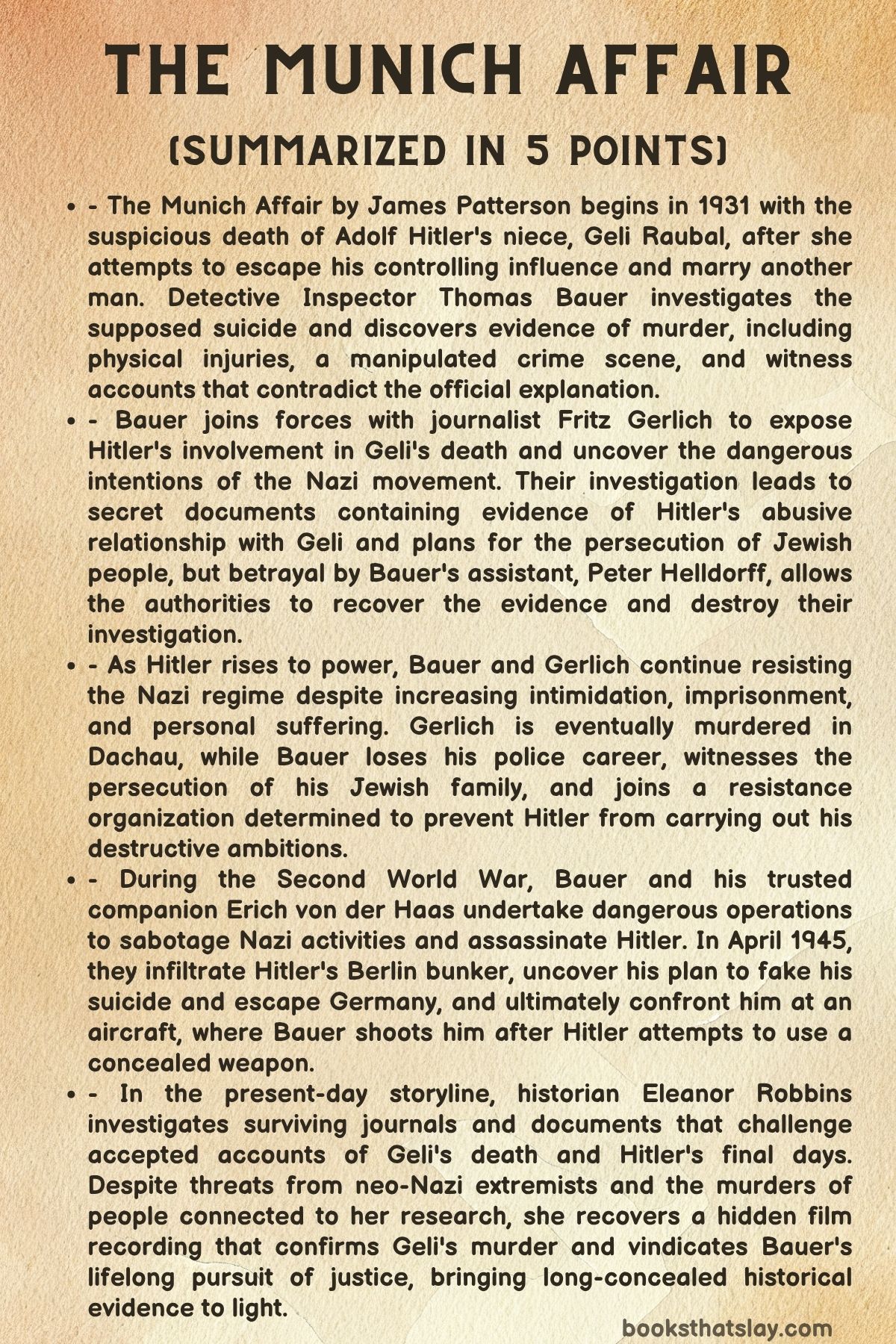
The novel begins with the mysterious death of Hitler’s niece, Geli Raubal, in 1931 and follows a determined detective whose pursuit of justice develops into a dangerous campaign against Nazi Germany. Alongside this historical narrative, a present-day historian investigates documents that challenge established accounts of the past. Through its interconnected storylines, the book examines political corruption, personal sacrifice, the manipulation of truth, and the courage required to resist authoritarian power.
Summary
The story begins in Munich in September 1931, when Adolf Hitler attends an evening performance at the Franz Kabarett with his twenty-three-year-old half niece, Angela Maria Raubal, known as Geli. Although their relationship appears affectionate in public, Geli lives under Hitler’s oppressive control, and her growing desire for independence threatens his possessiveness.
During the evening, Geli delivers an impressive singing performance that earns enthusiastic applause from the audience. Hitler initially encourages her but becomes furious when her success attracts more attention than he receives, abruptly ending their outing and confronting her during their return home.
At Hitler’s luxurious apartment, Geli announces that she intends to leave Munich, return to Vienna, and marry a man she loves. When she reveals that her prospective husband is Jewish and that she is pregnant with his child, Hitler reacts violently, striking her before eventually shooting her in the chest.
Hitler immediately contacts Rudolf Hess, who helps organize a cover-up designed to portray Geli’s death as suicide. The deception becomes essential to protecting Hitler’s political ambitions, especially as the Nazi Party continues gaining influence in a Germany suffering from economic hardship and political instability.
Detective Inspector Thomas Bauer is assigned to investigate Geli’s death and quickly discovers evidence inconsistent with suicide. Her broken nose, the missing bedroom mirror, the suspiciously cleaned surroundings, and the gunshot trajectory convince him that someone has deliberately altered the crime scene.
Bauer’s investigation encounters resistance from Nazi officials and his own superior, Heinrich Müller, who prioritizes political considerations over criminal justice. Medical examiner Elie Achterberg privately confirms that Geli’s injuries suggest murder, but government authorities remove her body and produce an official report supporting suicide.
Meanwhile, journalist Fritz Gerlich begins investigating the circumstances surrounding Geli’s death. His criticism of Hitler attracts violent retaliation from Nazi storm troopers, yet he refuses to abandon his reporting and eventually forms an alliance with Bauer.
As the two men gather evidence, they discover disturbing accounts of Hitler’s treatment of Geli, including testimony from her former lover Emil Maurice. Bauer learns that Hitler’s possessiveness extended into coercive private behavior and that Geli had repeatedly attempted to escape his influence.
Their investigation eventually leads them to compromising drawings and a handwritten letter describing Hitler’s relationship with his niece. Believing these materials may be concealed inside Nazi Party headquarters, Bauer secretly enters the Brown House by posing as a maintenance worker.
During the dangerous operation, Bauer unexpectedly encounters Hitler but successfully maintains his disguise and escapes with several envelopes from the dictator’s safe. The recovered materials include intimate drawings, Geli’s unfinished correspondence, Hitler’s handwritten letter, and documents outlining plans for the persecution of Jewish people.
The discoveries convince Bauer and Gerlich that Hitler represents a danger far greater than an ordinary criminal suspect. They prepare to publicize the evidence, hoping to expose both Geli’s murder and the Nazi movement’s intentions before Hitler can seize national power.
However, their investigation collapses when Bauer’s young assistant, Peter Helldorff, betrays them to the authorities. Bauer and Gerlich are arrested, the documents are confiscated, and Bauer eventually loses his position as detective inspector, leaving him professionally disgraced but determined to continue resisting Hitler.
More than a year later, Bauer works as an ordinary patrol officer while secretly collaborating with Gerlich and a resistance organization called the Ten Patriots. Through a deception involving Eva Braun, he places a concealed listening device inside Hitler’s Munich apartment, allowing the resistance to hear private discussions about future discriminatory legislation.
The recordings reveal the Nazis’ intention to deprive Jewish Germans of civil rights while concealing their most extreme policies until they control the government. Gerlich attempts to warn the public, but political maneuvering involving Franz von Papen, Hermann Göring, and President Paul von Hindenburg ultimately brings Hitler to the chancellorship in January 1933.
Hitler rapidly transforms his new position into dictatorial authority by exploiting the Reichstag fire, suppressing constitutional freedoms, empowering Nazi paramilitary organizations, and imprisoning political opponents. Gerlich is arrested and eventually sent to Dachau, while Bauer watches the police force become increasingly subordinate to the Nazi regime.
The persecution soon reaches Bauer’s family. His Jewish father-in-law, Selig Geiger, is brutally beaten and publicly humiliated, while Bauer’s wife, Amalie, loses her teaching position and is arrested for resisting Nazi officers.
With assistance from his resistance partner Erich von der Haas, Bauer rescues Amalie from detention and arranges for his family to escape Germany. Although the separation causes enormous personal suffering, Bauer remains behind because he believes that stopping Hitler has become his responsibility.
As the dictatorship strengthens, Bauer and Erich undertake repeated attempts to assassinate Hitler. Their operations include surveillance, planned bombings, sniper attacks, and sabotage, but unexpected circumstances and increasingly effective security arrangements repeatedly prevent them from reaching their target.
Gerlich is eventually murdered in Dachau, while Helldorff also becomes a victim of the regime he once helped protect. Before his death, however, Helldorff secretly preserves a mysterious film reel connected with the original investigation into Geli’s murder.
During the Second World War, Bauer and Erich continue operating against Nazi Germany, destroying military equipment and disrupting transportation networks. Their determination intensifies when Erich learns that his Jewish brother and relatives were murdered at Sobibór, turning his resistance into a deeply personal struggle for justice.
By April 1945, Germany is approaching defeat, and Bauer and Erich infiltrate Hitler’s underground bunker in Berlin using false military identities. They initially attempt to reach him through Eva Braun but eventually discover that Hitler intends to fake his suicide by substituting the body of a lookalike and escaping aboard an aircraft.
The two men intercept Hitler at the waiting plane. Erich confronts him over the murder of his family but cannot bring himself to execute an unarmed prisoner; when Hitler suddenly draws a concealed pistol, Bauer shoots and kills him, after which the resistance fighters escape Berlin by aircraft.
Running alongside these events is the contemporary investigation of Eleanor Robbins, a University of Chicago historian examining journals and documents preserved by descendants of people involved in the original conspiracy. Her research exposes her to neo-Nazi intimidation, theft, assassination attempts, and the murder of Franklin Linderman, whose family has secretly preserved evidence from Hitler’s safe.
Eleanor eventually discovers that a stranger secretly placed the missing film reel inside her jacket during an encounter in Vienna. Under FBI protection, she views the footage and discovers that it records Hitler’s abusive treatment of Geli and the confrontation ending in her murder.
The recording confirms Bauer’s original conclusion and exposes the official suicide account as a deliberate fabrication within the novel’s alternative history. Eleanor also learns that Bauer survived the war and spent decades with Amalie in the United States, allowing his long struggle to end with both personal reunion and the eventual recovery of the truth.
Characters
Thomas Bauer
Thomas Bauer is the central protagonist of The Munich Affair, representing professional integrity, personal courage, and resistance to institutional corruption. Initially introduced as a respected Munich detective inspector, he approaches Geli Raubal’s death with the conviction that criminal investigations must follow evidence rather than political convenience.
His refusal to accept the official suicide finding establishes his defining quality: an unwillingness to surrender his judgment to powerful individuals. Even when his superiors threaten his career and his investigation endangers his family, Bauer continues pursuing the truth.
Bauer is not presented as an uncomplicated hero, however, because his determination sometimes becomes an obsession that places other people at risk. His willingness to use threats, deception, physical force, and illegal methods demonstrates how his commitment to justice changes when ordinary legal institutions become instruments of oppression.
His relationship with Amalie reveals the emotional difficulties beneath his outward toughness. He loves his wife and children deeply, yet he struggles to reconcile his responsibilities toward them with his belief that Hitler must be stopped.
Over the years, Bauer develops from a conventional investigator into a resistance fighter prepared to risk his life against a dictatorship. His eventual confrontation with Hitler completes this transformation, showing a man whose long pursuit of justice has survived professional disgrace, repeated failure, physical suffering, and personal separation.
Adolf Hitler
The portrayal of Adolf Hitler in The Munich Affair centers on the connection between private cruelty and political authoritarianism. He is depicted as an intensely possessive, manipulative, and self-centered individual who regards other people’s independence as a threat to his authority.
His relationship with Geli Raubal provides the earliest demonstration of these characteristics. Although he claims to love her, his behavior reveals that he understands affection primarily through obedience, possession, and control.
Geli’s success as a singer provokes jealousy rather than genuine pride, while her decision to marry another man produces a violent reaction. Her murder becomes an expression of his refusal to accept that another person has the right to determine her own future.
Hitler’s political conduct follows a similar psychological pattern. He demands unquestioning loyalty, manipulates public opinion, punishes dissent, and uses manufactured crises to expand his authority.
His interactions with followers reveal his ability to alternate between personal charm and intimidation. Supporters such as Helene Bechstein perceive him as disciplined and patriotic, while those exposed to his private conduct encounter a far more dangerous personality.
The novel also emphasizes his dependence on carefully constructed public appearances. His efforts to conceal Geli’s murder, control newspapers, and eliminate witnesses demonstrate how preserving his reputation becomes inseparable from maintaining political power.
His final attempt to escape Berlin exposes the contradiction between his public demands for sacrifice and his personal instinct for survival. While millions have suffered under his leadership, he attempts to avoid the consequences of his own decisions.
Geli Raubal
In The Munich Affair, Geli Raubal represents the destruction of individual freedom through coercive personal relationships. Although her death initiates the central investigation, the opening events establish her as a young woman with ambitions, emotional needs, and a powerful desire to control her own life.
Her singing performance demonstrates that she possesses abilities and aspirations independent of Hitler. The audience’s enthusiastic response briefly gives her recognition based on personal achievement rather than her connection to a politically influential relative.
However, her relationship with Hitler has reduced her freedom to make ordinary decisions. His control over her residence, movements, relationships, and musical education transforms material comfort into a form of imprisonment.
Geli’s determination to leave Munich represents her most significant act of resistance. She rejects Hitler’s authority, refuses further submission to his degrading demands, and insists on marrying the man she loves.
Her pregnancy makes the confrontation especially significant because it represents a future beyond Hitler’s control. The murder destroys that possibility while exposing the terrible consequences of his possessiveness.
Although Geli cannot participate directly in the later events, her presence continues shaping the narrative through the investigation, recovered documents, and surviving film footage. She ultimately becomes a symbol of the victims whose experiences powerful institutions attempt to erase.
Fritz Gerlich
Through Fritz Gerlich, The Munich Affair examines the moral responsibilities of journalism under authoritarian pressure. Gerlich is an independent newspaper editor whose opposition to Hitler develops from political concern into a sustained effort to expose criminality and ideological extremism.
Unlike individuals motivated primarily by personal loyalty or political advantage, Gerlich believes that citizens deserve accurate information about those seeking public power. He recognizes that Hitler’s rhetoric is not merely theatrical political language but an expression of dangerous intentions.
His alliance with Bauer brings investigative journalism into direct cooperation with criminal detection. While Bauer examines physical evidence and witnesses, Gerlich studies political relationships, propaganda, public opinion, and the historical conditions enabling Nazi influence.
Gerlich’s commitment comes at a substantial personal cost. Nazi agents destroy his newspapers, attack his home, assault him physically, and threaten the safety of his wife, Sophie.
His Catholic faith becomes increasingly important to his understanding of resistance. He believes that remaining silent in the face of wrongdoing would constitute a betrayal of his moral obligations.
Even after imprisonment at Dachau, Gerlich refuses to abandon his beliefs. His execution demonstrates the vulnerability of principled individuals when institutions designed to protect freedom have been destroyed.
Eleanor Robbins
The Munich Affair gives Eleanor Robbins the responsibility of connecting historical events with their consequences in the present. A university historian approaching sixty, she investigates documents suggesting that established accounts of Hitler’s death and Geli Raubal’s supposed suicide are incomplete.
Eleanor approaches the investigation with academic discipline and curiosity. She understands that extraordinary historical claims require authentic documents, reliable testimony, and evidence capable of surviving rigorous scrutiny.
Her personal circumstances make her particularly interesting. She is grieving the death of her daughter, Annabelle, and has also experienced significant physical hardship through the loss of sight in one eye.
These experiences contribute to her resilience without eliminating her vulnerability. When neo-Nazi extremists threaten her, she experiences genuine fear and occasionally questions whether her research justifies the danger.
Her determination becomes stronger as she recognizes the sacrifices made by Bauer, Gerlich, and others. She begins to view her research not simply as an academic project but as a responsibility to those whose experiences were deliberately concealed.
The discovery of the missing film reel validates her persistence and investigative intelligence. By recovering the evidence and arranging its authentication, Eleanor completes work that earlier generations could not safely finish.
Erich von der Haas
Erich von der Haas is Bauer’s closest resistance partner and one of the novel’s clearest examples of loyalty under extreme pressure. His military and communications experience makes him essential to operations involving surveillance equipment, explosives, disguises, and planned assassinations.
Initially, Erich approaches resistance through a combination of patriotism and opposition to Nazi authoritarianism. He believes that the regime has betrayed Germany and that restoring the country’s dignity requires confronting its leadership.
His friendship with Bauer gradually becomes as important as their shared political objectives. The two men repeatedly place their lives in each other’s hands, developing a relationship strengthened by mutual respect and personal sacrifice.
Erich’s motivations become intensely personal when he learns that his Jewish relatives were deported to Sobibór and murdered. His grief changes the meaning of his struggle, making Hitler’s death a matter of family justice as well as political necessity.
Despite his desire for revenge, Erich remains morally conflicted. When he finally confronts Hitler, he discovers that killing an unarmed man violates principles he has spent years defending.
His hesitation demonstrates that prolonged resistance has not completely destroyed his humanity. Erich’s character distinguishes justified opposition to evil from the unrestricted violence practiced by the people he fights.
Amalie Bauer
Amalie Bauer represents emotional resilience, family loyalty, and the personal consequences of political persecution. As Thomas Bauer’s Jewish wife, she becomes increasingly vulnerable as Nazi ideology is transformed into government policy.
Initially, Amalie hopes that Germany’s constitutional institutions will restrain Hitler. Although she recognizes the danger, she is reluctant to abandon the home, profession, and community that have shaped her life.
Her dismissal from teaching demonstrates how persecution reaches ordinary citizens through discriminatory laws. Her refusal to accept the injustice quietly, followed by her arrest, reveals courage comparable to her husband’s.
Amalie is also important because she challenges Bauer’s tendency to define responsibility exclusively through political resistance. She reminds him that their marriage and children deserve protection alongside his wider obligations.
When circumstances require the family to escape Germany, Amalie accepts a painful separation without treating her husband’s struggle as meaningless. Her insistence that he promise to return reveals both her understanding of his character and her refusal to surrender hope.
Her eventual reunion with Bauer gives the novel an emotional resolution beyond its political conflict.
Peter Helldorff
Peter Helldorff is one of the novel’s most morally conflicted characters because his development demonstrates how fear and ambition can undermine otherwise decent intentions. Introduced as Bauer’s young police assistant, he initially appears willing to participate in a dangerous but legitimate murder investigation.
His decision to betray Bauer and Gerlich marks the central turning point in his characterization. Helldorff claims that threats against his police career compelled him to cooperate, but his subsequent promotion also reveals the advantages he receives from his compromise.
His betrayal contributes to the destruction of evidence and allows influential Nazi officials to escape accountability. The consequences are far greater than the immediate loss of Bauer’s investigation.
As the dictatorship develops, Helldorff begins recognizing the nature of the organization he helped protect. His professional advancement cannot free him from guilt, and his wife notices his growing unhappiness.
His decision to preserve the secret film reel suggests an attempt to retain evidence that might eventually expose Hitler. Nevertheless, this act also reflects his desire for protection against the regime rather than purely selfless courage.
His eventual execution demonstrates the danger of believing that cooperation with authoritarian power guarantees personal security.
Joseph Goebbels
Joseph Goebbels is depicted as the Nazi leadership’s principal strategist of propaganda and public manipulation. He understands that political success often depends on controlling how events are interpreted rather than establishing what actually happened.
His response to Geli’s murder demonstrates this ability. Instead of investigating the crime, he constructs explanations that portray her death as the consequence of emotional instability or frustration with her artistic ambitions.
Goebbels recognizes the effectiveness of repetition, misleading language, and contradictory accusations. By creating confusion, he hopes to weaken the public’s ability to distinguish reliable evidence from politically convenient claims.
His manipulation extends beyond newspapers to public speeches, political ceremonies, and attacks against opponents. He assists Hitler in transforming public resentment into support for increasingly extreme policies.
Goebbels’s intelligence makes him particularly dangerous because he understands the connection between language and power. His character demonstrates how deliberate misinformation can create conditions in which oppression becomes acceptable to large sections of society.
Rudolf Hess
Rudolf Hess functions as one of Hitler’s most dependable early associates and an important participant in the concealment of Geli Raubal’s murder. His loyalty places him at the center of the immediate response to her death.
Hess helps arrange the official suicide explanation and coordinates with other Nazi leaders to manage the political consequences. His actions illustrate how personal loyalty can become a justification for obstructing criminal justice.
He occasionally appears uncomfortable with certain propaganda proposals, particularly when they contradict facts he knows. However, these moments of hesitation rarely produce meaningful resistance.
His behavior exposes the limitations of a conscience subordinated to obedience. Although he recognizes disturbing aspects of Hitler’s conduct, he continues protecting the individual responsible.
Hess represents the committed subordinate who helps maintain an abusive system by treating loyalty as more important than accountability.
Heinrich Müller
Heinrich Müller embodies the corruption of legal authority through political ambition. As Bauer’s superior in the Munich police, he possesses the institutional power to support the investigation but chooses instead to protect Hitler’s interests.
His interference includes removing witnesses, accepting politically convenient findings, and transferring the investigation away from independent police control. These decisions make him directly responsible for preventing a legitimate examination of Geli’s death.
Müller is particularly disturbing because he understands the procedures and responsibilities of criminal investigation. His misconduct cannot be attributed to ignorance of professional standards.
His subsequent advancement within the Nazi security apparatus reinforces the novel’s portrayal of authoritarian institutions rewarding obedience and corruption.
When Bauer confronts him in Berlin during the regime’s collapse, their encounter becomes a reckoning between two former colleagues who made fundamentally different moral choices.
Bauer’s refusal to execute Müller while he is unarmed also demonstrates that the detective retains limits that his former superior abandoned long ago.
Heinrich Himmler
Heinrich Himmler represents the organized terror that enables Nazi political dominance. Unlike Goebbels, whose principal instrument is propaganda, Himmler relies on surveillance, intimidation, imprisonment, and systematic violence.
His attacks against Fritz Gerlich demonstrate how the Nazi movement attempts to eliminate criticism through physical coercion. Newspaper offices are destroyed, journalists are beaten, and ordinary legal protections become increasingly meaningless.
As the regime consolidates power, Himmler’s methods expand into the concentration camp system and the machinery of racial persecution. He helps transform ideological hatred into an administrative system capable of mass imprisonment and murder.
His character is frightening because cruelty is presented through organizational efficiency and unquestioning ideological commitment. Violence becomes an accepted instrument of governance rather than an extraordinary response.
Himmler illustrates how authoritarian systems require individuals capable of converting political objectives into practical mechanisms of terror.
Martin Bormann
Martin Bormann is portrayed as an important administrator within Hitler’s inner circle. His influence comes from proximity to the Nazi leader, access to confidential information, and his ability to coordinate decisions behind the scenes.
He assists in managing the political consequences of Geli’s death and participates in discussions concerning the protection of Hitler’s reputation. His presence in the early investigation demonstrates the close relationship between personal secrecy and party administration.
Bormann later becomes increasingly involved in the internal workings of Hitler’s government. He helps communicate orders, manage relationships among powerful officials, and preserve the dictator’s control over his subordinates.
His character represents bureaucratic complicity, showing how administrative skills can serve destructive political objectives.
Rather than depending primarily on public speeches or direct physical intimidation, Bormann exercises influence through access, organization, and loyalty.
Eva Braun
Eva Braun occupies a complicated position as Hitler’s companion and eventual wife. She is presented as a young woman attracted to recognition, fashion, photography, and the glamorous possibilities associated with political influence.
Bauer successfully exploits these interests when he impersonates a magazine correspondent and persuades her to cooperate with a proposed photographic feature. Her eagerness to be acknowledged independently of Hitler makes her susceptible to his deception.
Eva’s relationship with Hitler also demonstrates the limitations placed upon women within his private circle. She enjoys privileges unavailable to ordinary citizens but remains dependent upon his approval and changing attention.
Her apparent innocence in certain interactions contrasts with the political violence surrounding her. However, her continued loyalty also connects her to the regime’s privileged inner world.
Her final marriage to Hitler and death in the bunker demonstrate the devastating consequences of maintaining personal devotion to an individual whose political project has collapsed.
Emil Maurice
Emil Maurice is an important witness because his past relationship with Geli gives him knowledge unavailable to ordinary investigators. A former chauffeur and bodyguard associated with Hitler, he understands both the Nazi leader’s private behavior and the culture of obedience surrounding him.
Maurice initially resists Bauer’s questioning because cooperation threatens his position and safety. His fear becomes more pronounced when Bauer reveals knowledge of his Jewish ancestry.
Eventually, Maurice provides information about Geli’s romantic relationships, Hitler’s possessiveness, and the suspicious alterations made to her bedroom after the shooting.
His testimony strengthens Bauer’s murder theory while exposing Maurice’s own moral uncertainty.
Although he recognizes Hitler’s cruelty, Maurice struggles to abandon a political movement he once admired. His character demonstrates how dependence, fear, and past loyalty can keep individuals attached to organizations they no longer fully trust.
Sophie Gerlich
Sophie Gerlich offers an essential personal perspective on the sacrifices demanded by political resistance. As Fritz Gerlich’s wife, she understands the importance of his journalism but fears that his determination will destroy their marriage and expose them both to violence.
She repeatedly challenges Fritz to consider whether exposing Hitler has become more important than preserving their lives together. Her concerns are reasonable, particularly after Nazi agents assault her husband and attack their home.
Sophie is not portrayed as lacking moral courage. Instead, she recognizes consequences that Fritz sometimes minimizes because of his overwhelming commitment to public responsibility.
Following his arrest, she searches desperately for information about his imprisonment. Her encounters with powerless police officials reveal the suffering experienced by families whose relatives disappear into the Nazi detention system.
After Fritz’s murder, Sophie increasingly understands the extraordinary courage behind his refusal to remain silent. Her continued service to others demonstrates that resistance can survive through compassion, remembrance, and everyday acts of solidarity.
Selig Geiger
Selig Geiger, Amalie’s father, represents the dangerous confidence that established social position can offer during periods of political upheaval. A wealthy Jewish businessman, he initially believes that Hitler’s extremism is exaggerated political rhetoric rather than a realistic program of persecution.
His economic success and social connections encourage him to trust that respectable citizens will remain protected by ordinary legal institutions. This confidence repeatedly brings him into conflict with Bauer.
Selig’s transformation begins as Nazi hostility becomes increasingly visible and reaches its decisive moment when storm troopers attack his department store. Seeking assistance from the police, he is instead beaten and publicly humiliated.
The violence destroys his belief that wealth, citizenship, and personal respectability can protect him from organized hatred.
His later conversation with Bauer marks an important change in perspective. Selig recognizes that family relationships matter more than material achievements and finally accepts that the political danger Bauer identified was real.
Bernhard Stempfle
Bernhard Stempfle is a former Catholic priest whose association with Hitler gives him access to compromising information about the dictator’s private conduct. He knows about explicit drawings of Geli and a personal letter revealing disturbing aspects of their relationship.
Rather than exposing these materials, Stempfle attempts to profit from his knowledge. His fraudulent scheme involving the supposed purchase of missing drawings reveals greed, dishonesty, and a mistaken belief that his relationship with Hitler guarantees protection.
Bauer successfully exploits Stempfle’s vulnerability to uncover information about the handwritten letter.
Stempfle’s eventual imprisonment and execution demonstrate the danger faced by individuals who possess secrets threatening an authoritarian leader’s reputation.
His tragedy is partly the result of his inability to recognize that personal loyalty offers little security when those in power consider someone expendable.
Helene Bechstein
Helene Bechstein represents the wealthy and socially influential supporters who help transform Hitler from a political outsider into a figure accepted within respectable circles. Her financial assistance, social connections, and guidance contribute to his growing public influence.
She regards Hitler with almost maternal affection and interprets his political ambitions through admiration for his apparent discipline and patriotism. This perspective contrasts sharply with the reader’s knowledge of his conduct toward Geli.
Helene’s failure to recognize the danger beneath Hitler’s carefully managed behavior is an important element of her characterization.
Her support demonstrates that authoritarian movements can acquire legitimacy through individuals who focus on personal charm, social presentation, or selective political promises while overlooking more disturbing evidence.
Anni and Georg Winter
Anni and Georg Winter are the housekeepers employed at Hitler’s Munich apartment and important witnesses in the investigation into Geli’s death. Their proximity to the crime gives them information capable of challenging the official suicide account.
Georg initially provides statements that appear carefully prepared to support the Nazi explanation. His reluctance illustrates the pressure placed upon ordinary employees dependent upon powerful employers.
Anni is more emotionally connected to Geli and appears genuinely distressed by her death. Bauer recognizes that her affection for the young woman may encourage her to reveal details she would otherwise conceal.
Her admission that she heard Hitler and Geli arguing becomes an important breakthrough.
Together, the Winter household employees illustrate how witnesses can become trapped between moral responsibility and fear of retaliation.
Julius Schreck
Julius Schreck is Hitler’s chauffeur and bodyguard, a trusted associate involved in protecting the Nazi leader’s private activities. His position places him close to events that ordinary party members would never witness.
The narrative associates him with the suspicious activities following Geli’s death, including the possible removal of evidence from her bedroom. His loyalty makes him part of the network enabling Hitler to escape immediate suspicion.
Schreck demonstrates the practical importance of individuals who carry out instructions without challenging their moral consequences.
Although he does not dominate the narrative, his role shows that political cover-ups depend upon trusted assistants willing to preserve secrecy through seemingly routine actions.
Monica Bauer
Monica, Thomas Bauer’s great-granddaughter, connects Eleanor Robbins with the living descendants of individuals involved in the original investigation. As an American graduate student living in Munich, she possesses both personal interest in her family history and practical knowledge of the city.
Her cooperation helps Eleanor arrange meetings, follow complicated instructions, and investigate the historical materials.
Monica also provides an important emotional link between Bauer’s sacrifices and the generations that followed. Her existence demonstrates that his decision to protect his family had consequences extending well beyond his own lifetime.
She becomes particularly valuable when Eleanor develops the theory that an additional piece of evidence survived Peter Helldorff’s betrayal.
Her willingness to assist illustrates how historical responsibility can pass from one generation to another.
Francis and Franklin Linderman
Francis Linderman initiates Eleanor’s modern investigation by contacting her about historical documents connected with Bauer, Helldorff, and Hitler’s secrets. His apparent suicide before their scheduled meeting initially creates uncertainty surrounding the materials.
As Eleanor continues investigating, she learns that his death may have been deliberately arranged to resemble suicide. This possibility establishes the continuing danger associated with the surviving evidence.
Franklin Linderman, the son of Peter Helldorff, provides another connection to the concealed history. He acknowledges his father’s betrayal while asking Eleanor to understand the fear and ambition behind that decision.
Franklin confirms the existence of the mysterious film reel but is murdered before he can fully explain its significance.
The two men represent the consequences of inherited secrets and the difficulty of separating family loyalty from historical accountability.
Tyson Robbins
Tyson Robbins, Eleanor’s brother, serves as an important voice of caution throughout the contemporary investigation. He is deeply concerned by the threatening incidents surrounding her research and repeatedly urges her to return home.
His character provides a contrast to Eleanor’s determination. Where she focuses on the historical importance of the evidence, Tyson emphasizes her immediate physical safety and the emotional consequences of continuing.
His concerns are strengthened by Eleanor’s earlier personal losses and by the increasingly violent attempts to suppress her discoveries.
Tyson is not an opponent of historical truth, but he questions whether his sister should sacrifice her life to obtain it.
His protective attitude highlights the personal conflicts faced by individuals pursuing dangerous investigations.
Albert Einstein
Albert Einstein appears as an internationally respected scientist whose experiences reveal the effects of Nazi persecution on Germany’s intellectual community. His decision not to return to Germany follows reports of intimidation, arrests, and attacks against Jewish academics.
Einstein’s reputation does not protect him from the regime’s hostility. His property is searched, his professional environment becomes increasingly dangerous, and his public criticism of Hitler makes him a target.
His departure illustrates the intellectual and cultural damage inflicted by authoritarian rule.
Einstein also represents the difficult decisions forced upon individuals who must choose between remaining in their homeland and preserving their freedom.
Albert Speer
Albert Speer appears during the final collapse of Nazi Germany, when Hitler’s military defeat is becoming unavoidable. As the regime’s armaments minister, he has participated in sustaining the German war effort and therefore carries substantial responsibility for the dictatorship’s destructive policies.
His confrontation with Hitler over the Nero Decree reveals a conflict between political obedience and the survival of the German population.
Speer recognizes that destroying bridges, factories, transportation systems, and essential infrastructure would make civilian recovery extraordinarily difficult.
His decision not to implement the destruction order represents a late rejection of Hitler’s authority.
However, this decision does not erase his earlier involvement in the regime, making him an example of the complicated relationship between belated resistance and personal responsibility.
Lars von der Haas and His Family
Lars von der Haas, Erich’s brother, represents the civilian victims of Nazi racial persecution. Living with his Jewish family in Amsterdam, he attempts to preserve ordinary domestic life despite the increasing restrictions imposed by German occupation authorities.
His concern centers on protecting his wife Annika, daughter Dahlia, and elderly parents from deportation and separation.
After the family is transported to Sobibór, Lars initially believes the authorities’ claims about labor assignments. His attempts to reassure his relatives reveal the terrible vulnerability of people deliberately deceived about their intended fate.
When Lars eventually learns that his family members have been murdered, his grief leads him to attack an SS guard, resulting in his execution.
The family’s destruction becomes central to Erich’s later determination to confront Hitler personally.
Themes
The Manipulation of Truth and the Destruction of Independent Institutions
The struggle between truth and deliberate deception drives the central conflicts of The Munich Affair. From the opening investigation into Geli Raubal’s death, political authorities repeatedly attempt to replace verifiable evidence with explanations designed to protect powerful individuals.
Geli’s murder provides the clearest initial example of this process. Rather than permitting an independent investigation, Nazi officials establish a suicide narrative, interfere with witnesses, remove physical evidence, and influence the medical conclusions.
The significance extends beyond a single criminal case because the deception requires cooperation from institutions supposedly responsible for protecting the public. Police officers, government officials, medical authorities, and political lawyers participate directly or indirectly in preventing the truth from becoming known.
Joseph Goebbels develops this manipulation into a deliberate political method. His propaganda campaigns demonstrate that controlling public perception can be more effective than establishing a consistent factual explanation.
The repeated destruction of independent newspapers reveals how misinformation and physical intimidation reinforce one another. When journalists expose contradictions, the Nazis respond not by providing evidence but by threatening the individuals responsible.
Fritz Gerlich’s resistance establishes journalism as an essential defense against authoritarianism. His determination demonstrates that truthful reporting retains moral value even when those in power possess the ability to suppress publication.
Eleanor Robbins’s contemporary investigation extends this theme across generations. Her efforts reveal that deliberately concealed evidence can continue shaping historical understanding long after the individuals responsible have died.
Ultimately, the novel presents truth as something that requires sustained protection through independent institutions, personal courage, and the willingness to challenge official accounts.
The Corrupting Nature of Absolute Power
Hitler’s treatment of Geli establishes a direct relationship between personal domination and the broader political ambitions of authoritarian leadership. His inability to tolerate her independence reflects the same desire for unrestricted control that later shapes his approach to Germany.
Geli’s musical success should represent an occasion for celebration, but Hitler experiences it as a threat to his importance. Her determination to leave him becomes intolerable because he regards personal obedience as an entitlement rather than something freely given.
This possessiveness reveals how abusive power depends upon denying the separate identity of another person. Hitler attempts to control Geli’s movements, relationships, ambitions, and even her understanding of herself.
His political methods reproduce this pattern on a national scale. He seeks to control newspapers, eliminate opposition, restrict personal freedoms, and transform public institutions into instruments of obedience.
The character of Heinrich Müller demonstrates how political systems become corrupted when professional advancement depends upon serving powerful individuals. His abandonment of investigative responsibility allows criminal conduct to escape accountability.
The Nazi leadership’s internal relationships also reveal the instability created by absolute authority. Officials compete for Hitler’s approval while recognizing that disagreement or inconvenient knowledge can make them targets.
The executions of former associates demonstrate that loyalty cannot guarantee safety within such a system. Individuals who once benefited from their proximity to power eventually discover that they possess no independent protection.
By connecting personal cruelty with political dictatorship, the novel shows that absolute power encourages the treatment of human beings as possessions, obstacles, or instruments to be discarded whenever their existence becomes inconvenient.
Moral Courage, Resistance, and Personal Sacrifice
In The Munich Affair, resistance is portrayed as a continuing moral decision rather than a single extraordinary act. Thomas Bauer and Fritz Gerlich recognize the danger represented by Hitler before many of their contemporaries understand the consequences of his political ambitions.
Bauer’s refusal to falsify the investigation into Geli’s death establishes the first expression of his courage. He understands that obedience would protect his career, but professional integrity requires him to challenge individuals who possess growing political influence.
His commitment becomes more demanding when the legal system itself begins supporting the Nazi movement. Resistance then requires him to abandon conventional procedures and accept methods that would previously have conflicted with his professional identity.
Gerlich faces a comparable struggle through journalism. He continues publishing criticism despite knowing that Nazi retaliation threatens his home, livelihood, marriage, and physical safety.
Their decisions are not presented as painless achievements. Both men experience serious losses, and their families must endure the consequences of their unwillingness to compromise.
Amalie and Sophie provide important perspectives on these sacrifices. Their fears demonstrate that political courage cannot be separated from the responsibilities individuals owe to those who love them.
Erich’s experiences introduce another dimension of resistance through the desire for revenge. His confrontation with Hitler reveals that opposing cruelty does not automatically justify abandoning all moral restraint.
The novel suggests that courage involves preserving ethical principles under circumstances designed to make those principles impossible to maintain. Its resistance fighters are distinguished not simply by their willingness to confront violence but by their continuing efforts to protect human dignity.
Historical Memory, Complicity, and the Responsibility to Remember
The relationship between historical events and later generations gives the novel its broader moral significance. Eleanor Robbins’s investigation demonstrates that the consequences of political wrongdoing can persist through concealed documents, inherited secrets, unresolved questions, and the memories preserved by surviving families.
Her research begins with materials that challenge established accounts of the past. Rather than accepting either familiar explanations or extraordinary new claims without examination, she searches for evidence capable of establishing what actually occurred.
This process highlights the distinction between historical memory and historical certainty. Personal recollections, official records, and inherited accounts can all contain omissions or deliberate distortions.
Peter Helldorff’s betrayal becomes particularly significant because his descendants must confront the consequences of his actions. Franklin Linderman’s desire for a balanced portrayal of his father illustrates how historical responsibility can conflict with the understandable wish to protect a family’s reputation.
The novel also examines complicity through individuals who initially dismiss or accommodate Nazi behavior. Selig Geiger’s early confidence in the legal system, the hesitation of frightened witnesses, and the cooperation of ambitious officials demonstrate different ways in which people fail to confront developing injustice.
Their experiences suggest that responsibility is not limited to those who directly commit violent acts. Individuals who conceal wrongdoing, spread misinformation, or knowingly surrender institutional independence can also contribute to destructive political outcomes.
Eleanor’s discovery of the surviving film provides a symbolic resolution to the conflict between official history and suppressed evidence. The recording restores Geli’s experience to the historical record and vindicates Bauer’s determination to investigate her death.
The novel ultimately presents remembrance as an active responsibility, requiring later generations to examine uncomfortable evidence, recognize the costs of silence, and preserve the experiences of those whose voices powerful institutions attempted to erase.