Under Story by Chloe Benjamin Summary, Characters and Themes
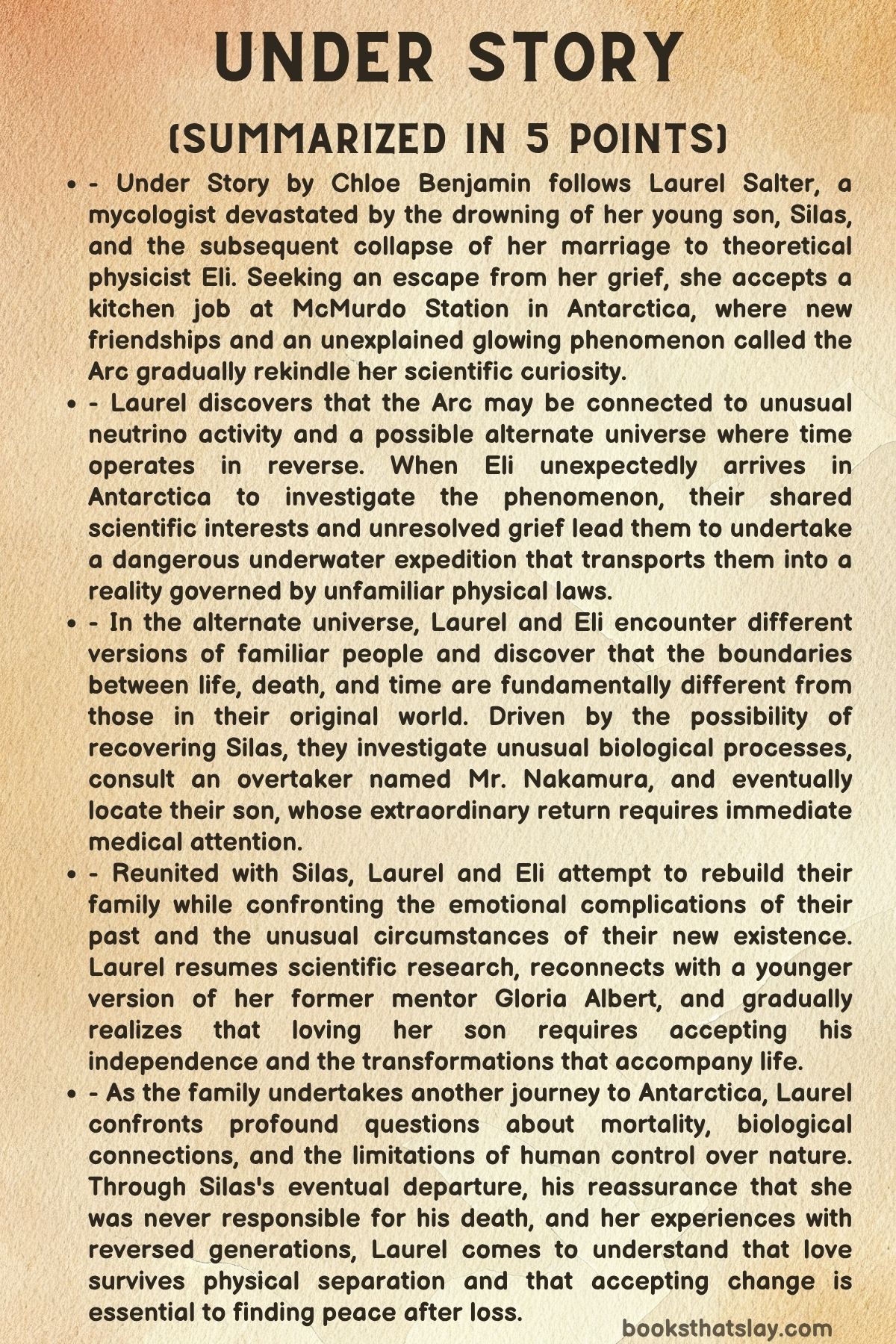
Under Story by Chloe Benjamin is a science fiction novel that combines family tragedy, scientific discovery, and an exploration of life, death, and human relationships. The story follows Laurel Salter, a mycologist whose life is shattered by the death of her young son and the collapse of her marriage. Seeking refuge in Antarctica, she encounters a mysterious phenomenon that challenges conventional understandings of time and reality.
Alongside her former husband, a theoretical physicist, Laurel discovers the possibility of an alternate universe where the boundaries between existence and mortality operate differently. Through her extraordinary journey, the novel examines grief, motherhood, scientific curiosity, and the enduring connections between people.
Summary
Laurel Salter is a thirty-six-year-old mycologist whose life has been devastated by personal tragedy. Following her divorce from her husband, Eli, and the death of their son, Silas, she leaves her university position in Wisconsin and accepts a job as a kitchen steward at McMurdo Station in Antarctica.
Her decision represents an attempt to escape the memories and emotional suffering that have become inseparable from her previous life. Rather than continuing her scientific career, Laurel chooses physically demanding work in an isolated environment where unfamiliar routines might offer relief from her grief.
During her journey to Antarctica, Laurel befriends Charlie Morrison, another newcomer searching for a different kind of life. At McMurdo, she shares accommodations with Nita Choudhury, a marine biologist who studies octopuses, and develops a friendship with Louis Carroll, an experienced Antarctic worker known for his humor.
Her supervisor, Jules Javurek, is someone she remembers from her Wisconsin childhood. Their reunion introduces an unexpected connection between the life Laurel has abandoned and the strange environment in which she hopes to begin again.
The demanding work and unusual community gradually help Laurel regain an awareness of everyday pleasures. Nevertheless, her memories of Silas and Eli remain painfully present, reminding her that geographical distance cannot eliminate emotional suffering.
Laurel also becomes interested in a mysterious glowing dome visible near Cape Evans. Known as the Arc, the unexplained phenomenon has attracted scientists investigating unusual particle detections that appear to contradict established physical theories.
At a scientific presentation, Laurel learns about neutrinos, elusive particles capable of passing through ordinary matter with almost no interaction. Researchers discuss experimental findings that suggest the possible existence of an unfamiliar fourth neutrino whose properties might challenge the conventional direction of time.
The discovery awakens Laurel’s scientific curiosity, which had diminished under the weight of her grief. She begins to suspect that the Arc might reveal something fundamental about the structure of reality.
Laurel’s understanding of the natural world began on her family’s apple orchard in Wisconsin. Her parents, Pete and Clare Salter, transformed an aging property into an environmentally conscious farm where biological diversity, seasonal labor, and respect for living systems shaped her childhood.
Her father encouraged her curiosity about nature, while her mother’s practical approach to life taught her the importance of persistence. Growing up among trees, sheep, and changing seasons, Laurel developed an appreciation for the invisible relationships that sustain ecosystems.
During adolescence, Laurel formed close friendships with Jules and Maisie O’Brien. She also became attracted to Eli, an intellectually gifted young man whose interests and personality distinguished him from others in her social circle.
Although their early connection did not develop into a lasting relationship, Laurel continued thinking about him after leaving for Madison. Their attraction became an enduring part of her emotional history, influencing how she imagined love and companionship.
At university, Laurel encountered Gloria Albert, an accomplished scientist whose ideas transformed her understanding of biology. Gloria introduced her to the importance of fungal networks and encouraged her to question assumptions about how organisms communicate and exchange resources.
Laurel eventually reconnected with Eli in San Francisco, where their intellectual interests strengthened their romantic relationship. While Laurel investigated the connections between living organisms, Eli pursued theoretical physics and developed a theory he called the Duoverse.
His theory proposed the possibility of a corresponding universe with inverted physical and temporal properties. Their discussions about the structure of reality became an important part of their relationship, allowing scientific curiosity and romantic attraction to develop together.
Their lives changed when Laurel unexpectedly became pregnant in December 2005. The birth of Silas introduced a new kind of love into their relationship, but it also brought practical responsibilities that complicated their ambitions.
Laurel struggled to balance motherhood with her academic career, while Eli became increasingly occupied with attempts to establish his scientific reputation. His theoretical work remained difficult to prove, and the frustrations surrounding his career contributed to tension within their family.
The couple eventually married in a modest courthouse ceremony attended by Silas and their loved ones. Despite genuine affection and moments of happiness, their relationship remained vulnerable to the pressures of parenting, professional disappointment, and differences in emotional temperament.
Their family life ended in catastrophe during a vacation near Lake Michigan, shortly before Silas’s eighth birthday. While swimming, Silas disappeared beneath the water, prompting a desperate search by Laurel, Eli, and emergency responders.
The boy drowned, leaving his parents overwhelmed by sorrow and guilt. Laurel became haunted by her inability to save him, and the tragedy eventually destroyed the fragile foundations of her marriage.
Back in Antarctica, Laurel briefly begins recovering a sense of independence and physical intimacy. Encouraged by her friends, she participates in the station’s social activities and becomes romantically involved with Miles, the sous chef.
However, her progress is interrupted when Eli unexpectedly arrives at McMurdo Station. Laurel initially avoids him, with Charlie, Louis, and Nita helping her maintain her distance, but she soon discovers that his arrival is connected to scientific research concerning the Arc.
Eli recognizes that the unusual neutrino detections might provide evidence for his theory of the Duoverse. Although their relationship remains strained, Laurel shares his curiosity about the phenomenon and gradually agrees to investigate its implications.
They develop a dangerous plan to examine the Arc underwater near Cape Evans. After weather conditions delay their expedition, the former couple secretly travels to the site and enters the freezing Antarctic water.
The dive nearly proves fatal when Laurel experiences severe physical distress and struggles to return to safety. With Eli’s assistance and the unexpected presence of a seal that helps her regain control of her breathing, she survives the ordeal.
When they emerge from the underwater basin, Laurel and Eli initially believe they have returned to their familiar world. However, subtle inconsistencies at McMurdo suggest that something extraordinary has happened.
Their equipment is not where they expect it to be, and familiar individuals seem to possess memories and relationships that Laurel and Eli do not recognize. As they investigate, they discover evidence that alternate versions of themselves exist in this reality.
They eventually realize that they have crossed into another universe, one in which time follows an inverted direction relative to their original world. The discovery provides extraordinary support for Eli’s theoretical work, but its personal implications are even more significant.
If the two universes contain corresponding individuals and histories, Laurel and Eli wonder whether Silas might exist somewhere in this alternate reality. Their scientific investigation becomes a search for the child they lost.
Traveling toward Wisconsin, they encounter a world where biological existence and death operate according to unfamiliar principles. Laurel becomes especially interested in cemeteries, where unusual processes connect the remains of individuals to the continuation of life.
Her knowledge of fungi helps her recognize the importance of underground networks that transport resources and biological materials between organisms. These discoveries suggest that the boundaries between life, death, and physical continuity are more complicated than she previously understood.
As Laurel and Eli spend years adapting to this reality, their relationship continues to suffer from unresolved disagreements. Their shared desire to find Silas gives them a common purpose, but it cannot automatically repair the emotional damage caused by his death.
Their investigation eventually leads them to Mr. Nakamura, an overtaker responsible for interpreting unusual relationships between death and renewed existence. He introduces them to the Maps, records that trace individual histories and lineages within the alternate universe.
These records indicate that the two realities are connected in ways that extend beyond the Antarctic portal. After questioning Mr. Nakamura about Silas, Laurel and Eli receive instructions that help them transform their hopes into a practical plan.
Mr. Nakamura directs them toward Michigan and emphasizes the importance of emergency preparation, including knowledge of resuscitation techniques. His advice suggests that recovering Silas may require immediate intervention rather than merely locating him.
As they approach the decisive moment, disagreements between Laurel and Eli intensify. Years of resentment and uncertainty return, revealing that their extraordinary journey has not removed the differences that once separated them.
Nevertheless, they continue their search and eventually find a child connected to Silas’s disappearance. His condition requires urgent medical attention, and Laurel must confront the terrifying possibility that their reunion might end in another loss.
At the hospital, medical professionals examine the child while his parents endure an agonizing period of uncertainty. The following morning, they receive confirmation that the boy is indeed Silas.
Recovering their son gives Laurel and Eli a happiness neither believed possible after his death. Yet they soon discover that rebuilding family life in the alternate universe is not the same as restoring the past they remember.
Silas’s physical and developmental circumstances differ from Laurel’s expectations, requiring her to adapt her understanding of motherhood. Instead of attempting to recreate specific childhood experiences, she gradually learns to appreciate the ordinary pleasures of watching him develop.
Laurel returns to scientific work, investigating electricity, biological processes, and the remarkable mechanisms through which this universe sustains life. She also meets a younger version of Gloria Albert and finds herself encouraging the ambitions of the scientist who once guided her own development.
This reversal allows Laurel to appreciate how relationships can influence individuals across different stages of existence. Although the circumstances are extraordinary, her satisfaction comes from offering another person the opportunity to pursue knowledge.
Meanwhile, her marriage to Eli remains imperfect. Their restored family brings moments of joy, but jealousy, insecurity, professional frustrations, and disagreements continue to test their relationship.
Laurel’s fear becomes especially apparent when Silas begins learning to swim. Memories of his drowning make the experience almost unbearable, yet she eventually allows him to enter the water and recognizes his happiness.
The family later travels aboard the Astralis toward Antarctica, where another expedition involving the Arc and an experimental device intended to influence entropy awaits them. Laurel increasingly understands that interfering with fundamental natural processes may produce consequences beyond human prediction.
The journey forces her to reconsider her desire to preserve Silas indefinitely. In a universe where the relationship between birth and death follows an unfamiliar order, she confronts the possibility that loving her child requires accepting transformations she cannot prevent.
A remarkable reversal of ordinary birth eventually makes Laurel the means through which Silas returns to his final resting place. The experience is physically and emotionally devastating, yet it deepens her understanding of the biological connection between mother and child.
Through this experience, Laurel recognizes that Silas’s existence is inseparable from larger processes involving ancestry, memory, and the continuation of life. Her understanding of loss begins to move beyond the idea that love depends entirely on keeping someone physically present.
The narrative also explores Laurel’s continuing emotional connection to Silas through an extraordinary encounter in which he appears to her. In a landscape associated with family, childhood, and nature, he reassures her that he never blamed her for his death.
This reassurance addresses one of the deepest sources of Laurel’s suffering. She begins to understand that her responsibility as a mother does not mean she possessed the power to control every circumstance of her son’s existence.
Her experiences in the alternate universe also transform her relationship with her parents. When she learns that her father, Pete, has been born into this reality, she accompanies Clare to the hospital and encounters him as an infant.
The reversal places Laurel in the unfamiliar position of caring for the man who once cared for her. Watching his development forces her to reconsider the meaning of generations, dependency, and the passage of time.
As Laurel continues investigating the connections between the universes, she collaborates with friends and acquaintances whose perspectives contribute to her understanding of the Arc. Their conversations raise the possibility that scientific discovery may require collective insight rather than individual intellectual achievement.
She and Eli also reconsider the history of their relationship, recognizing the significance of chance encounters, missed opportunities, and decisions that shaped their lives. Their experiences reveal that love can survive profound changes without becoming free from conflict or uncertainty.
By the conclusion of Under Story, Laurel’s journey has transformed her relationship with grief and the natural world. She comes to recognize that existence is defined by change, that human beings remain connected through forces they cannot completely understand, and that accepting the limitations of life does not diminish the love they carry for those they have lost.
Characters
Laurel Salter
Laurel Salter is the central character of Under Story, a scientist whose understanding of life is transformed by the death of her child and her experiences across two universes. Her journey examines the relationship between intellectual curiosity, motherhood, grief, and the human desire to control circumstances that are ultimately beyond anyone’s power.
Growing up on her family’s Wisconsin orchard, Laurel develops a strong connection to the natural world. Her father’s encouragement and her experiences with ecological systems eventually lead her toward mycology, a field that gives her a scientific understanding of relationships that remain invisible to ordinary observation.
Her identity changes dramatically after becoming a mother. Although she finds enormous satisfaction in raising Silas, the responsibilities of parenthood create tensions between her family life and professional ambitions, especially as Eli becomes absorbed in his theoretical research.
Silas’s death leaves Laurel overwhelmed by guilt, causing her to withdraw from both her marriage and her scientific career. Her decision to work in Antarctica reflects an attempt to escape an existence defined by loss, but it also demonstrates her willingness to survive even when she cannot imagine a meaningful future.
The discovery of the Arc reawakens Laurel’s scientific imagination and places her in circumstances that challenge her understanding of existence. Her determination to recover Silas reveals both the extraordinary strength of maternal love and the difficulty of accepting that love cannot guarantee safety or permanence.
In the alternate universe, Laurel gradually learns that recovering someone does not mean recovering the precise life they once shared. Her most significant development comes through recognizing that Silas has an existence beyond her expectations and that genuine love sometimes requires accepting separation and change.
Eli
Eli is Laurel’s former husband, a theoretical physicist whose intellectual ambitions and personal suffering shape the central conflict of Under Story. His belief in the possibility of a corresponding universe provides the scientific foundation for the extraordinary events that eventually reunite him with Laurel.
During their youth, Eli attracts Laurel through his intelligence, curiosity, and ability to discuss complex ideas with enthusiasm. Their eventual relationship develops through shared intellectual interests, particularly their different approaches to understanding the hidden structures of the natural world.
His theory of the Duoverse reflects his determination to challenge accepted scientific assumptions. However, his difficulty establishing evidence for the theory creates professional frustration and contributes to the imbalance in his relationship with Laurel.
As a father, Eli loves Silas, but his devotion to theoretical research frequently competes with his responsibilities at home. The resulting tension reveals how ambition can complicate otherwise loving relationships when practical burdens are distributed unequally.
Silas’s death leaves Eli emotionally devastated, although his response differs from Laurel’s. His involvement with the Arc suggests that scientific investigation becomes a means of confronting personal loss and pursuing a possibility that ordinary reality has denied him.
Eli’s relationship with Laurel remains complicated even after they recover their son. He demonstrates loyalty, intelligence, and determination, but his emotional limitations and unresolved frustrations show that extraordinary discoveries cannot automatically repair the difficulties of marriage.
Silas
Silas is Laurel and Eli’s son, whose death and extraordinary recovery provide the emotional foundation of Under Story. Although his role is closely connected to his parents’ experiences, he represents more than the child they are desperate to regain.
From birth, Silas transforms Laurel’s understanding of responsibility, attachment, and the demands of family life. His curiosity, enthusiasm, and love of swimming create memories that become especially painful after his drowning in Lake Michigan.
His death exposes the vulnerability of family happiness and the limitations of parental protection. For Laurel, the loss becomes inseparable from guilt, while for Eli, it adds a personal urgency to questions about the structure of reality.
When Silas is recovered in the alternate universe, his circumstances challenge Laurel’s expectations about their reunion. His physical and developmental differences require his parents to recognize him as a living individual rather than simply a restoration of their memories.
His eventual return to a final resting place reflects the novel’s unusual treatment of mortality and reversed time. His later reassurance that Laurel was not responsible for his death gives him an important role in her movement toward emotional acceptance.
Gloria Albert
Gloria Albert is an accomplished scientist and Laurel’s academic mentor, representing intellectual independence, imagination, and the transformative influence of education. In Under Story, her relationship with Laurel demonstrates how scientific knowledge develops through personal relationships as well as formal research.
Gloria encourages Laurel to investigate fungi and the networks connecting organisms beneath the surface of the natural world. Her willingness to question established assumptions helps Laurel develop the intellectual confidence necessary to pursue original scientific ideas.
Her unconventional personality distinguishes her from more traditional academic figures. Rather than presenting science as a collection of fixed conclusions, Gloria encourages an approach based on curiosity, uncertainty, and the possibility of discovering unexpected relationships.
In the alternate universe, Laurel encounters Gloria at a younger stage of life and finds herself occupying the position of mentor. This reversal gives their relationship additional significance because Laurel now has an opportunity to support someone who previously shaped her own intellectual development.
Gloria’s character also introduces a generational dimension through the experiences of her mother, Olga. Her personal history suggests that scientific achievement and individual identity are influenced by inherited experiences, displacement, and the decisions of earlier generations.
Pete Salter
Pete Salter is Laurel’s father, whose affection for the natural world strongly influences her childhood and eventual scientific career. His decision to establish an environmentally conscious orchard reflects his commitment to ecological balance and his belief that human activity should respect the relationships sustaining living systems.
As a parent, Pete encourages Laurel’s curiosity and provides a sense of warmth and connection. His influence remains evident throughout her adulthood, particularly in her interest in fungi, biological networks, and the relationships between different forms of life.
His appearance as an infant in the alternate universe creates one of the novel’s most unusual reversals of family relationships. Laurel becomes responsible for helping care for the man who once protected and raised her, confronting the changing nature of dependency and the limits of conventional ideas about generations.
Pete’s character ultimately emphasizes that family relationships are not defined exclusively by fixed roles. Care, love, and responsibility can persist even when the familiar ordering of parenthood and childhood is reversed.
Clare Salter
Clare Salter is Laurel’s mother, a practical and determined woman whose approach to family life contrasts with Pete’s warmth and scientific curiosity. Her contribution to the family’s orchard reflects perseverance, discipline, and the daily responsibilities required to sustain an ambitious agricultural project.
During Laurel’s childhood, Clare appears primarily through her role as a parent and partner. As Laurel grows older, however, she discovers that her mother possesses emotional desires and personal needs that cannot be understood entirely through family responsibilities.
Clare’s decisions challenge Laurel’s assumptions about loyalty and relationships. They reveal the difficulty of recognizing parents as independent individuals whose lives contain experiences and choices beyond their children’s understanding.
In the alternate universe, Clare’s relationship with Pete takes an unfamiliar form as she participates in caring for him during his infancy. Her character demonstrates that devotion must sometimes adapt to circumstances that radically alter the expected structure of family life.
Jules Javurek
Jules Javurek is Laurel’s childhood neighbor and later her supervisor at McMurdo Station. Their reunion connects Laurel’s Wisconsin upbringing with her new life in Antarctica, showing how relationships from the past can acquire different meanings as people change.
Jules has transitioned since Laurel last knew her, and their renewed acquaintance introduces questions about identity and personal transformation. Their interactions demonstrate that people cannot be understood solely through the memories others retain of their earlier lives.
As a supervisor, Jules provides practical guidance about the demanding responsibilities and communal expectations of Antarctic work. Her familiarity with the environment makes her a reassuring presence during Laurel’s initial adjustment.
Jules also introduces Laurel to the Arc, drawing her attention toward the scientific mystery that eventually transforms her life. Her combination of personal history, professional responsibility, and compassion makes her an important link between Laurel’s past and present.
Charlie Morrison
Charlie Morrison is one of Laurel’s earliest companions on her journey to Antarctica. Like Laurel, Charlie has come to the remote continent seeking a significant change, creating a foundation for their friendship even though their personal circumstances differ.
Charlie’s willingness to form connections helps Laurel adjust to the unfamiliar environment of McMurdo Station. Through shared work and social activities, Charlie contributes to the supportive community that gradually reduces Laurel’s isolation.
When Eli unexpectedly arrives, Charlie participates in the effort to help Laurel avoid an immediate confrontation. This loyalty reflects an understanding that Laurel needs the freedom to confront her painful history at her own pace.
Although Charlie does not occupy the central position of Laurel or Eli, the character represents the importance of companionship during emotional recovery. Charlie’s presence shows that meaningful relationships can develop even in temporary and unconventional communities.
Nita Choudhury
Nita Choudhury is a marine biologist who studies octopuses and shares living accommodations with Laurel at McMurdo Station. Her scientific background contributes to the intellectually curious atmosphere surrounding Laurel’s Antarctic experiences.
Nita’s unconventional approach to romantic relationships challenges Laurel’s assumptions about love and attachment. Her willingness to question traditional expectations provides a contrast to Laurel’s troubled marriage and her lingering attachment to Eli.
Their friendship gives Laurel opportunities to consider forms of intimacy and independence that differ from her previous experiences. Nita also contributes to the practical support Laurel receives when Eli arrives unexpectedly.
As Laurel’s understanding of the Duoverse develops, Nita remains part of the community through which scientific discoveries and personal experiences are discussed. Her character reinforces the idea that intellectual openness can extend beyond professional research into the way people understand relationships.
Louis Carroll
Louis Carroll is an experienced Antarctic worker whose humor and unconventional behavior make him one of Laurel’s important companions at McMurdo Station. His familiarity with station life helps create a welcoming atmosphere within an environment that initially feels physically and emotionally overwhelming.
Louis provides a contrast to Laurel’s grief-driven seriousness. His humor and participation in the station’s unusual social traditions remind her that enjoyment and friendship remain possible despite the suffering she has experienced.
When Eli arrives, Louis joins Charlie and Nita in protecting Laurel from an immediate encounter with her former husband. His actions demonstrate that beneath his playful personality lies genuine concern for the well-being of others.
Louis also contributes to the broader discussions surrounding the Arc and the nature of reality. His character emphasizes the value of friendship and collective curiosity outside formal scientific institutions.
Miles
Miles is the sous chef at McMurdo Station and becomes romantically involved with Laurel during her early experiences in Antarctica. His role is relatively brief, but his relationship with Laurel represents an important stage in her attempts to reclaim an independent emotional and physical life.
Following the death of Silas and her separation from Eli, Laurel has become accustomed to defining herself through grief. Her encounter with Miles demonstrates that attraction, pleasure, and physical intimacy are still possible, even when she feels uncertain about her future.
Miles does not function as a replacement for Eli or as a solution to Laurel’s suffering. Instead, his presence shows that recovery may begin through ordinary experiences that temporarily release a person from the emotional restrictions created by loss.
Mr. Nakamura
Mr. Nakamura is an overtaker whose knowledge of the alternate universe’s unusual biological processes becomes essential to Laurel and Eli’s search for Silas. In Under Story, he represents specialized knowledge that exists outside the scientific frameworks the couple initially relies upon.
His responsibilities involve interpreting the relationships between death, renewed existence, and the records known as the Maps. These documents reveal personal histories and lineages that suggest connections between the two universes.
Mr. Nakamura provides Laurel and Eli with information that transforms their uncertain hopes into a more practical objective. By directing them toward Michigan and advising them to prepare for medical emergencies, he demonstrates that extraordinary knowledge often requires ordinary human action.
His character also introduces an important limitation to scientific understanding. Although he possesses information unavailable to Laurel and Eli, he cannot guarantee that their search will succeed or eliminate the uncertainties surrounding their son’s existence.
Maisie O’Brien
Maisie O’Brien is one of Laurel’s close childhood friends in Wisconsin. Her presence establishes the social world in which Laurel grows up, providing a contrast to the isolation that characterizes much of her adult life after Silas’s death.
Through her friendship with Maisie, Laurel experiences the ordinary relationships and emotional developments of adolescence. These connections help establish that her identity was once shaped by companionship, curiosity, and the expectations of youth rather than by tragedy.
Although Maisie’s individual experiences receive limited attention in the supplied narrative, her role is significant in establishing Laurel’s early sense of belonging. She represents the personal history that continues to influence Laurel long after she leaves Wisconsin.
Kurt
Kurt is Laurel’s romantic partner during an earlier period of her adolescence. His relationship with her becomes complicated when she develops a strong attraction to Eli, introducing the emotional uncertainty that accompanies her early experiences of love.
His presence helps establish the circumstances under which Laurel begins recognizing the difference between an existing relationship and a powerful new attraction. The tension surrounding Kurt and Eli foreshadows the complicated romantic decisions that later shape Laurel’s adulthood.
Kurt receives comparatively little independent development, but he remains part of the emotional background of Laurel’s youth. His character illustrates how early relationships can influence a person’s understanding of loyalty, attraction, and the unpredictable direction of romantic life.
Olga
Olga is Gloria Albert’s mother, whose family history expands the novel’s consideration of displacement, inheritance, and the consequences of personal decisions. Her experiences provide context for Gloria’s development and suggest that an individual’s intellectual and emotional identity cannot be separated completely from earlier generations.
Through Olga, the story broadens beyond Laurel’s immediate family and acknowledges that different generations encounter their own forms of uncertainty and longing. Her circumstances contribute to the novel’s larger interest in how lives are shaped by choices whose consequences cannot always be anticipated.
Although the supplied account provides limited details about Olga’s individual actions, her importance lies in the generational perspective she brings to Gloria’s story. She reinforces the idea that personal histories extend beyond the boundaries of a single lifetime.
The Alternate Laurel
The alternate Laurel is Laurel Salter’s counterpart in the antiuniverse, a woman whose scientific interests and personal experiences have developed differently. Evidence of her work involving fungi and fossilized wood reveals both the similarities and differences between corresponding lives in the two realities.
Her existence challenges the protagonist’s assumption that identity is determined entirely by personal memory and experience. Although the two women share recognizable characteristics, their different histories suggest that individual identity is shaped by circumstances, decisions, and the direction of time.
The alternate Laurel also creates practical complications when the protagonist enters a world where other people already possess expectations about who she is. Her character functions as a reminder that the existence of another possible life does not make the original life meaningless.
The Alternate Eli
The alternate Eli is the counterpart of Laurel’s former husband in the antiuniverse. His existence provides further evidence that the two realities contain corresponding individuals whose personal histories have developed along different paths.
The discovery that alternate versions of Laurel and Eli have maintained a relationship suggests that circumstances can produce different outcomes from connections that remain recognizable across universes. Their apparent interest in the portal also raises questions about whether curiosity and longing recur in corresponding lives.
Although the alternate Eli receives limited independent characterization, his presence complicates the original couple’s understanding of identity and choice. He represents the possibility that familiar relationships can exist under radically different conditions without necessarily producing identical lives.
Themes
Grief, Loss, and the Limits of Human Control
Grief shapes Laurel’s understanding of herself, her relationships, and the world around her. In Under Story, the death of Silas creates an emotional crisis that challenges her belief that intelligence, preparation, and devotion can protect the people she loves.
Laurel’s suffering is intensified by guilt because she cannot separate her son’s death from the circumstances surrounding his disappearance. Her desperate efforts to find him in Lake Michigan become memories that repeatedly return, preventing her from accepting that some tragedies occur beyond anyone’s ability to intervene.
The collapse of her marriage demonstrates how grief can affect people differently even when they experience the same loss. Laurel and Eli share profound sorrow, but their contrasting emotional responses create distance rather than strengthening their relationship.
Laurel’s decision to travel to Antarctica reflects the desire to escape reminders of tragedy. However, the discovery of the Arc reveals that changing one’s surroundings cannot remove the emotional consequences of the past.
The possibility of reaching another universe gives Laurel an extraordinary opportunity to challenge the permanence of death. Her determination to recover Silas shows how grief can motivate people to pursue possibilities that would otherwise seem irrational or impossible.
Nevertheless, recovering her son does not eliminate uncertainty or restore their original family life. She must learn that love cannot preserve another person’s existence in exactly the form she desires.
Silas’s eventual reassurance that she was not responsible for his death becomes essential to her emotional transformation. Rather than overcoming grief through complete restoration, Laurel begins finding peace by recognizing that loss does not invalidate the love that preceded it.
The novel ultimately presents acceptance not as forgetting the dead, but as learning to continue living without possessing absolute control over their existence.
Motherhood, Love, and the Changing Nature of Family
Motherhood transforms Laurel’s understanding of identity long before she encounters the extraordinary possibilities of the Duoverse. The unexpected arrival of Silas introduces a powerful attachment that changes her priorities, responsibilities, and relationship with Eli.
Her early experiences as a mother reveal the complexity of balancing personal ambition with the practical demands of raising a child. Although Laurel remains committed to her scientific career, she carries substantial responsibilities at home while Eli struggles with professional frustration.
These unequal pressures reveal that love does not automatically create fairness or understanding within a family. The couple’s genuine affection exists alongside disagreements, resentment, and emotional exhaustion.
After Silas’s death, motherhood becomes inseparable from Laurel’s sense of failure. She interprets her inability to save him as evidence that she has failed in her most fundamental responsibility, even though the tragedy lies beyond her control.
Their reunion in the alternate universe challenges her expectations about what it means to recover a child. Silas is not simply a figure preserved in memory, and Laurel must acknowledge his changing physical circumstances, developmental needs, and growing independence.
Her decision to allow him to swim again becomes especially significant. Despite knowing the devastating consequences water has already brought into their lives, she recognizes that protecting her son cannot mean preventing him from experiencing the world.
The unusual circumstances surrounding Pete’s infancy expand this examination of family relationships. Laurel becomes a caregiver to her father, reversing the familiar arrangement between parent and child and revealing that dependence can shift across different stages of existence.
These reversals suggest that family roles are not permanently fixed. Parents become children, children develop beyond their parents’ expectations, and love continues even as the circumstances of care change.
The novel presents familial love as an ongoing willingness to recognize another person’s existence beyond one’s own needs, fears, and expectations.
Science, Time, and the Boundaries of Knowledge
Scientific curiosity drives much of the narrative, but the extraordinary discoveries in Under Story also expose the limitations of human understanding. Laurel and Eli approach reality through different disciplines, yet both seek explanations for relationships that remain hidden beneath ordinary appearances.
Laurel’s scientific interests focus on fungal networks and the biological connections sustaining ecosystems. Eli investigates theoretical physics, particularly the possibility that the universe possesses a corresponding reality with inverted physical properties.
Their respective fields initially appear distant from one another, but both scientists question whether observable reality represents the complete structure of existence. The Arc brings these approaches together by presenting evidence that challenges established assumptions about matter, time, and causality.
The suggestion of a fourth neutrino introduces the possibility that the conventional direction of time is not universal. For Eli, this offers potential evidence supporting his Duoverse theory, while for Laurel, it creates an opportunity to understand reality through an entirely unfamiliar perspective.
Their passage into the antiuniverse transforms theoretical speculation into personal experience. They encounter corresponding individuals, unfamiliar biological processes, and relationships between birth and death that challenge their assumptions about chronological existence.
However, scientific discovery does not eliminate emotional uncertainty. Even after reaching another universe, Laurel and Eli cannot determine precisely what will happen to Silas or guarantee that their efforts will produce the outcome they desire.
Mr. Nakamura’s knowledge of the Maps further demonstrates that understanding reality may require systems of knowledge unfamiliar to conventional scientific institutions. His guidance is valuable precisely because it combines extraordinary understanding with practical preparation.
The novel also explores the ethical implications of manipulating natural processes. The experimental device intended to influence entropy raises questions about whether humanity should attempt to control fundamental laws without fully understanding the consequences.
Science ultimately appears as a means of expanding human understanding rather than eliminating every limitation. The pursuit of knowledge remains valuable, but wisdom also requires recognizing uncertainty and accepting that some mysteries resist complete explanation.
Ecological Interdependence and the Continuity of Existence
Laurel’s childhood on the Wisconsin orchard establishes the idea that life exists through relationships rather than isolation. Her parents’ approach to agriculture emphasizes biological diversity, environmental responsibility, and the importance of understanding how different organisms contribute to a functioning ecosystem.
This upbringing influences her decision to study fungi, organisms that often operate outside ordinary human awareness. Through underground networks, fungi participate in the exchange of resources and help sustain relationships among plants and other living systems.
These biological connections become a central framework through which Laurel interprets her experiences in the alternate universe. When she encounters unusual processes associated with cemeteries and renewed existence, her scientific background helps her recognize relationships that extend beyond conventional distinctions between life and death.
The natural world is presented as a system of continual transformation. Matter, energy, and biological resources move between organisms, suggesting that existence involves participation in larger processes rather than complete independence.
Laurel’s experiences with Silas make these ideas intensely personal. His unusual return and eventual departure challenge her assumption that death represents only an absolute separation between individuals.
The biological connection between mother and child becomes particularly significant when Laurel recognizes that Silas remains part of her through ancestry, physical processes, and memory. Their relationship cannot be reduced entirely to the period during which they share an ordinary family life.
Pete’s appearance as an infant reinforces this understanding of existence through changing generations. The movement between dependency and independence demonstrates that family relationships also participate in continual transformation.
The community at McMurdo provides a social counterpart to these ecological relationships. Laurel survives her isolation partly because Charlie, Nita, Louis, Jules, and others offer companionship, knowledge, and support.
Through these parallel forms of connection, the novel suggests that individual existence cannot be understood separately from the systems sustaining it. Human relationships, biological networks, and the movement of generations all demonstrate that life continues through change, mutual dependence, and the connections that remain meaningful even when familiar forms disappear.