Ungrateful Immigrant Daughter Summary and Analysis
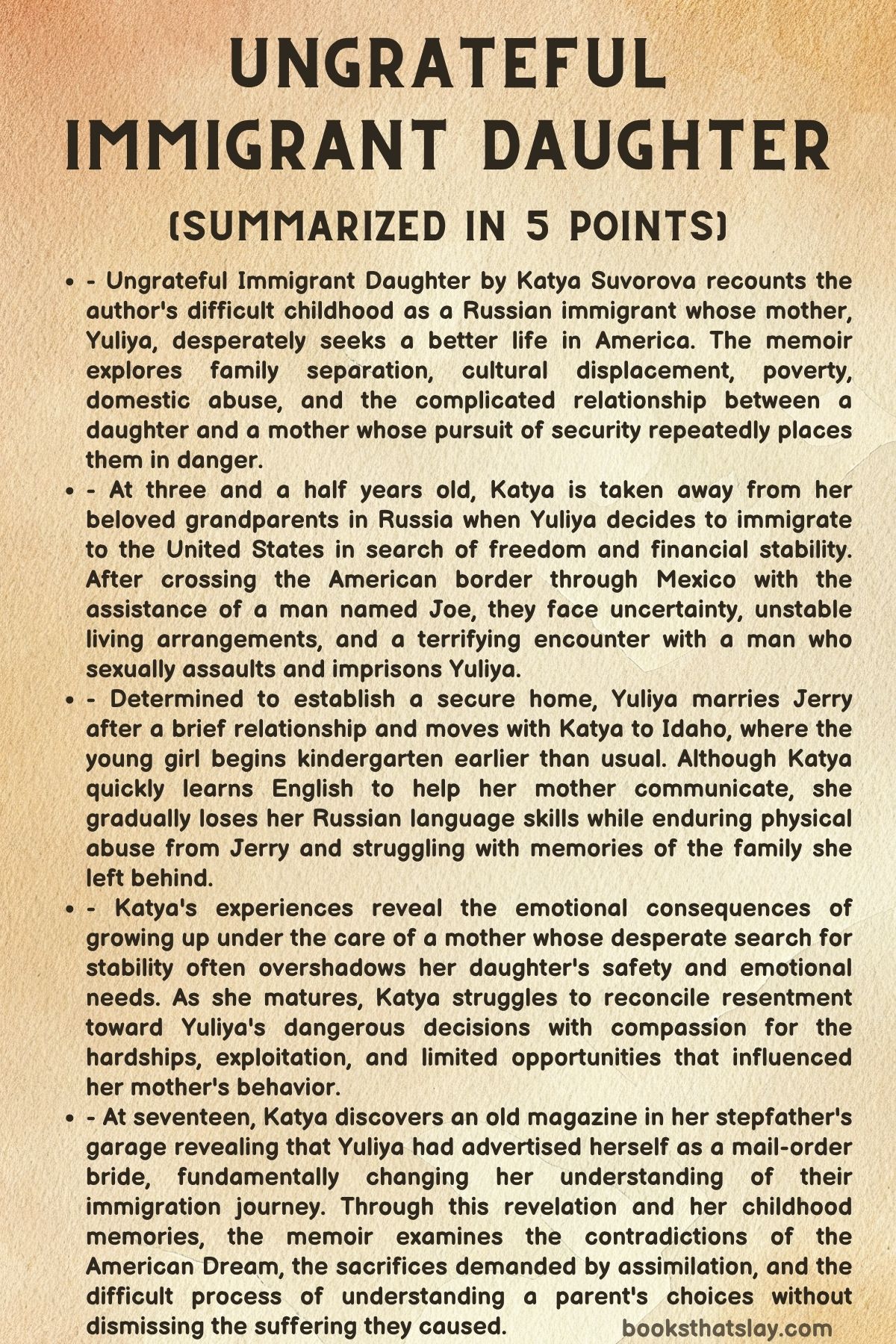
Ungrateful Immigrant Daughter by Katya Suvorova is a memoir about a Russian-born girl whose childhood is transformed by her mother’s determination to build a better life in the United States.
What begins as a promise of freedom becomes an unpredictable journey through family separation, poverty, abusive relationships, and cultural displacement. At its center is the complicated relationship between Katya and her mother, Yuliya, whose desire for security repeatedly exposes them to danger. Through childhood memories, painful revelations, and reflections on immigration, Suvorova examines the consequences of parental decisions, the emotional cost of assimilation, and the difficult relationship between love, resentment, and forgiveness.
Summary
Katya Suvorova’s memoir begins with a discovery that changes how she understands her childhood and her mother’s journey to America. At seventeen, while cleaning her stepfather’s garage in Houston, Katya comes across an old, damaged box containing belongings that appear to have been forgotten for years.
Among the objects are Russian horoscope pamphlets, newspapers, and an old magazine called Rose Russians. Katya recognizes the magazine because her mother, Yuliya, had once described it as a modeling catalogue, an explanation that had seemed perfectly ordinary when Katya was younger.
Looking through its pages with an older and more experienced perspective, Katya realizes that the photographs do not advertise clothing or fashion. Instead, they feature Russian women presenting themselves to American men as potential wives, complete with personal information and descriptions of their hopes for marriage.
Katya eventually finds her mother’s photograph and reads a declaration expressing her desire for a family and lasting love. The discovery reveals that Yuliya had advertised herself as a mail-order bride, exposing a hidden dimension of her search for security in the United States.
The magazine forces Katya to reconsider her mother’s relationships with American men and the circumstances that shaped their early years together. What once seemed like a confusing series of moves and marriages begins to acquire a different meaning, rooted in desperation, vulnerability, and the difficult choices involved in surviving as an immigrant woman.
Katya’s childhood memories return to Russia, where she spent her earliest years surrounded by the affection of her grandparents. Her grandmother, Valentina, whom she calls Babushka, was her primary caregiver and represented the comfort, familiarity, and stability that defined her earliest understanding of home.
At three and a half years old, Katya experiences a devastating separation when Yuliya decides to take her away from Russia. She desperately clings to her grandmother, unable to understand why she must leave the person who has provided so much of the love and reassurance in her young life.
Valentina promises that the separation will be temporary, but the reassurance does not become reality. Katya never returns to the childhood home she remembers, and the departure becomes a permanent rupture between her early Russian identity and the unfamiliar American existence awaiting her.
Yuliya believes America offers opportunities unavailable to them in Russia and describes it as a country of freedom, safety, and limitless possibility. Her confidence encourages the idea that crossing the border will mark the beginning of a secure and prosperous life, although Katya is too young to understand the practical difficulties involved.
Mother and daughter travel to Mexico, where a man named Joe helps them attempt to enter the United States. Their first two attempts are unsuccessful, creating uncertainty around a journey that Yuliya has presented as the solution to their problems.
On their third attempt, border officials permit them to enter without examining their documents. Looking back as an adult, Katya recognizes that their white appearance likely helped them avoid the scrutiny that other migrants might have faced.
This realization complicates the idealized image of America that her mother had encouraged her to believe. The country that supposedly treats everyone equally appears to apply different standards according to race and appearance, revealing inequalities Katya could not have understood as a child.
After entering the United States, Katya and Yuliya stay briefly with Joe in California. Their arrangement does not become permanent, however, and Yuliya soon leaves him, continuing her search for a man who can provide marriage, stability, and financial security.
With little money and no established support network, Yuliya begins visiting bars and meeting potential husbands. During these outings, she frequently leaves Katya alone in motel rooms, exposing the young girl to isolation and fear in surroundings she neither understands nor recognizes.
Katya’s experiences illustrate the vulnerability of children whose lives depend entirely on decisions made by adults. She has no meaningful influence over where they live, whom her mother trusts, or how long she must remain alone while Yuliya pursues another relationship.
The dangers of Yuliya’s search become terrifyingly clear when she meets a man who promises marriage and invites them into his home. Rather than offering the protection he claims to provide, he sexually assaults and imprisons Yuliya while locking Katya inside a closet.
The incident exposes the exploitation that can occur when promises of marriage are used to manipulate women who lack money, legal security, and dependable support. Katya is also made a victim of the situation, forced to endure confinement and the terror of being separated from her mother in an unfamiliar place.
Mother and daughter eventually escape, but the experience undermines Yuliya’s belief that American men necessarily represent safety and opportunity. The promise of an improved life has brought them into circumstances that are frighteningly different from the future she imagined.
Reflecting on these events years later, Katya struggles to reconcile her anger toward Yuliya with her understanding of the difficulties her mother faced. She recognizes that desperation and limited choices influenced Yuliya’s behavior, but this recognition does not erase the danger to which she exposed her daughter.
The complexity of their relationship becomes central to Katya’s perspective. Yuliya is neither simply a devoted mother nor merely a reckless parent; she is a woman attempting to survive while making decisions that repeatedly compromise her child’s safety.
Following their escape from California, Yuliya decides to move to Nevada, believing that living expenses will be more manageable there. Their financial situation remains precarious, however, and the uncertainty surrounding their immigration status makes finding a dependable source of support increasingly urgent.
Yuliya resumes her search for a husband and meets a man named Jerry. After knowing him for approximately two weeks, she marries him in Las Vegas, hoping that the relationship will finally provide the stable home she has been seeking.
Jerry takes Yuliya and Katya to Idaho, where they begin another stage of their American lives. Although the marriage appears to offer the possibility of permanence, the new arrangement soon introduces its own difficulties and painful experiences.
Yuliya and Jerry arrange for Katya to begin kindergarten even though she is younger than the normal enrollment age. Katya later learns that her documents were altered to make her appear older, allowing her to enter school earlier than she otherwise would have.
Yuliya explains that the decision was intended to help Katya learn English as quickly as possible. She hopes her daughter will become fluent enough to communicate with Americans and assist her mother in navigating a country whose language and customs remain unfamiliar.
This expectation places an extraordinary responsibility on a young child. Katya is not simply learning English for her own education; she is expected to become a source of linguistic support for her mother, reversing aspects of the traditional relationship between parent and child.
As Katya becomes more comfortable with English, her Russian begins to disappear from everyday use. Yuliya insists that they communicate in English, believing that complete immersion will accelerate their adjustment to American society.
The gradual disappearance of Russian creates a painful distance between Katya and the childhood she left behind. Her native language carries memories of her grandparents, familiar surroundings, and the emotional security that once defined her world.
Meanwhile, Jerry’s behavior reveals that the marriage has not delivered the protection Yuliya hoped to find. He physically abuses Katya, beating her with a belt and introducing another source of fear into her already unsettled childhood.
Despite these experiences, Katya continues to remember Russia with affection. She recalls her grandmother’s cooking, the warmth of family life, and visits to the Black Sea, experiences that contrast sharply with the isolation and uncertainty of her life in America.
One childhood incident becomes particularly revealing when Katya accidentally gets a Barbie shoe stuck inside her nose. Frightened and unable to explain what has happened in English, she instinctively begins speaking Russian, the language she associates with the earliest and most secure period of her life.
The incident illustrates how deeply childhood identity can survive beneath the demands of assimilation. Although Katya is being encouraged to speak English and adapt to American society, her native language remains connected to her most instinctive responses and her sense of safety.
Taken together, these early experiences establish the emotional conflicts that shape Katya’s understanding of her upbringing. Her mother’s determination to secure a better future creates opportunities for adjustment and survival, but it also leads to separation, abuse, cultural loss, and responsibilities that no young child should have to bear.
The discovery of the marriage magazine at seventeen gives these memories an additional significance. Katya begins to recognize that her mother’s pursuit of love and stability was shaped by circumstances far more complicated than the explanations she received as a child, leaving her to confront both the sacrifices Yuliya made and the harm that accompanied them.
Key People
Katya Suvorova
Katya Suvorova is the central figure and narrator of Ungrateful Immigrant Daughter, whose experiences reveal the emotional consequences of immigration through the perspective of a child. Her recollections show how decisions that adults consider necessary for survival can profoundly affect children who have little control over their circumstances.
As a young girl, Katya is deeply attached to her grandmother and the life she knows in Russia. Her forced separation from that environment becomes one of her earliest experiences of loss, establishing an emotional connection to her homeland that continues even as she adapts to the United States.
Her childhood is defined by repeated disruptions, including moves between unfamiliar places, encounters with dangerous adults, and uncertainty about her mother’s relationships. These experiences force her to confront fear and instability long before she has the emotional maturity to understand their causes.
Katya’s relationship with language is especially significant because it demonstrates how immigration changes her identity. She learns English quickly and is expected to help her mother communicate, but her growing fluency comes at the expense of the Russian language that connects her to her grandparents and earliest memories.
Her instinctive return to Russian during the Barbie shoe incident reveals that her original identity has not completely disappeared. Even as her surroundings demand adjustment, her emotional memories remain connected to the language of her childhood.
As a teenager, Katya becomes increasingly capable of questioning the stories she has been told about her family’s past. Discovering her mother’s photograph in a mail-order bride magazine forces her to reinterpret childhood events that previously seemed confusing or inexplicable.
Her adult perspective is distinguished by the tension between resentment and understanding. She recognizes that Yuliya faced considerable hardship, but she also refuses to ignore the fear, neglect, and abuse she experienced because of her mother’s decisions.
Katya ultimately represents the immigrant child who must construct an identity from conflicting experiences of belonging and displacement. Her perspective demonstrates that understanding a parent’s suffering does not necessarily eliminate the emotional consequences of growing up under that parent’s care.
Yuliya
Yuliya is one of the most complicated characters in Ungrateful Immigrant Daughter, embodying both the determination of a mother seeking opportunity and the damaging consequences of choices made under pressure. Her actions are driven by a powerful desire for security, but her understanding of how to achieve it repeatedly places herself and her daughter in vulnerable situations.
Her decision to leave Russia reflects her belief that America offers greater possibilities for happiness, freedom, and prosperity. She is willing to abandon familiar surroundings and separate Katya from her grandparents because she believes that a better future justifies the sacrifices involved.
Yuliya’s dependence on American men is central to her attempts to establish a stable existence. Rather than possessing financial independence or an established support network, she approaches marriage as a possible solution to the difficulties of immigration.
Her experiences in California expose the danger of this strategy when a man who promises marriage subjects her to sexual violence and imprisonment. This incident reveals that Yuliya is not simply making irresponsible choices; she is also vulnerable to exploitation by people who recognize her desperation.
Nevertheless, her vulnerability cannot entirely excuse her treatment of Katya. Leaving her young daughter alone in motel rooms and bringing her into unsafe environments demonstrates how the pursuit of personal security can overshadow the immediate responsibilities of parenthood.
Yuliya also has a complicated relationship with cultural identity. Her insistence that Katya speak English reflects her determination to make adaptation possible, but it simultaneously distances her daughter from the Russian language and the emotional connections associated with it.
Her decision to enroll Katya in school early further illustrates this contradiction. Although she intends to provide her daughter with an advantage, she also expects a young child to acquire the language skills necessary to help her mother navigate American life.
Yuliya emerges as a character who cannot be understood through simple judgments of good or bad parenting. Her determination, vulnerability, recklessness, and hope coexist, making her relationship with Katya an exploration of how survival instincts can conflict with parental responsibility.
Valentina (Babushka)
Valentina, Katya’s grandmother, represents stability, affection, and cultural continuity in Ungrateful Immigrant Daughter. Although her direct presence is concentrated in Katya’s memories of Russia, her emotional importance extends far beyond the family’s departure.
As Katya’s primary caregiver during her earliest years, Valentina provides the nurturing environment that establishes the child’s understanding of safety and belonging. Her home represents a dependable world in which Katya feels protected and loved without having to confront the uncertainties that later define her life.
The separation between grandmother and granddaughter becomes especially distressing because Katya is too young to understand why she is being taken away. Her desperate attempts to remain with Valentina reveal the depth of their attachment and the emotional violence that can accompany family separation, even when the adults believe they are acting for the best.
Valentina’s promise that the separation will be temporary carries considerable emotional weight. Although it is intended to reassure Katya, the fact that she never returns to her childhood home transforms the promise into a painful reminder of everything that immigration has taken from her.
Memories of Valentina’s cooking and familiar family routines preserve Katya’s relationship with her Russian heritage. These recollections demonstrate that belonging is not determined solely by nationality or geography but also by the relationships and experiences through which a child first understands home.
Valentina consequently becomes an emotional reference point against which Katya’s American experiences can be measured. Where the relationships surrounding her mother often introduce insecurity, her grandmother symbolizes the dependable care that Katya continues to remember.
Jerry
Jerry is an important figure in Ungrateful Immigrant Daughter because his marriage to Yuliya demonstrates the difference between obtaining a seemingly stable household and achieving genuine safety. His presence initially appears to offer a solution to the financial uncertainty that has followed mother and daughter throughout their early experiences in America.
Yuliya marries Jerry in Las Vegas after a brief relationship, and he brings them to Idaho. This transition creates the appearance of a more permanent living arrangement, providing an alternative to the temporary accommodations and uncertain relationships that previously defined their circumstances.
Jerry also participates in arranging Katya’s early kindergarten enrollment, suggesting that he occupies a significant position in determining the course of her daily life. His involvement in this decision reflects the authority he holds within the new family arrangement.
However, Jerry’s physical abuse of Katya reveals the danger concealed beneath the appearance of domestic stability. By beating her with a belt, he becomes another adult whose power over the child creates fear rather than protection.
His behavior is particularly significant because Yuliya’s search for marriage is supposed to secure a safer existence for herself and her daughter. Instead, Katya finds herself exposed to violence inside the household that was intended to offer permanence.
Jerry represents the limitations of defining security through marriage, financial support, or the presence of a father figure. His treatment of Katya demonstrates that a household cannot provide genuine stability when one of its adults uses authority to inflict harm.
Joe
Joe appears in Ungrateful Immigrant Daughter as the man who helps Yuliya and Katya enter the United States from Mexico. His involvement makes him important to the circumstances of their immigration, although the account provides limited insight into his personality and personal motivations.
Yuliya views Joe as a potential husband, reflecting her belief that a relationship with an American man could provide the means to establish a new life. His willingness to assist their crossing places him at the beginning of the American journey that shapes Katya’s childhood.
After two unsuccessful attempts, they successfully cross the border on their third occasion. Joe’s role in this process highlights how Yuliya depends on personal relationships rather than established institutions or independent resources to pursue her ambitions.
The relationship does not last, and Yuliya leaves Joe after they spend a short period in California. The account does not establish that he was abusive or explain the precise reasons for their separation, making it important to distinguish his limited portrayal from the dangerous men who enter their lives afterward.
Joe primarily represents the uncertainty surrounding Yuliya’s early efforts to secure a future in America. His presence marks an important transition, but his departure also demonstrates that successfully entering the country does not resolve the practical challenges of building a stable life.
The Unnamed Man in California
The unnamed man who assaults Yuliya is one of the most threatening figures in the story, demonstrating the dangers faced by immigrant women whose circumstances leave them dependent on unfamiliar people. His appearance is brief, but the violence associated with him has considerable significance for the memoir’s portrayal of vulnerability and exploitation.
He initially presents himself as a potential husband, offering precisely the kind of relationship that Yuliya believes will provide stability. By making promises of marriage, he gains an opportunity to exploit her hopes and her precarious circumstances.
His subsequent actions reveal the predatory nature of his intentions. He sexually assaults and imprisons Yuliya while locking Katya in a closet, transforming the apparent promise of a safe household into an experience of terror and confinement.
The man’s conduct illustrates how unequal power relationships can enable exploitation. Yuliya’s uncertain status, lack of resources, and limited support make her especially vulnerable to someone willing to manipulate her need for security.
For Katya, the experience reinforces the terrifying unpredictability of the adult world surrounding her. Her mother’s search for a protector instead brings them into contact with someone who threatens their safety, making the incident an important example of the contradictions shaping her childhood.
Katya’s Grandfather
Katya’s grandfather is part of the family environment she leaves behind in Russia. Although the supplied account provides little individualized detail about him, his presence contributes to the wider sense of family belonging that characterizes her earliest memories.
Together with Valentina, he belongs to a world of familiar relationships and routines that contrasts with the uncertainty of immigration. The loss of contact with her grandparents represents more than geographical separation because it also removes Katya from the family structure in which she initially felt secure.
His role illustrates the experience of relatives who remain behind when migration separates families. Even without extensive personal characterization, he is part of the emotional and cultural foundation that Katya continues to associate with Russia.
Katya’s Stepfather in Houston
Katya’s stepfather in Houston appears indirectly through the garage where the memoir’s opening discovery takes place. The account does not provide sufficient information to establish his personality, his relationship with Katya, or whether he is connected to any of the men described in her earlier childhood.
Nevertheless, the setting of his garage is important because it becomes the location where Katya unexpectedly encounters evidence of her mother’s concealed past. The damaged box and its contents reveal how family histories can remain physically present within a household even when important aspects of those histories have never been openly discussed.
His indirect presence also emphasizes the continuing importance of remarriage and changing family structures in Katya’s life. The episode establishes the setting for her discovery without providing enough evidence to make broader judgments about his character.
Themes
The American Dream and the Reality of Immigration
The contrast between the promise of America and the realities of immigrant life shapes Ungrateful Immigrant Daughter from its earliest events. Yuliya approaches the United States with the conviction that it offers freedom, opportunity, and a better future for herself and her daughter, yet their experiences repeatedly challenge those expectations.
Her decision to leave Russia is driven by the belief that migration can resolve difficulties that seem impossible to overcome in her homeland. America becomes more than a destination; it represents an imagined future in which financial insecurity, restricted opportunities, and personal dissatisfaction might finally disappear.
However, entering the country does not automatically provide the independence or protection Yuliya anticipates. Instead, she finds herself navigating unfamiliar surroundings with limited resources, uncertain immigration circumstances, and a dependence on relationships that can quickly become dangerous.
The episode at the border exposes another contradiction in America’s supposed commitment to equal opportunity. Katya’s later recognition that their white appearance likely contributed to their successful entry reveals how racial privilege can influence the experiences of migrants and complicates the idea that everyone encounters the same obstacles.
The family’s experiences after crossing the border further undermine the belief that geography alone can guarantee a better life. Motel rooms, unstable relationships, exploitation, and domestic violence demonstrate that personal security depends on far more than reaching a particular country.
The memoir therefore distinguishes between the ideal of opportunity and the practical realities that determine whether people can benefit from it. Yuliya’s hopes are understandable, but her experiences show that immigration can introduce new forms of vulnerability even while promising escape from old difficulties.
Through Katya’s perspective, the American Dream becomes a complicated inheritance rather than an unquestioned success story. The opportunities associated with America exist alongside profound emotional losses, demonstrating that achieving a new beginning does not necessarily mean finding safety, happiness, or belonging.
Motherhood, Sacrifice, and the Complexity of Love
Yuliya’s relationship with Katya demonstrates how maternal love can coexist with harmful decisions, particularly when a parent is struggling to survive. In Ungrateful Immigrant Daughter, motherhood is presented as an emotionally complicated responsibility rather than an identity that automatically guarantees wisdom, stability, or protection.
Yuliya believes that leaving Russia will improve her daughter’s future, and many of her subsequent decisions are influenced by this conviction. From her perspective, the sacrifices involved in migration may appear necessary because remaining in familiar circumstances seems to offer fewer possibilities.
For Katya, however, those same sacrifices carry a very different meaning. Leaving her grandparents means losing the people and surroundings that have provided her with dependable affection, while her mother’s pursuit of relationships repeatedly exposes her to isolation and fear.
This difference between parental intention and childhood experience creates the central tension in their relationship. Yuliya may consider her actions expressions of responsibility and determination, but Katya remembers the emotional consequences of decisions she was never allowed to make for herself.
The memoir also questions the assumption that suffering justifies every action taken in the name of survival. Yuliya’s vulnerability explains why she seeks assistance from American men, yet it does not erase the danger involved in leaving her daughter unattended or placing her in households where abuse occurs.
Katya’s retrospective understanding introduces an additional emotional complication. As an adult, she can recognize the pressures that influenced her mother while still acknowledging that those pressures resulted in genuine harm.
Compassion and anger consequently exist together rather than canceling one another. Katya’s efforts to understand Yuliya do not require her to deny the fear and instability of her childhood, just as recognizing those experiences does not mean rejecting every aspect of her mother’s love.
The relationship ultimately challenges simplified ideas about parental sacrifice. It suggests that love must be considered not only through what a parent hopes to achieve but also through how their choices affect the child who depends on them.
Language, Cultural Identity, and the Loss of Belonging
Language becomes an essential part of Katya’s struggle to understand where she belongs. Her transition from Russian to English reflects the practical demands of immigration, but it also exposes the emotional cost of adapting to a society that expects newcomers to change.
For Yuliya, English represents a means of survival and advancement. She believes that her daughter’s rapid acquisition of the language will make education easier and provide practical assistance in navigating unfamiliar institutions and everyday interactions.
Katya’s early enrollment in kindergarten therefore carries significance beyond ordinary schooling. It demonstrates how the responsibilities of immigration can be transferred to children, who may acquire the linguistic and cultural knowledge that their parents need but cannot easily obtain.
The gradual disappearance of Russian from Katya’s daily life creates a painful contradiction. Her growing ability to participate in American society increases her practical independence while weakening an important connection to the people and experiences that formed her earliest identity.
Russian is especially meaningful because it belongs to the period when Katya lived with her grandparents. It preserves memories of her grandmother’s affection, familiar family routines, and a sense of security that contrasts with the uncertainty she encounters after leaving home.
The incident involving the Barbie shoe reveals that language operates at a level deeper than deliberate communication. When Katya becomes frightened and struggles to explain herself, she instinctively returns to Russian, demonstrating that her emotional responses remain connected to the language of her earliest childhood.
This moment challenges the belief that cultural assimilation completely replaces a person’s previous identity. Although Katya is encouraged to embrace English and adapt to American expectations, her original language continues to exist within her memories and instinctive understanding of the world.
The theme also demonstrates that belonging cannot be measured simply by linguistic fluency. A child may become highly capable of functioning in a new society while continuing to experience separation from the people, places, and traditions that once made her feel secure.
Katya’s experience presents cultural identity as something shaped by both adaptation and loss. Her developing American life does not erase her Russian childhood, but the distance between these two experiences complicates her ability to understand herself as belonging entirely to either world.
Gender, Power, and Exploitation
Yuliya’s pursuit of marriage exposes the unequal power relationships that can emerge when women depend on romantic partnerships for financial security and social stability. Her experiences demonstrate how promises of love and protection can become instruments of manipulation when one person possesses significantly greater resources or authority than another.
The marriage magazine discovered by Katya symbolizes this imbalance. By presenting Russian women to prospective American husbands through photographs and personal descriptions, it reveals a system in which romantic relationships are shaped by expectations surrounding nationality, gender, financial opportunity, and access to a better life.
Yuliya’s participation in this arrangement reflects her desire for family and lasting love, but it also exposes the vulnerability of someone seeking stability through a stranger. Her hopes create opportunities for men to present themselves as protectors without necessarily demonstrating that they are trustworthy.
The unnamed man’s actions in California reveal the most extreme consequences of this vulnerability. His promise of marriage becomes a means of gaining access to Yuliya before he sexually assaults and imprisons her, demonstrating how the appearance of romantic commitment can conceal coercion and violence.
Jerry’s behavior introduces a different manifestation of unequal power within the household. Although his marriage to Yuliya appears to offer stability, his physical abuse of Katya demonstrates that a conventional family arrangement can conceal serious threats to those who possess the least authority.
These experiences reveal that women and children can face distinct but connected forms of vulnerability. Yuliya is exposed to exploitation because of her circumstances as an immigrant woman, while Katya suffers because she has little ability to challenge the adults who control her environment.
The memoir also complicates the relationship between vulnerability and responsibility. Yuliya is herself harmed by unequal power structures, yet some of her attempts to escape insecurity place her daughter in dangerous situations, demonstrating how suffering can have consequences beyond the person directly experiencing it.
Through these relationships, the story questions the assumption that marriage automatically provides protection or that dependence on a powerful partner guarantees stability. Genuine security requires safety, autonomy, and respect, none of which can be established merely through a wedding or the promise of financial support.
Ultimately, the theme exposes the dangers of arrangements in which unequal power is disguised as romantic opportunity. It emphasizes that the pursuit of love and survival can become especially hazardous when individuals lack the resources, independence, and protection necessary to make meaningful choices.