Until She Dies Summary, Characters and Themes
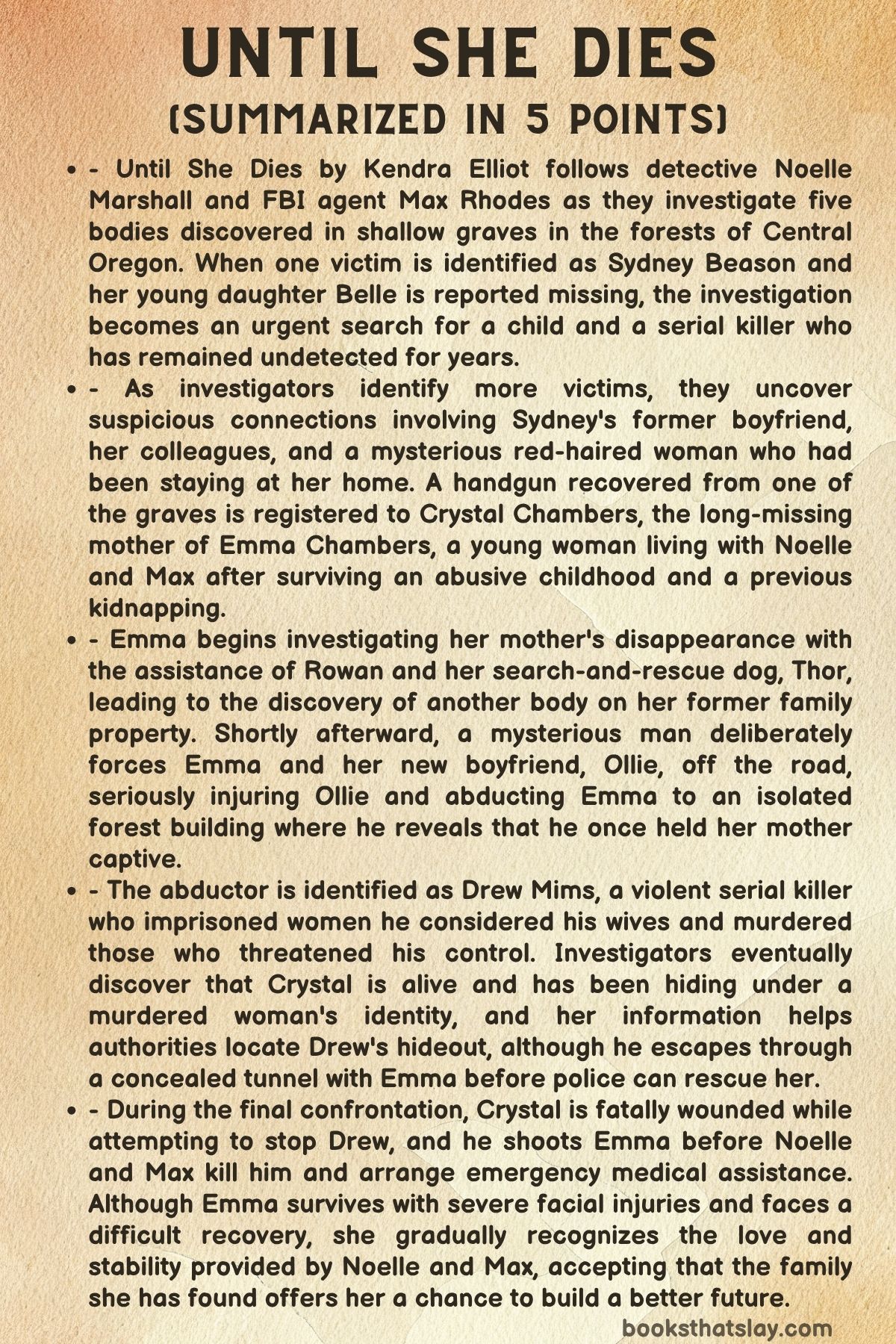
Until She Dies by Kendra Elliot is a crime thriller that combines a serial murder investigation with a disturbing story of captivity, family secrets, and survival. Set against the isolated forests of Central Oregon, the novel follows detective Noelle Marshall and FBI agent Max Rhodes as they investigate five buried bodies and the disappearance of a young girl.
Their search gradually exposes a dangerous connection to Emma Chambers, a young woman already struggling with the consequences of an abusive childhood and a previous kidnapping. Through unexpected discoveries, complicated family relationships, and escalating violence, the book examines the lasting effects of trauma, the search for justice, and the meaning of family. It’s the 3rd book in the Noelle Marshall series.
Summary
Ten years before the central investigation, Crystal Chambers makes a discovery that permanently changes her life. Suspecting her husband, Gage, of having an affair, she follows his truck through isolated forest roads after witnessing him leave a bar with another woman.
What begins as an attempt to expose her husband’s infidelity becomes a terrifying encounter when Crystal watches Gage deliver the woman to an intimidating stranger. The man confronts the woman, threatens her with a gun, and murders her while Gage stands by without intervening.
When the killer notices Crystal hiding nearby, he chases her through the forest and captures her. Crystal calls desperately for her husband, only to discover that Gage has no intention of saving her.
A decade later, Deschutes County detective Noelle Marshall is hiking through the Central Oregon wilderness with her friend Rowan, an experienced search-and-rescue handler, and Rowan’s German shepherd, Thor. Their peaceful outing takes a sinister turn when Thor begins alerting to suspicious locations beneath the forest floor.
The women discover what appear to be several shallow graves and summon investigators. A forensic examination confirms that five bodies have been buried in the area over different periods, suggesting that a serial murderer has operated undetected for years.
Noelle joins fellow detective Evan Bolton in organizing an extensive investigation. Forensic anthropologist Dr. Victoria Peres and medical specialists examine the remains, revealing that multiple victims were shot in the head.
One of the more recently buried women is identified through her breast implants as Sydney Beason, a thirty-nine-year-old divorced mother from Bend. Although Sydney has apparently been dead for approximately a week, nobody has reported her missing.
When Noelle and Evan visit Sydney’s townhouse, they discover evidence that she has a young daughter named Belle. The little girl is also missing, transforming the murder inquiry into an urgent search for a potentially endangered child.
Sydney’s former husband, Trey Beason, is devastated by the news and insists that he returned Belle following their scheduled visitation. With no reliable explanation for the child’s whereabouts, the authorities enlist the assistance of FBI agent Max Rhodes, Noelle’s romantic partner.
Max and Noelle have established a supportive household that also includes eighteen-year-old Emma Chambers, a young woman recovering from an earlier kidnapping. Emma has found stability in caring for rescued animals and developing a trusting relationship with the adults who have welcomed her into their lives.
As the investigation progresses, detectives discover that Sydney had concealed several important relationships. A neighbor reveals that a man driving a bright-blue Jeep frequently visited her, while forensic evidence suggests that an unidentified red-haired woman had been staying in her spare bedroom.
The boyfriend is identified as Hayden Hall, a plumber who admits that Sydney recently ended their relationship. Although Hayden appears genuinely distressed by her death and Belle’s disappearance, investigators cannot disregard him as a potential suspect.
Sydney’s colleague and close friend, Merritt Blocker, also attracts attention because of her intense reaction to the murder. Merritt insists that she knew everything about Sydney’s personal life, yet she seems unaware of both Hayden and the mysterious female houseguest.
Meanwhile, the forensic investigation identifies another victim as Layla Holder, a woman who disappeared from Boise several months earlier. Noelle discovers that Layla previously worked at Sherman Plumbing, the same company employing Hayden, creating the first significant connection between two of the murdered women.
The detectives question Hayden again, but he denies remembering Layla. Although his apparent connection to both victims increases suspicion, the investigation produces no convincing evidence that he committed the murders.
Other discoveries complicate the case. Investigators identify an older victim as Phoebe Colvin, a Canadian woman who disappeared twelve years earlier, while another possible lead points toward a woman named Elise Nunevillier, whose identity appears connected to Sydney’s missing houseguest.
At the same time, Noelle receives shocking information about a handgun recovered from one of the graves. Its restored serial number reveals that it originally belonged to Crystal Chambers, Emma’s mother, who vanished ten years earlier.
Emma has spent much of her life believing that her abusive father, Gage, may have murdered Crystal. The firearm’s discovery seemingly strengthens that suspicion, although dental comparisons eventually establish that the relevant remains do not belong to her mother.
Despite this disappointment, Emma begins taking greater control of her life. She develops a romantic connection with Ollie, the son of police chief Truman Daly, and their shared experiences of childhood loss and hardship help them understand one another.
During a movie date with Ollie, a scene involving a mother’s death causes Emma to consider another possibility. She begins wondering whether Gage buried Crystal somewhere on the rural property where Emma grew up.
Determined to investigate, Emma asks Rowan to bring Thor to the abandoned property. The dog identifies a possible burial site, and investigators subsequently uncover human remains that appear to belong to a man rather than Crystal.
Noelle begins suspecting that the newly discovered body may be Gage himself. Before investigators can establish its identity, however, another crisis changes the direction of the case.
After Emma leaves the property with Ollie, a black Ford Expedition deliberately forces his truck off a remote road. The vehicle crashes down an embankment, seriously injuring Ollie and leaving Emma vulnerable to an armed stranger.
The stranger threatens to murder Ollie unless Emma accompanies him. Unable to risk Ollie’s life, she surrenders and is transported to an isolated stone building deep within the forest.
When Ollie’s overturned truck is eventually discovered by officer Ben Cooley, rescuers learn that Emma has been abducted. Ollie survives but requires substantial medical treatment, while Noelle and Max urgently organize another search for the young woman.
Inside the remote building, Emma realizes that her captor is a dangerous, controlling man with experience imprisoning women. He restrains her, threatens her repeatedly, and refuses to explain why he has chosen her.
Eventually, he reveals that Emma is not his intended romantic victim but bait for another person. His disturbing familiarity with her appearance leads to a revelation: he once held her mother captive.
The man is Drew Mims, the stranger who murdered the woman Crystal saw in the forest ten years earlier. Drew had forced Crystal into captivity, declaring that she was his wife and treating her as a possession rather than a person.
Crystal survived by pretending to accept his authority while secretly preparing an escape. When an opportunity arose, she violently resisted him, inflicted lasting injuries, and fled into the wilderness.
Emma is horrified when Drew reveals that Crystal survived their encounter and is still alive. This knowledge raises painful questions about why her mother never returned to protect her from Gage.
Meanwhile, the investigation into Belle’s disappearance produces an unexpected breakthrough when the child is returned safely to her grandparents. The woman who brings her home is identified as Elise, the mysterious houseguest who had been staying with Sydney.
Shortly afterward, Ben Cooley stops a vehicle registered under Elise’s name. Noelle and Max are astonished to discover that the driver is actually Crystal Chambers.
Crystal explains that she assumed Elise’s identity after escaping Drew, using the murdered woman’s identity to conceal herself from her former captor. She spent years moving between different locations, convinced that returning to her old life would expose both herself and Emma to danger.
After seeing information about Emma, Crystal returned to Oregon and stayed with Sydney, an old school friend. Unfortunately, Drew recognized her while working as a delivery driver and began tracking her movements.
Drew attempted to abduct Crystal from Sydney’s vehicle but mistakenly confronted Sydney instead. Crystal escaped with Belle, while Sydney was forced to accompany Drew and was subsequently murdered.
Terrified that Drew would target Belle, Crystal kept the child hidden until she learned that Emma had been kidnapped. She then returned Belle to her grandparents and attempted to confront Drew herself.
With Crystal’s assistance, investigators identify Drew’s likely hideout as an abandoned Civilian Conservation Corps building deep in the forest. A tactical team surrounds the structure and begins negotiating for Emma’s release.
Drew demands that Crystal surrender herself in exchange for her daughter. When the negotiators refuse to expose Crystal to immediate danger, he threatens to burn the building with Emma inside.
Smoke soon rises from the structure, prompting officers to force their way inside. However, Drew has already escaped with Emma through a concealed underground passage leading beyond the police perimeter.
Noelle, Max, and tactical officers pursue the pair through difficult terrain. During the search, Crystal steals a police rifle and attempts to confront Drew independently, but he shoots her repeatedly before fleeing with Emma.
Despite her injuries, Crystal provides information that helps investigators continue the pursuit. Noelle eventually reaches a ridge where Drew is holding Emma hostage near a steep cliff.
Drew becomes increasingly unstable and begins addressing Emma as though she were Crystal. When Max arrives, Drew suddenly shoots Emma through the mouth, prompting Noelle and Max to open fire and kill him.
Emma survives the shooting but suffers extensive injuries to her jaw, teeth, mouth, and facial nerves. Emergency treatment saves her life, although her recovery requires multiple operations and prolonged medical care.
Crystal dies from her wounds, leaving Emma without the opportunity to confront her mother about the years they spent apart. Investigators subsequently confirm that the real Elise Nunevillier was among the murdered women and that Gage Chambers was buried on his former property.
Nearly four weeks later, Emma continues struggling with physical pain, emotional exhaustion, and changes to her appearance. She withdraws from Ollie and questions whether she will ever regain the confidence and independence she had begun developing.
Noelle and Max remain steadfast in their support, reminding Emma that she is an essential part of their family. Their reassurance helps her recognize that survival has given her a future beyond the cruelty she has experienced.
The novel concludes with Emma acknowledging her desire to live and accepting the love surrounding her. Although the murders have left permanent consequences, Noelle, Max, and Emma embrace the possibility of rebuilding their lives together.
Characters
Noelle Marshall
Noelle Marshall is the central investigative figure in Until She Dies, representing determination, professional intelligence, and the emotional challenges of protecting vulnerable people. As a Deschutes County detective, she approaches the discovery of five buried bodies with persistence and an understanding that every victim deserves identification and justice.
Her investigative abilities are strengthened by her attention to seemingly insignificant details. Whether examining clothing recovered from graves, interviewing reluctant witnesses, or recognizing connections between victims, Noelle demonstrates that effective detective work requires observation as much as technical expertise.
Her relationship with Emma reveals an equally important aspect of her personality. Having welcomed the young woman into her household, Noelle feels responsible for providing the stability and affection Emma never received from her biological parents.
This protective instinct becomes especially powerful when Emma is abducted. Noelle must balance her professional obligation to remain composed with the overwhelming fear of losing someone she has come to regard as her daughter.
Her character also reflects personal growth through earlier hardships, including painful relationships and physical trauma. By the conclusion, her willingness to embrace an unconventional family illustrates how deeply her priorities have changed.
Max Rhodes
Max Rhodes serves as both an FBI investigator and one of the principal emotional supports in Until She Dies. His experience with violent crimes and missing-child investigations makes him particularly valuable when Sydney Beason’s daughter disappears.
Max approaches investigations methodically, combining forensic evidence, witness statements, and interagency cooperation. He understands how rapidly a missing-person investigation can become overwhelmed by misleading information, and he works to distinguish credible leads from distractions.
His relationship with Noelle demonstrates his capacity for partnership rather than competition. Although they sometimes approach problems differently, he respects her judgment and recognizes the importance of supporting her during stressful investigations.
Max’s strongest emotional conflict concerns Emma, whom he previously rescued from another dangerous captor. Her second kidnapping makes him question his ability to protect the people he loves.
His guilt intensifies when Emma is shot during the confrontation with Drew. Nevertheless, his actions during the emergency demonstrate his devotion, and his presence throughout her recovery confirms that his commitment to her extends beyond professional responsibility.
Emma Chambers
Emma Chambers is one of the most emotionally significant characters in Until She Dies, with her experiences connecting the contemporary murder investigation to crimes committed a decade earlier. At eighteen, she is attempting to establish an independent life after years of neglect, abuse, abandonment, and captivity.
Her childhood with Gage left her struggling to trust others and recognize her own worth. Although she has found security with Noelle and Max, she remains vulnerable to memories of her parents and fears that the people she loves may eventually abandon her.
Emma’s developing relationship with Ollie shows her growing willingness to experience ordinary happiness. Their conversations, hikes, and movie date allow her to imagine a future shaped by companionship rather than survival alone.
Her decision to investigate her mother’s disappearance demonstrates remarkable initiative. Instead of accepting uncertainty indefinitely, she seeks answers even though she recognizes that the truth may be painful.
During her captivity with Drew, Emma relies on observation, patience, and emotional control to survive. Her ability to remain mentally active despite overwhelming danger reveals an inner strength that she does not always recognize in herself.
The shooting leaves her confronting another difficult recovery, particularly because her injuries affect her appearance and ability to communicate. Her eventual acceptance of Noelle and Max’s love represents an important step toward rebuilding her confidence and identity.
Crystal Chambers
Crystal Chambers occupies a complicated position in Until She Dies, functioning as both a survivor of horrific abuse and a mother whose prolonged absence has profoundly affected her daughter. Her story begins when she witnesses Drew Mims murder a woman and subsequently becomes his prisoner.
Although initially terrified, Crystal gradually recognizes that she must depend on her own intelligence to escape. Her decision to appear cooperative while secretly studying Drew’s habits demonstrates patience, resourcefulness, and determination.
Her marriage to Gage exposes another dimension of her victimization. Rather than attempting to rescue her, Gage abandons her to Drew, revealing that Crystal cannot rely on the person who should have been closest to her.
After escaping, Crystal assumes another woman’s identity and spends years hiding from Drew. Her decision protects her from immediate danger but leaves Emma alone with an abusive father, creating a painful moral conflict.
Crystal’s return reveals that she never completely escaped the consequences of her captivity. Her determination to confront Drew after learning about Emma’s abduction shows a desperate desire to protect the daughter she could not raise.
Her death while attempting to stop him gives her character a tragic conclusion. Although her final actions demonstrate courage and maternal devotion, they cannot erase the suffering caused by her long absence.
Drew Mims
Drew Mims is the principal antagonist of Until She Dies, representing extreme possessiveness, violence, and the desire to exercise complete control over other people. His crimes emerge from a distorted belief that women can be acquired, imprisoned, and forced into relationships.
Drew’s treatment of his captives reveals that he does not recognize their autonomy. He refers to imprisoned women as his wives, demonstrating how he transforms coercion and violence into a false sense of entitlement.
His physical strength, isolated hideout, and familiarity with the wilderness make him especially dangerous. The abandoned building provides a location where he can imprison victims without attracting attention, while his underground escape route shows his preparation for possible discovery.
His obsession with Crystal continues long after she escapes. Rather than accepting her freedom, he interprets her disappearance as an offense against his authority and remains determined to reclaim her.
Emma’s abduction exposes the depth of his obsession because he uses her as leverage to reach Crystal. As the confrontation progresses, his increasingly confused identification of Emma with her mother reveals how thoroughly his possessiveness has distorted his thinking.
Drew’s death ends his immediate threat, but the many bodies connected to his crimes demonstrate the devastation he has caused across numerous lives.
Gage Chambers
Gage Chambers is Emma’s abusive father and Crystal’s husband, whose selfishness and cowardice contribute directly to the suffering of both women. His involvement with Drew reveals that he is willing to facilitate violence against others while protecting his own interests.
His behavior during Crystal’s captivity is especially revealing. Although he knows where she is being held, he refuses to rescue her when Drew threatens to expose his criminal activities.
Gage appears more concerned about losing someone who performs domestic responsibilities than about his wife’s safety. This attitude reinforces the controlling behavior that later shapes Emma’s childhood.
His treatment of Emma leaves lasting psychological consequences, including insecurity, distrust, and uncertainty about her own value. Even after his apparent death, his influence continues through the memories she struggles to overcome.
The discovery of his remains on the former family property finally confirms his death. His character illustrates how abuse can continue affecting survivors long after the abuser is gone.
Ollie
Ollie is a compassionate young man whose developing relationship with Emma provides an important contrast to the violence dominating the novel. His difficult childhood enables him to understand emotional isolation without expecting Emma to explain every aspect of her past.
Having experienced family loss and periods of living independently in the wilderness, Ollie values stability and genuine connection. His relationship with Truman and Mercy has taught him the importance of accepting support from others.
Ollie’s attraction to Emma develops through quiet conversations and shared interests rather than dramatic declarations. He respects her boundaries, including her preference for driving separately to their first date.
His protective instincts become especially evident during the deliberate road attack. Although he attempts to avoid the approaching vehicle, he cannot prevent the crash that results in Emma’s abduction.
Following his own serious injuries, Ollie remains concerned about Emma and hopes to maintain their relationship. His disappointment when she withdraws demonstrates his emotional investment, while his continuing affection suggests the possibility of reconciliation.
Rowan
Rowan is an experienced search-and-rescue handler whose expertise repeatedly contributes to the investigation. Her German shepherd, Thor, first identifies the suspicious graves that expose Drew’s long history of violence.
Rowan approaches her responsibilities with patience and professionalism, understanding that canine alerts require careful interpretation and proper investigative procedures. She works closely with Noelle while respecting the importance of preserving possible evidence.
Her relationship with Emma shows her compassionate nature. When Emma asks for help searching her former property, Rowan takes the request seriously rather than dismissing it as an emotional reaction.
By assisting Emma, Rowan helps establish the circumstances surrounding another hidden death. She represents the value of specialized expertise, cooperation, and practical kindness within the community.
Thor
Thor is Rowan’s highly trained German shepherd and an essential participant in the discovery of the buried victims. His ability to detect human remains transforms an ordinary wilderness hike into the beginning of a major murder investigation.
His alerts also provide Emma with a way to investigate her mother’s disappearance. Although the remains discovered on her former property do not belong to Crystal, Thor’s work helps uncover another crime and contributes to the eventual identification of Gage.
Thor’s role emphasizes the value of search-and-rescue animals, whose abilities can reveal evidence that human investigators might otherwise overlook.
Evan Bolton
Evan Bolton is Noelle’s fellow detective and a major figure in coordinating the complicated investigation. His responsibilities include organizing forensic examinations, assigning investigative tasks, and managing information shared among participating agencies.
Evan demonstrates a calm and practical approach to police work. When multiple discoveries and missing-person reports threaten to overwhelm the task force, he helps investigators maintain their focus.
His friendship with Noelle allows him to challenge her assumptions constructively. For example, he reminds her that Emma is legally an adult and capable of deciding whether to provide a DNA sample.
His engagement to Rowan also establishes his personal connection to the surrounding community. Evan represents reliable leadership and the importance of cooperation during difficult investigations.
Sydney Beason
Sydney Beason is the murdered schoolteacher whose identification gives investigators their first substantial lead. As a divorced mother raising Belle, Sydney appears to have maintained an ordinary life shaped by her teaching career, friendships, and parental responsibilities.
However, the investigation reveals aspects of her private life that even close acquaintances did not understand. Her relationship with Hayden, disagreements involving her teaching partnership, and decision to shelter Crystal complicate the assumptions others make about her.
Sydney’s willingness to help Crystal suggests generosity and loyalty toward an old friend. Tragically, that decision brings her into Drew’s path when he mistakes her for the woman he intends to capture.
Her death becomes the central event connecting the contemporary murder investigation with Crystal’s disappearance. Through Sydney, the novel demonstrates how an apparently ordinary act of kindness can have unforeseen consequences.
Belle Beason
Belle Beason is Sydney’s young daughter, whose disappearance creates immediate urgency for the investigators. Although she does not fully understand the danger surrounding her, her vulnerability makes the consequences of the murders especially disturbing.
Belle is remembered as a cheerful child interested in dolls and sea turtles. These ordinary details help establish her individuality beyond her role as a missing child.
Her relationship with Crystal becomes essential to her survival. Crystal’s decision to take Belle into hiding protects her from Drew, even though investigators initially suspect that the unidentified houseguest may have abducted her.
Belle’s eventual return provides one of the few clear moments of relief in the story. Nevertheless, she must continue growing up without her mother, showing that physical safety cannot completely undo emotional loss.
Trey Beason
Trey Beason is Sydney’s former husband and Belle’s father. His position as an ex-spouse makes him an immediate subject of investigative scrutiny, particularly because his relationship with Sydney included tensions following their divorce.
However, his reaction to Belle’s disappearance reveals genuine fear and desperation. He becomes increasingly frustrated when investigators cannot provide meaningful information about his daughter.
His decision to confront authorities publicly reflects the helplessness of a parent who believes that time is running out. Although his behavior creates difficulties for the investigation, it also illustrates how fear can overwhelm patience and judgment.
Trey’s character challenges the assumption that a troubled marriage necessarily indicates murderous intent. His primary concern throughout the investigation remains Belle’s safety.
Hayden Hall
Hayden Hall is a plumber who becomes a significant suspect because of his romantic relationship with Sydney and his indirect connection to Layla Holder. His distinctive blue Jeep initially allows investigators to identify him.
Hayden admits that Sydney recently ended their relationship and that the separation left him emotionally distressed. His affection for Belle makes the disappearance especially upsetting, demonstrating that his attachment extended beyond Sydney herself.
His decision to drive past Sydney’s home after their breakup raises understandable concerns about boundary violations. Nevertheless, he cooperates with investigators and permits them to examine his residence.
When another murdered woman is connected to his workplace, Hayden’s position becomes increasingly suspicious. His character illustrates the difficulty of distinguishing genuinely suspicious circumstances from coincidences in a complex criminal investigation.
Merritt Blocker
Merritt Blocker is Sydney’s close friend and teaching partner, whose emotional attachment to the victim initially attracts police attention. She reacts dramatically to Sydney’s murder and insists that they shared an exceptionally close relationship.
However, Merritt’s confidence in her knowledge of Sydney becomes questionable when investigators reveal relationships she knew nothing about. Her inability to recognize the limits of their friendship suggests a degree of possessiveness and emotional dependence.
Merritt also conceals her own romantic relationship with Shawn Nickerson, creating an inconsistency between her expectations of Sydney and her own behavior. This contradiction demonstrates that even close friendships can contain considerable secrecy.
Although investigators temporarily consider whether Merritt could be the woman using Elise’s identity, her alibi eliminates that suspicion. Her character contributes to the novel’s examination of trust and the assumptions people make about those closest to them.
Shawn Nickerson
Shawn Nickerson is a colleague of Sydney and Merritt and secretly maintains a relationship with Merritt. His presence becomes important when the detectives question Sydney’s professional connections.
Shawn initially serves as a stabilizing influence during Merritt’s emotional reaction to her friend’s death. His relationship with her also reveals that members of Sydney’s supposedly familiar social circle have concealed important personal information.
Although Shawn is not central to the murders, his character reinforces the idea that private relationships can remain hidden even within close professional communities.
Layla Holder
Layla Holder is one of the women found buried in the forest, and her identification provides a significant investigative breakthrough. She disappeared from Boise several months before her remains were discovered, creating uncertainty about what happened during the intervening period.
Descriptions from her friend Pia portray Layla as sociable, attractive, and enthusiastic about dancing. Her decision to move away from her parents suggests a desire for independence and an opportunity to establish a new life.
Her estrangement from her family complicates the investigation because her parents possess little recent information about her. This distance also adds emotional weight to their reaction when Noelle informs them of her death.
Layla’s previous employment at Sherman Plumbing creates an apparent link to Hayden Hall and Sydney. Although her personal story remains less developed than those of the surviving characters, her fate illustrates how easily a victim’s disappearance can remain unresolved when personal connections have weakened.
Elise Nunevillier
Elise Nunevillier is a murder victim whose identity becomes central to the investigation long after her death. Her name initially appears to belong to Sydney’s mysterious houseguest, leading detectives to examine records associated with her past.
The discovery that someone has been using Elise’s identity creates a major turning point. Her mother, Kathy, recognizes that the woman in the surveillance photograph is not her daughter.
Investigators eventually establish that Crystal assumed Elise’s identity after escaping Drew. The real Elise is identified among the skeletal remains recovered from the forest.
Elise’s character is primarily understood through the consequences of her murder and identity theft. Her fate highlights how a victim’s disappearance can continue affecting family members for years while obscuring the truth about other crimes.
Phoebe Colvin
Phoebe Colvin is a Canadian woman whose remains are discovered among the older forest burials. Her disappearance twelve years earlier establishes that the murderer’s activities extend far beyond the more recent killings in Oregon.
Her identification becomes possible because a retired Vancouver detective preserved information about her case and remained committed to finding answers. This detail emphasizes the long-term importance of investigative persistence.
Although Phoebe’s personality receives limited attention, her death expands the scale of the tragedy. She represents victims whose lives and disappearances might otherwise be forgotten as time passes.
Ben Cooley
Ben Cooley is an experienced Eagle’s Nest police officer whose knowledge of the local countryside proves invaluable. Although older and no longer working full-time, he remains observant, determined, and deeply invested in the community.
His affection for Ollie motivates him to search carefully when the young man disappears. Rather than relying exclusively on electronic information, Ben studies road surfaces, disturbed vegetation, and unusual marks until he discovers the overturned truck.
Ben also detains the woman using Elise’s identity, leading to Crystal’s discovery and a decisive breakthrough in the investigation.
His character demonstrates that practical experience and familiarity with a community can be as valuable as advanced investigative technology.
Truman Daly
Truman Daly is the Eagle’s Nest police chief and Ollie’s father, whose role combines professional authority with parental concern. He contributes local knowledge and resources to the murder investigation while helping coordinate searches in the surrounding wilderness.
His strongest emotional conflict emerges when Ollie disappears. Truman must manage the responsibilities of a law enforcement leader while confronting the possibility that his son has been seriously injured or killed.
His supportive relationship with Ollie also illustrates the importance of dependable parental figures. Together with Mercy, he provides the family security that Ollie lacked during earlier periods of his life.
Mercy Kilpatrick
Mercy Kilpatrick is an important supporting figure within Truman and Ollie’s family. Her influence is associated with stability, protection, and the supportive relationships that have helped Ollie recover from earlier hardships.
She also forms part of the broader law enforcement network available to Noelle. Her connections help facilitate federal assistance during the search for Belle.
Although Mercy is not at the center of the investigation, her character contributes to the story’s portrayal of community cooperation and the importance of maintaining strong personal relationships during periods of crisis.
Shireen
Shireen is Sydney’s elderly neighbor, whose observations provide several important investigative leads. She remembers seeing a man visiting Sydney in a bright-blue Jeep and confirms that a red-haired woman had been staying in the townhouse.
Her familiarity with Belle also provides investigators with personal details about the missing child. These observations help establish a clearer picture of Sydney’s everyday life before her disappearance.
Shireen demonstrates how ordinary witnesses can possess valuable evidence without recognizing its significance. Her attention to neighborhood activity becomes an important contribution to the investigation.
Dr. Victoria Peres
Dr. Victoria Peres is the forensic anthropologist responsible for examining skeletal remains recovered from the burial sites. Her expertise helps establish the approximate ages, physical characteristics, and possible causes of death of unidentified victims.
Her careful examinations support the theory that the victims were murdered over an extended period. She also plays an important role when human remains are discovered on Emma’s former property.
By identifying features suggesting that the newly recovered victim is male, she helps redirect Noelle’s suspicions toward Gage rather than Crystal.
Victoria represents the scientific discipline and patience required to reconstruct violent crimes from incomplete physical evidence.
Dr. Lacey Harper
Dr. Lacey Harper is a forensic odontologist whose work helps identify victims through dental comparisons. Her expertise becomes especially valuable when skeletal remains cannot be identified through more immediate methods.
She also assists Emma in determining whether the remains found in the forest belong to Crystal. Her willingness to explain the identification process demonstrates sensitivity toward the emotional needs of surviving relatives.
Although the result does not resolve Crystal’s disappearance, Lacey provides Emma with reliable information rather than speculation. Her character reinforces the importance of scientific certainty when families are desperate for answers.
Dr. Natasha Lockhart
Dr. Natasha Lockhart is the medical examiner who performs Sydney Beason’s autopsy. Her examination confirms the gunshot wound through Sydney’s skull and helps investigators understand the manner of death.
Her findings contribute to the conclusion that multiple victims may have been killed by the same individual. She approaches the examination professionally, even as the details cause Noelle considerable physical discomfort.
Natasha’s work demonstrates how medical evidence can establish connections that witness statements and circumstantial clues cannot independently prove.
Dr. Joshua Ruiz
Dr. Joshua Ruiz is another medical specialist involved in examining the bodies discovered in the forest. His early observations help investigators understand the condition of the remains and identify possible causes of death.
His discovery of gunshot injuries contributes to the suspicion that the burial site contains victims of a serial murderer.
Although his role is primarily technical, his contribution reinforces the importance of cooperation between detectives, forensic specialists, and medical professionals.
Paulette
Paulette is Max’s grandmother, whose affectionate but intrusive behavior provides moments of relief from the intensity of the criminal investigation. Her unexpected visit to the FBI office with homemade food reveals her desire to remain involved in her grandson’s life.
Her curiosity occasionally frustrates Max, but her concern for him and Emma is genuine. She offers a contrast to his more difficult relationships with other members of his family.
Paulette represents enduring familial affection and the ordinary comforts that remain important even during extraordinary circumstances.
Kathy Nunevillier
Kathy Nunevillier is Elise’s estranged mother, whose contribution becomes decisive when investigators send her a photograph of the woman using her daughter’s identity. Although Kathy has had little recent contact with Elise, she recognizes that the photographed woman is someone else.
Her ability to distinguish the impostor exposes a major deception and redirects the investigation toward Crystal.
Kathy’s emotional response also reveals the suffering associated with unresolved family separations. Her relationship with Elise illustrates how estrangement does not necessarily eliminate parental concern or the desire for answers.
Jim and Darlene Holder
Jim and Darlene Holder are Layla’s parents, whose estrangement from their daughter complicates the investigation into her death. Their comfortable lifestyle contrasts with the emotional distance that developed between them and Layla.
When Noelle informs them of their daughter’s murder, their reactions reveal shock, sorrow, and regret. Jim particularly struggles with the knowledge that he did not do more to repair their relationship.
Their limited understanding of Layla’s recent life also prevents them from providing substantial investigative information. Through these characters, the novel explores how unresolved family disagreements can acquire permanent consequences when death eliminates the possibility of reconciliation.
Pia Jones
Pia Jones is Layla’s friend from Boise and the person who reported her missing. Her concern stands in contrast to the limited involvement of Layla’s estranged family.
Pia remembers Layla as sociable and enthusiastic about dancing, providing investigators with a more personal understanding of the murdered woman. Her account also helps establish the circumstances surrounding Layla’s disappearance.
Her character demonstrates the importance of friendships as sources of practical support, particularly when family relationships have deteriorated.
Pearl
Pearl is a supporting character associated with Emma’s workplace at the Coffee Café. She encourages Emma before her first date with Ollie and reassures her that he is a thoughtful young man.
Her supportive attitude contributes to Emma’s gradual willingness to establish new relationships. Although Pearl has little involvement in the criminal investigation, she represents the ordinary kindness that helps Emma feel more comfortable within her community.
Kaylie
Kaylie is part of Ollie’s extended family circle and provides an indirect connection between him and Emma. Emma recognizes Ollie partly through Kaylie’s social media posts, making their initial conversation less intimidating.
Ollie’s recollection of witnessing Kaylie being shot also reveals an important source of his emotional trauma. The experience helps explain why he understands fear, vulnerability, and the need for supportive relationships.
Kaylie’s role contributes to the larger picture of a family shaped by hardship but sustained through continuing emotional connections.
Themes
The Lasting Effects of Trauma and the Struggle to Recover
Trauma does not disappear when immediate physical danger ends, and the characters in Until She Dies repeatedly demonstrate how violence continues shaping their lives long after individual crimes have occurred. Emma’s experiences provide the clearest example because she has survived childhood abuse, abandonment, and kidnapping before facing another terrifying period of captivity.
Even after finding safety with Noelle and Max, Emma struggles with insecurity and fear. Her difficulty trusting others reflects the lasting consequences of growing up in an environment where the people responsible for protecting her repeatedly failed to do so.
Her developing relationship with Ollie suggests that recovery can involve ordinary experiences such as friendship, companionship, and shared interests. However, the movie scene that reminds her of Crystal demonstrates how seemingly harmless situations can unexpectedly reactivate painful memories.
The novel also examines trauma through Crystal, whose escape from Drew does not restore her sense of security. She remains so frightened of being found that she spends years living under another identity, sacrificing her relationship with Emma in the process.
Noelle and Max experience a different form of psychological distress because their work repeatedly exposes them to violence. Their emotional reactions to Emma’s injuries show that professional experience cannot eliminate personal fear.
Emma’s final struggle with her altered appearance and damaged confidence reinforces the idea that physical survival is only one stage of recovery. Her eventual willingness to accept love and imagine a future illustrates how healing depends on patience, emotional support, and the gradual rebuilding of self-worth.
The Meaning of Family Beyond Biological Relationships
Family relationships throughout the novel are defined less by biological connections than by the willingness to provide dependable care. Emma’s experiences demonstrate this distinction through the contrast between her biological parents and the household she builds with Noelle and Max.
Gage’s behavior reveals how devastating family relationships can become when authority is exercised through cruelty and intimidation. His treatment of Crystal and Emma contradicts the responsibilities normally associated with being a husband and father.
Crystal’s circumstances introduce greater moral complexity because her prolonged absence results partly from fear and the need to survive. Although she continues caring about Emma, her inability to return leaves her daughter with emotional injuries that cannot easily be repaired.
Against these painful relationships, Noelle and Max offer Emma a different understanding of family. They provide stability, respect her growing independence, and remain committed to her well-being even when her recovery becomes difficult.
Ollie’s experiences provide a parallel example through his relationship with Truman and Mercy. Their acceptance offers him the security he previously lacked, showing that meaningful parental relationships can develop beyond conventional family structures.
The story also explores how friendship can fulfill responsibilities that relatives sometimes neglect. Pia reports Layla missing when her estranged parents remain distant, while Rowan supports Emma when she wants to investigate Crystal’s disappearance.
The final scene emphasizes that family is sustained through continued choices rather than guaranteed by blood relationships. Emma’s recognition that she belongs with Noelle and Max transforms her understanding of love from something uncertain into a source of lasting security.
Power, Possession, and the Destruction of Personal Freedom
Drew Mims’s treatment of women exposes the destructive consequences of confusing possession with love. His belief that he has the right to designate captives as wives reflects an extreme form of coercive control in which another person’s wishes have no importance.
He does not regard Crystal or his other victims as independent individuals. Instead, he expects obedience, restricts movement, employs physical violence, and interprets attempts to escape as challenges to his personal authority.
The isolated building becomes a physical representation of this desire for domination. Its strong walls, remote location, restraints, and hidden escape route allow Drew to separate victims from outside assistance while maintaining control over their circumstances.
His relationship with Gage also reveals how abusive systems can be sustained by the cooperation or cowardice of others. Gage facilitates Drew’s access to women and refuses to help Crystal when doing so might expose his own misconduct.
Emma’s captivity demonstrates the psychological dimensions of coercion. Drew threatens Ollie’s life to force her compliance, making her apparent obedience the result of a desperate effort to prevent further violence.
Crystal’s escape represents resistance to this system of domination. By carefully studying Drew and eventually fighting back, she refuses to accept the identity he has imposed upon her.
Drew’s increasing confusion between Crystal and Emma further exposes the absence of genuine affection in his behavior. He becomes so consumed by his desire to control Crystal that he begins treating her daughter as a substitute for the woman who escaped him.
His death ends his immediate power over the surviving characters, but the lasting injuries suffered by Emma and others demonstrate how deeply coercive violence can affect a person’s life.
Justice, Hidden Truths, and the Consequences of Silence
The investigation in Until She Dies demonstrates how discovering the truth requires persistence, cooperation, and a willingness to question apparently convincing explanations. The five buried bodies initially provide investigators with little information beyond the evidence that several people have been murdered.
Through forensic examinations, dental comparisons, witness interviews, and searches of personal records, the detectives gradually reconstruct events extending across more than a decade. Each identification restores part of an individual victim’s history while revealing new connections.
The case repeatedly illustrates how secrecy can interfere with justice. Sydney’s concealed relationships, Crystal’s assumed identity, Gage’s criminal involvement, and various family estrangements prevent investigators from immediately understanding what happened.
These secrets do not all arise from the same motives. Crystal hides to protect herself from a violent captor, whereas Gage conceals information to avoid responsibility for his own actions.
The difference is important because the novel refuses to treat every concealed truth as equally blameworthy. Circumstances, intentions, and the consequences of disclosure all influence how secrecy should be understood.
The investigation also demonstrates the limitations of public attention. Misleading sightings, false reports, and sensational social media content distract authorities from credible evidence, revealing that widespread concern does not necessarily produce useful information.
Figures such as Ben Cooley, Dr. Harper, and the retired detective who preserved Phoebe’s records demonstrate that justice depends on sustained individual commitment. Their contributions show how experience, scientific knowledge, and persistence can help resolve crimes that might otherwise remain forgotten.
Nevertheless, the conclusion acknowledges that justice cannot restore everything the victims have lost. Drew is killed and several mysteries are resolved, but Crystal remains dead, Belle has lost her mother, and Emma faces a difficult recovery.
The novel ultimately presents truth as necessary for accountability without suggesting that answers automatically eliminate suffering. Its resolution lies in the survivors’ ability to acknowledge what happened, support one another, and continue living beyond the violence that changed their lives.