Twig’s Traveling Tomes Summary, Characters and Themes
Twig’s Traveling Tomes by Gryffin Murphy is a cozy fantasy romance that follows Louella Twig, an unconventional witch whose magical abilities allow her to connect readers with the books they truly need.
Living in a world where magic traditionally comes from nature, Louella has built an independent life around her traveling bookshop despite being rejected by the magical establishment. Her carefully organized existence changes when a charming former thief enters her shop, drawing her into an adventure involving stolen magical knowledge, extraordinary creatures, dangerous criminals, and unexpected friendships. Combining humor, romance, and magical discoveries, the novel explores self-acceptance, belonging, and the courage to embrace life’s unpredictable possibilities.
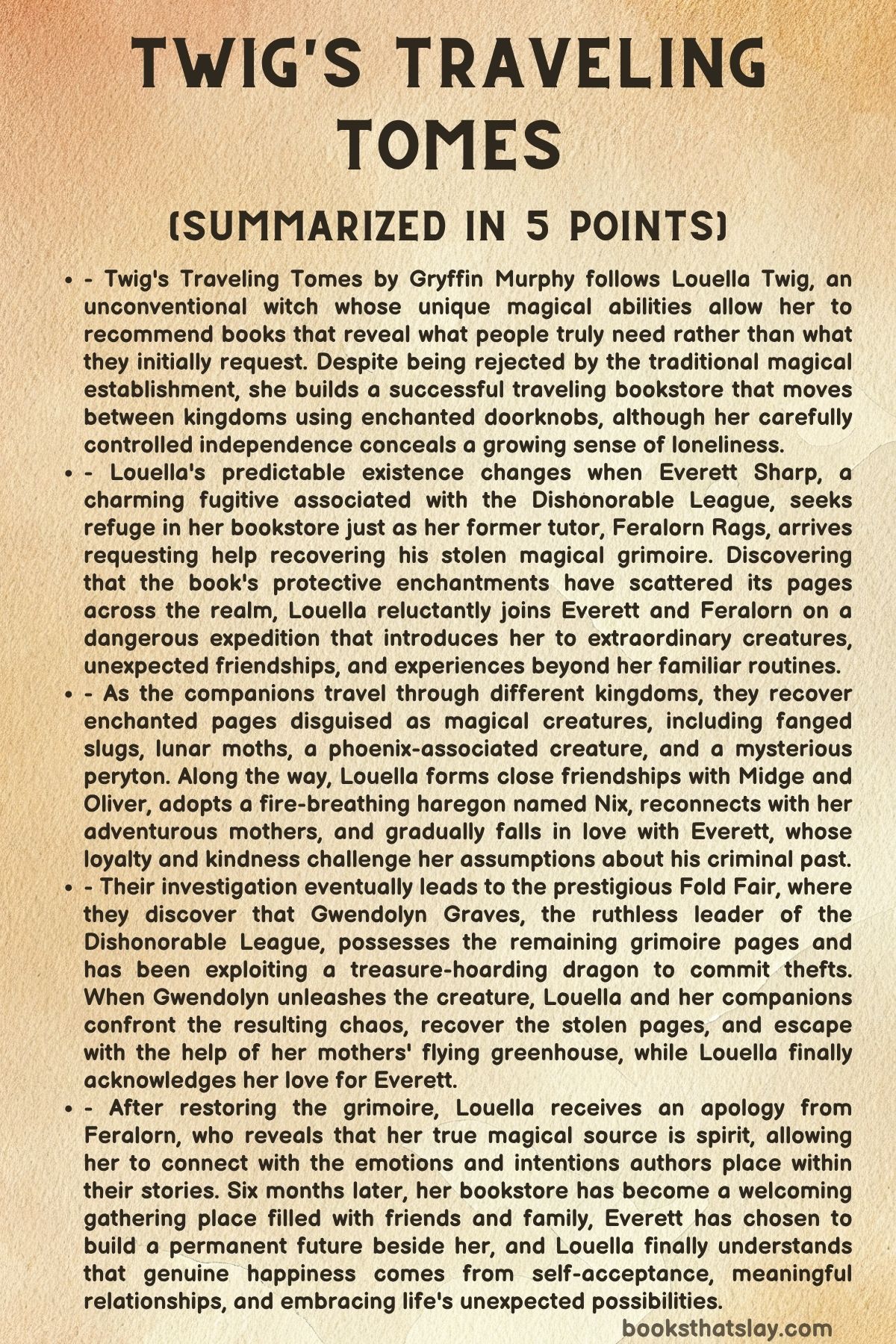
Summary
Louella Twig is a book witch living in the magical realm of Four, a world divided into four kingdoms where witches and wizards traditionally draw their powers from natural elements. Unlike other magical practitioners, Louella possesses an unusual connection to books, allowing her to sense the emotions and intentions contained within stories and recommend precisely what readers need.
Her abilities have never been properly appreciated by the magical establishment. Her former tutor, Feralorn Rags, considered her gifts incompatible with established magical principles, and she eventually abandoned her apprenticeship without receiving the ceremonial broom awarded to qualified witches.
Seven years later, Louella has established a successful traveling bookshop called Twig’s Traveling Tomes. Using enchanted doorknobs, she can transport her entire bookstore between kingdoms, serving customers while maintaining the independence she worked so hard to achieve.
Her recommendations, however, sometimes create problems. When she gives a gnome named Imogen Rake a book exposing her husband’s infidelity instead of advice about garden pests, the resulting confrontation forces Louella to relocate her shop.
Arriving in the coastal city of Azure, Louella encounters a mysterious man hiding among her shelves. Her magic directs her toward a book about escaping handcuffs, and she discovers that the stranger, Everett Sharp, is a fugitive bearing the tattoos of the notorious Dishonorable League.
Everett claims to have abandoned his criminal associates, but Louella remains suspicious. Despite her reluctance, she allows him to hide in her shop, beginning a relationship characterized by playful arguments, mutual curiosity, and an attraction neither is ready to acknowledge.
Their meeting coincides with the unexpected return of Feralorn, who reveals that his treasured grimoire has been stolen. The book contains knowledge about rare magical creatures and instructions for establishing bonds with them, making its disappearance especially dangerous.
Before Louella can fully consider helping him, a palace guard arrives searching for Everett. Attempting to escape, Everett activates one of the enchanted doorknobs without securing the bookstore, causing a chaotic journey that sends books flying and nearly injures Louella.
The shop eventually reaches Louella’s remarkable treehouse in the Ochre Forest. Although furious about the damage, she agrees to let Everett help restore the bookstore while Feralorn investigates the missing grimoire.
Using her unusual connection to books, Louella discovers that the grimoire’s protective enchantments have scattered its pages across the kingdoms. The pages have transformed into magical creatures, concealing themselves among other extraordinary beings.
Feralorn wants Louella to accompany him on a recovery mission, but she initially refuses. Everett persuades her to reconsider, arguing that she deserves adventures beyond the familiar routines of her bookstore, and offers to become her apprentice while they travel.
Their first destination is the garden belonging to Imogen, now calling herself Midge. Surprisingly, Midge apologizes for her earlier behavior and thanks Louella for revealing the truth about her marriage.
The missing pages are disguised as a parchment-colored slug hiding among enormous knightflowers. Everett retrieves the creature but suffers injuries when the dangerous plants attack him, prompting Louella to care for him and beginning a gradual change in their relationship.
Midge subsequently joins the expedition, hoping to escape the gossip surrounding her failed marriage. The expanding group travels to the Ventus Kingdom, where another portion of the grimoire has disguised itself as a lunar moth inside a restricted royal menagerie.
With help from Oliver Oak, a palace guard and Midge’s childhood friend, Louella and Everett enter the menagerie. Their recovery attempt succeeds, although insects destroy Everett’s clothing, leaving him temporarily dependent on one of Louella’s skirts.
Oliver soon decides to accompany the travelers, further expanding Louella’s previously limited social circle. Their shared experiences slowly teach her that companionship does not necessarily threaten the independence she values.
The expedition continues to the Ignis Kingdom, where the companions explore dangerous volcanic caves. Feralorn uses his affinity with magical creatures to summon a phoenix, helping them retrieve another portion of the grimoire.
During this journey, Everett reveals more about his criminal past. He explains that he left the Dishonorable League after refusing to steal a valuable ruby from an impoverished elderly half troll, prompting the organization’s leadership to frame him for crimes he never committed.
Louella begins understanding that his reputation conceals a more principled individual than she initially assumed. Their growing trust becomes particularly important when they learn that someone associated with the criminal organization may still be pursuing the missing pages.
Another clue leads them to a coastal grotto inhabited by sirens, whose enchanted songs exploit the deepest desires of their victims. Louella and Everett enter the water together, expecting to resist the creatures by blocking their ears.
Instead, the sirens discover that their magic has no effect on the pair. Louella eventually realizes that neither can be tempted by promises of their greatest desire because they are already holding what they want most: each other.
Although the revelation makes their attraction undeniable, Louella continues resisting its implications. Her fear of emotional vulnerability remains closely connected to the rejection she experienced during her magical education.
At Feralorn’s woodland tower, the group meets his current apprentice, Percival, whose suspicious behavior raises questions about the theft. Louella and Everett discover that Percival was manipulated by a mysterious romantic acquaintance who drugged him before stealing the grimoire.
This discovery supports their suspicions about the Dishonorable League and clears Percival of deliberate involvement. During the visit, Louella also confronts painful memories of being treated as an inadequate witch, while Everett reassures her that her abilities deserve admiration rather than dismissal.
The search then takes the companions into the Emerald Forest, where they meet Everett’s adoptive parents, Pluteous and Armilla Sharp. These enormous sylvan giants possess clairvoyant abilities and regard Everett with unmistakable affection.
With their help, the travelers recover another enchanted creature disguised as a fern fennec. Louella learns that Everett’s upbringing among beings who could predict the future encouraged his desire for unpredictable adventures.
They also discover a meaningful similarity in their childhoods, as both were adopted and sometimes struggled with feelings of difference. Their conversations create greater emotional intimacy, allowing Louella to recognize that Everett understands experiences she has rarely shared with others.
Back in the Ignis Kingdom, the companions encounter Arturo Watts, Feralorn’s former academic partner and someone initially suspected of stealing the grimoire. They discover that Arturo has independently recovered several enchanted fragments after recognizing Feralorn’s handwriting.
Combining their discoveries brings them considerably closer to reconstructing the book. However, growing evidence suggests that the original thief intends to exploit the grimoire’s knowledge at the upcoming Fold Fair, a prestigious gathering featuring extraordinary magical creatures.
The next expedition takes them through a dangerous abandoned mine toward a forest inhabited by fire-breathing haregons. Louella unexpectedly bonds with one of these creatures, adopting him as her familiar and naming him Nix.
During the recovery mission, Everett protects Louella and Nix from dangerous fireflies, suffering burns in the process. His willingness to risk himself strengthens Louella’s affection, while his encouragement forces her to consider whether she has been experiencing too much of life through fictional adventures.
Another journey brings them to the coast, where Louella encounters Julian Gloss, a painter whose apparent artistic magic initially gives her hope that unconventional magical gifts might be gaining recognition. She is devastated to discover that his powers actually come from water and that his family’s wealth helped secure his academic acceptance.
Everett comforts her, emphasizing that formal qualifications cannot determine her worth. Meanwhile, Feralorn and Arturo retrieve another enchanted fragment from the ocean, leaving only the final tracked creature to locate.
When Louella’s magical map reveals a creature moving rapidly across the realm, she contacts her adoptive mothers, Robin and Chlorella Twig. The adventurous plant witches arrive aboard their magnificent flying greenhouse, The Tillandsia, and identify the creature as a peryton, a hybrid resembling a stag and a giant bird.
During an exhilarating aerial pursuit, Louella overcomes her fear of heights to retrieve the enchanted pages. Although the companions recover every fragment shown on the map, they discover that the grimoire remains incomplete, indicating that someone has deliberately concealed the remaining portion.
The group decides to investigate the Fold Fair, where a criminal might attempt to display a valuable magical creature. Before departing, they celebrate their accomplishments aboard The Tillandsia, giving Louella an opportunity to reconnect with her mothers and acknowledge how much her life has changed.
During the celebration, Robin and Chlorella explain that their greatest concern was never Louella’s independence but the isolation she had accepted while trying to prove herself. Later, Louella and Everett share their first kisses, finally allowing their relationship to move beyond constant flirtation.
Their growing affection coincides with an important development in Louella’s magical education. Feralorn begins teaching her to control her book recommendations rather than automatically obeying the demands of her powers, helping restore their damaged relationship.
As the Fold Fair approaches, Louella discovers that Nix can communicate telepathically through their magical bond. Everett also begins making plans for a permanent future with her, including expanding the bookstore’s activities and creating a storytelling space for children.
At the fair, Louella and Everett disguise themselves as a married couple assisting her mothers. Their assumed relationship becomes increasingly meaningful as they explore the exhibitions, investigate suspicious participants, and enjoy the extraordinary collection of rare books.
Midge also confronts her former husband after discovering that he has entered one of her carefully cultivated knightflowers as his own creation. Supported by her companions, she publicly exposes his dishonesty and secures his disqualification.
During an evening ball, Everett attempts to confess something important to Louella, but her magic suddenly suggests books concerning betrayal and criminal partnerships. The disturbing recommendations revive her fears that he may still be connected to the Dishonorable League.
Before she can resolve her doubts, Louella is kidnapped by thieves belonging to LOOT, a breakaway organization formed by criminals who rejected the League’s greedy leader, Gwendolyn Graves. Everett attempts to rescue her and is captured himself, but they eventually escape after discovering that their captors are not working for Gwendolyn.
Feralorn subsequently identifies the remaining magical creature as a nobble, a treasure-hoarding dragon. The group discovers that Gwendolyn possesses the missing grimoire pages and has been using their instructions to control the creature for criminal purposes.
Gwendolyn attempts to escape when confronted at the fair, releasing the dragon and causing widespread panic. Louella pursues her through the castle gardens while her companions work to protect the spectators.
The dragon eventually turns against Gwendolyn, attracted by the jewels covering her body. Louella succeeds in recovering the stolen pages, but the enraged creature begins pursuing her and Everett.
With help from their friends and the arrival of The Tillandsia, the couple escapes using a grappling hook. During their desperate flight, Louella finally admits that she is falling in love with Everett.
Returning to the Ochre Forest, Louella completes the restoration of Feralorn’s grimoire. The wizard apologizes for rejecting her abilities and explains that her true magical source is spirit, the life force connecting authors to the stories they create.
Louella understands that her powers were never inferior merely because the academy failed to recognize them. Having developed a successful business, recovered the grimoire, and built meaningful relationships, she no longer needs institutional approval to believe in herself.
Everett then reveals the prophecy his adoptive parents gave him: he was destined to follow a barefoot witch named Twig who would lead him to treasure. He initially expected material wealth, but he now understands that the prophecy referred to love, friendship, and belonging.
Six months later, Twig’s Traveling Tomes has become a warmer, more welcoming establishment filled with plants, comfortable furnishings, and opportunities for readers to gather. Everett works alongside Louella, Nix continues developing his magical abilities, and her friendships remain an important part of her life.
A graduation broom now hangs above the bookstore entrance, symbolizing the recognition Louella once desperately wanted. Everett has also transformed his criminal tattoos into branching twigs, representing his new identity and devotion to her.
The novel concludes with their mutual declarations of love and a magical recommendation involving wedding planning, suggesting that Louella’s greatest adventure is not ending but entering a new stage.
Characters
Louella Twig
Louella Twig is the central protagonist of Twig’s Traveling Tomes, an independent and exceptionally talented witch whose unconventional abilities have shaped her identity and understanding of her place in the magical world. Her gift for connecting people with books that address their deepest needs makes her extraordinarily perceptive, although she initially struggles to recognize the full significance of her powers.
Having been rejected by the magical establishment, Louella has developed a fiercely independent personality and an intense desire to prove that she can succeed without anyone’s approval. Her traveling bookstore represents both her greatest accomplishment and the protective environment she has constructed to avoid further disappointment.
Louella’s intelligence, sharp humor, and organizational habits frequently contrast with her emotional uncertainty. She prefers predictable routines and fictional relationships because they offer a sense of control that real friendships and romantic attachments cannot guarantee.
Her relationship with Everett challenges these defensive habits by introducing uncertainty, attraction, and emotional intimacy into her carefully structured existence. Although she initially judges him according to his criminal reputation, his kindness and willingness to sacrifice himself gradually teach her to reconsider her assumptions.
Louella’s development also involves learning that genuine confidence comes from accepting her abilities rather than obtaining external validation. When Feralorn finally identifies spirit as her magical source, she understands that her unusual gift was never evidence of inadequacy.
By the novel’s conclusion, Louella has become more comfortable expressing affection, developing friendships, and embracing unfamiliar experiences. Her transformation demonstrates that independence and companionship can strengthen each other rather than exist as competing priorities.
Everett Sharp
Everett Sharp serves as the romantic male lead of Twig’s Traveling Tomes, bringing humor, adventure, and emotional complexity into Louella’s isolated existence. Initially introduced as a fugitive associated with the Dishonorable League, he appears untrustworthy, but his actions gradually reveal an individual guided by compassion and personal integrity.
His criminal reputation conceals a complicated history involving theft, betrayal, and resistance to exploitation. Everett’s decision to refuse an assignment targeting an impoverished elderly half troll establishes that he possesses moral boundaries even when operating outside conventional laws.
His playful personality allows him to challenge Louella without dismissing her concerns. He repeatedly uses humor to defuse tense situations, but his willingness to protect her during dangerous encounters demonstrates that his affection extends far beyond flirtation.
Everett’s upbringing among clairvoyant sylvan giants also provides important insight into his adventurous personality. Unable to share his adoptive family’s ability to anticipate future events, he became fascinated by uncertainty and sought experiences that could not be predicted in advance.
Despite his restless background, Everett ultimately discovers that adventure does not necessarily require constant movement. His relationship with Louella gives him a sense of belonging that he previously sought through dangerous expeditions and material discoveries.
His interpretation of the prophecy concerning a barefoot witch named Twig represents the completion of his emotional development. What he once understood as a promise of financial treasure becomes a recognition that love, friendship, and a shared future possess greater value than anything he could steal.
Feralorn Rags
Feralorn Rags occupies a complex position in Twig’s Traveling Tomes, functioning simultaneously as Louella’s former instructor, a source of emotional conflict, and an important guide in her eventual development. His conventional understanding of magical education initially prevents him from recognizing the legitimacy of her extraordinary abilities.
As a knowledgeable wizard with a particular interest in rare magical creatures, Feralorn possesses considerable expertise and a strong attachment to his research. The theft of his grimoire exposes his vulnerability and forces him to seek assistance from the former apprentice whose abilities he once dismissed.
His dramatic reactions and occasional stubbornness provide considerable humor, particularly when his anxiety over the missing book clashes with the other travelers’ less formal attitudes. However, these exaggerated qualities coexist with genuine concern for magical creatures and the dangerous consequences of misusing his research.
Feralorn’s relationship with Louella changes as he witnesses her growing confidence and the remarkable effectiveness of her gifts. His decision to teach her greater magical control demonstrates that he has become willing to reconsider the limitations of his earlier instruction.
His eventual apology represents an acknowledgment that established authorities can misunderstand unfamiliar talents. By identifying the true nature of Louella’s magic, he helps her find an explanation for her abilities while repairing a relationship damaged by years of rejection.
Imogen “Midge” Rake
Midge’s journey in Twig’s Traveling Tomes demonstrates the importance of reclaiming personal independence after betrayal and disappointment. Initially introduced as an angry gnome dissatisfied with Louella’s book recommendation, she becomes an unexpected friend after discovering that the supposedly inappropriate novel correctly exposed her husband’s infidelity.
Her transformation from an embarrassed and resentful wife into an enthusiastic adventurer shows considerable emotional resilience. Rather than allowing the collapse of her marriage to define her identity, she chooses to explore opportunities that had previously seemed unavailable.
Midge’s practical gardening knowledge becomes especially useful during the expedition, while her willingness to confront dangerous situations demonstrates that courage is not determined by physical size. She repeatedly contributes to the group’s success through persistence, resourcefulness, and determination.
Her confrontation with her former husband at the Fold Fair represents an important moment of self-assertion. By exposing his attempt to claim ownership of her knightflower, she publicly rejects the assumption that marriage gives him authority over her achievements.
Midge also plays an important role in Louella’s emotional development. Her friendship demonstrates that unexpected relationships can emerge from uncomfortable beginnings and that meaningful companionship often requires overcoming initial misunderstandings.
Oliver Oak
Oliver Oak is a palace guard whose quiet reliability and willingness to help others make him an important supporting character. His childhood friendship with Midge provides the group with access to the royal menagerie and establishes his connection to the travelers before he formally joins their expedition.
Initially associated with duty and established rules, Oliver becomes increasingly interested in experiencing life beyond his professional responsibilities. His decision to accompany the group reflects a desire for greater personal freedom and a willingness to question the routines that previously defined his existence.
Oliver’s practical abilities and dependable temperament balance the more impulsive personalities surrounding him. He contributes to dangerous recovery missions, protects his companions, and frequently provides a calm perspective during difficult situations.
His friendship with Midge also illustrates emotional maturity, particularly when he supports her independence without attempting to control her romantic or personal decisions. Through Oliver, the novel presents loyalty as a commitment to another person’s well-being rather than an expectation of exclusive attachment.
Arturo Watts
Arturo Watts is a knowledgeable wizard whose relationship with Feralorn initially creates suspicion concerning the stolen grimoire. As Feralorn’s former academic partner and apparent rival, he appears to have both the expertise and possible motivation to become involved in the theft.
However, Arturo proves far more trustworthy than the travelers initially believe. After recognizing Feralorn’s handwriting on unusual magical creatures, he independently begins collecting the enchanted fragments to protect them.
His actions reveal intelligence, initiative, and loyalty that exist beneath an occasionally mysterious exterior. Rather than pursuing recognition for his discoveries, he prioritizes preserving valuable knowledge and helping restore the stolen book.
Arturo’s relationship with Feralorn also introduces suggestions of unresolved romantic affection. Louella’s recommendation of a romance novel reflects her recognition that their connection may involve feelings neither has fully acknowledged.
Through Arturo, the story demonstrates how assumptions based on rivalry or incomplete information can obscure genuine character. His inclusion in the traveling party also reinforces the value of cooperation between individuals whose skills and experiences complement each other.
Gwendolyn Graves
Gwendolyn Graves serves as the primary antagonist of Twig’s Traveling Tomes, representing the destructive consequences of greed, manipulation, and the pursuit of power without ethical restraint. As the ruthless leader of the Dishonorable League, she exploits her criminal organization to acquire valuable possessions and maintain authority over others.
Her treatment of Everett reveals a vindictive personality unwilling to tolerate challenges to her control. When he refuses to steal from a vulnerable individual, she retaliates by arranging accusations against him, demonstrating her willingness to destroy another person’s reputation for personal advantage.
Gwendolyn’s theft of Feralorn’s grimoire reflects her desire to convert specialized magical knowledge into financial and political power. By using its instructions to control a treasure-hoarding nobble, she transforms an extraordinary creature into an instrument of criminal exploitation.
Her lavish appearance and obsession with expensive jewels reinforce the importance she places on material wealth. Ironically, these same possessions contribute to her defeat when the dragon becomes attracted to the treasure she carries.
Gwendolyn functions as a direct contrast to Everett, whose criminal history does not prevent him from behaving compassionately. Her downfall emphasizes that the moral significance of a person’s actions depends on their intentions and treatment of others rather than their reputation alone.
Robin Twig
Robin Twig is one of Louella’s adoptive mothers, an adventurous plant witch who travels between kingdoms aboard the extraordinary flying greenhouse known as The Tillandsia. Her spirited personality and enthusiasm for exploration contrast with Louella’s preference for familiar environments and controlled routines.
Robin’s relationship with her daughter is characterized by affection, acceptance, and confidence in Louella’s unusual abilities. Unlike the academic authorities who dismissed her gift, Robin has never required conventional qualifications as proof of her daughter’s worth.
Her participation in the recovery mission demonstrates both her practical magical expertise and her willingness to support Louella during dangerous circumstances. The arrival of The Tillandsia expands the group’s possibilities and helps them retrieve the elusive peryton.
Robin also recognizes the emotional limitations Louella has imposed upon herself. By expressing concern about her daughter’s loneliness, she encourages Louella to understand that personal independence does not require rejecting companionship.
Chlorella Twig
Chlorella Twig is Louella’s other adoptive mother and Robin’s partner in commanding The Tillandsia. Like Robin, she possesses a strong connection to plant magic and embraces a life characterized by movement, discovery, and unusual experiences.
Chlorella provides a supportive parental presence without attempting to dictate Louella’s choices. Her acceptance of her daughter’s unconventional magical talents stands in sharp contrast to the rigid expectations of the formal educational system.
Her role during the expedition highlights the importance of family relationships that encourage individual growth rather than demand conformity. Alongside Robin, she contributes transportation, magical knowledge, and practical assistance during the most difficult stages of the quest.
Chlorella also helps Louella recognize that her family has always valued her happiness more than her professional achievements. Her presence reinforces the idea that unconditional acceptance can provide a foundation for developing greater confidence and emotional openness.
Nix
Nix is Louella’s haregon familiar, a small magical creature whose unusual appearance and fire-breathing abilities introduce humor, affection, and additional responsibility into her life. Louella encounters him during the expedition through the volcanic region and develops an unexpected attachment that leads to his adoption.
Their relationship becomes increasingly significant as Nix grows more comfortable with her and begins communicating telepathically. His first unexpected mental request for dandelion leaves demonstrates that their bond is developing in ways Louella does not fully understand.
Although Nix frequently creates comic situations, particularly when his sneezes produce dangerous flames, he also represents Louella’s growing capacity to care for another being. His presence encourages her to adapt her routines and accept responsibilities that cannot always be managed through careful planning.
The relationship between Louella and Nix also symbolizes her increasing confidence as a witch. Her bond with a familiar offers another confirmation that her abilities are genuine, valuable, and capable of developing beyond the limitations once imposed upon her.
Pluteous Sharp
Pluteous Sharp is one of Everett’s adoptive parents, a sylvan giant whose imposing physical appearance contrasts with his affectionate treatment of his son. His family possesses unusual clairvoyant abilities connected to the natural world, allowing its members to anticipate events and understand patterns that ordinary beings cannot perceive.
Pluteous helps reveal an important dimension of Everett’s past, particularly the emotional challenges of growing up among relatives who possessed abilities he could not share. Despite these differences, the family’s enthusiastic welcome establishes that Everett has always been loved and accepted.
His knowledge of magical creatures and forest environments also contributes directly to the expedition’s success. Through Pluteous, the novel presents family as a relationship defined by loyalty and affection rather than biological similarity.
Armilla Sharp
Armilla Sharp is Everett’s other adoptive parent and an affectionate member of the sylvan giant family living in the Emerald Forest. Her warm reception of Everett, including the family’s embarrassing childhood nickname for him, reveals a gentler side of the adventurous former thief.
Like Pluteous, Armilla possesses a connection to the forest and its unusual methods of sharing knowledge. Her abilities help establish the magical richness of Everett’s upbringing and explain his complicated relationship with predictions about the future.
Armilla’s influence is especially significant through the prophecy that eventually guides Everett toward Louella. Although he initially misunderstands its promise of treasure, the prediction ultimately becomes a symbol of his discovery that emotional belonging is more valuable than material wealth.
Percival
Percival is Feralorn’s current apprentice, whose involvement in the grimoire’s disappearance initially makes him appear suspicious. His nervousness and reluctance to discuss the theft suggest that he possesses information he fears revealing.
The investigation eventually establishes that Percival was manipulated by a mysterious romantic acquaintance who expressed interest in Feralorn’s research. After being given a sleeping potion, he lost consciousness and awakened to discover that both the stranger and the grimoire had disappeared.
Percival’s situation illustrates how emotional vulnerability can be exploited by individuals with dishonest intentions. His desire for affection makes him susceptible to deception, but the story distinguishes his poor judgment from deliberate criminal behavior.
Louella’s insistence that he confess the truth to Feralorn also emphasizes personal responsibility. Although Percival is not the principal culprit, acknowledging his mistakes remains necessary for restoring trust.
Cal
Cal is a friendly plant witch whose encounters with Louella provide a contrast to the judgmental attitudes of the magical establishment. Their conversations demonstrate the possibility of developing friendships based on shared curiosity and mutual respect.
An apparently innocent question about Louella’s magical education initially reminds her of the graduation broom she never received. However, Cal’s genuine friendliness helps establish that other magical practitioners need not share the academy’s narrow definition of legitimate talent.
Cal later visits Louella’s bookstore and appreciates her remarkable recommendations. Their discussion of incorporating more greenery into the shop also reflects the gradual transformation of Louella’s private business into a warmer community space.
Although Cal has a relatively limited role in the central adventure, the character represents the everyday social connections that help Louella overcome isolation. Cal’s presence demonstrates that acceptance can emerge through ordinary friendship as well as dramatic acts of loyalty.
Julian Gloss
Julian Gloss is a painter whose privileged background and condescending personality expose the inequalities within the magical educational system. When Louella initially encounters him, she believes his artistic abilities might represent another unconventional form of magic comparable to her own.
Her excitement quickly turns to disappointment when Julian reveals that his actual magical source is water. His acceptance into the academy was facilitated by his wealthy family rather than by institutional recognition of a previously misunderstood magical discipline.
Julian’s dismissive treatment of Louella intensifies her longstanding insecurity about her lack of formal qualifications. His behavior reveals how individuals who benefit from established systems can become insensitive to those excluded by the same institutions.
His appearance contributes to Louella’s realization that academic prestige does not necessarily correspond to talent, kindness, or moral character. As a result, Julian functions as a representation of the social attitudes she must overcome to develop genuine self-confidence.
Midge’s Former Husband
Midge’s former husband is a dishonest and self-serving figure whose infidelity initiates an important change in her life. His betrayal is exposed through Louella’s unconventional book recommendation, demonstrating how the book witch’s powers sometimes reveal truths that customers would rather avoid.
His behavior becomes even more objectionable when he attempts to exhibit Midge’s carefully cultivated knightflower at the Fold Fair as his own achievement. This act reveals that his dishonesty extends beyond their marriage into his willingness to exploit her abilities for public recognition.
His eventual humiliation and disqualification provide a satisfying resolution to Midge’s struggle for independence. Through his conduct, the story criticizes individuals who treat relationships as opportunities for personal advantage rather than partnerships based on respect.
The Persistent Palace Guard
The palace guard who repeatedly attempts to arrest Everett serves as a recurring source of tension and comic disruption. His determination to locate the fugitive creates several difficult situations for Louella, particularly when protecting Everett requires her to resist the demands of her own magical recommendations.
The guard represents the conventional understanding of criminality that Everett’s experiences gradually challenge. His pursuit is based on Everett’s public reputation, while Louella increasingly recognizes that the accusations against him do not accurately reflect his character.
Although the guard is not developed as extensively as the principal characters, his appearances help sustain the danger surrounding Everett’s past. He also contributes to several humorous episodes involving disguises, magical books, and the companions’ improvised efforts to avoid discovery.
The Nine-Fingered Halfling
The nine-fingered halfling is a mysterious criminal associated with the Dishonorable League whose appearance at the Fold Fair introduces a sudden threat to Louella. His distinctive physical characteristic makes him recognizable, while his involvement in her kidnapping creates uncertainty about Everett’s former associates.
The revelation that the kidnappers belong to LOOT, a separate organization formed by criminals dissatisfied with Gwendolyn’s leadership, complicates the initial assumption that all thieves share the same objectives. The halfling’s involvement demonstrates the fragmented and unpredictable nature of the criminal world.
His role also contributes to the novel’s recurring distinction between reputation and individual motivation. Although his actions are threatening, the situation eventually reveals that the criminal organizations operating within the realm possess competing loyalties and interests.
Amira
Amira is a friend of Midge who appears during the travelers’ social gathering following their successful expedition in the Emerald Forest. Her presence provides Midge with an opportunity to explore personal relationships beyond the unhappy marriage that previously restricted her life.
Although Amira receives relatively little development, her interaction with Midge contributes to the latter’s growing sense of freedom. The encounter also reveals Oliver’s willingness to respect Midge’s independence rather than impose expectations upon her choices.
Amira therefore contributes to the novel’s broader representation of social renewal after emotional disappointment. Her appearance suggests that Midge’s future contains opportunities for affection, friendship, and experiences unrelated to her former husband.
Themes
Self-Acceptance and the Rejection of Conventional Expectations
Louella’s struggle to recognize the legitimacy of her unusual magical abilities establishes a sustained examination of self-worth and the limitations of institutional judgment. In Twig’s Traveling Tomes, magical education is organized around established categories, leaving little room for talents that do not conform to accepted explanations.
Because Louella’s connection to books cannot initially be classified within these categories, her instructors treat her abilities as inadequate rather than attempting to understand them. Their rejection creates an emotional wound that continues affecting her confidence long after she establishes a successful business.
Her missing graduation broom becomes a symbol of this unresolved insecurity. Although her bookstore demonstrates exceptional magical skill and commercial achievement, Louella continues measuring herself against the qualifications she was denied.
The encounter with Julian Gloss exposes another weakness in the educational system by revealing how privilege can influence academic acceptance. His success despite his condescending attitude contrasts sharply with Louella’s exclusion, illustrating the difference between institutional recognition and genuine ability.
Feralorn’s eventual discovery that her magical source is spirit provides a resolution to the uncertainty surrounding her powers. However, the deeper achievement is Louella’s realization that her worth never depended entirely upon his explanation.
Her successful recovery of the grimoire, development of magical control, and ability to form meaningful relationships have already demonstrated her capabilities. Recognition becomes valuable not because it creates her identity but because it acknowledges qualities she possessed all along.
The theme extends beyond magical education to question the broader tendency to judge people according to established expectations. By presenting an unconventional witch who succeeds through abilities others misunderstand, the novel suggests that meaningful achievement often requires confidence in forms of talent that conventional institutions have not learned to appreciate.
Friendship, Found Family, and the End of Isolation
Louella’s independence initially appears to be one of her greatest strengths, but her carefully controlled lifestyle gradually reveals the emotional cost of avoiding close relationships. Her bookstore allows her to travel freely, earn her own living, and interact with customers without developing attachments that might expose her to rejection.
However, the comfort of this arrangement also conceals considerable loneliness. She spends much of her private time reading fictional adventures and romances, experiencing emotional excitement through stories while hesitating to pursue comparable connections in her own life.
The recovery expedition disrupts this pattern by bringing together individuals who might otherwise have remained strangers. Everett, Midge, Oliver, Feralorn, Arturo, and the others form a community whose members contribute different abilities, personalities, and perspectives.
Their companionship develops through shared danger, comic misunderstandings, acts of generosity, and practical cooperation. Rather than requiring complete agreement, their friendships grow through learning to appreciate differences and support one another despite occasional frustrations.
Midge’s experience provides a parallel exploration of this theme. After the collapse of her marriage, joining the traveling party allows her to recover a sense of belonging without sacrificing her newly reclaimed independence.
Everett’s relationship with his adoptive parents further reinforces the idea that family is defined by affection and commitment rather than biological connection. His upbringing among sylvan giants demonstrates that meaningful family bonds can exist between individuals with very different abilities and backgrounds.
Louella’s reunion with Robin and Chlorella also clarifies that loving relationships need not limit personal freedom. Her mothers never objected to her independence; they feared that her determination to prove herself had encouraged unnecessary isolation.
By the conclusion, the transformed bookstore reflects Louella’s emotional development. What was once primarily a controlled personal refuge has become a welcoming space where friends, family members, and customers can gather.
The novel ultimately presents belonging not as the abandonment of individuality but as the discovery that personal freedom becomes richer when shared with people who respect and support it.
Love, Trust, and Emotional Vulnerability
The relationship between Louella and Everett explores how romantic intimacy requires individuals to confront insecurities that independence alone cannot resolve. In Twig’s Traveling Tomes, their attraction develops through disagreements, practical cooperation, moments of physical danger, and gradually increasing emotional honesty.
Louella initially regards Everett as a potential threat because of his association with the Dishonorable League. Her suspicion appears reasonable given his criminal background, but it also reflects a broader reluctance to trust anyone capable of disrupting her carefully maintained emotional boundaries.
Everett challenges these assumptions through consistent acts of kindness and loyalty. His willingness to risk injury while retrieving the grimoire’s pages demonstrates that his affection is supported by meaningful actions rather than merely charming conversation.
Their encounter with the sirens becomes a significant turning point because the creatures’ magic exposes feelings neither character has openly acknowledged. The failure of the enchanted song suggests that the deepest desires of both characters are already being fulfilled through their closeness.
However, recognizing affection does not immediately eliminate fear. Louella continues hesitating because accepting Everett’s love would require trusting a future she cannot completely predict or control.
Everett faces uncertainty of his own, particularly concerning whether Louella genuinely wants him to remain in her life. His willingness to discuss a shared future reveals that his emotional development involves abandoning the assumption that freedom requires constant movement.
The disturbing book recommendations at the Fold Fair temporarily revive Louella’s mistrust, demonstrating that emotional growth rarely follows an uninterrupted progression. Even after experiencing Everett’s loyalty, she must consciously choose whether to believe in the relationship they have built.
Their eventual declarations of love represent more than the fulfillment of romantic attraction. They establish that trust depends upon recognizing another person’s actions, accepting uncertainty, and allowing oneself to become emotionally vulnerable.
Through their relationship, the novel suggests that meaningful love does not eliminate independence. Instead, it creates a partnership in which both individuals can retain their identities while choosing to build a shared future.
Greed, Moral Integrity, and the True Meaning of Treasure
The stolen grimoire creates a conflict between two fundamentally different understandings of value. For Gwendolyn Graves, magical knowledge represents an opportunity to acquire wealth and exercise power, while the other characters gradually discover that its greatest significance lies in preservation, cooperation, and responsible use.
Gwendolyn’s exploitation of the nobble demonstrates how greed transforms extraordinary abilities into instruments of harm. Rather than respecting the creature’s nature, she manipulates its treasure-seeking instincts to support increasingly ambitious criminal activities.
Her conduct also reveals that wealth and authority do not necessarily indicate moral superiority. Despite her luxurious appearance and influential position within the Dishonorable League, her actions are driven by selfishness and a willingness to exploit vulnerable individuals.
Everett provides a contrasting perspective. Although he possesses criminal experience and has committed thefts, his refusal to target an impoverished elderly half troll establishes that he recognizes ethical limits.
His conflict with Gwendolyn demonstrates that morality cannot be determined solely by legal status or public reputation. An individual regarded as a criminal may possess greater compassion than a powerful figure who claims authority over others.
The restoration of Feralorn’s grimoire offers another interpretation of treasure. The book’s value comes from the knowledge it preserves, the creatures it helps protect, and the cooperation required to recover its missing pages.
Everett’s prophecy brings these different meanings together. Initially believing that following a barefoot witch named Twig would lead him to material riches, he eventually understands that the promised treasure is something far more personal.
His relationship with Louella gives him affection, stability, friendship, and a place where he genuinely belongs. These discoveries satisfy needs that wealth or adventure alone could never fulfill.
The final contrast between Gwendolyn’s downfall and Everett’s happiness emphasizes the consequences of their different priorities. Gwendolyn loses control because she attempts to possess everything, while Everett gains a meaningful future by learning what deserves his loyalty.
Through this distinction, the novel presents true wealth as the ability to recognize and protect what matters most. Love, friendship, integrity, and shared experiences ultimately prove more enduring than possessions acquired through deception or force.