The Paradox Club Summary, Characters and Themes
The Paradox Club by Charlie Lovett is a science fiction mystery that explores parallel universes, family relationships, scientific discovery, and the consequences of changing reality.
The novel follows Tess Maxwell, a troubled young woman whose search for emotional stability leads her toward a secret organization dedicated to protecting objects from other universes. As Tess investigates her father’s mysterious death, she discovers that her childhood memories conceal extraordinary truths about her identity. Combining scientific theories with personal struggles, the story examines how love, grief, ambition, and individual choices influence human lives across different versions of reality.
Summary
Tess Maxwell is a twenty-two-year-old student at the University of Illinois whose life has become increasingly difficult because of obsessive-compulsive disorder, depression, and persistent intrusive voices. Unable to manage her academic responsibilities or maintain her emotional stability, she reluctantly accepts her therapist’s recommendation to take medical leave and return to Wisconsin.
Tess has endured psychological difficulties since childhood, particularly after the death of her father, Harry Maxwell, in a mysterious fire on their family’s private island. Her mother, Marie, blamed her for the tragedy and subsequently withdrew almost completely from her life, leaving family friend Vivian Harbottle to provide the affection and stability she desperately needed.
For Tess, Maxwell’s Island represents the happiest years of her life, when she spent countless evenings discussing science with Harry on their wooden dock. Their conversations covered astronomy, gravity, quantum mechanics, time, probability, and the possibility of parallel universes, while also teaching Tess valuable lessons about curiosity, responsibility, and personal choice.
Harry was a brilliant physicist who believed scientific discoveries could reveal realities that ordinary human experience could never anticipate. He frequently told Tess stories and insisted that every story was true somewhere, a statement she interpreted as imaginative philosophy rather than a literal description of the universe.
Meanwhile, Richard Pollard, a retired academic living in Florida, continues serving as president of a secret organization called the Paradox Club. Its members possess knowledge of extraordinary physical objects that have somehow entered their universe from alternative realities.
The organization was founded in 1933 after wealthy collector Morris Parrish discovered a mysterious edition of Charles Dickens’s Great Expectations containing passages unknown to conventional literary history. Albert Einstein recognized that the book appeared to originate outside their universe, prompting the establishment of a society dedicated to collecting and protecting such objects.
These artifacts, known as untethered foreign objects, occasionally appear in geographical locations where the boundaries separating universes are unusually weak. Although the club originally intended to safeguard humanity against the possible dangers of interdimensional contact, disagreements have developed over how its discoveries should be used.
The greatest threat comes from Pilgrim 3, the ambitious keeper of the club’s vault, who desires scientific recognition and unquestioned authority. While Richard attempts to preserve the organization’s original principles, Pilgrim secretly recruits supporters and searches for information about Harry’s unfinished research.
Before his death, Harry discovered a vintage Philco radio capable of receiving broadcasts from another universe whose history differed significantly from his own. He realized that the radio might provide evidence of temporary alignments between parallel realities, during which objects could cross from one universe into another.
Harry eventually calculated two significant dates: June 17, 2005, and October 14, 2015. The first corresponded to the devastating fire that apparently killed him, while the second approached as Tess unexpectedly returned to Wisconsin.
At Vivian’s house in Madison, Tess initially hopes to recover from her psychological difficulties while reconnecting with memories of her father. Vivian welcomes her warmly, but Tess remains concerned about her aunt’s strange habit of recounting elaborate experiences that she insists actually happened.
Vivian describes working as a television writer, a manuscript archivist, and even a boxer who competed without relying on sight. Although the stories seem impossible and sometimes disappear from Vivian’s memory immediately after she tells them, they consistently provide Tess with temporary relief from her intrusive voices.
Seeking another connection to her childhood, Tess visits Marie and discovers that her mother has remarried a man named David. Their meeting reopens years of emotional pain, particularly when Tess learns that Marie plans to move to Florida without making any serious attempt to rebuild their relationship.
Nevertheless, Marie gives Tess an old photograph of herself with Harry and reveals that her father intended her to inherit his enormous personal library. The collection is delivered to Vivian’s house, where Tess begins organizing more than fifteen hundred books.
While arranging the volumes, Tess discovers an unusual system of handwritten numbers and letters that Harry deliberately concealed inside their covers. Her determination to impose order on the collection leads her to uncover a secret message addressed directly to her.
Harry’s message explains that Vivian possesses important information about his scientific work and warns Tess about the approaching date of October 14, 2015. He instructs her to seek refuge on Maxwell’s Island if danger appears and suggests that Marie holds something essential to her safety.
Searching through Vivian’s belongings, Tess also discovers Harry’s old Philco radio. When she switches it on, she hears broadcasts describing an unfamiliar version of history, including events involving the Titanic and Franklin Roosevelt that never occurred in her world.
Unknown to Tess, activating the radio triggers an alarm at the Paradox Club’s headquarters in Manhattan. Valentine 6, a young physicist secretly working for Richard, recognizes the importance of the signal and attempts to warn him before Pilgrim 3 can intervene.
Pilgrim identifies the radio’s possible location and dispatches two operatives, Montag 5 and Nemo 7, to recover it. Although Montag faithfully follows her increasingly aggressive instructions, Nemo is secretly loyal to Richard, having been recruited years earlier by Harry to monitor Pilgrim’s activities.
The operatives arrive at Vivian’s house just as Tess begins preparing to follow her father’s warning. Suspicious of their behavior, she initially refuses them entry, but Montag eventually seizes Vivian at gunpoint and forces both women into a vehicle.
Richard reaches the house too late to prevent their abduction and begins following the kidnappers toward the east. Meanwhile, Valentine escapes surveillance in New York after stealing an unusual book, Gatsby the Great, that Richard believes may prove essential.
During the journey, Nemo secretly communicates with Tess using Morse code, reassuring her that he intends to help them escape. His message provides Tess with a reason to remain hopeful, although Montag’s aggression makes any attempt at resistance extremely dangerous.
The kidnappers stop at a motel in Michigan, where Vivian tells Tess a story about a boxer who learned to transform an apparent disadvantage into an unexpected strength. Inspired by the lesson, Tess begins deliberately imitating the compulsive behaviors that have troubled her throughout her life.
She persuades Montag that she must go outside to count and touch the vehicles in the parking lot, creating an opportunity for Richard, Nemo, and Valentine to intervene. Their coordinated rescue succeeds when Richard causes a diversion with his rental car and the captives escape in separate vehicles.
After the rescue, Tess experiences another severe psychological episode but manages to calm herself by imagining the familiar dock on Maxwell’s Island. The technique, previously taught by her therapist, helps her recognize that she possesses greater control over her responses than she had believed.
Richard and Vivian finally explain the existence of the Paradox Club and reveal that Harry’s mysterious radio genuinely receives transmissions from another universe. Tess also learns that Maxwell’s Island contains a location where the boundaries separating realities become unusually thin.
Despite Richard’s objections, Tess insists upon returning to the island because her father’s hidden message explicitly directed her there. Their decision becomes increasingly urgent when they discover that Montag still possesses the radio and that Pilgrim intends to perform her own experiment during the approaching alignment.
On the island, Tess demands the complete truth about the fire that killed Harry. Richard and Vivian eventually reveal a devastating secret: Tess herself is an untethered foreign object who entered their universe during Harry’s failed experiment.
In the reality where Richard and Vivian have been living, the original Tess drowned at eleven after jumping into the lake to rescue a teenager who had deliberately driven his truck into the water. Unlike Tess’s memories, in which Harry heard a squeaking door and rescued her, this version of events ended with his daughter dying.
Overwhelmed by grief, Harry became obsessed with the possibility of retrieving another version of Tess from a parallel universe. He developed calculations concerning temporal alignments and attempted to open a passage between the two realities in the island’s restricted clearing.
His experiment succeeded in bringing Tess from her original universe into his own, but the resulting catastrophe killed him before he discovered that she had arrived safely. Tess consequently spent the following decade living in a world that was almost identical to her own but fundamentally different.
The revelation explains why Marie rejected her after the fire: the woman had already lost her biological daughter and could not accept the newcomer as the same child. Although her response caused Tess enormous suffering, it emerged from grief, emotional confusion, and resentment toward Harry’s dangerous experiment.
Vivian also reveals that her unusual experiences originated during the same catastrophe. The experiment changed her relationship with parallel realities, allowing her consciousness to travel temporarily into other universes and return with memories that she involuntarily expresses as stories.
Tess realizes that her persistent sense of displacement has a genuine explanation beyond the psychological symptoms she has struggled to manage. Determined to reunite with the Harry and Marie of her original reality, she decides that she must attempt the crossing before the opportunity disappears for another eighty-five years.
Completing the experiment requires three artifacts associated with Maxwell’s Island: Gatsby the Great, an unusual edition of Darwin’s The Descent of Man, and a jeweled pendant worn by Marie. Valentine retrieves the two books, while Tess prepares to confront the woman whose rejection has shaped much of her life.
Marie unexpectedly arrives at the boat landing, allowing the two women to discuss their painful relationship without the misunderstandings that previously separated them. Marie acknowledges her failure to treat Tess compassionately, and Tess finally forgives her before accepting the pendant Harry had entrusted to her.
Their reconciliation gives Tess a sense of emotional freedom even though they are preparing to separate permanently. Marie also asks Tess to deliver a message of love to Harry when she returns to her original universe.
Pilgrim soon arrives with Montag, the radio, and journalist Anderson Tait, whom she has invited to witness what she expects will be her greatest scientific achievement. Tess outwardly agrees to assist her, explaining that the three artifacts and the radio can make the crossing possible.
However, Tess has recognized a crucial error in Pilgrim’s understanding of Harry’s calculations. Pilgrim believes the alignment will occur at 5:22 a.m. Central Time, whereas Harry based his calculations on the island’s actual solar time, placing the critical moment slightly more than eight minutes earlier.
Tess carefully arranges the equipment and manipulates Pilgrim into following her instructions while Richard and Vivian provide distractions. When the portal opens unexpectedly, Tess enters the passage with the radio and foreign objects, disappearing into her original universe.
Pilgrim desperately attempts to follow but encounters an invisible barrier that prevents her from crossing. Her failure destroys her opportunity for international recognition and exposes the danger of allowing ambition to overpower scientific caution.
Afterward, Richard returns to the Paradox Club and oversees a change in its leadership. Pilgrim loses her position as keeper of the vault, Valentine becomes her replacement, and Nemo eventually succeeds Richard as president.
Meanwhile, Tess awakens on Maxwell’s Island in her original universe, where Vivian welcomes her and both Harry and Marie are alive. Their affectionate reunion restores the family relationships she spent ten years mourning and gives her the security she had almost stopped believing was possible.
Harry later explains that Pilgrim could not cross because another version of her already existed in Tess’s universe. Tess, however, could enter the other reality because its original version of her had died, leaving no living counterpart to prevent the crossing.
By the summer of 2016, Tess has begun rebuilding her life, although her obsessive-compulsive disorder has not disappeared entirely. Continuing treatment and living in a supportive environment help her manage her symptoms more effectively, demonstrating that returning home provides emotional stability rather than a miraculous cure.
The novel closes with Tess and Harry once again discussing science on their beloved dock, restoring the relationship that defined her childhood. Looking toward Arcturus, the star Harry always considered his own, Tess recognizes that their bond has endured across different realities and remains a source of comfort wherever she exists.
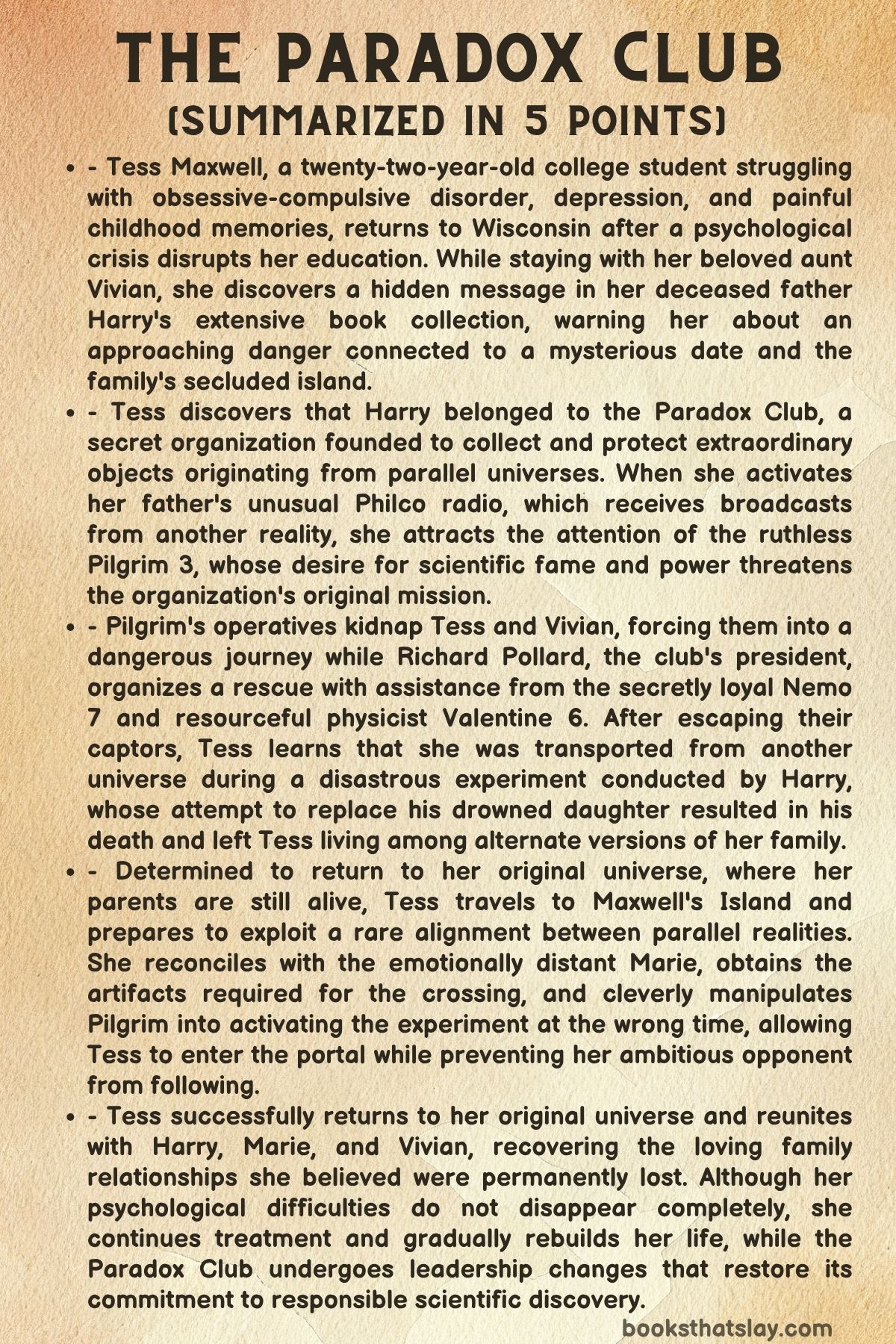
Characters
Tess Maxwell
Tess Maxwell is the central character of The Paradox Club, and her journey connects the novel’s scientific mysteries with its exploration of identity, belonging, and psychological suffering. Her intelligence, determination, and emotional vulnerability make her a complex protagonist whose greatest challenge involves understanding both the world around her and her place within it.
From childhood, Tess possesses an exceptional capacity for scientific reasoning, encouraged by Harry’s habit of treating her questions seriously. However, her obsessive-compulsive disorder transforms her natural curiosity into a source of distress whenever she begins imagining the consequences of apparently insignificant decisions.
Harry’s death and Marie’s rejection intensify her difficulties, leaving her convinced that she somehow caused the destruction of her family. Her repeated therapy sessions reveal her fear of uncertainty, her longing for affection, and her inability to believe that happiness can exist without the constant possibility of disaster.
Her discovery that she originated in another universe fundamentally changes her understanding of herself. Nevertheless, the revelation does not erase her previous suffering, because the rejection, loneliness, and psychological difficulties she experienced remain genuine parts of her life.
Tess’s development becomes especially clear when she deliberately imitates her compulsive behaviors to escape Montag and later outsmarts Pilgrim through scientific reasoning. Instead of relying entirely on others to protect her, she begins recognizing her ability to make informed decisions and influence her circumstances.
Her return to her original universe provides emotional security but does not automatically eliminate her disorder. By continuing treatment while rebuilding her relationship with her parents, Tess demonstrates that recovery involves accepting support, exercising personal agency, and learning to live with uncertainty.
Harry Maxwell
Harry Maxwell is the emotional and intellectual foundation of The Paradox Club, even though much of the novel concerns the consequences of his apparent death. His scientific brilliance, devotion to Tess, and willingness to challenge established knowledge influence nearly every important development in the story.
As a father, Harry encourages Tess to question assumptions and approach complicated ideas without fear. His conversations with her about gravity, parallel universes, thermodynamics, and probability reveal a patient teacher who believes scientific understanding should be accessible and personally meaningful.
However, Harry’s affection coexists with considerable personal flaws. He sometimes overlooks Tess’s psychological difficulties, underestimates the emotional consequences of his experiments, and assumes that his intelligence allows him to manage risks that others consider unacceptable.
The distinction between the two versions of Harry exposes the consequences of different motivations. In the universe where Tess dies, grief drives him toward a dangerous attempt to recover her, while the Harry in her original reality survives and eventually welcomes his daughter home.
His decision to pursue the experiment against Marie’s objections demonstrates how love can become destructive when combined with desperation and excessive confidence. Although his intentions are understandable, his actions cost him his life and cause lasting suffering for the people he hoped to protect.
Harry’s hidden message also reveals his foresight and enduring concern for Tess. Ultimately, he represents both the extraordinary possibilities of scientific curiosity and the moral responsibility that must accompany intellectual achievement.
Vivian Harbottle (Ardan 1)
Vivian Harbottle serves as Tess’s surrogate mother, scientific mentor, and emotional protector throughout The Paradox Club. Her warmth and loyalty provide a necessary contrast to Marie’s rejection, making her one of the few people Tess consistently trusts.
A university physics professor and longtime friend of Harry and Marie, Vivian possesses considerable scientific knowledge. Nevertheless, her relationship with Tess is defined less by academic expertise than by her willingness to offer affection without demanding emotional perfection.
Vivian’s extraordinary stories initially make her appear unreliable or mentally unwell. The revelation that her consciousness travels between parallel universes transforms these seemingly impossible accounts into evidence of the experiment’s lasting effects.
Her inability to control or retain the memories also gives her experiences a tragic dimension. She possesses access to extraordinary realities but must repeatedly surrender her recollections, preventing her from fully understanding the lives she briefly inhabits.
Vivian’s greatest strength is her capacity to remain present when circumstances become difficult. She protects Tess during the kidnapping, helps her recognize unexpected strengths, and supports her decision to return home despite understanding that their separation may be permanent.
Her character illustrates a form of love grounded in sustained responsibility rather than biological relationships. Even when she cannot prevent suffering, Vivian provides the emotional support that allows Tess to endure it.
Marie Maxwell (Nova 1)
Marie Maxwell is among the most emotionally complicated characters in The Paradox Club, embodying the destructive consequences of unresolved grief and the possibility of eventual forgiveness. Her rejection of Tess initially presents her as a cruel and emotionally unavailable mother, but the revelation about the parallel universes considerably complicates that judgment.
Before the tragedy, Marie shares a loving but occasionally frustrating marriage with Harry and maintains a close friendship with Vivian. Her position within their intellectual circle is sometimes uncomfortable because Harry frequently discusses his discoveries with Vivian and Tess while leaving Marie feeling excluded.
The death of her original daughter devastates Marie, and Harry’s subsequent attempt to retrieve another version of Tess violates her understanding of parenthood and loss. When the experiment succeeds, she confronts someone who resembles the daughter she mourns but possesses memories belonging to another reality.
Her inability to separate her grief from the new Tess’s innocence results in years of emotional neglect. Although her circumstances explain her reactions, they do not justify the suffering she inflicts on a child who has no responsibility for the disaster.
David’s affection gradually helps Marie imagine a future beyond her memories of Harry. Her decision to move to Florida reflects a desire for renewal, although she initially attempts to achieve it by avoiding painful family relationships.
Her final conversation with Tess marks an important transformation because she acknowledges the damage caused by her rejection. By surrendering the jeweled pendant and accepting their separation, Marie demonstrates a belated willingness to place Tess’s needs above her own unresolved pain.
Richard Pollard (Calvin 4)
Richard Pollard represents institutional responsibility, careful judgment, and loyalty to the principles upon which the Paradox Club was established. As its president, he understands both the scientific importance of interdimensional discoveries and the potentially catastrophic consequences of exploiting them recklessly.
His friendship with Harry gives him a personal investment in protecting Tess and Vivian. He also carries the burden of knowing that Harry’s experiments produced consequences the club could neither anticipate nor easily reverse.
Richard’s apparent retirement conceals his continuing commitment to the organization. His decision to establish an intelligence network demonstrates that he recognizes Pilgrim’s growing influence and understands the dangers of confronting her without reliable information.
Throughout the rescue operation, Richard combines strategic thinking with practical courage. Although he lacks the physical aggression of his opponents, he successfully evades surveillance, follows the kidnappers, and coordinates the intervention that frees Tess and Vivian.
His willingness to reconsider his objections to Tess’s return reveals an important distinction between responsible leadership and rigid authority. He may believe an action is dangerous, but he ultimately recognizes that Tess deserves some control over her own future.
Richard’s decision to elevate Valentine and later support Nemo as his successor confirms his belief that power should be entrusted to individuals who demonstrate integrity. His character emphasizes that wisdom often involves protecting others without attempting to control every aspect of their lives.
Pilgrim 3
Pilgrim 3 is the principal antagonist of The Paradox Club, representing the corruption of scientific discovery through ambition, insecurity, and an overwhelming desire for recognition. Her position as keeper of the vault gives her access to extraordinary knowledge, but she increasingly regards the club’s resources as instruments of personal advancement.
Her abusive childhood helps explain her obsession with power and her determination never to appear helpless again. Rather than developing sympathy for other vulnerable individuals, however, she responds by cultivating authority and demanding obedience from those around her.
The unusual book Gatsby the Great has particular significance for Pilgrim because its discovery marked her introduction to the organization. Its alternative ending, in which Gatsby survives, also symbolizes her fascination with realities where apparently fixed outcomes can be different.
Pilgrim’s desire to announce the existence of parallel universes before international journalists demonstrates her need for public validation. She convinces herself that achieving scientific greatness justifies violating the club’s rules and exposing humanity to unknown dangers.
Her greatest weakness is her inability to recognize that other people possess knowledge she lacks. Tess exploits this arrogance by presenting information that appears to support Pilgrim’s experiment while concealing the timing error that determines its outcome.
When Pilgrim fails to cross the portal, her psychological collapse exposes the fragility beneath her authoritarian personality. Her removal from office reinforces the novel’s distinction between genuine scientific achievement and the pursuit of personal glory.
Nemo 7
Nemo 7 is one of the novel’s most important supporting characters because his apparent loyalty to Pilgrim conceals a long-standing commitment to Harry and Richard. His work as a double agent requires patience, emotional restraint, and the ability to operate under constant suspicion.
Harry originally recruits Nemo because he recognizes the danger posed by Pilgrim’s growing influence. After Harry’s death, Nemo continues providing intelligence to Richard, preserving his cover even as Pilgrim becomes increasingly aggressive.
Nemo’s greatest test occurs during the kidnapping of Tess and Vivian. Although he must cooperate outwardly with Montag, he repeatedly attempts to prevent violence and eventually communicates his true intentions to Tess through Morse code.
His decision to reveal himself to Valentine allows Richard’s separate rescue efforts to succeed. The episode demonstrates his ability to recognize opportunities while accepting substantial personal risk.
Unlike Pilgrim, Nemo does not regard secrecy as a means of securing personal superiority. His eventual appointment as president reflects the trust he earns through years of loyalty, intelligence, and responsible judgment.
Valentine 6
Valentine 6 is a young physicist whose intelligence initially appears wasted on routine monitoring duties at the Paradox Club. Her dissatisfaction comes from recognizing that she possesses valuable abilities but has little opportunity to contribute meaningfully to the organization’s work.
Richard identifies her independence and recruits her as a confidential informant. Although the assignment exposes her to considerable danger, Valentine accepts because she believes the club’s original purpose deserves protection.
Her courage becomes evident when she delays reporting the radio’s signal, challenges Pilgrim’s accusations, and secretly recovers Gatsby the Great. These actions require more than technical expertise because she must anticipate the behavior of powerful opponents.
Valentine also demonstrates considerable practical ingenuity when she uses an acquaintance’s telephone and misdirects her pursuers with a tracked bag. Her resourcefulness helps her reach Michigan, where she joins Nemo and contributes to the successful rescue.
Her eventual appointment as keeper of the vault represents a significant generational change within the organization. Valentine embodies the possibility of scientific leadership based on competence, ethical responsibility, and earned trust rather than intimidation.
Montag 5
Montag 5 functions as Pilgrim’s primary enforcer, relying upon physical intimidation and threats to accomplish objectives that he rarely questions. His willingness to kidnap Tess and Vivian demonstrates how institutional corruption becomes especially dangerous when powerful individuals possess obedient agents.
Unlike Pilgrim, whose ambition involves public recognition and scientific authority, Montag appears primarily motivated by control and the satisfaction of exercising force. He treats vulnerable people as obstacles and considers violence a practical solution to resistance.
His relationship with Nemo exposes his inability to distinguish genuine loyalty from calculated obedience. Because Montag assumes intimidation guarantees cooperation, he overlooks the possibility that others may act against him while appearing compliant.
The motel escape humiliates him precisely because Tess succeeds without matching his aggression. Her intelligence and careful manipulation defeat the power he assumes his weapon provides.
Although Montag eventually adjusts to the club’s changed leadership, the novel offers little evidence of substantial moral transformation. He remains an example of how obedience without independent ethical judgment can enable serious wrongdoing.
Lidenbrock 2
Lidenbrock 2 operates as one of Pilgrim’s trusted associates, carrying out surveillance and investigative assignments connected to her efforts to consolidate authority. His role is particularly important in identifying the significance of the radio’s signal and attempting to recover the stolen book.
His familiarity with Harry’s earlier experiments gives him knowledge that younger members lack. However, he uses this understanding primarily to advance Pilgrim’s objectives rather than question their consequences.
Lidenbrock’s pursuit of Valentine and his decision to hide a tracking device in her bag demonstrate his preference for covert control. His actions make him a dangerous opponent even when he does not openly resort to Montag’s physical aggression.
After Pilgrim loses power, Lidenbrock transfers his loyalty to Richard’s administration without gaining a position of comparable influence. His adaptability suggests a stronger attachment to institutional survival than to any consistent moral or scientific principle.
David
David is Marie’s second husband and represents the possibility of finding affection and stability after devastating personal loss. Unlike Harry, whose scientific brilliance sometimes prevents him from attending to ordinary emotional needs, David offers Marie practical companionship and patient understanding.
His relationship with Marie allows her to imagine a future that does not require abandoning the memory of her first husband and daughter. He listens to her painful recollections without demanding that she suppress or simplify them.
When Montag threatens their home, Marie realizes how much David means to her and becomes determined to protect their marriage. His presence helps reveal her capacity for love even after years of destructive grief.
Although David remains outside the novel’s central scientific investigations, he plays an important emotional role. He demonstrates that rebuilding a life after tragedy can involve new relationships rather than the complete recovery of what was lost.
Anderson Tait
Anderson Tait is a journalist associated with Scientific American whom Pilgrim invites to witness her attempted breakthrough. His presence illustrates Pilgrim’s determination to turn an extraordinary scientific event into a public demonstration of her importance.
Initially, Anderson appears to function primarily as an observer whose professional credibility could help validate her achievement. His participation also raises questions about the responsibility involved in communicating scientific discoveries whose consequences remain poorly understood.
After the experiment fails, Richard offers Anderson membership in the Paradox Club in exchange for maintaining secrecy. This resolution places him within the organization whose existence Pilgrim had hoped to expose.
His character demonstrates that access to remarkable information creates obligations extending beyond the desire to publish or achieve recognition.
Tess’s Therapists
The therapists who work with Tess throughout her adolescence and early adulthood provide an important psychological perspective on her experiences. Their conversations establish that her distress cannot be reduced to the extraordinary circumstances surrounding her displacement between universes.
Through discussions of compulsive rituals, intrusive voices, depression, and grief, they help Tess recognize patterns that have become central to her daily life. They encourage treatment, practical coping techniques, emotional awareness, and a more realistic understanding of personal responsibility.
The exercise involving the imaginary return to Maxwell’s Island becomes especially significant during Tess’s rescue. When panic threatens to overwhelm her, she uses the technique independently and gradually regains control.
Their work also challenges the assumption that scientific explanations automatically resolve psychological suffering. Even after Tess discovers the truth about her origins, the coping skills she has developed remain essential to her continued recovery.
Morris Parrish
Morris Parrish is a wealthy businessman and collector whose discovery of an unfamiliar edition of Great Expectations initiates the events leading to the creation of the Paradox Club. His importance lies in his willingness to investigate an apparently impossible object rather than dismiss it.
By consulting Einstein, Parrish transforms a private curiosity into a question with extraordinary scientific implications. His resources and initiative help establish an institution dedicated to examining discoveries that conventional knowledge cannot explain.
Parrish represents the constructive potential of intellectual curiosity when supported by cooperation and responsibility. His original intentions provide a useful contrast to Pilgrim’s later attempts to exploit the institution for personal gain.
Albert Einstein
Albert Einstein appears as a historical scientific figure whose expertise contributes to the founding of the Paradox Club. His examination of Parrish’s unusual book establishes the possibility that physical objects may cross boundaries separating different universes.
Within the novel, Einstein represents the willingness to reconsider established assumptions when confronted with evidence that existing theories cannot satisfactorily explain. His involvement also gives the organization’s extraordinary discoveries a foundation in serious scientific inquiry.
Although he does not participate directly in Tess’s adventures, his influence persists through the club’s founding principles. His presence connects the speculative science of the story with the broader history of humanity’s attempts to understand reality.
Harry’s Grandfather and Father
Harry’s grandfather and father establish the Maxwell family’s long-standing connection to the Paradox Club. Their inherited sensitivity to objects from other universes helps explain why Harry possesses abilities that most scientists cannot reproduce.
His grandfather, known as Nemo 1, originally acquires Maxwell’s Island because of an unusual attraction toward its geographical properties. His discovery of an unfamiliar edition of Darwin’s work eventually connects the family to the organization’s earliest members.
Harry’s father, Lidenbrock 1, continues this association, making scientific curiosity and interdimensional mysteries part of the family’s intellectual inheritance. Their roles demonstrate that Tess’s eventual discoveries emerge from several generations of investigation rather than an isolated experiment.
Ashley
Ashley is Tess’s college roommate, whose decision to move out becomes a significant emotional setback during a brief period when Tess has begun feeling happier. Although Ashley struggles with Tess’s compulsive behavior, her departure intensifies Tess’s belief that other people will eventually reject her.
Ashley’s role illustrates the social consequences of psychological conditions that affect shared living arrangements. Her frustration may be understandable, but Tess experiences the separation through the accumulated pain of earlier abandonment.
The episode also reinforces an important lesson from therapy: emotional progress does not guarantee protection against disappointment. Tess must learn that a painful rejection does not invalidate the moments of happiness she experienced beforehand.
Bradley
Bradley is Valentine’s neighbor, whom she approaches while attempting to escape the surveillance arranged by Pilgrim’s associates. Although Valentine does not particularly enjoy his company, she recognizes that his presence offers an opportunity to obtain a telephone without exposing her own communications.
His role is limited but useful because it helps demonstrate Valentine’s ability to improvise under pressure. Their interaction also shows that seemingly ordinary social connections can become important during dangerous circumstances.
Mr. Drakos
Mr. Drakos is a restaurant owner who assists Valentine when she realizes that Lidenbrock is following her through Manhattan. By allowing her to hide inside a supply closet, he gives her the opportunity to send an urgent warning to Richard.
His willingness to help contrasts with the threatening behavior of Pilgrim’s operatives. Although he knows relatively little about the larger conflict, his intervention demonstrates how ordinary acts of cooperation can influence extraordinary events.
Prefect 16
Prefect 16 is the author of the unpublished history of the Paradox Club, excerpts from which provide important background about the organization’s origins and responsibilities. The character functions primarily as a historical narrator rather than an active participant in Tess’s immediate experiences.
Through these writings, the reader learns that club members live outwardly ordinary lives while protecting secrets with enormous implications for humanity. Prefect 16’s perspective emphasizes the institution’s original purpose and the responsibilities associated with preserving dangerous knowledge.
The historical accounts also create a contrast between the organization’s founding ideals and the internal power struggles that later threaten its existence.
Themes
Identity, Belonging, and the Meaning of Home
Tess’s struggle to understand her identity provides the emotional foundation of The Paradox Club. Her persistent feeling that she does not belong becomes especially significant because the novel eventually reveals that she literally exists outside the universe in which she was born.
Throughout her adolescence and early adulthood, Tess struggles to explain why ordinary circumstances feel unfamiliar or emotionally disconnected. Although her psychological conditions contribute to this experience, her displacement between parallel realities introduces another explanation that challenges conventional ideas about identity.
Her relationship with Marie makes the question particularly painful because the woman who raised her no longer recognizes her as the daughter she lost. Tess possesses memories of maternal affection and childhood happiness, yet those experiences belong to another version of her family.
This contradiction raises questions about whether identity depends upon physical continuity, personal memories, relationships, or the recognition of others. Tess remains fundamentally the same person despite crossing universes, but her arrival transforms how the people around her understand their relationships with her.
Maxwell’s Island functions as a symbol of belonging because it exists in both realities while carrying different emotional meanings. In one universe, it becomes the location of devastating loss, whereas in the other, it remains a place where Tess experiences security and affection.
Her eventual return suggests that home is defined not simply by geography but by relationships that allow individuals to feel understood and accepted. Nevertheless, her experiences also demonstrate that personal identity continues developing through suffering, decisions, and relationships, regardless of the environment in which someone lives.
The novel ultimately presents belonging as a combination of emotional recognition and personal understanding. Tess finds greater stability when she returns to her family, but she must also accept the lasting influence of the decade she spent elsewhere.
Grief, Love, and the Possibility of Forgiveness
Grief transforms the Maxwell family in ways that extend far beyond the original tragedy. Harry, Marie, Tess, and Vivian respond differently to loss, demonstrating how the same event can produce radically different emotional consequences.
In the universe where Tess drowns, Harry becomes incapable of accepting a future without his daughter. His love motivates him to pursue scientific possibilities that might restore her, but his determination eventually develops into an obsession that overrides caution and disregards Marie’s objections.
Marie experiences the same loss but responds by resisting Harry’s attempt to replace their daughter with another version of her. After the experiment, she struggles to distinguish the innocent newcomer from the painful circumstances of her arrival, resulting in years of emotional rejection.
Tess suffers because she interprets Marie’s behavior as proof that she has somehow destroyed her family. Her memories of a loving childhood make the rejection especially difficult to understand, while her obsessive thoughts repeatedly return to questions of guilt and responsibility.
Vivian offers a contrasting response to suffering by remaining emotionally available even when she cannot prevent tragedy. Her affection demonstrates that caring for another person does not require perfect understanding or the ability to resolve every difficulty.
The reconciliation between Tess and Marie becomes possible only after both acknowledge the truth about their experiences. Marie accepts responsibility for her treatment of Tess, while Tess recognizes that understanding another person’s pain can make forgiveness possible without excusing past wrongdoing.
Love also appears through Harry’s scientific conversations with Tess, which preserve their emotional connection across realities. Their relationship suggests that affection can influence personal identity and provide stability even when circumstances change dramatically.
The novel portrays forgiveness as a conscious decision rather than an automatic consequence of understanding. By forgiving Marie before returning home, Tess releases part of the resentment that has shaped her life and gains the freedom to pursue her own future.
Scientific Discovery, Storytelling, and Moral Responsibility
Scientific knowledge in The Paradox Club possesses extraordinary potential, but the novel repeatedly questions whether the ability to accomplish something establishes the right to pursue it. The discovery of parallel universes creates possibilities for understanding reality while introducing dangers that conventional scientific institutions are unprepared to manage.
Harry represents the excitement of intellectual exploration through his conversations with Tess and his determination to investigate unfamiliar phenomena. He encourages independent thought, challenges accepted assumptions, and teaches his daughter that scientific understanding develops through questioning rather than unquestioning obedience.
However, his failed experiment demonstrates the dangers of allowing emotional desperation to influence scientific judgment. Although his desire to recover Tess is understandable, his willingness to proceed despite substantial uncertainty results in his death and serious consequences for others.
Pilgrim presents a different form of scientific irresponsibility because her decisions are primarily motivated by ambition and public recognition. She regards the discovery of parallel universes as an opportunity to achieve fame, even when the experiment threatens the safety of people who have not consented to its risks.
The Paradox Club’s founding principles offer an alternative based on preservation, investigation, and restraint. Its members originally recognize that an extraordinary discovery may require secrecy when uncontrolled exploitation could produce consequences extending beyond individual interests.
Storytelling provides an equally important way of examining truth. Harry’s assertion that every story is true somewhere initially appears philosophical, but Vivian’s experiences reveal that seemingly impossible narratives can originate from actual events in other realities.
Her stories challenge the assumption that scientific truth and imaginative expression must always occupy separate categories. They also provide Tess with comfort and practical lessons that scientific explanations alone cannot supply.
By connecting storytelling with scientific investigation, the novel suggests that knowledge becomes most valuable when it serves human understanding and welfare. Intellectual achievement requires humility, ethical responsibility, and recognition that even brilliant individuals may not understand every consequence of their actions.
Free Will, Control, and the Consequences of Choice
Tess’s obsession with controlling her circumstances develops from her awareness that seemingly insignificant decisions can produce enormous consequences. Her father’s explanations of chaos theory, probability, and the butterfly effect intensify this concern by suggesting that minor differences may eventually transform entire futures.
The distinction between the two universes demonstrates this possibility through the accident that determines whether Tess survives. A small difference involving a door and Harry’s ability to hear it contributes to dramatically different outcomes for the Maxwell family.
Such events challenge the assumption that people can reliably predict the consequences of their actions. Harry’s scientific knowledge allows him to calculate extraordinary physical phenomena, yet he cannot fully anticipate the destructive results of his attempt to restore his daughter.
Tess initially responds to uncertainty through compulsive rituals and attempts to eliminate every possibility of making a mistake. Her psychological condition makes her feel personally responsible for events over which she has little meaningful control.
Her therapists repeatedly encourage her to distinguish between circumstances she can influence and those she must learn to accept. This distinction becomes essential because her emotional development depends upon abandoning the impossible expectation of preventing every undesirable outcome.
The confrontation with Montag demonstrates a transformation in her understanding of personal agency. Rather than attempting to control every detail of the situation, she identifies one opportunity, uses her knowledge of her opponent’s assumptions, and acts despite uncertainty.
Her final confrontation with Pilgrim develops this ability further. Tess succeeds because she understands the scientific information available to her, recognizes Pilgrim’s weaknesses, and makes a deliberate choice about when to act.
Nevertheless, the novel does not suggest that intelligence can eliminate uncertainty or guarantee happiness. Tess continues experiencing obsessive-compulsive symptoms after returning home, reminding readers that gaining control over important decisions does not mean controlling every aspect of life.
Her development ultimately reflects a movement from fear-driven behavior toward purposeful action. By accepting that uncertainty is unavoidable while recognizing her ability to choose how she responds, Tess begins building a life guided by understanding rather than fear.


