The Thief and the Traitor Bride Summary, Characters and Themes
The Thief and the Traitor Bride by V. L. Bovalino is a romantic fantasy novel that combines political espionage, magical conspiracies, and the difficult process of rebuilding a broken marriage.
The story follows Elinore Gordon, a successful merchant and secret intelligence agent whose carefully controlled life is disrupted when she discovers that the thief she has been pursuing is her estranged husband, Caspian Khari. Forced to work together on a dangerous mission, the couple confronts old betrayals while uncovering a conspiracy involving powerful nobles and an ancient magical system. Through their experiences, the novel examines loyalty, manipulation, personal independence, and the courage required to trust again. It’s the 2nd book in The Hand and the Heart series.
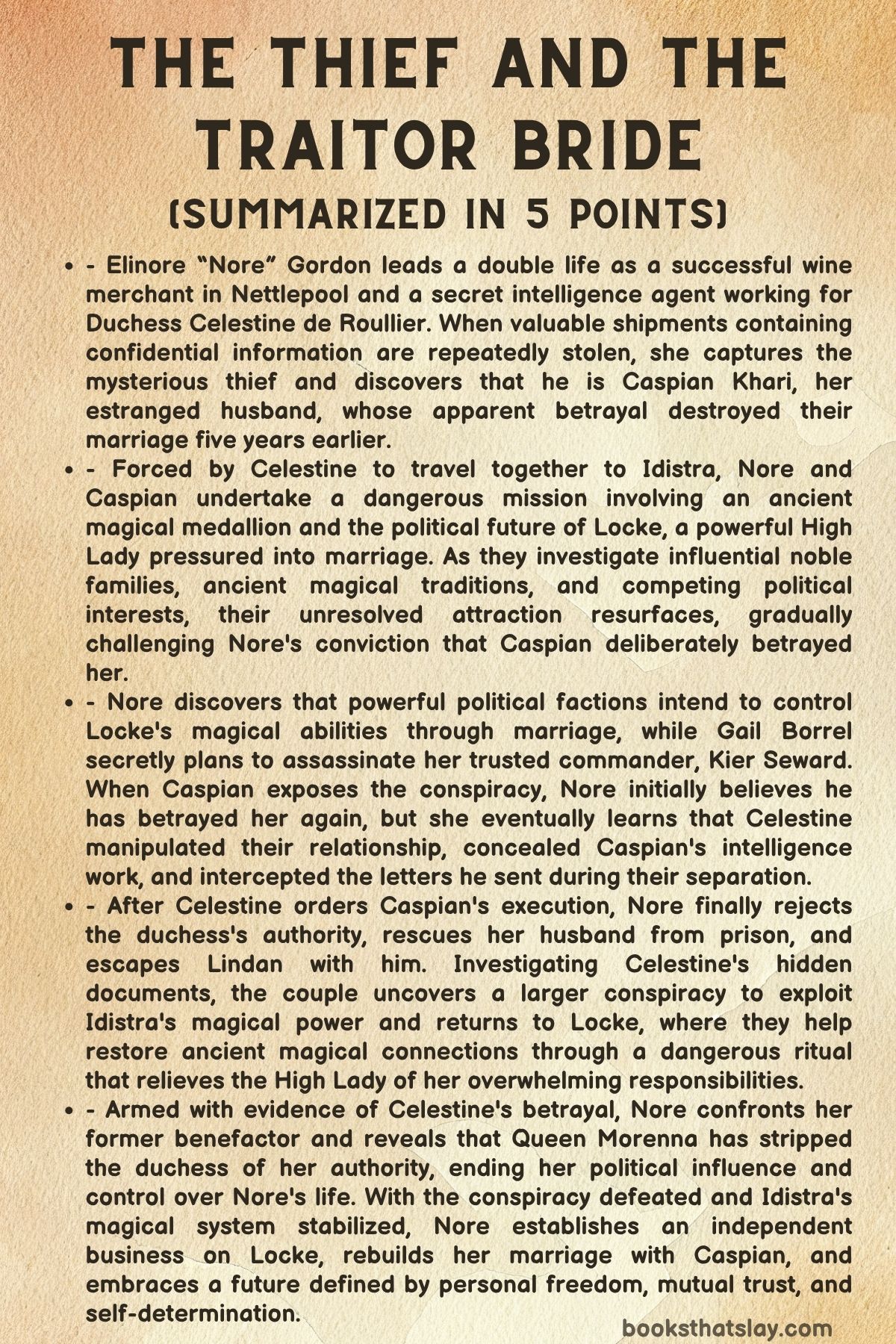
Summary
Elinore Gordon, commonly known as Nore, lives a carefully organized double life in the bustling harbor city of Nettlepool. She manages Miller & Sons Trading, a successful wine business, while secretly working as Finch, an intelligence agent serving the Lindle crown under the supervision of Duchess Celestine de Roullier.
Nore has spent years developing an exceptional talent for gathering information, conducting negotiations, and concealing her true intentions. Her dedication to Celestine is almost absolute, partly because the duchess helped rescue her from a childhood marked by illegitimacy, social exclusion, and limited opportunities.
Born Elinore Arlowe, Nore is the unacknowledged daughter of a nobleman’s son and Golda Barber, a servant in the aristocratic household. Her intelligence eventually attracts Celestine’s attention, leading to an apprenticeship with Edith Gordon, a demanding merchant who teaches her the skills necessary to establish an independent career.
Although this arrangement provides Nore with financial security and professional opportunities, it also makes her deeply dependent upon her benefactors. She learns to measure her worth through usefulness, obedience, and the successful completion of assignments, gradually accepting the belief that personal happiness is a weakness.
Her disciplined existence begins unraveling when valuable shipments disappear from her company’s vessels despite elaborate security precautions. The thefts are especially alarming because certain wine bottles conceal intelligence reports concerning Idistra, a collection of six nations recovering from a devastating war.
Determined to capture the mysterious criminal, Nore purchases an ancient Karathak stone capable of temporarily suppressing different forms of magic. She arranges a carefully coordinated operation around her incoming shipments and finally succeeds in apprehending the thief.
The prisoner’s identity, however, leaves her devastated. He is Caspian Khari, the man she secretly married years earlier and whose apparent betrayal destroyed her faith in romantic love.
Nore and Caspian originally met when she was a young merchant apprentice undertaking an assignment for Celestine. Caspian, a charming theater performer with roots in Idistra and Nadira, intervened when a stranger threatened her near a theater.
Their immediate attraction developed into a passionate relationship, and they eventually married in a private ceremony combining traditions from their different backgrounds. For Nore, Caspian represented affection and companionship beyond the demanding responsibilities that dominated her life.
Their marriage collapsed when Nore discovered that the mysterious artifact thief she had been ordered to capture was Caspian himself. During their confrontation, he seriously injured her before recognizing whom he was fighting, leaving her convinced that her husband had deliberately deceived and endangered her.
Caspian subsequently suffered brutal punishment at Celestine’s hands, including the loss of a finger, before escaping into exile. Nore never received a satisfactory explanation for his activities and spent the following years believing that he had betrayed both their marriage and her country.
Their reunion becomes even more complicated when Celestine announces that Caspian will accompany Nore on an important assignment to Idistra. The duchess needs his extraordinary abilities as an amalgamate, someone capable of working with different magical systems, to retrieve a powerful ancient medallion.
Nore must simultaneously investigate the political situation surrounding Locke, the young High Lady who controls the source of Idistra’s magical power. Several influential families want Locke to marry an acceptable candidate, supposedly to stabilize the region and prevent another conflict.
Nore reluctantly accepts the mission and travels with Caspian to Idistra. Their voyage begins with hostility, bitter accusations, and painful reminders of their previous relationship, but circumstances gradually force them to cooperate.
When Caspian becomes seriously ill during the journey, Nore personally nurses him through his fever. Their interactions reveal that neither has completely overcome the emotional consequences of their separation, despite Nore’s repeated insistence that she can never trust him again.
Upon arriving in Idistra, they meet Gail Borrel, a nobleman associated with Nestrian political interests. Gail explains the effort to secure a politically advantageous marriage for Locke, whose control over the region’s magical system makes her an enormously influential figure.
Nore uses her legitimate profession as a wine merchant to approach aristocratic families and gather intelligence about potential marriage candidates. Caspian assists her, and their surprisingly natural partnership reminds both of them how effectively they once worked together.
As their investigation progresses, Nore discovers that Locke’s supposed refusal to marry conceals a far more complicated situation. The High Lady experiences dangerous fluctuations in magical power, and political factions appear increasingly interested in controlling her rather than protecting her.
Meanwhile, Nore and Caspian investigate the ancient medallion Celestine wants recovered. With the assistance of Professor Terlo Augustine, they study Idistran magical history and discover connections between the artifact, ancient binding ceremonies, and the Isle of Locke.
Nore secures access to the Isle by arranging to supply wine for the Peacetide festival. Once there, she establishes relationships with influential residents, including Garna Thrick, and gathers information concerning Locke’s household, personal history, and security arrangements.
During her explorations, Nore repeatedly encounters a mysterious woman near the Isle’s coastal ruins. Their conversations develop into an unexpected friendship based on shared feelings of loneliness and the burdens imposed by responsibility.
Nore eventually discovers that the woman is Locke herself. This revelation changes her understanding of the High Lady, who proves considerably more intelligent, vulnerable, and compassionate than the intimidating political figure described in official intelligence reports.
Further investigation reveals that Locke once possessed a wedding gown bearing an emblem associated with the Seward family. Nore begins suspecting that Locke’s relationship with Kier Seward, the formidable commander of her guards, extends beyond their public responsibilities.
Her growing sympathy for Locke conflicts with her assignment. She increasingly recognizes that forcing the High Lady into a politically advantageous marriage could place her under the control of people interested primarily in exploiting her magical abilities.
At the same time, Nore and Caspian begin rebuilding their emotional and physical relationship. Their renewed intimacy creates opportunities for honesty, but disagreements about Celestine continue preventing genuine reconciliation.
Caspian repeatedly warns that the duchess cannot be trusted and that the intelligence Nore collects may contribute to a dangerous conspiracy. Nore initially dismisses his concerns because she cannot imagine turning against the woman who shaped her entire career.
The situation changes when Gail reveals that his political allies intend to poison Kier, removing the greatest obstacle to controlling Locke. Horrified by the assassination scheme, Nore nevertheless continues investigating the ancient artifact while concealing her growing doubts.
An expedition into an ancient burial site finally leads Nore and her companions to the medallion. Before they can complete their mission, however, Locke and her guards confront them, apparently because Caspian has exposed their activities.
Nore is arrested for violating a sacred tomb and believes her husband has betrayed her once more. Caspian subsequently secures her release by exposing Gail’s conspiracy and surrendering him to Locke’s authorities.
Their confrontation afterward reveals a devastating truth: Caspian once served Celestine’s intelligence organization under the codename Starling. The duchess deliberately concealed his employment from Nore while using both spouses for assignments that eventually placed them in direct conflict.
Nore also discovers that Caspian repeatedly wrote letters attempting to explain his circumstances, but Celestine intercepted their correspondence. What Nore understood as proof of indifference was actually the result of systematic manipulation.
Their developing understanding is interrupted when Tern, another intelligence agent, arrives and takes them back to Lindan. Caspian is imprisoned, while Nore must report to Celestine about the failed political operation.
Although Nore presents the duchess with a substitute for the recovered medallion, Celestine remains determined to eliminate Caspian. She orders his execution, leaving Nore with an impossible choice between obedience and the man she still loves.
Nore finally recognizes that Celestine’s authority has never been entirely benevolent. Searching the duchess’s private records, she discovers the hidden letters Caspian wrote during their separation, together with evidence suggesting an extensive conspiracy involving Idistra’s magical power.
Determined to reclaim control over her life, Nore secretly gathers supplies and uses her intelligence credentials to enter Caspian’s prison. She confesses that she still loves him, provides magical materials needed for their escape, and helps him overcome the prison’s defenses.
The couple flees Lindan, abandoning the apparent security of Nore’s former life. During their journey, Caspian explains that Celestine recruited him when he was a vulnerable refugee and later demanded repayment when he attempted to leave her service.
He had undertaken dangerous artifact-retrieval assignments to purchase his freedom, unknowingly becoming the criminal Nore was ordered to apprehend. His recent return to Lindan was also connected to an investigation into a conspiracy involving Nestria and Celestine.
Rather than disappearing permanently, Nore decides to confront the larger political threat. With Caspian’s help, she studies the documents recovered from Celestine’s residence and discovers evidence that the duchess intends to redirect Idistra’s magical power for her own political advantage.
The couple returns to Locke with the assistance of Captain Isla Cross. Although Locke initially distrusts them, Nore presents evidence of the conspiracy and proposes investigating the dangerous instability affecting the High Lady’s magic.
Working alongside Caspian, Terlo, and Kier, she discovers that Idistra’s magical system was damaged when the Isle was destroyed and later resurrected. Ancient connections once distributed magical responsibility across multiple people and nations, but their destruction left Locke carrying an almost unbearable burden.
Nore proposes recreating an ancient binding ceremony to restore those connections. The ritual requires cooperation among individuals possessing different magical abilities and carries the possibility of killing Locke if the redistribution fails.
Despite the danger, Locke agrees. During the ceremony in the Ghostwood, thousands of magical connections become visible, confirming how extensively the region’s power has concentrated within her.
The participants successfully redistribute that power through restored magical bonds, stabilizing the system and allowing Locke to survive. For Nore, the achievement represents the first time she has used her professional abilities primarily to protect another person’s freedom rather than satisfy Celestine’s ambitions.
Armed with evidence of the duchess’s conspiracy, Nore arranges a final confrontation on neutral territory. Celestine initially dismisses her former subordinate’s demands, but Nore reveals that Queen Morenna has already been informed of her unauthorized political activities.
The queen strips Celestine of her authority and possessions and orders her exile from Lindan. Locke insists that the disgraced duchess face legal judgment rather than becoming the victim of a private assassination.
With Celestine defeated, Nore and Caspian establish a new life on Locke, where Nore operates her own trading enterprise while maintaining connections with Miller & Sons through Kota.
Locke eventually prepares to marry Kier, confirming the relationship that political interference nearly destroyed. Nore assists with the wedding arrangements, while Caspian continues supporting her professional activities.
Their marriage has survived years of deception, separation, and mistrust, but their reunion is now based on mutual understanding rather than blind obedience. The story concludes with Nore and Caspian investigating another suspicious situation together, finally able to choose their own future.
Characters
Elinore “Nore” Gordon
Elinore Gordon is the central protagonist of The Thief and the Traitor Bride, a highly intelligent merchant and intelligence agent whose extraordinary professional competence conceals profound emotional insecurity. Her identity as Finch, a trusted operative working for Duchess Celestine, reflects years of discipline, ambition, and an intense need to prove that she deserves the opportunities she has received.
Nore’s childhood as the illegitimate daughter of a nobleman’s son profoundly shapes her understanding of relationships and personal worth. Having grown up without the privileges enjoyed by legitimate aristocratic children, she comes to believe that acceptance must be earned through usefulness, exceptional achievement, and obedience.
Her relationship with Celestine reinforces these convictions, making it difficult for her to recognize the difference between genuine guidance and exploitation. Even after establishing herself as a successful businesswoman, she remains psychologically dependent upon the duchess’s approval.
Nore’s marriage to Caspian initially offers an alternative to this demanding existence, providing affection, companionship, and the possibility of being loved without having to demonstrate professional value. His apparent betrayal destroys that security, encouraging her to become increasingly suspicious of emotional attachment.
Throughout the novel, Nore’s greatest struggle involves recognizing that loyalty does not require surrendering her independence. Her growing friendship with Locke, renewed relationship with Caspian, and discovery of Celestine’s manipulation gradually force her to reconsider the principles governing her life.
Her decision to rescue Caspian, protect Locke, and confront Celestine represents a fundamental transformation. Rather than abandoning her intelligence or ambition, she learns to exercise those qualities according to her own moral judgment.
Caspian Khari
Caspian Khari is Nore’s estranged husband and one of the most emotionally significant characters in The Thief and the Traitor Bride. A former theater performer, accomplished thief, and exceptionally talented amalgamate, he combines charm, humor, resourcefulness, and dangerous magical abilities with a complicated history of exploitation.
His mixed Idistran and Nadiran heritage provides him with connections to different cultures and magical traditions. His displacement during the Idistran war leaves him vulnerable to powerful individuals, particularly Celestine, who recruits him into her intelligence organization under circumstances that eventually become oppressive.
Caspian’s apparent criminality initially makes him seem untrustworthy, especially because Nore remembers the violent encounter that ended their marriage. However, his actions become more understandable as the novel reveals that he undertook dangerous assignments to obtain freedom from Celestine’s control.
His relationship with Nore remains central to his emotional identity. Despite their separation, he continues writing to her, attempting to explain his circumstances and preserve a relationship that she believes he willingly abandoned.
Caspian frequently challenges Nore’s unquestioning loyalty to Celestine, recognizing the duchess’s manipulation because he has experienced it himself. His willingness to risk Nore’s anger by exposing Gail’s conspiracy demonstrates that his commitment to protecting others can outweigh his desire to preserve her immediate trust.
Although his secrecy contributes to the couple’s suffering, Caspian gradually becomes more open about his fears and experiences. His development emphasizes the importance of personal freedom, accountability, and allowing another person to make decisions independently.
Duchess Celestine de Roullier
Duchess Celestine de Roullier serves as the principal antagonist of The Thief and the Traitor Bride, exercising enormous influence through her aristocratic position and control of the Lindle intelligence network. Her outward appearance as a sophisticated benefactor conceals a calculating personality that regards personal relationships as instruments of political power.
Celestine’s relationship with Nore illustrates her preferred method of manipulation. By providing education, employment, and social advancement, she creates a sense of indebtedness that makes Nore reluctant to question her motives.
She subsequently reinforces this dependence by presenting emotional attachment as a dangerous weakness. Her approval becomes a reward granted through professional obedience, ensuring that Nore associates personal sacrifice with moral responsibility.
Celestine’s treatment of Caspian exposes the cruelty underlying her apparent generosity. She recruits him when he is vulnerable, demands repayment when he seeks independence, and conceals his identity and correspondence from the woman he loves.
Her political ambitions eventually extend beyond controlling individual agents. By investigating Idistra’s magical inheritance and marriage traditions, she attempts to acquire influence over a foreign magical system for personal advantage.
Celestine’s downfall is particularly significant because she is defeated by someone whose intelligence she helped cultivate. Nore’s successful resistance demonstrates that authoritarian control becomes vulnerable when those subjected to it recognize their own capabilities.
Locke
Locke, the High Lady of the Isle of Locke, is a central political and emotional figure in The Thief and the Traitor Bride. As the person responsible for sustaining Idistra’s magical power, she occupies a position of extraordinary authority while facing demands that severely restrict her personal independence.
Throughout much of the novel, outsiders describe Locke as stubborn, politically difficult, and unwilling to fulfill her obligations through marriage. These judgments conceal the exhaustion, grief, and overwhelming responsibility that define her actual circumstances.
Her relationship with Nore allows readers to encounter a more personal version of the High Lady. During their conversations near the coastal ruins, Locke reveals humor, intelligence, loneliness, and a desire to interact with someone who does not immediately treat her as a political resource.
The discovery of her abandoned wedding plans and complicated relationship with Kier further challenges the assumption that she simply opposes marriage. Her resistance concerns the loss of choice and the possibility of being controlled by individuals who covet her power.
Locke’s personal history, including the tragedy of a lost pregnancy, contributes to her emotional complexity. She has endured suffering while simultaneously maintaining a magical system whose instability threatens her survival.
Her willingness to participate in the dangerous binding ritual shows considerable courage. By accepting assistance and allowing magical responsibility to be redistributed, she moves toward a future in which leadership no longer requires total personal sacrifice.
Kier Seward
Kier Seward is Locke’s formidable military commander and one of the most influential supporting characters in The Thief and the Traitor Bride. Known as the Viper, he possesses exceptional combat abilities, considerable political importance, and an unwavering determination to protect the High Lady.
His intimidating reputation initially creates uncertainty about his motivations. However, his interactions with Locke reveal a relationship characterized by affection, trust, and responsibilities extending beyond their official positions.
Kier’s significance becomes particularly clear when Gail identifies him as an obstacle to the proposed political marriage. His loyalty and considerable power make him dangerous to factions hoping to impose their preferred partner upon Locke.
Despite his protective instincts, Kier must eventually recognize that he cannot preserve Locke’s safety simply by preventing others from approaching her. His participation in the effort to restore Idistra’s magical system requires trusting Nore, Caspian, and Terlo despite their earlier actions.
His eventual marriage to Locke represents the triumph of a relationship based on mutual affection rather than political coercion. Through Kier, the novel presents loyalty as something that can protect another person’s independence instead of restricting it.
Professor Terlo Augustine
Professor Terlo Augustine is an accomplished scholar whose expertise in Idistran magical history becomes essential to uncovering the truth about Locke’s deteriorating condition. His academic curiosity, patience, and willingness to investigate neglected historical sources complement Nore’s practical intelligence and Caspian’s magical experience.
Terlo provides crucial information concerning ancient artifacts, ceremonial traditions, magical inheritance, and the relationships between wells and mages. His research helps establish that the mysterious medallion has a much greater significance than Celestine initially suggests.
Although he is excited by the possibility of studying rare magical materials, Terlo does not remain detached from the human consequences of his discoveries. He becomes an active participant in the effort to prevent Locke’s exploitation.
His contribution to the final binding ritual demonstrates the importance of historical knowledge in resolving contemporary political problems. He helps transform apparently obscure scholarship into practical knowledge capable of protecting an entire region.
Gail Borrel
Gail Borrel is a politically connected Idistran nobleman who initially presents himself as a cooperative ally in Nore’s assignment. His association with Nestrian interests makes him valuable as a source of information about marriage negotiations and the competing factions seeking influence over Locke.
Beneath his courteous behavior, however, Gail possesses considerable ambition and a willingness to employ ruthless methods. He interprets Locke’s authority primarily as an opportunity to obtain political advantage.
His plan to poison Kier reveals how far he is prepared to go to remove opposition. Rather than respecting the High Lady’s decisions, Gail supports manipulating her circumstances until she has little practical choice but to accept the arrangement preferred by his allies.
Gail represents a political worldview in which individuals become obstacles or resources depending upon their usefulness. His eventual capture exposes the dangerous intentions concealed behind claims of protecting Idistra’s stability.
Edith Gordon
Edith Gordon is the wealthy merchant who becomes Nore’s guardian, employer, and professional mentor after Celestine recognizes the girl’s potential. Her demanding training provides Nore with the financial, mathematical, and commercial expertise that later allows her to build a successful career.
Edith values discipline, efficiency, intelligence, and emotional restraint. Under her supervision, Nore acquires the confidence necessary to navigate a commercial world in which her illegitimate birth and gender might otherwise restrict her opportunities.
However, Edith’s guidance also reinforces the belief that work must take precedence over personal suffering. Her insistence that Nore continue performing professional duties after the devastating confrontation with Caspian reveals the limitations of her emotional support.
Edith consequently occupies an ambiguous position in Nore’s development. She provides genuine opportunities while helping establish the harsh expectations that Nore must eventually reject.
Tern
Tern is a ship captain and intelligence operative whose professional association with Nore is complicated by romantic attraction. His reliability, familiarity, and apparent concern initially make him a reassuring presence during the increasingly dangerous investigation.
His feelings become more apparent when he discovers that Nore and Caspian are presenting themselves as a married couple. His unexpected kiss reveals a personal interest that Nore has previously kept at a distance.
Despite his concern for her, Tern remains closely connected to Celestine’s intelligence organization. He repeatedly reminds Nore of the duchess’s expectations and ultimately participates in transporting Caspian back to Lindan as a prisoner.
His character illustrates the difficulties of maintaining personal relationships within an institution that demands obedience. Although his attachment to Nore appears genuine, his professional loyalty prevents him from becoming a dependable source of independence.
Sparrow
Sparrow is a fellow intelligence operative whose activities demonstrate the extensive reach of Celestine’s organization. Responsible for delivering instructions, arranging operational details, and facilitating Nore’s assignments, Sparrow helps maintain the administrative structure behind the duchess’s elaborate intelligence network.
Sparrow’s involvement in the preparations for the Idistran mission shows how carefully Celestine controls the circumstances surrounding her agents. Even apparently routine arrangements, such as Caspian’s confinement aboard the ship, reinforce the hierarchy within which Nore operates.
Unlike characters whose personal histories receive extensive attention, Sparrow is primarily defined through professional responsibilities. The character nevertheless contributes to the novel’s portrayal of intelligence work as a coordinated system rather than the achievement of isolated individuals.
Kota
Kota is Nore’s chief clerk at Miller & Sons Trading and one of the most important figures in her commercial life. Competent, dependable, and familiar with the complicated operations of the business, Kota provides continuity while Nore undertakes dangerous assignments elsewhere.
Early in the novel, Kota conceals shipping discrepancies to protect a junior employee, an action that angers Nore because it compromises her elaborate security procedures. The incident reveals the contrast between Kota’s concern for colleagues and Nore’s tendency to prioritize professional accountability.
Despite occasional disagreements, Nore trusts Kota sufficiently to leave the business under the clerk’s supervision during her travels. This confidence becomes particularly meaningful after Nore decides to escape Celestine’s authority.
By the conclusion, Kota oversees Miller & Sons in Lindan while Nore establishes new commercial opportunities on Locke. Their professional relationship demonstrates that trust can develop through shared responsibility rather than absolute obedience.
Hands
Hands is an elderly supplier operating within Nettlepool’s complicated commercial and criminal networks. His expertise in unusual magical objects makes him an important contact for Nore, who relies on specialized equipment to compensate for the limitations of her physical and magical abilities.
He supplies the ancient Karathak stone capable of suppressing different magical systems. This artifact allows Nore to capture Caspian after repeated failures against his extraordinary abilities.
Hands represents the practical knowledge circulating outside official institutions. His contribution also emphasizes Nore’s resourcefulness, since she repeatedly solves problems by identifying knowledgeable individuals and obtaining tools suited to specific challenges.
Garna Thrick
Garna Thrick is an influential organizer of Locke’s Peacetide festival who becomes an important contact during Nore’s investigation. Her position provides access to social circles and administrative relationships that would otherwise be difficult for an outsider to enter.
Nore approaches Garna through legitimate commercial activities, demonstrating how professional relationships can become valuable sources of information. Their acquaintance eventually helps Nore learn more about Locke’s household and the people closest to the High Lady.
Garna’s relationship with Ola, a member of the household guard, also connects the Isle’s civic activities with its security arrangements. Through Garna, the story portrays the personal networks sustaining daily life beyond aristocratic negotiations and military concerns.
Ola
Ola is Garna’s partner and an important figure within Locke’s household guard. Her position makes her particularly relevant to Nore’s efforts to understand the High Lady’s security arrangements and the relationships surrounding the fortress.
Although Ola does not receive the same extensive development as the principal characters, her presence broadens the portrayal of Locke’s trusted community. The household depends upon people whose responsibilities involve practical protection and everyday service rather than public political ambition.
Ola also helps establish the importance of relationships among Locke’s supporters. These connections provide a contrast to the transactional alliances proposed by foreign political factions.
Jessa Picantor-Donan
Jessa Picantor-Donan is a prominent figure among the individuals considered possible marriage partners for Locke. Her social position places her within the competition through which influential families hope to obtain access to the High Lady’s extraordinary authority.
During their encounter at a harbor gathering, Jessa responds favorably to Nore’s charm and knowledge of wine. Her flirtatious manner allows Nore to gather information without appearing to conduct a formal investigation.
Jessa’s role demonstrates that the marriage negotiations involve social performance as well as political ambition. Personal charm and aristocratic standing become instruments through which powerful families attempt to shape the future of Idistra.
Lucia Knight
Lucia Knight is a member of an influential Idistran family whom Nore approaches while investigating the political competition surrounding Locke’s marriage. Her participation in wine tastings allows Nore to gather information through apparently ordinary social conversation.
Lucia belongs to the aristocratic environment in which family alliances, inheritance, and political ambition influence marital decisions. Her interactions with Nore help establish the range of interests competing for influence over the High Lady.
Although her individual motivations receive limited attention, Lucia contributes to the portrayal of noble society as a network in which personal relationships often carry political consequences.
Relina Lark
Relina Lark is a tailor whose professional association with Locke provides an unexpected source of important information. Through her work, Nore discovers evidence of an elaborate wedding gown that the High Lady never wore.
The garment contradicts the widespread belief that Locke has always rejected marriage. Its design, particularly the embroidered family emblem, helps Nore investigate the identity of the person Locke once intended to marry.
Relina’s role demonstrates how apparently insignificant domestic records can preserve truths concealed by official political accounts. Clothing becomes a valuable historical witness, revealing private emotional circumstances that public negotiations deliberately overlook.
Bell Owndig
Bell Owndig is the resident scholar associated with Locke’s fortress and a respected authority on the Isle’s ancient history. Bell’s knowledge of historical artifacts, ceremonial traditions, and preserved records makes the fortress collection an important source of information for Nore and her companions.
Bell’s professional relationship with Terlo allows the visiting investigators to examine materials that would otherwise be difficult to access. Their scholarly discussions create opportunities for Caspian to investigate magical traces connected to the missing medallion.
Bell represents the preservation of institutional memory. The character’s presence reinforces the importance of understanding a society’s past before attempting to alter the magical arrangements upon which its survival depends.
Captain Isla Cross
Captain Isla Cross is a resourceful young sailor who helps Nore and Caspian return to Locke after their escape from Lindan. Her ownership or command of a fast vessel makes her particularly valuable when the couple needs to travel quickly and discreetly.
Isla accepts the dangerous assignment after Nore offers generous compensation. Her participation demonstrates the continued importance of Nore’s commercial abilities, even after she abandons her official intelligence position.
Although Isla is not directly involved in the central emotional conflicts, her practical assistance enables Nore and Caspian to expose the conspiracy threatening Locke. She represents the independent professional relationships that become increasingly important after Nore separates herself from Celestine’s organization.
Cleoc Strata
Cleoc Strata is a politically important figure associated with Caspian’s activities during the Idistran war and his later investigation into the conspiracy involving Nestria and Lindan. Caspian’s connection to Cleoc helps explain why his return to the region involves responsibilities beyond his personal reunion with Nore.
The revelation that Caspian has been working on Cleoc’s behalf changes Nore’s interpretation of his apparently suspicious behavior. His actions are connected to an effort to expose dangerous political schemes rather than simply pursue personal profit.
Although Cleoc does not occupy the center of the narrative, this association establishes that Caspian possesses alliances and commitments outside Celestine’s control.
Queen Morenna
Queen Morenna is the Lindle monarch whose authority ultimately allows Nore to defeat Celestine without resorting to assassination. Although the queen remains largely removed from the immediate events, her position is crucial to the political resolution.
Nore’s decision to inform Morenna about Celestine’s unauthorized activities demonstrates her growing ability to distinguish loyalty to legitimate political authority from obedience to an individual superior. The queen’s intervention exposes the duchess’s personal ambitions as a betrayal of the institution she claims to serve.
By stripping Celestine of her authority and possessions, Morenna provides the legal foundation for Nore’s independence. Her role shows how carefully gathered evidence can challenge abuses of power when placed before someone possessing sufficient authority to act.
Golda Barber
Golda Barber is Nore’s mother, a servant whose relationship with a member of the Arlowe aristocracy results in Nore’s illegitimate birth. Her social position establishes the class divisions that profoundly influence Nore’s early experiences.
The refusal of Nore’s paternal family to acknowledge her openly leaves her growing up between social worlds without fully belonging to either. Golda’s circumstances therefore contribute to the insecurity that eventually makes Nore particularly sensitive to recognition from powerful benefactors.
Although Golda’s independent experiences receive relatively little attention, her place in Nore’s history is significant. She represents the disadvantaged social environment from which Nore struggles to escape.
Anina
Anina is a young noblewoman whose distress over an arranged marriage provides an early opportunity for Nore to demonstrate her intelligence. Her predicament attracts Nore’s attention during the latter’s youth at Arlowe.
Nore’s resourceful handling of Anina’s situation impresses Celestine and contributes to the decision to provide her with formal training. Anina consequently plays an indirect but important role in the development of Nore’s career.
Her arranged marriage also introduces the conflict between personal choice and aristocratic obligation that later becomes central to Locke’s circumstances. Through Anina, the novel establishes that marriage can function as an instrument of social and political control.
Laurella Seward
Laurella Seward is Kier’s mother and a member of the family whose connections become important to Nore’s investigation into Locke’s abandoned marriage plans. During a festival gathering, Nore notices a distinctive emblem on Laurella’s jewelry.
The emblem resembles the design discovered on Locke’s unused wedding gown, strengthening Nore’s suspicion that Locke and Kier share a concealed romantic history. This detail becomes an important clue in reconstructing the High Lady’s private circumstances.
Laurella’s character illustrates how family symbols and inherited associations can preserve evidence of relationships that powerful individuals prefer to keep private. Her significance lies primarily in helping Nore identify an emotional truth behind the political negotiations.
Audrick Millen
Audrick Millen is one of Nore’s social and political contacts in Nettlepool. Their dinner engagement demonstrates how Nore integrates intelligence gathering into the ordinary activities of her commercial life.
Even while emotionally shaken by Caspian’s capture, Nore continues meeting Audrick and collecting useful political information. The incident reveals the strength of her professional conditioning and her difficulty allowing private concerns to interrupt assigned responsibilities.
Audrick’s relatively limited role nevertheless helps establish the breadth of Nore’s information network. Her success as an agent depends upon numerous acquaintances who may not recognize the intelligence value of their conversations.
Grimsby
Grimsby is Nore’s temperamental cat and an unexpectedly meaningful presence in her domestic life. Although the animal does not participate in the political conflicts directly, Nore’s concern for Grimsby reveals an affectionate side of her personality that contrasts with her rigid professional conduct.
Her determination to ensure Grimsby’s safety during her escape illustrates that abandoning Celestine does not require abandoning everything connected to her former existence. She carries into her new life the relationships and attachments that genuinely matter to her.
Grimsby’s later presence on Locke contributes to the sense of domestic stability that Nore and Caspian gradually recover. The cat also provides occasional humor within a narrative otherwise dominated by dangerous assignments and emotional conflict.
Themes
Loyalty, Manipulation, and the Abuse of Power
Loyalty becomes dangerous when individuals are taught to value obedience more highly than independent judgment. In The Thief and the Traitor Bride, Nore’s devotion to Celestine demonstrates how an apparently beneficial relationship can gradually develop into a mechanism of psychological and political control.
Celestine initially provides Nore with opportunities that would otherwise have been nearly impossible for someone born into her circumstances. Education, professional employment, and access to influential social circles create a genuine sense of gratitude.
However, Celestine uses these advantages to establish an expectation of permanent indebtedness. Nore comes to believe that questioning the duchess would constitute a personal betrayal, even when her instructions conflict with Nore’s own interests.
The manipulation becomes particularly destructive when Celestine deliberately interferes with Nore’s marriage. By concealing Caspian’s employment and intercepting his letters, she transforms two people who love each other into enemies whose emotional suffering reinforces their dependence on her.
Caspian’s experiences reveal another dimension of the same system. His recruitment as a vulnerable refugee and the financial obligations imposed upon him demonstrate how assistance can become a form of coercion when powerful benefactors demand repayment through compulsory service.
The political conspiracy surrounding Locke extends this pattern to an entire society. Foreign nobles claim to pursue stability while secretly seeking control over the person who sustains their magical power.
Nore’s eventual rebellion demonstrates the importance of separating loyalty to legitimate responsibilities from personal submission to authority. She does not simply reject every institution associated with her past; instead, she exposes Celestine’s betrayal to Queen Morenna and uses legal authority to challenge the duchess’s ambitions.
The novel ultimately presents genuine loyalty as a relationship requiring honesty, mutual respect, and the freedom to disagree. When obedience becomes more important than another person’s dignity, loyalty loses its ethical purpose and becomes an instrument of domination.
Marriage, Betrayal, and the Reconstruction of Trust
Nore and Caspian’s marriage illustrates how love can survive separation while trust remains painfully difficult to restore. Their relationship begins with genuine affection, shared humor, and the experience of finding acceptance beyond their complicated professional identities.
However, the secrecy surrounding their work creates circumstances in which neither possesses enough information to interpret the other’s actions accurately. When Nore discovers that Caspian is the thief she has been investigating, his apparent deception destroys the security she associates with marriage.
Their separation becomes especially tragic because both experience profound suffering while believing the other has willingly abandoned them. Celestine’s interception of Caspian’s letters prevents communication that might have exposed the misunderstanding much earlier.
Their forced reunion demonstrates that emotional reconciliation cannot occur simply because romantic attraction remains powerful. Nore continues fearing vulnerability, while Caspian struggles to understand why she refuses to reconsider the story she has believed for years.
Their renewed intimacy offers temporary comfort but does not immediately resolve the underlying conflict. They must confront the circumstances of their separation, acknowledge their individual mistakes, and recognize how thoroughly outside interference shaped their relationship.
Caspian’s apparent betrayal during the expedition to the ancient tomb becomes an important test. Although Nore initially interprets his actions through the pain of their past, the revelation that he was protecting her and exposing Gail’s conspiracy begins challenging her assumptions.
The discovery of the intercepted letters finally provides evidence that their separation was sustained through deliberate manipulation. Nore’s decision to rescue Caspian becomes meaningful because she chooses him after confronting the truth rather than acting only upon desire.
Their eventual reconciliation does not erase the injuries caused by secrecy and mistrust. Instead, the novel suggests that rebuilding a marriage requires honesty, accountability, patience, and the willingness to accept that genuine love cannot exist without personal freedom.
Personal Freedom and the Right to Choose
The struggle for independence shapes the experiences of Nore, Caspian, and Locke, three individuals whose extraordinary abilities make them valuable to powerful institutions. In The Thief and the Traitor Bride, each must confront expectations that redefine personal responsibility as an obligation to surrender individual choice.
Nore believes that her professional success proves her independence. She possesses wealth, manages a successful business, and exercises considerable authority, yet her decisions remain constrained by the expectations of Celestine.
Her situation demonstrates that material security does not necessarily create emotional or psychological freedom. Despite her accomplishments, she struggles to imagine a future outside the arrangements established by her benefactors.
Caspian’s experience presents a more explicit form of coercion. Recruited during a period of vulnerability, he discovers that the assistance he received has become a debt that prevents him from leaving intelligence work and pursuing an ordinary married life.
His dangerous attempts to obtain independence lead directly to the confrontation that destroys his marriage. The tragedy reveals how exploitative systems can compel individuals to make decisions that appear irrational or dishonest when their circumstances remain concealed.
Locke experiences similar restrictions despite possessing enormous political authority. Her control over Idistra’s magical power makes her indispensable, encouraging nobles to treat her marriage as an instrument of political management rather than a personal decision.
Her refusal to accept their preferred arrangements becomes an assertion of autonomy. The discovery that her magical burden results partly from damaged historical connections further reveals the injustice of expecting one individual to sustain an entire society without adequate support.
The final binding ritual provides a practical alternative to these oppressive expectations. By redistributing magical responsibility, the participants create a system that no longer depends upon Locke’s continued self-sacrifice.
Nore’s decision to leave Celestine and establish an independent business similarly demonstrates that freedom requires more than escaping immediate danger. It involves constructing relationships, responsibilities, and institutions that allow people to determine their own futures.
Identity, Social Class, and Self-Worth
Nore’s experiences reveal how social class and childhood rejection can shape a person’s understanding of value long after their material circumstances improve. Born outside the aristocratic privileges associated with her paternal family, she grows up observing the unequal treatment of people whose opportunities depend upon inherited status.
Her illegitimacy becomes an unspoken reminder that intelligence and character do not necessarily determine social acceptance. Consequently, she develops a strong desire to prove herself through achievements that cannot easily be dismissed.
Edith’s rigorous training allows Nore to transform this ambition into professional competence. Her extraordinary abilities as a merchant and intelligence agent demonstrate that she can succeed within social institutions that initially offered her little recognition.
However, professional achievement also becomes a means of avoiding the deeper insecurity created by her childhood. Nore increasingly measures her personal worth through usefulness, treating mistakes as evidence that she might lose the approval upon which her identity depends.
Celestine exploits this vulnerability by associating emotional restraint with professional excellence. The duchess encourages Nore to suppress desires that might interfere with her assignments, leaving her unable to distinguish genuine self-discipline from the denial of legitimate emotional needs.
Caspian challenges this understanding because his affection does not depend upon Nore’s accomplishments. He values her intelligence and ambition, but he also recognizes the humor, tenderness, stubbornness, and vulnerability that she attempts to conceal from others.
Her friendship with Locke offers another opportunity to reconsider identity. Nore initially approaches the High Lady as a political subject, yet their personal conversations reveal how misleading official reputations can become.
Both women occupy roles that appear powerful from the outside while privately experiencing loneliness and severe restrictions. Their developing understanding encourages Nore to see that a person’s value cannot be reduced to rank, productivity, or political usefulness.
By the conclusion, Nore no longer needs Celestine’s approval to justify her existence. She continues applying her intelligence and commercial abilities, but her achievements now emerge from independently chosen ambitions rather than a desperate need to earn acceptance.