The Washwoman at the River’s End Summary, Characters and Themes
The Washwoman at the River’s End by Megan Shade is a dark romantic fantasy novel that explores love, redemption, revenge, and the struggle against divine control.
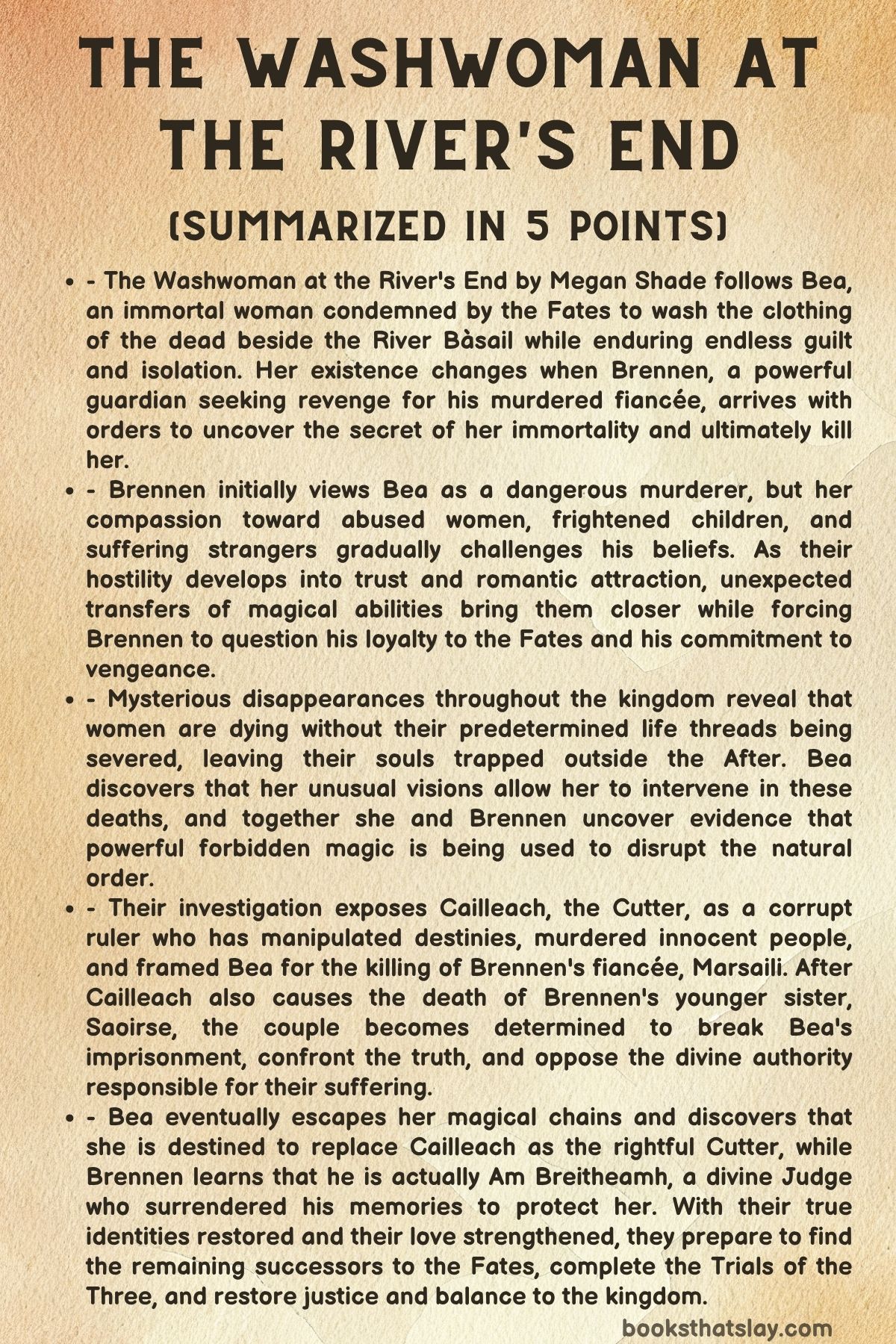
The story follows Bea, an immortal woman condemned to wash the clothing of the dead, and Brennen, a powerful guardian determined to avenge his murdered fiancée. When their lives become connected, they discover dangerous secrets about the Fates who govern their kingdom. As their relationship changes from hatred to love, they must confront the truth about Bea’s punishment, mysterious deaths, and a conspiracy threatening the natural order of life and death. It’s the 1st book of the Curse of the Fates series.
Summary
For more than a century, Bea has lived imprisoned beside the River Bàsail, serving an endless punishment imposed by the three Fates. Known throughout the kingdom as the Washwoman, she must cleanse the clothing of people approaching death and sing their souls toward the After, a supernatural realm beyond the mortal world.
Her curse forces her to witness countless deaths without being able to intervene, while her immortality prevents her from escaping through death. Haunted by memories of murders she believes she committed, Bea spends her days longing for freedom, with only the occasional appearance of a blue-violet dragon she calls Lolly offering comfort.
Her miserable existence begins changing when she experiences an unusual vision of a young woman enjoying an ordinary afternoon rather than approaching death. When the woman’s clothing subsequently appears in the river, Bea suspects someone is dying before their appointed time.
Meanwhile, Brennen, a respected guardian serving the Cutter Cailleach, remains consumed by grief over the murder of his fiancée, Marsaili Lennox, six years earlier. During the festival of Samhain, he makes a binding bargain with the goddess of death, promising to kill Marsaili’s murderer before the next Samhain or surrender his soul for eternity.
Shortly afterward, Cailleach summons Brennen and orders him to investigate Bea, discover how she previously escaped her magical imprisonment, and find a way to kill her. The Cutter also reveals that women have been disappearing throughout the kingdom without their life threads being severed, suggesting that someone is interfering with the established order of destiny.
Brennen accepts the assignment because he believes Bea murdered Marsaili, but Cailleach makes his mission even more dangerous by threatening the lives of his seven younger siblings if he fails. He arrives at the river determined to uncover Bea’s weaknesses and fulfill his oath.
Their first encounters are hostile, with Brennen treating Bea as a dangerous murderer despite her obvious vulnerability. He examines the magical wards surrounding her prison, forces her to demonstrate the limits of her chain, and repeatedly questions her about the deaths in Vengach.
Bea refuses to submit quietly to his authority, answering his suspicion with sarcasm and deliberately irritating him through small acts of defiance. Her playful behavior conceals considerable suffering, including the physical injuries caused by her restraints and the emotional damage of a century spent isolated from ordinary human contact.
Brennen’s certainty begins weakening when he witnesses Bea showing compassion toward people who have harmed her. After a frightened boy named Billy attacks her, Bea helps protect him from drowning, later repairs his damaged shoe, and insists that the child deserves kindness despite his cruelty.
Brennen subsequently discovers that Billy and his mother, Anna, are being abused by Edgar, the boy’s father. He intervenes, helps Anna end the marriage, and arranges shelter for them at a local tavern run by Theo, a compassionate man who challenges Brennen’s assumptions about the Washwoman.
Another important incident involves Kenna, a young woman escaping her violent husband, Hamish. Bea directs Kenna toward safety and accepts a brutal beating rather than reveal her destination, demonstrating a willingness to suffer for someone else’s protection.
As Brennen spends more time beside the river, he notices contradictions between Bea’s reputation and her behavior. His suspicions remain, but her kindness, remorse, loneliness, and extraordinary endurance gradually force him to reconsider whether she deserves the punishment imposed upon her.
Their relationship becomes more complicated when Brennen instinctively catches Bea during a fall, accidentally transferring one of his magical gifts, called a dàn, into her body. The ability grants Bea supernatural steadiness but leaves Brennen without a power he has possessed for years.
A later flood produces an even greater transformation when Brennen risks his life to rescue Bea from drowning. Their physical contact transfers several additional magical abilities to her, including protection against freezing temperatures, leaving him increasingly vulnerable while demonstrating how strongly he has begun caring about her.
As their hostility lessens, Brennen starts treating Bea with greater consideration, bringing her blankets, clothing, medicine, and food. These seemingly ordinary gestures restore some of the dignity she has been denied and establish an emotional connection neither expected.
At the same time, Bea’s supernatural visions continue revealing women who appear to be dying outside their predetermined destinies. She discovers that she can interact with people inside these visions and sometimes bring physical objects back, suggesting that her powers extend beyond those permitted by the Fates.
One vision introduces Betty, a generous woman who offers Bea food and a green dress without knowing her terrible reputation. Betty’s subsequent death deeply affects Bea, strengthening her determination to understand the unexplained disappearances and prevent other innocent people from suffering.
Brennen eventually discovers that the missing women may actually be dead, even though Cailleach has never officially ended their lives. Their souls have apparently been denied entrance into the After, where they gather near the river’s dark boundary and desperately beg Bea for help.
When Brennen reports these discoveries, Cailleach reacts with anger rather than concern and orders him away from Bea. Her response raises his suspicions about the Fates’ intentions, especially after he learns that their power has not always been permanent and that previous rulers were replaced when their appointed service ended.
During his absence, Brennen investigates the kingdom’s oppressive laws and begins questioning the justice of serving Cailleach. His longtime friend Garrick eventually admits that he also doubts the Cutter’s authority, allowing Brennen to recognize that opposition to the Fates may be necessary.
Upon returning to Bea, Brennen joins her efforts to save the threatened women. They discover that cutting a person’s dedication dàn, the magical mark connecting individuals to the Fates, can prevent the mysterious deaths, giving Bea her first genuine opportunity to change someone’s destiny.
Their partnership also develops into a powerful romantic attachment, although Brennen struggles with guilt over Marsaili’s death and his obligation to kill Bea. He eventually confesses his attraction, and the two begin exploring their feelings while carefully avoiding physical contact that might transfer more of his magic.
Their fragile happiness is threatened when Brennen discovers forbidden records suggesting that Bea’s immortality can be broken. During an emotional confrontation, he finally reveals that Marsaili was one of the people Bea supposedly murdered, devastating her with the knowledge that she has fallen in love with the man whose happiness she once destroyed.
Meanwhile, the evidence against Cailleach becomes increasingly disturbing when she publicly executes Harold, a villager who possesses forbidden magical writings. Brennen witnesses the Cutter deliberately severing Harold’s life thread before its appointed ending, revealing that she may be responsible for the unnatural deaths occurring throughout the kingdom.
The danger becomes personal when Cailleach kills Brennen’s youngest sister, Saoirse, as an apparent act of retaliation. Forced to watch Bea wash the little girl’s clothing, Brennen experiences overwhelming grief and finally understands the cruelty of the authority he has spent his life defending.
Bea attempts to comfort him by carving a wooden lamb in memory of Saoirse, whose last possession was a similar gift from her brother. Their shared grief strengthens their determination to escape the Cutter’s control and uncover what truly happened during the murders in Vengach.
Using the magical compulsion attached to Bea’s curse, Brennen forces her to confront her buried memories. She finally remembers that Cailleach herself slaughtered Marsaili’s family and magically controlled Bea’s body, forcing her to hold the weapon used to kill Marsaili.
The revelation establishes that Bea was framed for atrocities she desperately attempted to prevent, while Cailleach deliberately concealed the truth. Brennen realizes that the person responsible for his fiancée’s murder is the very ruler he serves, freeing him from his mistaken belief that loving Bea means betraying Marsaili.
Their reconciliation allows them to imagine a future together. Bea reveals that she has spent years collecting objects for a counterspell capable of breaking her imprisonment, and Brennen helps provide the final pieces, including a carved skylark bearing her name and a broken handfasting cord.
Before they can complete their plans, the Epoch begins, bringing darkness and monstrous creatures into the kingdom. Brennen rushes to defend the villagers before returning to Bea, where they finally perform the counterspell and destroy the magical restraints that have held her for more than a century.
Bea’s freedom immediately leads to another extraordinary development when Lolly carries her into the After and Brennen follows. There, they encounter the goddess of death, Ban-dia a’ Bhàis, who reveals that Brennen is actually Am Breitheamh, the divine Judge who surrendered his identity and memories to enter the mortal world.
His true purpose was to find and protect the woman destined to replace Cailleach as the next Cutter. The goddess also reveals that Theo and Garrick are Brennen’s divine brothers, who accepted mortal roles to assist in restoring the natural order.
Bea learns that her imprisonment, lost memories, and apparent guilt were all part of Cailleach’s attempt to prevent her rightful succession. The counterspell was never intended merely to permit Bea’s death; it was designed to restore her freedom so that she could assume her true responsibilities.
The women whose souls remain trapped may have been potential successors to the other Fates, the Weaver and the Measurer. Their murders are therefore part of Cailleach’s broader effort to preserve her power by preventing the natural succession of divine rulers.
Although Bea initially fears becoming responsible for determining death, the goddess explains that her compassion and respect for life make her especially suited to the role. Accepting that her suffering can become a source of wisdom rather than an eternal punishment, Bea embraces her destiny.
The novel concludes with Bea and Brennen preparing to find the remaining successors, awaken their powers, and complete the Trials of the Three to overthrow Cailleach. An epilogue reveals Theo reaching the mysterious woman near the Faerie Pools, whose frightened reaction and unexplained connection to him establish the beginning of another important struggle.
Characters
Bea (The Washwoman)
Bea is the central protagonist of The Washwoman at the River’s End, an immortal woman whose identity has been reduced to the punishment she has endured for more than a century. Chained beside the River Bàsail, she is forced to witness death repeatedly while performing rituals that guide departed souls toward the After.
Her personality combines humor, compassion, stubbornness, and considerable emotional pain. Despite suffering through prolonged isolation, physical cruelty, and the belief that she committed terrible crimes, she retains the ability to show kindness toward strangers and even those who mistreat her.
Her compassion becomes particularly apparent through her treatment of Billy and Kenna. Rather than retaliating against the boy who attacks her, she recognizes the influence of his upbringing, while her determination to protect Kenna demonstrates a willingness to suffer rather than betray another vulnerable person.
Bea’s greatest internal struggle concerns guilt and whether she deserves forgiveness. She believes her past violence makes her unworthy of happiness, yet her instinct to protect others reveals that her identity cannot be understood entirely through the actions attributed to her.
Her relationship with Brennen helps restore her sense of personhood. Through his growing tenderness, she begins reclaiming ordinary experiences such as warmth, food, laughter, companionship, and romantic affection.
The discovery that Cailleach manipulated her memories and forced her participation in Marsaili’s murder transforms her understanding of the past. She must recognize that her suffering was not necessarily justified and that the crimes defining her reputation were part of a deliberate deception.
Her eventual revelation as the rightful successor to the Cutter completes her development. Instead of seeking death as an escape from punishment, Bea chooses to live with purpose, accepting responsibility for protecting the natural order against those who misuse divine authority.
Brennen
Brennen is the male protagonist of The Washwoman at the River’s End, initially presented as a disciplined guardian whose commitment to justice has become inseparable from revenge. The murder of his fiancée, Marsaili, has dominated his life for six years, leading him to swear an irreversible oath that places his soul and family in danger.
His personality is shaped by duty, honor, protectiveness, and a rigid understanding of right and wrong. As the eldest brother responsible for seven younger siblings, he has learned to place obligations above personal desires, although his determination sometimes becomes a justification for cruelty.
His treatment of Bea initially reveals the limitations of his moral certainty. Convinced that she is a murderer, he subjects her to unnecessary suffering while telling himself that his actions are justified by the seriousness of her crimes.
However, Brennen possesses a strong instinct to defend vulnerable people, which becomes evident when he protects Billy, rescues Anna from abuse, and risks his own life to save Bea from drowning. These actions expose the conflict between his compassionate nature and the anger governing his judgment.
His growing love for Bea forces him to reconsider the meaning of justice, particularly when evidence suggests that her supposed guilt conceals a more complicated truth. The discovery that Cailleach murdered Marsaili ultimately redirects his loyalty away from the institution he serves and toward the principles he originally believed it represented.
Brennen’s final revelation as Am Breitheamh gives his character a larger mythological significance. His willingness to surrender divine identity and live as a mortal demonstrates that his protective instincts existed long before the events of the story, making his relationship with Bea both a personal romance and part of a greater struggle to restore balance.
Cailleach (The Cutter)
Cailleach is the principal antagonist of The Washwoman at the River’s End, embodying the corruption of authority when power becomes more important than the responsibilities attached to it. As the Cutter, one of the three Fates, she controls the ending of life threads and possesses immense influence over the kingdom’s supernatural order.
Initially, she appears to be a formidable but legitimate ruler concerned about threats to destiny. Her willingness to threaten Brennen’s innocent siblings, however, exposes the cruelty underlying her demands for obedience.
Cailleach maintains power through intimidation, secrecy, manipulation, and control over magical knowledge. By restricting access to forbidden records and punishing those who challenge her, she prevents ordinary people from discovering that the Fates are not necessarily permanent rulers.
Her treatment of Bea represents the most extreme expression of her selfishness. Recognizing Bea as her destined successor, she manipulates the young woman’s memories, frames her for murder, and condemns her to prolonged imprisonment rather than surrender her own authority.
The murders of potential divine successors reveal that Cailleach’s crimes extend far beyond personal cruelty. Her actions interfere with the natural succession of the Fates and create disturbances that affect both the living world and the souls awaiting passage into the After.
Unlike Bea, who becomes increasingly conscious of how power affects vulnerable lives, Cailleach treats other people as obstacles to be eliminated. Her character demonstrates how fear of losing control can transform an office meant to preserve order into an instrument of oppression.
Marsaili Lennox
Marsaili is Brennen’s murdered fiancée, whose death initially provides the central motivation for his pursuit of vengeance. Although she is absent from the present-day action, her memory influences many of Brennen’s decisions and his emotional responses toward Bea.
She is remembered as a compassionate woman who cared deeply about others. This quality becomes particularly important when Bea recovers the memory of fleeing to Vengach and receiving food, shelter, and kindness from Marsaili before Cailleach arrived.
Marsaili’s murder becomes a source of unbearable guilt for Bea and unresolved grief for Brennen. Because the true circumstances remain concealed for years, both characters build much of their understanding of themselves around a distorted account of her death.
The revelation that Cailleach controlled the murder transforms Marsaili from a symbol of revenge into evidence of the Cutter’s deliberate cruelty. Her memory ultimately helps Brennen distinguish honoring the dead from perpetuating injustice against the living.
Theo
Theo is one of the most compassionate supporting characters in The Washwoman at the River’s End, initially introduced as the tavern keeper who offers refuge to vulnerable people in Dalbàsail. His willingness to assist Anna, Billy, Kenna, and others establishes him as someone whose morality depends upon practical kindness rather than unquestioning obedience to authority.
Unlike many villagers, Theo refuses to accept the Washwoman’s reputation without considering the woman herself. Having encountered Bea during childhood, he remembers her gentleness and consistently encourages Brennen to judge her according to her actions rather than frightening stories.
Theo also functions as an important moral adviser to Brennen. His observations about punishment, mercy, and human suffering encourage the guardian to reconsider whether revenge can ever fully resolve grief.
As the danger surrounding Cailleach increases, Theo willingly joins the investigation despite the risks to his livelihood and safety. His decision to travel toward the Faerie Pools demonstrates that his courage extends beyond offering sympathy from a secure distance.
The revelation that Theo is actually the divine Guide and Brennen’s brother transforms his apparently ordinary role into part of the larger plan against Cailleach. His discovery of the mysterious woman near the Faerie Pools suggests that his responsibilities will become increasingly important beyond the novel’s conclusion.
Garrick
Garrick is Brennen’s oldest friend and fellow guardian, initially appearing as a loyal servant of Cailleach’s government. In The Washwoman at the River’s End, his character demonstrates how personal loyalty and institutional duty can become increasingly difficult to reconcile when the ruling authorities abandon their moral responsibilities.
His relationship with Brennen is built upon years of friendship, shared training, and mutual trust. Although he initially reacts with disbelief when Brennen expresses sympathy for Bea, Garrick gradually reveals that he has also been questioning Cailleach’s treatment of ordinary people.
His decision to spare a young man suspected of opposing the Fates demonstrates that his conscience has begun taking precedence over unquestioning obedience. He recognizes that disagreement with authority should not automatically justify violence or imprisonment.
The final revelation that Garrick is actually the divine guardian of the gates of the After and the eldest brother of Brennen and Theo expands his significance. His willingness to enter the mortal world and surrender his memories demonstrates a commitment to protecting the natural order, even at considerable personal cost.
Ban-dia a’ Bhàis (The Goddess of Death)
Ban-dia a’ Bhàis is the powerful goddess of death whose influence extends beyond the authority of the three ruling Fates. Her presence initially seems distant and intimidating, particularly when Brennen invokes her legendary dagger to make an irreversible bargain involving his soul.
She represents a deeper supernatural order in which divine power exists to serve a purpose rather than simply guarantee eternal authority. Her explanation of the Fates’ succession reveals that the kingdom’s disasters are consequences of Cailleach’s refusal to accept the limits of her appointed role.
Her relationship with Brennen is especially significant because she knows his true identity as Am Breitheamh. She participated in the agreement through which he entered the mortal world, surrendered his memories, and accepted responsibility for protecting the next Cutter.
When Bea finally reaches the River’s End, the goddess provides the information necessary to understand her imprisonment and destiny. She also reassures Brennen that Saoirse has found peace with her deceased parents, offering comfort without denying the pain of the child’s death.
Ban-dia a’ Bhàis ultimately acts as a guardian of cosmic balance. Rather than simply commanding Bea to accept her destiny, she explains why compassion, understanding, and respect for life are essential qualities in someone entrusted with determining death.
Eiridh (Lolly)
Eiridh is the magnificent blue-violet dragon Bea affectionately names Lolly, initially appearing as a mysterious creature that circles above the river valley. Although the dragon seems unable to see or hear Bea during her imprisonment, her presence provides the isolated woman with companionship and a sense of wonder.
The dragon’s unusual behavior becomes one of the earliest indications that the established magical order is beginning to change. Her decision to land near the valley suggests that she possesses a connection to events beyond Bea’s understanding.
During the Epoch, Eiridh helps defend the valley against supernatural creatures before carrying Bea into the After. Her apparently frightening actions are eventually revealed to be part of a much deeper bond.
When the dragon bows before Bea and communicates with her directly, their true relationship begins to emerge. Eiridh’s recognition confirms Bea’s connection to the supernatural responsibilities she is destined to assume.
The relationship between Bea and Eiridh also symbolizes the transformation of distant hope into genuine freedom. What once seemed an unreachable source of comfort becomes an active partnership in the struggle to restore the natural order.
Mire (The Muse of Love and Madness)
Mire is the enigmatic Muse of Love and Madness, whose appearances introduce warnings and supernatural mysteries into Bea’s imprisonment. She first visits the river and warns Bea that someone she destroyed is coming to find her, anticipating Brennen’s arrival and the emotional consequences of their meeting.
Her identity suggests a close connection between powerful emotions, altered perceptions, and unexpected changes in destiny. Unlike the rigid authority represented by Cailleach, Mire operates through riddles, warnings, and unpredictable interventions.
Her significance becomes clearer when Brennen’s forgotten past is revealed. During the ancient agreement intended to protect the next Cutter, Mire secretly adds an unknown element of magic that complicates the original plan.
Her actions suggest that love and apparent disorder may possess powers capable of changing outcomes that divine authorities believe are predetermined. Nevertheless, her exact intentions remain uncertain, preserving an important mystery for the continuing story.
Saoirse
Saoirse is Brennen’s youngest sister and one of the clearest representations of innocence in the novel. Her affection for her older brother reveals a tender side of his personality that contrasts with the intimidating guardian he presents to strangers.
She particularly treasures the wooden lamb Brennen carves for her birthday. The simple gift illustrates the importance of ordinary family love in a world dominated by supernatural threats and political violence.
Saoirse’s murder becomes one of the story’s most devastating events because she is punished for her brother’s growing resistance to Cailleach. Her death exposes the Cutter’s willingness to destroy innocent lives to preserve her authority.
The presence of Brennen’s carved lamb among her possessions intensifies the tragedy. His later regret over failing to complete the second lamb she requested demonstrates how grief often becomes attached to seemingly minor unfinished promises.
Although Saoirse dies before the conclusion, she continues influencing Brennen’s decisions. The goddess’s confirmation that she has found peace provides some consolation while reinforcing his determination to prevent other families from suffering similar losses.
Harold
Harold is an older resident of Dalbàsail whose attitude toward the Washwoman is shaped by fear, grief, and personal loss. He blames Bea for circumstances surrounding the death of his wife, Isla, even when other villagers question whether such accusations are justified.
His possession of forbidden magical records makes him important to Brennen’s investigation. The documents describe attempts to destroy Bea’s immortality and contain knowledge suggesting that the Fates’ control over magic may not be absolute.
Although Harold’s hatred of Bea limits his judgment, his willingness to preserve prohibited knowledge reveals a degree of resistance to official restrictions. He believes that understanding supernatural power may provide answers unavailable through the kingdom’s sanctioned teachings.
His execution by Cailleach demonstrates the danger of possessing information that threatens the ruling order. The Cutter’s deliberate decision to end his life early transforms his death into a crucial piece of evidence against her.
Harold’s fate is particularly tragic because he is celebrating the prospect of another child joining his family shortly before his death. His execution illustrates how authoritarian violence destroys personal happiness without regard for innocence or ordinary human aspirations.
Kenna
Kenna is a young woman whose desperate attempt to escape domestic abuse introduces one of Bea’s clearest opportunities to demonstrate compassion. Severely injured by her husband, Hamish, she approaches the Washwoman hoping to discover whether safety is possible.
Her vulnerability immediately awakens Bea’s protective instincts. Rather than treating Kenna as another visitor seeking supernatural answers, Bea recognizes the urgency of her circumstances and directs her toward someone who may provide shelter.
Kenna’s situation becomes particularly important because Bea willingly endures violence to prevent Hamish from discovering her destination. The incident reveals that Bea’s commitment to protecting others is stronger than her fear of further suffering.
Her disappearance also connects the personal experiences of vulnerable women to the broader mystery surrounding the kingdom. Although Kenna’s specific circumstances differ from the supernatural deaths, the uncertainty surrounding her safety contributes to Brennen’s investigation.
Kenna ultimately represents the possibility of escaping an abusive system. Her attempt to reclaim control over her life parallels Bea’s struggle to escape the punishment and authority imposed upon her.
Hamish
Hamish is Kenna’s abusive husband, whose cruelty exposes the dangers faced by people without effective protection. He approaches Bea with threats and violence, believing that his marriage entitles him to control his wife’s movements and choices.
His character represents domination on a personal scale. Like Cailleach, he treats another person’s independence as an offense against his authority and responds to resistance through intimidation.
Hamish also attempts to exploit Bea’s magical compulsion, hoping to force her to reveal information that would endanger Kenna. His willingness to attack a defenseless woman demonstrates that he values control more than justice or human dignity.
Brennen eventually confronts Hamish and drives him away, but the danger returns when he approaches Bea again. Their later confrontation emphasizes how the protagonists’ understanding of protection has changed, with both willing to oppose violence rather than remain passive.
Anna
Anna is Billy’s mother, a woman trapped in an abusive marriage to Edgar. Her circumstances initially remain concealed, showing how domestic violence can persist within communities even when neighbors believe they understand one another.
When Brennen discovers her situation, Anna receives an opportunity to escape through a magically recognized dissolution of her marriage. Her relocation to Theo’s tavern represents an important movement toward personal safety and independence.
Anna’s character demonstrates the practical consequences of compassion. Brennen does not merely condemn her husband’s actions but uses his authority to provide meaningful protection and help her establish a safer future.
Her later appearance during the Epoch reinforces her vulnerability within the kingdom’s broader instability. Brennen’s decision to protect her and her child against attacking creatures confirms that his sense of responsibility increasingly extends beyond the orders of the Fates.
Billy
Billy is a young boy whose initial cruelty toward Bea reflects the frightening stories he has absorbed from adults. Believing the Washwoman to be a dangerous monster, he attacks her without understanding either her suffering or the consequences of his actions.
His behavior becomes more understandable when Brennen discovers that Billy has grown up in a household dominated by violence. The boy’s aggression reflects the fear and harmful examples that have shaped his childhood.
Bea refuses to define Billy entirely through the attack. Her decision to protect him from drowning and repair his damaged shoe introduces the possibility that kindness can interrupt the repetition of cruelty.
Billy’s eventual apology reveals that his prejudices are not permanent. His willingness to reconsider his understanding of Bea demonstrates how direct experiences of compassion can challenge inherited beliefs.
Through Billy, the novel examines how children learn prejudice, how violence influences behavior, and why opportunities for change remain important.
Edgar
Edgar is Billy’s violent father and Anna’s abusive husband. His behavior reveals how authority within a household can become destructive when it depends upon fear rather than care.
He terrorizes his family, creating an environment in which Billy learns aggression and Anna struggles to protect herself. His actions demonstrate the damaging effects of domestic abuse on both immediate victims and children who witness it.
Brennen’s intervention brings Edgar’s violence into the open and helps end his control over Anna and Billy. His character provides a smaller but important example of the same abusive relationship between power and vulnerability that shapes the kingdom’s larger political system.
Betty
Betty is a generous woman whom Bea encounters during one of her unusual supernatural visions. Without knowing Bea’s identity or reputation, she welcomes the hungry stranger into her home, gives her bread, and offers her a beautiful green dress.
Her kindness affects Bea because it is offered without suspicion, fear, or expectation of repayment. After more than a century of being treated as a monster, Bea experiences the rare comfort of receiving help simply because she is a person in need.
Betty’s subsequent death makes the supernatural disappearances emotionally personal for Bea. Rather than remaining an abstract mystery, the unnatural deaths now threaten people whose ordinary goodness she has witnessed directly.
Her character reinforces the significance of everyday generosity. Although her appearance is relatively brief, her actions help Bea recover a sense of dignity and strengthen her determination to protect innocent lives.
Lillian
Lillian is Betty’s surviving sister, whose grief gives the consequences of the mysterious disappearances a personal dimension. Through her correspondence with Brennen, the story shows how unexplained loss continues affecting families long after a loved one has vanished.
Brennen’s struggle to write a meaningful letter of condolence reveals his own uncertainty about how to comfort grieving people. Bea’s advice helps him understand that acknowledging suffering can be more valuable than offering explanations that cannot remove it.
Lillian’s information about Betty’s disappearance also assists the investigation. Her character demonstrates that ordinary families, despite possessing little supernatural power, can contribute essential knowledge to the search for truth.
Molly
Molly is Bea’s childhood friend from Dalbàsail and an important figure in her memories of life before imprisonment. Their relationship represents the friendship and ordinary human connection Bea once possessed before her existence became dominated by punishment.
The emotional circumstances involving Molly and Liam contributed to the crisis that preceded Bea’s original defiance of the Fates. Although the available account provides limited details about Molly’s individual decisions, her importance lies in the personal history that Bea struggles to remember and understand.
Molly also represents the possibility of a life Bea might have lived outside the control of supernatural authorities. Remembering her helps Bea reconnect with an identity that existed before the title of Washwoman replaced her name.
Liam
Liam is the young man Bea believed she loved before the events that led to her original punishment. His relationship with her belongs to a time when Bea still imagined that happiness, companionship, and a future of her own were possible.
The devastating betrayal associated with this period of her life contributes to the emotional circumstances behind her defiance of the Fates. Because her memories remain fragmented, Liam’s precise role should be understood through Bea’s painful recollections rather than assumptions about every event.
His presence in her history contrasts with her relationship with Brennen. Whereas her earlier experiences became associated with betrayal and lost hope, her developing romance with Brennen gradually restores her ability to imagine love without surrendering her independence.
Athair
Athair is Cailleach’s formidable dragon and an important manifestation of the Cutter’s supernatural authority. His presence reinforces the overwhelming difference in power between the ruling Fate and the ordinary people she commands.
During the events in Vengach, Cailleach orders Athair to burn Marsaili’s family, making the dragon an instrument of the violence used to frame Bea. This incident demonstrates how supernatural strength can become destructive when directed by a corrupt ruler.
Athair’s role also contrasts with Eiridh’s relationship with Bea. Whereas Eiridh ultimately recognizes and supports the rightful successor, Athair is associated with Cailleach’s ability to intimidate and destroy those who threaten her position.
The Tailor’s Daughter
The tailor’s daughter is one of the women caught in the mysterious sequence of unnatural deaths. Bea encounters her through a supernatural vision and attempts to warn her before the approaching danger can claim her life.
After her death, the young woman’s spirit appears near the boundary of the After, where she retains enough awareness to communicate with Bea. Her altered songs and desperate warnings reveal that the souls trapped outside their rightful destination are gradually losing their minds.
Her accusations force Bea to recognize that saving future victims does not eliminate her responsibility toward those already suffering. Through this character, the novel gives a recognizable voice to the consequences of Cailleach’s interference with death.
The Young Blacksmith
The unnamed young blacksmith becomes central to Bea’s discovery that unnatural deaths can be prevented. When Bea enters her workshop through a supernatural vision, she realizes that the woman’s dedication dàn may be connected to the danger threatening her.
Bea makes the desperate decision to cut through the mark, even though the blacksmith interprets the action as an attack. The young woman’s frightened resistance emphasizes that Bea’s attempts to help can appear threatening when the people involved do not understand her intentions.
The absence of death-clothes afterward suggests that the intervention succeeded. This incident marks an important transformation in Bea’s role, allowing her to prevent a death rather than merely witness and cleanse its consequences.
The Woman at the Faerie Pools
The mysterious young woman living near the Faerie Pools appears repeatedly in Bea’s disturbing dreams before becoming the focus of Theo’s journey. Her damaged dedication dàn and apparent vulnerability suggest that she possesses an unusual connection to the forces threatening the kingdom.
She is eventually discovered in a secluded magical setting, surrounded by beautiful pools and tiny faeries. Her apparent familiarity with the environment suggests that she possesses qualities or abilities not yet fully explained.
When Theo approaches her, she reacts with immediate terror, while he experiences a powerful sense of recognition. Their encounter establishes an unresolved mystery surrounding her identity, possible destiny, and relationship to the divine succession.
Because the story concludes before their relationship is explained, her character represents an important promise of future revelations. She may become crucial to the search for the remaining Fates, but the novel leaves the precise nature of her role uncertain.
Themes
Guilt, Punishment, and Redemption
Guilt shapes Bea’s understanding of herself long before she discovers the truth about her past. In The Washwoman at the River’s End, her imprisonment illustrates how punishment can become psychologically destructive when it separates a person from dignity, personal choice, and the possibility of forgiveness.
For more than a century, Bea believes she deserves suffering because she remembers herself as a murderer. Her inability to recover the complete circumstances of the crimes leaves her trapped between overwhelming remorse and uncertainty about what actually happened.
The novel challenges the assumption that punishment automatically produces justice. Although Bea has endured terrible physical and emotional suffering, her sentence does little to repair the damage caused by the deaths attributed to her.
Her path toward redemption develops through the choices she makes while imprisoned. Protecting Kenna, forgiving Billy, helping vulnerable strangers, and attempting to prevent unnatural deaths demonstrate her moral character more clearly than the accusations defining her reputation.
The revelation that Cailleach controlled the murders transforms the meaning of Bea’s guilt. It becomes clear that her punishment was not an appropriate response to wrongdoing but part of a deliberate effort to suppress the truth and prevent her from fulfilling her destiny.
Nevertheless, Bea’s transformation remains meaningful because her compassion develops before she learns she was framed. Her kindness is not motivated by the certainty of innocence or the expectation of reward.
Ultimately, redemption emerges through her willingness to reclaim her identity and protect others from the injustices she has experienced. Her decision to become the next Cutter establishes that freedom involves not merely escaping suffering but accepting responsibility for what comes afterward.
Love, Trust, and Emotional Transformation
Bea and Brennen’s relationship begins with hatred, fear, and assumptions that appear impossible to overcome. Brennen believes he has encountered the woman responsible for destroying his future, while Bea recognizes him as another representative of the powers that have controlled and punished her.
Their growing attachment depends upon a gradual reconsideration of those assumptions. Brennen must learn to distinguish genuine danger from inherited accusations, while Bea must accept that someone may care for her without intending to exploit or humiliate her.
The development of trust is especially visible through small acts of consideration. Brennen’s gifts of clothing, blankets, food, and medicine become important because Bea has spent so many years without ordinary affection or comfort.
Their physical relationship introduces another complication because direct contact can transfer Brennen’s magical abilities into Bea’s body. The danger forces both characters to consider boundaries, restraint, and the consequences of intimacy rather than treating desire as permission to disregard one another’s safety.
Brennen’s grief over Marsaili further complicates their romance. He initially interprets his attraction to Bea as a betrayal, demonstrating how unresolved loss can prevent someone from accepting the possibility of future happiness.
Bea’s emotional transformation is equally significant. Having internalized the belief that she is monstrous and undeserving of love, she slowly learns to recognize affection as something she can receive without shame.
Their relationship ultimately becomes a source of courage rather than an escape from reality. By confronting painful truths together, they develop a partnership strong enough to challenge the system that originally forced them into opposition.
Love does not erase Marsaili’s death, Saoirse’s murder, or Bea’s suffering. Instead, it gives the characters a reason to seek justice without allowing vengeance and despair to determine the rest of their lives.
Divine Power, Free Will, and the Corruption of Authority
The kingdom’s supernatural government depends upon the belief that the Fates possess unquestionable authority over the lives of ordinary people. In The Washwoman at the River’s End, this belief becomes increasingly difficult to defend as the consequences of Cailleach’s rule are exposed.
The dedication dàn symbolizes the connection between individuals and the magical system governing their existence. Although these marks provide access to supernatural abilities, they also make people dependent upon institutions that restrict how power can be used.
Cailleach’s refusal to surrender her position demonstrates what happens when an individual begins treating authority as personal property. Rather than accepting the succession that should preserve balance, she manipulates destinies, murders possible successors, and suppresses information about the origins of the Fates.
The kingdom’s ordinary inhabitants experience this corruption through fear and material hardship. Villagers face the withdrawal of magical protection, punishment for possessing forbidden knowledge, and accusations of treason whenever they question official authority.
The experiences of Anna, Kenna, and Bea also reveal the relationship between institutional oppression and personal domination. Their struggles demonstrate how systems that normalize obedience can encourage powerful individuals to treat vulnerable people as possessions rather than independent human beings.
Brennen’s changing loyalties provide an important examination of free will. Initially convinced that duty requires obedience, he gradually recognizes that genuine integrity sometimes demands resistance to the very authorities a person has promised to serve.
The revelation that the Fates can be replaced challenges the appearance of permanent divine superiority. It establishes that supernatural power carries responsibilities and limitations that cannot legitimately be abandoned for personal advantage.
Bea’s acceptance of her destiny offers an alternative model of leadership. Her experience of helplessness and suffering may allow her to exercise tremendous power with greater restraint, making compassion essential to the restoration of order.
Death, Grief, and the Responsibility to Protect Life
Death exists throughout the novel as both a supernatural process and an intimate human experience. Bea encounters it through her compulsory duties, while Brennen experiences its emotional consequences through the losses of Marsaili and Saoirse.
The distinction between witnessing death and understanding grief is central to their development. Bea initially appears to possess extraordinary knowledge of mortality, yet her imprisonment prevents her from sharing ordinary relationships with the people whose deaths she observes.
Brennen, meanwhile, understands bereavement but initially allows grief to become a justification for revenge. His fixation on killing Marsaili’s supposed murderer demonstrates how suffering can narrow moral judgment when loss becomes the defining purpose of a person’s life.
Saoirse’s death exposes the limitations of vengeance even more clearly. Brennen cannot restore his sister or undo the cruelty responsible for her death, leaving him to confront the painful reality that protecting the living requires more than punishing the guilty.
The souls trapped outside the After provide another perspective on mortality. Their suffering reveals that death is not merely the ending of physical life but part of a larger process requiring care, dignity, and respect for the departed.
Bea’s concern for these spirits is especially meaningful because she refuses to abandon them after discovering how to prevent future deaths. She recognizes that those already harmed remain deserving of attention even when their suffering cannot easily be repaired.
The revelation of Bea’s destiny as the next Cutter transforms the meaning of her relationship with death. What once existed solely as an instrument of punishment becomes a sacred responsibility requiring judgment, compassion, and an understanding of the consequences of every decision.
Ultimately, the story presents respect for life as inseparable from the responsible acceptance of death. Bea’s willingness to confront both realities prepares her to become a different kind of divine ruler, one whose power is guided by the humanity that Cailleach has abandoned.