The Wretched Divine Summary, Characters and Themes
The Wretched Divine by Adalyn Grace is a dark fantasy romance that explores the boundaries between good and evil, faith and rebellion, and love and betrayal.
Set in a kingdom devastated by centuries of warfare between angels and demons, the novel follows Aurelie Chantelune, a newly appointed knight whose determination to protect her people leads her into a dangerous alliance with two supernatural beings. When her father undergoes a mysterious demonic transformation, Aurelie must question everything she has been taught about divine justice and monstrous evil. Through forbidden soulbonds, political conspiracies, hidden identities, and unexpected relationships, the story examines the consequences of inherited hatred and the difficult choices required to challenge an established order.
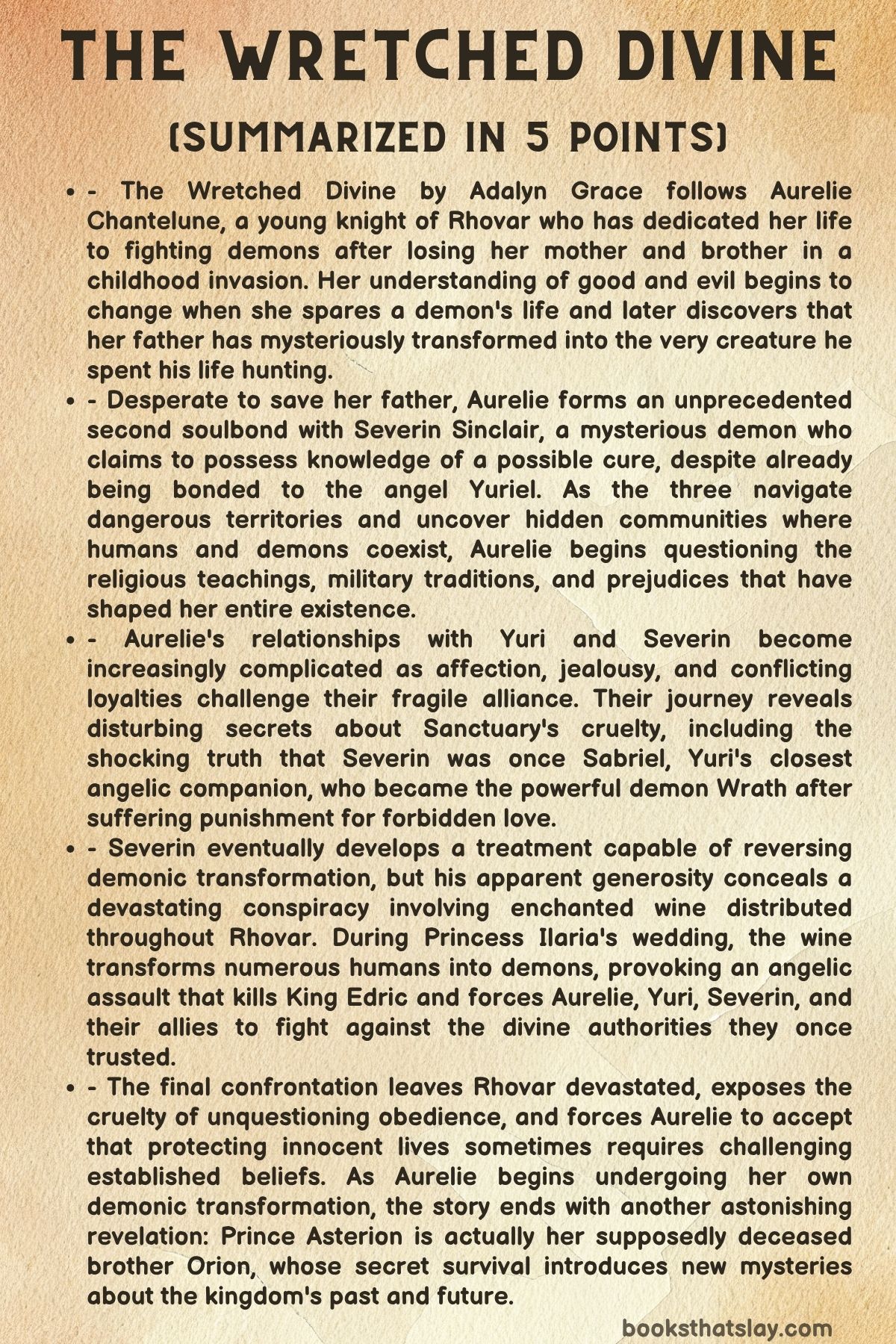
Summary
Aurelie Chantelune grows up in the kingdom of Rhovar, where generations of humans have fought alongside angels against demons. Her childhood is shattered when a devastating invasion brings Gluttony, one of the Original Sins, into the royal castle and results in the apparent deaths of her older brother, Orion, and her mother, Myrah.
Before sacrificing herself to save her daughter, Myrah gives Aurelie a lyre and urges her never to abandon music, reminding her that existence should involve more than warfare. Aurelie survives through a concealed passage, but her escape leaves her burdened by guilt and determined to become a knight capable of protecting others.
More than a decade later, Aurelie achieves that ambition and joins Rhovar’s defenders under the leadership of her father, Captain Varen Chantelune. Although her knighthood represents an important personal victory, she hopes to earn an even greater honor by killing a demon and qualifying for a soulbond with an angel.
Her closest companions include Princess Ilaria Noriclat, whose freedom is restricted by royal expectations, and the Beaumont twins, Nicolas and Solange. Nicolas develops romantic feelings for Aurelie, while Solange resents the privileges associated with the Chantelune family’s military reputation.
Another enormous demon assault interrupts Aurelie’s celebrations, destroying homes, farmland, and much of Rhovar’s remaining security. During the fighting, she encounters an unusually powerful envyborn demon who possesses the abilities granted by a human soulbond.
After overcoming the creature, Aurelie hesitates to kill her when she learns that doing so will also destroy the bonded human. Instead, she severs the demon’s tail and allows her to escape, convincing the kingdom’s soldiers that she has earned her first victory.
The deception qualifies Aurelie for an angelic bond, although the knowledge that she has lied troubles her conscience. Meanwhile, the surviving demon, Lute, returns to Severin Sinclair, a mysterious figure who operates a successful wine business while secretly preparing an elaborate scheme against Rhovar.
Severin recognizes that Aurelie’s unexpected mercy makes her different from the knights who ordinarily destroy demons without hesitation. He becomes interested in using her unusual willingness to question established beliefs for his own purposes.
As Rhovar struggles with military losses and dwindling food supplies, King Edric plans an alliance with neighboring Frienen through the arranged marriage of Ilaria to Prince Asterion. Ilaria opposes the arrangement but finds herself unable to resist the political expectations surrounding her position.
Aurelie eventually undergoes the sacred bonding ceremony with Yuriel, commonly called Yuri, a powerful angelic Soldier who has been reluctantly selected to protect her. Yuri has spent centuries maintaining emotional distance from others, and the intimate connection created by their bond immediately unsettles him.
The ceremony becomes a catastrophe when Varen unexpectedly transforms into a demon. When Nicolas attempts to kill him, Aurelie cuts off the knight’s sword hand, destroying their developing relationship and creating hostility between herself and the Beaumont family.
Varen is imprisoned, while Aurelie desperately searches for a way to reverse his transformation. Her investigations lead her back to Severin, whom she previously encountered in the royal archives disguised as a scholar.
When Severin reveals his demonic identity, Aurelie initially attacks him. However, his claim that demonic transformations may be reversible forces her to consider the possibility that her father’s life can be saved through forbidden knowledge.
Severin proposes forming a second soulbond with her, despite her existing connection to Yuri. Aurelie reluctantly agrees after realizing that established angelic teachings offer no solution to Varen’s condition.
She is taken to Veritas, a hidden settlement where humans and demons coexist peacefully. The ordinary relationships, businesses, and friendships she witnesses there challenge her conviction that demons are inherently incapable of compassion or civilized behavior.
Aurelie’s connection with Severin also gives her access to his magical abilities, particularly the manipulation of sound. Their increasingly personal relationship combines mutual attraction with distrust, since Severin conceals much of his history and the true nature of his long-term plans.
When a demon named Claude attacks Aurelie, she accidentally channels Severin’s magic and kills him, also harming the human bonded to him. The incident reveals the destructive consequences of soulbonds and makes Aurelie reconsider the meaning of the victories she once pursued.
Meanwhile, Yuri searches for his missing partner with assistance from Vex, an unusual white vesper. Upon finding Aurelie and Severin together, he discovers her second bond and reacts with anger, but eventually agrees to examine Severin’s proposed cure.
Early experiments prove unsuccessful, demonstrating that the treatment requires a substance associated with angelic power. The unlikely companions consequently travel into dangerous territory, where their conflicting beliefs repeatedly threaten their fragile cooperation.
Their journey is interrupted when demons serving Kieran attack them and capture Yuri. Aurelie and Severin infiltrate the enemy settlement, discovering the angel brutally tortured inside a ruined church.
Severin unleashes his destructive sound magic against the captors, while Aurelie struggles to free Yuri. When she finally confesses that she never killed the demon whose tail earned her angelic bond, Yuri nevertheless supports her, allowing her to channel his Glory and defeat Kieran.
The rescue strengthens their complicated relationships and reveals that both men are becoming emotionally attached to Aurelie. Their alliance also begins challenging the ancient hostility separating angels from demons.
Guided by Vex, the travelers discover a hidden burial ground containing the remains of fallen angels. Severin obtains the materials necessary for his experiments, while Aurelie notices that the discovery affects him far more personally than he is willing to explain.
His grief hints at a history of loss involving the angels. At the same time, Yuri’s memories gradually reveal his former friendship with Sabriel, an angel who fell in love with a mortal woman and suffered terrible punishment after Yuri reported the forbidden relationship.
Back in Veritas, Severin successfully transforms a hybrid demon into a human, apparently proving that his cure can save Varen. The discovery inspires hope that the longstanding war might finally be resolved without the destruction of either side.
Aurelie celebrates by performing music with Severin, recovering a part of herself that she abandoned after her mother’s death. The shared performance deepens their romantic connection, while Yuri struggles with jealousy and the restrictions imposed by his angelic upbringing.
However, Yuri secretly investigates Severin’s research and discovers that the treatment is not as reliable as it appears. He also learns that Severin’s wine contains a substance capable of weakening angels and reversing the cure’s effects.
Before Yuri can warn Aurelie, Lute captures him. Severin conceals the imprisonment and allows Aurelie to believe a fabricated letter claiming that Yuri has voluntarily returned to Sanctuary.
Aurelie and Severin subsequently travel to Rhovar disguised as a married merchant couple, bringing large quantities of his wine for Ilaria’s wedding. Unknown to Aurelie, the shipment forms part of a scheme to transform the kingdom’s inhabitants into demons.
Meanwhile, Ilaria has secretly maintained her own soulbond and romantic relationship with Lute. Determined to save Varen before the royal authorities experiment on him, she uses her forbidden shadow magic to free him from imprisonment.
Ilaria reluctantly marries Prince Asterion, who surprises her with his apparent kindness and understanding. Nevertheless, the wedding celebration becomes disastrous when Yuri escapes captivity and arrives with Varen to expose Severin’s deception.
Severin demonstrates that his treatment can restore Varen to human form, but the guests have already begun consuming his enchanted wine. King Edric transforms into a demon and is killed by an angel, plunging the celebration into violence and confusion.
An angelic army led by Commander Xadriel arrives and begins attacking the transformed humans. Severin reveals himself as Wrath, one of the Original Sins, and Yuri recognizes him as Sabriel, the friend he believed had died centuries earlier.
The revelation exposes the cruelty behind the angelic laws that condemned Sabriel’s forbidden love. Yuri finally understands that his old companion survived as a demon and that the conflict between divine authority and demonic rebellion is far more complicated than Sanctuary admits.
Yuri rejects Xadriel’s commands and fights alongside Severin, Aurelie, and Azriel. Their resistance temporarily unites former enemies against an army willing to destroy innocent humans simply because they have undergone demonic transformation.
As the battle worsens, Aurelie uses her lyre and Severin’s sound magic to rally Rhovar’s inhabitants. She even urges untransformed citizens to drink the enchanted wine so that they can acquire the power necessary to resist the angels, making a morally devastating choice in her attempt to preserve the kingdom.
Varen and Azriel help force Xadriel’s army to retreat, while Yuri survives and Severin is rescued from serious injuries. Their victory comes at a terrible cost: Edric is dead, Sybil has transformed, much of Rhovar is devastated, and Aurelie herself begins developing demonic features.
The novel concludes with another extraordinary revelation when Ilaria is taken aboard a ship by Prince Asterion. After using illusion magic to prevent her escape, he reveals that his identity has been concealed all along.
The prince is actually Orion Chantelune, Aurelie’s brother and Ilaria’s former intended husband, who was believed to have died during the invasion years earlier. His survival raises new questions about the past and leaves the kingdom’s future, Aurelie’s transformation, and the relationships among the surviving characters unresolved.
Characters
Aurelie Chantelune
Aurelie Chantelune is the central protagonist of The Wretched Divine, a courageous but emotionally wounded young knight whose understanding of righteousness changes dramatically throughout the novel. Her childhood trauma, particularly the loss of her mother and brother during a demon invasion, establishes the foundation of her fierce loyalty to Rhovar and her determination to become a capable warrior.
Initially, Aurelie accepts the kingdom’s teachings that angels represent goodness and demons embody evil. However, her decision to spare Lute demonstrates an instinctive compassion that conflicts with the uncompromising principles of her military upbringing.
Her father’s transformation becomes the event that forces her to reconsider those principles. When Varen becomes the very creature he has spent his life destroying, Aurelie recognizes that judging individuals solely by their supernatural identity can lead to injustice.
Her relationships with Yuri and Severin further complicate her development. Yuri represents the angelic traditions she once trusted completely, while Severin exposes her to forbidden knowledge, unfamiliar desires, and the possibility of peaceful coexistence between enemies.
Aurelie also struggles with the expectations associated with her family’s reputation. Her rediscovery of music, especially through the lyre inherited from Myrah, represents the recovery of an identity that extends beyond military duty and inherited tragedy.
Nevertheless, she is not portrayed as morally flawless. Her final decision to encourage Rhovar’s citizens to undergo demonic transformation illustrates how desperation can lead even compassionate individuals to violate the freedom of those they intend to protect.
By the conclusion, Aurelie has become far more independent and powerful, but her transformation into a demon leaves her confronting the very condition she once considered monstrous. Her journey demonstrates that genuine moral growth does not eliminate difficult choices but requires accepting responsibility for their consequences.
Yuriel (Yuri)
Yuriel is one of the most emotionally conflicted characters in The Wretched Divine, an angel whose outward discipline conceals centuries of shame, grief, and unresolved attachment. Although he possesses extraordinary abilities as a Soldier, he is uncomfortable with intimacy and initially regards his soulbond with Aurelie as an obligation rather than a welcome relationship.
His reluctance is rooted in his traumatic past with Sabriel, his closest friend during his early years in Sanctuary. When Sabriel fell in love with a mortal woman, Yuri reported the forbidden relationship because he believed obedience would protect his friend from greater punishment.
Instead, his actions enabled Xadriel to murder the woman and force Yuri to participate in Sabriel’s mutilation. The experience left him believing that emotional attachment inevitably leads to suffering, making detachment appear essential to his survival.
Aurelie challenges these defenses through their bond, which forces Yuri to experience feelings he has spent centuries attempting to suppress. His growing attraction to her creates a conflict between personal happiness and the divine laws governing his existence.
His relationship with Severin initially reflects everything he has been taught about demons. However, their shared efforts to protect Aurelie gradually reveal their similarities, especially their capacity for sacrifice and their resentment of circumstances beyond their control.
The revelation that Severin is actually Sabriel transforms Yuri’s understanding of both the past and the war itself. His eventual rejection of Xadriel represents his willingness to choose compassion over obedience, making his development one of the novel’s clearest examples of moral awakening.
Severin Sinclair (Sabriel / Wrath)
Severin Sinclair is among the most complicated figures in The Wretched Divine, combining charm, intelligence, romantic intensity, and extraordinary cruelty. Introduced as an accomplished wine merchant and mysterious scholar, he gradually emerges as a powerful demon whose activities are connected to a conspiracy decades in preparation.
His supernatural abilities allow him to manipulate sound, transforming music and ordinary vibrations into instruments of destruction. This power complements his theatrical personality, his talent for deception, and his desire to control circumstances without revealing his true intentions.
Severin’s affection for Aurelie becomes an increasingly important contradiction within his character. He initially views her as a useful participant in his plans, but their growing closeness develops into genuine desire and emotional attachment.
Nevertheless, his willingness to imprison Yuri, deceive Aurelie, and kill Gareth reveals that his love does not automatically make him trustworthy. His determination to achieve his objectives can override his compassion, exposing the moral dangers of allowing personal suffering to justify unlimited retaliation.
The revelation that Severin was formerly Sabriel, Yuri’s angelic companion, fundamentally changes his characterization. His transformation into Wrath represents the lasting consequences of angelic punishment and the rage created by losing someone he loved.
His opposition to Sanctuary is therefore deeply personal rather than simply an expression of demonic aggression. Although his promised cure offers the possibility of liberation, his use of enchanted wine demonstrates how easily a revolutionary cause can become coercive.
Severin ultimately embodies the tension between justice and vengeance. He challenges a cruel authority while repeatedly employing methods that resemble the oppression he condemns, leaving his future moral direction unresolved.
Princess Ilaria Noriclat
Princess Ilaria is a central figure in The Wretched Divine, representing the struggle for independence within a society governed by religion, military necessity, and inherited political obligations. Despite her royal position, she possesses limited authority over the decisions that shape her personal future.
Her friendship with Aurelie provides an important emotional connection to someone who understands the restrictions of noble expectations. Their relationship is also shaped by their shared grief over Orion, whose apparent death destroyed a future Ilaria had once welcomed.
Unlike many members of Rhovar’s ruling class, Ilaria increasingly questions the belief that the Divine must always be obeyed. Her dissatisfaction with the kingdom’s religious leadership grows as she witnesses the destruction caused by the continuing war.
Her secret relationship and soulbond with Lute reveal both her courage and her capacity for deception. Although she supports Aurelie’s willingness to challenge established beliefs, she initially conceals her own forbidden relationship, creating a painful conflict between the friends.
Ilaria’s decision to rescue Varen demonstrates that her rebellious nature is supported by genuine concern for others. She risks her safety and reputation to prevent the authorities from experimenting on a man she knows is still capable of human thought and feeling.
Her arranged marriage to Asterion highlights the political exploitation of royal women, while the final revelation of his true identity creates a deeply personal complication. By the conclusion, Ilaria faces an uncertain future involving her supposedly deceased former fiancé, her relationship with Lute, and the destruction of the kingdom she was expected to serve.
Lute
Lute is an envyborn demon whose survival initiates many of the central events in The Wretched Divine. When Aurelie spares her during their first confrontation, she becomes the living evidence of the knight’s willingness to act against the demands of her upbringing.
Initially, Lute appears hostile, suspicious, and committed to Severin’s secret plans. Her sharp personality and resentment toward humans make her particularly distrustful of Aurelie, whom she considers a possible threat to the hidden community of Veritas.
However, her relationship with Ilaria introduces an entirely different side of her character. As the princess’s secret bonded partner and lover, Lute demonstrates tenderness, loyalty, and emotional vulnerability that contradict the stereotypes surrounding demons.
Her knowledge of shadow magic also becomes important to Ilaria’s development, giving the princess supernatural abilities with which to challenge her father’s authority. Their relationship demonstrates that forbidden bonds can offer genuine affection rather than merely corruption or manipulation.
Despite these sympathetic qualities, Lute remains deeply involved in Severin’s conspiracy. Her imprisonment of Yuri and Vex demonstrates that personal love does not prevent her from participating in morally questionable actions.
Her characterization therefore resists a simple division between sympathetic and villainous figures. She is capable of affection and protection while remaining willing to endanger others for the success of a cause she believes will liberate her people.
Captain Varen Chantelune
Varen Chantelune is Aurelie’s father and one of Rhovar’s most respected military leaders. His identity is built upon discipline, sacrifice, and his lifelong commitment to defending the kingdom against demonic attacks.
Although he is proud of Aurelie’s knighthood, his expectations also contribute to her belief that she must continually prove her worth. Their relationship is affectionate but shaped by the emotional restrictions and demands of military life.
Varen’s sudden transformation into a demon challenges everything he represents. The man who has dedicated his existence to destroying monsters becomes vulnerable to execution by the very society he has protected.
Despite his frightening physical changes, he retains enough awareness to recognize Ilaria and consider the consequences of escaping. His continued concern for others demonstrates that moral identity cannot be reduced to physical appearance.
His eventual restoration through Severin’s treatment establishes the possibility that demonic transformation can be reversed. Later, his decision to defend transformed citizens rather than blindly support the angels marks an important change in his understanding of duty.
Varen ultimately represents the possibility of preserving one’s humanity while confronting experiences that contradict deeply established beliefs.
Azriel
Azriel is the powerful angel bonded to Varen and an important parental figure in Aurelie’s life. His connection to the Chantelune family demonstrates that a soulbond can develop into a relationship characterized by loyalty, affection, and shared responsibility.
Unlike Yuri, who initially fears emotional closeness, Azriel has embraced the family created through his partnership with Varen. He considers Aurelie almost his own daughter and repeatedly shows concern for her safety and happiness.
His considerable healing abilities and battlefield experience make him one of Rhovar’s most valuable defenders. However, Varen’s transformation exposes the vulnerability inherent in soulbonds, since the fate of one partner can threaten the other.
Azriel’s allegiance becomes particularly significant when the angels turn against the transformed people of Rhovar. Rather than surrendering his judgment to Sanctuary, he helps resist Xadriel’s forces.
His actions suggest that loyalty to loved ones and responsibility toward innocent people can become more meaningful than unquestioning loyalty to divine institutions.
Orion Chantelune / Prince Asterion
Orion Chantelune is Aurelie’s older brother, whose apparent death during the childhood invasion shapes much of her emotional development. Remembered as playful, intelligent, and interested in researching demons, he represents the family life Aurelie lost before becoming a knight.
His relationship with Ilaria was rooted in affection and mutual curiosity, making his disappearance equally devastating for the princess. The memories associated with him also preserve an alternative vision of Rhovar’s future, one involving knowledge and understanding rather than constant warfare.
Throughout much of the novel, Orion exists primarily through Aurelie’s grief and the research materials he left behind. His apparent sacrifice contributes to her determination to protect others from the helplessness she experienced as a child.
The epilogue radically changes his position when Prince Asterion reveals that he is actually Orion. His ability to employ illusions, his connection to Vex, and his successful assumption of a foreign prince’s identity suggest that he has acquired extraordinary knowledge and abilities during his years away.
His conduct toward Ilaria is particularly ambiguous because he treats her gently while also preventing her escape and concealing his identity. His return promises answers about the original invasion but raises troubling questions about his intentions and the secrets he has kept from his family.
Myrah Chantelune
Myrah Chantelune is Aurelie and Orion’s mother, whose brief appearance establishes one of the novel’s most enduring emotional influences. Her devotion to music contrasts with the militarized culture surrounding the Chantelune family.
During the invasion, Myrah prioritizes saving Aurelie even though doing so requires leaving herself exposed to Gluttony. Her final gift of the lyre becomes a lasting reminder that survival should involve joy, creativity, and personal fulfillment.
Although Aurelie initially associates the instrument with grief, her eventual return to music represents the recovery of the values her mother tried to preserve. Myrah’s influence therefore extends far beyond her physical presence in the story.
She symbolizes parental sacrifice, the persistence of memory, and the possibility of maintaining a personal identity beyond the demands of conflict.
Commander Xadriel
Xadriel is a high-ranking angelic commander whose authority reflects the oppressive aspects of Sanctuary’s religious and military hierarchy. He presents obedience as an absolute duty and treats violations of divine law as threats that must be punished without mercy.
His cruelty becomes most apparent through the punishment imposed upon Sabriel after the angel falls in love with a mortal woman. Xadriel murders the woman and forces Yuri to mutilate his closest friend, deliberately transforming loyalty and friendship into instruments of psychological suffering.
These actions expose a profound contradiction between the ideals of holiness he claims to defend and the violence he practices. His authority depends less upon moral wisdom than upon preserving a system that refuses to acknowledge its own injustice.
During the final confrontation, Xadriel continues treating transformed humans as enemies deserving destruction. His refusal to consider Severin’s cure demonstrates his unwillingness to accept evidence that challenges his established worldview.
He functions as the primary embodiment of institutional cruelty, showing how supposedly sacred authority can become dangerous when obedience replaces compassion.
Vex
Vex is a white vesper, or Luminel, whose intelligence, curiosity, and unusual behavior distinguish her from the more aggressive red Nyxaris. She first encounters Yuri during his search for Aurelie and agrees to assist him in exchange for one of his feathers.
Her knowledge of concealed routes, supernatural creatures, and forgotten places proves essential to the central characters’ investigation. Without her guidance, they would struggle to locate the hidden angelic burial ground and obtain the materials needed for Severin’s research.
Although she frequently behaves mischievously, Vex demonstrates courage and loyalty during dangerous confrontations. She helps Aurelie rescue Yuri and later assists the imprisoned angel in escaping Severin’s cellar.
The revelation that Vex knows Orion’s concealed identity suggests that her knowledge extends beyond what she has disclosed to her companions. Her connections make her a potentially important figure in the unresolved mysteries surrounding the Chantelune family.
Nicolas Beaumont
Nicolas Beaumont is a young knight whose romantic interest in Aurelie initially suggests the possibility of a conventional future built around marriage, shared military service, and loyalty to Rhovar. His kindness and concern make him an appealing companion during the early events of the novel.
However, his relationship with Aurelie is shaped by the expectations of their families rather than by a complete understanding of her emotional needs. Aurelie’s fear of attachment also prevents their developing romance from becoming secure.
Their connection collapses when Nicolas attempts to kill the transformed Varen during the bonding ceremony. Aurelie reacts instinctively to protect her father, severing Nicolas’s sword hand and permanently changing their relationship.
Nicolas’s injury illustrates the devastating consequences of conflicting loyalties during moments of fear. His character also represents the life Aurelie might have followed had she remained committed to the values she initially accepted.
Solange Beaumont
Solange Beaumont is Nicolas’s twin sister and a capable knight whose loyalty to her family frequently conflicts with Aurelie’s interests. Her resentment of the Chantelune family’s privileged reputation contributes to the tension between them even before the catastrophic bonding ceremony.
When Aurelie injures Nicolas, Solange’s distrust becomes deeply personal. She views Aurelie’s actions through the suffering of her brother and becomes increasingly determined to confront the dangers associated with demonic influence.
Her participation in military expeditions demonstrates her courage and competence. However, her commitment to the kingdom’s established beliefs makes it difficult for her to recognize the moral uncertainties that Aurelie gradually accepts.
The confrontation in the castle passages further develops their antagonism when Aurelie accidentally uses sound magic to prevent Solange from breathing. The incident reveals how far the former companions have moved from their shared military identity.
Solange is not simply an unreasonable enemy, since her anger arises from genuine family loyalty and personal injury. Nevertheless, her rigid perspective makes her an important contrast to Aurelie’s evolving understanding of demons.
King Edric Noriclat
King Edric is Rhovar’s ruler and Ilaria’s father, responsible for maintaining the kingdom’s military strength during an increasingly destructive war. His decisions are driven by the belief that political alliances, religious obedience, and military power are necessary for national survival.
His arrangement of Ilaria’s marriage to Prince Asterion reveals his willingness to subordinate individual happiness to the perceived needs of the state. Although he considers the alliance essential, he rarely gives sufficient weight to his daughter’s feelings or independence.
Edric also supports harsh measures against demons, reinforcing the culture of uncompromising hostility that dominates Rhovar. His authority therefore represents both the responsibility of leadership and the dangers of inflexible political thinking.
His transformation after consuming Severin’s enchanted wine becomes one of the novel’s most significant ironies. The ruler who has defended a system dedicated to destroying demons is suddenly condemned by that same system.
His death at an angel’s hands demonstrates that the Divine’s supposed protection of humanity is conditional. The tragedy also destroys the security upon which Ilaria’s future had been built.
Queen Sybil Noriclat
Queen Sybil is Ilaria’s mother, a royal figure whose behavior reflects the responsibilities and conventions imposed upon women within the ruling family. She approaches her daughter’s arranged marriage as a necessary political duty rather than an opportunity for individual choice.
Although she attempts to comfort Ilaria, her reassurance frequently reinforces the expectations that make the princess feel trapped. Sybil appears to believe that accepting obligations with dignity is an essential part of royal life.
Her role demonstrates how restrictive traditions can be perpetuated even by individuals who care about those affected by them. She is not presented as deliberately cruel, but her understanding of duty prevents her from fully recognizing Ilaria’s frustration.
Her eventual demonic transformation during the wedding catastrophe leaves the royal family’s future uncertain. Her fate also emphasizes that political status provides no protection against the consequences of the supernatural conflict.
Kieran
Kieran is a powerful demon leader whose violent activities threaten both Rhovar and the more peaceful demonic community protected by Severin. His forces carry out attacks that undermine any possibility of cooperation between humans and demons, making him an enemy even to members of his own kind.
His capture of Yuri exposes the extent of his cruelty. Rather than simply imprisoning the angel, Kieran subjects him to deliberate humiliation and torture, treating his suffering as retaliation for the historical violence committed against demons.
Kieran’s actions demonstrate how collective suffering can be transformed into justification for personal brutality. Although his hatred of angels exists within a larger history of oppression, his treatment of Yuri reproduces the cruelty he supposedly opposes.
His eventual defeat by Aurelie represents an important turning point in her ability to use angelic Glory. It also shows that rejecting prejudice against demons does not require denying the existence of dangerous individuals among them.
Lori
Lori is a young angelic Soldier who has trained under Yuri and regards him as an important mentor. His enthusiasm and trust contrast with Yuri’s guarded personality, revealing the latter’s capacity for affection even when he attempts to maintain emotional distance.
Before Yuri departs for Rhovar, Lori gives him a feather that allows them to communicate. This seemingly simple gesture becomes essential when Yuri is imprisoned by Severin and needs to summon assistance.
Lori’s willingness to respond reflects his loyalty and confidence in his teacher. However, his arrival also places him within the increasingly complicated conflict between Sanctuary and the transformed citizens of Rhovar.
When Severin threatens him, Yuri’s immediate concern demonstrates how deeply he values the young Soldier. Lori consequently represents both the innocence still present within angelic society and the danger posed when younger generations inherit the conflicts of their elders.
Commander Edevane Beaumont
Commander Edevane Beaumont is a senior military figure and a member of the Beaumont family, whose responsibilities place him close to Rhovar’s royal leadership. His involvement in military operations reflects the kingdom’s reliance upon experienced commanders during its increasingly desperate struggle against demons.
He participates in expeditions investigating the unusual creatures appearing beyond the kingdom’s borders. These encounters reveal the growing danger posed by hybrid demons and the limitations of the military’s understanding of its enemies.
Edevane also represents the connection between family loyalty and institutional authority. His position gives the Beaumont family’s conflicts with Aurelie broader consequences within the kingdom’s military structure.
Although he does not undergo the same degree of personal transformation as the principal characters, his presence reinforces the political and military environment that makes reconciliation difficult.
Claude
Claude is a greedborn demon living in Veritas whose hostility toward Aurelie reveals that the hidden settlement is not free from prejudice or violence. Despite the peaceful coexistence practiced by many residents, he regards a Chantelune knight as an enemy whose presence cannot be tolerated.
His decision to attack Aurelie demonstrates the destructive consequences of treating individuals as representatives of an opposing group rather than judging their personal actions.
When Aurelie accidentally channels Severin’s magic and kills him, the consequences extend to his human bonded partner. Claude’s death therefore becomes an important lesson about the interconnected nature of supernatural relationships.
His character demonstrates that even an individual portrayed as dangerous can possess relationships whose destruction causes suffering beyond the immediate confrontation.
Gareth
Gareth is a hybrid demon used in Severin’s experiments to develop a treatment capable of reversing demonic transformation. His apparent restoration to human form becomes crucial evidence supporting Severin’s claim that his research can change the future of both species.
However, Gareth’s continued imprisonment suggests that the successful demonstration conceals serious complications. His hostility toward angels also raises questions about whether physical transformation necessarily produces changes in personality or allegiance.
When Yuri gives him enchanted wine, Gareth begins reverting to his demonic form. The incident reveals that Severin’s cure is vulnerable to interference and that its effectiveness has been misrepresented.
Severin’s subsequent decision to kill Gareth exposes his willingness to sacrifice individuals who threaten his plans. Gareth consequently represents the ethical dangers of experimentation conducted without meaningful concern for the lives of its subjects.
Melisandre
Melisandre is a flirtatious performer associated with Severin’s tavern in Veritas. Her familiarity with Severin reveals aspects of his social life that Aurelie initially knows little about, particularly his popularity and relationships within the hidden demonic community.
Her possessive behavior toward Severin creates jealousy and discomfort for Aurelie, who is still struggling to understand the emotional consequences of their newly established soulbond.
Melisandre also contributes to the danger surrounding Aurelie’s presence in Veritas. Her curiosity and tendency toward gossip threaten to expose the identity of a human knight whose discovery could provoke serious hostility.
Although she remains a supporting figure, her involvement emphasizes the ordinary rivalries, attractions, and social complications that exist within demon society.
King Thalorian
King Thalorian is the ruler of Frienen, the neighboring kingdom whose political alliance becomes essential to Rhovar’s attempts to survive. His realm suffers from disease, creating an incentive to seek assistance from a kingdom associated with powerful angels.
His interest in divine intervention is especially significant because Frienen traditionally follows star-centered religious practices. This suggests that political survival can encourage rulers to reconsider or compromise established beliefs.
The marriage alliance involving Prince Asterion and Princess Ilaria connects Thalorian’s kingdom to Rhovar’s increasingly unstable situation. However, the prince’s concealed identity introduces uncertainty about the full circumstances surrounding the arrangement.
Thalorian’s role primarily illustrates the broader political consequences of the supernatural conflict, which extends beyond the immediate battlefield.
Caiel
Caiel is an angel who expresses interest in the assignment to become Aurelie’s bonded partner. His presence during the selection process demonstrates that the opportunity is considered important within Sanctuary.
Although Caiel does not become central to the subsequent events, his willingness to accept the assignment contrasts with Yuri’s strong reluctance. This difference helps establish that angels do not all approach their responsibilities or relationships in the same manner.
His limited involvement also reinforces the authority possessed by senior commanders, whose decisions determine which angels receive particular duties regardless of their individual preferences.
Gluttony
Gluttony is one of the Original Sins and the terrifying demon responsible for the catastrophe that defines Aurelie’s childhood. Its attack on the Chantelune family creates the emotional foundation for Aurelie’s hatred of demons and her eventual decision to become a knight.
The creature’s overwhelming power demonstrates the enormous difference between ordinary human defenders and the most dangerous supernatural beings.
Gluttony’s apparent killing of Myrah and Orion transforms a moment of domestic happiness into lifelong trauma for Aurelie. However, the later revelation that Orion survived complicates the family’s understanding of what happened during the invasion.
Gluttony primarily represents the destructive forces that initiate the central conflict, while also embodying the violent experiences that make Aurelie’s early prejudices understandable.
Themes
The Inheritance of Hatred and the Complexity of Good and Evil
Centuries of warfare have shaped the beliefs of humans, angels, and demons so completely that hostility has become an inherited responsibility rather than a conclusion based on individual experience. In The Wretched Divine, Aurelie initially accepts this understanding of the world because her family’s suffering appears to confirm everything she has been taught about demonic cruelty.
Her decision to spare Lute becomes the first significant challenge to this worldview. By recognizing that killing one demon could also destroy an innocent human, she discovers that moral responsibility cannot always be satisfied through obedience to military expectations.
The community of Veritas expands this realization by demonstrating that demons can form loving relationships, work peacefully, and create meaningful social bonds. Their ordinary existence contradicts the claim that demonic identity automatically determines moral character.
However, the novel does not simply reverse the conventional distinction between good and evil. Claude and Kieran remain dangerous despite their shared identity with sympathetic demons, while Yuri and Azriel demonstrate that angels are capable of genuine compassion even when their leaders act cruelly.
Severin makes the issue particularly difficult because his justified anger toward Sanctuary exists alongside his willingness to deceive and endanger innocent people. His suffering explains his desire for retaliation without making every action he takes morally acceptable.
Through these conflicting examples, the story argues that goodness and cruelty emerge from choices rather than fixed categories of existence. Overcoming inherited hatred requires individuals to examine the consequences of their own behavior instead of relying upon the identities and histories of those around them.
Religious Authority, Obedience, and Moral Responsibility
Sanctuary’s authority rests upon the conviction that divine commands represent absolute moral truth. Angels are expected to obey their superiors without questioning the justice of their decisions, while humans are taught to regard angelic intervention as evidence of righteousness.
Yuri’s experiences reveal the devastating consequences of this system. His decision to report Sabriel’s forbidden relationship originates from a sincere belief that obedience will prevent greater harm, yet it enables Xadriel to commit an atrocity.
The punishment exposes how religious authority can become an instrument of cruelty when its legitimacy is treated as unquestionable. Xadriel’s actions are particularly disturbing because he presents violence against vulnerable individuals as necessary enforcement of divine law.
Ilaria challenges similar assumptions within Rhovar. Her objections to religious teachings arise from witnessing suffering that the kingdom’s spiritual leaders repeatedly justify without offering meaningful solutions.
Aurelie also experiences a transformation in her understanding of faith. Her connection to Yuri initially reinforces her confidence in divine protection, but the discovery of Sanctuary’s hidden history makes unquestioning belief increasingly impossible.
The final battle brings these tensions into direct conflict when angelic forces attempt to destroy humans who have undergone demonic transformation. Their willingness to kill the people they supposedly protect demonstrates the danger of placing institutional purity above individual lives.
By choosing to resist Xadriel, Yuri and Azriel establish that moral responsibility sometimes requires disobedience. The novel ultimately distinguishes genuine ethical judgment from loyalty to authority, suggesting that faith loses its moral purpose when it becomes an excuse to ignore suffering.
Love, Soulbonds, and the Struggle for Personal Freedom
Soulbonds create relationships of extraordinary intimacy by connecting the emotions, physical experiences, and sometimes the survival of two individuals. In The Wretched Divine, these connections repeatedly challenge the belief that love and loyalty can be controlled through laws, traditions, or political expectations.
Aurelie’s relationships with Yuri and Severin expose different aspects of emotional vulnerability. Yuri fears attachment because his earlier experiences taught him that love invites punishment, while Severin struggles to reconcile genuine affection with his determination to pursue revenge.
Their competing desires place Aurelie in a difficult position, but her development involves recognizing that she possesses the right to determine her own relationships. Her growing independence challenges the expectation that romantic attachment must conform to the rules established by her family or supernatural authorities.
Ilaria experiences a similar conflict through her secret relationship with Lute and her arranged marriage to Asterion. Although she possesses royal status, her future is treated as a political resource that can be exchanged for military assistance.
Her bond with Lute offers affection and personal choice, but secrecy prevents the relationship from existing openly. The eventual revelation of Asterion’s identity further complicates her ability to determine whom she can trust.
The novel also examines the darker possibilities of intimate connections. Soulbonds can transmit suffering, expose private experiences, and make individuals vulnerable to manipulation, demonstrating that emotional closeness does not automatically guarantee freedom.
Through these relationships, love emerges as both a source of strength and a serious responsibility. Meaningful intimacy requires honesty, consent, and respect for individual agency rather than possessiveness or compulsory loyalty.
Transformation, Identity, and the Reclamation of the Self
Physical transformation repeatedly challenges the characters’ understanding of what makes an individual human, divine, or monstrous. Varen’s sudden change into a demon provides one of the clearest examples because his appearance becomes frightening while his memories, loyalties, and concern for others remain recognizable.
His condition forces Aurelie to confront the possibility that the qualities defining a person’s identity exist independently of physical form. The kingdom’s willingness to execute him reveals how easily fear can replace recognition of an individual’s continued humanity.
Severin’s identity as Sabriel develops this theme through a different form of transformation. His emergence as Wrath demonstrates the lasting consequences of cruelty, grief, and rejection, but his surviving connection to Yuri suggests that his earlier self has not disappeared completely.
Aurelie’s own transformation at the conclusion creates an especially powerful reversal. After dedicating her life to killing demons, she begins acquiring the features associated with the creatures she has been trained to fear.
However, transformation is not exclusively physical. Aurelie undergoes an equally significant emotional change as she begins questioning inherited beliefs and acknowledging desires that military life encouraged her to suppress.
Music becomes the strongest expression of this internal development. Myrah’s lyre initially represents childhood loss, but Aurelie’s eventual return to performing allows her to reconnect with the creativity and happiness she believed had vanished with her mother.
Her musical abilities also become essential during the final battle, demonstrating that the interests she once considered separate from her responsibilities can become sources of extraordinary strength.
The story consequently presents identity as something continually shaped by memory, relationships, experiences, and personal choices. Rather than remaining defined by inherited roles or external appearances, the characters must decide which parts of themselves deserve preservation and which beliefs they must abandon to grow.