Like in Love with You Summary, Characters and Themes
Like in Love with You by Emma R. Alban is a historical romance set within the highly controlled social world of Regency-era Bath, where reputation, marriage, family expectations, and class determine much of a young woman’s future.
At its center are Lady Rosalie Tisend and Catherine Pine, two intelligent women who first approach each other as social rivals before recognizing that their fascination has little to do with competition. Their developing romance is surrounded by unwanted suitors, an old family scandal, matchmaking schemes, loyal friendships, and mothers who must confront the consequences of choices made decades earlier. The novel ultimately focuses on love as an act of personal choice.
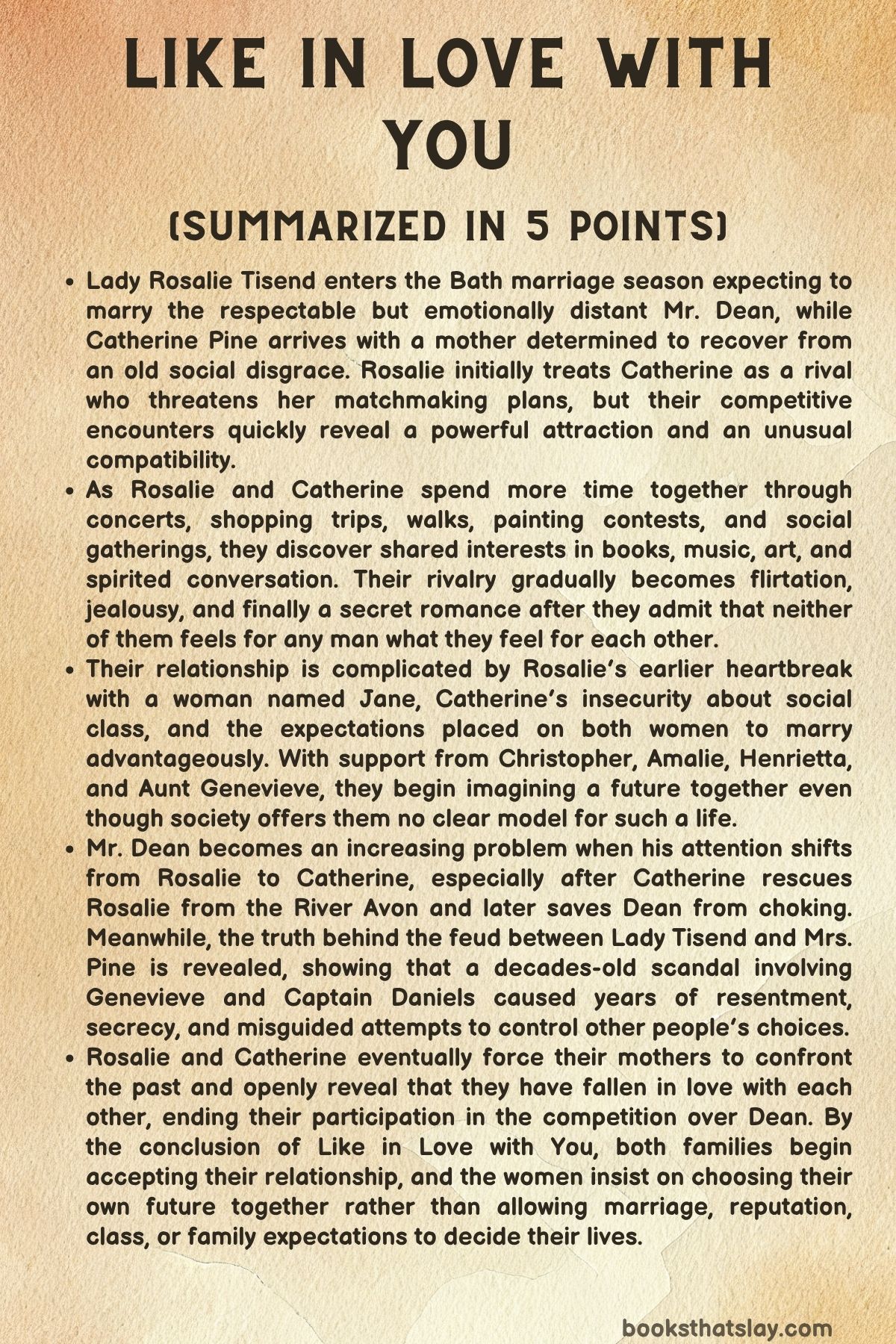
Summary
Lady Rosalie Tisend has spent a year courting Mr. Dean, one of Bath society’s most desirable bachelors, yet she feels remarkably little excitement about the prospect of marrying him. Far more interesting to Rosalie is the task of arranging suitable matches for her friends Henrietta Raught and Amalie Linet, an activity in which her social influence and sharp understanding of people give her considerable power.
Rosalie’s carefully ordered season changes when Mrs. Pine arrives in Bath with her daughter Catherine. Catherine immediately attracts attention from the same gentlemen Rosalie hopes to steer toward her friends, prompting Rosalie to interfere with Catherine’s introductions and quietly redirect potential suitors elsewhere.
Catherine quickly realizes someone is sabotaging her opportunities and identifies Rosalie as the culprit. Instead of simply resenting her, however, Catherine finds herself fascinated by Rosalie’s confidence, beauty, and commanding presence.
Their rivalry becomes more complicated because their mothers share a painful history. Eleanor Pine explains that Lady Tisend destroyed her social reputation twenty-five years earlier by spreading a damaging rumor, and Eleanor therefore encourages Catherine to steal Mr. Dean from Rosalie as a form of revenge.
Catherine reluctantly entertains the possibility, but Dean immediately disappoints her. Although handsome and socially valuable, he shows little curiosity about her thoughts, interests, or personality.
Rosalie attempts to redirect Catherine toward Mr. Sholle, a respectable young man who appears suitable on paper. Yet the more Rosalie tries to manage Catherine’s romantic future, the more time the two women spend together.
They discover a shared love of Gothic novels, music, art, humor, and spirited conversation. Rosalie finds Catherine intellectually engaging in ways Dean has never been, while Catherine begins seeing the lively, clever woman concealed beneath Rosalie’s polished social manner.
A private concert brings their families and friends together and intensifies both the old maternal rivalry and the younger women’s attraction. Eleanor successfully performs before the society that once rejected her, giving Catherine hope that her mother might finally regain the confidence and position she lost decades earlier.
At the same event, Catherine’s own musical performance impresses the audience and deeply affects Rosalie. Rosalie answers with an accomplished performance of her own, but their supposed competition increasingly feels like an excuse to remain focused on each other.
Their growing intimacy continues during shopping expeditions, garden gatherings, painting competitions, walks, and social outings. Rosalie enthusiastically chooses clothes for Catherine, pays close attention to her appearance, and begins imagining physical closeness that she can no longer explain as simple rivalry.
Catherine experiences the same realization. After remembering an earlier youthful kiss with another girl, she recognizes that her feelings for Rosalie are not curiosity or adolescent experimentation but genuine adult desire.
A portrait-painting contest exposes the situation almost comically. Both women are meant to concentrate on the gentlemen they are painting, yet each repeatedly looks toward the other, and Aunt Genevieve eventually produces an image showing Catherine and Rosalie staring at one another around Mr. Dean.
Rosalie’s growing jealousy becomes increasingly difficult to ignore. She dislikes seeing Catherine with Mr. Sholle and even briefly worries that her brother Christopher might become interested in Catherine, though Christopher is actually becoming attracted to Amalie.
At a performance of Romeo and Juliet, Catherine spends more time watching Rosalie than the stage. During the interval they meet privately in a cloakroom, joke about their unwanted suitors, and almost kiss before being interrupted.
The moment forces both women to acknowledge what has been developing between them. Christopher soon confronts Rosalie, revealing that he has noticed her feelings and understands that her obsession with Catherine has never truly been about protecting her courtship with Dean.
Rosalie then reveals why she has been so afraid. Years earlier she loved a young woman named Jane, only for Jane to become engaged and dismiss their relationship as a temporary youthful experience.
The rejection convinced Rosalie that loving women could only end in pain. She therefore chose the emotionally safe path of marrying a respectable man, even if that meant sacrificing the possibility of passionate love.
Christopher challenges this belief and offers complete support. He even agrees to pretend to court Catherine so that Rosalie can accompany them and obtain opportunities to spend time with her privately.
Rosalie also learns uncomfortable truths about herself while questioning her mother about Eleanor Pine. Lady Tisend initially explains that she ruined Eleanor’s reputation because she believed manipulating Eleanor toward Mr. Pine would ultimately protect her, forcing Rosalie to recognize that she has been behaving similarly whenever she decides what Catherine ought to want.
Rosalie resolves to stop controlling Catherine’s future. Soon afterward, during a private meeting at the Tisend home, Catherine and Rosalie finally kiss and admit that their attraction is mutual.
They begin using their first names with greater intimacy and agree to continue seeing each other secretly. Their happiness is complicated by the knowledge that neither woman knows how two women might openly build a permanent life together within their society.
Christopher becomes their enthusiastic ally and helps create opportunities for them to meet. An overnight visit to Blaise Castle House gives Catherine and Rosalie enough privacy to speak more seriously about their future.
The grandeur of the estate initially leaves Catherine feeling socially inferior to Rosalie. Catherine fears that her country upbringing and lesser social status make her inadequate for the privileged world Rosalie occupies.
Rosalie rejects the idea completely, insisting that Catherine lacks certain opportunities rather than intelligence, sophistication, or worth. Their conversation becomes an important turning point because they discuss not only their attraction but the practical uncertainty surrounding a shared future.
Rosalie admits that she has never wanted a man as she wants Catherine. Rather than forcing themselves to make immediate lifelong promises, they decide to continue discovering what kind of life they want together.
Their relationship becomes physically intimate, but the emotional commitment matters equally. Both women begin imagining not merely secret meetings but an actual future in which they can choose one another.
Back in Bath, the problem of Mr. Dean grows increasingly urgent. Catherine and Rosalie devise a plan to make themselves so unappealing that Dean will lose interest in both of them.
The strategy goes disastrously wrong. Rosalie deliberately behaves recklessly during a boating excursion and falls into the River Avon, while Dean remains safely on the boat and Catherine immediately jumps into the water to help her.
The incident demonstrates the enormous difference between them. Dean responds to Rosalie with irritation, while Catherine risks herself without hesitation because Rosalie’s safety matters more to her than appearances.
Unfortunately, Catherine’s bravery only increases Dean’s admiration for her. Later, when he criticizes Rosalie, Catherine defends her so forcefully that he becomes even more impressed.
A second accident makes matters worse when Dean begins choking during a social gathering. Catherine instinctively saves him, and the event is reported publicly, transforming her into a celebrated heroine and strengthening rumors that Dean intends to propose.
Catherine becomes increasingly frustrated because everyone around her discusses her marriage as though she has no authority over the decision. Mr. Sholle withdraws from pursuing her, society treats her connection with Dean as inevitable, and Eleanor becomes thrilled by the possibility of her daughter marrying into the family that once looked down upon her.
Meanwhile, the truth behind Eleanor and Lady Tisend’s feud finally emerges. Aunt Genevieve reveals that Captain Daniels seduced her when she was only fifteen, creating a scandal that Rosalie’s family concealed to protect her reputation.
Lady Tisend had feared Daniels would similarly harm Eleanor. Unable to reveal Genevieve’s secret, she spread a rumor about Eleanor in an attempt to drive Daniels away and encourage Mr. Pine to marry her instead.
The revelation changes Rosalie’s understanding of her mother. Lady Tisend caused real harm by taking away Eleanor’s choices, but her actions came partly from fear, secrecy, and a desperate attempt to protect two women she loved.
Rosalie’s friends increasingly become central to protecting her relationship with Catherine. Amalie discovers the truth and immediately accepts them, while Henrietta, Christopher, and others join the effort to help the women communicate and meet privately.
Rosalie also begins reconsidering her identity as a matchmaker. Seeing Henrietta and Mr. Rile genuinely choose one another teaches her that introducing people cannot create love by itself, because lasting affection depends upon mutual desire and continued choice.
Catherine’s situation becomes more urgent when Eleanor prepares an elaborate tea and expects Dean to propose. Matters worsen when Lord Dean publicly repeats the decades-old rumor about Eleanor, humiliating her before Bath society.
Catherine hopes the insult will finally make Eleanor reject the Dean family, but Eleanor instead becomes even more determined to secure the marriage. She believes Catherine marrying Dean would permanently silence the scandal and prove that society can no longer reject them.
Rosalie, Catherine, Christopher, Amalie, Henrietta, and their allies therefore devise an unusual final plan. Rather than merely stopping Dean, they decide they must end the feud between their mothers so that neither daughter remains trapped inside an old conflict.
During Eleanor’s tea, their friends create distractions while Rosalie and Catherine maneuver Lady Tisend and Mrs. Pine into the same troublesome water closet. Once everyone is trapped together, Rosalie refuses to open the door until the women finally discuss the past honestly.
Aunt Genevieve joins them and explains what Captain Daniels did to her. Lady Tisend apologizes to Eleanor for deciding what was best for her instead of trusting her with the truth, and Eleanor eventually agrees to attempt forgiveness.
The reconciliation gives Catherine and Rosalie enough courage to reveal their own secret. Catherine announces that neither woman wants Dean because they have fallen for each other, while Rosalie makes clear that she does not want to marry any man.
Their mothers initially avoid responding directly, leaving both women frightened about what their confession will cost them. The immediate threat of Dean, however, is solved when Mr. Pine deliberately proposes a business connection to Lord Dean.
Lord Dean reacts with predictable snobbery and publicly rejects any union between the families. Mr. Pine proudly declares that his wife and daughter are worth more than the Dean fortune, finally destroying the possibility of Catherine being forced toward Dean.
At the Tisend home, Rosalie’s family confronts the larger question of her future. Her father assures her that she will never be forced into marriage, while Christopher promises that she and Catherine can eventually live with him if necessary.
Lady Tisend then reveals something Rosalie never expected: she herself once loved a woman, and her husband has always known. She explains that her eventual love for Rosalie’s father did not erase that earlier experience and apologizes for creating a home in which Rosalie believed she could never speak honestly.
Catherine faces a similar conversation with her parents. Her father accepts her without hesitation, while Eleanor struggles because Catherine’s future no longer resembles the life she had imagined for her daughter.
Eleanor ultimately remembers how painfully her own choices were taken away from her. She therefore refuses to repeat the same mistake and promises that, although she needs time to adjust, she will not stand between Catherine and Rosalie.
The two families immediately begin arguing over practical arrangements for the couple, almost repeating the controlling behavior that caused so many problems in the first place. Catherine finally interrupts them and insists that she and Rosalie must be included in every decision concerning their lives.
Rosalie proudly supports her. Alone for a brief moment, the two women openly tell each other that they are in love.
Like in Love with You closes without pretending that Rosalie and Catherine possess a perfect solution to every social obstacle ahead. What they finally have is more valuable than the predetermined futures everyone tried to impose upon them: supportive friends, families willing to change, genuine love, and the right to decide together what their life will become.
Characters
Lady Rosalie Tisend
Rosalie is one of the central figures in Like in Love with You, introduced as a highly capable young woman who appears completely at ease within Bath society. She understands social rules, manages conversations confidently, and uses her influence to promote marriages among her friends, yet this apparent certainty hides how disconnected she is from the future others expect her to accept.
Her courtship with Mr. Dean represents Rosalie’s attempt to choose safety over emotional risk. She does not particularly love him, but after being hurt by Jane, she convinces herself that marrying a respectable man would provide stability without exposing her to the vulnerability she once experienced.
Catherine disrupts this controlled existence because Rosalie cannot manage her feelings with the same precision she applies to society. Her attraction initially appears as irritation, fascination, competitiveness, and jealousy before she accepts that Catherine offers the intellectual, emotional, and physical connection she has been denying herself.
Rosalie’s development also involves recognizing the danger of benevolent control. After realizing that her mother justified manipulating Eleanor by claiming it was for her own protection, Rosalie sees that her own matchmaking instincts can also remove other people’s choices.
By the end of the novel, Rosalie becomes more willing to let others decide for themselves and more willing to accept assistance with her own happiness. Her relationship with Catherine changes her from someone who organizes everyone else’s future into someone prepared to admit that she cannot control love and does not need to.
Catherine Pine
Catherine is the second central character in Like in Love with You, arriving in Bath as an outsider whose presence immediately disturbs Rosalie’s carefully arranged social plans. She is observant enough to notice Rosalie’s interference quickly and confident enough to respond to it rather than allowing herself to be intimidated.
Her early willingness to pursue Mr. Dean has little to do with genuine romantic interest. Catherine is primarily motivated by love for her mother and a desire to restore Eleanor’s lost social standing, demonstrating how deeply family loyalty influences her decisions.
Catherine’s relationship with Rosalie reveals her intellectual confidence as well as her emotional uncertainty. She enjoys books, music, art, and argument, and she quickly recognizes that conversations with Rosalie contain a depth that her interactions with male suitors lack.
She also struggles with class insecurity. At Blaise Castle, wealth and aristocratic culture make her question whether she could ever belong beside Rosalie, but Rosalie’s refusal to treat her as inferior helps Catherine separate social privilege from personal worth.
Catherine becomes increasingly assertive as the story progresses. She refuses Mr. Dean internally long before she can safely do so publicly, defends Rosalie when Dean insults her, and eventually challenges both families when they begin planning her future without consultation.
Her final strength lies in claiming authority over her own life. Catherine understands that loving Rosalie may require sacrifices, but she decides that a difficult future chosen freely is preferable to a comfortable future chosen by others.
Mrs. Eleanor Pine
Eleanor Pine carries one of the oldest emotional wounds in Like in Love with You. Once driven from respectable society by a rumor spread by Lady Tisend, she returns to Bath still shaped by the humiliation, anger, and insecurity created by that experience.
Her desire for Catherine to win Mr. Dean initially appears vindictive, but it is also connected to a desperate wish for social restoration. Catherine marrying one of Bath’s most desirable men would allow Eleanor to prove that the society which rejected her can no longer define her worth.
This motivation causes Eleanor to overlook Catherine’s actual feelings. She increasingly treats the possible marriage as a solution to her own history, unintentionally transferring the burden of an old conflict onto her daughter.
Lord Dean’s public repetition of the old scandal shows how fragile Eleanor’s regained confidence remains. Rather than immediately rejecting the Dean family, she initially concludes that Catherine must marry Dean precisely because such a union would defeat the stigma once and for all.
Her reconciliation with Lady Tisend forces her to confront how much of her adult life has been governed by a choice someone else made for her. This recognition becomes essential when Catherine reveals her relationship with Rosalie.
Eleanor does not instantly understand or celebrate the future Catherine wants, which makes her eventual decision more meaningful. Remembering the damage caused when others controlled her life, she accepts that loving her daughter requires allowing Catherine to make choices Eleanor would not have made for her.
Lady Tisend
Lady Tisend occupies a morally complicated position in Like in Love with You because she is simultaneously responsible for Eleanor’s suffering and motivated by genuine fear for people she loved. Her decision to spread the rumor remains harmful regardless of intention, but the later explanation reveals the restrictive environment in which that decision was made.
She believed Captain Daniels posed a danger to Eleanor after witnessing the consequences of his relationship with Genevieve. Unable to reveal Genevieve’s secret without risking her reputation, Lady Tisend chose manipulation instead of trust.
This same habit appears in her relationship with Rosalie. She sincerely wants security for her daughter but assumes that she understands what form that security must take, repeatedly treating marriage as the safest answer.
The revelation that Lady Tisend once loved a woman significantly deepens her character. It shows that her failure to understand Rosalie did not come from simple prejudice but from silence, generational fear, and an inability to communicate parts of herself that might have brought them closer.
Her eventual response becomes practical rather than condemnatory. Once forced to confront Rosalie’s wishes directly, she begins searching for ways to protect the relationship instead of trying to erase it.
Christopher Tisend
Christopher is Rosalie’s brother and one of the story’s most dependable sources of support. He notices Rosalie’s attraction to Catherine before Rosalie is ready to speak openly and approaches her with understanding rather than judgment.
His greatest importance lies in making acceptance feel ordinary. Christopher does not treat Rosalie’s feelings as a scandal requiring explanation; instead, he focuses on whether Catherine makes his sister happy and how he can help them create opportunities to be together.
He also becomes involved romantically with Amalie. Their mutual attraction allows Rosalie to observe what reciprocal affection looks like, indirectly helping her understand why her relationship with Dean has always felt so empty.
Christopher’s promise that Catherine and Rosalie can eventually live with him demonstrates that his support extends beyond temporary encouragement. He is prepared to reorganize his own future so his sister does not have to sacrifice hers.
Amalie Linet
Amalie begins as one of Rosalie’s closest friends and one of the women Rosalie is determined to match successfully. Her growing connection with Christopher gradually gives her a romantic storyline of her own.
Her importance becomes greater when Catherine confides in her. Amalie has already recognized Catherine and Rosalie’s feelings, and her calm acceptance provides Catherine with one of her first experiences of openly discussing the relationship with a trusted friend.
Amalie also becomes a practical ally by carrying letters, arranging meetings, and helping disrupt Dean’s proposal. Her willingness to spill wine on Catherine’s expensive dress during the tea shows both quick thinking and complete commitment to helping her friends.
Through Amalie, the novel shows how friendship can create private spaces of freedom within a restrictive society. She does not need to fully understand every difficulty Catherine and Rosalie face in order to believe that they deserve to choose each other.
Henrietta Raught
Henrietta is another of Rosalie’s closest friends and initially one of the principal beneficiaries of her matchmaking. Rosalie carefully encourages Mr. Rile’s interest in Henrietta, believing they could be well suited.
The relationship ultimately succeeds, but Henrietta’s engagement teaches Rosalie an important lesson. Rosalie may have helped create opportunities, yet Henrietta and Rile build their relationship because they genuinely continue choosing each other.
Henrietta also participates in the later schemes designed to help Catherine and Rosalie. Her suggestion that their mothers simply be trapped together until they talk is absurd but effective, reflecting both her loyalty and her increasingly active role in the friendship group.
Mr. Dean
Mr. Dean functions less as a traditional romantic rival than as a representation of the future Rosalie and Catherine are expected to want. He possesses wealth, status, and physical attractiveness, yet he repeatedly demonstrates how little those qualities matter without emotional compatibility.
His interactions with Rosalie are marked by indifference. After a year of courtship, he still shows little interest in the subjects that matter to her, and his response when she falls into the river reveals irritation rather than concern.
His behavior toward Catherine initially appears more attentive, particularly after she rescues him, but much of his attraction seems connected to admiration, social perception, and circumstance rather than deep understanding. He also changes his tone quickly when Catherine disagrees with him, suggesting that his convictions are shaped by the approval he wants from her.
Dean therefore becomes a useful contrast to Catherine and Rosalie’s relationship. Their attraction develops through curiosity, shared interests, humor, vulnerability, and sacrifice, while his courtship remains centered on convention and suitability.
Aunt Genevieve
Genevieve is initially presented as an eccentric and perceptive older relative who notices more than the younger characters realize. Her portrait of Catherine and Rosalie looking toward each other reveals that she understands their attraction long before either woman openly acknowledges it.
Her personal history later becomes central to explaining the feud between Lady Tisend and Eleanor. As a fifteen-year-old, Genevieve was exploited by Captain Daniels, and the family’s attempt to protect her reputation produced decades of secrecy and unintended harm.
Genevieve refuses to let the past remain hidden once she understands its consequences. She intervenes during the confrontation between the mothers and later forces Lady Tisend to confront Rosalie’s confession rather than retreat into silence.
She represents an older generation capable of rejecting secrecy even after being harmed by it. Her support gives Rosalie an important model of survival and acceptance.
Mr. Pine
Catherine’s father is characterized by affection, humor, and a strong instinct to protect his family. Catherine worries about his health, and their relationship consistently provides her with emotional security.
His strongest moment occurs when he deliberately provokes Lord Dean into rejecting the proposed match. Rather than treating the rejection as humiliation, Mr. Pine declares that his wife and daughter are worth more than the Dean fortune.
His later acceptance of Catherine reinforces his role as a loving parent who values his daughter more than social convention. He does not require Catherine’s future to resemble his expectations before supporting her happiness.
Rosalie’s Father
Rosalie’s father plays a quieter role but becomes important during the family confrontation about her future. He knows about Lady Tisend’s past relationship with a woman, which shows that their marriage has long contained more understanding than Rosalie realized.
When Rosalie finally speaks about Catherine, he assures her that she will not be forced to marry. His response is significant because marriage would traditionally have been one of the primary tools through which her family could control her future.
He also praises Christopher for supporting Rosalie. His willingness to protect both children’s autonomy helps transform the Tisend household from a source of pressure into part of the couple’s support system.
Mr. Sholle
Mr. Sholle is originally chosen by Rosalie as a suitable alternative for Catherine. He possesses respectable social standing and appears interested in her, making him useful to Rosalie’s early plan to remove Catherine from competition over Dean.
His interactions with Catherine reveal the limitations of compatibility based purely on social qualifications. Rosalie herself admits that she would not want Sholle because he does not share enough of her interests, exposing the contradiction in recommending him so confidently to someone else.
Eventually, Sholle withdraws when he believes Catherine is likely to marry Dean. His departure further illustrates how little control Catherine has over the public interpretation of her romantic future.
Mr. Rile
Mr. Rile becomes Henrietta’s successful match and provides one of the healthier heterosexual relationships in the story. His interest develops into a genuine engagement rather than remaining a social arrangement managed entirely by Rosalie.
His relationship with Henrietta helps Rosalie distinguish matchmaking from love. She can create an introduction, but she cannot manufacture the affection that develops afterward.
Mr. Fortes
Mr. Fortes is associated primarily with Amalie before Christopher becomes the clearer romantic possibility. His famously poor poetry becomes a source of humor and emphasizes how little genuine compatibility exists between him and Amalie.
His presence helps establish Rosalie’s early habit of evaluating and rearranging other people’s romantic lives. As the story progresses, her attention shifts away from managing men like Fortes and toward understanding her own desires.
Lady Jones
Lady Jones serves as a chaperone during the Blaise Castle journey but appears more perceptive and accommodating than the lovers initially expect. Her comment that Catherine and Rosalie seem like kindred spirits suggests that their connection is visible even when they believe they are behaving discreetly.
She also creates opportunities for the women to spend time together without openly acknowledging what she knows. Her behavior shows how sympathetic adults can quietly provide space for relationships that society does not formally recognize.
Jane
Jane appears through Rosalie’s memory but has a major psychological influence on her. Rosalie once loved her deeply, only for Jane to become engaged and dismiss their relationship as a youthful experience.
The rejection teaches Rosalie to associate loving women with abandonment and emotional danger. Her decision to court Dean is therefore partly a defense mechanism created by the pain Jane left behind.
Catherine challenges that fear because she does not minimize what exists between them. Where Jane treated the relationship as temporary, Catherine repeatedly insists on imagining a real future with Rosalie.
Captain Daniels
Captain Daniels never participates directly in the present-day events, yet his actions shape both families decades later. His exploitation of the young Genevieve becomes the hidden cause behind Lady Tisend’s decision to interfere with Eleanor.
He represents the destructive power of male privilege within a society that punishes women more severely than the men who harm them. Genevieve’s reputation had to be protected while Daniels himself could potentially move on to another young woman.
The secrecy surrounding him demonstrates how attempts to preserve social respectability can create secondary victims. Eleanor suffers for something she never did because the truth about Daniels is considered too dangerous to reveal.
Lord Dean
Lord Dean represents the harshest form of aristocratic prejudice in the novel. His casual recollection of the old rumor humiliates Eleanor publicly and exposes how easily respectable society can preserve a woman’s disgrace for decades.
His contempt for commercial connections later becomes useful when Mr. Pine intentionally proposes a business arrangement. Lord Dean rejects the possibility of joining the families, unknowingly freeing Catherine from the match she desperately wants to escape.
His behavior also exposes the emptiness of the social elevation Eleanor hoped Catherine might gain. Entering the Dean family would not truly defeat the values that once excluded her; it would bind Catherine to them.
Miss Wrigsby and Miss Teit
Miss Wrigsby and Miss Teit are minor members of the wider friendship network who participate in the group effort to help Rosalie and Catherine. Their inclusion shows that the lovers are gradually surrounded by a small community willing to support them.
Although they receive less individual development than the central friends, their presence matters socially. The couple’s future becomes possible not only because of personal courage but because trusted people are willing to protect their privacy and assist them.
Themes
Choice Versus Social Expectation
The struggle for personal choice shapes nearly every major conflict in Like in Love with You. Rosalie and Catherine live in a society where marriage is treated not simply as a private romantic decision but as a family strategy involving status, reputation, money, security, and public approval.
Rosalie initially accepts this structure by pursuing Dean despite feeling little for him. Catherine participates for different reasons, considering Dean because marrying him might restore her mother’s wounded social standing.
Neither woman therefore begins the story completely free. Their lives have been influenced by fear, duty, family history, and the assumption that a socially successful marriage should matter more than personal desire.
The same problem exists in the older generation. Lady Tisend once decided what Eleanor needed without telling her the truth, believing that manipulating her future could be justified by good intentions.
Eleanor later risks repeating that pattern by pushing Catherine toward Dean because she believes the marriage will repair decades of humiliation. Both mothers must eventually understand that protection becomes another form of control when the person supposedly being protected has no meaningful say.
Catherine’s final confrontation with both families completes this theme. Even after the parents accept the relationship, they immediately begin deciding where and how the women should live until Catherine insists that she and Rosalie must participate in shaping their own future.
The novel therefore treats freedom not as simply escaping an unwanted husband but as gaining authority over one’s own life. Rosalie and Catherine do not require certainty about what comes next; they require the right to make that uncertainty theirs.
Love as Mutual Recognition
Rosalie and Catherine’s romance develops through recognition rather than conventional suitability. Their attraction is important, but what distinguishes their relationship from the courtships surrounding them is the degree to which they pay attention to each other as complete individuals.
They share books, music, humor, art, curiosity, and intellectual argument. Catherine notices the playful woman beneath Rosalie’s controlled social persona, while Rosalie takes Catherine’s opinions seriously even when others treat her relative lack of aristocratic experience as a weakness.
This contrast is especially clear through Mr. Dean. He possesses nearly everything society says a desirable husband should possess, but neither woman experiences the kind of connection with him that exists naturally between them.
Rosalie has spent a year with Dean without developing the understanding she reaches with Catherine in a matter of weeks. Catherine similarly finds Dean’s conversations tedious because his attention does not make her feel genuinely known.
Their love also becomes visible through action. Catherine jumps into freezing water when Rosalie falls because concern overrides calculation, while Rosalie repeatedly notices Catherine’s discomfort and creates space where she can speak freely.
The relationship becomes strongest when they stop trying to force it into a complete plan. Their decision to discover the future together acknowledges that love does not require immediate certainty to be real.
The story therefore presents lasting affection as repeated mutual choice. Rosalie and Catherine matter to each other because each keeps seeing, listening to, protecting, and choosing the other even when conventional life offers easier alternatives.
The Damage Caused by Secrecy
Secrets protect characters temporarily while creating much larger problems across generations. Genevieve’s exploitation by Captain Daniels is hidden because revealing it could destroy her reputation, but preserving that secret leads Lady Tisend to sacrifice Eleanor’s reputation instead.
The consequences last twenty-five years. Eleanor carries resentment and humiliation into Catherine’s adulthood, Lady Tisend lives with guilt, Genevieve remains unaware of the full price paid for protecting her, and Rosalie and Catherine inherit a feud they did not create.
Rosalie repeats a smaller version of this pattern in her personal life. Her earlier experience with Jane leaves her afraid to acknowledge her attraction to women, so she constructs the socially acceptable fiction that marriage to Dean will be enough.
Catherine similarly spends much of the story performing interest in men because she cannot immediately explain her feelings for Rosalie to her family. Their secrecy is understandable, yet it becomes increasingly painful once private love and public courtship begin moving in opposite directions.
The decisive moments occur when characters finally speak truths that have remained hidden. Genevieve explains what happened, Lady Tisend admits her motives, Rosalie and Catherine reveal their relationship, and Lady Tisend eventually shares her own past experience of loving a woman.
Truth does not erase the damage already done. Eleanor does not instantly forget her humiliation, and the mothers do not immediately understand every aspect of their daughters’ relationship.
What honesty does provide is the possibility of change. Once secrecy stops controlling the families, everyone can begin responding to the people actually standing before them rather than to fear, assumptions, and stories preserved from the past.
Friendship, Family, and Creating a Place to Belong
A central strength of Like in Love with You is its portrayal of community as something that can be actively built rather than simply inherited. Catherine and Rosalie cannot rely on society at large to provide an obvious place for their relationship, so the people around them become essential to making their future imaginable.
Christopher offers immediate loyalty once he understands Rosalie’s feelings. Amalie responds to Catherine’s confession without judgment, Henrietta helps devise plans, and several friends participate in carrying letters, creating distractions, arranging meetings, and protecting private moments.
These actions transform friendship from background companionship into practical support. Catherine and Rosalie are not saved by one dramatic gesture but by a network of people repeatedly choosing to help them.
Their families undergo a similar transformation. Both households initially contribute to the pressure surrounding marriage, yet the parents eventually reconsider what love and protection should mean.
Catherine’s father rejects the Dean family because he values his wife and daughter more than aristocratic approval. Rosalie’s father refuses to force her into marriage, while Lady Tisend begins searching for ways to make her daughter’s chosen life possible.
Eleanor’s acceptance is slower and more conflicted, but her willingness to change is especially significant because she recognizes the danger of taking choices away from another person. She cannot immediately imagine Catherine’s future, yet she decides that uncertainty is not a reason to control her.
The conclusion therefore does not present belonging as effortless social acceptance. Rosalie and Catherine create belonging through people who listen, adapt, protect, and allow them to participate in determining what their shared life will become.