Not Mine to Love Summary, Characters and Themes
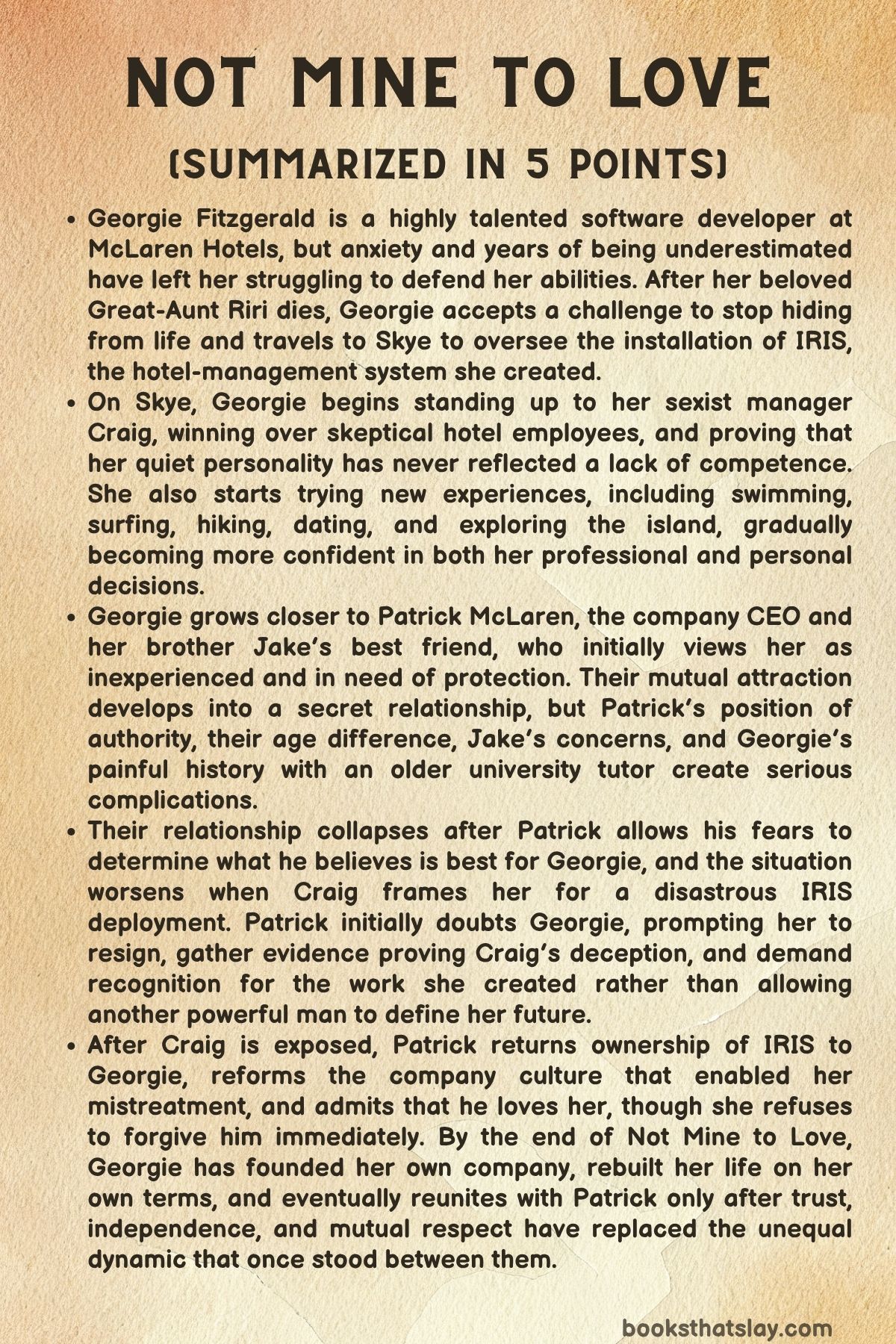
Not Mine to Love by Rosa Lucas is a contemporary workplace romance centered on Georgie Fitzgerald, a gifted software developer whose technical ability is hidden beneath severe anxiety and years of damaged confidence.
Her assignment at a luxury hotel on the Isle of Skye becomes the beginning of a much larger change in her life. While proving that she created an innovative hotel-management system, Georgie begins challenging a sexist manager, trying experiences she previously avoided, and confronting her attraction to CEO Patrick McLaren. Their relationship grows alongside Georgie’s transformation from someone accustomed to shrinking herself into a woman determined to control her work, relationships, and future. It’s the 3rd book in the Billionaire Brits series.
Summary
Georgie Fitzgerald works as a software developer for McLaren Hotels and has spent months creating IRIS, an intelligent hotel-management system capable of improving operations across the company. She is exceptionally talented at coding but struggles badly with public speaking, especially after years of criticism have taught her to doubt herself.
During an important presentation, everything goes wrong. Patrick McLaren, the intimidating CEO and best friend of Georgie’s older brother Jake, unexpectedly enters the room, worsening the nervousness Georgie has felt around him since adolescence.
A rehearsal recording accidentally plays during the presentation, exposing Georgie’s embarrassing self-coaching and comments about her anxiety. Humiliated, she flees to the bathroom and later overhears Patrick questioning whether she was properly prepared while her manager, Craig, eagerly suggests that she may need formal performance management.
Patrick has already formed an inaccurate opinion of Georgie. Years earlier, Jake had asked him to give his younger sister an opportunity at the company, leading Patrick to assume that Georgie obtained her position partly through family connections rather than exceptional ability.
He does not even realize that Georgie created IRIS. Instead, he interprets her nervousness as professional weakness and advises her to receive additional training, reinforcing her fear that people see only the anxious woman rather than the skilled developer underneath.
Three months later, Georgie is grieving the death of her beloved Great-Aunt Riri. Riri had taken Georgie in after university and became the person who helped her rebuild herself after a destructive relationship left her confidence shattered.
Riri leaves Georgie her Fulham home, but also leaves behind a recorded message challenging her to change the way she lives. She tells Georgie that brilliance is meaningless if she spends her life hiding, saying no to experiences, allowing others to dominate her, and avoiding risks because she fears embarrassment or failure.
The message arrives at exactly the moment Georgie needs it. Craig continues belittling her, taking control of work she understands better than anyone and selecting Roy instead of her to oversee the installation of IRIS at Clachmòr House, McLaren Hotels’ prestigious property on Skye.
For once, Georgie challenges him. She insists that sending her to Skye makes more sense because she knows the system better than anyone, and Craig eventually gives in.
Her journey begins with another major test when she discovers that Patrick intends to fly her from Inverness to Skye in his helicopter. Georgie is terrified, but Riri’s challenge to say yes encourages her to continue.
During the flight, her fear of crashing becomes so overwhelming that Patrick himself suddenly seems less frightening. They begin talking naturally, and Georgie’s knowledge of reliability engineering surprises him.
Patrick also reveals his deep attachment to Skye. His grandfather came from the island, and Clachmòr House represents more than another business investment; restoring the property connects Patrick to his family and to an earlier version of himself who once enjoyed practical work more than corporate leadership.
Their growing ease disappears after landing when Patrick questions whether Georgie can manage such an important installation alone. He mentions that Jake asked him to watch over her, leaving Georgie furious that both men continue treating her as an inexperienced younger sister rather than an adult professional.
Georgie settles into a staff cottage with Fee, an outgoing yoga instructor who encourages her to enjoy the island. Inspired by Fee and Riri, Georgie creates a list of experiences she wants to attempt, including swimming, hiking, wildlife trips, local food, whisky, dating, and romantic adventure.
She also gives herself professional goals: make IRIS succeed and force Patrick to recognize her competence. The list becomes a practical expression of the life Riri wanted her to claim.
Georgie’s first attempt to introduce IRIS to Chef MacLeod fails because she approaches the kitchen staff with technical language rather than addressing their actual concerns. Craig uses the failure against her, and Patrick angrily assumes she has mishandled the rollout.
Georgie nearly accepts that judgment, but then recognizes similarities between Craig’s behavior and the tactics used by her former boyfriend Steve. Rather than retreating, she returns to MacLeod, admits that her approach was wrong, explains the system in practical terms, and demands professional respect.
MacLeod responds positively. Patrick is forced to admit that Georgie handled the conflict well and begins reconsidering his assumptions about her.
At dinner, supposedly arranged so Georgie can try Scottish food, she discusses hotel waste, customer patterns, complaints, and operational data with Patrick. Her observations make him realize that she does not simply understand software; she understands how information can improve the hotel itself.
Georgie also challenges Patrick’s belief that employees must become louder and more aggressive to succeed. She argues that workplaces should allow quieter people to contribute without requiring them to imitate dominant personalities.
Patrick agrees to let her continue the installation without Roy as backup. His respect for her grows quickly, but so does an attraction he believes he should resist because he is her employer, considerably older, and Jake’s closest friend.
Their relationship changes during a boat trip Patrick organizes so Georgie can see wildlife and go swimming. Away from offices and job titles, they talk about fear, family, adventure, and the different ways they have built their lives.
Patrick begins seeing Georgie as funny, intelligent, curious, and attractive rather than simply nervous. Georgie, who has carried a crush on him since she was young, becomes increasingly aware that her feelings are no longer based on fantasy.
Patrick eventually kisses her. The attraction is mutual and intense, but he abruptly stops because he believes continuing would cross too many boundaries.
His attempt to protect Georgie feels like rejection to her. She decides that Patrick’s uncertainty will not stop her from continuing her new life, and she later goes surfing and agrees to a date with local fisherman Malcolm.
At the same time, Georgie becomes increasingly successful with IRIS. She abandons Craig’s rigid presentation style when meeting housekeeping staff, listens to their practical problems, and begins creating features that directly respond to their needs.
Patrick repeatedly discovers that Craig’s reports about Georgie do not match what other employees tell him. He also notices that Georgie has been creating valuable improvements without receiving proper recognition.
At the Herring Festival, Georgie tries to enjoy her date with Malcolm, but Patrick appears nearby. When Malcolm becomes too intoxicated to drive safely, Patrick intervenes.
Georgie accepts the safety concern but angrily rejects Patrick’s assumption that he can control her choices. She tells him she is neither Jake’s child nor Patrick’s responsibility and challenges the contradiction between rejecting her romantically while interfering in her dates.
Patrick finally admits that he cannot stop thinking about their kiss. Later, at Georgie’s cottage, their unresolved attraction becomes impossible to deny, and they begin a secret relationship.
Patrick is careful about consent and makes Georgie feel wanted in ways Steve never did. Their intimacy becomes emotionally important because Georgie begins shedding years of shame about her body, desires, and lack of experience.
Patrick also becomes emotionally attached despite insisting that their situation is complicated. He spends increasingly more time helping Georgie complete her Skye list, taking her hiking, fishing, swimming, and sightseeing.
When Georgie loses Riri’s treasured necklace while hiking, Patrick initially dismisses it as a chain. Unknown to Georgie, however, he later searches the mountain for it before discovering that it had fallen inside his vehicle.
The secret gesture reveals how important Georgie has become to him. Eventually they agree that their relationship is exclusive, although Georgie asks Patrick not to tell Jake yet.
Georgie finally realizes that she loves Patrick. Her happiness is complicated when Jake arrives on Skye and continues treating her as his little sister, while Georgie worries that she may not fit naturally into Patrick’s wealthy and accomplished social world.
At a Harvest Ceilidh, Georgie’s insecurity intensifies when she sees Patrick with Maren, a confident woman with whom he previously had a casual relationship. Georgie leaves, Patrick follows, and their argument turns into a private reconciliation.
Unfortunately, they accidentally activate an old hotel intercom and broadcast enough of their encounter for others to discover the relationship. Jake confronts Patrick angrily.
Patrick then learns the full truth about Steve. Georgie’s former partner had actually been her thirty-year-old university tutor, placing him in a position of authority when their relationship began.
Jake forces Patrick to confront uncomfortable similarities: Patrick is also older, powerful, and professionally senior to Georgie. When Jake asks whether Patrick can genuinely promise his sister a stable future, Patrick cannot answer confidently.
Georgie secretly overhears Patrick saying that he should never have begun the relationship. Although he believes ending things will protect her, Georgie sees his choice as another man deciding what is best for her without trusting her judgment.
She challenges Jake for treating protection as control and later gives Patrick an opportunity to fight for their relationship. When he cannot, she ends it and returns to London.
Rather than allowing the breakup to destroy her career, Georgie commits herself to finishing IRIS. She creates healthier boundaries, spends more time with Jake, and begins rebuilding a life beyond work.
Craig soon forces the deployment of an unfinished IRIS feature despite Georgie’s warnings. She documents her objections, but when the system suffers a major failure, Craig deletes evidence and claims Georgie acted without authorization.
Patrick sees technical records connected to Georgie’s account and, in one of his worst decisions, asks whether she might have damaged the system because he ended their relationship. Georgie is devastated that he believes she could harm thousands of guests out of personal anger.
She tells Patrick that the real failure is the company culture he created: Craig is automatically trusted because he sounds authoritative, while quieter employees are ignored. Georgie resigns rather than accept responsibility for something she repeatedly warned against.
Soon afterward, Roy and several IT employees confront Patrick. They confirm that Craig ordered the deployment and reveal that Georgie created most of IRIS while receiving neither the title nor the recognition her work deserved.
Georgie independently recovers deleted emails and technical logs proving Craig falsified evidence. She prepares to defend herself legally, expecting McLaren Hotels to attack her.
Instead, Patrick admits that the internal investigation cleared her completely. Craig has been fired, and Patrick accepts Georgie’s demands for compensation, a written apology, and proper professional acknowledgment.
He then transfers the ownership and intellectual property rights for IRIS to Georgie, recognizing that she created something far beyond the responsibilities of her junior position. The decision gives Georgie the freedom to build her own company and license the technology wherever she chooses.
Patrick later visits her privately, apologizes for both his personal failures and the company culture he allowed to develop, and tells her that he loves her. Georgie still loves him but refuses to reunite immediately because returning IRIS cannot automatically repair broken trust.
Patrick responds by changing both his company and himself. He introduces stronger systems for reporting abuse, examines managerial bias, acknowledges Georgie publicly as IRIS’s creator, and accepts that leadership must protect employees who lack institutional power.
Four weeks later, Georgie is in Norway on an expedition with Jake. She has started building IRIS into her own business, with Roy joining her, and has continued embracing experiences she once would have avoided.
Jake secretly arranges for Patrick to meet her during the expedition but makes clear that Georgie alone must decide whether to approach him. Patrick tells her he wants a permanent life with her and no longer expects her to fit conveniently into the structure he created for himself.
Georgie chooses to give him another chance. Their reunion is based not simply on attraction but on Patrick finally respecting her independence and Georgie entering the relationship from a position of confidence rather than dependency.
Three months later, Georgie runs her own company, Fortis, with Roy and a young developer named Alya. IRIS has several hotel clients, including McLaren Hotels, and Georgie is deliberately building the kind of workplace she once needed herself.
She protects quiet employees, values realistic deadlines and thoughtful work, and maintains professional boundaries even with Patrick. Riri’s photograph remains on her desk as a reminder of the challenge that changed her life.
Patrick eventually moves into Riri’s renovated house with Georgie. Their families and friends become part of their shared world, and Patrick adds one final ambition to their household whiteboard: he wants to marry her.
Characters
Georgie Fitzgerald
Georgie is the emotional and professional center of Not Mine to Love, and her development is fundamentally about learning that quietness does not equal weakness. She begins the book as an exceptionally capable programmer who has become conditioned to underestimate herself because public anxiety, workplace sexism, an abusive past relationship, and years of being treated as Jake’s fragile younger sister have convinced her that other people are better judges of her abilities than she is.
Her greatest strength is not that she suddenly becomes fearless. Georgie remains nervous, awkward, analytical, and occasionally uncertain, but she gradually stops treating those qualities as reasons to surrender authority over her own life.
Riri’s final challenge gives her permission to experiment with courage in practical ways. Georgie goes to Skye, confronts Chef MacLeod, challenges Craig, surfs despite being terrible at it, dates Malcolm, travels with Patrick, argues with Jake, and eventually builds a company of her own.
Her relationship with Patrick is important because it tests whether her growing independence is genuine. At first she risks repeating an old pattern by falling for an older, powerful man, but she ultimately proves that she is no longer willing to accept a relationship in which someone else makes decisions on her behalf.
Her strongest moment comes after Patrick doubts her during the IRIS crisis. Georgie loves him, yet she resigns, gathers evidence, makes professional demands, refuses his first attempt at reconciliation, and rebuilds her career independently.
By the conclusion, she does not become confident because Patrick chooses her. Patrick is able to become part of her future only after Georgie has already chosen herself.
Patrick McLaren
Patrick is both the romantic lead and one of the people whose failures create Georgie’s greatest obstacles in Not Mine to Love. He is intelligent, hardworking, loyal, commercially successful, and capable of considerable generosity, yet he initially mistakes authority for insight and assumes that his judgment is more reliable than Georgie’s own understanding of herself.
His biggest flaw is paternalism. Patrick frequently tells himself that he is protecting Georgie, but his decisions often deny her agency, particularly when he attempts to regulate her dating life, decides their relationship is too dangerous for her, and later doubts her during the IRIS disaster.
His attraction to Georgie forces him to reconsider the fixed image he formed when she was younger. As he watches her handle hotel staff, analyze data, improve IRIS, challenge Craig, and confront him directly, he gradually recognizes that the nervous woman he dismissed is one of the most capable people in his company.
Patrick’s emotional conflict becomes more serious after learning about Steve. Instead of trusting Georgie to distinguish between an abusive relationship and a consensual one, he becomes frightened by the resemblance between his position and Steve’s and ends the relationship in the name of protecting her.
His worst professional mistake occurs when he allows Craig’s apparent evidence to outweigh what he knows about Georgie’s character. That failure exposes a broader weakness in his leadership: he has built a successful company without paying sufficient attention to how power operates inside it.
Patrick earns the possibility of reconciliation only when he stops trying to repair everything through money, business decisions, or grand gestures. His later reforms, apologies, willingness to accept rejection, and decision to meet Georgie as an equal show genuine change rather than a temporary romantic performance.
Jake Fitzgerald
Jake is Georgie’s loving but overprotective older brother. His adventurous career and fearless personality make him appear almost opposite to Georgie, and his repeated habit of calling her “Button” reflects how strongly he continues viewing her through the lens of childhood.
His protectiveness comes from genuine concern and guilt. Jake remembers the damage Steve caused and worries that Georgie remains vulnerable, which explains why he asks Patrick to watch her on Skye.
The problem is that Jake often converts love into supervision. By asking Patrick to monitor Georgie, reacting violently when he discovers their relationship, and attempting to decide whether Patrick is suitable for her, Jake contributes to the very pattern Georgie is trying to escape.
Their confrontation becomes important because Georgie finally explains that constant protection can become another form of control. Jake eventually understands this and proves capable of changing.
His decision in Norway is especially meaningful. He creates an opportunity for Georgie and Patrick to meet but deliberately tells his sister that the choice belongs entirely to her, showing that he has finally learned the difference between supporting Georgie and directing her.
Great-Aunt Riri
Riri, whose full name is Iris, remains one of the strongest influences in Not Mine to Love despite dying relatively early in the story. She gave Georgie stability after university and recognized that the young woman’s problem was never a lack of intelligence but a growing habit of making herself smaller to avoid criticism, risk, and disappointment.
Her recorded message after her death becomes the foundation of Georgie’s transformation. Riri does not simply tell Georgie to become more confident; she encourages her to build a life, accept occasional embarrassment, make imperfect decisions, and refuse to become anyone’s punchbag.
The iris necklace symbolizes their connection. Georgie’s devastation when it disappears shows how deeply Riri remains tied to her sense of home and emotional security.
Riri also influences Georgie professionally because IRIS is named after her. By the end, Riri’s legacy has expanded from a private memory into a company and a philosophy of living, with Georgie finally creating the independent, courageous life Riri believed she deserved.
Craig
Craig represents the institutional form of many of the pressures Georgie faces throughout Not Mine to Love. Unlike Steve, whose control was personal and intimate, Craig uses workplace authority to silence her, minimize her achievements, and maintain a hierarchy in which confidence is treated as more valuable than competence.
His sexism often appears through apparently ordinary behavior. He interrupts Georgie, dismisses her concerns, assigns authority to male colleagues, makes inappropriate comments, and benefits from Georgie doing complex technical work without receiving proper recognition.
Craig is also deeply threatened by Georgie’s competence. Roy recognizes this before Georgie does, observing that colleagues naturally approach her when difficult technical problems arise.
The IRIS failure exposes the full extent of Craig’s character. Rather than accept responsibility for forcing an unsafe deployment, he deletes evidence and attempts to sacrifice Georgie’s career to protect his own position.
His eventual dismissal is important not merely because an antagonist is punished. The investigation into his conduct forces Patrick to acknowledge that Craig succeeded for so long because the company structure allowed his behavior to flourish.
Fee
Fee becomes the friend Georgie does not realize she needs. Confident, socially relaxed, sexually open, and comfortable discussing emotions, she initially appears almost completely different from Georgie.
Her importance lies in the fact that she never treats Georgie’s awkwardness as a defect. When she finds Georgie crying, Fee does not make her apologize or explain herself; she simply accepts the emotion and offers friendship.
Fee encourages Georgie to swim, surf, date, dress with greater confidence, and experience Skye rather than hiding inside work. She provides a form of female companionship that helps Georgie understand how isolated she has become.
Yet Fee is more than a comic or carefree influence. She also warns Georgie when Patrick’s reputation and emotional uncertainty could hurt her, showing that friendship involves both encouragement and protection without control.
Roy
Roy is one of Georgie’s most dependable professional allies. Unlike Craig, he recognizes her ability immediately and openly states that she should be the person sent to Skye because she understands IRIS better than anyone.
His support is particularly valuable because it is never presented as rescue. Roy respects Georgie’s competence and does not need her to become louder or more socially dominant before taking her seriously.
During the crisis, Roy helps lead the group of IT employees who confront Patrick and reveal the truth about Georgie’s contribution. Their willingness to risk their own jobs demonstrates how much respect she has earned among the people who actually work beside her.
Roy later joins Fortis as Georgie’s first employee. His decision reinforces the conclusion that Georgie’s leadership is founded on trust and technical respect rather than status.
Maren
Maren initially functions primarily through Georgie’s perception of her. Beautiful, athletic, adventurous, and comfortable around Patrick, she seems to embody every quality Georgie fears she lacks.
Georgie assumes that Maren represents the type of woman Patrick should naturally prefer. This comparison reveals more about Georgie’s insecurity than about Maren herself.
When Georgie actually meets her during the surfing lesson, Maren is friendly and professional. The contrast between Georgie’s imagined rival and the real woman demonstrates how insecurity can turn another person into a symbol rather than allowing her to remain an individual.
Maren also has a previous casual sexual relationship with Patrick, which intensifies Georgie’s concerns about whether she can handle his romantic history. Ultimately, however, Maren is not a genuine romantic antagonist because Patrick’s feelings for Georgie are fundamentally different.
Chef MacLeod
Chef MacLeod initially appears as one of Georgie’s first major professional challenges on Skye. He reacts badly to IRIS because Georgie approaches him with corporate language instead of acknowledging the expertise of the kitchen staff.
His hostility initially shakes Georgie’s confidence, but their second interaction becomes a turning point. Georgie admits that her presentation was poorly designed while refusing to accept disrespect.
MacLeod responds because Georgie begins speaking to him as a professional rather than treating him as a reluctant user who needs technical instruction. His changing attitude demonstrates Georgie’s growing understanding that good technology depends on listening to the people expected to use it.
He later becomes one of the people whose positive feedback forces Patrick to reconsider his assumptions about Georgie. His relationship with Fee also gives him a lighter supporting role beyond the workplace conflict.
Steve
Steve never dominates the present-day action, yet his influence reaches into nearly every major decision Georgie makes. He was her much older university tutor and therefore entered their relationship with significant professional and emotional power over her.
His abuse worked partly through criticism, withdrawal, and repeated suggestions that Georgie was too sensitive or inadequate. He taught her to interpret another person’s displeasure as evidence that she had done something wrong.
The later revelation that Steve physically injured Georgie by slamming a car door on her hand clarifies how far his controlling behavior eventually went. His reaction afterward, accusing Georgie of dramatizing the injury, demonstrates the manipulation that damaged her trust in her own perceptions.
Steve’s importance lies in the pattern Georgie must learn to recognize. She notices echoes of him in Craig and occasionally in Patrick, but her growth allows her to challenge those behaviors instead of automatically surrendering.
Malcolm
Malcolm is a local fisherman who becomes Georgie’s first serious attempt to date after deciding that Patrick will not control her romantic life. He is attractive and initially considerate, making him a plausible alternative rather than merely a joke or obvious mismatch.
Their date matters because Georgie genuinely tries to enjoy herself. She drinks, dances, laughs, kisses Malcolm, and participates in a chaotic festival she once would probably have avoided.
The lack of chemistry compared with Patrick helps Georgie admit the strength of her existing feelings. Malcolm therefore serves less as a rival and more as evidence that Georgie cannot simply replace one emotional attachment with another.
His decision to consider driving while heavily intoxicated also provides the situation that forces Georgie and Patrick into one of their most important confrontations.
Ravi
Ravi is Georgie’s former manager and represents the kind of leadership she needs but rarely receives afterward. He encouraged her ideas and helped restore some of the confidence damaged during university.
His importance becomes clearer through contrast with Craig. Ravi demonstrates that Georgie does not require constant pressure or aggressive management to succeed; she performs well when someone recognizes her intelligence and creates room for her to contribute.
Although his role is limited, he helps establish that Georgie’s later struggles are not evidence of professional incompetence. The environment around her has changed.
Mary
Mary is one of the hotel employees whose positive assessment of Georgie reaches Patrick after Craig has attempted to portray the rollout negatively. Her feedback contributes to Patrick’s realization that Georgie is succeeding precisely because she listens to staff rather than imposing corporate solutions.
Her role also reinforces one of the novel’s workplace arguments: the people closest to day-to-day operations often understand an employee’s real contribution more accurately than distant managers do.
Liam McLaren
Liam is Patrick’s brother and one of the people able to challenge him without being intimidated by his position as CEO. He represents Patrick’s family life and later becomes important when Patrick is trying to understand why his attempts to repair things with Georgie have failed.
Liam helps Patrick recognize that relationships cannot be managed like companies. Contracts, money, compensation, and practical corrections may address professional harm, but they cannot substitute for vulnerability, accountability, or emotional honesty.
Gemma
Gemma, Liam’s partner, belongs to the successful social circle that initially makes Georgie feel insecure during the Harvest Ceilidh. Her presence contributes to Georgie’s fear that Patrick belongs to a polished world in which she may never feel naturally comfortable.
Gemma is therefore important less because of conflict and more because of what Georgie projects onto Patrick’s family and friends. Georgie’s discomfort shows that her insecurity has shifted from simply believing she is unattractive to worrying that she is socially and professionally unsuitable for the man she loves.
Edward
Edward is part of Patrick’s trusted personal circle and, together with Liam, pushes him to think differently about his relationship with Georgie. He helps challenge Patrick’s instinct to treat emotional problems as situations that can be solved through decisive action.
His function is particularly important after Patrick has already done the technically correct things by firing Craig, reforming the company, and transferring IRIS. Edward helps underline that doing the right thing professionally does not automatically restore intimacy.
Alya
Alya appears near the end as a talented young developer working for Georgie at Fortis. Although her role is small, she represents the future Georgie is creating.
Georgie once needed leaders who would recognize intelligence without demanding aggressive self-promotion. By hiring people such as Alya and deliberately designing a healthier workplace, she becomes the leader she once wished someone else would be.
Alya therefore helps complete Georgie’s professional development. Success is no longer simply escaping Craig or owning IRIS; it means using her own authority differently from the people who failed her.
Themes
Confidence, Fear, and Choosing to Participate in Life
Fear controls much of Georgie’s early existence, but the story does not treat courage as the disappearance of anxiety. Not Mine to Love repeatedly shows Georgie frightened, embarrassed, uncertain, or physically uncomfortable at precisely the moments when she makes her greatest progress.
Her public-speaking disaster establishes how strongly humiliation governs her choices. Georgie is not simply afraid of performing badly; she has built a life around avoiding situations where other people might see her fail.
Riri’s message changes the question Georgie asks herself. Instead of wondering whether an experience will be safe or whether she will perform well, she begins asking whether avoiding it means refusing to live.
Skye becomes the testing ground for this new approach. Georgie boards a helicopter despite her fear, surfs badly until she succeeds, swims in cold water, hikes beyond her comfort level, attends social events, dates, confronts managers, and eventually travels to Norway.
None of these experiences magically removes her nervousness. Their importance comes from proving that fear does not need to make decisions for her.
This idea extends into work and relationships. Georgie eventually accepts that speaking up may produce conflict and that loving Patrick may expose her to pain, but she also learns that avoiding every possibility of failure creates its own form of loss.
By the conclusion, confidence means trusting herself enough to participate. Georgie still prepares, researches, worries, and occasionally overthinks, but she no longer mistakes discomfort for a command to retreat.
Power, Authority, and the Right to Make Personal Choices
Different forms of authority surround Georgie throughout the story. Craig controls her professionally, Steve once controlled her academically and romantically, Jake attempts to protect her as an older brother, and Patrick possesses both corporate power and emotional influence.
The novel repeatedly distinguishes between support and control. Someone may believe that a decision is being made for Georgie’s benefit while still denying her the right to judge her own needs.
Patrick’s behavior provides the clearest example. He repeatedly stops himself from pursuing Georgie because he recognizes the legitimate ethical complications of being her employer, yet he also begins deciding what she can or cannot emotionally handle.
Georgie ultimately rejects this paternalism. She does not argue that every relationship involving unequal power is automatically harmless; instead, she insists that acknowledging risk cannot mean treating an adult woman as incapable of making an informed choice.
Jake undergoes a similar change. His concern after Steve’s abuse is understandable, but he eventually realizes that seeing Georgie permanently as a damaged younger sister prevents him from respecting the person she has become.
The Norway reunion demonstrates the healthier alternative. Jake creates an opportunity but explicitly gives Georgie control over what happens next, while Patrick arrives prepared to accept either reconciliation or rejection.
The story therefore argues that genuine care requires respect for autonomy. Protecting someone does not mean taking possession of their decisions, especially when power differences already exist.
Workplace Sexism, Visibility, and Quiet Competence
Georgie’s professional conflict exposes how organizations can overlook capable employees even when their work is essential. Craig’s behavior is openly sexist at times, but the more damaging problem is the ordinary structure that continually rewards his confidence while making Georgie responsible for work that others receive credit for.
Her technical ability is never the real issue. Colleagues already know that Georgie solves difficult problems, understands IRIS better than anyone, and routinely performs beyond her junior position.
What she lacks is institutional visibility. Because she struggles with presentations, avoids confrontation, and does not promote herself aggressively, senior leaders such as Patrick initially assume that the confident manager must be the more capable person.
The IRIS crisis exposes how dangerous that assumption becomes. Craig can order an unsafe deployment and then construct a believable accusation because the company is accustomed to trusting his authority.
Georgie’s response is significant because she refuses to solve the problem merely by becoming more like Craig. She argues that organizations should not require every thoughtful or introverted employee to become louder before their expertise receives respect.
Patrick eventually recognizes that Craig is not an isolated problem. Management systems, promotion practices, reporting structures, and leadership habits allowed his behavior to continue.
Georgie carries that lesson into Fortis. Her success is measured not only by owning IRIS but by intentionally building a company where quieter employees receive time, recognition, realistic expectations, and protection from people who misuse authority.
Love, Trust, and the Difference Between Desire and Partnership
The romance in Not Mine to Love begins with attraction, but the decisive question becomes whether desire can develop into a relationship built on trust. Georgie and Patrick have strong physical chemistry almost immediately once they begin seeing each other differently, yet attraction alone repeatedly proves insufficient.
Patrick can make Georgie feel beautiful, safe, wanted, and understood in intimate moments. He can search a mountain for Riri’s necklace, organize adventures from her list, and show a gentleness that contrasts strongly with the intimidating executive she once feared.
Yet he also fails her when trust matters most. He decides to end their relationship after speaking with Jake rather than allowing Georgie to participate in the decision, and he later considers the possibility that she deliberately damaged IRIS.
The second failure is especially damaging because it strikes at Georgie’s professional identity. Patrick knows her personally and has witnessed her integrity, yet institutional evidence presented by a more authoritative man temporarily matters more to him.
His later confession of love cannot erase that injury. Georgie’s refusal to reunite immediately demonstrates her most mature understanding of relationships: loving someone and trusting someone are not automatically the same thing.
Patrick therefore has to change without any guarantee that Georgie will reward him. He reforms the company, acknowledges her ownership of IRIS, accepts responsibility, respects her rejection, and finally approaches her without trying to control the outcome.
Their reconciliation succeeds because Georgie no longer needs Patrick to validate her worth and Patrick no longer expects love to operate according to his authority. They choose each other only after both understand that partnership requires equality, accountability, vulnerability, and the freedom to walk away.