Ready or Not Summary, Characters and Themes
Ready or Not (Hide and Seek #2) by Sheridan Anne is a dark romantic suspense novel centered on Harper-Rayn Madden, a hospital worker whose life is shattered when a masked attacker turns an old psychiatric fear into a terrifying reality.
The story combines a dangerous stalking case with Harper’s complicated romance with SWAT commander Knight Slater, whose love for her is tested when he initially doubts what she is experiencing. As the threat becomes increasingly personal, Harper must confront questions of trust, family loyalty, trauma, self-protection, and survival while discovering that the person hunting her has been closer to her life than she ever imagined.
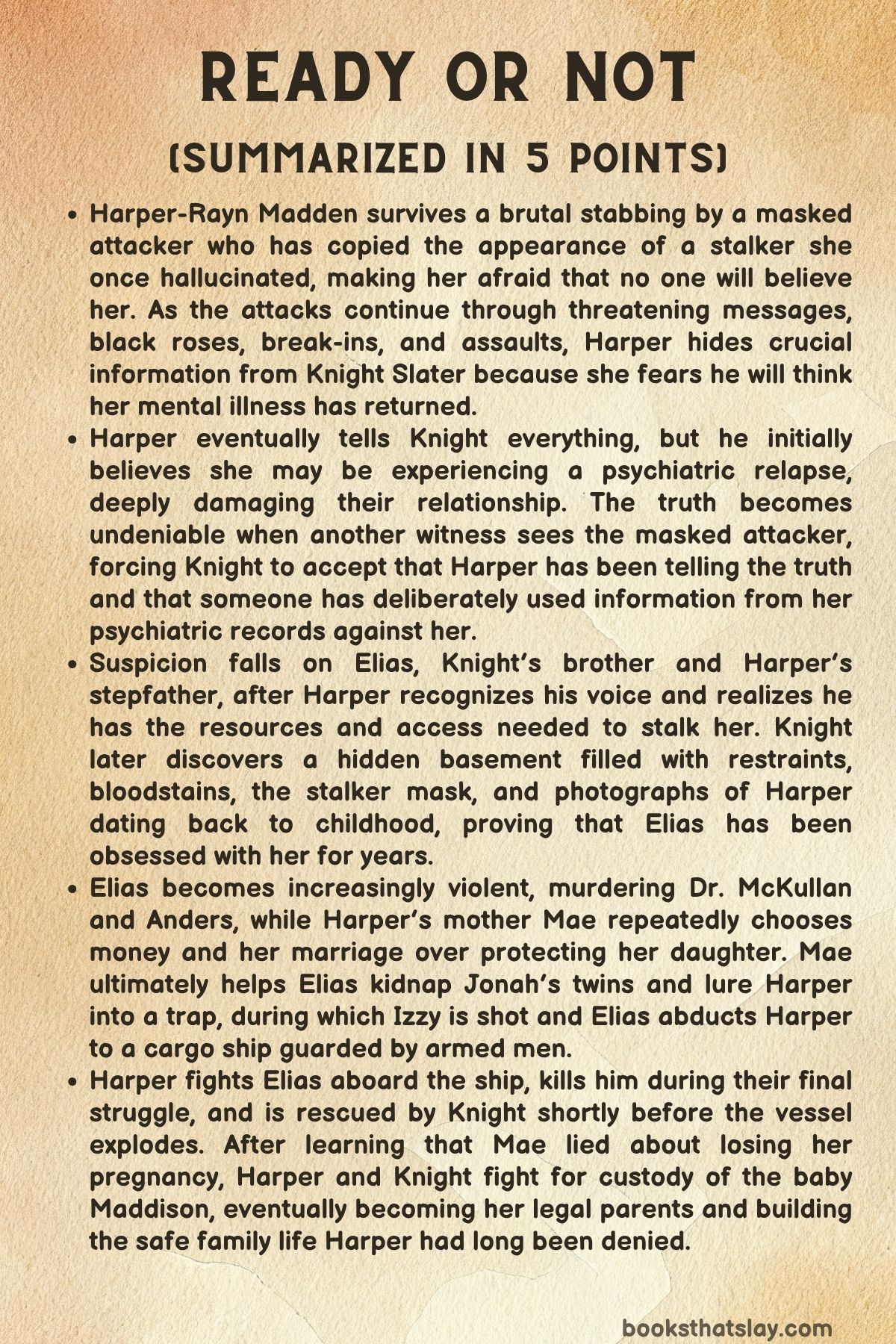
Summary
Harper-Rayn Madden finishes a shift at Blackstone Private Hospital and heads toward her car, only to be attacked by a masked man in the parking garage. He stabs her in the abdomen and leaves her bleeding on the concrete, but Harper manages to call emergency services before losing consciousness.
Because the attack happens beside the hospital, her colleagues reach her quickly. Amelia helps control the bleeding while doctors rush Harper into surgery, repairing damage to her kidney and intestine as Knight Slater races to her side.
Knight is horrified by the amount of blood left at the crime scene and immediately begins thinking beyond the official police investigation. Detective Gray has little physical evidence, however, because the attacker carefully avoided surveillance and left almost nothing useful behind.
When Harper wakes, she tells Knight only part of the truth. The attacker wore the exact type of mask associated with a frightening stalker Harper had previously hallucinated, and he seemed to know details from her private therapy records.
Harper is terrified that revealing this connection will make everyone question whether the attack actually happened. She therefore describes the assailant only in general physical terms while keeping his connection to her psychiatric history secret.
Her recovery brings Knight even closer to her. Harper moves into his home, and their relationship becomes increasingly serious despite the complications caused by their unusual family connection, since Knight is technically her step-uncle through marriage.
Jonah, Harper’s brother, discovers their relationship after Knight informs him about her stabbing. His initial shock eventually gives way to reluctant acceptance when he realizes that Knight genuinely loves Harper and makes her happy.
As Harper returns to work, the danger returns with her. After one shift, she discovers the masked stalker hiding inside her car, where he attacks and intimidates her before disappearing.
Physical marks on Harper’s throat and a black rose left inside the vehicle prove to her that the encounter was real. Yet instead of reporting what happened, she hides the evidence because she remains afraid that Knight will connect the masked figure with her previous hallucinations.
Another black rose later appears outside Knight’s home. Harper almost tells him everything, but his praise for her apparent psychological progress makes her hesitate, and she hides the flower instead.
The stalker eventually enters Knight’s house while Harper is alone. He attacks and sexually assaults her, claiming that she belongs to him and that living with Knight is an act of disobedience that deserves punishment.
Harper manages to fight back long enough to escape the house. This time she tells Knight the entire truth, including the mask, the stolen therapy information, the black roses, the attack in her car, and everything she has hidden since the stabbing.
Instead of accepting that someone has deliberately recreated her old hallucination, Knight believes Harper may be experiencing a psychiatric relapse. His reaction devastates her because the stalker had predicted that nobody would believe her.
Harper searches for the hidden black rose that could prove her story, only to discover it has disappeared. Feeling betrayed by the person whose trust matters most, she leaves Knight and stays with Izzy.
Knight visits her and insists that he believes Harper is genuinely frightened, but he still thinks the masked attacker may be a manifestation of her illness. Harper argues that love without trust cannot protect her, leaving them trapped between two completely different interpretations of the same danger.
They eventually reconcile enough to remain together, although Knight still has doubts. Harper agrees to continue addressing her mental health while Knight promises that he will investigate the possibility that she is right.
The next major revelation comes during a family dinner with Harper’s mother, Mae, and Mae’s wealthy husband, Elias. Elias casually calls Harper “kitten” in a voice and tone that immediately remind her of the masked stalker.
Harper realizes that Elias fits everything she knows about the attacker. His build, financial resources, access to the family, possible hospital connections, and familiarity with her life all make him a credible suspect.
Knight initially struggles to accept that his own brother could be responsible. Still, he finally agrees that Elias must be investigated rather than dismissed, marking the first real shift in his response to Harper’s claims.
The truth becomes undeniable when Harper is attacked again at the hospital. Carly witnesses the masked man, giving Knight independent confirmation that Harper has been telling the truth all along.
Knight is crushed by guilt. He realizes that while Harper was facing a real predator, his refusal to believe her increased her isolation and helped the attacker exploit the uncertainty surrounding her psychiatric history.
Evidence quickly points toward Elias. Knight confronts his brother directly, and Elias effectively exposes his obsession with Harper, his desire to control her, and his confidence that wealth and influence will protect him.
Knight threatens him and demands that he surrender. Elias instead disappears, forcing Knight and his team to continue searching while Harper receives constant protection.
Harper’s mother refuses to accept the truth even after Harper describes the stalking, stabbing, assault, and manipulation. Mae remains far more concerned about preserving her wealthy marriage than acknowledging what Elias has done to her daughter.
The situation becomes more complicated when Mae reveals that she is pregnant. Knight explains that Elias previously had a vasectomy, meaning the baby belongs to someone else and Mae could be in serious danger if Elias discovers her infidelity.
Harper still offers to help Mae leave him, particularly for the unborn child’s sake. Mae rejects her and cruelly suggests that the new baby may provide the kind of daughter she always wanted, deepening Harper’s understanding that her mother has consistently failed her emotionally.
Meanwhile, Harper returns to work and receives encouraging news from Dr. McKullan, who intends to retire and hopes Harper will eventually succeed him. The professional opportunity briefly gives Harper something hopeful to imagine beyond the stalking.
That hope is destroyed when Elias infiltrates the hospital morgue. He murders Dr. McKullan and fatally wounds Anders, the young SWAT officer assigned to guard Harper.
Knight later discovers how Elias entered the facility and escaped during the resulting chaos. Anders dies from his injuries, leaving Harper overwhelmed by guilt over the people who have been killed while trying to protect her.
Desperate to understand how to defeat someone like Elias, Harper deliberately stops taking her medication so that her original hallucinated stalker will return. When the figure appears, Harper recognizes him as a product of her own mind rather than confusing him with Elias.
Instead of fearing the hallucination, she demands advice. His answer is that Elias will never stop voluntarily and can only truly be stopped through death.
Harper resumes taking her medication afterward, but the idea remains with her. Knight eventually discovers what she did and confronts her, although he chooses to trust her promise that she will not deliberately trigger the hallucination again.
Knight’s investigation also uncovers something far worse than expected. Inside Elias’s mansion, he discovers a hidden basement containing restraints, cages, bloodstains, and years of secretly taken photographs of Harper.
Some photographs date back to Harper’s childhood, proving that Elias’s interest in her began before Mae married him. Knight realizes that Elias may have pursued Mae primarily because marriage gave him regular access to Harper.
He also finds the mask used in the attacks. Any remaining doubt about his brother’s guilt disappears.
Mae later arrives at Harper and Knight’s house badly injured, apparently after Elias attacked her. She finally admits that Harper had been right about him, yet she remains unwilling to abandon the marriage because she is still obsessed with preserving her wealth and lifestyle.
Mae claims that the pregnancy has ended because of the attack. Harper, who had already begun considering whether she and Knight might someday protect or raise the child, is devastated.
Her grief pushes her toward a reckless decision. Remembering the advice of her hallucinated stalker, Harper escapes her protection detail, takes one of Knight’s guns, and goes to Elias’s home intending to kill him.
Harper confronts Elias and shoots him in the thigh. She tries to finish him after thinking about his victims, but Elias attacks her, takes the weapon, and attempts to force her toward his hidden basement.
Knight and the SWAT team arrive before Elias can succeed. Elias is arrested, although Harper is also briefly taken into custody for breaking into his house and shooting him.
Legal complications threaten the case against Elias. His attorneys challenge important evidence, while Harper’s psychiatric history could be used to undermine her credibility if the strongest physical proof is excluded.
For a short period, Harper and Knight try to rebuild ordinary life. Harper spends time with Izzy, grows closer to Jonah, and prepares excitedly for an overnight visit from Jonah and Emily’s young twins, Haylee and Taliah.
The sleepover becomes another nightmare when the twins suddenly vanish. Security footage reveals Mae taking them from the house.
Knight immediately understands that the kidnapping is probably a trap intended to bring Harper to Elias. Before Knight can reach her, Harper and Izzy drive to Mae and Elias’s mansion themselves because Harper refuses to wait while the children may be in danger.
There they discover that Mae has deliberately sided with Elias. Her earlier injuries were part of a manipulation designed to regain Harper’s trust, and she helped create the false story surrounding the pregnancy loss in order to push Harper toward confronting Elias.
When Harper attempts to rescue the twins, Mae shoots Izzy in the chest. Elias then takes Harper while Mae removes the children.
Knight and his SWAT team arrive soon afterward. They find Izzy critically wounded but alive, rescue Haylee and Taliah, and arrest Mae.
Using information obtained from Mae and documents found in Elias’s office, Knight concludes that Elias has taken Harper aboard a cargo ship waiting offshore. He organizes a large tactical rescue operation and approaches the ship with his team under cover of darkness.
Harper awakens aboard the vessel injured, bound, and psychologically exhausted. Believing Izzy may have died because of her, she initially feels almost incapable of fighting anymore.
Gunfire outside tells her that Knight has found her. The knowledge restores her determination to survive.
When Elias returns, Harper fights him. She smashes an oil lamp during the struggle, starting a fire, and eventually gets hold of Elias’s knife.
Harper repeatedly stabs Elias, finally killing the man who has controlled and terrorized her life. She then becomes trapped in the burning cabin until Knight reaches her and carries her toward safety.
They discover that the ship contains explosives and must evacuate immediately. Knight jumps into the water holding Harper just before the vessel explodes behind them.
At the hospital, Harper learns that the twins are safe and Mae is in custody. She is also overwhelmed with relief when Izzy wakes after surgery.
Another revelation follows when Amelia explains that Mae lied about losing her baby. The pregnancy survived Elias’s attack, meaning Harper’s unborn sister is still alive.
Harper immediately decides that she will fight to keep the child away from Mae. Knight supports her without hesitation and promises that if they receive custody, they will raise the baby together.
Six months later, Elias’s fortune has passed to Knight because of his legal arrangements with Mae. Knight donates nearly all of it to organizations helping women, children, and survivors of abuse, retaining only what is necessary for the custody battle.
Mae remains imprisoned and gives birth to a healthy daughter named Maddison. Harper and Knight bring the baby home while legal proceedings continue.
When Mae eventually signs away her parental rights, Harper and Knight receive full custody. Harper realizes that she does not simply want to act as Maddison’s older sister; she wants to be her mother, while Knight fully embraces becoming Maddison’s father.
The story therefore ends with Harper no longer defined by the man who hunted her or the mother who failed her. She and Knight create the secure family both have fought to protect, turning survival into the beginning of a new life rather than merely the end of Elias’s violence.
Characters
Harper-Rayn Madden
Harper is the emotional and narrative center of Ready or Not, and much of her characterization comes from the conflict between what she knows she has experienced and what other people are willing to believe. She is physically resilient from the opening attack onward, surviving severe injuries and repeatedly finding ways to resist Elias even when she is frightened, isolated, or badly hurt.
Her greatest vulnerability is not physical weakness but the uncertainty created by her psychiatric history. Because she previously experienced a masked hallucination, Elias can copy that figure and use Harper’s own medical past against her, knowing that she will hesitate to report him and that other people may question her credibility.
Harper’s secrecy frequently places her in additional danger, but the book makes clear why she behaves this way. She fears losing Knight’s respect and fears being reduced to a diagnosis rather than treated as someone capable of understanding the difference between an internal hallucination and an external attacker.
Her development eventually becomes a struggle for personal authority. She learns to defend her understanding of reality, confront the emotional damage caused by Mae, accept help without surrendering control, and recognize that surviving Elias does not require pretending that the experience caused no lasting harm.
Her decision to protect Maddison completes this development. Harper refuses to repeat Mae’s pattern of conditional and self-centered motherhood, choosing instead to create the safe family environment she never received herself.
Knight Slater
Knight is Harper’s lover, protector, and one of the most conflicted figures in Ready or Not. As a SWAT commander, he is trained to rely on evidence, assess danger rationally, and take control when other people panic, qualities that make him highly effective professionally but create serious problems when Harper describes something that seems impossible.
His initial disbelief does not come from indifference. Knight genuinely thinks Harper may be experiencing a psychiatric relapse, and from his perspective refusing to reinforce that possibility is a form of protecting her.
That decision becomes one of his greatest failures. Once Carly confirms the masked attacker is real, Knight must accept that his confidence in his own judgment caused him to mistrust Harper at the exact time she needed him to listen.
Knight does not avoid responsibility afterward. His guilt becomes productive rather than merely self-punishing: he investigates Elias, increases Harper’s protection, examines evidence he previously discounted, and acknowledges that Harper understood the situation better than he did.
His relationship with Harper also reveals a softer side that sharply contrasts with his tactical profession. He imagines marriage, children, domestic stability, and a permanent home, and his eventual willingness to raise Maddison proves that his commitment extends far beyond physical attraction or romantic intensity.
Elias
Elias is the central antagonist of Ready or Not, and his defining characteristic is possession disguised as obsession. He does not love Harper as an independent person; he wants control over her identity, body, fear, and relationships.
His most disturbing weapon is psychological rather than physical. By stealing or accessing information about Harper’s former hallucination, he transforms a private mental-health experience into a real-world method of terror and deliberately relies on the likelihood that other people will doubt her.
The photographs found in his hidden basement reveal that his fixation began years before Mae’s marriage. This suggests that his relationship with Mae was never simply a marriage that later gave him access to Harper; access to Harper may have been one of its purposes from the beginning.
Elias is also protected by wealth, preparation, and confidence in legal manipulation. He believes resources, influence, careful planning, and Harper’s psychiatric history will allow him to escape consequences even when others begin to understand what he has done.
His inability to accept rejection ultimately makes peaceful resolution impossible. Every boundary Harper establishes becomes another reason for punishment in his mind, and his final confrontation with her confirms that he would rather destroy her than accept that she belongs only to herself.
Mae
Mae functions as one of the harshest emotional antagonists in Ready or Not because her betrayal comes from a parent rather than a stranger. Harper repeatedly hopes for some evidence that her mother will choose her safety over money, status, or Elias, and Mae repeatedly refuses.
Her treatment of Harper reveals longstanding emotional neglect. She frequently frames Harper as a source of embarrassment and seems more interested in controlling appearances than understanding her daughter’s pain.
Even after learning what Elias has done, Mae continues defending the life associated with him. Her attachment to wealth becomes so extreme that she minimizes violence against herself and refuses Harper’s offer of help.
Her eventual cooperation with Elias represents the complete destruction of the mother-daughter relationship. She participates in kidnapping her grandchildren, manipulates Harper’s concern about the pregnancy, and helps lure her into danger.
Mae’s pregnancy gives her another opportunity to behave differently, but she fails that test as well. Harper’s later determination to raise Maddison therefore becomes a direct rejection of Mae’s model of motherhood.
Izzy
Izzy is Harper’s closest friend and one of her strongest emotional supports. Her friendship brings humor, normality, and companionship into a story dominated by violence and fear.
She never treats Harper as fragile simply because terrible things have happened to her. Instead, she teases her, spends time with her, celebrates professional successes, listens to her fears, and provides a place to stay when Harper leaves Knight.
Izzy also demonstrates extraordinary loyalty when the twins are kidnapped. She accompanies Harper to Mae’s mansion despite knowing the situation may be dangerous and is shot while helping protect Harper and the children.
Her refusal afterward to let Harper accept responsibility for the shooting is especially important. Izzy understands that friendship includes personal agency, and she refuses to allow Harper’s guilt to erase the fact that she made her own decision to help.
Ace
Ace is one of Knight’s SWAT colleagues and belongs to the close group that gradually becomes Harper’s chosen family. His personality is often expressed through humor, teasing, and irreverent reactions to otherwise stressful situations.
His interactions with Harper show that he regards her as part of the group rather than merely Knight’s girlfriend. Even during embarrassing situations, his teasing reflects familiarity rather than cruelty.
Ace’s feelings for Izzy expose a less confident side of him. Although he is professionally capable and comfortable in dangerous situations, romantic competition with Diesel makes him nervous, jealous, and increasingly unable to hide how strongly he feels.
His reaction when Izzy is shot also demonstrates the seriousness beneath the humor. The possibility of losing her strips away the playful rivalry and reveals how emotionally important she has become to him.
Diesel
Diesel is another member of Knight’s SWAT team and shares Ace’s protective relationship with Harper. He is competent, dependable, and often serves as part of the security surrounding Harper once Elias’s threat becomes undeniable.
Compared with Ace, Diesel often appears slightly more restrained during comic situations. When Harper experiences an embarrassing emergency at home, for example, Diesel makes more effort to preserve her dignity while Ace finds the situation openly hilarious.
His attraction to Izzy creates tension with Ace. Diesel’s interest is obvious enough that Izzy becomes nervous around him, and the competition eventually threatens the friendship and professional partnership between the two men.
Despite this romantic subplot, Diesel remains reliable during the larger crisis. His presence during protection duties and tactical operations confirms his importance within Knight’s trusted inner circle.
Jonah
Jonah is Harper’s brother, and his relationship with her improves significantly over the course of the story. He initially reacts with disbelief when he discovers Harper is involved with Knight because of the unusual family connection created through marriage.
Once he recognizes that Knight makes Harper happy, however, Jonah chooses his sister’s well-being over conventional expectations. His acceptance helps repair some of the distance that previously existed between them.
Jonah becomes especially important because he represents the possibility of a healthier biological family relationship. Unlike Mae, he listens when Harper finally explains what Elias has done and reacts with horror rather than denial.
His trust in Harper is also symbolized by allowing Haylee and Taliah to stay overnight with her. The kidnapping damages Harper emotionally, but the danger originates with Mae and Elias rather than Harper’s ability to care for the children.
Emily
Emily is Jonah’s partner and the mother of Haylee and Taliah. She remains more peripheral than Jonah, but her presence establishes the family life Harper increasingly wants to become part of.
Her pregnancy also complicates discussions about who might eventually care for Mae’s unborn child. Jonah explains that adding another child to his household may be difficult because Emily is already expecting again.
Emily therefore helps establish the practical reasons Harper and Knight begin imagining themselves as potential guardians. Her family with Jonah also gives Harper another model of family life that differs from the unstable relationship she experienced with Mae.
Izzy, Ace, and Diesel as a Friendship Unit
Although each has an individual role, Izzy, Ace, and Diesel also function collectively as part of Harper and Knight’s chosen support system. Their jokes, arguments, attraction, and companionship keep the central couple connected to a wider social world.
Their presence matters because Harper’s recovery is not presented as something that happens through romance alone. Friendship, loyalty, professional trust, and ordinary shared moments all contribute to rebuilding a sense of normal life.
Dr. McKullan
Dr. McKullan is an important professional mentor to Harper. He recognizes both her anxiety and her competence, allowing her to remain connected to the career that gives her purpose.
His plan to retire and eventually have Harper succeed him demonstrates how highly he values her professional ability. At a time when Harper’s private life is dominated by people questioning her judgment, his confidence provides meaningful validation.
His murder becomes one of the story’s most devastating consequences of Elias’s campaign. Harper interprets his death as something caused by her existence, deepening the guilt that later drives several reckless decisions.
Amelia
Amelia is one of Harper’s reliable hospital friends and medical supports. She helps save Harper immediately after the parking-garage stabbing by responding quickly and helping control the bleeding.
Her role remains associated with competence, friendship, and practical care rather than dramatic conflict. She treats Harper as someone worth protecting without stripping her of dignity.
Amelia also delivers the crucial revelation near the end that Mae lied about the pregnancy loss. That information transforms Harper’s grief into a new purpose and directly leads toward the custody fight for Maddison.
Detective Gray
Detective Gray represents the formal law-enforcement response to Harper’s case. His early investigation is limited by the attacker’s careful planning, poor surveillance coverage, and lack of useful evidence.
He sometimes frustrates Knight because official procedures cannot move as quickly as Knight’s protective instincts demand. Yet Gray is not presented as malicious or intentionally dismissive; he is constrained by what can legally be established.
His later requirement to arrest Harper after she shoots Elias also illustrates those limits. Even when the moral situation is complicated, Gray must respond to the evidence and accusations formally presented to him.
Anders
Anders is a younger SWAT officer assigned to protect Harper when she returns to the morgue. His discomfort around the realities of morgue work creates light comic moments shortly before the story turns violently against him.
When Elias appears, Anders immediately places himself between the attacker and Harper. Even after receiving a potentially fatal injury, he continues trying to stop Elias and tells Harper to escape.
His death has enormous emotional consequences for Harper. She sees a young man with a future lose his life while protecting her, intensifying her belief that anyone close to her may become collateral damage in Elias’s obsession.
Hunter
Hunter is another SWAT officer assigned to Harper’s protection. He takes the responsibility seriously and becomes personally devastated when Mae manages to abduct the twins while he is helping guard the house.
Afterward, Hunter blames himself and offers to resign. Knight refuses the resignation because he understands that Elias and Mae deliberately created circumstances designed to defeat the protection around Harper.
Hunter’s reaction shows the psychological cost carried by the people responsible for keeping others safe. His guilt mirrors Harper’s tendency to take responsibility for outcomes created by Elias.
Carly
Carly has a relatively small role but performs one of the most important functions in the story. She witnesses the masked attacker at the hospital and thereby provides external confirmation that Harper has not imagined him.
Her testimony changes Knight’s entire understanding of the situation. Once another person sees the masked man, Harper’s psychiatric history can no longer explain away the physical threat.
Carly therefore becomes the character whose observation breaks Elias’s most effective psychological weapon: isolation through disbelief.
Vincent
Vincent is a hospital employee whom Harper briefly considers as a possible suspect. His physical build and access make him plausible enough to enter her thoughts while she tries to identify the stalker.
Harper ultimately struggles to imagine him as violent. His role is therefore less about personal development and more about showing how uncertainty has contaminated Harper’s relationships with ordinary people around her.
Tony
Tony is a hospital security guard who escorts Harper after she returns to work. His presence temporarily gives her enough confidence to cross the parking area after the trauma of her stabbing.
His limited role nevertheless demonstrates how drastically Harper’s daily routine has changed. Tasks that were once ordinary now require security measures and constant vigilance.
Laith
Laith belongs to Harper and Izzy’s broader friendship circle. He participates in the more relaxed social scenes that give Harper moments of normality away from Elias.
Although he does not drive the main conflict, his presence contributes to the sense that Harper has a community beyond Knight. These secondary friendships matter because they prevent her world from becoming completely defined by the stalker.
Celia
Celia is one of the nurses involved in Harper’s recovery. She helps monitor Harper after surgery and forms part of the medical environment that keeps Harper alive after the opening attack.
Her role is primarily supportive, but it reinforces the importance of Harper’s hospital community. The same workplace that later becomes a target of Elias initially serves as the place that saves Harper.
Harlow
Harlow owns or works at the tattoo studio Knight visits with Harper. The character’s narrative role is brief but connected to one of Knight’s symbolic demonstrations of commitment.
Knight chooses to tattoo the mark of Harper’s bite onto himself, turning something personal between them into a permanent physical reminder. Harlow therefore appears during a scene that emphasizes how seriously Knight views their future together.
Haylee and Taliah
Haylee and Taliah are Jonah and Emily’s four-year-old twins and Harper’s nieces. Their overnight stay matters greatly to Harper because being trusted with them represents how much her relationship with Jonah has improved.
Their kidnapping turns that happiness into terror. Because they are innocent children, their use as bait reveals how far Mae and Elias are willing to go to control Harper.
Harper’s immediate willingness to risk herself for them also demonstrates her strong protective instinct. She refuses to calculate her own safety while believing the girls could be in danger.
Maddison
Maddison is Mae’s newborn daughter and Harper’s much younger half-sister, although she ultimately becomes Harper and Knight’s daughter in every meaningful parental sense. She spends most of the story unborn, yet her existence becomes increasingly important to Harper.
Harper fears that Maddison could grow up experiencing the same emotional neglect she endured. That possibility forces Harper to consider motherhood long before she expected to become a parent.
When Harper finally holds Maddison, the question of whether she is acting as a sister or mother resolves itself emotionally. Her desire to raise the baby represents a decision to replace inherited dysfunction with deliberate care.
Harper’s Therapist
Harper’s therapist represents the professional treatment system that helped Harper manage her previous hallucinations. The sessions should provide safety and confidentiality, but Elias’s apparent access to therapeutic information destroys Harper’s confidence in that privacy.
As a result, Harper withholds crucial information even during therapy. This limits the therapist’s ability to understand what is happening and demonstrates how Elias damages not only Harper’s sense of safety but also her willingness to trust structures designed to help her.
Harper’s Hallucinated Stalker
The hallucinated stalker is not an independent real person, but he functions almost like a character because Harper experiences him as a recognizable presence. Before Elias copies the figure, he represents a frightening symptom Harper has learned to control through medication.
His return after Harper intentionally stops taking her medication is different from her earlier fear. Harper recognizes him immediately as a product of her own mind and confronts him rather than allowing him to define reality for her.
His advice that Elias must be killed reflects a darker part of Harper’s own thinking rather than external wisdom. His admission that he has no name because he is part of Harper confirms that the conversation is ultimately an encounter with her own fear, anger, and survival instinct.
Maddison’s Biological Father
Maddison’s biological father remains largely outside the central story. His significance lies mainly in the fact that the pregnancy proves Mae has been unfaithful to Elias and that he later expresses no interest in raising the child.
His absence clears the legal and emotional space for Harper and Knight to take responsibility for Maddison. Unlike the other adults who fail the child before her birth, they deliberately choose to become her parents.
Themes
Trust, Belief, and the Right to Define Reality
Ready or Not repeatedly asks what happens when a person tells the truth but has a history that makes the truth difficult for others to accept. Harper understands that Elias is real, yet the fact that he copies her former hallucination gives him a powerful method of attacking her credibility.
The danger becomes worse because Harper anticipates disbelief before anyone actually rejects her story. She hides evidence, lies about attacks, avoids honest conversations in therapy, and attempts to protect her relationship with Knight by withholding exactly the information that could help him protect her.
Knight’s response exposes the moral difficulty of belief. He does not dismiss Harper because he thinks she is foolish; he genuinely believes that agreeing with a hallucination could worsen her condition, so his attempt to act responsibly becomes an emotional betrayal from Harper’s perspective.
Carly’s eyewitness account finally establishes the external truth, but the deeper damage cannot disappear as quickly. Knight has to confront the fact that good intentions did not prevent him from failing Harper.
The story therefore treats trust as more than affection. Trust requires allowing someone to possess authority over their own experience, especially when that experience does not fit comfortably within another person’s assumptions.
Trauma, Fear, and Reclaiming Personal Control
Harper’s trauma affects ordinary spaces, decisions, and relationships long after the initial stabbing. A parking garage becomes frightening, returning to work requires security precautions, and even her home eventually becomes another place associated with attack.
Elias attempts to make fear permanent by removing the distinction between safe and unsafe spaces. He enters Harper’s car, home, hospital, and family environment, teaching her that increased security does not necessarily mean freedom from danger.
Harper’s response changes throughout the novel. Early on, she survives mainly through endurance and concealment, but later she actively seeks self-defense training, challenges Elias, protects the twins, and fights for her own survival aboard the ship.
Some attempts to reclaim control are unhealthy. Stopping her medication and entering Elias’s house with a gun show how easily empowerment can turn into dangerous impulsiveness when grief and anger override judgment.
The later consensual pursuit game with Knight provides a symbolic contrast. Being chased was previously associated with helplessness, but Harper voluntarily transforms the dynamic into something governed by consent and trust.
Control, then, is not presented simply as becoming stronger than the attacker. It means deciding who has access to her, what risks she accepts, and how she wants fear to influence the rest of her life.
Family Betrayal and the Difference Between Blood and Loyalty
Harper’s biological and marital family relationships repeatedly challenge the assumption that family automatically provides safety. Mae is her mother, yet she often causes deeper emotional damage than people who have no biological connection to Harper.
Mae consistently places status and wealth above her daughter. Even after hearing that Elias stalked, stabbed, and assaulted Harper, she resists accepting the truth because accepting it would require surrendering the life Elias provides.
Her eventual participation in Elias’s scheme makes that betrayal active rather than passive. By helping kidnap the twins and lure Harper into danger, Mae chooses the man hurting her daughter over Harper herself.
Other relationships provide a direct contrast. Jonah becomes increasingly supportive, Izzy risks her life for Harper, Knight commits himself to repairing his failure, and the SWAT team repeatedly treats Harper as someone whose safety matters personally.
The novel therefore separates biological connection from earned loyalty. Family becomes meaningful through action rather than title.
Maddison’s future makes this contrast especially clear. Harper may technically be her half-sister, while Knight has no biological relationship to the baby at all, yet both are prepared to give her the stable parenting Mae cannot provide.
Breaking Cycles and Building a Chosen Future
By the end of Ready or Not, survival becomes connected to the larger question of what Harper will do with the life she fought to keep. Killing Elias ends the immediate threat, but it does not automatically repair her relationship with herself, erase Knight’s mistake, or undo the damage caused by Mae.
Harper’s greatest victory is therefore not simply defeating Elias. It is refusing to let the people who harmed her determine what kind of partner, sister, friend, or parent she becomes.
Her decision regarding Maddison is central to that idea. Harper grew up knowing what it felt like to receive conditional affection from a mother who valued appearance, comfort, and self-interest above emotional security.
When faced with the possibility that Maddison could experience the same childhood, Harper chooses intervention rather than repetition. She does not pretend that becoming a mother will be easy or that she had always planned for it; she chooses the responsibility because she knows exactly what the absence of dependable love can do.
Knight makes the same future-oriented choice by supporting her without hesitation. Together they use the resources inherited from Elias largely to support survivors and use what remains to secure Maddison’s future.
The closing custody decision transforms the story’s meaning. Harper cannot rewrite her childhood, but she can prevent its failures from becoming another child’s inheritance.