The Score: How to Stop Playing Somebody Else’s Game Summary and Analysis
The Score: How to Stop Playing Somebody Else’s Game is a philosophical examination of what happens when numbers, rankings, metrics, and standardized rules begin directing human attention.
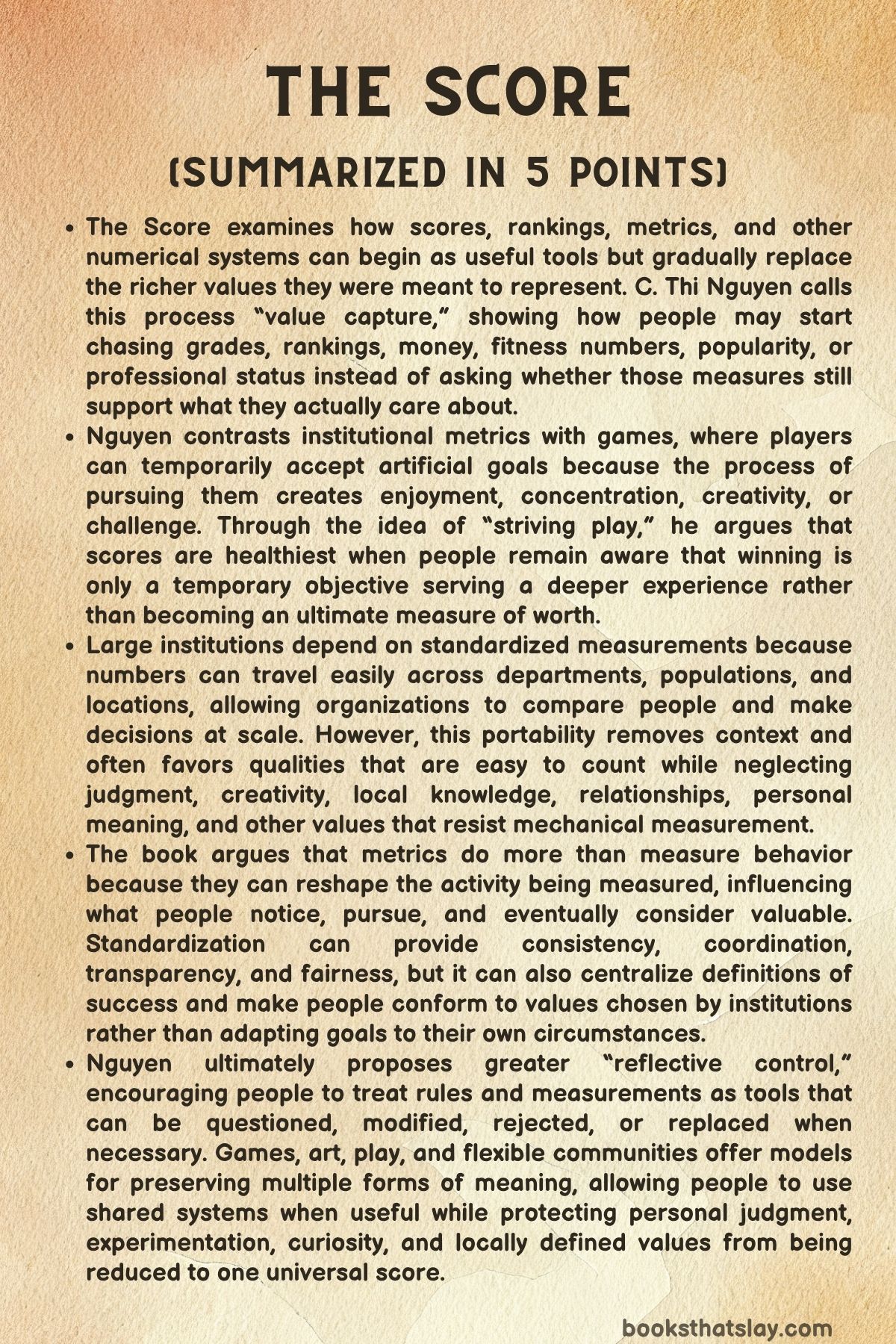
C. Thi Nguyen starts from games, hobbies, professional life, health, art, education, and institutions to ask why scores can sometimes create freedom and creativity while producing conformity elsewhere. His central concern is “value capture,” the process by which an easy-to-measure signal gradually replaces the richer value it was supposed to represent. Rather than rejecting measurement, Nguyen investigates when metrics are useful, when they become dangerous, and how people might preserve the freedom to choose and revise the values that organize their lives.
Summary
Nguyen begins from a personal problem: the strange power that scores have to clarify desire. Rock climbing once helped him escape anxiety, overwork, and dissatisfaction with himself because climbing grades offered concrete challenges and visible signs of improvement, yet that clarity also tempted him to reduce the activity to numerical advancement. A friend named Sherwood helped him notice that climbing could be about movement, balance, elegance, technique, and bodily awareness rather than simply reaching a harder grade.
This experience becomes a model for “value capture,” in which a metric originally created to represent something important eventually replaces that richer purpose. Nguyen recognizes the same process in academic philosophy, where rankings and professional prestige shifted his attention from large philosophical questions toward work more likely to improve his career standing, and he sees similar pressures in social media, fitness, education, and other areas where numerical indicators offer an attractive sense of certainty.
Games help explain why scores are so psychologically compelling. Nguyen distinguishes achievement play, where winning matters beyond the activity, from “striving play,” where people temporarily adopt a goal precisely because pursuing it creates an enjoyable or meaningful experience; catching a trout while fly-fishing, winning a party game, solving a puzzle, or reaching the top of a climb may matter intensely during play even if the result becomes unimportant afterward.
In striving play, the official objective is therefore a tool rather than the ultimate value. A player may seriously want victory inside the game while recognizing that the deeper reason for participating is concentration, challenge, movement, companionship, surprise, or the pleasure of exercising a skill, which means the score remains subordinate to the player’s larger purposes.
Institutional scoring works differently because it often claims to measure real value rather than provide a temporary objective. Nguyen uses health goals and law-school rankings to show how an indicator can begin as useful guidance and then become an authoritative definition: schools alter their policies to improve rankings, applicants treat higher-ranked institutions as automatically superior, and individuals pursue weight, nutrition totals, or exercise achievements without continually asking whether those figures correspond to health or happiness.
Scoring also creates convergence. Informal skateboarding can accommodate several incompatible ideas of excellence at once, including grace, athletic power, originality, danger, or style, but a formal competition needs judges to produce one official result, encouraging qualities that can be recognized and compared consistently; standardized recipes operate similarly by making cooking reproducible while reducing the adaptive judgment that an experienced cook may use when responding to ingredients, taste, and circumstance.
Games nevertheless demonstrate that strict rules can generate creativity rather than destroy it. Drawing on Bernard Suits, Nguyen describes games as voluntary attempts to overcome unnecessary obstacles, arguing that restrictions in fishing, climbing, sports, or puzzles are valuable because they make certain forms of action possible; a climber voluntarily refuses easier methods of reaching the top because the restriction creates a particular challenge requiring balance, strength, attention, and invention.
This leads Nguyen to call games an art form whose medium is agency. A designer does not merely create an external object but arranges goals, abilities, restrictions, incentives, and obstacles so players can temporarily inhabit a distinctive way of thinking and acting, while the pleasure of the activity may lie in what Nguyen calls “process beauty”: the felt elegance of solving, coordinating, moving, deciding, improvising, cooking, or performing rather than simply admiring a finished result.
The contrast with bureaucracy becomes sharper when Nguyen examines transparency and data. Public metrics can expose corruption, favoritism, waste, or discrimination, but transparency requires measurements that outsiders can understand, which may force expert institutions to justify themselves through simplified indicators; charitable overhead ratios, for example, can make efficient administration look wasteful even when research, planning, infrastructure, and skilled employees substantially improve an organization’s effectiveness.
Large institutions also need information that can travel. Detailed judgments about originality, growth, community, culture, teaching, or well-being may be highly informative within their original context, but numbers such as GPAs, disease rates, lifespan, productivity figures, or standardized outcomes can pass quickly between departments and strangers, giving them extraordinary administrative power while discarding much of the detail from which they were produced.
Nguyen personifies several forces behind this transformation as Scale, Rules, Parts, and Control. Scale requires portable information; Rules requires procedures that different people can apply consistently; Parts favors standardized workers, objects, credentials, and processes that can substitute for one another; and Control enables centralized institutions to collect information from many places and send decisions back outward.
Mechanical values arise from these pressures. Flexible concepts such as maturity, wisdom, friendship, health, creativity, or excellence require judgment, whereas mechanical systems replace judgment with explicit procedures such as age limits, numerical thresholds, rankings, or standardized tests; these procedures can reduce certain forms of bias and increase consistency, but they also sacrifice sensitivity to exceptions, local circumstances, and expertise.
Games reveal a different possibility because players often possess what Nguyen calls “reflective control.” They can choose a difficulty level, modify equipment, create house rules, invent speedrun categories, abandon an unsatisfying objective, or switch to another game entirely, allowing them to use rules seriously without treating those rules as permanent statements about what matters.
Institutional metrics are harder to escape because they are embedded in technologies, markets, professional systems, schools, workplaces, and platforms. Standardization makes enormous cooperation possible, just as standardized time, measurements, maps, factory parts, medical classifications, and shared procedures allow people across great distances to coordinate, but every standard also reflects particular purposes and determines which aspects of reality will become visible to institutions.
Classification therefore becomes political and cultural as well as technical. A university that measures graduation and employment but not curiosity, friendship, or happiness has already defined student success in a particular way, while categories such as “screen time” may group together activities that differ radically in educational, creative, social, and recreational meaning; once institutional systems adopt classifications, experiences without official categories can become harder to study, fund, or even recognize.
Games preserve greater diversity because they function as separate “islands of meaning.” Chess ratings, skateboarding achievements, role-playing goals, speedruns, and party-game victories do not have to be translated into a universal ranking, so multiple communities can maintain incompatible standards without declaring that one system represents human value as a whole.
Large institutions face the opposite pressure. Drawing on James C. Scott, Nguyen explains that states, corporations, and large markets need environments to become legible, which encourages simplified streets, forests, workforces, classifications, and values; a society becomes easier to administer when diverse ambitions can be translated into common measures such as productivity, income, longevity, profit, or engagement.
Nguyen does not conclude that society should eliminate metrics. Modern medicine, public health, scientific research, government, and industry depend upon large-scale coordination, and people cannot personally investigate every expert claim, product, treatment, institution, or technology they encounter; there is, as he puts it, simply “too much world,” making some outsourcing of knowledge and judgment unavoidable.
His proposed response is “value federalism,” in which standardized measures are used where scale genuinely requires them while more personal domains remain open to local judgment. Carbon emissions or infectious disease may demand shared measures, but art, friendship, hobbies, meaningful work, education, fitness, and personal happiness should permit far more variation rather than being governed by a single public definition of success.
One obstacle to this balance is “objectivity laundering.” Metrics can make decisions appear as if they were dictated by neutral facts even though people first had to decide what to measure, how to classify cases, how to combine information, and which outcomes counted as desirable; a number may be objectively calculated while the value system that produced it remains contestable.
Clarity itself is another temptation. Simple rankings, scores, and explanations feel satisfying because they reduce complexity, but Nguyen warns that genuine understanding is different from the feeling of certainty, and a person who organizes life around one easy standard—such as money, weight, prestige, or productivity—may gradually stop encountering experiences that would challenge that standard.
The danger becomes social when institutions reward people who are especially effective at speaking the universal language of metrics. Researchers may optimize publication counts rather than careful science, organizations may maximize visible outputs rather than their deeper missions, and communities whose experiences do not fit official categories may struggle to justify themselves because the standardized vocabulary of success belongs to outsiders.
Nguyen ultimately turns toward art and play because they protect forms of value centered on activity itself. Amateur music, role-playing, fan fiction, cosplay, games, cooking, artistic creation, physical skill, conversation, and other participatory practices can matter because of what it is like to perform them, even when they produce no prestigious object, high score, professional credential, or economically useful result.
The practical goal is therefore not to abolish rules but to build “infrastructures of play” that combine useful structure with opportunities for modification. Nguyen points to medical protocols that coordinate professionals while leaving room for clinical judgment and to communities such as BoardGameGeek, where rankings coexist with specialized lists, detailed reviews, personal categories, and numerous ways of finding games according to different tastes.
Nguyen closes by refusing to supply a universal score for a good life. Meaning depends on personality, circumstance, culture, relationships, local experience, and forms of enjoyment that may resist public explanation, so the healthier alternative is to retain as much control as possible over the goals one adopts, to use clear rules when they help, and to remain willing to revise or abandon them when they cease serving what actually matters.
Key People
C. Thi Nguyen
Nguyen is both the author and the central experiential figure of The Score, and his personal life gives the philosophical argument much of its practical force. Rather than presenting metrics as an abstract administrative problem, he repeatedly examines moments when numerical targets altered his own attention, including professional philosophy, rock climbing, health, yoga, fishing, cooking, and yo-yoing.
His significance lies in his willingness to examine how easily a reflective person can still be captured by external measures. He understands that rankings and scores are incomplete, yet he nevertheless experiences their motivational power, showing that value capture is not merely a consequence of ignorance but can emerge because clarity, competition, social recognition, and visible progress are psychologically attractive.
Nguyen also functions as an experimental subject who repeatedly tries different relationships with rules. He learns that a difficult climbing grade can sharpen attention without becoming the meaning of climbing, that a yo-yo can be used in ways unrelated to competitive technical difficulty, and that an artificial objective can become valuable when a person retains the ability to step outside it.
His final position is therefore neither anti-score nor anti-institution. He represents a form of disciplined flexibility: someone prepared to enter systems seriously, accept temporary constraints, use external guidance, and still ask whether those systems continue to support the life and experiences he values.
Sherwood
Sherwood appears briefly but plays a decisive role in The Score because he gives Nguyen an alternative interpretation of climbing. Where climbing grades invite a straightforward story of improvement through increasingly difficult achievements, Sherwood directs attention toward movement, technique, balance, elegance, and the specific quality of interacting with the rock.
His importance is philosophical as much as personal. Sherwood demonstrates that escaping a metric does not require abandoning seriousness, skill, or ambition; it may instead require changing what one notices and learning to recognize forms of excellence that cannot be compressed into one hierarchy.
He therefore represents a kind of counter-education. Nguyen has learned to see climbing through the language of grades, while Sherwood teaches him to perceive values that the grading system makes easy to overlook, revealing how another person can reopen possibilities that a dominant score has narrowed.
Nguyen’s Spouse
Nguyen’s spouse appears primarily through examples involving scientific work and family history, but these appearances help connect his philosophical ideas to concrete practices. As a chemist, she writes standard operating procedures that enable trained workers to reproduce tests reliably, providing Nguyen with a clear example of why mechanical rules are genuinely useful rather than merely bureaucratic burdens.
Through her professional work, the book shows that standardization can preserve knowledge across people and time. A procedure reduces the amount of personal expertise required at each step, allowing complicated systems to function even when the original designer is absent.
Her presence also complicates any simplistic criticism of mechanization. The lesson is not that procedural consistency destroys judgment in every case but that its advantages should be understood alongside what it excludes, especially local sensitivity, improvisation, and forms of expertise that cannot be completely written into a rule.
Nguyen’s Spouse’s Grandparents
The grandparents become important through the house and food forest they created, both of which were closely adapted to personal preference and local circumstance. Their property represents a form of lived judgment that does not aim primarily at universal legibility: its features make sense because of the people who designed and inhabited it rather than because strangers could instantly evaluate it.
After the property is sold, house flippers remove distinctive features and replace them with conventional choices that will be easier for a broad market to recognize and value. The transformation becomes a vivid human example of how standardization changes the thing being evaluated rather than simply measuring it.
The grandparents therefore represent local knowledge, particularity, and the legitimacy of values that do not need to be universally shared. Their home demonstrates that something can be deeply successful for particular people even when it does not maximize the criteria preferred by a large and anonymous market.
Bernard Suits
Bernard Suits provides one of the philosophical foundations of The Score through his account of games as voluntary attempts to overcome unnecessary obstacles. His formulation allows Nguyen to explain why restrictions can be desirable even when they make an objective harder to achieve, because the inefficient path may be the very source of the experience a player wants.
Suits is particularly important because his theory separates practical efficiency from meaningful activity. Recreational fishing would lose much of its point if the goal were pursued with industrial fishing equipment, while climbing would become a different activity if climbers simply used whatever technological means allowed them to reach the top most easily.
Through Suits, difficulty ceases to look like an unfortunate barrier standing between a person and success. It becomes material from which forms of attention, skill, strategy, movement, and satisfaction can be constructed, helping Nguyen explain why game rules can liberate agency even though institutional rules may constrain it.
Lorraine Daston
Lorraine Daston enters the argument through her historical work on rules, helping Nguyen distinguish older forms of rule-following from modern mechanical procedure. Her scholarship supports the claim that rules were not always imagined as algorithmic instructions designed to eliminate judgment; they could instead function as general principles whose users were expected to understand purposes, interpret circumstances, and recognize exceptions.
Within The Score, Daston therefore provides historical depth to Nguyen’s critique of mechanical values. She makes it possible to see rigid procedural consistency not as the inevitable meaning of rationality but as a particular institutional solution to problems of scale, bias, coordination, and trust.
Her contribution is especially important because it prevents Nguyen’s discussion from becoming nostalgic or simplistic. Flexible rules can preserve expertise but also allow bias and inconsistency, while mechanical rules can reduce those dangers at the cost of adaptation, making the conflict a genuine trade-off rather than a contest between obvious good and obvious bad.
James C. Scott
James C. Scott supplies Nguyen with a powerful account of legibility and centralized administration. Scott’s analysis of states helps explain why governments, corporations, and other large organizations favor simplified maps, standardized categories, regular arrangements, and information that can be collected from distant locations and interpreted by people who lack local knowledge.
His role in the book is to expand the problem beyond individual psychology. Value capture does not occur only because a person becomes too obsessed with a score; institutional systems actively reshape environments so those scores become easier to calculate, compare, and govern through.
Scott therefore helps Nguyen explain why local complexity is politically significant. Diverse communities, practices, and values can be difficult for centralized institutions to administer, which creates pressure to replace them with common categories and stable meanings even when those standardized representations omit much of what makes particular situations valuable.
Johan Huizinga
Johan Huizinga appears through the idea of the “magic circle,” the conceptual boundary that separates the meanings created inside play from ordinary life. Nguyen uses this concept to explain how two people can behave ruthlessly toward each other during a competitive game without treating their temporary hostility as a statement about their actual relationship.
Huizinga’s importance comes from showing why narrow scoring systems are comparatively safe inside games. The rules are contained within a temporary social space, and players can recognize that maximizing points inside that space does not necessarily express their permanent moral or personal values.
The same behavior becomes dangerous when game-like reasoning escapes that boundary. If financial success, career advancement, productivity, or another real-world score is pursued with the same indifference to consequences that can be harmless inside a board game, other people’s actual resources and well-being can be affected.
María Lugones
María Lugones contributes the concept of playfulness that becomes central to The Score near the end of Nguyen’s argument. Her work helps him describe the ability to enter different social worlds, adopt unfamiliar roles and values seriously enough to understand them, and still retain the freedom to move elsewhere rather than treating one system as absolute.
This position stands between two extremes. A rules dogmatist cannot imagine life outside the currently dominant system, while a rules skeptic refuses to inhabit unfamiliar systems long enough to discover why their practices might matter to participants.
Lugones therefore helps define the attitude Nguyen ultimately wants to cultivate. Playfulness requires commitment without permanent submission, openness without naïveté, and enough patience to discover values that cannot be understood from the outside through quick measurement or familiar categories.
Aristotle
Aristotle appears in Nguyen’s discussion of activity valued for its own sake. His presence helps support the idea that human abilities should not always be understood merely as instruments for producing external outcomes, because exercising a capacity can itself be part of a worthwhile life.
This distinction strengthens Nguyen’s criticism of outcome-centered culture. Fitness, knowledge, money, artistic technique, mathematical ability, and other capacities can become strangely empty if they are accumulated endlessly but never exercised in activities whose experience matters to the person performing them.
Aristotle thus helps shift the question from “What result did this produce?” to “What was worth doing here?” That change supports Nguyen’s defense of participatory art, games, amateur creation, conversation, movement, and other activities whose value may be primarily located in their performance rather than in an externally measurable product.
Themes
Metrics, Value Capture, and the Replacement of Rich Values
Value capture occurs when a representation of value becomes easier to pursue than the underlying value itself. The Score repeatedly shows how this replacement can happen almost invisibly: climbing grades begin as guides to challenge, professional rankings begin as signals of reputation, health measurements begin as indicators of physical condition, and social-media metrics begin as rough measures of attention, yet each can gradually reorganize behavior until improving the number becomes more important than the purpose that originally justified it.
The psychological attraction comes partly from clarity. Friendship, wisdom, health, intellectual significance, artistic success, community, or bodily well-being are complicated values that may conflict internally and require judgment, whereas a grade, ranking, weight, publication count, salary, or engagement number produces a precise answer.
That precision reduces uncertainty but can also suppress reflection. Once people know exactly what improves the visible score, they no longer need to ask the more difficult question of whether improvement in that score actually produces the life, institution, education, health, or work they wanted.
Nguyen’s concern is therefore deeper than the familiar claim that people “game the system.” Even perfectly honest participants can be captured because the measurement trains attention, determines what progress looks like, distributes praise and resources, and gradually makes unmeasured values harder to notice.
The danger increases when the metric is socially rewarded. Individuals can theoretically reject a private fitness target, but students, academics, workers, schools, charities, and businesses may face rankings that control employment, funding, reputation, and access to opportunity, meaning that the score can reshape the environment surrounding choice.
The solution is not permanent suspicion of every number. Metrics can be efficient and informative, but Nguyen insists that they should remain instruments whose purpose can be questioned rather than authorities that silently determine what people are allowed to value.
Standardization, Scale, and Centralized Control
Large organizations require information that can survive distance. A teacher’s detailed understanding of a student’s intellectual development, a doctor’s intuitive perception of a patient, a cook’s response to changing ingredients, or a community’s understanding of its own social life may be extremely valuable locally, yet such knowledge is difficult to aggregate across thousands or millions of cases.
Standardization solves this problem by creating stable categories, procedures, measurements, credentials, and classifications. These forms of information can move between strangers, departments, cities, and institutions without requiring every recipient to possess the original expert’s experience.
The achievement is enormous. Standardized time coordinates transportation and work, standard procedures reproduce scientific tests, shared medical classifications enable research and treatment, compatible manufactured parts support industrial production, and common measures allow governments and institutions to coordinate activities on scales that local judgment alone could not sustain.
Yet portability has a price because information must be simplified enough to remain stable across contexts. Details that cannot be classified consistently tend to disappear from official representations, while qualities that are easy to count gain institutional importance even when they are not necessarily the qualities people care about most.
Standardization also redistributes power. When categories and procedures are determined centrally, local communities lose some ability to decide what deserves attention, and experts may be forced to translate their judgments into terms that distant administrators or outsiders can understand.
Nguyen’s argument therefore identifies a structural tension rather than a villain. Scale enables coordination, Rules enables consistency, Parts enables interchangeability, and Control enables administration, but together these forces can make society increasingly responsive to standardized representations and decreasingly responsive to particular people, places, histories, and purposes.
Play, Agency, Restriction, and Process Beauty
Restrictions are usually associated with lost freedom, yet games demonstrate that carefully chosen restrictions can create possibilities that unrestricted action would never produce. A climber who refuses technological assistance, a player who obeys artificial rules, or an angler who uses deliberately inefficient equipment accepts obstacles because overcoming them generates the form of activity desired.
Nguyen’s concept of agency explains why this matters. Games provide players with temporary goals, abilities, priorities, and limitations, allowing them to inhabit forms of decision-making that may emphasize calculation, deception, coordination, dexterity, improvisation, patience, strategic planning, or attentiveness.
The score therefore has a different function inside successful play. Rather than announcing an ultimate value, it helps construct the struggle through which the desired experience becomes possible.
This is closely connected to process beauty. Modern evaluation often looks toward products and outcomes because they are visible to outsiders, yet the performer may experience value within the action itself: the elegance of a movement, the satisfaction of a clever solution, the sensory judgment involved in cooking, or the coordination that develops among people completing an activity together.
A final product cannot fully represent these experiences. Two processes may produce similar results while feeling completely different to the people involved, just as an impressive dish produced through tedious mechanical labor may offer the cook less satisfaction than a simpler meal requiring attention, tasting, adaptation, and judgment.
Games become philosophically important because they remind people that goals can be adopted for the sake of activity. Instead of enduring the process solely to obtain the outcome, a striving player chooses an outcome because pursuing it creates a form of experience worth having.
Reflective Control, Value Pluralism, and Personal Meaning
Reflective control is the ability to step outside a goal system and ask whether it deserves continued allegiance. A player may care intensely about winning while playing, yet still modify the rules, lower the difficulty, invent a new objective, change equipment, abandon the game, or recognize afterward that victory itself has little lasting significance.
That flexibility becomes Nguyen’s model for a healthier relationship with values. People need goals serious enough to guide action, but they also need enough distance from those goals to notice when a once-useful standard has become boring, harmful, inappropriate, or disconnected from what they actually care about.
The Score ultimately defends value pluralism because different people and communities may reasonably pursue incompatible forms of success. A meaningful hobby, relationship, educational experience, artistic practice, physical challenge, or way of living need not be translated into a universal ranking before it can count as worthwhile.
This is why games function as “islands of meaning.” Their scores do not need a conversion system that determines whether a chess achievement is superior to a climbing achievement or whether a speedrun should outrank a role-playing experience, allowing several independent value systems to coexist without becoming one hierarchy.
Nguyen’s idea of value federalism extends this principle to social organization. Shared metrics should govern domains where large-scale coordination is genuinely necessary, while other areas should preserve more space for local judgment, variation, experimentation, and personal adaptation.
The final emphasis on art, play, and infrastructures of play follows naturally from this argument. Meaning is often discovered through participation rather than calculated in advance, so people need environments that encourage them to try unfamiliar practices, notice unexpected forms of value, change their minds, and protect experiences that may never be fully expressible through a universal score.


