Transcription Summary, Characters and Themes
Transcription by Ben Lerner is a literary work about memory, recording, authorship, family, and the unstable boundary between what happened and what can later be reconstructed.
Centered on a writer’s relationship with his elderly former mentor Thomas and, later, Thomas’s son Max, the book examines how voices survive through technology, recollection, imitation, and storytelling. A damaged recording becomes the central ethical problem, but the story extends far beyond that incident into fatherhood, aging, mental illness, artistic influence, and mortality. Hotels, phones, interviews, dreams, and repeated conversations become spaces where past and present overlap, leaving the characters to question whether any remembered life can ever be faithfully preserved.
Summary
The book is a short, three-part autofictional work structured around hotels: “Hotel Providence,” “[Hotel Villa Real],” and “Hotel Arbez.”
At forty-five, an unnamed writer travels by train to Providence to interview Thomas, his ninety-year-old former mentor. Even before arriving, his thoughts are divided between the professional purpose of the trip and his concern for Eva, his ten-year-old daughter, whose growing anxiety has made school increasingly difficult for her.
During the journey, he dreams that he is trying to collect Eva from a school in Paris but cannot reach her because he has become trapped in an endless line. The dream captures several fears already troubling him: failing as a parent, being separated from someone he loves, losing control of time, and finding himself unable to reach the person who needs him.
After arriving at Hotel Providence, he accidentally drops his phone into a sink. The accident destroys the device he intended to use for recording Thomas, creating a practical problem that soon becomes a moral one.
Instead of telling Thomas that the phone no longer works, the narrator goes ahead with the interview and allows his former teacher to believe the conversation is being recorded. The dead phone sits between them as a false witness, apparently preserving Thomas’s words even though nothing is actually being captured.
Thomas begins talking about his childhood in Nazi Germany and some of his earliest experiences of sound and memory. Hitler’s voice coming through the radio is among the impressions that have remained with him, connecting political terror with the strange power of technology to make distant voices suddenly present within a private room.
Their conversation expands into memories of Thomas’s parents, his artistic development, dreams, communication, technological change, and the invisible signals that travel through space. For Thomas, recorded and transmitted voices are connected not only with technology but with memory itself, since both allow someone absent to seem temporarily present.
As the interview continues, Thomas’s cognitive decline becomes increasingly evident. He sometimes confuses the narrator with Max, his own son, and begins addressing the younger man as though identities and generations have become interchangeable.
Thomas speaks about Virginie, Max’s mother, whose severe mental illness shaped the family and whose eventual death remains emotionally significant. He also recalls a journey to Switzerland, though his memories no longer stay reliably connected to the people who actually experienced those events with him.
Thomas’s confusion makes the narrator uncomfortable, yet it also connects him with his own past. He remembers his college years, including a period of psychological instability in which auditory experiences disturbed his understanding of what was real.
Thomas had once helped him interpret those experiences without reducing them to something meaningless or shameful. That earlier intellectual and emotional support partly explains why Thomas remains so important to the narrator long after the formal student-teacher relationship has ended.
Memories of Mia also return. Their college relationship was complicated by stories told by Anisa about Mia and Andrés, creating uncertainty about loyalty, intimacy, and what could actually be trusted.
These recollections mirror the problem occurring in Providence. Just as the narrator once struggled to distinguish between stories, perceptions, and facts in his personal life, he is now participating in an act that will make the boundary between documented speech and reconstructed memory dangerously unclear.
At the end of this period with Thomas, he calls Eva using Thomas’s landline because his own phone is unusable. Hearing Eva’s voice without seeing her, while standing inside the world of his aging mentor, produces an uncanny sense that different generations and moments are occupying the same space.
The experience reinforces the book’s concern with disembodied voices. A voice can come from the past, from another city, from a recording, from memory, or from a telephone line, yet its emotional power may remain even when the physical person is absent.
Years later, Thomas has died, and the narrator travels to Madrid to participate in a memorial program at the Reina Sofía devoted to Thomas’s life and work. Scholars, curators, artists, and filmmakers have gathered to discuss the influence he left behind.
The narrator gives a public talk about Thomas and then returns to Hotel Villa Real. In private, he searches online for Andrés, the man connected with the difficult period involving Mia during his college years.
His decision to search for Andrés shows that the past remains unfinished for him. Old relationships continue to exist as unresolved records within his mind, much as Thomas’s voice continues to exist through publications, memories, and the testimony of people influenced by him.
The narrator later speaks with Mia and attends a dinner connected with the memorial events. Rosa, a curator who had been close to Thomas and deeply involved with his legacy, gives a toast celebrating the lasting effect of Thomas’s thought and work.
The evening appears to be devoted to honoring Thomas, but the narrator has introduced a serious complication through something he revealed during his own memorial talk. He admitted publicly that an important portion of Thomas’s final published interview had never been recorded.
After the phone accident in Providence, the narrator had allowed Thomas to continue believing that the conversation was being captured. He later reconstructed the missing discussion from memory and presented the resulting text as part of the interview.
Rosa confronts him privately about the disclosure. The narrator initially views what he did as an extension of the normal editorial process, since interviews are frequently shortened, cleaned up, reorganized, or reconstructed from notes before publication.
Rosa insists that this situation is different. Thomas believed he was being recorded, and his cognitive decline means that the narrator’s decision cannot easily be treated as a harmless technical adjustment.
The ethical issue becomes more serious because the reconstructed interview has become part of Thomas’s public legacy. Readers encounter the published words as Thomas’s own speech, even though part of that speech exists only because another person remembered, recreated, arranged, and wrote it afterward.
Rosa tells the narrator that Max is furious. From Max’s perspective, his father’s vulnerability has been transformed into literary material by someone Thomas trusted, while the true circumstances surrounding that material were concealed until after Thomas’s death.
She also questions the narrator’s decision to reveal the deception during the memorial gathering itself. What he may have imagined as an act of belated honesty becomes, for others, an intrusion into an occasion devoted to commemorating someone who can no longer respond.
The narrator’s defenses gradually weaken. He begins to recognize that the anecdote he had treated partly as an embarrassing story about a broken phone is actually connected with larger questions of consent, authorship, authority, and the ownership of another person’s voice.
The book then shifts more fully toward Max, allowing Thomas’s son to tell his own story rather than remaining merely a figure inside his father’s memories. This change in perspective alters Thomas as well, revealing dimensions of his life that cannot be understood solely through the narrator’s admiration.
Max’s account begins largely through his relationship with his daughter Emmie. She has severe difficulty eating, and after years of anxiety, medical consultation, and unsuccessful strategies, her condition is diagnosed as ARFID.
Max and his wife Adelle eventually consult Dr. Saro, whose recommendations overturn many of their assumptions about how Emmie’s eating should be managed. Instead of making food a heavily regulated struggle, they begin removing restrictions and allowing her greater control.
Their home fills with candy, desserts, and foods that might traditionally be considered inappropriate for a child already having difficulty eating properly. The strategy appears strange from the outside, especially to Thomas when he visits the family in Los Angeles.
Thomas also objects to the amount of screen time Emmie is allowed. His criticism provokes an intense reaction from Max because it activates much older resentments concerning Thomas’s parenting and the emotional distance Max experienced while growing up.
Max’s anger cannot be separated from his memories of Virginie. His mother’s mental illness and death placed enormous emotional pressure on the family, and Thomas’s manner of responding to those circumstances left Max with unresolved feelings about responsibility, absence, and care.
Ironically, the practices Thomas criticizes help Emmie improve. Allowing her to watch screens while eating reduces some of the anxiety surrounding meals, and she gradually begins consuming larger amounts and eventually expands the range of foods she can tolerate.
The family’s experience with Emmie becomes another example of how conventional expectations can fail when confronted with individual reality. What looks irresponsible from one perspective can become an effective form of care when understood within the specific needs of the person involved.
Soon afterward, the COVID-19 pandemic begins. Thomas becomes seriously ill in Providence and is hospitalized, leaving Max to confront the possibility that his father will die while physical separation prevents an ordinary farewell.
Believing death is imminent, Max speaks to Thomas through a nurse’s phone. The distance created by the hospital and pandemic makes the telephone the only available channel through which decades of complicated emotion can finally be expressed.
Max tells his father about his anger and pain, but he also speaks of forgiveness, gratitude, and love. The call becomes a long-delayed attempt to say everything that might otherwise remain unsaid if Thomas dies.
Thomas unexpectedly survives. The survival should transform the farewell into the beginning of a new relationship, yet cognitive decline creates another painful complication: Thomas remembers almost nothing about Max’s extraordinary confession.
Max is left with the strange experience of having emotionally resolved something with a father who cannot remember that the resolution occurred. The meaning of the conversation therefore exists primarily within Max rather than as a shared event between father and son.
When Max later visits Providence, he secretly records a long conversation with Thomas. The secret recording creates a significant parallel with the narrator’s earlier deception, although the circumstances and emotional motives are different.
Thomas talks about assisted dying through Dignitas and asks Max to accompany him to Switzerland. Mortality, choice, memory, and responsibility now become inseparable as Max must consider what it means for an aging father to ask his son to participate in decisions surrounding the end of his life.
During this conversation, Thomas’s damaged memory creates an especially painful reversal. He fails to remember that Max accompanied him on a trip in 2004 to the Hotel Arbez.
At the same time, Thomas retains details involving the narrator, the former student who has occupied such an important place in his intellectual and emotional life. To Max, this imbalance carries the implication that another younger man has somehow been preserved more successfully inside his father’s memory than Thomas’s own son.
The Hotel Arbez itself becomes a fitting destination for these questions because the building literally stands across the French-Swiss border. Parts of the same hotel belong to different countries, meaning that a person can cross an international boundary simply by moving through the building.
That physical division reflects the unstable boundaries running through the entire story. The narrator moves between student and substitute son, Thomas moves between memory and forgetting, Max moves between anger and forgiveness, and recorded voices move between factual document and reconstruction.
The three hotels also provide temporary spaces in which identities become unsettled. Hotel Providence contains the false recording, Hotel Villa Real becomes the setting for the consequences of that deception, and Hotel Arbez represents the divided territory of Thomas and Max’s relationship.
By the end, there is no simple distinction between authentic memory and false memory, or between a faithful record and an invented one. Every character depends on forms of transcription: phones, interviews, remembered conversations, published texts, recordings, dreams, and stories told by one person about another.
The title Transcription therefore applies not merely to converting speech into writing but to the larger human effort to preserve experience. Every preservation changes what it tries to keep, and the book leaves its characters confronting the troubling possibility that remembering someone always involves rewriting them.
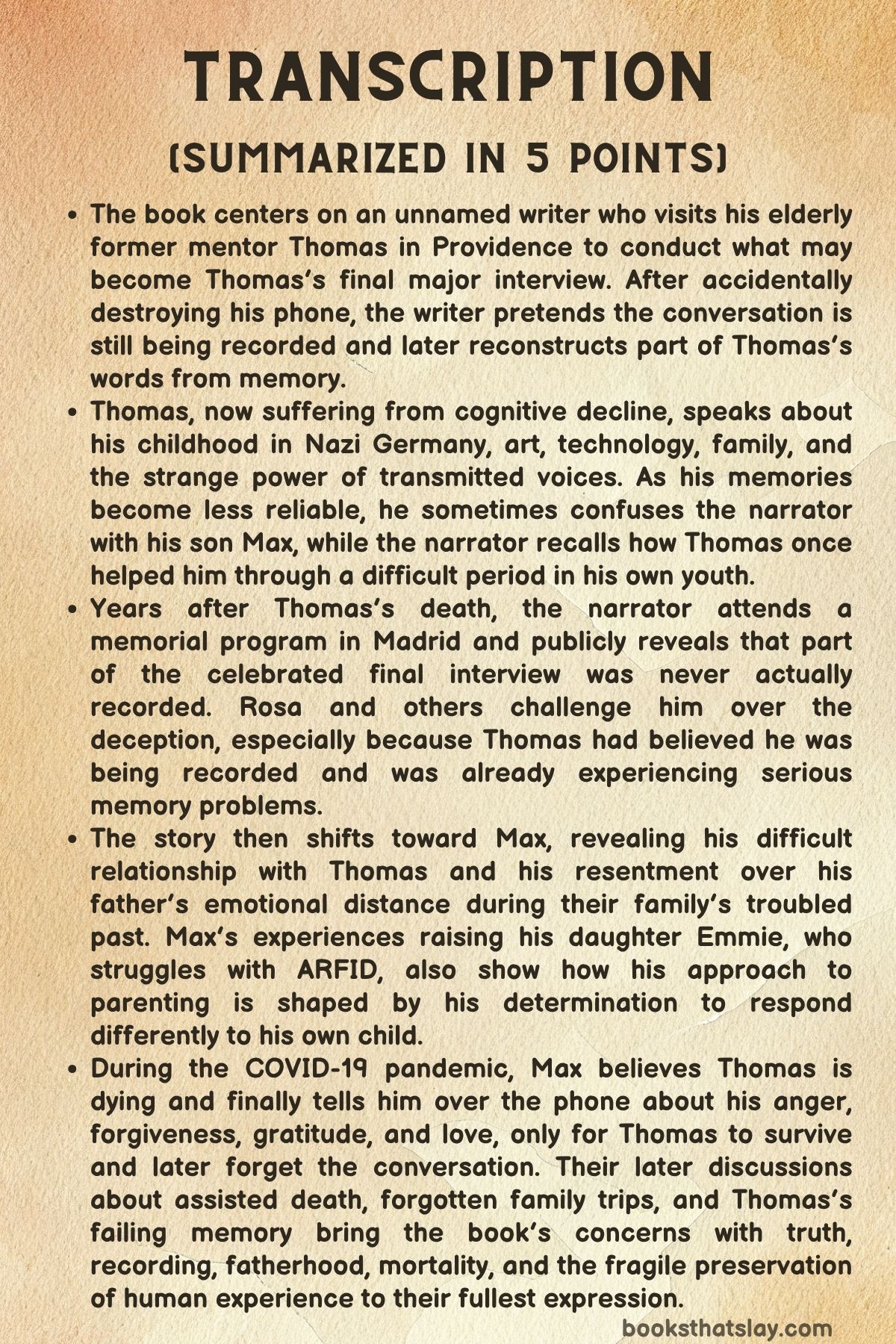
Characters
The Narrator
The unnamed narrator is both a writer and a former student whose relationship with Thomas combines admiration, gratitude, dependency, guilt, and a complicated sense of inheritance. In Transcription, his position is difficult because he is simultaneously a participant in Thomas’s life and someone professionally accustomed to turning other people’s words into written material.
His decision to pretend that his damaged phone is recording Thomas reveals one of his central weaknesses: he allows embarrassment and convenience to become ethical compromise. Rather than admitting a small mistake immediately, he creates circumstances in which he later has to reconstruct another person’s speech from memory and present that reconstruction with the authority of documentation.
His actions are not portrayed as simple malicious exploitation. He genuinely loves and respects Thomas, remembers how important Thomas was during his own psychological difficulties, and seems to believe that he can preserve the essential truth of their conversation even without an actual recording.
That belief is precisely what makes him morally complicated. He trusts his literary ability and memory enough to substitute them for technological evidence, yet he does not fully confront the fact that Thomas never consented to having remembered speech presented as recorded speech.
His relationship with Eva reveals another side of him. He is an anxious father who fears failing to reach his daughter emotionally, and the dream in which he cannot collect her suggests a deep concern that love may not guarantee access to another person’s inner life.
His memories of Mia, Anisa, and Andrés also show how strongly uncertainty has shaped him. Long before the incident with Thomas, he was already preoccupied with the problem of competing narratives and with how easily another person’s words can alter one’s understanding of reality.
His eventual confession at the memorial suggests a need to correct the record, but the timing complicates any simple interpretation of honesty. By confessing when Thomas can no longer respond, he transfers the consequences of his disclosure onto Max, Rosa, and the people responsible for Thomas’s legacy.
Thomas
Thomas stands at the intellectual and emotional center of Transcription, even when he is absent or dead. He is an aging artist and thinker whose influence extends through students, family members, colleagues, curators, and people attempting to preserve his work after his death.
His childhood in Nazi Germany gives his fascination with voices and technology a historical seriousness. Hitler’s voice on the radio is one of his early memories, making broadcast sound both a technological wonder and a reminder that unseen voices can exercise enormous power over individual consciousness.
As a mentor, Thomas profoundly affects the narrator. During the narrator’s period of psychological disturbance, Thomas provides ways of understanding unusual auditory experiences that allow the younger man to think about them rather than simply fear them.
Yet Thomas is not presented only through the narrator’s admiration. Max’s perspective complicates the image of the distinguished mentor by exposing Thomas as an emotionally difficult father whose intellectual capacities did not necessarily translate into sensitivity within his own family.
Thomas’s relationship with Virginie appears to have left lasting damage in Max. Her severe mental illness and death remain central to the emotional history between father and son, and Thomas’s apparent distance becomes one of the grievances Max continues carrying into adulthood.
His cognitive decline gives the character much of his tragic complexity. He still possesses flashes of intelligence, memory, and verbal power, but people and events are increasingly rearranged inside his mind.
His tendency to confuse the narrator with Max is especially significant because it exposes the instability of identity within memory. The narrator may occupy a partly filial position for Thomas, while Max experiences the painful possibility that an intellectual successor has become more accessible to his father’s failing mind than his biological son.
Thomas’s interest in Dignitas introduces his final attempt to exert control over a life increasingly shaped by bodily weakness and failing memory. His desire to choose the circumstances of death is therefore connected with autonomy, but it also places Max in an emotionally difficult position by making the son responsible for accompanying him toward that choice.
Max
Max is one of the characters who most strongly changes the reader’s understanding of Thomas. In Transcription, his perspective challenges the tendency to judge a celebrated intellectual primarily through the admiration of students, colleagues, and institutions.
As Thomas’s son, Max carries decades of unresolved resentment. He remembers not only his father’s behavior but the atmosphere surrounding Virginie’s mental illness and death, experiences that affected his understanding of family responsibility and emotional availability.
His anger becomes especially visible when Thomas criticizes the way Max and Adelle are handling Emmie’s eating problems. Thomas sees screen use and unrestricted access to sweets as questionable parenting, whereas Max hears the criticism through the accumulated history of having been raised by Thomas.
Max’s relationship with Emmie therefore becomes an important contrast with his own childhood. He is willing to abandon conventional rules when they do not help his daughter, even when doing so makes his household appear permissive or irrational to outsiders.
The apparent success of this approach reinforces Max’s determination to respond to Emmie as an individual rather than according to abstract standards. His fatherhood is partly shaped by an effort not to repeat the emotional failures he attributes to Thomas.
The pandemic phone call with Thomas is Max’s most vulnerable moment. Believing his father is dying, he finally speaks without restraint about anger, forgiveness, gratitude, and love, giving himself permission to acknowledge contradictory emotions at once.
Thomas’s survival does not provide the expected resolution because his memory of the conversation disappears. Max must therefore accept that forgiveness does not always require the other person to remember receiving it.
His secret recording of Thomas later complicates his moral position. Although he is angry about the narrator’s manipulation of Thomas’s final interview, Max also uses recording technology privately when trying to preserve his own father, revealing how easily the desire to keep a disappearing person can lead someone into ethically uncertain territory.
Eva
Eva is the narrator’s ten-year-old daughter and one of the quieter but emotionally important figures in the book. Her anxiety about school creates a contemporary parent-child problem that repeatedly echoes the narrator’s older relationship with Thomas and Max’s relationship with his own father.
The narrator worries about being unable to reach Eva when she needs him. His dream of trying and failing to collect her from school transforms this ordinary parental fear into an image of permanent separation, suggesting his anxiety that communication can fail even between people who deeply love one another.
Eva’s voice over Thomas’s landline is especially important because she is physically absent yet emotionally immediate. The scene places her voice beside the narrator’s memories of Thomas and his awareness of multiple generations, turning a simple phone call into a moment when parenthood, mentorship, aging, and childhood seem temporarily connected.
Virginie
Virginie, Thomas’s former partner and Max’s mother, is present largely through the memories of others, but her influence on the family is extensive. Her severe mental illness and eventual death form part of the emotional background against which Max judges Thomas both as a husband or partner and as a father.
Because Virginie does not control the telling of her own story, she also demonstrates one of the central problems explored throughout the book: a person may survive primarily through other people’s accounts. What readers know of her has already passed through Thomas’s damaged recollection or Max’s painful family memory.
Her absence therefore remains active rather than passive. The consequences of her illness continue shaping Max’s resentment, Thomas’s recollections, and the emotional distance between father and son long after she is gone.
Mia
Mia belongs to the narrator’s college past and represents an earlier period in which he struggled with uncertainty, desire, trust, and competing versions of events. His memories of her return while he is dealing with Thomas, suggesting that his present ethical crisis awakens older questions about how he decides what to believe.
The narrator’s later conversation with Mia shows that the past has never become entirely settled. Even years later, she remains connected in his mind with Andrés and with stories that once shaped his emotional reality.
Mia is therefore important not because she dominates the present action but because she reveals how memory continually reorganizes old relationships. The narrator does not simply remember her; he reinterprets what happened between them in light of what he now knows about storytelling, evidence, and uncertainty.
Anisa
Anisa is associated with the deceptive or unreliable stories concerning Mia and Andrés during the narrator’s college years. Her role demonstrates how one person’s speech can alter other people’s relationships even when the truth of that speech remains uncertain.
Through Anisa, the book establishes an early personal example of the dangers of mediation. The narrator learns about important events not necessarily by witnessing them but by receiving someone else’s account, placing him in the same interpretive position later occupied by readers of his reconstructed interview with Thomas.
Her importance lies less in extensive direct action than in the effect of her words. She shows that narration itself can become an event with real consequences.
Andrés
Andrés is connected with Mia and the narrator’s unresolved memories of college. The fact that the narrator searches for him online years later, while attending Thomas’s memorial in Madrid, indicates that Andrés remains a figure of unanswered questions rather than a closed chapter of the narrator’s youth.
The search is significant because technology offers the narrator another form of access to the past. Just as recordings seem to preserve voices, internet searches seem to promise that lost people can be recovered through traces, yet information does not necessarily produce emotional certainty.
Andrés consequently represents the persistence of unresolved history. His continuing place in the narrator’s thoughts shows how a person can remain psychologically present even after direct contact has ended.
Rosa
Rosa serves as one of the strongest ethical counterweights to the narrator in Transcription. As a curator closely connected to Thomas and invested in preserving his legacy, she understands that the reliability of Thomas’s published words matters beyond the narrator’s private intentions.
Her confrontation after the memorial forces the narrator to reconsider his reconstruction of the Providence interview. She rejects his attempt to place the incident within ordinary editorial practice because Thomas believed he was being recorded and was already experiencing significant cognitive decline.
Rosa is also sensitive to the consequences of timing. The narrator’s public confession may appear to him like transparency, but she recognizes that revealing the deception at a memorial forces Thomas’s family and professional community to respond to an ethical problem during an event meant to honor him.
Her character therefore represents accountability rather than simple condemnation. She asks the narrator to consider how his choices affected a vulnerable person and how those choices altered the historical record left behind.
Emmie
Emmie, Max and Adelle’s daughter, experiences severe difficulty eating and is eventually diagnosed with ARFID. Her condition places Max and Adelle in a situation where familiar assumptions about healthy parenting no longer provide useful answers.
Her response to treatment becomes especially revealing. Removing restrictions, permitting sweets, and allowing screens during meals appear unconventional, yet these changes help reduce her anxiety and enable her to begin eating more successfully.
Emmie’s storyline also provides an important generational contrast. Thomas evaluates her behavior according to his own assumptions, while Max chooses to trust specialists and his daughter’s actual responses rather than maintain rules simply because adults consider them proper.
Through Emmie, care becomes associated with adaptation. Supporting another person sometimes requires abandoning the appearance of correctness in favor of understanding what actually allows that person to function.
Adelle
Adelle, Max’s wife and Emmie’s mother, shares the long period of uncertainty surrounding their daughter’s inability to eat normally. She participates in the difficult parental process of consulting doctors, trying unsuccessful approaches, and eventually accepting a treatment strategy that may look irresponsible to outsiders.
Her partnership with Max suggests a household attempting to respond collectively rather than blaming Emmie for behavior she cannot easily control. Although Max receives more narrative attention, Adelle’s presence helps establish that the family’s unconventional choices are part of a sustained effort to protect their daughter.
She also belongs to the generation dealing with the consequences of Thomas and Max’s unresolved relationship. Thomas’s visit brings older family tensions into the home she has created with Max, showing how conflicts between parents and children can continue affecting later marriages and households.
Dr. Saro
Dr. Saro plays a limited but important role by providing a new framework for understanding Emmie’s eating difficulties. The diagnosis and treatment recommendations challenge the family’s previous attempts to regulate food through ordinary expectations.
Instead of treating Emmie’s behavior as stubbornness or poor discipline, Dr. Saro helps Max and Adelle see that reducing pressure can be more effective than increasing control. His approach becomes a practical demonstration of the value of responding to an individual’s actual condition rather than forcing that person to conform to a general model.
The improvement that follows gives his advice broader thematic relevance. What first appears counterintuitive can become reasonable when the underlying situation is properly understood.
Themes
Memory, Recording, and the Problem of Preservation
Memory in Transcription is never a simple storage system. The story repeatedly places human recollection beside technologies designed to preserve voices, demonstrating that neither memory nor recording can guarantee complete access to the past.
The narrator’s broken phone exposes this problem directly. Once the recording fails, he attempts to reproduce Thomas’s words from memory, turning recollection into a substitute for documentation and creating uncertainty about where Thomas’s speech ends and the narrator’s authorship begins.
Thomas’s cognitive decline intensifies the issue. He remembers certain historical experiences from childhood while confusing people in the present, and he can preserve details involving the narrator while forgetting experiences that Max remembers as fundamental to their relationship.
The secret recording Max later makes does not solve the problem either. Even when technology captures exact words, it cannot preserve the entire emotional situation surrounding them, nor can it guarantee that speaker and listener understand those words in the same way.
The pandemic phone call offers the clearest example. Max remembers the conversation as a decisive emotional farewell, but Thomas later remembers nothing of it, meaning that an event of immense importance can remain real for one person while effectively disappearing for another.
The book therefore presents preservation as necessarily incomplete. Records can keep sounds, memory can preserve impressions, and writing can reconstruct experience, but none of these methods can reproduce an entire human moment without alteration.
Fathers, Children, and Inherited Emotional Distance
Parent-child relationships repeat across generations, but the book refuses to suggest that they repeat in exactly the same form. The narrator worries about Eva, Max struggles with Thomas, and Max in turn attempts to care for Emmie in ways shaped partly by what he believes was missing from his own childhood.
Thomas appears very different depending on whether he is viewed as mentor or father. The narrator remembers a man capable of offering intellectual and psychological guidance during a vulnerable period, while Max remembers emotional distance and unresolved pain surrounding Virginie.
This contrast demonstrates that personal qualities do not operate uniformly across relationships. Someone capable of generosity toward a student may still disappoint a child, because parenthood creates expectations and responsibilities fundamentally different from those of mentorship.
Max’s treatment of Emmie becomes especially important in this context. He accepts strategies that Thomas considers improper because he values his daughter’s actual needs over the appearance of conventional parental authority.
The narrator’s fear of failing Eva adds another variation. His anxiety is less openly resentful than Max’s relationship with Thomas, but his recurring fear of being unable to reach his daughter shows that emotional connection can never be taken for granted.
Across these relationships, love does not erase misunderstanding. Parents can care for children while failing them, children can resent parents while loving them, and forgiveness can occur without creating a perfectly repaired relationship.
Authorship, Truth, and Ethical Responsibility
The reconstructed interview raises the difficult question of whether emotional or literary truth can justify altering the factual conditions under which a text was produced. The narrator believes he remembers enough of Thomas’s conversation to restore what the broken phone failed to capture, but accuracy is not the only ethical issue involved.
Thomas believed that a functioning recording device was preserving his speech. Because that belief was false, the narrator’s later reconstruction rests on a concealed difference between what Thomas thought was happening and what actually happened.
Rosa emphasizes that distinction because Thomas’s cognitive decline increases his vulnerability. The narrator is not merely editing a fully informed speaker’s words; he is making decisions about the public representation of an elderly man whose ability to monitor those decisions is weakening.
The problem becomes larger once the interview enters Thomas’s professional legacy. Readers treat published interviews as documents associated with a real person, meaning that a reconstructed passage can influence how future audiences understand someone who can no longer clarify or contest the record.
Max’s own secret recording prevents the issue from becoming morally simplistic. His actions show that the desire to preserve another person can tempt even someone angry about another recording-related deception.
Truth therefore involves more than whether individual sentences are approximately accurate. Consent, context, intention, power, attribution, and the expectations of future readers all determine whether an act of preservation is responsible.
Mortality, Voice, and Continuing Presence
Death is repeatedly approached through voices that remain present when bodies are absent. In Transcription, telephones, interviews, published texts, memories, and recordings create forms of continued presence, but they also emphasize the distance separating the living from people who are dying, aging, or already dead.
Thomas’s childhood memory of Hitler on the radio introduces the strange authority of a disembodied voice. Long before digital devices become central to the story, sound already possesses the ability to cross physical boundaries and place an absent person inside another person’s immediate surroundings.
The narrator later experiences something more intimate when he hears Eva over Thomas’s landline. Her voice arrives from elsewhere while he is physically beside his aging mentor, making childhood and old age feel momentarily connected through transmission.
The pandemic transforms this technological possibility into necessity. Max cannot be physically beside Thomas when he believes his father is dying, so the nurse’s phone becomes the only space in which their relationship can reach what appears to be its final exchange.
Thomas’s unexpected survival complicates that apparent closure because his failing memory erases the conversation from his own awareness. Max discovers that words can remain permanently important to the speaker even when the listener no longer possesses them.
Thomas’s later interest in assisted death gives mortality another dimension by turning death from an approaching event into a possible decision. His wish for control over the end of his life stands against the uncontrollable disappearance of memory, leaving voice as one of the few things people can attempt to preserve after physical presence is gone.