Until I Die Summary, Characters and Themes
Until I Die by Deidra Duncan is a dystopian war romance set in a fractured United States ruled by an authoritarian regime that strips women of autonomy and crushes political opposition.
At its center is Sophia Reeves, a medic for the Defiance who becomes the secret contact of Lucas Scott, one of the regime’s most feared Blood Colonels. What begins as an intelligence arrangement shaped by fear gradually becomes a complicated relationship involving trust, guilt, trauma, loyalty, and love. Against a background of executions, military operations, political manipulation, and personal loss, the book asks whether a person responsible for terrible acts can still choose to become something different.
Summary
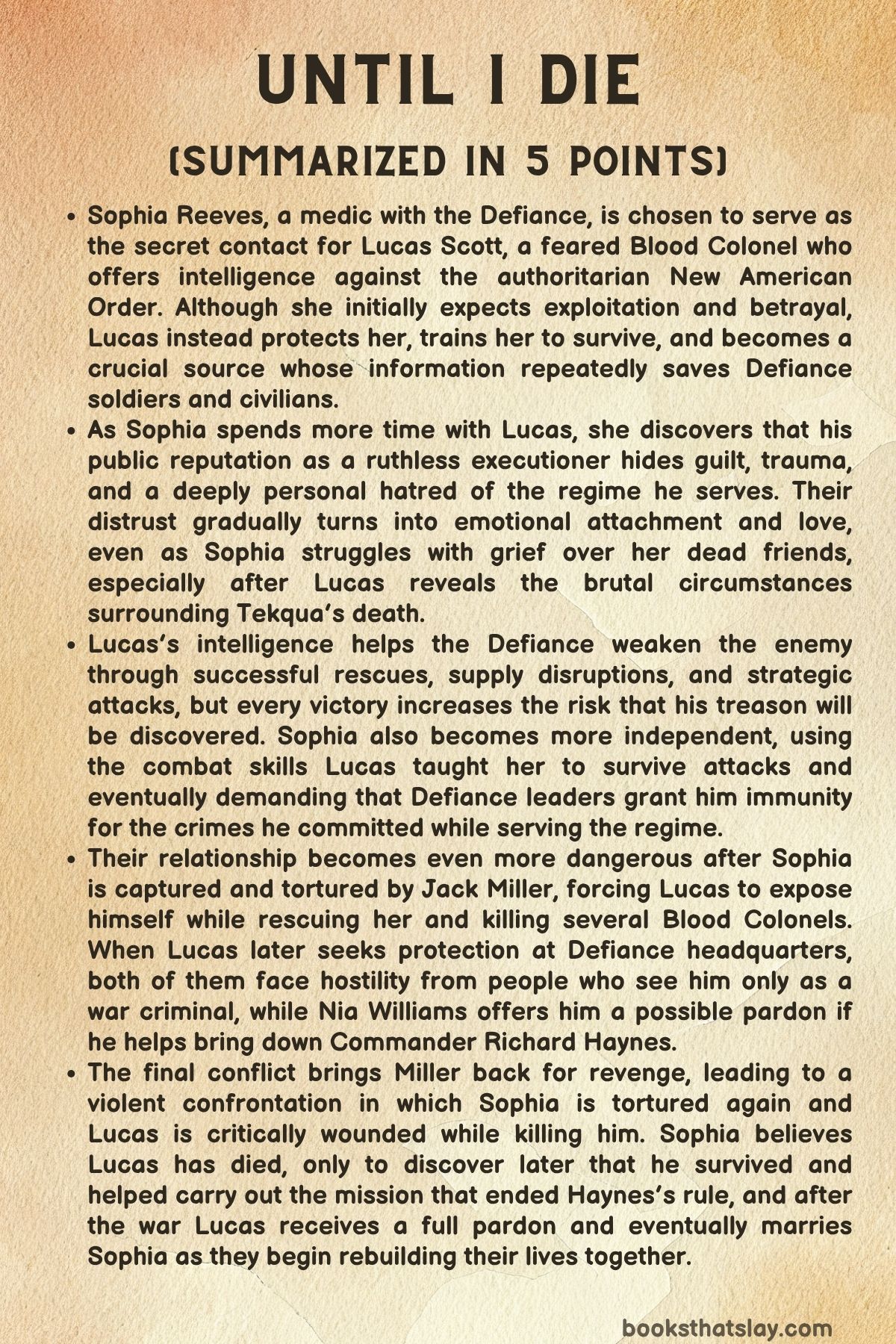
Sophia Reeves has spent years serving the Defiance, a resistance movement fighting the New American Order and the authoritarian government that has replaced the old United States. Prime Delegate Nia Williams and General Theodore Harrison summon her with an extraordinary assignment: Lucas Scott, a notorious Blood Colonel responsible for public executions, wants to provide secret military intelligence, but he will communicate only through a female intermediary.
Sophia assumes the arrangement will require sexual submission because the New American Order has reduced women to property and made violence against them routine. She nevertheless accepts, partly because the Defiance desperately needs reliable information and partly because she still hopes to learn what happened to her missing best friend, Tekqua.
Sophia understands exactly why intelligence matters after another resistance operation ends with catastrophic casualties because of faulty information. As a medic, she treats wounded soldiers and even helps a dying man named Aiden end his suffering, reinforcing her belief that Lucas’s information could save lives even if meeting him means placing herself in terrible danger.
Her first encounter with Lucas appears to confirm her fears when he insults her and imposes strict rules concerning secrecy, weekly meetings, and obedience. Yet when Sophia assumes that he expects sex, Lucas refuses her offer and explains that he chose a single contact because he wants one person to memorize his intelligence, making it harder for the Defiance to discard either the information or its messenger.
Lucas immediately proves useful by warning of an impending Hunter attack. The Defiance evacuates civilians and prepares an ambush, but during the battle Sophia and another medic, Liliana, are cornered by Hunters; Lucas unexpectedly kills members of his own side to prevent Sophia from being captured, then shields her while additional soldiers pass nearby.
Liliana is already dying, and Lucas ends her suffering before sending Sophia to safety. His actions disturb Sophia because they conflict with everything she believes about him: the public Blood Colonel appears merciless, yet the private informant has just risked exposure and death to save her.
Sophia’s confusion is intensified by memories of her own wartime losses. She remembers killing a Hunter to save Tekqua, the death of Rodrigo during a disastrous evacuation, the disappearance of friends such as Princeton and Daniela, and her father’s warning that killing becomes truly dangerous when a person stops feeling remorse.
Lucas seems to violate that principle because he can kill with astonishing calm. At the same time, his behavior toward Sophia becomes increasingly protective: he gives her safer clothing, Hunter weapons, a pager, an emergency signaling system, and combat training designed to stop her from freezing when physically threatened.
Lucas also gives the Defiance information that repeatedly changes the course of operations. He helps arrange the rescue of Lily Wyatt, the sixteen-year-old daughter of General Dean Wyatt, who was intended to be handed to Lucas as a bride; his disgust toward the plan reveals that he does not share many of the values of the government he publicly serves.
As Sophia spends more time with him, she discovers evidence of a private life hidden beneath his reputation. She notices punishment brands on his body, hears him admit that he remembers the voices of people begging him for mercy, learns that his sister suffered because of the regime, and gradually realizes that his clinical behavior during executions does not mean those deaths leave him untouched.
Their weekly meetings become a mixture of intelligence work, argument, combat practice, humor, and growing attraction. Lucas teaches Sophia to fight with knives and escape close-range attacks, while Sophia increasingly challenges his belief that he deserves only hatred and death.
Their progress is shaken when Lucas admits that he volunteered to execute a thirteen-year-old boy. Furious, Sophia attacks him with the very skills he taught her, but Lucas refuses to defend himself and seems willing to let her kill him, revealing the depth of his self-hatred.
Sophia later asks Lucas to discover Tekqua’s fate. He learns that Tekqua was captured, assaulted by Blood Colonels after resisting them, and died after falling against a transport ramp while restrained; the revelation triggers a severe panic attack, and Lucas holds Sophia through the storm until she can breathe again.
Their emotional dependence grows after this moment. When another Hunter unexpectedly enters the safe house, Lucas and Sophia are forced to stage a scene suggesting that he keeps her as a sexual prisoner, but the performance exposes how completely she has come to trust him even when circumstances make him appear threatening.
The staged encounter is followed by their first voluntary kiss, and Sophia begins understanding the complicated purpose behind Lucas’s executions. He chooses fast methods for people who would otherwise be killed more brutally, though he refuses to describe his actions as mercy because he believes accepting that explanation would excuse too much.
Meanwhile, Lucas’s intelligence allows Theo to free approximately two hundred prisoners. To protect his position during one operation, however, Lucas kills thirty-two innocent people, and the guilt nearly destroys him; when Sophia finds him afterward, their suppressed emotions finally break through, and they become lovers.
Theo reacts harshly when he realizes what has happened. Sophia accuses him of hypocrisy because he initially sent her to Lucas expecting that she might be sexually exploited, yet now condemns a relationship that Sophia herself has chosen.
Lucas reacts differently by attempting to end the personal relationship altogether. Believing that anyone he loves will eventually become a target, he reduces their meetings to brief exchanges of intelligence, insisting that Sophia must protect her heart from a man he assumes is already condemned.
Their separation collapses when Sophia is unexpectedly sent into field combat and is severely wounded. Using Lucas’s training, she kills the Hunter attacking her and manages to reach their safe house, where she activates the red emergency signal moments before losing consciousness.
Lucas finds her, stops the blood loss, and saves her life. His attempt at emotional distance disappears as he angrily condemns the Defiance for repeatedly treating Sophia as expendable, while Sophia admits that she could never participate in an operation intended to execute him.
During Sophia’s recovery she discovers that Lucas was a doctor before becoming a Hunter. He cares for her wounds with extraordinary attention and finally reveals more of his past, including the damage inflicted on his sister and family by Jack Miller, Anna’s House network, and the system Lucas outwardly serves.
Sophia asks him to remain with her, and Lucas promises that he will stay until he dies. Their relationship deepens during her recovery, even as both understand that his role as a secret informant is becoming impossible to maintain.
When Sophia finally returns to Defiance headquarters, she tells Theo that Lucas saved her and openly acknowledges their sexual relationship. She then uses her importance to Lucas as leverage, demanding that the resistance consider granting him immunity for his crimes in exchange for his continued cooperation.
Theo eventually agrees to pursue the arrangement. Lucas receives conditional immunity and continues supplying information that weakens Hunter logistics, while Sophia spends increasing amounts of time with him and begins imagining a future neither of them had previously allowed themselves to consider.
That fragile possibility is shattered when Hunters capture Sophia during an attack on a medical facility. She is beaten, restrained, starved, and eventually brought before Jack Miller and other Blood Colonels, with Lucas forced to participate in the appearance of her degradation so he can preserve his cover long enough to reach her.
Lucas eventually engineers access to Sophia and discovers that her captors carved a Brotherhood Cross into her back. His rage erupts into open violence against Miller, Blake, Kingston, and the other colonels, permanently exposing him as a traitor.
Sophia joins the fight rather than remaining passive. Miller survives long enough to shoot Lucas, forcing the couple to escape before reinforcements arrive; during their flight, Sophia and Lucas finally tell each other that they are in love.
Lucas still tries to separate from her because he believes his exposure has made her unsafe. Sophia refuses, arguing that he would never abandon her if their situations were reversed, and she takes him directly to Defiance headquarters to demand protection under the immunity agreement.
The reception is hostile. Many Defiants know Lucas only as the man who publicly executed prisoners, and some attack him in the stockade while others turn their anger toward Sophia for loving him.
Theo eventually announces that Lucas has been the secret intelligence source responsible for many of the Defiance’s recent victories and declares both Lucas and Sophia protected under command sanctuary. The announcement prevents immediate vengeance but cannot erase years of hatred.
Nia Williams then makes Lucas’s final pardon conditional on helping the Defiance reach Commander Richard Haynes. Sophia must also give a public interview describing her experiences, allowing the rebellion to expose the regime’s treatment of women and present Lucas’s defection as evidence of the New American Order’s internal collapse.
Sophia and Lucas reluctantly accept. While Lucas helps prepare the mission, they are allowed to live together in an isolated cabin, where Sophia finally admits that the trauma of her capture has left her far from fine and Lucas refuses to let her hide from that reality.
Sophia’s interview becomes a major propaganda success, but soon afterward Hunters launch a devastating assault on Defiance headquarters. Lucas, Sophia, Adam, and the others fight through the chaos until Sophia sees that Jack Miller has survived their earlier confrontation and has come specifically for revenge.
Miller captures Sophia again and uses extraordinary violence to draw Lucas into a trap, breaking her finger and driving a knife through her hands into a chair. Lucas arrives with Adam, and the confrontation ends inside a burning cabin as Lucas kills Miller with his own blade and Sophia shoots Miller repeatedly to make certain he cannot recover.
Lucas has been stabbed deeply in the chest and collapses. Sophia tries desperately to drag him from the burning building despite her mutilated hands, but smoke overwhelms her before she can escape.
She awakens in a hospital five days later and is told that Lucas was believed dead. Although Haynes’s regime is collapsing and the Unified States is surrendering under international pressure, victory means almost nothing to Sophia because she believes the person she wanted to share that future with is gone.
Nia Williams later brings Sophia to Washington for a press conference following Haynes’s assassination. Sophia expects another political ceremony built around her suffering, only to see Lucas walk toward her alive.
He survived the stabbing and went on to participate in the mission against Haynes. When Sophia asks again for the promise that once ended with death, Lucas finally changes it: instead of saying he will remain until he dies, he promises to remain forever.
The collapse of the regime does not instantly erase the damage left by war, but it gives Sophia and Lucas something they rarely possessed before: choice. Their relationship becomes publicly famous, Lucas eventually receives a full pardon, and the couple begins trying to build a life that is no longer governed entirely by combat, secrecy, or the expectation of death.
Lucas covers the Brotherhood brands on his arm with new tattoos, while Sophia begins accepting the possibility of professional help and emotional recovery. One year later, after Lucas’s pardon becomes official, they marry, and Sophia keeps both his old gold ring and her wedding ring as reminders of everything they survived before finally reaching a future together.
Characters
Sophia Reeves
Sophia is the emotional and narrative center of Until I Die, and nearly every major conflict is filtered through her attempts to remain compassionate in circumstances that repeatedly punish compassion. She begins as a medic who regards herself as increasingly expendable because so many members of her original circle have died, and that damaged sense of self-worth explains why she accepts an assignment that others might have considered intolerable.
Her defining quality is not physical strength but persistence. Sophia experiences panic attacks, grief, combat trauma, sexualized threats, serious injuries, and repeated encounters with death, yet she continually returns to medical work, friendship, resistance activity, and eventually love.
Her development is especially visible through combat training. Early in the story she freezes when threatened and depends heavily on others, whereas later she uses Lucas’s lessons to defeat attackers, survive knife fights, resist capture, and participate directly in confrontations with men such as Miller.
Sophia also becomes increasingly politically independent. She begins by obeying Theo and Williams despite private doubts, but ultimately challenges their hypocrisy, demands immunity for Lucas, rejects attempts to use her as a weapon against him, and insists that her intimate choices belong to her rather than to either political side.
Her love for Lucas is therefore connected to her larger struggle for agency. Choosing him does not erase his past; instead, Sophia knowingly accepts the moral complications while refusing to let other people define what she is permitted to feel.
Lucas Scott
Lucas is the central moral contradiction of Until I Die. Publicly, he is a Blood Colonel feared for carrying out executions with clinical precision, yet privately he is a traitor who supplies the Defiance with information capable of dismantling the system he appears to defend.
His apparent coldness is gradually revealed as emotional containment rather than absence of conscience. He remembers the pleas of those he has killed, believes himself deserving of death, and sometimes treats his continued survival almost as punishment.
Lucas’s medical background is crucial to understanding him. His ability to save Sophia after catastrophic blood loss shows that healing was once central to his identity, making his transformation into an executioner even more psychologically destructive.
His protectiveness toward Sophia grows from practical concern into total emotional commitment. He gives her weapons, clothing, training, communications equipment, medical treatment, intelligence, and repeated physical protection, but his deepest fear is not dying himself; it is that loving him will cause Sophia to die.
Lucas also has a severe tendency toward self-sacrifice and self-condemnation. He repeatedly attempts to distance himself from Sophia because he assumes he has no legitimate future, and even the possibility of pardon initially fails to convince him that society will ever allow him to exist as anything other than a murderer.
His ultimate arc does not erase his crimes. Instead, the book allows him to act against the regime, accept responsibility, assist in destroying Haynes’s government, and imagine that redemption may involve living with what he has done rather than simply dying for it.
General Theodore Harrison
Theo occupies a complicated position in Until I Die because he is simultaneously Sophia’s protector, superior officer, family-like figure, and occasional source of betrayal. His love for Sophia appears genuine, particularly when she is injured or threatened, but he repeatedly places strategic necessity above her personal safety.
His greatest contradiction appears in the original assignment. Theo is reluctant to send Sophia to Lucas, yet ultimately allows an operation whose planners assume she may have to submit sexually to an enemy officer, and Sophia later forces him to recognize how deeply this conflicts with the Defiance’s stated commitment to equality.
Theo’s hostility toward Lucas is understandable because Lucas has personally executed people belonging to the resistance. At the same time, Theo gradually accepts that the Defiance depends on Lucas’s intelligence and eventually publicly protects him when anger inside headquarters threatens to become mob violence.
Theo therefore represents the compromises of leadership during war. He cares about individuals, but command repeatedly requires him to think in terms of casualty numbers, operations, political consequences, and strategic assets, sometimes making him resemble the systems he opposes more than he would like to admit.
Nia Williams
Nia Williams represents political calculation at its most disciplined in Until I Die. She recruits resistance fighters before the war fully develops, recognizes the value of Lucas’s intelligence network, and continually thinks several steps beyond the immediate needs of individual people.
Unlike Theo, Williams rarely allows emotional concern to interfere visibly with strategy. She treats Sophia’s relationship with Lucas as useful political material, ties Lucas’s pardon to the operation against Haynes, and transforms Sophia’s trauma into testimony designed to influence international opinion.
Her actions can appear ruthless because she is willing to use personal suffering for public objectives. Yet the story also establishes that her calculations contribute directly to the destruction of the New American Order and the eventual political collapse of Haynes’s regime.
Williams embodies the uncomfortable difference between personal morality and wartime leadership. Her decisions often wound Sophia emotionally, but they are made within a framework in which military victory and national reconstruction depend on extracting maximum value from limited opportunities.
Tekqua
Tekqua remains one of the most influential absent characters in Until I Die. Her disappearance shapes Sophia’s decision to accept the Lucas assignment because the possibility that he might discover what happened to her gives Sophia a personal reason to endure the danger.
Memories establish Tekqua as brave, practical, and deeply important to Sophia. Sophia’s first killing occurs while saving her from a Hunter, making Tekqua permanently connected to Sophia’s earliest understanding of the moral cost of violence.
The truth of Tekqua’s death also exposes the gendered brutality of the regime. Her assault by Blood Colonels and accidental death while restrained demonstrate how institutionalized cruelty destroys people even when no formal execution has been ordered.
Tekqua therefore continues shaping Sophia long after death. Learning her fate brings painful closure but also strengthens Sophia’s understanding that grief cannot simply be defeated through discipline or avoidance.
Adam
Adam functions as one of Sophia’s most dependable surviving friends. He notices her repeated Thursday disappearances, recognizes Hunter equipment among her possessions, and correctly senses that Theo has involved her in an arrangement carrying serious personal danger.
What distinguishes Adam is his refusal to demand information Sophia cannot safely provide. His priority is whether she is being harmed, showing a form of loyalty based on trust rather than control.
He later defends Sophia when Defiants turn against her because of Lucas. Adam also fights beside Sophia and Lucas during the final attacks, suffering a gunshot wound while helping them confront Miller.
His survival matters because he represents continuity between Sophia’s former life within the resistance and the uncertain future she builds with Lucas. He reminds her that loving Lucas does not require abandoning every relationship that existed before him.
Devon
Devon belongs to Sophia’s remaining emotional support network and helps connect her to ordinary friendship during a period when secrecy and grief are isolating her. His presence recalls an earlier version of Sophia who could joke, socialize, and participate in relationships not defined entirely by trauma.
When the truth about Lucas finally becomes public, Devon does not simply reduce Sophia to her controversial relationship. He helps reinforce the idea that she remains a valued friend even after months of emotional withdrawal.
Devon’s role is quieter than those of Adam or Zara, but that quietness is meaningful. He represents the continued existence of community around Sophia even when she convinces herself that repeated loss has left her alone.
Zara Akbari
Zara is one of the clearest sources of emotional care available to Sophia outside her relationship with Lucas. Having helped train Sophia medically alongside Dr. Grayson, she understands both Sophia’s professional competence and the defensive habits she has developed after repeated loss.
Zara challenges Sophia’s insistence that she is fine without forcing an unwanted confession. Her willingness to talk openly about grief and isolation briefly allows Sophia to laugh again and recognize that withdrawing from everyone has not actually protected her.
Later, Zara treats Sophia after her capture and is permitted to care for Lucas while he is confined. Her medical role therefore extends into a broader function as a bridge between divided people.
Zara offers a model of support that differs from Lucas’s fierce protectiveness or Theo’s authority. She helps by remaining present, observant, and emotionally honest.
Isaac
Isaac represents the difficulty ordinary Defiance members face when asked to accept Lucas as anything other than an enemy. He has fought against Hunters directly and therefore cannot easily separate the intelligence source Sophia loves from the Blood Colonel whose public identity symbolizes state violence.
His hostility, however, does not become mindless vengeance. Isaac continues participating in Sophia’s world, helps enforce boundaries around Lucas’s confinement, and eventually remains part of the resistance operation against Haynes.
The character is important because his discomfort gives legitimacy to a question the romance cannot erase: people harmed by Lucas’s side are not required to forgive him simply because Sophia does. Isaac’s restraint shows that coexistence can begin before emotional reconciliation does.
Lily Wyatt
Lily Wyatt is a sixteen-year-old girl raised within the New American Order’s gender ideology. Her father intends to give her to Lucas as a bride and political reward, demonstrating how thoroughly the regime treats female autonomy as disposable.
After her rescue, Lily initially responds with hostility rather than gratitude because she has internalized the beliefs of the society that oppressed her. Her prejudices and assumptions show that liberation from an institution does not instantly free a person from its conditioning.
Lucas’s disgust at what has been done to Lily becomes one of Sophia’s earliest indications that he does not genuinely accept the ideology he publicly serves. Lily therefore functions both as a victim of indoctrination and as evidence of Lucas’s concealed moral rebellion.
Jack Miller
Jack Miller is the most personal antagonist in the story because his violence is directed not merely at political enemies but at people Lucas loves. His past involvement in the destruction of Lucas’s family helps explain why Lucas became a traitor, while his later treatment of Sophia transforms the political conflict into a deeply personal one.
Miller thrives on humiliation, domination, and psychological cruelty. He understands that hurting Sophia is one of the most effective ways to hurt Lucas, and he deliberately turns her body into both a weapon and a message.
His repeated survival extends his threat beyond ordinary battlefield antagonism. When he captures Sophia during the final assault, breaks her finger, and drives a knife through her hands to lure Lucas into a trap, his purpose is revenge rather than strategy.
Miller’s eventual death requires both Lucas and Sophia. That shared act gives the confrontation symbolic importance because the person he tried to reduce to helpless bait actively participates in ending his power over them.
Richard Haynes
Richard Haynes is the ideological architect of the political catastrophe. He transforms nationalist promises about unity, religion, borders, and traditional families into censorship, political murder, gender oppression, racial persecution, martial law, and eventually open warfare.
Haynes rarely needs direct personal interaction with Sophia because his influence is present throughout the society surrounding her. The Hunters, the Brotherhood Cross, the degradation of women, the public executions, and the war itself all grow from the political system built around him.
His importance lies in showing how authoritarianism develops through escalation. Repressive policies become normalized one stage at a time until murder, forced obedience, and institutional terror can be presented as necessary components of national stability.
His assassination therefore represents more than the removal of one individual. It signals the destruction of the central authority holding the New American Order together, although the surviving loyalists prove that ending a ruler does not immediately erase the movement he created.
Anna
Anna operates within the regime’s shadow structures and is connected to the House, a system associated with the exploitation of women. Her connection to Lucas’s past and to the information network surrounding captured women makes her an important figure in understanding what happened to his family and why he turned against the government.
She also demonstrates that political systems of abuse depend on networks rather than a single villain. The House exists because numerous people maintain, profit from, or tolerate an institution designed to reduce women to objects.
Anna’s network later becomes relevant when Lucas searches desperately for Sophia after her capture. The absence of information from that network contributes to his belief that Sophia may have been killed and discarded without documentation.
General Dean Wyatt
Dean Wyatt is Lily’s father and a senior figure in the Unified States Army. His willingness to give his sixteen-year-old daughter to Lucas as a bride and reward exposes how fully political loyalty, patriarchy, and personal control have become connected within the regime.
Wyatt also functions as a contrast with Lucas. Both are powerful men operating inside the same system, but Lucas secretly rejects the assumption that Lily should be transferred between men as property, whereas Wyatt apparently accepts the arrangement as legitimate.
Through Wyatt, the story shows that the regime’s abuse of women is not limited to criminal behavior occurring outside official authority. It is built directly into family expectations, military relationships, and ideas of male entitlement.
Logan Bergeron
Logan Bergeron is responsible for recording Sophia’s public testimony. His role becomes important because he recognizes the political value of the contrast between Lucas’s terrifying public reputation and Sophia’s account of the man who trained, protected, and repeatedly rescued her.
For Sophia, Logan’s interview represents another loss of privacy. She must recount deeply traumatic experiences for an audience because Lucas’s pardon and the Defiance’s international strategy partly depend on making her personal story politically useful.
Logan is not presented as deliberately cruel, but his professional task shows how storytelling can become another battlefield. The version eventually broadcast cannot contain every contradiction of Sophia and Lucas’s relationship, so their painful private history becomes a simplified public narrative.
Rodrigo
Rodrigo belongs to Sophia’s original wartime circle and becomes one of the first people whose death transforms her emotionally. During the evacuation of Safe House Red, he repeatedly protects members of the squad before being shot in the chest.
Sophia cannot save him despite her medical knowledge. His death teaches her that professional competence cannot prevent every loss and that grief can produce an almost physical collapse.
Rodrigo consequently becomes part of the emotional background that explains Sophia’s later detachment. Each new death is experienced not in isolation but on top of memories of people such as Rodrigo who disappeared earlier in the war.
Daniela
Daniela is another member of Sophia’s earlier circle whose suffering remains deeply connected to her fear of Hunters. Memories of what happened to Daniela contribute to Sophia’s panic when Lucas initially exposes her vulnerability during training and while changing her appearance.
Although Daniela receives limited direct action in the later story, her importance survives through Sophia’s trauma. She represents the experiences Sophia has witnessed or learned about that make capture by the New American Order seem worse than death.
The character therefore helps explain why Sophia’s earliest interactions with Lucas are governed by terror rather than ordinary distrust. Sophia has concrete reasons to believe that powerful men connected to his organization are capable of extreme abuse.
Princeton
Princeton is one of the last members of Sophia’s original squad to die before Tekqua disappears. The memory of his death is powerful enough that hearing Lucas’s identity during Sophia’s first briefing contributes to her panic attack.
His importance is primarily emotional rather than strategic. Princeton belongs to the accumulation of losses that causes Sophia to think of herself as one of the few people left from a vanished group.
Through characters such as Princeton, the story makes Sophia’s grief cumulative. She is not recovering from one tragedy but carrying many unresolved deaths simultaneously.
Liliana
Liliana works beside Sophia as a medic during the operation made possible by Lucas’s first major intelligence contribution. When Hunters ambush them, she receives a fatal knife wound that Sophia desperately wants to treat.
Lucas recognizes that Liliana cannot survive and removes the weapon, causing her death quickly. The moment becomes central to Sophia’s early judgment of Lucas because she initially experiences his action primarily as another example of his coldness.
Liliana’s death later becomes part of the broader question surrounding mercy. The story repeatedly asks whether ending unavoidable suffering can coexist with moral responsibility when violence has already removed every good option.
Aiden
Aiden appears briefly as a mortally wounded soldier after a disastrous Defiance operation. Sophia discovers that removing the bolt from his chest will kill him, but Aiden asks her to do it because continued survival would mean only prolonged suffering.
His death parallels later questions about Lucas’s behavior toward condemned prisoners. Sophia herself is capable of causing death when she believes no realistic path to survival remains, complicating any simple division between healers and killers.
Aiden therefore contributes to one of the book’s central moral tensions. War repeatedly forces characters to choose among terrible outcomes rather than between obvious right and wrong.
Dr. Grayson
Dr. Grayson helped train Sophia after Theo transferred her from direct combat duty into medical service. Although his role in the later plot is limited, that training becomes crucial because Sophia’s medical competence allows her to contribute to the Defiance in ways that preserve life rather than merely destroy enemies.
His presence also links Sophia to Zara and to the professional identity she develops during the war. Medicine becomes one of the few areas in which Sophia can repeatedly act according to values that existed before the conflict.
Dr. Grayson therefore contributes indirectly to Sophia’s moral stability. Her role as a medic remains an important counterweight to the violence surrounding her.
Sophia’s Father
Sophia’s father shapes one of her most important beliefs about violence. After Sophia kills a Hunter to save Tekqua, he refuses to pretend that killing is harmless but also refuses to condemn her for choosing the life of an innocent friend over the life of an attacker.
His warning that the true danger begins when taking a life no longer causes remorse becomes a standard Sophia repeatedly applies to Lucas. For much of the story, she judges his humanity by asking whether the people he kills still matter to him.
The lesson ultimately helps Sophia reinterpret Lucas. His calm exterior initially appears to prove he has lost his heart, but his guilt and self-hatred later show that he has been affected by every act he tries to compartmentalize.
Sophia’s Mother
Sophia’s mother is instrumental in the family’s decision to join the resistance. When Theo and Nia Williams warn that Haynes has converted the country into an autocracy, she quickly decides that remaining passive is no longer acceptable.
She also appears in Sophia’s memories as a source of comfort after Rodrigo’s death. That combination of political courage and maternal care helps explain the values Sophia carries into adulthood.
Even after Sophia loses much of her original family structure, her mother’s influence survives in her refusal to accept authoritarian control as normal. Sophia’s later insistence on personal agency reflects principles that were established long before Lucas entered her life.
Sergeant Taylor
Sergeant Taylor belongs to the original group operating with Sophia during the brutal evacuation of Safe House Red. The squad’s experience exposes Sophia to torture, battlefield executions, and the death of people she knows personally.
Taylor’s role represents the structured military environment in which Sophia first learns to function under extreme danger. Characters from this period remain important because they establish that Sophia possessed courage before meeting Lucas even if she lacked his close-combat skills.
Her later transformation is therefore not a movement from cowardice to bravery. It is a movement from one form of courage toward greater physical confidence and self-reliance.
Lucas’s Sister
Lucas’s unnamed sister is one of the strongest forces behind his betrayal of the New American Order. She opposed their strict father, rejected the values surrounding her, and eventually became trapped within the authoritarian system Lucas had outwardly joined.
Her suffering helps explain why Lucas’s loyalty collapses. His hostility toward men such as Miller and his intense reaction to the exploitation of women are personal as well as ideological because he has witnessed the regime consume someone he loved.
She also explains why Sophia matters to Lucas in ways that frighten him. Having already failed to protect one important woman from the system, he becomes almost compulsively determined not to fail Sophia in the same way.
Lucas’s Father
Lucas’s father represents the rigid family values that helped shape Lucas before the war. His strictness contributed to conflict with Lucas’s sister, while Lucas’s later comments suggest that he believes both his father and he himself deserve punishment for choices connected to the regime.
The father therefore exists partly as a source of inherited guilt. Lucas is not only trying to escape a military identity but also attempting to break from assumptions about authority, obedience, and masculinity that existed within his family before the larger political collapse.
His influence helps explain why Lucas is simultaneously disciplined and self-destructive. The character learned obedience extremely well before eventually deciding that the structure demanding that obedience was morally indefensible.
Blake
Blake is one of the Blood Colonels present during Sophia’s captivity and becomes part of the grotesque social environment in which powerful men treat violence, prisoners, and sexual domination as entertainment. His participation makes clear that Miller’s cruelty is not merely an individual abnormality.
When Blake becomes involved in the struggle surrounding Sophia’s escape, he is part of the group Lucas must openly turn against. The conflict therefore marks the point at which Lucas can no longer preserve even the appearance of loyalty to the organization.
Blake’s limited characterization is intentional in effect. He represents the broader class of officers who have normalized the regime’s brutality so completely that another person’s suffering can become casual conversation.
Kingston
Kingston is another Blood Colonel involved in the confrontation surrounding Sophia’s rescue from Miller. Like Blake, he contributes to the atmosphere of normalized cruelty within the officer class.
His presence is important because Lucas is not rebelling against one uniquely evil rival. By attacking Miller, Kingston, Blake, and the others, Lucas is finally turning his violence against the institutional group to which he once belonged.
The confrontation therefore transforms his treason from secret intelligence work into visible rebellion. Once that happens, there is no plausible route back into the NSF.
Jayden
Jayden appears briefly after Lucas reaches Defiance headquarters, but Lucas immediately detects some form of history between him and Sophia. The reaction exposes Lucas’s possessiveness and demonstrates how quickly he evaluates anyone who might matter emotionally to her.
Because the available material gives Jayden little independent development, his significance lies primarily in what his presence reveals about Lucas. Even surrounded by armed enemies and facing possible imprisonment, Lucas remains intensely attentive to Sophia’s relationships and emotional signals.
Themes
Survival, Trauma, and the Cost of War
Until I Die presents survival as something far more complicated than remaining physically alive. Sophia survives battles, captures, the deaths of friends, sexualized threats, knife wounds, severe blood loss, torture, smoke inhalation, and the apparent death of Lucas, yet each survival leaves emotional consequences that cannot be removed simply because the immediate danger has passed.
Her panic attacks and intrusive memories make the past repeatedly enter the present, while her habit of saying she is fine becomes a method of avoiding how damaged she actually feels. The turning point comes not when she stops experiencing trauma but when she finally admits to Lucas that she is not fine, acknowledging that endurance and recovery are not the same thing.
Lucas embodies another version of survival because he has learned to function by separating action from visible emotion. He can execute prisoners, fight with extraordinary efficiency, and maintain his position among violent men, but the voices of those he has killed remain in his mind, demonstrating that emotional numbness is partly a performance required to continue functioning.
The end of the war therefore does not function as an instant cure. Sophia begins considering professional help, Lucas covers the marks of his former organization, and both must learn how to make ordinary choices after years in which nearly every decision concerned immediate survival, showing that living after violence requires a different kind of courage.
Love as Vulnerability, Choice, and Resistance
Sophia and Lucas begin their relationship in circumstances almost designed to make genuine intimacy impossible. She enters the safe house expecting sexual exploitation, while Lucas deliberately limits the relationship to intelligence and initially treats emotional attachment as a weakness that could expose them both.
Trust develops through repeated choices rather than instant attraction. Lucas refuses to violate Sophia’s boundaries, teaches her to defend herself, protects her during operations, finds the truth about Tekqua, treats her injuries, and repeatedly risks his position to keep her alive, while Sophia gradually chooses to see the person concealed behind the Blood Colonel identity without pretending his past has disappeared.
Love becomes dangerous precisely because neither character remains emotionally disposable. Lucas initially believes death would be easy if he had nothing to lose, but loving Sophia gives his enemies a way to hurt him, while Sophia discovers that loving someone marked for death means experiencing grief before the loss has even occurred.
Their relationship also becomes a form of resistance against systems that try to control intimacy. The New American Order treats women as property, while even Defiance leaders initially make assumptions about what Sophia should sacrifice for the cause; by insisting that her relationship with Lucas is her own decision, Sophia claims authority over a part of herself that both political systems repeatedly attempt to use.
Guilt, Redemption, and Moral Ambiguity
Lucas’s story refuses to treat redemption as equivalent to innocence. Until I Die repeatedly reminds the reader that he has killed prisoners, served the regime, protected his cover through lethal violence, and participated in institutions responsible for enormous suffering, even while gradually revealing why he acted as he did and what those actions have done to him.
His guilt is so severe that he often views death as the only appropriate conclusion to his life. When Sophia attacks him after learning about the execution of a child, he refuses to defend himself, suggesting that part of him wants someone else to impose the punishment he believes he deserves.
The story nevertheless separates accountability from permanent moral paralysis. Lucas cannot undo the deaths behind him, but he can provide intelligence, rescue prisoners, betray the regime, defend Sophia, assist the Defiance, expose fellow Blood Colonels, and eventually help remove Haynes.
Sophia’s role is crucial because she does not simply declare him forgiven. She struggles repeatedly with what he has done and recognizes that victims of his actions may never accept him, but she also rejects the belief that a human being who has committed terrible acts must therefore remain committed to evil forever; the conditional pardon later formalizes that same tension between responsibility and the possibility of change.
Authoritarianism, Gender, and the Control of Human Lives
The political collapse surrounding Sophia begins with ideas presented as traditional order rather than immediate dictatorship. Haynes promotes nationalism, religion, borders, obedience, and conventional family structures, but those principles gradually become mechanisms for censorship, political murder, racial persecution, the destruction of judicial independence, and the legal subordination of women.
Gender oppression is therefore not a secondary feature of the regime. Sophia expects that being assigned to Lucas means becoming sexually available to him, Lily Wyatt is treated as a political gift to an adult man, captured women face assault and exploitation, and institutions such as the House turn female bodies into objects controlled by powerful men.
The Defiance opposes those beliefs, but the story also examines how resistance movements can reproduce elements of the systems they condemn. Theo and Williams initially permit an assignment in which Sophia’s possible sexual exploitation is considered an acceptable strategic cost, and Sophia later has to fight her own leaders for recognition of her personal choices.
In Until I Die, political freedom therefore involves more than removing Haynes from power. The reconstruction implied at the end requires restoring individual agency, rebuilding institutions, confronting the social attitudes that allowed authoritarian rule to develop, and allowing people such as Sophia to decide what happens to their bodies, relationships, professions, and futures without those choices being determined by governments, commanders, or war.