The Legend of the Nine-Tailed Fox Summary, Characters and Themes
The Legend of the Nine-Tailed Fox by Katrina Kwan is a fantasy romance built around an enemies-to-lovers relationship between Yue, a feared nine-tailed fox demon, and Sonam, a royal prince who has devoted his life to hunting demons.
Their forced journey through Hell challenges the moral categories by which both have lived, while an ancient conflict involving fallen star gods, Houyi’s bloodline, and the mysterious Maskmaker threatens the mortal world. At its center, the novel is concerned with grief, revenge, acceptance, family, and the difficult recognition that someone taught to be an enemy may still become the person one trusts most.
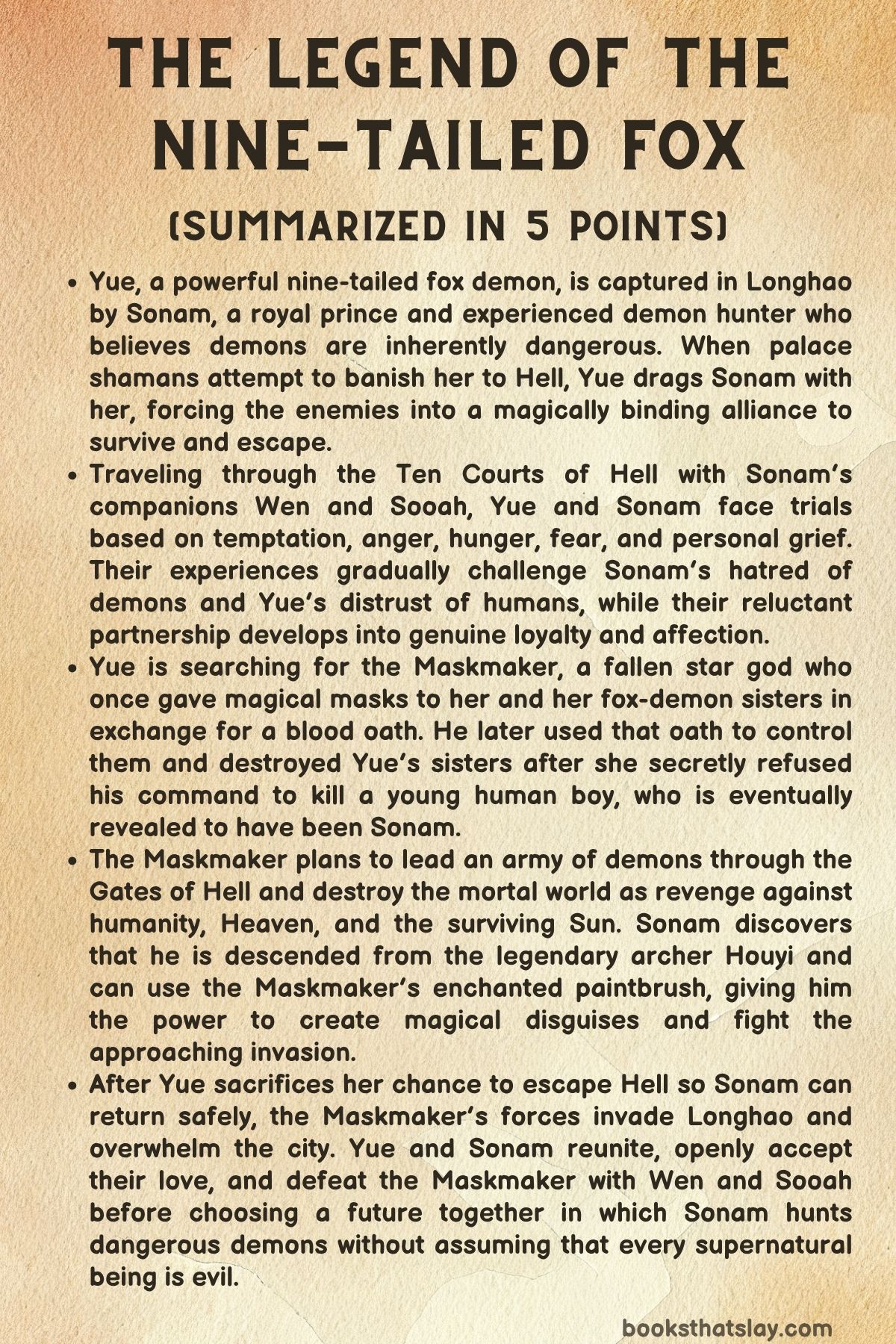
Summary
Yue is a nine-tailed fox demon who survives by consuming humans and absorbing their qi and souls. Although she insists that humans are simply food, her behavior reveals a more selective morality: she chooses cruel or abusive people when possible and secretly helps those harmed by them, even while refusing to admit that compassion influences her decisions.
Yue also carries a porcelain mask created by a mysterious figure known as the Maskmaker. The mask allows her terrifying true form, marked by six eyes, nine tails, burns, and immense physical size, to appear completely human, and she has spent years searching for its creator for reasons connected to a painful past.
Meanwhile, Captain Sonam investigates a wave of disappearances in Longhao with his loyal companions Wen and Sooah. Sonam is an experienced demon hunter who discovers evidence that demons are responsible, yet the strange humanlike appearance of the suspected predator does not match what he knows about ordinary demonic disguises.
Sonam eventually encounters Yue and immediately recognizes her as a threat. With Wen and Sooah’s help, he captures her, removes her mask, and reveals her true body before the horrified public.
Yue is transported to the Jade Palace, where she learns that Sonam is not merely a soldier but one of the king’s sons. His relationship with his father is strained, and despite his royal blood he has lived apart from the privileges enjoyed by his brothers, carrying a deep desire to be acknowledged by the family that has long treated him as an outsider.
The palace shamans prepare to banish Yue to Hell. Refusing to go quietly, she grabs Sonam at the last moment and drags him through the gate with her, expecting that both of them will die during the fall.
They survive, badly injured, and resume their hostility almost immediately. Sonam poisons Yue with a substance capable of killing supernatural beings but possesses the antidote, giving him leverage to propose a bargain.
Yue must help him escape Hell and must not kill him until they return to the mortal world. In exchange, Sonam cures her, and the two seal the agreement through a magically binding blood oath.
Their uneasy partnership begins in a distorted reflection of Longhao where roads shift and buildings become part of monstrous guardians. Yue discovers that the Maskmaker has been in Hell, while Sonam learns that Wen and Sooah followed him into the underworld and have been captured by demons.
Yue and Sonam rescue them, although Yue’s willingness to kill and consume another demon horrifies Wen. Sonam nevertheless insists that they need her knowledge and strength, forcing the four travelers into a tense alliance.
Their journey is shaped by the ancient history of the Ten Courts of Hell. Long before their time, the archer Houyi shot nine of ten destructive star gods from the heavens, leaving one star alive to become the Sun.
The defeated gods were sent to Hell, where Death required them to serve within different courts as punishment for their cruelty toward humanity. The youngest escaped, received an enchanted paintbrush from his mother Xihe, and became a master of magical disguises.
That escaped star god eventually became the Maskmaker. Consumed by resentment toward Houyi, Heaven, humanity, and the surviving Sun, he tried to steal an immortality elixir from Houyi’s family, causing Chang’e to drink it and become permanently separated from her husband on the moon.
Houyi pursued the Maskmaker for the rest of his life and passed that duty to his descendants. Unknown to Sonam for much of the story, he belongs to this bloodline and has inherited a divine blessing that will eventually allow him to use the Maskmaker’s enchanted brush.
As Yue, Sonam, Wen, and Sooah cross Hell, each court forces them to confront personal weaknesses. In the Court of Temptation, Sooah refuses revenge against those who abused her, Wen rejects false lovers because of his devotion to his wife, and Sonam is offered the royal recognition he has always desired.
Sonam rejects a vision in which his father and brothers kneel before him because he realizes that power was never his true desire. What he wanted was love, attention, and the acknowledgment denied to both him and his dying mother.
Yue faces an even crueler illusion: her dead sisters restored to life. To remain with them, she must kill Sonam, but she refuses, choosing painful reality over an artificial reunion.
Their experiences steadily change the relationship between Yue and Sonam. Each sees the grief underlying the other’s hatred: Sonam became a demon hunter after his beloved brother Jun died in a demon attack, while Yue’s obsession with the Maskmaker grew from the destruction of her sisters.
Sooah also forms a bond with Yue and reveals her own history of abuse and mutilation. Her refusal to organize her life around revenge unsettles Yue, who fears that abandoning vengeance would make her sisters’ deaths meaningless.
The travelers later encounter Kelai, a star goddess assigned to the Court of Hunger. Rather than starving visitors, Kelai feeds them, bathes them, and gives them comfort, but her generosity becomes imprisonment when loneliness makes her unable to tolerate their departure.
After escaping her pavilion, Sonam promises he will return for her. Kelai believes him and gives him a magical map leading toward what his heart most desires, as well as directions to a hidden passage that can shorten their route.
The emotional distance between Sonam and Yue continues to shrink. They share stories, train together, exchange small gestures of care, and become increasingly aware of their attraction, even though both believe their identities as hunter and demon make a future together impossible.
The Maskmaker eventually captures Yue and traps her inside a dream. There she receives the life she secretly wants most: her sisters are alive, Sonam is a peaceful painter rather than a demon hunter, and the two of them are openly in love.
Yue ultimately rejects the dream because she knows it is false. Sonam, Wen, and Sooah rescue her, and during the confrontation the Maskmaker recognizes Sonam’s divine blood and realizes that he is descended from Houyi.
The travelers also learn that the Maskmaker is preparing an army of demons to invade the mortal world. His masks will allow his followers to assume trusted appearances, and his goal is nothing less than the destruction of the existing order that rejected him.
As they race toward the Gates of Hell, Sonam discovers that Houyi’s blessing allows him to wield the enchanted paintbrush. He begins creating magical masks of his own and uses his artistic imagination in ways the Maskmaker never anticipated.
The past gradually reveals the full connection between Yue and Sonam. Centuries earlier, the Maskmaker had saved Yue and gained control over her and her sisters by offering magical masks in exchange for a future favor sealed by blood.
He later ordered the foxes to attack sun temples and forced Yue to become increasingly violent. When he commanded her to eat a lonely human child, Yue refused.
That child was Sonam. Yue instead played with him, listened to his worries about his father and brothers, and secretly allowed him to leave alive.
The Maskmaker discovered her disobedience and used their blood oath to punish Yue’s family, destroying her sisters while she watched helplessly. Yue escaped with her mask and spent centuries searching for him, carrying the belief that her act of mercy toward Sonam had indirectly caused the deaths of those she loved.
Near the exit from Hell, the Maskmaker catches the group. Yue realizes that once Sonam leaves the underworld their oath will be fulfilled, so she forces Wen and Sooah to take him through the gate while she remains behind to delay the enemy.
Sonam returns to Longhao and warns his father that an invasion is coming, but the king refuses to believe him and imprisons the group. Moments later the Gates of Hell open and demons flood into Longhao, proving Sonam’s warning correct.
Using the magical brush and masks, Sonam escapes confinement and joins the defense of the city. He transforms into demonic forms himself, gaining a new physical understanding of the creatures he spent his life hunting.
Sonam eventually finds Yue alive. Their reunion finally strips away their remaining emotional defenses, and Sonam tells her that he accepts all of her rather than only the parts that resemble humanity.
Yue admits that she cannot directly strike the Maskmaker because her ancient blood oath still binds her. Sonam therefore must deliver the final blow, while Yue protects and supports him.
Together with Wen and Sooah, they confront the fallen god. Sonam’s creativity with the enchanted masks, Sooah and Wen’s loyalty, Yue’s strength, and their willingness to fight cooperatively counter the Maskmaker’s superior divine power.
The Maskmaker is finally defeated, and palace shamans close the Gates of Hell, although hundreds of demons escape before the seal is restored. Longhao begins rebuilding after the devastation.
Sonam refuses his father’s demand that Yue be treated as an ordinary threat, pointing out that she helped save the city. The king assigns him to hunt the demons that remain loose in the mortal world, but Sonam no longer believes that every demon is automatically evil.
A year later, Yue has become part of the life she once believed she could never possess. She shares a meal with Sonam, Wen, Sooah, Ling, and the children, surrounded by companionship rather than isolation.
Sonam has also stopped measuring himself by his father’s approval. With reports of demons appearing elsewhere, he and Yue prepare for new journeys together, no longer hunter and prey but partners who have chosen one another despite everything that once placed them on opposite sides.
Characters
Yue
Yue is the emotional center of The Legend of the Nine-Tailed Fox, built around a contradiction between the monster she believes herself to be and the moral choices she repeatedly makes. She is unquestionably dangerous, consumes human beings, and possesses immense supernatural strength, yet she establishes limits on whom she will harm and frequently directs her violence toward abusers, predators, and people who cause suffering.
Her harshness functions partly as self-protection. Yue has lived for centuries with grief over her sisters and guilt over the belief that her refusal to kill the young Sonam caused their destruction, so she reduces herself to the language of hunger, revenge, and survival because those identities seem safer than admitting how deeply she still desires companionship.
Her relationship with the Maskmaker explains much of her emotional damage. He first appeared as a rescuer, later manipulated Yue and her sisters into a blood oath, then transformed that promise into a mechanism of domination and punishment.
Yue therefore associates trust with danger. Her long search for the Maskmaker gives her life direction, but it also prevents her from imagining an identity that exists beyond vengeance.
Sonam gradually challenges that limitation. Yue initially wants to kill him, then keeps him alive because of their oath, then protects him because she genuinely cares whether he survives.
Her greatest transformations occur when she repeatedly chooses reality over comforting falsehood. She rejects an illusion of her living sisters rather than murder Sonam, later rejects a dream in which she possesses the perfect family and romantic future, and eventually accepts that love cannot erase pain but can still create something meaningful after loss.
By the conclusion, Yue has not become human and does not need to. Her growth lies in accepting that compassion, love, violence, grief, desire, and monstrosity can all exist within the same person without one element completely defining her.
Sonam
Sonam begins The Legend of the Nine-Tailed Fox as a man whose identity depends upon certainty. Demons are monsters, hunters destroy them, royal duty defines his place in society, and proving his usefulness seems like the only path toward earning the acceptance of his father.
Behind that discipline is an abandoned child still seeking approval. Sonam grew up separated from the royal family, lost his beloved brother Jun in a demon attack, and watched his mother die without receiving the attention she sought from the king.
Demon hunting becomes both revenge and self-validation. Every creature Sonam kills allows him to believe that Jun’s death is being answered and that he is proving himself worthy of the royal blood that has never provided him with emotional security.
Hell destroys the simplicity of his worldview. Yue repeatedly saves people, refuses cruelty, displays loyalty, grieves her family, and reacts to suffering in ways that cannot be reconciled with Sonam’s belief that demons are incapable of meaningful goodness.
His central achievement is therefore not defeating the Maskmaker but learning to question the assumptions on which he built his life. Even before loving Yue, he begins treating her as a person rather than an object of extermination.
Sonam’s artistic side is equally important. His drawings connect him to Jun and later allow him to use the Maskmaker’s enchanted brush with an imagination the fallen god lacks.
By the ending, Sonam no longer needs kingship, paternal approval, or unquestioning obedience to determine his worth. His decision to stand beside Yue even when his father objects shows that he has replaced inherited judgment with a morality based on personal knowledge, loyalty, and choice.
The Maskmaker
The Maskmaker is the principal antagonist of The Legend of the Nine-Tailed Fox, but his role extends far beyond conventional villainy. He represents what grief and humiliation can become when they are protected from self-examination for centuries.
Originally one of the star gods cast into Hell after Houyi shot nine stars from the sky, he experiences his fall as an unforgivable insult. Instead of accepting responsibility for the destruction the stars caused, he interprets punishment entirely through the language of victimhood.
His resentment expands outward. He hates Houyi for defeating him, the Sun for receiving human worship, Heaven for rejecting him, humans for prospering without him, and eventually any creature unwilling to obey his plan.
The Maskmaker’s enchanted brush symbolizes his deepest flaw. He can change appearances endlessly, but he never changes internally.
His treatment of Yue and her sisters reveals his preference for control rather than relationship. He rescues Yue not because he values her life but because he recognizes a useful future servant, and the masks he provides become tools for binding the foxes to his authority.
His downfall grows from the same isolation he mistakes for superiority. He commands through fear and coercion, while Sonam, Yue, Wen, and Sooah fight through loyalty, affection, and freely chosen cooperation.
The Maskmaker possesses greater raw power than any of them individually, yet he cannot understand why people would risk themselves for one another without being compelled. That blindness leaves him unable to comprehend the very force that ultimately defeats him.
Sooah
Sooah becomes one of the most morally significant supporting characters in The Legend of the Nine-Tailed Fox because her strength comes from refusing to become what cruelty attempted to make her. She has endured severe abuse, humiliation, physical violence, and the loss of her tongue, yet she does not allow revenge to become the organizing principle of her existence.
Her trial in the Court of Temptation makes this clear. When offered the chance to punish those responsible for her suffering, Sooah refuses, not because they deserve forgiveness but because she refuses to surrender control of her identity to them.
That decision directly challenges Yue. Sooah demonstrates that refusing revenge does not diminish the seriousness of past harm and does not mean pretending that injustice never happened.
Her relationship with Sonam is rooted in dignity. He treated her as a capable person when others had reduced her to a victim, and she responds with profound loyalty without losing her independence.
Sooah’s bond with Yue develops with similar generosity. Rather than demanding that Yue become harmless before offering friendship, she gradually judges her according to what Yue actually does.
Teaching Yue sign language and eventually treating her as an older sister makes Sooah one of the first humans to offer Yue uncomplicated belonging. Her presence shows that communication can exist without speech and that trust can grow even between people whose histories would seem to place them permanently apart.
Wen
Wen initially provides the strongest resistance to accepting Yue within the group. He witnesses her kill and consume another demon, understands exactly what she is capable of doing to humans, and refuses to ignore the danger simply because Sonam has entered a temporary agreement with her.
His suspicion is understandable rather than merely prejudiced. Wen’s responsibility is to protect Sonam and Sooah, and trusting a creature who once intended to eat their captain appears reckless.
What makes Wen important is his ability to revise his judgment. As Yue repeatedly saves the group, protects Sonam, and proves that her behavior does not match his expectations, Wen slowly begins acknowledging what she has done.
His personal life also reveals a strong protective instinct. He loves his wife Ling deeply and previously helped her escape an abusive marriage arrangement, showing that his loyalty is rooted in action rather than sentiment alone.
Wen remains practical throughout the story. Even when emotional tensions increase between Yue and Sonam, he thinks about survival, responsibility, and the people waiting in the mortal world.
His eventual acceptance of Yue matters because it is earned. He does not abandon caution overnight; he changes because accumulated evidence makes continued hatred dishonest.
Kelai
Kelai initially appears to reverse the expected cruelty of Hell. As keeper of the Court of Hunger, she feeds exhausted travelers instead of starving them and provides bathing, clothing, shelter, and comfort.
Her generosity, however, develops into imprisonment. Kelai is so terrified of returning to loneliness that she seals the group inside her pavilion and tries to prevent them from continuing their journey.
This makes her sympathetic without making her harmless. Her pain explains her actions but does not erase the fact that she takes away the travelers’ freedom.
Sonam’s response becomes especially revealing. Rather than treating Kelai only as another obstacle, he recognizes the desperation behind her behavior and promises to return after helping the others escape.
Kelai rewards that compassion by giving Sonam the magical map and information about a shortcut. Her character therefore illustrates how loneliness can distort kindness into possession, while also showing that genuine empathy can resolve a conflict that force alone might only deepen.
Jun
Jun’s physical presence belongs mostly to Sonam’s memories, yet his influence extends throughout the story. As Sonam’s beloved elder brother, he represents the affection and guidance that Sonam did not receive consistently from his father.
His death during a demon attack becomes the event around which Sonam constructs much of his adult identity. Sonam’s vow to destroy demons grows from grief for Jun, making the dead brother indirectly responsible for both his profession and his hatred of Yue’s kind.
Jun’s teaching about courage becomes even more enduring. He taught Sonam that courage does not mean being free from fear but being willing to act while afraid.
That idea eventually becomes more important than Sonam’s revenge. It guides him through Hell, shapes his willingness to love Yue despite uncertainty, and gives him a moral inheritance stronger than the royal recognition he spent much of his life pursuing.
The King of Longhao
The king is central to Sonam’s emotional wounds even though he occupies comparatively little direct space in the action. His failure as a father shapes Sonam’s hunger for recognition, the isolation of Sonam’s childhood, and the pain surrounding the final illness of Sonam’s mother.
The Court of Temptation exposes exactly what Sonam wanted from him. Sonam does not truly crave the throne; he wants the king to acknowledge that he matters.
The king’s failure to believe Sonam’s warning about the demonic invasion repeats the same pattern on a larger scale. He dismisses the son whose experience should make his testimony valuable and loses crucial time before the Gates of Hell open.
Even after the city is saved, his discomfort with Yue demonstrates that his worldview changes more slowly than Sonam’s. He is not portrayed as completely malicious, but his authority repeatedly prevents him from seeing the people closest to him clearly.
Qin and Yue’s Sisters
Yue’s sisters represent the family and belonging that define almost every emotional decision she makes. Qin is specifically remembered among them, but the sisters function collectively as Yue’s earliest source of protection, companionship, and identity.
Their destruction leaves Yue with two forms of grief. She mourns the family itself, but she also carries guilt because their punishment followed her refusal to kill the child who was secretly Sonam.
That guilt explains why the Maskmaker can manipulate her so effectively. He convinces Yue that compassion caused catastrophe, encouraging her to interpret mercy as weakness and obedience as the only way to protect those she loves.
The repeated illusions involving her sisters show that Yue’s deepest desire is not revenge at all. What she wants is to belong somewhere without expecting that everyone she loves will eventually be taken from her.
Ling
Ling appears primarily through Wen’s memories and later within the peaceful future shared by the group. Her history of abuse before her relationship with Wen parallels several other stories of exploitation in the novel.
Wen’s decision to help her escape demonstrates the protective qualities that define him. Their marriage also strengthens the importance of chosen relationships throughout the story because Ling’s future improves when someone refuses to accept the social arrangement that would have condemned her to further violence.
By the final scene, Ling’s presence helps establish the domestic world into which Yue has been welcomed. She represents an ordinary human life that once seemed completely inaccessible to Yue.
Houyi
Houyi exists both as legendary hero and as the origin of the conflict that shapes Sonam’s destiny. When ten stars threaten the world with unbearable heat, he acts against beings considered far beyond mortal power and shoots nine of them from the sky.
His decision to spare the final star shows that his goal is survival rather than indiscriminate destruction. He understands that destroying every star would simply replace one catastrophe with another.
His later conflict with the Maskmaker becomes more personal after Chang’e is taken from the mortal world. Houyi’s grief leads him into a lifelong pursuit that he eventually passes to his descendants.
Sonam therefore inherits both the blessing and burden of Houyi’s legacy. Yet where Houyi’s story is shaped by pursuit, Sonam eventually learns that inherited hatred does not have to determine every judgment he makes.
Chang’e
Chang’e’s role is defined by sacrifice, love, and separation. When the Maskmaker attempts to seize the immortality elixir, she drinks it rather than allow him to use its power to bargain for his brothers’ freedom.
The decision saves the elixir from the Maskmaker but separates Chang’e permanently from Houyi and carries her to the moon. Her fate becomes one of the tragedies produced by the Maskmaker’s refusal to accept responsibility for his original downfall.
Chang’e also contributes to the novel’s repeated connection between love and impossible distance. Her relationship with Houyi becomes a legendary counterpart to Yue and Sonam, who likewise fear that the conditions of their identities make lasting companionship impossible.
The Sun
The surviving star becomes the Sun after Houyi spares him, taking responsibility for providing the light necessary for human life. His survival allows the world to recover after the destructive period caused by all ten stars appearing together.
However, the Sun is not presented as purely noble. When his escaped brother asks for assistance, he refuses to help and appears unwilling to share the glory and worship he receives from humanity.
That rejection contributes to the Maskmaker’s resentment, although it does not excuse the violence that follows. The Sun therefore adds moral complexity to the ancient conflict by showing that being on the victorious side does not automatically make someone generous or compassionate.
Xihe
Xihe is the mother who takes pity on the youngest fallen star god after Heaven and the Sun reject him. She secretly gives him the enchanted paintbrush and teaches him how its magic can create disguises.
Her action is motivated by maternal concern, but the gift becomes one of the most dangerous instruments in the story. The Maskmaker uses it to hide, manipulate others, create magical masks, build an army, and pursue revenge over centuries.
Xihe therefore occupies an important position in the background mythology. Her intentions are compassionate, but the consequences demonstrate that love without judgment can empower destructive behavior when assistance is given without confronting the recipient’s motives.
Lin
Lin is a demon Yue meets in Hell who recognizes the craftsmanship of the Maskmaker’s porcelain masks. She provides Yue with one of the first strong confirmations that the man she has hunted for years is somewhere within the underworld.
Lin also leads Yue and Sonam toward Wen and Sooah after revealing that living humans have been captured. Her usefulness does not protect her once Yue decides she has extracted all necessary information.
Yue kills and consumes Lin, reminding the humans and the reader that Yue’s growing sympathy should not be confused with conventional human morality. Lin’s death becomes one of the moments that keeps Wen’s distrust alive.
Bao
Bao is the large boar demon associated with the group holding Wen and Sooah captive. He and the other demons view living humans as rare food, reversing the ordinary balance of power the hunters experienced in the mortal world.
Although Bao is a comparatively minor figure, the encounter surrounding him establishes the practical necessity of Yue and Sonam’s partnership. Sonam cannot simply fight his way through every danger alone, while Yue must protect him because their lives have become magically connected.
Death
Death appears in the ancient history of the fallen star gods as an authority unwilling to excuse divine beings simply because of their status. When the nine defeated brothers arrive in Hell expecting special treatment, Death insists that power does not erase responsibility.
The punishment imposed upon them forces each brother to serve within Hell and witness the consequences of destructive behavior. Death therefore represents a standard of accountability that the Maskmaker spends centuries attempting to evade.
Sonam’s Mother
Sonam’s mother is another character whose importance is measured through absence and memory. Her final illness becomes inseparable from Sonam’s anger toward the king because she repeatedly sought acknowledgment from him and never received the final visit she deserved.
Her treatment helps Sonam reject the false throne offered in the Court of Temptation. When the illusion suggests that abandoning loved ones is an acceptable sacrifice for leadership, Sonam understands that such a kingdom would reproduce the very cruelty that wounded him as a child.
The Royal Brothers
Sonam’s seven royal brothers represent the family structure from which he has always felt excluded. Their proximity to the king reinforces Sonam’s belief that he must earn a place that seems to come naturally to them.
Their ridicule after Sonam returns from Hell demonstrates that the exclusion is not merely imagined. Rather than listening to his warning, they mock his account and contribute to the delay that leaves Longhao vulnerable to the Maskmaker’s invasion.
Their importance lies less in individual characterization than in what they represent emotionally: the life Sonam once believed he wanted and ultimately learns he does not need.
Themes
Revenge, Grief, and the Choice to Move Forward
Revenge gives several characters a reason to keep moving when grief has otherwise emptied their lives. Yue hunts the Maskmaker because her sisters were destroyed, Sonam hunts demons because Jun was killed, Houyi pursues the fallen god after losing Chang’e, and the Maskmaker spends centuries retaliating against everyone he associates with his humiliation.
The crucial distinction is not whether their pain is justified but what they allow that pain to become. Sonam’s hatred encourages him to judge every demon through Jun’s death, while Yue fears that abandoning vengeance would betray her sisters.
The Maskmaker carries this logic to its extreme. He transforms suffering into entitlement, treating every rejection as permission to cause greater destruction and eventually deciding that the world itself should be ruined because it did not give him what he believed he deserved.
Sooah offers the clearest alternative. She refuses revenge against people who inflicted terrible harm on her, demonstrating that rejecting vengeance does not require denying pain or forgiving those responsible.
The Legend of the Nine-Tailed Fox therefore treats recovery as a question of ownership over the future. Yue and Sonam do not stop loving the people they lost when they loosen their attachment to revenge; instead, they stop allowing the dead and the guilty to dictate every decision that remains.
The Maskmaker cannot make that transition. His tragedy lies not simply in having suffered but in preserving his grievance so completely that nothing new can enter his identity.
The Instability of the Labels “Human” and “Monster”
The division between humans and demons initially seems absolute because both Yue and Sonam have constructed their lives around it. Sonam sees demons as creatures to destroy, while Yue describes humans primarily as prey and assumes that their morality is mostly hypocrisy.
Their journey steadily exposes how inadequate those categories are. Yue kills humans, yet she protects children, helps abused women, risks herself for Sonam’s companions, and repeatedly shows concern for people she claims not to value.
Humans, meanwhile, are capable of abuse, neglect, cruelty, ridicule, and exploitation. Sooah’s suffering was created by humans, Ling faced violence from a human man, Sonam’s deepest childhood wounds came from his royal family, and many of Yue’s chosen victims are people who harm those weaker than themselves.
The argument is not that demons are secretly harmless or that humans are secretly worse. Yue remains capable of frightening violence, just as Sonam remains justified in recognizing that some supernatural creatures pose serious dangers.
What changes is the assumption that species can replace individual judgment. Sonam learns to ask what a being actually chooses to do rather than deciding moral worth from its nature alone.
His use of demonic masks during the invasion strengthens this idea physically. Once transformed, the demon hunter experiences the body, senses, and power he once regarded entirely from the outside, making the boundary between hunter and hunted less secure than he imagined.
Love, Belonging, and Chosen Family
Yue’s deepest hunger is not physical. Beneath centuries of feeding, violence, wandering, and revenge is a desire to belong somewhere without fearing that the relationship will be taken from her.
The Court of Temptation understands this immediately by restoring her sisters. The later dream created by the Maskmaker goes further, giving her not only family but a peaceful Sonam, domestic security, artistic companionship, and a future in which nobody asks her to hide what she is.
Yue rejects both illusions because belonging obtained through deception cannot replace real connection. That decision is painful precisely because the false worlds reveal what she genuinely wants.
Her real family begins forming far less perfectly. Wen distrusts her, Sooah must slowly establish communication with her, Sonam begins as the man trying to kill her, and all of them pass through fear and conflict before genuine trust exists.
This makes their eventual closeness more meaningful. Sooah calling Yue a sister, Wen accepting her presence, Sonam protecting her mask, and the final shared meal with Ling and the children create belonging through repeated acts rather than predetermined obligation.
Sonam undergoes a related transformation. He spends much of his life seeking acceptance from his biological father and royal brothers, only to discover that Wen, Sooah, Yue, and the people who stand beside him in danger provide the loyalty he wanted from the palace.
Chosen family does not erase biological family in the story. Instead, it proves that belonging is strongest when it is actively given rather than inherited as an empty title.
Identity, Masks, and Being Truly Seen
Masks in The Legend of the Nine-Tailed Fox operate as both magical objects and symbols of the identities characters construct for survival. Yue’s porcelain mask allows her to look human, protecting her from immediate fear and violence while also reinforcing the assumption that her real face must remain hidden.
The Maskmaker uses disguise differently. His constant transformations help him escape consequences, manipulate others, and control the way people perceive him.
He can assume countless faces, yet none produces real intimacy because every identity is another instrument of avoidance. His power changes appearances while leaving his resentment untouched.
Sonam’s relationship with masks develops in the opposite direction. When he gains access to the enchanted brush, he does not treat transformation solely as deception; he uses imagination to create possibilities, protect companions, and eventually experience forms completely unlike his own.
His response to Yue’s true face carries the greatest emotional significance. He sees the scars, supernatural features, predatory body, anger, grief, and history that Yue considers unlovable, yet his affection does not depend upon replacing them with a beautiful human disguise.
Yue’s growth similarly requires abandoning the belief that she must choose between being a monster and being worthy of love. The story does not ask her to become more human before receiving acceptance.
Instead, identity becomes something broader than appearance, species, inherited duty, or past behavior. To be truly seen is not to have one’s frightening qualities ignored but to have them acknowledged without allowing them to cancel every other part of the self.