A Court of Silver Flames Summary, Characters and Themes
A Court of Silver Flames is the fifth and final installment of the fantasy series A Court of Thorns and Roses by Sarah J. Maas. It shows us the raw and transformative journey of Nesta Archeron as she confronts her traumatic past, grapples with her newfound Fae identity, and forges deep connections with unexpected allies, challenging both societal expectations and her own self-perceptions in a world filled with magic, danger, and love.
At its center is her difficult bond with Cassian, a warrior who challenges her without looking away from her pain. The story is about recovery without easy answers: learning to live with guilt, accepting help, reclaiming the body, and choosing connection after years of isolation.
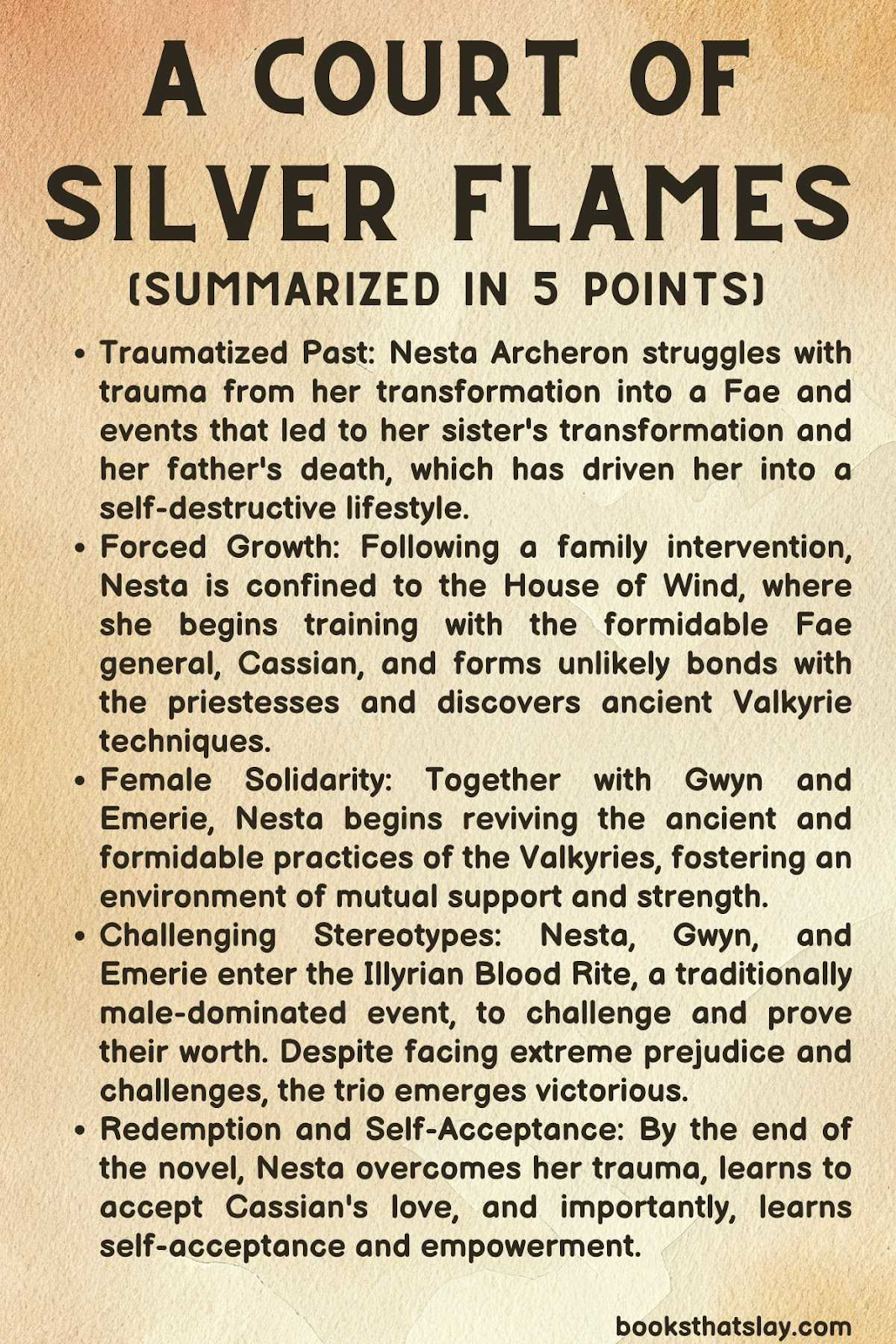
Summary
Nesta Archeron begins the story in a state of collapse. She lives alone in a poor apartment in Velaris, spending her nights on drinking, sex, and music that helps her avoid her memories.
Her family and the Night Court have grown tired and frightened of her self-destruction, especially because she has been using Feyre and Rhysand’s money while refusing help. Cassian is sent to bring her to Feyre’s new riverfront house, where Feyre, Rhysand, Amren, and Cassian confront her.
Feyre insists this is not punishment, but Nesta experiences it as humiliation and control. She is given a choice: live in the House of Wind, train with Cassian every morning, and work in the library every afternoon, or leave for the human lands where she would be isolated and unsafe as High Fae.
Nesta feels betrayed, especially when she learns Elain helped pack her belongings. She leaves with Cassian feeling stripped of choice and abandoned by the sisters she both loves and resents.
Life in the House of Wind begins painfully. Nesta refuses to train, barely eats, and treats Cassian with coldness.
Cassian, however, sees that her cruelty is not simple arrogance. She is haunted by the Cauldron, Elain’s kidnapping, their father’s murder, Feyre’s sacrifices, and the terrible power inside her.
Rhys warns Cassian that Nesta is dangerous, while also assigning him political work connected to the human queens. The crone queen Briallyn, who was changed by the Cauldron and blames Nesta for it, appears to be searching for power with possible help from Beron of the Autumn Court and Koschei, the death-lord who controls Vassa’s curse.
Cassian’s duties now extend beyond battle, forcing him into diplomacy with Eris, Lucien, Jurian, and Vassa.
Nesta’s first attempts at training fail because the Illyrian camp of Windhaven exposes her to mockery and misogyny. Devlon insults her, and Nesta refuses to participate while Cassian trains alone under hostile eyes.
Cassian eventually realizes that public humiliation only hardens her resistance. He moves training to the House of Wind, beginning with breathing, stretching, and balance rather than weapons.
In the library, Nesta works under Clotho and meets Gwyn, a priestess with warmth, intelligence, and her own history of trauma. In Windhaven, Nesta also meets Emerie, an Illyrian shopkeeper whose wings were clipped by her father.
These women become the first cracks in Nesta’s isolation.
As Nesta settles into routine, the House of Wind begins responding to her like a quiet friend. It feeds her, gives her cake, offers warmth, and denies her wine when she tries to fall back into old habits.
Nesta attempts to descend the ten thousand stairs to escape, but the stairs defeat her again and again. Nightmares continue, especially memories of the Cauldron and her father’s death, yet training slowly gives her body hunger, exhaustion, and purpose.
Cassian begins to understand that Nesta’s refusal to train comes from fear of being seen trying, fear of failure, and fear of her own body. Their relationship shifts from pure hostility into something more charged, honest, and vulnerable.
The larger danger grows when the Night Court learns that Briallyn may be searching for the Dread Trove, three ancient Made objects: the Mask, the Harp, and the Crown. Because Nesta and Elain were Made by the Cauldron, they may be able to sense the Trove.
Elain offers to help, but Nesta refuses to let her risk herself. To protect Elain, Nesta agrees to scry.
The act terrifies her because her last contact with the Cauldron led to Elain’s abduction, but she eventually succeeds in locating the Mask in the Bog of Oorid. Before this, she invites priestesses to train with her and Cassian.
Gwyn is the first to join, then Emerie follows, and eventually more priestesses appear. What began as Nesta’s punishment becomes the foundation for a reborn Valkyrie sisterhood.
Nesta, Cassian, and Azriel travel to the Bog of Oorid to retrieve the Mask. There, enchanted Autumn Court soldiers attack Azriel and Cassian, while Nesta is separated and hunted by a kelpie.
The creature drags her into the black water, forcing her to relive the terror of the Cauldron. Instead of waiting to be saved, Nesta reaches for the Mask and uses it.
Wearing it, she commands the dead, kills the kelpie, and emerges from the bog with terrifying power. Cassian and Azriel witness the scale of what she is, but when the Mask is removed, Nesta is once again shaken, traumatized, and human in her fear.
This victory proves that her power can protect her, but it also frightens everyone around her.
Nesta’s healing continues unevenly. She trains harder, bonds with Gwyn and Emerie over books and shared courage, and begins using Mind-Stilling, a Valkyrie practice that helps her reach calm without numbness.
She and Cassian begin a sexual relationship while pretending it is only physical, though both are increasingly emotionally involved. Nesta also accidentally Makes magical blades, showing that her power is not only death but creation.
Amren even suggests that power like hers could make her a political force beyond anyone’s control. Cassian is disturbed by how easily others discuss Nesta as a weapon or tool.
A major rupture occurs when Nesta learns the truth about Feyre’s pregnancy. Because Feyre’s unborn child has Illyrian wings and Feyre’s body cannot safely deliver him, Feyre, the baby, and Rhys may all die.
Nesta is furious that this truth has been hidden, and in anger she reveals it to Feyre in the cruelest possible way. Rhys is enraged, and Cassian takes Nesta into the wilderness.
There, stripped of distractions, Nesta finally breaks. She confesses her self-hatred, guilt, and belief that she has failed everyone.
Cassian answers with his own shame and stays beside her. This journey becomes a turning point.
Nesta does not become instantly healed, but she begins to believe she may be more than the worst things she has done.
After returning, Nesta embraces training, friendship, music, and life in the House. She attends the priestesses’ service and is deeply moved by Gwyn’s singing.
She retrieves the Harp from the Prison with Cassian, kills the ancient prisoner Lanthys using the Made sword she names Ataraxia, and learns more about the Trove’s terrible history. During Winter Solstice, she performs at the Hewn City to secure Eris’s alliance, using courtly grace as power rather than submission.
Later, at the river house celebration, she begins reconciling with Elain and receives a Symphonia from Cassian. That night, the mating bond between Nesta and Cassian becomes clear, though they still need time to speak openly about it.
Nesta, Gwyn, and Emerie grow into a true unit. Gwyn cuts the Valkyrie ribbon, the women pass a harsh qualifier-style obstacle course, and Nesta conquers the ten thousand stairs at last.
Amren reveals that Nesta Made the House of Wind alive through loneliness and need, and Nesta accepts the House as friend and home. This peace is shattered when Nesta, Gwyn, and Emerie are abducted and thrown into the Blood Rite, the brutal Illyrian survival trial.
Outside, Cassian, Rhys, and Azriel are unable to interfere because of the Rite’s magic. Inside, Nesta wakes early because she is Made, gathers weapons and supplies, and chooses not to seek victory alone.
She searches for her friends.
Nesta rescues Emerie from freezing water and helps free Gwyn from violent Illyrian males. The three women choose to climb Ramiel and win the Rite together, not as Illyrian warriors, but as Valkyries.
When enemies block the pass, Nesta stays behind to hold them off so Gwyn and Emerie can reach the summit. Her stand echoes the old legends, but her strength now comes from love and clarity rather than rage.
Gwyn and Emerie win the Blood Rite, becoming Carynthian. Nesta then faces Briallyn, who has used the Crown to enslave Cassian.
When Briallyn commands Cassian to kill himself, Nesta uses her deepest power to Unmake the queen and save him.
There is no time to rest. Feyre has gone into premature labor, and she, Rhys, and the baby are dying.
Nesta gathers the Mask, Crown, and Harp, stops Time, holds Death away, and gives back most of the power she stole from the Cauldron to save Feyre, Rhys, and Nyx. She also changes her own and Feyre’s bodies so future winged births can be survived.
Rhys kneels to her in gratitude, and Nesta is finally embraced as family. The story closes with spring in Velaris.
Nesta continues training with the Valkyries, prepares for her mating ceremony with Cassian, receives the House of Wind as a home, and visits her father’s grave with her sisters. She has not erased her pain, but she has chosen love, friendship, responsibility, and life.
Chapter-By-Chapter Summary
Part One: Novice
Chapter 1
Cassian goes to Nesta’s run-down apartment in Velaris to bring her to Feyre’s new riverfront house. He finds her hungover, underfed, emotionally closed off, and hiding behind drink, sex, and cruelty.
Nesta’s inner narration reveals how deeply traumatized she remains by the Cauldron, Elain’s kidnapping, her father’s death, and her own terrifying power. She resents Feyre’s new life, Rhys’s authority, and the happy “family” she feels excluded from.
At the meeting, Feyre, Rhys, Amren, and Cassian confront Nesta about her destructive behavior and lavish spending. Feyre frames the intervention as concern rather than punishment, but Nesta experiences it as control.
The chapter ends with the revelation that Nesta is being sent with Cassian to train.
Chapter 2
Feyre lays out Nesta’s new reality: she will move into the House of Wind, train with Cassian every morning, and work in the library every afternoon. Nesta resists fiercely, but Amren and Feyre give her only two options: cooperate or return to the human lands, where she would be isolated and unsafe as High Fae.
Nesta feels betrayed when she learns Elain agreed to the plan and packed her belongings. She and Feyre have a painful private argument in which old resentments surface: Feyre’s sacrifices, Nesta’s shame, Elain’s distance, their father’s death, and Nesta’s feeling that she has nowhere to belong.
Feyre refuses to back down. Nesta leaves feeling severed from her sisters and stripped of control.
Chapter 3
Cassian speaks privately with Rhys, who warns him that Nesta is not simply a difficult trainee but a dangerous unknown. Rhys admits he fears Nesta’s power and asks Cassian to be careful.
He also gives Cassian a new political assignment: investigate the human queens, who may be scheming again with help from dangerous allies. Cassian is uncomfortable being pushed beyond the role of warrior into courtly intrigue.
Later, Mor arrives to winnow Cassian and Nesta to the House of Wind. Nesta is installed in her old room, painfully aware that the place is not home.
Alone, she shuts out the sunlight, sinks into bed, and tries to breathe through the hollow despair pressing in on her.
Chapter 4
Cassian meets Mor at a riverside café, where they discuss Nesta, Mor’s diplomatic work, and the mounting political crisis. Mor reveals that Vallahan is reluctant to sign the new peace treaty, partly because unrest among the human queens could lead to another war.
Cassian realizes Vassa may be the best source of insight into the queens. Meanwhile, Nesta wakes in the House of Wind and reflects on her mother, her lost human life, Tomas, poverty, and the armor of cruelty she built to survive.
Cassian later lies awake, aware of Nesta nearby and anxious about the next day’s training. Rhys checks in mentally, and Cassian understands that Nesta’s recovery may become a battlefield of its own.
Chapter 5
Nesta and Cassian clash at breakfast when he insists she eat enough to survive training. He bluntly links her refusal to her grief, provoking her rage, but eventually she eats.
Their banter becomes charged, revealing both hostility and attraction. Mor winnows them to Windhaven, where the Illyrian camp greets Nesta with suspicion and misogyny.
Devlon insults her as a “witch” and invokes old taboos about women and weapons. Cassian defends her, but Nesta refuses to participate.
She sits on a rock while Cassian trains alone, knowing the watching Illyrians are mocking him. Though part of her wants to help him, she cannot make herself rise.
Cassian turns away, wounded, and begins his exercises in silence.
Chapter 6
Nesta watches Cassian train and cannot help admiring his power and beauty. Mor arrives and confronts Nesta, telling her she would have voted to send her back to the human lands.
Nesta answers cruelly, but Mor’s words hit hard. Back at the House of Wind, Nesta begins her work in the library under Clotho, the silent high priestess.
The library unsettles her, especially its dark lower depths and the memories of Hybern’s attack there. Clotho assigns her simple shelving work, which unexpectedly quiets Nesta’s mind.
At dinner, Cassian does not appear. When the House refuses to give her wine, Nesta decides to descend the ten thousand stairs herself, determined to get it.
Chapter 7
Cassian visits the manor where Vassa, Jurian, and Lucien live, only to find Eris there as well. The encounter forces Cassian into the political role Rhys assigned him.
Eris reveals that Autumn Court soldiers have gone missing under strange circumstances, possibly because of human or magical interference. Vassa and Jurian discuss the human queens’ ambitions and the danger of Briallyn, the crone queen who blames Nesta for her condition.
Koschei, the death-lord who holds Vassa’s curse, looms as a hidden threat. Cassian struggles with courtly subtlety but gathers important information: Briallyn may be aligning with Beron and hunting for power.
Eris warns Cassian that he is better suited to battle than politics.
Chapter 8
Nesta attempts the ten thousand stairs but quickly discovers how brutal they are. Cassian finds her collapsed on the landing and needles her, while Azriel appears and quietly observes the tension.
The chapter contrasts Nesta’s stubbornness with the House’s physical isolation: she is free to leave, but the stairs are their own prison. Cassian later deals with political fallout from the meeting with Eris, Rhys, and Azriel, including concern over Briallyn, Beron, and Koschei.
Back in training, Nesta still refuses to participate, but her body and pride are slowly being forced to confront limits. Cassian tries different tactics, including suggesting shops in Windhaven, but Nesta remains withdrawn and unresponsive.
Chapter 9
Nesta visits Emerie’s shop in Windhaven and meets the Illyrian female shopkeeper, who bears scars from wing clipping and carries herself with iron strength. The two women exchange guarded respect, and Nesta buys needed supplies.
In the library, Nesta also begins interacting more with Gwyn, a copper-haired priestess assigned to Merrill. Gwyn shows curiosity and warmth, introducing a new kind of companionship into Nesta’s life.
Nesta continues shelving books and begins noticing the library’s rhythms and the priestesses’ fear. The House of Wind also becomes increasingly responsive, providing food and comfort despite Nesta’s resistance.
By the end, Nesta is surprised to find herself hungry, fed, and quietly grateful to the House.
Chapter 10
Nesta’s relationship with the House deepens: it provides food, cake, warmth, and small comforts, almost like a silent friend. Cassian notices and teases her, using her irritation to point out practical reasons she should learn to fight.
That night, Nesta has a nightmare about Elain’s abduction, the Cauldron, and her father’s death. Desperate for drink, she tries the stairs again, panics, slips, and nearly falls to her death.
Her power erupts instinctively, burning her fingerprints into stone as she saves herself. The next morning, bruised and ashamed, she still refuses to train.
Cassian asks her, even says “please,” but she cannot rise. His disappointment hurts more than she expects.
Chapter 11
The House locks Nesta out of the private library until she eats, showing that it has begun to challenge her self-destructive habits. At dinner with Cassian and Azriel, she spars verbally but also lets them see flashes of vulnerability.
Azriel calmly asks why she will not train, and his quiet manner unsettles her more than Cassian’s anger. Cassian realizes Nesta’s refusal is not laziness but fear—fear of failure, fear of her body, and fear of being seen trying.
He remembers Feyre’s starvation and trauma and connects it to Nesta’s current state. The chapter ends with Cassian deciding to try one final time, changing his approach from force to patience.
Chapter 12
Cassian moves training from Windhaven to the House of Wind, removing the Illyrian audience that humiliated Nesta. He starts gently, with stretches, breathing, balance, and bargains rather than weapons.
Nesta participates because the lesson feels private and manageable, though she masks her relief with sarcasm. Cassian explains some of Emerie’s history and the neglect Illyrian females suffer, especially during Amarantha’s reign.
Nesta listens and begins to understand that training might be more than punishment—it could be survival, control, and dignity. The chapter also softens the emotional distance between Nesta and Cassian.
When he says he does not hate her, she answers quietly that she has never hated him either.
Chapter 13
Nesta’s body aches from training, but she feels hunger and exhaustion in healthier ways. In the library, Gwyn teaches her how to shelve books with magic and asks for help correcting a mistake involving Merrill’s research.
Nesta risks Merrill’s anger to help Gwyn, revealing an unexpected protective streak. Gwyn speaks about Valkyries, priestesses, research, and the possibility of recovering lost female warrior traditions.
Nesta’s day becomes filled with training, library work, food, and the faint beginnings of friendship. Though she still feels alone, Gwyn’s presence changes the texture of her routine.
That night, Nesta sleeps deeply, and the suggestion of Cassian’s presence nearby lingers like comfort she is not ready to name.
Chapter 14
Cassian worries when Nesta misses breakfast, but the House reveals it has been feeding her. He discusses the House’s strange behavior with Rhys and later meets Eris in the Spring Court, where political tensions sharpen.
Eris continues to position himself as a reluctant ally against Beron and Briallyn, though Cassian distrusts him deeply. Meanwhile, Nesta asks Cassian about Gwyn’s past, and he tells her enough about Sangravah to explain the priestess’s trauma without violating too much of her privacy.
Nesta absorbs the horror of what Gwyn survived. Back at the House, Nesta begins calling the House her friend, and it rewards her with comfort and cake, reinforcing its growing sentience.
Chapter 15
Nesta ventures near the library’s lower levels and senses the darkness dwelling there. Gwyn helps her escape its pull and explains the priestesses’ Invoking Stones, which summon help if danger arises.
Gwyn’s own trauma from Sangravah is discussed more directly, and Nesta recognizes another survivor’s fear, shame, and courage. The chapter deepens the library as both sanctuary and haunted place: healing exists there, but darkness remains.
Nesta’s connection to Gwyn strengthens through shared trust. Meanwhile, Nesta’s attraction to Cassian intensifies.
Her body begins awakening alongside her training, and desire becomes another arena where she struggles with control, denial, and vulnerability.
Chapter 16
Cassian and Nesta continue training, and she begins asking serious questions about Illyrian warrior culture. Cassian explains the Blood Rite: the brutal survival trial Illyrian males undergo to become warriors, ending at the sacred mountain Ramiel.
He also tells her about the Valkyries, the legendary female warriors who once fought with discipline, breath, and unity. Nesta becomes fascinated by them, especially the idea of women training together.
Cassian describes the Illyrian Rite’s cruelty but also its purpose as a test of endurance. Nesta forms an idea: the priestesses in the library might benefit from training, not as soldiers for anyone else, but for themselves.
Cassian supports the idea, and his approval matters to her.
Chapter 17
Nesta asks Clotho for permission to invite priestesses to train on the roof, and Clotho agrees. Nesta posts a sign-up sheet but receives no names at first, forcing her to confront the possibility of rejection.
She keeps training and pushing herself, even reaching five hundred stairs. Then Elain visits, and the sisters’ unresolved grief erupts.
Elain challenges Nesta’s possessiveness and accuses her of hiding behind pain. Nesta, feeling abandoned by Elain and replaced by Feyre, lashes out.
The argument cuts deep, especially because Elain refuses to remain the fragile sister Nesta wants to protect. Cassian witnesses the aftermath and sees Nesta go emotionally dead, making clear how much the confrontation shattered her.
Chapter 18
After the fight with Elain, Nesta spirals and tries to descend the stairs again, desperate for music, drink, and numbness. Cassian intercepts her, forcing a confrontation about what she is running from.
Nesta rejects the idea that anyone understands her pain, especially Cassian, whose own trauma she refuses to compare with hers. Their argument becomes physical and emotionally charged as he blocks her path and she tries to push past him.
Cassian challenges her, but his presence also grounds her. Nesta, furious at his confidence and the effect he has on her, grabs him and kisses him.
The kiss is both a weapon and a confession, ending the chapter in unresolved desire.
Chapter 19
The kiss leaves both Nesta and Cassian shaken. Nesta tries to reclaim power by mocking him and walking away, but Cassian is deeply affected.
The next morning, Azriel teases Cassian, who is obviously distracted. Azriel has returned from spying on Briallyn and says Rhys wants both Cassian and Nesta at the river house.
Cassian also mentions Nesta’s argument with Elain, prompting Azriel’s protective concern. The chapter uses humor and awkwardness to show how Nesta and Cassian’s relationship has shifted: they are no longer simply enemies or reluctant partners.
At the same time, the larger plot presses in as Azriel’s findings about Briallyn require everyone’s attention.
Chapter 20
At the river house, Azriel reports that Briallyn is gathering forces and that Beron has pledged support, but her real target is not simply territory. She seeks the Dread Trove: ancient Made objects of terrible power, hidden even from memory by spells.
Amren explains that Made beings like Nesta and Elain might be able to sense or wield the Trove. The Mask, Harp, and Crown are revealed as relics that could reshape the balance of power.
Nesta is horrified by the idea of scrying again, because her last attempt drew the Cauldron’s attention and led to Elain’s kidnapping. The chapter ends with Elain entering and offering to use herself to find the Trove.
Chapter 21
Nesta violently rejects Elain’s offer to help locate the Trove. Elain pushes back, insisting she is not a child and should be allowed to choose danger if she wishes.
Their argument exposes Nesta’s suffocating protectiveness and Elain’s frustration at being treated as delicate. Amren explains that both sisters still have powers, and Nesta realizes she may be the safer option because of her own Made nature.
To protect Elain, Nesta agrees to attempt the scrying herself. Later, Feyre privately tells Nesta she is pregnant.
The announcement stirs complicated emotions: joy, distance, envy, fear, and shame. Nesta recognizes that Feyre wanted her to know first, but she cannot respond gracefully.
Chapter 22
Cassian and Azriel discuss Nesta’s likely role in finding the Trove. Cassian defends giving her space, while Azriel remains practical about the danger Briallyn and Koschei pose.
Cassian understands Nesta’s fear because Elain’s abduction left scars on all of them. Later, Nesta and Cassian’s sexual tension finally spills over in a charged encounter governed by their bargain and mutual stubbornness.
The scene is about power as much as desire: Nesta wants control, Cassian refuses to be merely used, and both test the boundaries between pleasure, pride, and emotional vulnerability. Cassian leaves afterward, telling her they are even, but the encounter only makes their bond more complicated.
Chapter 23
Cassian struggles with how much he wants Nesta and how carefully he must handle her. During training, Azriel joins them, and Nesta asks to see how Cassian and Azriel fight.
Their demonstration is brutal, beautiful, and revealing, showing the difference between battlefield violence and controlled training. Nesta studies them seriously, beginning to think like a fighter.
In the library, Gwyn’s research and the priestesses’ presence continue to influence her. Nesta’s own sense of purpose sharpens: she cannot let Elain be used, and she cannot avoid the Trove forever.
By the end of the chapter, she decides what she must do—face the scrying rather than run from it.
Chapter 24
Clotho summons Cassian and tells him Nesta has been practicing obsessively in the library stacks, risking injury. Cassian realizes Nesta has replaced avoidance with overexertion and needs balance, not punishment.
He finds her and tries to coax her into rest, conversation, and a healthier pace. Their exchange shows how well he is learning to read her, including the difference between discipline and self-harm.
Nesta resists but listens more than she once would have. The chapter also returns to the sign-up sheet for training.
After days of emptiness, a name finally appears: Gwyn. This is a turning point for Nesta’s idea of priestess training and for the rebirth of the Valkyrie legacy.
Part Two: Blade
Chapter 25
Gwyn arrives for training, terrified but determined. Nesta is nervous, wanting badly not to scare her away, while Cassian adapts the lesson with care.
Gwyn proves quick, graceful, and eager once she overcomes the first shock of being outdoors. She explains that movement and breathing were part of temple life, and Nesta sees how training might connect to healing rather than violence.
Nesta later invites Emerie to join, hoping to extend the same possibility to another woman trapped by Illyrian cruelty. Meanwhile, Cassian continues his political duties, including tense dealings around Eris and the looming threat of Briallyn.
The chapter ends with Cassian unsettled, caught between Nesta’s growth and larger dangers.
Chapter 26
Nesta and Cassian share dinner, and for once their conversation becomes almost companionable. Cassian explains his difficult meeting with Eris, including the insults Eris used and the political complexity of needing him as an ally.
Nesta recognizes that words can wound Cassian in ways he rarely admits, especially when they echo his lifelong shame over being Illyrian and “bastard-born.” Her empathy surprises both of them. They discuss Eris, Beron, Mor, and the possibility that Eris, awful as he is, might still be a better ruler than his father.
The emotional intimacy between Nesta and Cassian deepens through honesty rather than flirtation, though their attraction remains just beneath the surface.
Chapter 27
Nesta uses Gwyn’s presence as a buffer after the awkward intensity with Cassian. Training continues, and Gwyn proves increasingly committed.
Nesta asks Emerie again to join them, but is unsure whether she will accept. The chapter shows Nesta beginning to care about the group as something beyond her own mandated recovery.
She thinks about the Trove, the Valkyries, and whether the priestesses will ever feel safe enough to train. Cassian notices Gwyn’s progress and Nesta’s growing investment, while also maintaining his own duties in Windhaven.
The chapter ends with a surprise: Emerie appears in the training ring, ready to join. Nesta’s small idea has become a real circle.
Chapter 28
Emerie begins training and struggles because her clipped wings have altered her balance. Cassian handles the subject with unusual gentleness, explaining how Illyrian wings affect movement and how wing clipping damages more than flight.
Emerie reveals that her father did the damage himself, and Cassian’s rage on her behalf shows Nesta another side of him. Gwyn and Emerie quickly form an easy rapport, giving Nesta the first glimpse of a true friendship group.
Rhys arranges for Madja to examine Emerie’s wings, though full healing may not be possible. The chapter also includes banter between Cassian and Rhys, emphasizing that the priestess training has become something the Inner Circle is watching with cautious hope.
Chapter 29
Nesta attempts the stairs again after nightmares of her father, and the House offers her bones and stones for scrying. She refuses, confessing her fear that the Cauldron will find what she loves and hurt it.
Amren pressures Cassian and the others to push Nesta into scrying, even using Elain as leverage if necessary. Nesta, Gwyn, and Emerie continue training and bonding over romance novels.
Nesta defends Gwyn from Merrill, earning the respect of other priestesses, three of whom join training. Eventually Nesta tries to scry for the Mask.
The attempt triggers a nightmare in which the Cauldron’s darkness attacks her. Rhys enters her mind, sees her trauma and true power, and identifies it as death.
Chapter 30
Nesta awakens from the scrying aftermath, shaken but alive. Her training group notices her exhaustion, and she admits to nightmares, creating a moment of honesty with Gwyn and Emerie, who also know trauma.
The chapter shifts to Rhys and the devastating news about Feyre’s pregnancy: because the baby has Illyrian wings and Feyre’s body is currently High Fae, childbirth could kill Feyre, the child, and Rhys through their bargain. Rhys’s terror is raw, and Cassian supports him physically and emotionally.
Azriel warns that others, including Tamlin and Eris, will eventually learn of the pregnancy. The chapter balances Nesta’s internal battle with a new, heartbreaking threat to Feyre.
Chapter 31
Cassian returns injured from sparring with Rhys, and Nesta tends to him with sharp concern. Their banter becomes intensely flirtatious, showing how much their dynamic has changed.
Later, Nesta joins Rhys, Feyre, Amren, Azriel, and Cassian to scry for the Mask again. This time she succeeds, sensing it in the Bog of Oorid, a cursed and deadly place.
The experience is frightening, cold, and tied to the Cauldron, but she endures it. Nesta insists they go quickly, before she can lose her nerve.
Cassian understands the urgency behind her choice. The chapter ends with the plan to retrieve the Mask, moving the Trove plot from theory into immediate danger.
Chapter 32
Cassian, Nesta, and Azriel prepare to travel to the Bog of Oorid, while Rhys and Feyre reluctantly remain behind. Feyre worries, Rhys is protective, and Nesta feels the weight of weapons she barely knows how to use.
Azriel winnows them into the bog, a dead and silent place thick with mist, black water, and oppressive magic. Nesta senses something watching them.
As Cassian flies with her to scout, Azriel disappears from view. The chapter builds dread through the bog’s unnatural quiet and the sense that Oorid consumes sound and safety.
Nesta’s role shifts from reluctant participant to necessary guide, because only she can sense the Mask’s presence.
Chapter 33
Azriel is attacked by Autumn Court soldiers, who shoot him with ash arrows that limit his power. Cassian leaves Nesta on an island while he helps Azriel fight.
The soldiers bear Eris’s insignia, raising the question of whether Eris betrayed them or whether someone else controls the missing soldiers. Cassian and Azriel manage to subdue some attackers, but their priority becomes finding Nesta.
Alone in Oorid, Nesta faces the bog’s horror and realizes another predator is near. When she looks into the black water, a monstrous face looks back.
The chapter splits the danger: Cassian and Azriel face enchanted soldiers, while Nesta faces something older, more intimate, and far more terrifying.
Chapter 34
The creature in the water is a kelpie, a deadly being that drags victims beneath the bog. Nesta is trapped on the island, forced to confront fear that mirrors the Cauldron: cold water, helplessness, and violation.
Cassian and Azriel identify the soldiers as likely Eris’s missing men, but their strange behavior suggests enchantment. They rush to locate Nesta, increasingly frantic.
Meanwhile, the kelpie toys with Nesta and pulls her into the water. The chapter heightens her terror and isolation, making clear that no one may reach her in time.
Nesta must survive with what little training, instinct, and power she has, even though she still fears using any of it.
Chapter 35
Underwater, Nesta relives the terror of the Cauldron. The kelpie’s attack becomes a nightmare of bodily helplessness, but she remembers her weapons and the Mask.
Rather than surrender, she reaches for the very object everyone fears. The Mask responds to her Made power and her need.
As the kelpie tries to control and destroy her, Nesta seizes the chance to turn the ancient power against him. The chapter is short but pivotal: Nesta stops waiting to be saved.
She uses a Dread Trove object despite the danger, accepting that some part of her can command what terrifies others. By putting on the Mask, she becomes something the bog itself must fear.
Chapter 36
Wearing the Mask, Nesta no longer needs air and no longer feels pain. She summons the dead from Oorid’s depths, raising ancient warriors who obey her will.
Cassian and Azriel witness the dead kneel before her, and both instinctively bow to the power of Death embodied. Nesta emerges from the bog holding the kelpie’s severed head, a terrifying echo of her victory over Hybern.
Yet when she removes the Mask, the power vanishes and she collapses into shock. Cassian pulls her from the water and holds her as she shakes.
The chapter shows the awe and horror of Nesta’s power, but also the traumatized woman left behind once the divine mask is gone.
Chapter 37
The group retreats to the Hewn City, where Rhys and Azriel interrogate the surviving Autumn soldiers. The soldiers seem emptied of ordinary thought, driven only by violence, confirming that Briallyn or Koschei may have used the Crown to control them.
Feyre is disturbed by the torture, highlighting moral tension even among the Night Court. Nesta rests after Oorid, and Cassian stays close.
Later, their desire finally becomes physical in a more complete way, though both insist it is only sex. Nesta expects emotional comfort afterward but Cassian leaves, trying to honor boundaries and protect himself.
The chapter mixes political dread, moral ambiguity, and Nesta’s hunger for intimacy she cannot yet admit.
Chapter 38
Emerie and Gwyn immediately notice Nesta’s changed energy with Cassian and tease her, giving the training scenes warmth and humor. Nesta keeps the details private but feels the strengthening bond among the three women.
Training expands: more priestesses join, and the group begins to resemble the seed of a new Valkyrie unit. Nesta watches the women face fear, sunlight, male presence, and physical challenge.
Cassian sees in Nesta a fierce vow forming: never again will she be powerless, and never again will these women be easy prey. The chapter marks an emotional shift from individual recovery to collective empowerment, with Nesta becoming a protector and leader almost despite herself.
Chapter 39
Nesta channels the fire awakened by Oorid into training and stairs. More priestesses join, so Azriel begins helping Cassian teach while maintaining a careful, nonthreatening distance.
Gwyn is distracted by Azriel but remains focused on learning. Cassian teaches Nesta, Gwyn, and Emerie techniques that can disable a male quickly, emphasizing practical survival.
Nesta continues descending the stairs and using breathing exercises to steady herself. Gwyn guides her into Mind-Stilling, a Valkyrie technique of inner calm.
For the first time, Nesta reaches a place of true stillness inside herself—not numbness, not dissociation, but grounded peace. The chapter shows that training is no longer simply physical; it is teaching Nesta how to inhabit herself.
Chapter 40
Cassian takes Nesta to a blacksmith so she can begin learning about swords. In training, she grows stronger and more focused.
Lucien visits the House of Wind, partly to see Elain but also to assess Nesta’s progress for Feyre. Cassian bristles at the idea of Nesta being watched like a curiosity.
Lucien witnesses Nesta strike a training block with such cold power that it burns from within and collapses into cinders. His reaction is grave: Nesta’s power is far beyond ordinary magic.
The chapter reinforces that even as Nesta heals through discipline and friendship, the death-power inside her remains vast, dangerous, and not fully understood by anyone.
Chapter 41
Helion arrives in the Hewn City on a pegasus, bringing knowledge and spectacle. The Inner Circle consults him about the Trove, Briallyn, the Crown, and Feyre’s pregnancy.
Helion explains that if Briallyn has the Crown, she may be controlling minds and manipulating events from afar. The Harp remains unaccounted for, and the Prison becomes a likely place to search.
Nesta and Cassian’s sexual relationship continues, intense but still framed by both as physical rather than emotional. Political urgency grows: Briallyn, Koschei, Beron, Eris, Feyre’s condition, and Nesta’s power all converge.
The chapter broadens the mythology of the Trove while keeping Nesta and Cassian’s private bond increasingly central.
Chapter 42
Rhys summons Cassian, Azriel, and Amren after discovering that the swords Nesta helped forge are Made. Nesta has unintentionally created new magical blades, something only great powers were believed capable of doing.
Amren compares them to Gwydion and the Dread Trove, warning that these weapons may form a new Trove. Rhys considers the implications of Nesta’s power and whether she might even be powerful enough to become High Queen, a possibility Amren raises but Rhys rejects.
Cassian is disturbed by how everyone speaks of Nesta as a political tool. The chapter clarifies that Nesta’s creative power is as frightening as her destructive power: she can Make objects of legend.
Chapter 43
Nesta and Cassian meet Eris in the Spring Court, where the beauty of the land makes Nesta think of Elain and Feyre’s past with Tamlin. Eris learns that most of his missing soldiers are dead and that the survivors were enchanted by Briallyn or Koschei.
He reacts with controlled anger, revealing more complexity beneath his cruelty. Tamlin appears in a broken, beastlike state, and Nesta sees firsthand what remains of Feyre’s former lover.
Cassian and Nesta discuss Tamlin, Eris, and the ways people can wound others while being wounded themselves. Nesta recognizes uncomfortable parallels between Eris’s verbal cruelty and her own.
Her self-awareness deepens.
Chapter 44
Training intensifies as Cassian introduces Valkyrie techniques, including the eight-pointed star and Mind-Stilling. Gwyn is thrilled by Cassian’s firsthand knowledge of the historical Valkyries, and the priestesses become increasingly committed to reviving their methods.
Cassian tells them about the Valkyries’ courage during the War, including their doomed final stand. Nesta realizes fighting alone is not enough; the Valkyries also had music, movement, discipline, and joy.
The idea of joy unsettles her because she has survived through numbness and anger for so long. By the end, Nesta understands that healing cannot only be rage channeled into a blade.
She needs music, friendship, and something worth living for.
Chapter 45
Gwyn, Emerie, and Nesta practice punishing Valkyrie exercises and joke about sword names. Cassian asks Nesta what she would name a blade, planting the seed for Ataraxia.
Beneath the humor, Nesta grows more capable and more connected to her friends. Then she learns the terrible truth about Feyre’s pregnancy: Feyre, Rhys, and the baby may all die.
The others had hidden this from Feyre or at least from Nesta, and Nesta feels the lie as another form of control. Rage drives her down the ten thousand stairs, and for the first time she reaches Velaris.
The achievement is swallowed by anger as she heads straight for confrontation.
Chapter 46
Nesta storms to Amren’s apartment, where old resentments explode. She accuses Amren of choosing Feyre and abandoning her.
Amren answers harshly, insisting Nesta has wasted her gifts and hurt those trying to help. In the heat of anger, Nesta goes to Feyre and reveals the danger of the pregnancy, using the truth as a weapon because the Inner Circle hid it.
Feyre is devastated. Rhys is furious beyond reason and tells Cassian to get Nesta out of the city before he kills her.
The chapter is one of Nesta’s lowest points: she tells the truth, but with cruel intent, proving that her healing is real but fragile.
Chapter 47
Cassian finds Nesta fleeing toward her old habits and carries her away before she can return to drinking. He takes her into the wilderness on Rhys’s order, though he is emotionally torn between protecting her and being angry at what she did to Feyre.
Azriel provides supplies, and Feyre reaches out mentally to Cassian, asking him to take care of Nesta and himself. Cassian brings Nesta to a remote region known for healing, though he is not sure why instinct led him there.
Nesta is silent, hollow, and ashamed. The chapter begins the wilderness journey that forces her to confront herself without distractions, alcohol, or cruelty.
Chapter 48
Cassian wakes Nesta and makes her hike with a heavy pack. He does not coddle her, but he also ensures she eats and survives.
Nesta remains nearly silent, trapped in self-loathing after hurting Feyre. The physical demands of the hike strip away her defenses, leaving exhaustion, shame, and anger.
Cassian reflects that the land was once used for healing by those wounded in body and spirit, and he hopes it may help Nesta. The chapter is quiet and punishing, focused on movement rather than dialogue.
Nesta cannot talk about what she has done yet, but each mile forces her deeper into her own grief.
Chapter 49
The hike continues into harsher terrain, and Nesta’s body reaches its limits. Cassian keeps pushing, not out of cruelty but because there is nowhere else for her emotions to go.
Nesta finally begins unraveling. She thinks of every perceived failure: Feyre hunting for the family, Elain’s suffering, her father’s death, the Illyrians killed by the Cauldron, and her own inability to be good.
At the mountain lake, the dam breaks. Nesta weeps, allowing herself to feel the guilt and self-hatred she has buried beneath rage for years.
Cassian stays with her. The chapter is the emotional collapse that must happen before genuine healing can begin.
Chapter 50
Nesta fully confesses her self-loathing to Cassian, admitting she believes she is unworthy, hateful, and responsible for every failure. Cassian answers not with easy comfort but with his own shame: he too has internalized insults about being a bastard brute.
Their honesty creates a profound bond. Nesta begins to understand that healing does not mean erasing darkness but learning to live beyond it.
By the lake, Cassian trains her with a sword, and she finds focus, clarity, and a strange peace. She moves through the eight-pointed star under the moonlight, and Cassian sees light return to her eyes.
This chapter closes Part Two with rebirth through truth, movement, and trust.
Part Three: Valkyrie
Chapter 51
Nesta returns to training changed. Emerie and Gwyn immediately suspect something happened with Cassian, but Nesta deflects.
Cassian introduces the Valkyrie ribbon test: cutting a hanging ribbon with a sword, a deceptively difficult feat representing readiness for battle. The women try and fail, learning that skill requires precision, patience, and calm rather than brute force.
Gwyn invites Nesta to attend the priestesses’ evening service and listen to the music. Nesta, who has long used tavern music to drown herself out, is offered a different kind of music: communal, sacred, and healing.
The chapter reorients her joy from self-destruction toward belonging.
Chapter 52
Nesta attends the priestesses’ service and hears Gwyn sing. The music moves her deeply, offering the stillness and release she once sought in taverns but without numbness.
Gwyn’s voice becomes a symbol of survival, beauty, and courage. During or after this experience, Nesta’s awareness of the Trove sharpens, and the Harp becomes the next target.
Rhys prepares to open the wards around the Prison, admitting that he shielded it after learning of Beron’s treachery. Cassian worries about sending Nesta into danger again, especially because the Harp may be more unpredictable than the Mask.
The chapter links music, magic, and dread: Nesta’s healing senses guide them toward another ancient horror.
Chapter 53
Nesta and Cassian travel to the Prison to retrieve the Harp. The island feels abandoned and wrong, as if something beautiful once existed there and was erased.
Nesta carries the Made sword Rhys gave Cassian, which she later names Ataraxia. Inside the Prison, she senses trapped beings and histories buried in the stone.
They find the Harp, but touching it reveals visions of Briallyn, the Crown, and possible ancient crimes committed with the instrument. Nesta also realizes Briallyn may have seen Gwyn and Emerie through her connection to the Trove, putting her friends in danger.
Amid the fear, Nesta tells Cassian she thinks he might be her friend. He answers that he always has been.
Chapter 54
The Harp’s power accidentally releases Lanthys, an ancient and deadly prisoner Cassian once helped trap. Lanthys tempts Nesta with visions and tries to manipulate her through desire, fear, and ambition.
Cassian fights to protect her, but Lanthys is far beyond ordinary strength. Nesta uses Ataraxia and her own power to destroy him, proving that the Made sword can kill horrors even the Prison feared.
Autumn Court soldiers arrive, complicating the escape, but Nesta refuses to slaughter them. Instead, she uses the Harp to winnow herself and Cassian back to Feyre’s river house.
Cassian collapses from his injuries, and Nesta is left holding both victory and the terror of what the Harp can do.
Chapter 55
Cassian is healed, though Rhys grounds him after his injuries. Nesta apologizes silently to Feyre for revealing the pregnancy danger cruelly, and Feyre forgives her through mind-speech.
The Inner Circle discusses where to hide the Harp and what Nesta saw in the Prison, including the Wild Hunt and the possibility that ancient people were trapped in the walls. Rhys admits the Trove items must be separated and heavily warded.
Later, Cassian takes Nesta to her old human cottage. There she confronts memories of poverty, her father’s injury, Feyre’s sacrifices, and the carved wooden rose her father made.
Nesta does not fully heal, but she begins to understand what she must eventually say to Feyre.
Chapter 56
A month passes. Winter settles over Velaris, and Nesta’s life gains structure: training, library work, music, sex with Cassian, and dance lessons with Mor for a political plan involving Eris.
Nesta’s body grows stronger, healthier, and less haunted-looking. She continues bonding with Gwyn and Emerie, and the priestess training progresses through cold weather.
Mor helps prepare Nesta for a Hewn City ball, though tension remains between them. Nesta also confronts the darkness at the heart of the House of Wind and realizes the House has shown her its own broken, shadowed center.
Instead of fearing it, she accepts it as friend and home. The House gives her a Solstice gift.
Chapter 57
Winter Solstice arrives, but this year the celebration includes a dangerous political performance in the Hewn City. Nesta appears in Night Court black, powerful and commanding, to impress Eris and secure his deeper allegiance.
She dances with Eris, using beauty, poise, and calculation as weapons. Cassian struggles with jealousy and fury but understands the plan.
Eris offers marriage to Nesta in exchange for alliance and armies, enraging Cassian. Rhys allows the negotiation to play out enough to test Eris’s commitment.
The chapter shows Nesta reclaiming the courtly skills her mother drilled into her, not as a pawn for marriage but as a political force. Cassian’s protective feelings become harder to hide.
Chapter 58
Nesta attends the more intimate Solstice celebration at the river house, remembering how isolated she felt the previous year. This time, Elain approaches her, and the sisters begin a tentative reconciliation.
Nesta participates in the family gathering, speaks with Azriel, receives gifts, and gives Cassian a meaningful present. Cassian gives her a rare Symphonia, offering music not as escape but as joy she can keep.
The emotional warmth of the night overwhelms Nesta, and afterward she asks Cassian to stay with her. Their physical relationship becomes emotionally intimate, and the mating bond snaps into place.
Nesta finally experiences Cassian’s presence as safety, warmth, and home rather than threat.
Chapter 59
Nesta wakes in Cassian’s arms after the mating bond has formed, though neither fully discusses it yet. Cassian leaves for the annual snowball fight with Rhys and Azriel, and Nesta worries in his absence.
She invites Gwyn and Emerie to stay at the House for a read-in, showing how much she now wants companionship. The three women talk, laugh, and exchange friendship bracelets with charms.
Nesta makes a wish that they will have the courage to go into the world when ready and always find their way back to one another. The bracelets glow faintly, suggesting Nesta’s Made power has touched them.
Their sisterhood becomes magically and emotionally sealed.
Chapter 60
Cassian returns after days away and sees that Nesta, Gwyn, and Emerie have become a unit. Gwyn finally cuts the Valkyrie ribbon, encouraged by Nesta, Emerie, and Azriel’s quiet admiration.
The success is a major milestone for Gwyn and for the reborn Valkyries. Cassian and Azriel then put the women through a Blood Rite Qualifier-style obstacle course, testing endurance, teamwork, and combat under pressure.
The women pass, battered but proud. Cassian says they are now as close to Illyrian warriors as they can be without the Rite itself.
Nesta rejects that framework: she would rather be a Valkyrie. Gwyn and Emerie agree.
Their identity is no longer borrowed from Illyria—it is their own.
Chapter 61
Nesta sets herself one final personal test: conquering the ten thousand stairs. Using Mind-Stilling and the inner rhythm she has built through training, music, and friendship, she descends and ascends successfully.
She reaches the House during Starfall, where the Inner Circle is gathered. Amren reconciles with her, explaining that Nesta Made the House come alive out of loneliness and need for a friend.
Nesta realizes that the House’s darkness is not evil but something wounded, like her, managed through acceptance rather than denial. Amren welcomes Nesta back to the Night Court.
The chapter brings emotional restoration: Nesta has friends, a home, self-control, and a place among the people she once rejected.
Chapter 62
Spring arrives, but Briallyn and Beron remain threats. Feyre’s pregnancy danger is unresolved, and the Blood Rite approaches.
Nesta, Gwyn, and Emerie continue training as a true unit. Cassian and Nesta meet Eris, who discusses the sacred mountains: the Prison, Ramiel, and the Middle’s mountain, hinting at ancient mysteries beneath them.
The political plot tightens around Eris, Briallyn, and Koschei. That night, Nesta stays with Emerie after an argument or emotional strain, and Gwyn is also present, having left the library to comfort her.
The peace is shattered when attackers abduct Nesta, Gwyn, and Emerie from their beds. Darkness takes Nesta, setting the Blood Rite plot into motion.
Chapter 63
Cassian goes to Emerie’s shop expecting to find Nesta, only to discover that Nesta, Gwyn, and Emerie are gone. Their scents and the broken space reveal an abduction.
Devlon confirms the worst: the Blood Rite began at midnight, and the three women have been placed inside it. The Rite’s magic prevents outside interference, meaning Cassian, Rhys, and Azriel cannot simply rescue them without violating sacred laws and risking disaster.
Cassian is frantic, furious, and helpless. The chapter is brief but devastating: the women trained to reclaim choice and safety have been thrown into the most brutal Illyrian trial against their will.
Part Four begins with survival as the only option.
Part Four: Ataraxia
Chapter 64
Nesta wakes in the Blood Rite surrounded by sleeping Illyrian males. Because she is Made, she wakes before many others and uses the advantage to kill or incapacitate a threat, steal clothes, weapons, and supplies, and begin searching for Gwyn and Emerie.
She remembers that Cassian, Rhys, and Azriel survived the Rite by finding one another and reaching Ramiel, but she has no intention of winning without her friends. Outside the Rite, Cassian is desperate to intervene, while Rhys and the others are constrained by the Rite’s magic and politics.
Nesta’s training immediately proves useful: she thinks strategically, controls panic, and chooses survival over despair.
Chapter 65
Nesta climbs to survey the terrain and realizes Ramiel is impossibly far. She also discovers that the friendship bracelet charm may still work despite the Rite’s magic, perhaps because it was Made.
This gives her a way to find her friends. Weapons have been planted in the Rite, violating tradition and proving Briallyn has manipulated the trial.
Meanwhile, Cassian and Azriel track Briallyn’s movements and curse Eris for getting captured, recognizing that larger schemes are unfolding outside the Rite. Nesta evades attackers and follows the bracelet’s pull.
The chapter shows two simultaneous races: Nesta’s race to find Gwyn and Emerie, and Cassian’s race to stop Briallyn before she uses the Crown.
Chapter 66
Nesta finds Emerie after learning she escaped attackers by jumping into a river. Emerie is trapped, injured, and nearly frozen near dangerous rapids and a waterfall.
Nesta risks her life to reach and rescue her, using practical courage rather than magic. She strips down, enters the freezing water, and drags Emerie out, then works to revive and warm her.
Their bracelets point urgently toward Gwyn, so despite exhaustion and danger, they move on. The chapter is a powerful test of Nesta’s loyalty: she does not calculate whether saving Emerie helps her win; she simply refuses to abandon her.
The Valkyrie bond becomes action, not sentiment.
Chapter 67
Nesta and Emerie track Gwyn and find evidence that she has been captured by a group of Illyrian males, including Bellius. The threat of sexual violence and torture hangs heavily over the scene, especially given Gwyn’s past, but Nesta and Emerie act with controlled fury.
They use stealth, training, and teamwork to attack the camp and free Gwyn. Gwyn, traumatized but alive, joins them as they flee.
The three women clasp hands and affirm what they have become to each other: sisters. This chapter is one of the clearest payoffs of their training.
They are not helpless victims; they are survivors who come for one another, even when the odds are terrible.
Chapter 68
The three Valkyries continue through the Rite, sleeping in trees, avoiding beasts, and conserving strength. Emerie explains the paths up Ramiel, including the Breaking and the Pass of Enalius, where legendary warriors once held the line.
The women debate whether to survive quietly or attempt the impossible. Nesta realizes that winning would prove something not to the Illyrians, but to themselves.
They decide to climb Ramiel and win the whole Rite, not as Illyrian warriors but as something new: Valkyries reborn. The chapter transforms the Blood Rite from a punishment into a chosen trial.
They reclaim the story by choosing the hardest path together.
Chapter 69
Cassian and Azriel follow Briallyn’s caravan and find Eris seemingly captured or cooperating. Koschei appears as a terrifying shadow over his lake, revealing that the trap has been designed for them.
He wants Vassa to know he is waiting. Briallyn uses the Crown to seize Cassian’s mind and winnow him away, while Azriel escapes with Eris and the Made dagger.
On Ramiel, Nesta, Gwyn, and Emerie near the summit but face enemies blocking the pass. Gwyn and Emerie are injured and exhausted.
Nesta draws a line and chooses to hold the pass alone so her friends can continue climbing. The chapter aligns her with Enalius’s legendary sacrifice.
Chapter 70
Nesta fights wave after wave of Illyrian warriors at the pass. She is exhausted, outnumbered, and without Ataraxia, yet her training, focus, and will hold firm.
The chapter is short and almost mythic: Nesta becomes the line between her friends and death. She does not fight from rage alone anymore but from clarity and love.
The name Ataraxia—Inner Peace—echoes as the ideal she has been moving toward throughout the book. Even without the sword, she embodies its meaning.
Nesta holds the pass so Gwyn and Emerie can reach the summit, proving that her strength is no longer self-destructive. It protects.
Chapter 71
Koschei’s trap unfolds outside the Rite as Briallyn captures Cassian with the Crown. Meanwhile, Nesta continues holding the pass, aware that Gwyn and Emerie are still climbing.
The narration links her stand to the ancient Valkyrie and Illyrian legends Cassian taught her. She is a Valkyrie holding the pass, and that identity sustains her.
Bellius reveals that he never cared about winning the Rite; he wanted the chance to hurt Nesta and the others. He attacks her as the storm and mountain rage around them.
The chapter heightens both fronts of danger: Cassian is enslaved by Briallyn, and Nesta is nearly spent but still refusing to yield.
Chapter 72
Gwyn and Emerie reach the top of Ramiel and win the Blood Rite. Nesta knows that is enough; her sacrifice has achieved its purpose.
Bellius continues attacking, but Nesta fights back with everything Cassian taught her. When he mocks her, she claims Cassian as her mate aloud, giving voice to the bond she had not fully acknowledged.
The word strengthens her, not because it makes her dependent, but because she finally accepts love as part of her power. She breaks Bellius’s nose and keeps fighting.
The chapter is a fierce emotional turning point: Nesta’s mate bond, training, and Valkyrie identity converge in survival.
Chapter 73
Nesta and Bellius continue their brutal fight until Cassian appears—but he is not himself. Briallyn has used the Crown to control him.
Nesta briefly feels hope at seeing her mate, only to realize he has been turned into a weapon against her. Cassian cannot warn her or resist.
Under Briallyn’s command, he presents Nesta to the queen. The horror is intimate: Briallyn understands that forcing Cassian to hurt Nesta is crueller than attacking her directly.
The chapter ends with Nesta facing Briallyn and the Crown at her most exhausted, after surviving the Rite and holding the pass. Victory turns instantly into a new nightmare.
Chapter 74
Briallyn reveals her plan: she manipulated the Blood Rite, planted weapons, targeted Emerie, used Bellius, and waited for Cassian to get close enough for the Crown to enslave him. She wants Nesta’s Trove connection and power.
Briallyn commands Cassian to kill himself, forcing Nesta into an impossible choice. Nesta reaches into the deepest part of her power and Unmakes Briallyn, reducing the queen to ash and leaving only the Crown behind.
This act is more than killing; it reverses Briallyn’s Made existence. Nesta saves Cassian and ends the immediate threat of the crone queen.
The chapter completes Nesta’s arc from fearing her death-power to wielding it deliberately to protect love.
Chapter 75
Cassian is alive; the knife Briallyn ordered him to use is unbloodied. Nesta rushes to him, and their reunion confirms the depth of their bond.
Azriel and Mor arrive, reporting that Gwyn and Emerie are safe, Eris is alive, and the Made dagger has been recovered. The joy is brief.
Mor brings urgent news: Feyre has gone into premature labor, and the situation is dire. Nesta has just survived the Blood Rite and defeated Briallyn, but she is immediately called to face the book’s other great crisis—Feyre, Rhys, and the baby hovering near death.
The chapter pivots from battlefield triumph to family terror.
Chapter 76
At the river house, Feyre is bleeding and in labor months too early. The atmosphere is silent and deathlike.
Nesta joins Elain at Feyre’s side while Madja tries to save mother and child. The baby is born silent, Feyre begins dying, and Rhys collapses into grief and panic.
Because of his bargain with Feyre, Rhys will die with her. Nesta senses Death in the room as an actual presence.
Fresh from Ramiel, filthy and wounded, she understands that no ordinary healing will be enough. She gathers the Trove—the Mask, Crown, and Harp—and prepares to do what no one else can.
The chapter ends as she plucks the Harp’s final string: Time.
Chapter 77
Nesta stops Time with the Harp and holds Death at bay with the Mask. In the frozen room, she walks past the grief of everyone she loves and reaches Feyre.
A mysterious feminine presence, connected to the Mother or the Cauldron, speaks to her. Nesta realizes she no longer wants to feel nothing; she wants the messy, painful, beautiful life she has built.
She gives back most of the power she stole from the Cauldron, using it to save Feyre, Rhys, and Nyx. She also alters her own and Feyre’s bodies so future winged births will be survivable.
Rhys kneels to her in gratitude, and Nesta embraces him, finally accepted.
Chapter 78
Gwyn and Emerie wait at the river house, healed but shaken. Nesta reunites with them, and they reveal that they won the Blood Rite, becoming Carynthian—an almost impossible achievement.
Nesta says she got a crown too, though hers is the literal Crown of the Trove. The friendship bracelets helped bring Gwyn and Emerie where they were needed, confirming Nesta’s wish-magic mattered.
Nesta and Cassian reunite by the river and finally speak their love openly. The tension, denial, and pain between them give way to mutual certainty.
Nesta has saved her sister, survived the Rite, defeated Briallyn, and chosen life. The chapter is emotional release after relentless trial.
Chapter 79
Cassian visits Eris in the Hewn City after Nyx’s birth. Eris survived Briallyn’s capture and explains how he mixed truth and lies to deceive Beron, who tortured him for information.
Cassian sees more clearly that Eris is trapped in a brutal family and political system, not simply a villain. They discuss Beron, Koschei, and the continuing danger of future alliances.
Cassian asks why Eris left Mor in the woods centuries ago, but Eris refuses to explain to him, implying Mor is the only one owed that truth. Cassian leaves with a cutting but compassionate assessment: Eris might be a decent male deep down, but he is too cowardly to act like one.
Chapter 80
Spring blooms in Velaris. Feyre and Nyx recover, Nesta trains with Gwyn, Emerie, and the priestesses, and the Valkyrie work continues rather than ending with the Rite.
Nesta and Cassian prepare for their mating ceremony, and Rhys gifts them the House of Wind, acknowledging the House’s bond with Nesta while preserving the library for the priestesses. Feyre paints Nesta’s portrait and hangs it beside hers and Elain’s, symbolically restoring Nesta to the family.
Nesta visits her father’s grave with Feyre, Elain, and Nyx. She finally speaks to him, acknowledging anger, grief, and love.
The book closes with Nesta accepting Velaris, the House, Cassian, her sisters, and herself as home.
Characters
Nesta Archeron
Nesta Archeron is the emotional center of A Court of Silver Flames, and her journey is built around anger, shame, trauma, and the terrifying work of recovery. At the beginning of the book, Nesta is not simply difficult or cruel; she is a woman who has lost control over her body, identity, family, and future.
The Cauldron remade her against her will, the war took her father, and her own powers frighten her because they feel like proof that something monstrous lives inside her. Her drinking, sexual encounters, and verbal cruelty are not presented as freedom but as ways to avoid feeling anything too deeply.
What makes Nesta compelling is that the book does not excuse the harm she causes, especially to Feyre, Elain, Cassian, and Amren, but it also refuses to reduce her to that harm.
Her transformation comes slowly through structure, not sudden inspiration. Training teaches her to inhabit her body instead of punishing it.
The library gives her quiet work and a place among other wounded women. Gwyn and Emerie give her friendship without requiring her to become gentle overnight.
Cassian gives her challenge, desire, honesty, and eventually love. Nesta’s power as Death is frightening, but the book gradually shows that her greater strength is choice.
She chooses to scry to protect Elain, retrieves the Trove, hold the pass for her friends, Unmake Briallyn to save Cassian, and finally surrender most of her stolen power to save Feyre. By the end, Nesta has not become soft in a simple way.
She remains sharp, proud, and intense, but her sharpness is no longer aimed mainly at herself. She becomes a protector, a friend, a sister, a mate, and a woman who accepts that she deserves to live.
Cassian
Cassian is Nesta’s trainer, lover, mate, and emotional counterpart, but he is never only a romantic figure in the book. He is a warrior with deep loyalty to Rhys, Feyre, Azriel, Mor, and the Night Court, yet he also carries old wounds from poverty, illegitimacy, rejection, and Illyrian brutality.
His confidence in battle hides a lifelong sensitivity to being seen as low-born or brutish. This is why Nesta’s words can hurt him so deeply: she often strikes the exact places where he already feels shame.
At the same time, Cassian is one of the few people stubborn enough to keep returning to her without pretending she is harmless.
His role in Nesta’s recovery is complicated because he begins as part of the system forcing her into change. He follows Feyre and Rhys’s decision to place Nesta in the House of Wind, but over time he learns that command and pressure will not heal her.
His best moments come when he adapts: moving training away from Windhaven, beginning with breathing and balance, giving her room to fail privately, and recognizing when discipline has become self-punishment. Cassian also grows through his political assignments.
He is uncomfortable with diplomacy, but his interactions with Eris, Vassa, Jurian, Lucien, and the Autumn Court force him to think beyond the battlefield. His bond with Nesta becomes strongest when both admit shame rather than hiding behind desire or anger.
By the end, Cassian is not Nesta’s rescuer. He is the person who stands beside her, believes in her strength, and accepts her as mate after she has chosen herself.
Gwyneth Berdara
Gwyneth Berdara is one of the most important figures in Nesta’s healing because she represents survival without denial. Gwyn lives in the library after enduring horrific violence at Sangravah, and her fear of the outside world is real.
Yet she is also curious, clever, disciplined, funny, and brave. She begins as a priestess who helps Nesta with shelving and research, but her decision to join training changes the direction of the book.
Gwyn is the first name on the training sign-up sheet, and that small act carries enormous weight. It tells Nesta that her idea matters, that another woman trusts her enough to try, and that healing can begin with one step onto the roof.
Gwyn’s courage is not loud at first. It appears in her willingness to stand in the sun, practice movement, ask questions about Valkyries, and return each day despite fear.
Her singing later becomes a powerful sign of the life she still carries inside her. When she cuts the Valkyrie ribbon, the moment is more than a training success; it shows that precision, calm, and trust can grow from a body once associated with terror.
During the Blood Rite, Gwyn is again threatened by male violence, but the story refuses to leave her as a victim. Nesta and Emerie come for her, and Gwyn continues the climb with them.
By reaching Ramiel with Emerie, she claims victory on her own terms. Gwyn’s arc is one of fear met with practice, friendship, and fierce self-respect.
Emerie
Emerie is a powerful portrait of endurance inside a culture designed to limit her. As an Illyrian female whose wings were clipped by her own father, she carries the physical and emotional evidence of misogyny.
Her shop in Windhaven is more than a business; it is a declaration that she will survive in a place that has tried to control, shame, and diminish her. When Nesta first meets Emerie, the connection between them is guarded, but there is immediate recognition.
Both women know what it means to use pride as armor. Both know what it means to keep standing while others expect them to break.
Emerie’s decision to join training is deeply significant because it means returning to movement after her body has been damaged. Her clipped wings affect her balance, and the training forces her to confront pain that is both physical and cultural.
Cassian’s anger on her behalf shows the cruelty of what was done to her, but Emerie’s own persistence is what defines her. She becomes part of the triangle of friendship with Nesta and Gwyn, bringing dry humor, loyalty, and steady courage.
In the Blood Rite, Nesta rescues her from freezing water, but Emerie is never passive. She continues despite injury, climbs Ramiel with Gwyn, and becomes Carynthian.
Her victory is a direct challenge to every Illyrian belief that females are weaker, lesser, or unworthy of weapons. Emerie’s strength lies in the fact that she has been wounded by her world and still refuses to be owned by it.
Feyre Archeron
Feyre Archeron occupies a difficult position in Nesta’s story because she is both sister and authority figure. She loves Nesta and wants her to live, but her intervention also strips Nesta of choice in a way that mirrors Nesta’s deepest wounds.
Feyre’s frustration is understandable: she once kept the family alive while Nesta and Elain did not act, and she now watches Nesta destroy herself while pushing away every offer of help. Yet Feyre’s compassion remains present even when she is firm.
She frames the move to the House of Wind as a chance for Nesta to recover rather than as exile, though Nesta cannot receive it that way at first.
Feyre’s pregnancy adds another layer to her role. The danger surrounding the birth is kept from her or around her in ways that raise questions about protection and control.
When Nesta reveals the truth cruelly, Feyre is hurt, but she later forgives Nesta because she understands pain better than most. Feyre’s relationship with Nesta is marked by years of resentment, sacrifice, guilt, and love that neither sister can express cleanly.
The birth crisis becomes the moment when Nesta’s love for Feyre becomes action without cruelty. By giving up much of her power to save Feyre, Rhys, and Nyx, Nesta finally answers Feyre’s past sacrifices with one of her own.
Feyre’s decision to paint Nesta and place her portrait beside the sisters’ images signals restoration, not because all wounds vanish, but because Nesta belongs again.
Rhysand
Rhysand is protective, politically sharp, and deeply loving, but the book also shows his capacity for fear-driven control. His suspicion of Nesta is not baseless.
Her power is enormous, connected to death, the Cauldron, and Made objects that could change the balance of the world. As High Lord, he sees danger where Cassian often sees pain.
This makes Rhys a source of pressure in Nesta’s life, especially when he speaks of her as a possible threat or when decisions are made around her without fully respecting her agency.
His most vulnerable role appears through Feyre’s pregnancy. Rhys is terrified because losing Feyre and the baby would also mean his own death through their bargain.
His fear leads to secrecy, and secrecy leads to harm. His rage after Nesta tells Feyre the truth is extreme, revealing how deeply panic can distort even a loving person’s judgment.
Yet Rhys is not static. When Nesta saves Feyre, Nyx, and him, his gratitude is total.
His kneeling before her is one of the book’s most important gestures because it reverses the power dynamic between them. He moves from fearing Nesta’s power to honoring what she chooses to do with it.
Rhys’s arc in relation to Nesta is about learning that control cannot replace trust, even when the stakes are unbearable.
Elain Archeron
Elain Archeron is often treated by others as delicate, but the book makes clear that this perception frustrates her. Nesta’s love for Elain is intense and protective, but it is also suffocating.
Nesta wants to shield Elain from danger because Elain’s kidnapping and suffering remain among Nesta’s deepest wounds. Yet Elain is no longer the fragile human sister Nesta remembers.
She has her own trauma, powers, desires, and agency. When she offers to help find the Trove, Nesta reacts with anger because she cannot bear the idea of Elain being used or harmed again.
The conflict between Elain and Nesta is one of the book’s most painful sisterly tensions. Elain challenges Nesta’s possessiveness and refuses to remain the person Nesta uses as proof that she can still protect someone.
This forces Nesta to confront the difference between love and control. Elain’s quieter strength also appears in her willingness to stand near Feyre during the birth crisis and in her tentative reconciliation with Nesta during Solstice.
She is not the main focus, but her presence matters because she exposes one of Nesta’s central flaws: Nesta often mistakes guarding someone for truly seeing them. Elain’s role is to insist, gently but firmly, that she must be seen as a full person.
Amren
Amren functions as one of Nesta’s harshest mirrors. Their former friendship gives Amren’s criticism special force, and Nesta experiences Amren’s distance as abandonment.
Amren sees Nesta’s power and wasted potential with unusual clarity, but her methods are often severe. She pushes for Nesta to scry, argues that Nesta must stop hiding from what she is, and speaks in ways that wound rather than comfort.
This makes her a difficult character in Nesta’s arc: she is often right about Nesta’s avoidance, but not always kind in how she names it.
Amren’s interest in Nesta is also political and magical. She understands that Nesta’s Made nature and death-power place her beyond ordinary categories.
Her suggestion that Nesta might be powerful enough to become High Queen reveals how strategically she thinks. To Cassian, this sounds like turning Nesta into a tool; to Amren, it may sound like recognizing power where others fear it.
Their reconciliation near the end is important because Amren explains that Nesta Made the House of Wind alive from loneliness. In recognizing the House as wounded but not evil, Amren also helps Nesta understand herself.
Amren’s role is not gentle guidance. She is a hard voice of truth, and the book uses her to show that truth without tenderness can still cut deeply.
Azriel
Azriel is a quieter but essential presence in the book. As spymaster, he brings information about Briallyn, the Trove, Koschei, and political threats, but his emotional function is just as important.
Unlike Cassian, Azriel does not meet Nesta’s anger with open heat. His calm questions often unsettle her more because they leave less room for performance.
When he asks why she will not train, he helps Cassian understand that Nesta’s resistance is rooted in fear rather than laziness.
Azriel’s behavior around the priestesses also matters. He assists training while maintaining careful distance, aware that his presence as a male warrior could frighten women who have survived violence.
This restraint shows empathy without making him the center of their healing. His quiet admiration when Gwyn cuts the ribbon gives that moment added warmth, but he does not take ownership of it.
As Cassian’s brother, he provides humor, support, and practical help, especially when Cassian is frantic over Nesta’s abduction into the Blood Rite. Azriel’s character here is controlled, observant, and protective.
He rarely demands attention, but he strengthens the emotional and strategic world around the main characters.
Eris Vanserra
Eris Vanserra is one of the book’s most morally uncertain figures. He is cruel, polished, calculating, and often insulting, yet the story repeatedly suggests that he is not as simple as he appears.
His dealings with Cassian and Nesta reveal a male trapped inside the violent politics of the Autumn Court, under Beron’s power and cruelty. Eris wants alliance against his father and Briallyn, but he also protects himself through arrogance and half-truths.
His sharp tongue functions as both weapon and shield.
Nesta’s interactions with Eris are especially revealing because she recognizes something of herself in him. Both use words to injure.
Both understand performance. Both know how courtly manners can become a form of combat.
The Hewn City dance shows Eris responding to Nesta’s power and poise, even offering marriage as political strategy. Yet his later capture and suffering under Beron complicate him further.
Cassian’s final judgment that Eris may be decent deep down but too cowardly to act on it captures the tragedy of the character. Eris may have reasons for what he has done, including the old wound involving Mor, but the book does not absolve him.
It leaves him suspended between possible redemption and continued moral failure.
Briallyn
Briallyn is the book’s clearest immediate antagonist. As the crone queen remade by the Cauldron, she blames Nesta for the ruined state of her body and seeks revenge through ancient power.
Her pursuit of the Dread Trove, especially the Crown, makes her dangerous not because she is physically mighty but because she can control minds, manipulate systems, and turn people into weapons. She uses Beron’s interests, enchanted soldiers, the Blood Rite, Bellius, and eventually Cassian himself to corner Nesta.
What makes Briallyn cruel is her understanding of emotional pain. She does not merely want Nesta dead; she wants Nesta broken.
Forcing Cassian to kneel under the Crown’s control and ordering him to kill himself is designed to destroy Nesta through love. Briallyn’s manipulation of the Blood Rite also shows her contempt for the lives of Gwyn, Emerie, and the Illyrian males she uses.
Her defeat comes when Nesta Unmakes her, an act that answers Briallyn’s own Made existence. Briallyn’s role is to externalize the fear that power will always be used for domination.
Nesta’s victory over her proves the opposite: power can be used to protect, to refuse control, and to end a cycle of violation.
Koschei
Koschei remains a distant but ominous force throughout the book. He does not dominate the page through constant presence, but his influence is felt through Vassa’s curse, Briallyn’s actions, the Crown, and the broader political threat surrounding the human queens.
As a death-lord confined by his lake, Koschei represents old, patient evil. He waits, schemes, and uses others to extend his reach.
His appearance during the trap involving Cassian, Azriel, Eris, and Briallyn confirms that the immediate conflict is part of a larger danger.
Koschei’s power lies in patience and indirect control. Unlike Briallyn, who is driven by personal revenge, Koschei seems to think across longer games.
He wants messages sent, alliances tested, and pieces moved into place. His connection to Vassa keeps the human and fae political worlds linked, while his interest in the Trove suggests that ancient objects may become central to future conflicts.
In this book, Koschei is not resolved, and that is the point. He is the shadow left beyond Nesta’s personal victory, a reminder that healing one life does not end every threat in the world.
The House of Wind
The House of Wind becomes one of the most unusual and emotionally meaningful characters in A Court of Silver Flames. At first, it appears to be a prison to Nesta: beautiful, remote, and impossible to leave without facing the ten thousand stairs.
Yet the House gradually becomes her quiet companion. It gives her food, warmth, cake, books, music, and comfort.
It also challenges her self-destruction by refusing wine and locking her out of spaces until she cares for her body. Unlike the people around Nesta, the House does not argue, shame, or demand explanations.
It simply responds.
The revelation that Nesta Made the House alive out of loneliness gives this relationship profound meaning. The House’s darkness is not evil; it is wounded, hidden, and familiar.
Nesta recognizes it because it resembles her own inner life. Her acceptance of the House’s shadowed center becomes a form of self-acceptance.
The House gives Nesta friendship before she is ready to admit she needs friends, and home before she believes she deserves one. By the end, Rhys gifting the House to Nesta and Cassian feels right because the House has already chosen her.
It is not only a setting. It is the first place that shelters Nesta without requiring her to pretend she is healed.
Mor
Mor appears less often than the central characters, but her presence adds tension, history, and political weight. She helps move Nesta to the House of Wind, participates in Night Court discussions, and later trains Nesta in dance for the Hewn City performance.
Her relationship with Nesta is strained from the beginning. Mor judges Nesta harshly and admits she would have voted to send her to the human lands.
This makes Mor difficult for Nesta to trust, especially when Nesta already believes the Inner Circle sees her as an outsider.
Mor’s role is also tied to Eris. The unresolved history between them shapes Cassian’s distrust of him and complicates every political conversation involving the Autumn Court.
Eris’s refusal to explain the truth to Cassian suggests that Mor’s story remains hers to tell, not his. In her work with Nesta, Mor is not warm in the way Gwyn or Emerie are, but she helps Nesta recover a skill from her human upbringing and turn it into power.
The Hewn City dance shows that Nesta can use grace, beauty, and social training for her own purpose rather than as her mother’s pawn. Mor’s function in the book is therefore both personal and political: she embodies old wounds, hard judgments, and the uneasy alliances required by survival.
Nesta and Feyre’s Father
Nesta and Feyre’s father is dead before most of the book’s action, but his presence remains central to Nesta’s guilt. His failure to protect and provide for his daughters during their poverty shaped Nesta’s anger long before the Cauldron or the war.
She resented his passivity, his broken spirit, and the way Feyre had to hunt to keep them alive. Yet his death in the war, especially his final attempt to come to his daughters’ aid, leaves Nesta with unresolved grief.
She cannot fit her anger and love into one clean memory.
The carved wooden rose becomes the symbol of this conflict. It represents care, apology, inadequacy, and love all at once.
When Nesta visits the old cottage and later her father’s grave, she begins to face the truth that love does not erase failure, and failure does not erase love. Her father’s role in the book is not to become idealized after death.
Instead, he remains complicated: a man who failed his daughters, tried too late to help, and still mattered deeply. Nesta’s final words at his grave show that healing includes accepting mixed feelings without forcing them into forgiveness or hatred alone.
Themes
Healing Through Discipline, Not Denial
Nesta’s recovery does not come through a single confession, romance, or magical solution. It comes through repeated acts that force her to return to herself: eating breakfast, stretching, breathing, shelving books, climbing stairs, holding a sword, attending training, and showing up again after failure.
The book treats healing as physical and ordinary before it becomes emotional. Nesta has spent years trying to escape her body because her body carries the memory of being Made, violated by the Cauldron, and changed beyond consent.
Training under Cassian slowly teaches her that her body can be a place of strength rather than punishment. The early lessons are not glamorous.
They are humiliating, awkward, and exhausting. That is exactly why they matter.
Discipline also becomes different from control. When Feyre and Rhys force Nesta into the House of Wind, she experiences it as another loss of agency.
But over time, Nesta begins choosing the structure for herself. She trains when no one forces her, practices Mind-Stilling, helps other women learn, and conquers the stairs because she wants to.
This distinction is crucial. Healing cannot be imposed from outside, but structure can create conditions where a person begins to choose life again.
Nesta’s progress remains uneven, and the book respects that. She hurts Feyre even after improving.
She falls back into shame. Yet she also returns to the work.
Recovery is shown as practice: imperfect, repetitive, and powerful because it continues.
Sisterhood as Chosen Strength
The bond between Nesta, Gwyn, and Emerie becomes one of the strongest emotional forces in A Court of Silver Flames because it is built without sentimentality or easy trust. Each woman enters the friendship with wounds caused by violence, control, and systems that treated female bodies as disposable.
Gwyn carries the trauma of Sangravah and the fear of leaving the library. Emerie bears the pain of Illyrian misogyny and wing clipping.
Nesta carries the Cauldron, war, family guilt, and self-hatred. None of them begins as a perfect friend.
They are guarded, sarcastic, frightened, and unsure. Their sisterhood grows because they keep showing up beside one another.
Training turns friendship into embodied trust. They breathe together, fail together, read together, laugh together, and eventually fight together.
The Valkyrie revival matters because it gives them a history larger than their pain. They are not merely recovering from what was done to them; they are claiming a legacy of women who fought with skill, unity, rhythm, and courage.
The Blood Rite proves the depth of that bond. Nesta does not try to win alone.
She rescues Emerie from freezing water and helps free Gwyn from attackers. Later, she holds the pass so they can reach the summit.
Gwyn and Emerie’s victory is also Nesta’s victory because their sisterhood rejects the idea that survival must be solitary. Strength here is communal, chosen, and fiercely protective.
Power, Control, and Moral Choice
Power in the story is never neutral. The Dread Trove can command the dead, stop time, open impossible paths, and control minds.
Nesta’s own power can kill, Make, Unmake, and alter life itself. Briallyn wants power as revenge and domination.
Koschei uses power through distance, curses, and manipulation. Rhys fears Nesta’s power because he understands what it could do politically and physically.
Amren sees its possible strategic use. Cassian worries when others speak of Nesta as a weapon.
Through these tensions, the book asks what separates protection from control, and leadership from possession.
Nesta’s arc is not about becoming less powerful so others can feel safe. It is about deciding what her power is for.
At first, she fears it because it feels like death inside her. In Oorid, the Mask shows her that she can command horror and survive.
In the Prison, Ataraxia proves that what she Makes can destroy ancient evil. Against Briallyn, she uses her power to Unmake a tyrant who enslaves Cassian.
During Feyre’s labor, she gives up much of that power to save lives. These choices define her more than the power itself.
The contrast with Briallyn is sharp: both women were Made, both are marked by the Cauldron, and both suffer. Briallyn turns pain into violation.
Nesta turns pain, after much struggle, into protection. The moral center of power lies in consent, sacrifice, and love.
Home, Belonging, and the Courage to Stay
Nesta begins without a true home. Her apartment is not freedom; it is a hiding place.
Feyre’s river house feels like evidence that everyone else has moved on without her. The House of Wind first feels like a prison because its height and stairs make escape nearly impossible.
Even her relationships feel homeless. She does not know how to belong to her sisters, the Night Court, Cassian, or herself.
Much of the story follows her slow movement from exile toward chosen belonging. This movement is not simple acceptance into an existing family.
Nesta must build a life that can hold who she actually is.
The House of Wind is central to this theme because it becomes home before Nesta understands why. It feeds her, comforts her, challenges her, and reveals its own darkness.
When Nesta learns that she Made it alive out of loneliness, the House becomes a reflection of her need for companionship. Accepting the House means accepting that wounded things can still offer shelter.
Her friendships with Gwyn and Emerie also create belonging outside the Inner Circle, which is important because Nesta needs more than forgiveness from Feyre’s family. She needs relationships that are hers.
By the end, home includes Cassian, the Valkyries, the House, her sisters, Velaris, and even her father’s grave. Staying becomes an act of courage.
Nesta chooses not to disappear into drink, rage, or shame. She chooses to remain.