Abeng Summary, Characters and Themes
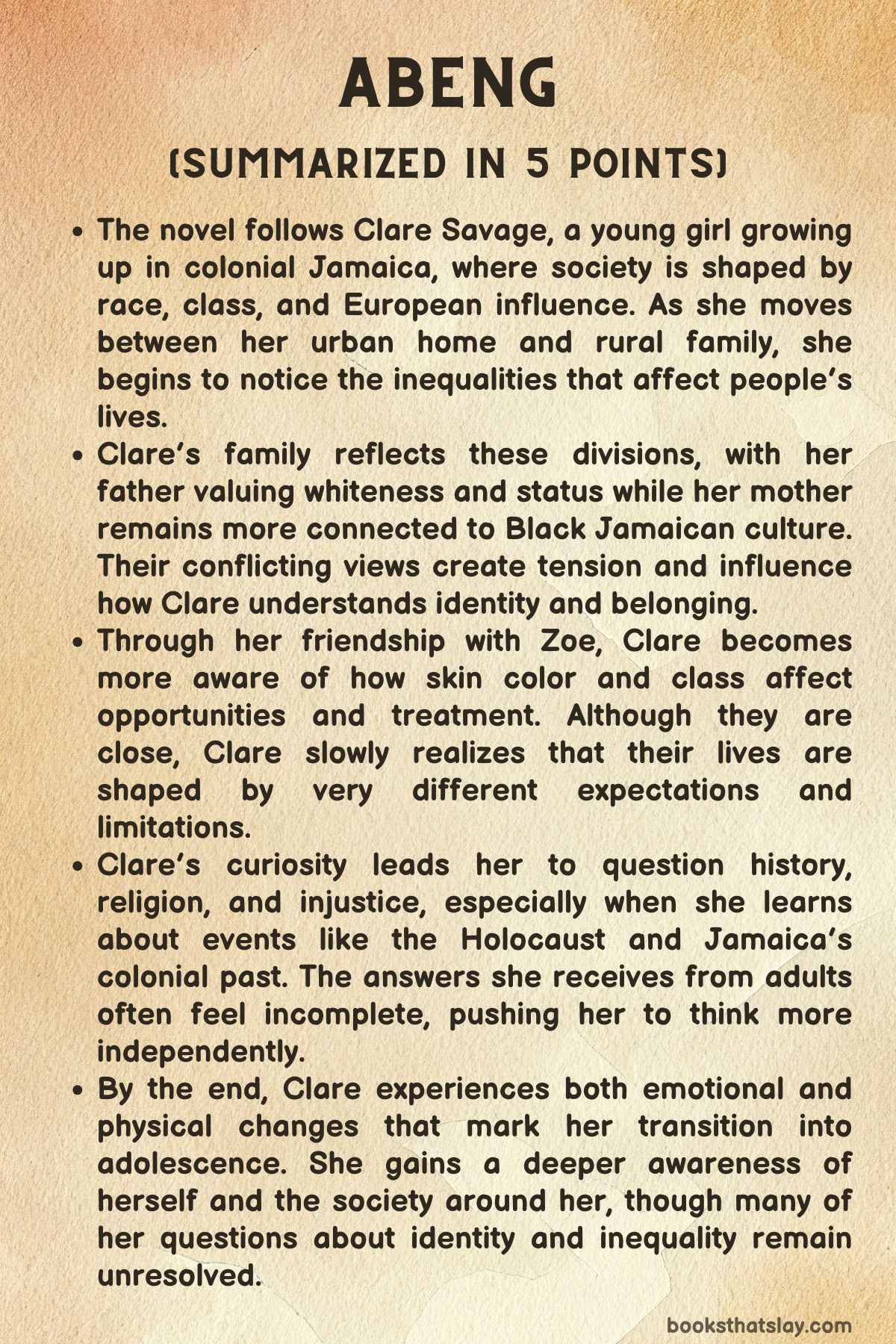
Abeng by Michelle Cliff is a coming-of-age novel set in Jamaica during the late 1950s, a time when the island was still a British colony and social life was shaped by the legacies of slavery and colonial rule. The story centers on Clare Savage, a light-skinned Jamaican girl growing up between two very different cultural worlds.
Through Clare’s childhood experiences, the novel explores race, class, colonial history, and identity. Cliff shows how the past—slavery, rebellion, and colonial power—continues to shape everyday life in Jamaica. As Clare begins to question the beliefs around her, she slowly becomes aware of the inequalities and hidden histories that influence her family, her friendships, and her own sense of self.
Summary
The story begins in Jamaica during the late 1950s, when the island remains under British colonial influence. Clare Savage lives in Kingston with her parents, Boy and Kitty Savage, and her younger sister Jennie.
Their lives reflect the complicated social divisions of Jamaican society. Although most people on the island are Black or mixed-race, the culture still values whiteness and European traditions.
This influence shapes the education system, social status, and even religious practices.
On a hot Sunday during mango season, the Savage family attends church at John Knox Memorial Church, a respectable place attended by middle-class Jamaicans. After the service, they return home for dinner prepared by their servant, Dorothy.
Later they go swimming at the beach, which is part of their weekly routine. During this outing, Boy believes something touches him in the water and fears it might be a shark.
Even though his wife reassures him that the sea is safe, the experience unsettles him and he vows never to swim again.
Clare is curious about the natural world. Some time before the beach trip she discovers a fossil, which leads her father to explain the ancient history of the island and the insignificance of human life compared to the age of the earth.
These conversations give Clare the impression that her father treats her almost like a son rather than a daughter. Boy has unusual interests in mystical ideas and natural disasters.
He believes that everything in the world follows a divine plan and that human effort matters very little. His beliefs influence the way he lives his life.
Instead of working hard, he spends his time drinking, gambling at the racetrack, and pursuing affairs with other women. Kitty, in contrast, is careful with money and supports the family through her job at a hotel.
Religion appears in many forms in Clare’s life. Besides the formal Presbyterian church her family attends, they also visit the Tabernacle of the Almighty Church, a smaller and more emotional place of worship mostly attended by working-class Black women.
During services, people sometimes fall into spiritual trances while the minister warns against sinful pleasures such as dancing, drinking, and movies. These sermons have little effect on the difficult lives of the congregation.
Many Black Jamaicans work for very low wages and struggle simply to survive each week.
Another kind of spiritual tradition exists in the countryside where Clare’s grandmother, Miss Mattie, lives. When Clare visits her, she witnesses prayer gatherings that combine Christian belief with older cultural traditions.
Stories of the Maroons—communities of formerly enslaved people who fought against colonial forces—are remembered there. One legendary figure is Nanny, a spiritual leader who resisted the British during the eighteenth century and became famous for her courage and magical reputation.
The narrative often shifts away from Clare’s present life to describe the historical background of Jamaica. The island was first colonized by Spain and later taken by Britain in the seventeenth century.
During the long period of slavery, enslaved Africans resisted oppression through rebellion and escape. Some formed Maroon communities in the mountains, fighting guerrilla battles against colonial authorities.
Despite this history, many Jamaicans are not taught about these struggles in school. Instead, their education focuses mainly on British culture and European history.
Clare’s own family history reflects the complicated racial and social hierarchies of the island. On her father’s side, the family traces its origins to an English judge who arrived in Jamaica during the nineteenth century and built plantations worked by enslaved people.
The family takes pride in this white ancestor and prefers to ignore the mixed heritage that also runs through their lineage. Over time the family fortune declines as plantations are sold and lands divided.
One story from this past reveals the cruelty of the plantation system. The judge forced a young woman named Inez to become his mistress.
After becoming pregnant, she secretly ended the pregnancy with help from a wise woman. Later she escaped from the plantation and helped formerly enslaved people obtain land and tools after emancipation.
Meanwhile the judge reacted violently to the end of slavery, even burning enslaved workers in an attempt to resist change. Clare grows up unaware of these dark parts of her ancestry.
Her father’s own life is shaped by family instability. His mother left Jamaica to pursue an acting career in the United States and later died in Hollywood.
As a child he was raised by relatives who struggled with alcoholism and nostalgia for their fading family status. Despite these circumstances he was intelligent and earned a scholarship to a Jesuit school.
During World War II he served in North Africa, where he developed a fascination with Calvinist ideas about divine election. He came to believe that certain people were chosen by God for salvation regardless of their behavior, and he convinced himself that his own family belonged to this special group.
After the war he married Kitty Freeman. Kitty came from a rural family with mixed African and European heritage.
Before marriage she had strong ambitions to become educated and contribute to her community, but those plans gradually faded after she had children. Her marriage to Boy becomes tense and filled with arguments.
Although he never physically harms her, his threatening words frighten Clare.
Clare spends part of each year in the countryside with her grandmother. There she becomes close friends with Zoe, a girl from a poorer family who lives nearby.
Zoe attends a small local school run by Mr. Powell, a teacher who once encountered ideas about Black nationalism but later chose a cautious approach. He encourages pride in Jamaican culture while avoiding political conflict that might endanger his students.
Despite their strong friendship, Clare and Zoe grow increasingly aware of the social differences between them. Clare’s lighter skin and urban upbringing give her privileges that Zoe does not share.
At school Clare sees how darker-skinned students are sometimes ignored or treated unfairly. One student suffers a seizure during prayer and receives little help, and later the school removes her scholarship to avoid embarrassment.
As Clare enters adolescence, she becomes curious about the wider world. One day she skips school to watch a film about Anne Frank.
The story of the Holocaust deeply troubles her, and she tries to understand why such suffering happened. Her teachers offer vague explanations and suggest that people in the world did not know about the atrocities in time to stop them.
Clare finds these answers unsatisfying. When she asks her father, his response reveals troubling beliefs.
He suggests that Jewish people brought suffering upon themselves by opposing Hitler. Although he eventually admits he cannot fully explain the tragedy, his remarks disturb Clare and cause her to question his moral authority.
Determined to understand more, Clare secretly reads books about the Holocaust. Through these accounts she begins to see parallels between the oppression of Jews in Europe and the treatment of darker-skinned people in colonial societies.
She realizes that systems of power often define certain groups as less than fully human.
Meanwhile her friendship with Zoe deepens. They share conversations about their changing bodies and the mysteries of adulthood.
Zoe explains menstruation to Clare because her own parents avoid discussing such topics openly. Their curiosity also leads them to read sensational newspaper stories about sexuality and unusual events, which both frighten and fascinate them.
One morning the girls decide to hunt a wild pig that has lived in the hills for many years. Clare brings a rifle while Zoe carries a machete.
As they climb the hill, Zoe becomes nervous about the consequences if they are discovered. She knows that adults in the community might blame her rather than Clare because of their different social positions.
Clare struggles with the realization that she can leave the countryside and return to the city while Zoe must face the judgments of local people.
Eventually they abandon the hunt and go swimming in a nearby river. With no bathing suits, they swim naked and relax together on a rock afterward.
Their peaceful moment is interrupted when a cane cutter unexpectedly appears. Clare fires her rifle into the air to scare him away, but the bullet accidentally strikes and kills her grandmother’s bull.
The incident causes serious trouble. The cane cutter reports what happened, and Miss Mattie believes Clare’s behavior reflects the arrogance of her father’s family.
Soon Clare’s parents arrive and remove her from the countryside without asking many questions. Instead of dealing with the conflict directly, they send her to live temporarily with an elderly white woman named Miss Beatrice Phillips.
Life in Miss Beatrice’s house is lonely and rigid. The old woman is openly racist and holds strong beliefs about racial hierarchy.
She keeps many dogs trained to attack Black people and frequently makes cruel remarks about others. Clare spends her days reading newspapers aloud to her host and observing the strange routines of the household.
She begins to understand how prejudice operates in everyday life.
During a visit to Miss Beatrice’s sister, Clare secretly meets the woman early one morning. The sister reveals a tragic story from her youth.
She once fell in love with a Black man and became pregnant. Her father murdered the man and forced her into a marriage with someone else.
The experience left her isolated and ashamed. Through this confession Clare learns how strict racial boundaries have shaped many lives in Jamaican society.
That night Clare dreams about Zoe. In the dream she harms her friend but also cares for her wound afterward.
When she wakes, she discovers that her first menstrual period has begun. Sitting alone on the veranda, she reflects on the changes in her body and the confusing emotions she feels about friendship, race, and identity.
Although she cannot yet fully understand the meaning of her dream or her experiences, the moment marks an important step in her growing awareness of herself and the world around her.
Characters
Clare Savage
Clare Savage stands at the center of the novel as a child moving toward adolescence while trying to understand the world that has formed her. She is intelligent, observant, sensitive, and often more serious than the people around her realize.
What makes her especially important is that she does not fit neatly into a single social category. She is light-skinned, educated, and linked to a family that values whiteness and respectability, yet she is also drawn toward the Black rural culture represented by her mother’s family and by Zoe.
This divided position gives her a double vision. She benefits from privilege without fully accepting the beliefs that support it, and this creates in her a deep and growing unease.
Clare’s character is shaped by curiosity. She wants to know about history, religion, injustice, the body, and the hidden meanings beneath ordinary events.
She asks difficult questions about death, slavery, race, and suffering, and she is rarely satisfied by the answers adults give her. Her interest in Anne Frank and the Holocaust shows that she is trying to build a moral understanding of the world rather than simply inherit one.
She senses that cruelty is never accidental and that silence often protects power. Even before she has the language to explain what she feels, she recognizes that something is wrong in the social order around her.
At the same time, Clare is still a child, and the novel does not treat her as fully wise or fully innocent. She can be selfish, impulsive, and blind to the consequences of her actions.
Her friendship with Zoe reveals this most clearly. Clare wants closeness and equality, but she does not always grasp what separates them in practical terms.
She can imagine a shared future because she has never had to measure possibility by money, skin color, or social punishment in the same way Zoe has. Her decision to take the rifle and go hunting shows both her adventurous spirit and her immaturity.
She wants freedom, but she does not yet understand how unevenly freedom is distributed.
Her emotional life is also marked by longing. She yearns for connection, especially from her mother, and this hunger shapes many of her responses to other people.
Her bond with Zoe carries affection, admiration, dependence, and desire, though she is too young to name all of it. Her first menstruation at the end marks more than bodily change.
It signals that Clare is entering a new stage of consciousness, one in which race, class, history, gender, and desire will no longer remain separate questions. In Abeng, Clare is not only growing up; she is awakening to the truth that identity is made through conflict, memory, and recognition.
Boy Savage
Boy Savage is one of the most troubling figures in the novel because he combines charm, intelligence, vanity, and moral failure in ways that reveal the damage done by colonial thinking. He is Clare’s father, and he sees himself as a man apart from ordinary people.
He is fascinated by religion, destiny, myth, and apocalyptic ideas, but these interests do not make him compassionate or disciplined. Instead, they help him excuse his own behavior.
His belief that some people are divinely chosen allows him to imagine that he belongs to a superior order and therefore does not need to be accountable in the same way as others.
His attachment to the white side of his ancestry is central to his character. Although his family history is mixed, he prefers a version of the past that centers white lineage, property, and status.
He adopts the values of the colonial class even when his own life does not fully match its power or prestige. This makes him a figure of imitation and insecurity.
He clings to ideas of refinement, hierarchy, and spiritual election because they protect him from facing the more violent truths of his inheritance. The brutality of the plantation past remains in the background of his family story, but Boy is more interested in preserving family pride than in confronting that legacy honestly.
As a husband and father, he is unreliable and unsettling. He is adulterous, irresponsible with money, and emotionally domineering.
His repeated statement that he will not kill Kitty creates an atmosphere of fear even though he never openly commits violence. That phrase matters because it shows how power can operate through threat, mood, and instability.
Clare lives under the pressure of his temper and his worldview. He also treats her in ways that suggest both favoritism and projection, as though she were the child into whom he can place his own ambitions and ideas.
Boy’s response to Jewish suffering is one of the clearest indicators of his moral failure. He cannot offer Clare a humane explanation for the Holocaust because his thinking has already been shaped by a habit of blaming the oppressed and admiring systems of chosen superiority.
He is not evil in a simple or theatrical way. He is frightening because he is recognizable: educated enough to sound persuasive, spiritually minded enough to seem thoughtful, and corrupted enough to justify cruelty when it protects his sense of order.
He represents the internalization of colonial values at the level of family life, belief, and imagination.
Kitty Savage
Kitty Savage is one of the most complex characters because much of her life is defined by restraint, disappointment, and feeling that has been pushed inward. She is Clare’s mother, and unlike Boy, she is connected in a living way to the Black Jamaican world of the countryside.
She knows local plants, customs, kinship networks, and the texture of rural life. She feels most alive away from the city, where her body and spirit seem more at ease.
This link to the land and to ordinary Black people gives her an emotional depth that Boy lacks, yet it does not make her warm or expressive in her role as mother.
Kitty is a woman whose early promise has been narrowed by marriage, labor, and silence. Before her marriage, she had ambition and direction.
She wanted education, meaningful work, and a life larger than domestic duty. Those possibilities were interrupted by history and then absorbed into the demands of adulthood.
Her marriage to Boy becomes a structure of frustration rather than partnership. She directs much of her emotional energy into conflict with him, and the result is that her daughters experience her more as distant presence than as source of comfort.
Clare longs for physical tenderness from her, but Kitty rarely provides it.
What makes Kitty especially moving as a character is the contrast between her reserve at home and her compassion toward others. She shows pity for strangers, respect for old customs, and generosity toward poor people in the countryside.
She saves money and carries food to those in need. This means her emotional capacity is not absent; it is displaced.
She can respond to suffering in the world, but not easily to intimacy within her own family. That split helps explain why Clare experiences her as both admirable and unreachable.
Kitty also embodies a conflict around race that she never fully resolves. She identifies deeply with Black Jamaicans and seems to carry a strong, almost buried loyalty to them, yet she keeps that feeling contained.
The phrase about keeping darkness locked inside captures her condition well. She has not embraced the colonial values Boy celebrates, but she has not openly rejected them either.
Her silence becomes part of the novel’s moral landscape. She is not an oppressor in Boy’s mold, yet her inability to speak fully or act openly also allows damaging structures to continue.
She is a tragic figure not because she lacks strength, but because her strength has been turned inward for too long.
Zoe
Zoe is one of the clearest moral and emotional counterpoints to Clare. She is intelligent, self-possessed, physically strong, and far more realistic than her friend about how the world works.
Their friendship is real and loving, but Zoe sees its limits more clearly because she has to. She is poorer, darker-skinned, and rooted in a social world where mistakes bring consequences quickly.
She cannot afford romantic illusions about equality. This gives her a kind of early wisdom.
She understands class, labor, reputation, and vulnerability not as abstract ideas but as facts that govern daily life.
Zoe is also important because she offers Clare another way of being female. She is knowledgeable about menstruation, sex, danger, and bodily change in a way that comes from practical life rather than formal instruction.
She helps Clare enter knowledge that the adults around her either hide, distort, or refuse to explain. In this sense she becomes both friend and teacher.
Their conversations create a private space of discovery where shame and curiosity exist side by side.
Her friendship with Clare contains affection but also tension. Zoe is capable of closeness, but she does not surrender her sense of social reality.
When Clare refuses to let her try on the bathing suit, the moment exposes the inequality between them. Zoe later receives the harsh but truthful warning from her mother that a girl like Clare can never fully belong to her world.
Zoe carries that lesson forward. By the time of the pig-hunting episode, she can state plainly what Clare still struggles to admit: that Clare can leave, while Zoe will remain to answer for whatever happens.
That clarity does not make Zoe cold. It makes her credible and strong.
Zoe also stands at the edge of Clare’s awakening desire. Clare is drawn to her body, her company, and her presence, though she cannot yet interpret these feelings fully.
Zoe becomes a figure through whom Clare experiences beauty, intimacy, difference, and the limits of identification. She is not simply a symbolic contrast to Clare.
She is a full person whose insight exposes the illusions of privilege and whose friendship forces Clare toward self-knowledge.
Miss Mattie
Miss Mattie represents memory, discipline, survival, and the authority of the rural maternal line. She is a powerful presence in Clare’s life because she connects the child to histories and practices that exist outside the official colonial world.
Her house is a place of prayer, custom, labor, social ranking, and storytelling. Through her, the novel presents a form of Jamaican life that contains Christianity, African continuities, and practical wisdom without trying to separate them neatly.
She is not an easy or openly affectionate grandmother. She is strict, watchful, and shaped by hardship.
Her own life has taught her to rely on endurance rather than tenderness. She has survived poverty, labor, disappointment in marriage, and the burdens of caretaking.
These experiences have made her formidable but also emotionally guarded. The distance between her and Kitty suggests that strength in this family often travels through severity rather than comfort.
She cares, but her care is structured through rules, work, and judgment.
Miss Mattie also carries the weight of mixed ancestry in a different way from Boy. In her case, race is not a matter of prestige but of lived contradiction.
Her lineage includes both white and Black forebears, yet her loyalties and values are grounded in the Black rural world. She is far less invested in fantasies of refinement and far more aware of how power actually behaves.
That is why Clare’s accidental killing of the bull becomes, for Miss Mattie, more than childish error. She reads it as evidence of corruption carried in the bloodline of the paternal family.
Her response may seem harsh, but it comes from a long memory of domination and irresponsibility.
As a character, she is also linked to female inheritance. The narrative places her close to the world of wise women, folk knowledge, prayer circles, and stories of resistance.
She is not romanticized as purely nurturing or mystical. Instead, she appears as a woman who has built authority out of necessity.
She protects order because disorder has always cost women like her dearly.
Jennie Savage
Jennie, Clare’s younger sister, remains less fully developed than the older characters, yet her presence is important because she helps define Clare’s place within the family. Jennie is part of Clare’s domestic world, but she does not seem to carry the same burden of questioning or divided consciousness.
Clare often appears alone in a deeper way because no sibling bond fully relieves her isolation. Jennie’s more limited role emphasizes that Clare is the child through whom conflict is most intensely experienced.
Jennie also helps illuminate parental dynamics. The summary suggests that Boy treats Clare almost as though she were a son, which gives Clare a distinct place in the father’s imagination.
Jennie, by contrast, seems to remain more in the background, which reflects the unequal emotional arrangements inside the household. Her relative quietness in the narrative is therefore meaningful.
It shows how one child may become the site of family projection while another is left less examined.
Even in her smaller role, Jennie contributes to the theme of girlhood. Clare’s awareness of bodily privacy, nakedness, and later physical change is partly measured against the fact that until a certain point the only person she had been naked with was her younger sister.
Jennie belongs to the earlier stage of childhood that Clare is leaving behind. Her presence marks innocence not yet broken by history, sexuality, or political awareness in the way Clare’s has been.
Dorothy
Dorothy, the family servant, occupies a quieter but revealing place in the social structure of the novel. She prepares meals and performs domestic labor that sustains the household, yet she stands at the edge of family recognition rather than inside it.
Her role shows how middle-class life in colonial Jamaica depends on the work of Black women whose labor is treated as normal, necessary, and often invisible.
Though the summary offers limited psychological detail about her, Dorothy matters because she embodies the unequal intimacy of servant life. She is physically close to the family, present in their routines, and essential to their comfort, but she does not share their status.
The fact that the household can move through church, dinner, and leisure while her work remains in the background tells us much about class and race relations. Characters like Dorothy reveal how social hierarchy is reproduced not only through grand historical forces but through everyday domestic arrangements.
Her presence also sharpens the contrast between proclaimed Christian values and actual social practice. A family may attend church, speak of morality, and value respectability while depending on an unequal labor system that goes unquestioned.
Dorothy therefore functions as part of the novel’s critique of colonial respectability. She is one of the many figures whose work supports a world that does not fully see her.
Nanny
Nanny is not a conventional character moving through the same present-time action as Clare, yet she is one of the most important presences in the novel’s imaginative world. She appears as legendary ancestor, rebel leader, spiritual figure, and symbol of anti-colonial resistance.
The stories about her connect the child’s life to the long history of Jamaican struggle against slavery and domination. She represents a historical memory that official education ignores or distorts.
Nanny’s importance lies in what she offers as a counter-history. Where the colonial world teaches obedience, whiteness, and European greatness, Nanny stands for Black resistance, strategy, spiritual power, and female authority.
She is remembered not as passive victim but as leader. This matters greatly within a novel concerned with what children are and are not taught.
Through Nanny, the past becomes source of strength rather than only source of suffering.
She also broadens the meaning of womanhood in the book. Female power here is not limited to motherhood, sacrifice, or domestic endurance.
Nanny represents command, intelligence, and collective struggle. Her legendary qualities do not weaken her significance.
They show how memory itself can become a form of resistance. For Clare, even indirectly, Nanny helps make imaginable a history outside the one authorized by colonial culture.
Inez
Inez is one of the most important figures from the family past because her story exposes the violence buried beneath respectable genealogies. She is forced into sexual exploitation by the plantation owner and initially appears as yet another victim of colonial power.
Yet the narrative refuses to leave her in that position. She survives, resists, ends an unwanted pregnancy with the help of another woman, plans her escape, and later helps prepare material support for people emerging from slavery.
This combination of injury and agency makes her a crucial figure in the moral architecture of the novel. She represents the truth that the wealth and prestige claimed by certain families were built through coercion, rape, and terror.
At the same time, she represents forms of resistance often excluded from official records: female solidarity, reproductive control, strategic patience, and practical preparation for freedom.
Inez matters especially because Clare does not know this history. That absence is part of the book’s critique.
The child inherits the surface of family identity while the suffering that made that identity possible remains hidden. Inez therefore stands not only for resistance but for erased memory.
Her story challenges the false nobility of the paternal line and restores human reality to those colonial histories try to reduce to property.
Mr. Lewis Powell
Mr. Lewis Powell is a smaller but significant intellectual figure in the rural world. As a teacher, he stands between colonial instruction and local reality.
He has encountered Black nationalist ideas and has seen enough of the world to know that history is larger than the curriculum handed down from Britain. Yet he does not become a revolutionary teacher.
Instead, he chooses caution, compromise, and limited cultural affirmation.
This makes him an especially believable character. He is not simply brave or cowardly; he is shaped by disappointment and fear.
His exposure to racism and political repression outside Jamaica has convinced him that open protest can lead to suffering without transformation. As a result, he promotes pride in Jamaica and in Black writing, but he stops short of encouraging radical political consciousness.
He gives his students something more than the colonial script, though not enough to overturn it.
His character shows how damaged societies often produce damaged forms of leadership. He has knowledge, but it is constrained by caution.
He wants to protect his students, yet that very protective instinct also limits what he is willing to teach them. He is an example of the educated colonial subject who knows more than he can comfortably say.
Miss Beatrice Phillips
Miss Beatrice Phillips represents aging white colonial authority in its most stripped and unapologetic form. She is racist, rigid, and convinced of her own standards, yet she is not presented as grand or glamorous.
Instead, she is narrow, repetitive, and mean in ordinary ways. This ordinariness is important because it shows prejudice not as a dramatic aberration but as a daily practice sustained through habit, speech, and household routine.
Her house becomes a place where Clare witnesses the persistence of white supremacy outside the formal end of slavery. Miss Beatrice trains dogs against Black people, insults those around her, and treats cruelty as normal.
In her presence, Clare learns another lesson about silence. She sees acts of intolerance so petty and constant that they might seem easy to ignore, but their cumulative effect is to reveal a whole structure of feeling built on contempt.
Miss Beatrice is also a figure of decline. She belongs to an older colonial order that is fading, yet she still exerts influence.
This makes her symbolic of a social world that is decaying without disappearing. She is not powerful in the way plantation owners once were, but her beliefs remain alive in manners, institutions, and inherited attitudes.
She is the afterlife of empire in domestic form.
Winifred Stevens
Winifred Stevens, Miss Beatrice’s sister, provides one of the most haunting examples of how racial boundaries damage even those who appear to benefit from them. Her story of loving a Black man, becoming pregnant, and losing both the lover and the child to patriarchal and racial violence is devastating.
She reveals the personal cost of a system built to defend whiteness at all costs.
What makes her memorable is the way she combines confession, ruin, and internalized punishment. She has suffered because of racist authority, yet she has also absorbed its lesson so deeply that she now speaks as though crossing racial lines inevitably leads to sorrow.
Her mind and body bear the marks of repression, shame, and loss. She is not simply victim or warning; she is evidence of how domination reproduces itself inside memory.
For Clare, this encounter is crucial because it reveals that race is not only an external social rule but a force that enters love, sex, kinship, and motherhood. Winifred’s life shows the hidden casualties of respectability and purity.
Her suffering expands Clare’s understanding of what social order really means.
Robert
Robert, Clare’s godfather and distant cousin, represents another form of difference the family refuses to accept. He is described by relatives as strange or funny because he lives outside expected masculine norms and prefers male companionship.
The family’s reaction to him shows how sexuality, like race, is policed through gossip, ridicule, and exclusion. His relationship with a darker-skinned man intensifies that rejection, since it violates both sexual and racial expectations.
Robert’s importance lies partly in what Clare cannot yet fully understand about him. She avoids him because she senses something emotionally risky in his openness.
Later, when she reflects on her own attachment to Zoe, Robert becomes a silent parallel. He is one of the few figures in her world whose life suggests that desire may not follow approved paths.
Yet the family offers no language for this except mockery and discomfort.
His drowning is therefore symbolically heavy. It removes a source of embarrassment from the family’s point of view, but it also erases a figure who might have stood as an alternative model of feeling and identity.
Robert is treated as expendable by the family narrative, and that expendability reveals the limits of its claimed respectability.
Mad Hannah
Mad Hannah is a figure through whom the novel examines grief, social cruelty, and communal judgment. After the drowning of her son Clinton, she becomes mentally unstable, and the community responds not with care but with blame.
People explain her suffering in a way that frees themselves from responsibility. By calling her foolish and treating her son as weak, they transform tragedy into moral accusation.
This makes Mad Hannah more than a local eccentric or background figure. She represents what happens to people whose grief becomes too visible and therefore too inconvenient.
Her story also reveals the harshness with which poor communities, themselves burdened by suffering, may still enforce norms of masculinity and maternal responsibility. Clinton is condemned for being too attached to his mother, and Hannah is condemned for failing to produce the right kind of son.
Their loss becomes a spectacle others use to secure their own distance from vulnerability.
For Clare, meeting Mad Hannah is part of her education in social reality. The encounter brings her close to suffering that cannot be explained away by manners or religion.
Hannah stands for the broken edge of communal life, where pity and cruelty remain dangerously close.
Miss Ruthie
Miss Ruthie, Zoe’s mother, plays a quiet but decisive role in shaping the novel’s understanding of class and friendship. She is poor, practical, and far less sentimental than Clare.
Her judgment that a girl like Clare can never truly be Zoe’s friend is painful, but it comes from experience rather than malice. She knows how hierarchy works and refuses comforting illusions.
Her insight matters because it interrupts the fantasy that affection alone can erase structural difference. She is not denying that Clare and Zoe care for each other.
She is stating that care exists within a society where whiteness, money, and status matter, and that those forces will eventually test any friendship. In this sense, Miss Ruthie acts as a truth-teller.
She says directly what other adults either conceal or soften.
She also represents maternal knowledge of survival. Unlike Kitty, whose feelings often remain inward, Miss Ruthie speaks plainly.
Her understanding is social, not abstract. She knows what it costs to be dark-skinned and poor, and she wants her daughter to know it too.
Christopher Columbus
Although he appears only through historical narration, Christopher Columbus functions as an originating figure in the novel’s critique of empire. He is not presented as heroic discoverer but as the beginning of a long process of conquest, naming, dehumanization, and mythmaking.
His presence reminds the reader that the violence shaping Clare’s world did not begin with her family or even with British rule. It began with the colonial habit of seeing other peoples as less human and therefore available for domination.
His role is conceptual as well as historical. He stands for the stories empires tell about themselves and about those they conquer.
By placing him within a discussion of who counts as human, the novel ties the treatment of Indigenous people, Africans, Jews, and Black Jamaicans into a larger pattern of exclusion. He is therefore not only a person from the past but a principle of classification and conquest that remains active in the present.
Granny Judith and Mas Samuel
Judith and Mas Samuel deepen the maternal family history by embodying an earlier crossing of racial and social boundaries. Judith, a white woman who ran away with a servant, and Samuel, the brown man remembered with affection, form a union that unsettles conventional hierarchy.
Yet the summary suggests that Judith becomes bitter in old age while Samuel remains beloved. This contrast hints at the unequal emotional consequences of their shared history.
Together they represent a family origin that cannot be reduced to purity or simple legitimacy. Their story undermines the fantasy of clean racial lines and shows that Jamaican family histories are built through transgression as much as through law.
They matter because they reveal that mixture is not an exception to social order but one of its hidden foundations.
James Eduard Constable
James Eduard Constable, the English judge and plantation founder in the paternal line, stands as the brutal ancestor whose legacy shadows the present. He embodies the union of law, whiteness, property, and violence.
His importance lies not merely in personal cruelty but in the fact that he represents a whole system that was legal, profitable, and admired by those who benefited from it. He is remembered with family pride for actions that should inspire horror, and that false reverence is itself part of the novel’s indictment.
His role in sexual violence, punishment of enslaved people, and refusal to accept emancipation reveals the raw structure of colonial power. He is the kind of figure later generations sanitize in order to preserve status.
The fact that his descendants celebrate his discipline while suppressing the suffering he caused shows how historical memory becomes an instrument of privilege.
As a character in the family imagination, he is less an individual than a monument to inherited corruption. His presence explains why later members of the family, especially Boy, cling so fiercely to white ancestry.
To admit the truth about him would require admitting that their claims to superiority are rooted in atrocity.
Themes
Colonial Legacy and Historical Memory
The narrative repeatedly shows how colonial history continues to shape Jamaican society long after slavery and formal imperial control have begun to fade. The social order that surrounds Clare is not simply a modern community; it is a structure formed through centuries of conquest, plantation labor, racial classification, and cultural domination.
These historical forces appear in family stories, education, religion, and even casual conversations. People inherit ideas about superiority and inferiority without always realizing that these beliefs were originally created to justify colonial rule.
Family history provides one of the clearest examples of how the past continues to influence the present. Clare’s paternal lineage traces itself proudly to a British plantation owner who accumulated wealth and authority through violence and exploitation.
Later generations remember this ancestor as a figure of prestige, carefully ignoring the cruelty that made his position possible. This selective memory reveals how colonial power survives through storytelling.
When the brutal aspects of the past are hidden or softened, the descendants of those who benefited from empire can maintain a sense of legitimacy and pride. The silence around these events becomes a powerful tool that protects the social hierarchy.
Education also reflects the lingering effects of colonial ideology. Schools emphasize British culture, literature, and historical narratives while minimizing African history and the stories of resistance within Jamaica itself.
Students learn about European heroes but remain largely unaware of the Maroons and other rebels who fought against slavery. This imbalance teaches children to admire the colonizers while neglecting the courage and creativity of their own ancestors.
As a result, young people grow up with limited knowledge of their cultural inheritance.
The presence of figures such as Nanny challenges this silence. Her story represents a counter-history in which enslaved people resisted oppression and built communities of independence.
Through such memories, the narrative shows that colonial authority was never absolute and that resistance existed alongside domination. These competing histories reveal a society still negotiating how it understands its past.
Clare’s growing awareness reflects the struggle between official narratives and hidden truths. As she learns more about the suffering caused by colonial systems, she begins to see how deeply these structures influence everyday life.
In Abeng, the colonial legacy is not simply a historical background. It is an active force that shapes identity, morality, and social relationships across generations.
Race, Color, and Social Hierarchy
Race and skin color operate as powerful organizing principles in Jamaican society, determining access to opportunity, respect, and authority. The narrative shows that color prejudice does not simply divide white and Black communities; it also produces a complex hierarchy within the island’s mixed population.
Lighter skin often brings advantages in education, employment, and social status, while darker skin frequently leads to marginalization. These distinctions are subtle in daily life but deeply influential in shaping relationships.
Clare’s position reveals the contradictions created by this system. Her light complexion gives her privileges that many other children do not receive.
Teachers, neighbors, and strangers often treat her with a level of respect associated with whiteness or near-whiteness. At the same time, her family background includes African ancestry and connections to rural Black communities.
This mixture places her in an ambiguous position. She benefits from a system that privileges light skin, yet she also senses that the hierarchy is unjust and historically constructed.
Her friendship with Zoe highlights these tensions in a personal way. The girls share affection, curiosity, and trust, yet their lives are shaped by different expectations.
Zoe understands the risks attached to her darker skin and lower economic status. When they plan adventures or challenge social rules, Zoe knows that blame will fall more heavily on her.
Clare initially struggles to recognize this imbalance because privilege often makes inequality appear invisible to those who benefit from it. Their friendship becomes a space where the realities of color hierarchy gradually become impossible to ignore.
Adult attitudes reinforce these divisions. Some members of Clare’s extended family openly value whiteness and attempt to distance themselves from Black identity.
This desire for racial prestige leads to judgment about who people should marry, where they should live, and how they should behave. The fear of social decline drives many of these decisions.
By aligning themselves with whiteness, families attempt to maintain a fragile sense of superiority even when their economic circumstances do not fully support it.
The narrative also shows how color prejudice can be internalized by those who suffer under it. Some darker-skinned individuals reproduce the same social hierarchies in their interactions with others, demonstrating how colonial ideologies penetrate everyday thinking.
These patterns illustrate that racism is not only enforced from above; it also becomes embedded in community behavior and self-perception.
Within Abeng, the theme of racial hierarchy reveals how identity is shaped by historical power structures. The system of color classification affects friendships, education, and family expectations, making it one of the most pervasive forces in the characters’ lives.
Identity and Coming of Age
Clare’s development from childhood toward adolescence forms the emotional center of the narrative. Her experiences reveal that growing up involves more than physical maturity; it also requires confronting complex social realities that challenge earlier assumptions about the world.
Clare begins the story as a curious but relatively sheltered child. As she observes the tensions around her, she gradually becomes aware of the contradictions embedded in her family, community, and society.
One aspect of this growth involves intellectual awakening. Clare constantly asks questions about history, morality, and injustice.
Her interest in events such as the Holocaust shows that she is trying to understand suffering beyond her immediate environment. The explanations she receives from adults are often incomplete or evasive, forcing her to seek knowledge independently.
This process of questioning authority marks an important step in her transition from passive learner to critical thinker.
Her changing relationship with her body also contributes to this transformation. As she approaches puberty, Clare becomes increasingly conscious of physical sensations, sexuality, and the boundaries between innocence and knowledge.
Conversations with Zoe introduce her to subjects that adults avoid discussing openly. These exchanges reveal the confusion and curiosity that accompany early adolescence, while also emphasizing how cultural silence around sexuality leaves young people to discover information through informal channels.
Emotional growth emerges through Clare’s relationships. Her longing for affection from her mother and her fascination with Zoe show how deeply she desires connection.
These relationships are complicated by social divisions and personal misunderstandings, yet they push Clare to examine her own feelings more carefully. She learns that affection, loyalty, and desire can exist alongside conflict and difference.
The turning point occurs after the episode with the rifle and the accidental killing of the bull. The consequences of this event force Clare to confront the impact of her actions on others.
She begins to recognize that her choices carry different consequences for people depending on their social position. This realization marks a shift from childish spontaneity toward moral responsibility.
Her first menstruation at the end symbolizes the culmination of these changes. The physical event signals the arrival of adulthood, but it also represents a deeper awareness of identity and belonging.
Clare is beginning to understand that she occupies a complicated position within Jamaican society. Her journey toward self-understanding will require confronting the historical and social forces that have shaped her life.
Silence, Complicity, and Moral Responsibility
Silence appears repeatedly as a force that protects injustice and prevents honest confrontation with difficult truths. Many characters avoid discussing painful histories, controversial beliefs, or personal failures.
This pattern reveals how social systems maintain themselves not only through open power but also through collective refusal to speak about uncomfortable realities.
Family history provides one of the clearest examples of this silence. The violent actions of Clare’s colonial ancestor are largely absent from everyday conversation.
Instead, the family celebrates his achievements and treats his legacy as a source of pride. By ignoring the suffering he caused, later generations avoid questioning the moral foundations of their social status.
This selective memory allows privilege to continue without acknowledging the exploitation that created it.
Kitty’s character also illustrates how silence can shape personal relationships. She carries strong emotions about race, injustice, and the struggles of ordinary Jamaicans, yet she rarely expresses these feelings openly within her family.
Her reluctance to speak creates distance between herself and her children. Clare senses that her mother holds powerful convictions, but those beliefs remain largely unspoken.
This quiet restraint becomes a form of complicity because it allows dominant ideas within the household to remain unchallenged.
Educational institutions contribute to this pattern as well. Teachers provide vague or misleading explanations about historical tragedies such as the Holocaust.
Their reluctance to address uncomfortable facts leaves students without a clear understanding of how such events occurred. The absence of honest discussion reinforces ignorance and prevents young people from developing a strong ethical framework.
Social prejudice also depends on silence. When characters witness acts of racism or cruelty, they often choose not to protest.
These small moments accumulate, allowing discriminatory attitudes to appear normal. Individuals who question the system risk isolation or punishment, which encourages many people to remain quiet even when they disagree internally.
Clare gradually becomes aware of how silence operates in her environment. Her efforts to ask questions and seek information represent attempts to break this pattern.
As she grows older, she begins to recognize that understanding injustice requires confronting the stories people prefer to hide.
In Abeng, silence is not presented as mere absence of speech. It functions as a powerful social mechanism that preserves inequality and shields individuals from moral responsibility.
By exposing these quiet forms of complicity, the narrative invites readers to consider the ethical consequences of what societies choose not to say.