Agnes Grey Summary, Characters and Themes
Agnes Grey by Anne Brontë is a quiet but sharp novel about a young woman’s attempt to earn her place in the world. Agnes, the sheltered daughter of a poor clergyman, becomes a governess after her family loses its security.
Her work brings her into wealthy homes where she faces spoiled children, selfish parents, class prejudice, loneliness, and moral strain. Through Agnes’s clear-eyed narration, the book shows how limited women’s choices were, especially when they needed to support themselves. It is also a story about patience, self-respect, faith, and the slow growth of love based on kindness and shared values.
Summary
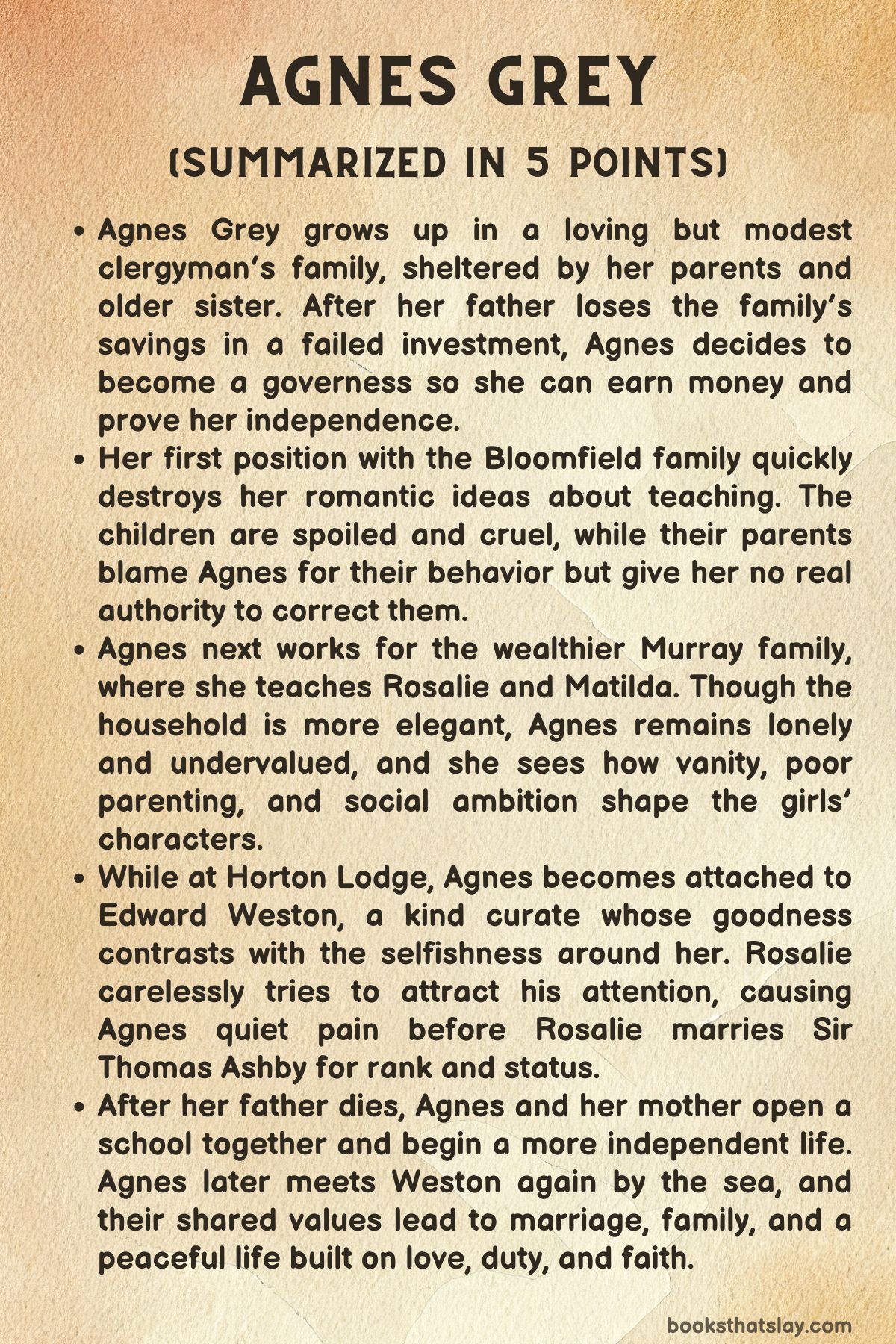
Agnes Grey grows up in a modest but loving parsonage in the north of England. Her father, Richard Grey, is a clergyman, and her mother is a woman of higher social rank who gave up wealth and family approval to marry him.
Agnes is the younger of two surviving daughters, the elder being Mary. Because Agnes has been lovingly protected, her family tends to see her as delicate and impractical, but she longs to prove that she can act for herself.
The family’s peaceful life changes when Mr. Grey invests their savings in a shipping venture that fails after the ship is lost. The financial blow damages his health and spirits.
Mrs. Grey becomes careful and economical, while Mary helps by selling her paintings. Agnes, eager to contribute, proposes becoming a governess.
Her family laughs at the idea, thinking she is too young and helpless, but she persists. She imagines the work as noble and pleasant: she will guide children, earn money, and show her family that she has strength and usefulness.
Her first position is with the Bloomfield family at Wellwood. Agnes arrives full of hope, but the household quickly disappoints her.
Mrs. Bloomfield is cold and formal, while Mr. Bloomfield is rude, irritable, and harsh. Their children are spoiled, disobedient, and cruel.
Tom, the eldest, delights in tormenting animals and defying Agnes. Mary Ann refuses lessons and often behaves badly, while little Fanny is mischievous when her parents are absent.
Agnes tries to govern them through patience, firmness, kindness, and moral instruction, but her authority is constantly undermined. The parents blame her for the children’s faults while refusing to correct the children themselves.
Agnes is humiliated by her failure, especially when the family’s relatives and visitors treat her as inferior or invisible. She is particularly disturbed by Mr. Robson, Mrs. Bloomfield’s brother, who encourages Tom’s cruelty and Mary Ann’s vanity.
When Tom brings Agnes a nest of baby birds to torture, Agnes kills them quickly to save them from greater suffering. Mrs. Bloomfield scolds her for spoiling the boy’s amusement, revealing the moral emptiness of the household.
Soon after, Agnes is dismissed. Though wounded by the injustice, she resolves to try again, believing that experience has made her stronger.
Back home, Agnes enjoys her family’s company, but her father’s health remains poor. Her mother helps her search for a better post, and Agnes is hired by the Murrays of Horton Lodge.
The position pays more and involves older children, so Agnes hopes it will be easier and more respectful than her first placement. Yet her hopes are only partly fulfilled.
At Horton Lodge, Agnes finds a richer, grander household, but not a kinder one. Mr. Murray is a country squire whom she sees little of, while Mrs. Murray cares mainly for fashion, social rank, and her daughters’ accomplishments.
Agnes is expected to make the girls attractive and polished without demanding real discipline or effort from them. The sons, John and Charles, are unruly and soon sent away to school.
Their departure improves Agnes’s daily life, but she remains socially isolated.
Rosalie Murray, the eldest daughter, is beautiful, vain, shallow, and used to getting her way. She manipulates Agnes into finishing her drawings and needlework while claiming the credit herself.
Matilda, Rosalie’s younger sister, cares more for horses, dogs, and rough outdoor pleasures than lessons or manners. Agnes does what she can, but her influence is limited because the family values appearance more than character.
After two years at Horton Lodge, Rosalie enters society and begins enjoying the attention of men. She is courted by several admirers, including Sir Thomas Ashby, Mr. Hatfield the vicar, and others.
She treats courtship as a game, measuring men by wealth, rank, admiration, and the amusement they provide. Agnes disapproves of Rosalie’s vanity and selfishness, but her advice carries little weight.
During this period Agnes becomes aware of Mr. Edward Weston, the new curate. Unlike Mr. Hatfield, whose religion seems severe and self-important, Mr. Weston is gentle, sincere, and compassionate.
Agnes first admires him through his sermons, then through his conduct among the poor. A widow named Nancy Brown tells Agnes how Mr. Weston comforted her spiritual distress with patience and kindness, while Mr. Hatfield had only scolded her.
Agnes feels increasingly drawn to Weston’s goodness, humility, and practical charity.
Agnes’s loneliness deepens her attachment to him. She has no true friend at Horton Lodge, and her position keeps her apart from people of her own age and interests.
Small moments with Weston become precious to her. He picks primroses for her when she cannot reach them, speaks with her about home and flowers, and later gives her bluebells.
Agnes begins to hope that he may care for her, though she often rebukes herself for wishing too much.
Rosalie notices Agnes’s interest and cruelly amuses herself by trying to attract Weston’s attention. She has already rejected Mr. Hatfield after encouraging him to propose, taking pleasure in his humiliation.
Though she is expected to marry Sir Thomas Ashby, whom she does not love and barely respects, she wants to prove she can fascinate Weston too. Agnes suffers quietly, concealing her jealousy and pain.
Her sense of dignity prevents her from displaying her feelings, but inwardly she is hurt.
Rosalie eventually marries Sir Thomas and leaves Horton Lodge. Agnes forgives her, though she recognizes the emptiness of Rosalie’s values.
Around the same time, Agnes receives alarming news from home: her father is gravely ill. When she asks Mrs. Murray for leave, Mrs. Murray responds with coldness, treating death as an ordinary inconvenience.
Agnes rushes home, but her father has already died.
After the funeral, Mrs. Grey decides not to live dependently with Mary and her husband. Instead, she plans to open a small school with Agnes.
She also receives a letter from her estranged father offering financial help if she admits that her marriage was a mistake. Mrs. Grey refuses.
She remains loyal to her late husband, saying she will never regret their union. Agnes respects her mother’s strength and moral independence.
Agnes returns briefly to Horton Lodge to give notice. During her final weeks there, she sees Weston again.
He asks about her mother and her future, and he seems genuinely interested in her happiness. Agnes longs to believe he cares for her, but as her departure approaches and no clear declaration comes, she tries to abandon hope.
On her last Sunday, Weston asks whether it would matter to her if they met again. Agnes admits that she would be glad, but she leaves without knowing whether they ever will.
Agnes joins her mother at their school in A—, where their work slowly becomes successful. She enjoys teaching with her mother and finds more peace than she had in service to wealthy families.
Still, she secretly hopes to hear from Weston. When no word comes, she tries to accept that he did not love her and contents herself with remembering him.
Later, Rosalie, now Lady Ashby, invites Agnes to visit Ashby Park. Agnes goes partly in hope of learning news of Weston.
She finds Rosalie restless, dissatisfied, and unhappy in marriage. Sir Thomas is unpleasant, and Rosalie has little interest in her child.
She regrets losing the freedom and admiration she enjoyed before marriage. Agnes advises her to seek happiness through duty, goodness, and care for others, but Rosalie is not ready to change.
Agnes learns only that Weston has left the area, and she returns home with little hope.
One morning, while walking by the sea, Agnes unexpectedly meets her old dog Snap, followed by Mr. Weston. He tells her he has received the living of a nearby parish and now lives only two miles from A—.
He speaks of having a house and income, but lacking companionship. Agnes is overcome with hope, though she tries to remain composed.
Weston walks her home and asks to meet her mother.
From then on, Weston visits often. He and Mrs. Grey get along well, and his friendship with Agnes grows naturally.
At last, after a storm has cleared, he takes Agnes for a walk to a small hilltop church. There he tells her plainly that, though he has met other women in the neighborhood, only Agnes could be the companion he wants.
He has already spoken with her mother and asks if Agnes loves him. She answers yes.
Agnes marries Edward Weston. Their life is modest but happy, marked by mutual respect, faith, work, charity, and shared trials.
They have three children, whom Agnes raises with the care and moral guidance she had so often seen lacking in wealthy homes. The novel ends with Agnes secure not in luxury, but in love, usefulness, and a peaceful conscience.
Characters
Agnes Grey
Agnes Grey is the narrator and moral center of Agnes Grey, a young woman whose quietness should not be mistaken for weakness. At the beginning, she is sheltered by a loving family and treated as someone too delicate to face hardship, yet she is deeply eager to prove her usefulness.
Her decision to become a governess grows from financial need, but also from a desire for independence, self-respect, and adult responsibility. Agnes’s greatest strength is her moral steadiness.
She is often ignored, insulted, or misunderstood, but she continues to judge people by kindness, self-control, honesty, and religious principle rather than by wealth or rank. Her experiences with the Bloomfields and Murrays gradually remove her romantic ideas about employment and society.
She learns that good intentions alone cannot reform spoiled children when parents encourage selfishness and cruelty. Still, she does not become bitter.
Her narration is calm, observant, and sometimes wounded, but rarely self-pitying. In love, Agnes is restrained and inward.
Her affection for Edward Weston is intense, yet she refuses to behave vainly or manipulatively. By the end, she gains not worldly grandeur but a life suited to her values: useful work, mutual love, family, faith, and peace.
Edward Weston
Edward Weston represents the kind of goodness Agnes most admires: practical, humble, gentle, and sincere. He is not presented as a dazzling romantic hero, but as a morally serious man whose worth is revealed through action.
His treatment of the poor, especially Nancy Brown, shows his religious compassion. Unlike Mr. Hatfield, he does not use religion to frighten or shame people; he comforts, listens, and encourages useful goodness.
His kindness to animals also matters in the novel’s moral world, because cruelty to helpless creatures repeatedly exposes bad character in others. Weston’s relationship with Agnes develops quietly through shared values rather than dramatic declarations.
He notices her mind, her loneliness, her seriousness, and her capacity for sympathy. This makes him different from the people around her, who either overlook her or treat her as a servant.
Weston’s love is respectful and patient. When he finally proposes, it is not based on beauty, vanity, or social ambition, but on companionship and moral likeness.
He becomes Agnes’s reward, not because marriage solves every problem, but because he offers the friendship, respect, and shared purpose she has long lacked.
Mrs. Grey
Mrs. Grey is one of the strongest moral figures in the novel. Born into a higher social class, she gives up wealth and family approval to marry Richard Grey, and she never regrets that choice.
Her marriage is based on affection and principle rather than ambition, making her a contrast to Rosalie Murray, who marries for title and status. Mrs. Grey is practical, intelligent, and resilient.
When the family loses its money, she responds not with complaint but with economy and action. After her husband’s death, she refuses to become dependent on others and chooses to open a school with Agnes.
Her rejection of her father’s offer is especially important: she will not deny the value of her marriage for financial gain. Through her, the novel presents dignity as something independent of wealth.
She also helps explain Agnes’s character. Agnes has inherited her mother’s moral courage, religious steadiness, and belief in useful labor.
Mrs. Grey’s love is protective, but not possessive. She worries for Agnes, yet allows her to try, fail, learn, and return stronger.
Richard Grey
Richard Grey, Agnes’s father, is a kind and principled clergyman whose weakness lies less in morality than in judgment and emotional endurance. His decision to invest the family’s money in a shipping venture causes the financial disaster that begins Agnes’s working life.
He is not greedy, but he is persuaded into a risky choice that has severe consequences. After the loss, his health and nerves decline, and he becomes a figure of suffering within the household.
His illness adds urgency to Agnes’s desire to earn money and prove herself. He also represents the vulnerability of genteel poverty: the family has education, manners, and moral worth, but little protection against economic failure.
Though he becomes physically weak, he still worries about his daughters’ future and urges them to save what they earn. His death marks a turning point in Agnes’s life, forcing the family to leave the old parsonage and begin again.
He is remembered with love, and Mrs. Grey’s loyalty to him confirms that his value as a husband and father cannot be measured by financial success.
Mary Grey
Mary Grey, Agnes’s older sister, is a quieter presence, but she helps define the loving family world from which Agnes comes. She is practical and talented, contributing to the family by selling her watercolor paintings after their financial loss.
Her role shows that the Grey daughters are educated and capable, though their opportunities are limited by gender and class. Mary’s marriage to a vicar offers one possible future for a woman of her background: domestic stability, religious duty, and service within a parish.
Agnes views Mary’s marriage approvingly because it is based on goodness and shared values rather than wealth or display. Mary also functions as a contrast to Rosalie.
Rosalie asks whether Mary’s husband is rich, handsome, and grand, while Agnes values his wisdom, kindness, and moral character. Through Mary, the novel quietly reinforces the difference between a marriage chosen for inner worth and one pursued for status.
Rosalie Murray
Rosalie Murray is beautiful, charming, vain, and emotionally careless. She has been raised to value admiration above principle, and this shapes almost everything she does.
Her beauty gives her power, but she uses that power selfishly. She enjoys attracting men not because she loves them, but because their attention flatters her pride.
Her treatment of Mr. Hatfield is especially revealing: she encourages him until he proposes, then takes pleasure in humiliating him. Her behavior toward Agnes is also cruel, though often disguised as playful confidence.
When she suspects Agnes’s affection for Weston, she tries to win his attention simply to prove she can. Rosalie’s tragedy is that she mistakes social victory for happiness.
She marries Sir Thomas Ashby because he gives her rank and a grand position, but marriage quickly reveals the emptiness of her choice. As Lady Ashby, she is restless, dissatisfied, and trapped in a life she once thought desirable.
Her neglect of her child shows that she has not grown into responsibility. Rosalie is not a villain in a melodramatic sense; she is the product of indulgence, vanity, and a society that teaches women to treat beauty and marriage as their chief instruments of power.
Matilda Murray
Matilda Murray is rough, energetic, and undisciplined, with little interest in the accomplishments expected of young ladies. She prefers horses, dogs, outdoor activity, and blunt speech.
In some ways, she is less false than Rosalie because she does not hide her tastes behind polished manners. Yet her honesty does not make her morally admirable.
She lacks self-control, refinement, and sympathy, and she has been allowed to grow according to impulse rather than principle. Agnes sees that Matilda might have been improved by better guidance, but Mrs. Murray wants results without supporting real discipline.
Matilda’s attachment to animals is also morally mixed. She likes dogs and horses, but her world of hunting and sport still includes casual cruelty, as shown when a dog kills a hare and she fails to respond with the seriousness Agnes and Weston feel.
Matilda’s character shows another failure of upper-class education. While Rosalie is trained for vanity, Matilda is barely trained at all.
Both girls suffer from indulgent parenting, though in different forms.
Mrs. Murray
Mrs. Murray is a fashionable, self-centered mother who cares more about appearances than moral formation. She wants her daughters to be accomplished, attractive, and socially successful, but she does not take responsibility for their deeper character.
Her expectations of Agnes are unreasonable: she wants the governess to reform her children without authority, discomfort, firmness, or inconvenience. She also treats Agnes as socially inferior while depending on her labor.
Mrs. Murray’s coldness is especially clear when Agnes receives news of her father’s illness. Rather than responding with compassion, she treats death as a general fact that should not cause such agitation.
As a mother, she is negligent not because she ignores her children entirely, but because she misunderstands what they truly need. She prepares Rosalie for display and marriage, not wisdom or kindness.
She criticizes Matilda’s manners but does little to shape her conduct. Through Mrs. Murray, Anne Brontë criticizes parents who outsource moral responsibility while blaming governesses for failures created at home.
Mr. Murray
Mr. Murray is a background figure, but his distance matters. He is a country squire with wealth and authority, yet he appears largely uninvolved in the education and moral development of his children.
His absence from daily domestic responsibility reflects a household where status is secure but guidance is weak. He helps create the conditions in which Rosalie and Matilda grow selfish or undisciplined, not necessarily through active cruelty, but through neglect.
His rank also contributes to the unequal world Agnes must navigate. At Horton Lodge, she is surrounded by wealth, yet she has little comfort, little respect, and little power.
Mr. Murray’s limited presence suggests that social position alone does not produce virtue, order, or happiness.
Tom Bloomfield
Tom Bloomfield is one of the clearest examples of childhood corrupted by indulgent and immoral adults. At only seven, he is violent, arrogant, lazy, and cruel.
His pleasure in torturing birds is not treated as harmless childish mischief; it is a serious sign of moral disorder. What makes Tom especially troubling is that his cruelty is encouraged by male relatives, particularly his father and uncle.
When Agnes tries to teach him mercy, she is opposed by the very adults who should support her. Tom’s character exposes the hypocrisy of parents who demand obedience from a governess while training a child to despise restraint.
He also shows that children are not naturally angelic in the novel’s view. They require firm moral education, consistent boundaries, and good examples.
Without these, childish selfishness can harden into brutality.
Mary Ann Bloomfield
Mary Ann Bloomfield is disobedient, vain, and resistant to instruction. Her behavior is less openly cruel than Tom’s, but she is equally difficult for Agnes to manage.
She refuses lessons, lies on the floor, screams when corrected, and learns quickly that her mother will protect her from discipline. Mary Ann’s character shows how children can use adult inconsistency to defeat moral training.
She also reflects the early formation of vanity, especially when encouraged by adults such as Mr. Robson. Agnes sees in her the same dangerous tendencies that later appear in more socially polished form in Rosalie Murray.
Mary Ann is young, but the household already teaches her that charm, noise, and manipulation can overpower patience and reason.
Fanny Bloomfield
Fanny Bloomfield, the youngest Bloomfield child, appears outwardly docile before her parents but behaves badly with Agnes. Her duplicity is important because it shows how early children in such a household learn performance.
She understands that conduct can change depending on who is watching. This makes Agnes’s position even harder, because the parents see only selected behavior and then blame the governess when reports do not match their preferred view of their children.
Fanny’s role is small, but she adds to the novel’s argument that bad education begins early. Even very young children can become selfish and deceitful when adults reward appearances instead of truth.
Mrs. Bloomfield
Mrs. Bloomfield is cold, formal, and deeply unfair. She hires Agnes to educate her children but gives her little real support.
She praises the children as clever and good, then blames Agnes when their behavior worsens or becomes visible. Her idea of motherhood is possessive rather than morally responsible: she dislikes others disciplining her children, yet she will not correct them properly herself.
Her treatment of Agnes reveals the vulnerable position of governesses, who are expected to produce results while remaining deferential, pleasant, and powerless. Mrs. Bloomfield also exposes a failure of compassion.
She does not try to understand Agnes’s loneliness, youth, or difficulty. Instead, she watches, judges, and dismisses.
Her household becomes Agnes’s first painful lesson in the difference between employment imagined from a distance and employment lived under social inequality.
Mr. Bloomfield
Mr. Bloomfield is rude, bad-tempered, and authoritarian. He speaks harshly to Agnes almost immediately, revealing that he does not view her as a respectable young woman but as someone beneath him.
His behavior at meals and with his family creates an atmosphere of tension and humiliation. He expects Agnes to control the children, yet his own example teaches anger, dominance, and disrespect.
His encouragement of Tom’s cruelty to animals is especially damaging. Mr. Bloomfield represents a form of masculinity based on force rather than moral discipline.
He can make the children obey through fear, but he cannot make them good. His treatment of Agnes also shows how class and gender combine to silence her.
She is educated and morally superior to him in many ways, but in his house she has little power to defend herself.
Mr. Robson
Mr. Robson, Mrs. Bloomfield’s brother, is coarse, misogynistic, and morally corrupting. His influence over Tom is particularly harmful because he encourages the boy’s cruelty and rebellion against women’s authority.
He treats compassion as weakness and laughs at defiance when it is directed against mothers, grandmothers, and governesses. His contempt for women helps explain why Tom becomes so resistant to Agnes’s guidance.
Mr. Robson’s casual cruelty to animals, including kicking his dog, places him among the novel’s clearest examples of bad character. He is not merely unpleasant; he actively teaches children to despise mercy.
In the moral structure of Agnes Grey, how a person treats the powerless reveals who they are, and Mr. Robson repeatedly fails that test.
Mr. Hatfield
Mr. Hatfield is a clergyman whose religion lacks warmth, humility, and charity. He is socially ambitious, eager to please the wealthy, and severe toward the poor.
His sermons present God as harsh rather than loving, and his visit to Nancy Brown shows his failure as a spiritual guide. Instead of listening to her fears with compassion, he scolds her and offers little comfort.
His behavior toward animals also contrasts sharply with Weston’s kindness. Mr. Hatfield’s courtship of Rosalie reveals vanity and worldly desire beneath his religious office.
He is drawn to her beauty and status, and when she rejects him, she exposes how much pride was involved in his attachment. Yet Rosalie’s cruelty does not make him admirable by contrast.
He remains a warning against religious authority without tenderness. His later marriage to a wealthy woman confirms the worldly pattern of his choices.
Nancy Brown
Nancy Brown is a poor widow whose seriousness, humility, and spiritual anxiety make her important to Agnes. She offers Agnes something rare during her time at Horton Lodge: sincere conversation and moral sympathy.
Through Nancy, the novel shows the emotional and religious lives of the poor with respect rather than condescension. Nancy’s distress also creates a clear contrast between Mr. Hatfield and Mr. Weston.
Where Hatfield scolds, Weston listens; where Hatfield pushes away her cat, Weston shows gentleness. Nancy’s improvement after following Weston’s advice suggests that religion, when joined with kindness and useful action, can bring peace.
She also helps Agnes see Weston’s character more fully. In a world where the wealthy often behave selfishly, Nancy’s cottage becomes a place where true worth is easier to recognize.
Sir Thomas Ashby
Sir Thomas Ashby is wealthy, titled, and morally unattractive. Rosalie does not love him, and even she recognizes his faults, yet she marries him because he offers rank and a grand estate.
He represents the danger of treating marriage as a social achievement rather than a moral and emotional union. When Agnes meets him after the marriage, he appears disagreeable and sinister, confirming her earlier fears.
His presence at Ashby Park helps explain Rosalie’s misery. He does not provide companionship, tenderness, or moral stability.
Yet the novel does not present Rosalie simply as his victim. She chose him with open eyes because she valued the position he could give her.
Sir Thomas therefore functions as both a personal failure as a husband and a symbol of the empty rewards offered by status-driven marriage.
John Murray
John Murray is one of the younger Murray children, unruly and poorly educated. Agnes believes he might have become decent under better instruction, which suggests that his faults are not entirely innate.
Like the Bloomfield children, he has been shaped by weak discipline and indulgence. His inability or unwillingness to learn Latin is likely to be blamed on Agnes because she is a female teacher, even though the real problem lies in his own resistance and the family’s lack of structure.
John’s character helps broaden the novel’s criticism of education. Boys are often excused, indulged, or sent away, while women such as Agnes are blamed for not correcting faults they did not create and are not empowered to cure.
Charles Murray
Charles Murray is sly, malicious, and spoiled by his mother’s affection. As Mrs. Murray’s darling, he benefits from partiality that makes him harder to correct.
His presence at Horton Lodge is brief, but he adds to the pattern of children whose faults are protected by parental blindness. Agnes is relieved when he is sent to school, which shows how exhausting and thankless her role has become.
Charles also demonstrates that affection without discipline can be harmful. Mrs. Murray’s fondness does not make him kinder; it shields him from correction and allows selfishness to grow.
Snap
Snap, the little terrier, is more than a household pet. He reflects the novel’s concern with kindness toward dependent creatures.
Originally neglected when Matilda grows bored with him, he comes under Agnes’s care and becomes a small source of affection in her lonely life. Losing him pains her because he is one of the few beings at Horton Lodge who offers uncomplicated attachment.
His reappearance with Mr. Weston near the sea is emotionally important. It reconnects Agnes with a past sorrow but transforms it into joy, because Snap leads her back to Weston.
In a novel where treatment of animals often reveals moral character, Snap helps link Agnes and Weston through shared gentleness.
Themes
The Moral Difficulty of Governess Work
The governess occupies an uneasy place between servant and gentlewoman. Agnes is educated, morally serious, and socially refined, yet in the households where she works, she is denied the respect usually granted to ladies of her background.
She is expected to teach, discipline, entertain, improve manners, form character, and remain pleasant under insult, but she is not given real authority. This contradiction defines much of her suffering.
The Bloomfield parents blame her for their children’s behavior while constantly weakening her ability to correct it. The Murray family expects her to polish their daughters without making lessons demanding or discipline uncomfortable.
Her employers treat education as a service they have bought, not as a moral partnership requiring parental effort. This makes Agnes’s work almost impossible.
The theme is not only about personal hardship; it is a criticism of a social system that uses educated women while refusing to honor their labor. Governesses are close enough to the family to witness its private failures, but too socially powerless to challenge them openly.
Agnes’s endurance reveals her strength, yet the novel also makes clear that patience cannot compensate for injustice built into the role.
Class, Respectability, and Hidden Cruelty
Rank and wealth do not equal virtue in Anne Brontë’s world. The wealthy families Agnes serves have large houses, social confidence, and influence, but their moral lives are often shallow or cruel.
The Bloomfields are financially comfortable, yet their home is marked by rudeness, bad temper, and careless parenting. The Murrays possess greater rank and polish, but their values are dominated by appearance, marriage prospects, and social display.
Agnes, though poorer and dependent on wages, often shows greater dignity than those who employ her. This reversal is central to the social criticism of Agnes Grey.
Respectability is shown as a surface that can hide selfishness, vanity, and emotional coldness. The novel pays special attention to how people behave toward those beneath them in power: governesses, servants, poor tenants, children, and animals.
The test of character is not public elegance but private conduct. Mr. Robson’s cruelty, Mrs. Murray’s indifference, and Mr. Hatfield’s spiritual pride all expose the moral failure that can exist beneath social privilege.
Agnes’s poverty makes her vulnerable, but it does not make her inferior. Her judgment teaches the reader to separate true worth from inherited status.
Marriage, Love, and False Happiness
Marriage is presented as one of the most important moral choices a person can make. The novel contrasts marriages based on love and principle with marriages based on rank, vanity, or convenience.
Mrs. Grey’s marriage to Richard Grey cost her wealth and family approval, yet she never regrets it because it was founded on genuine affection and spiritual companionship. Mary’s marriage also appears steady because Agnes values her husband’s goodness rather than his income or appearance.
Rosalie’s marriage to Sir Thomas Ashby is the opposite. She chooses him because he can make her Lady Ashby and give her a grand home, even though she knows he is morally unappealing.
Her later dissatisfaction is not surprising; she has gained status but lost freedom, respect, and real companionship. Through Rosalie, the novel criticizes a society that trains women to seek admiration and position, then leaves them unhappy when these rewards prove empty.
Agnes and Weston’s relationship offers another model. Their love grows through shared values, kindness, useful work, and mutual respect.
The novel does not treat marriage as mere romance. It asks whether two people can help one another live wisely, faithfully, and well.
Religion as Conduct, Not Display
Religious belief in the novel is measured by behavior rather than words, office, or outward seriousness. Several characters speak or act under the cover of religion, but not all embody its spirit.
Mr. Hatfield is a clergyman, yet his sermons are severe, his manner is proud, and his treatment of the poor lacks compassion. He represents religion used as authority without love.
Edward Weston, by contrast, practices faith through patience, service, humility, and kindness. His comfort of Nancy Brown shows that religious guidance should help people live better, not merely frighten them with judgment.
Agnes herself also understands religion as a daily discipline. It shapes how she treats children, animals, the poor, her employers, her disappointments, and her hopes.
She struggles with anger, loneliness, jealousy, and sorrow, but she continually returns to conscience and prayer. The novel’s religious vision is practical: goodness is shown in mercy, self-command, truthfulness, charity, and responsibility.
Even advice to Rosalie centers on this idea. Happiness does not come from display or indulgence, but from doing what is right.
Faith is not separate from ordinary life; it is tested in every ordinary action.