Alas Babylon Summary, Characters and Themes
Alas, Babylon by Pat Frank is a Cold War survival novel about ordinary people facing the collapse of modern America after a nuclear attack. Set in the small Florida town of Fort Repose, the book follows Randy Bragg, a drifting and underestimated man who is forced into leadership when disaster destroys the country’s systems of government, trade, medicine, transport, and communication.
The novel is not only about nuclear war, but about what remains after fear becomes daily life: courage, food, water, law, loyalty, and the hard question of whether civilization can begin again.
Summary
Alas, Babylon begins in Fort Repose, Florida, a quiet town where people are still absorbed in local habits, gossip, politics, and routine. Florence Wechek, the Western Union manager, starts her day watching her neighbor Randy Bragg from across the street.
She sees him as lazy, immoral, and suspicious, partly because of his drinking and his relationships with women. Randy is a former political candidate from an old local family, but his public support for constitutional principles and racial integration cost him an election and damaged his standing in town.
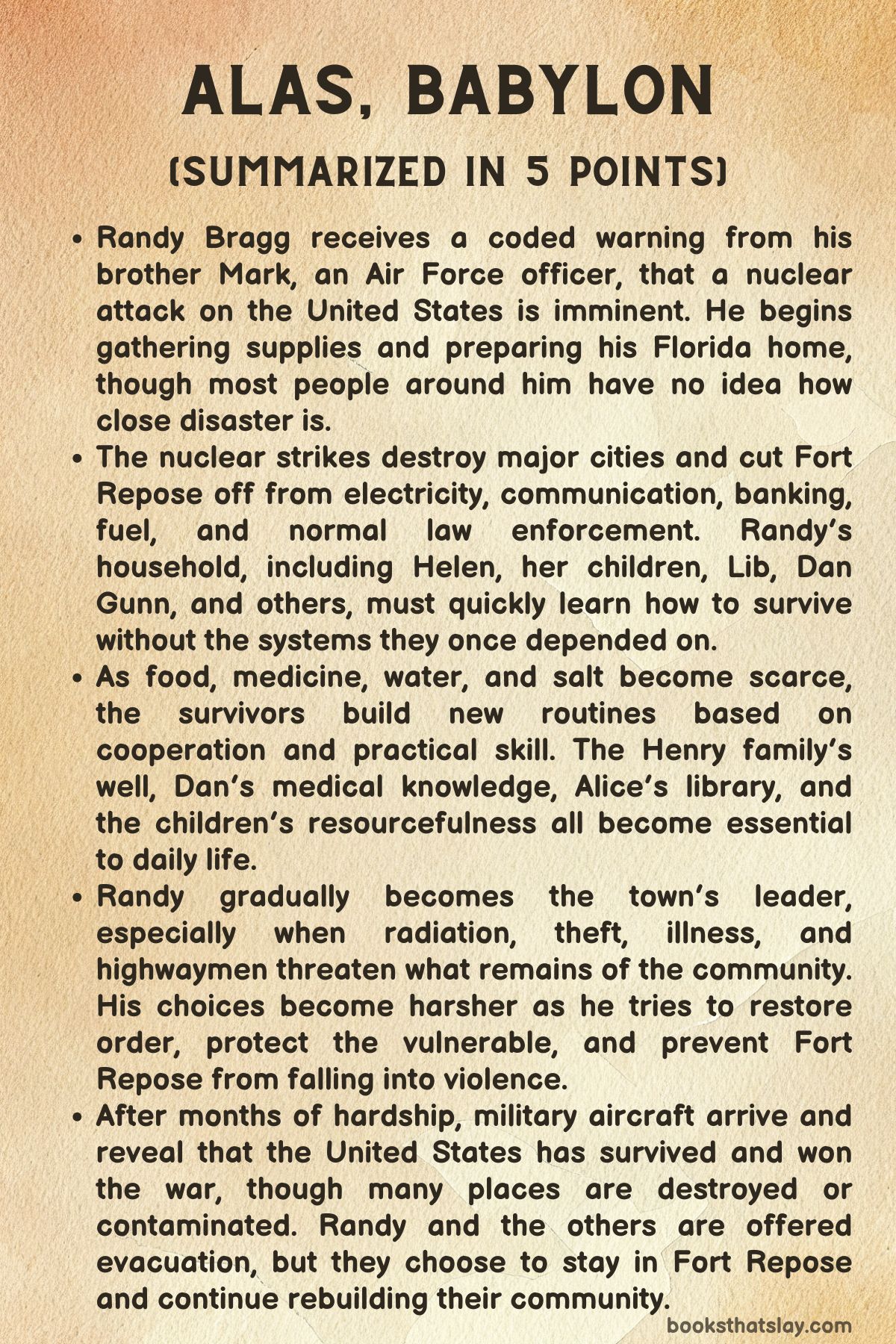
Randy’s life changes when he receives a telegram from his brother Mark, an Air Force officer. The message asks Randy to meet him at McCoy Air Force Base and says that Mark’s wife Helen and their children, Ben Franklin and Peyton, are being sent to Florida.
It ends with the phrase “Alas, Babylon,” a private code the brothers created to mean that nuclear war is coming. Randy immediately understands the warning.
Though Fort Repose is still calm, he begins to prepare, buying food, liquor, gasoline, and supplies. He also cashes a large check Mark sent him, though the local banker, Edgar Quisenberry, resents him and nearly refuses to cooperate.
At the base, Mark explains that the United States has learned of a Soviet plan to launch a massive nuclear strike. He believes the attack may happen very soon.
He gives Randy money and asks him to protect Helen and the children. Randy returns home frightened and burdened by knowledge he cannot easily share.
He tells a few trusted people, including his girlfriend Lib McGovern and Dr. Dan Gunn, but many others would not believe him even if he warned them.
Tensions overseas rise after a dangerous incident in the Mediterranean. An American pilot shoots at a hostile aircraft, causing an explosion that leads to a disastrous bombing in Syria.
This accident adds to the wider crisis and helps push the world closer to war. Mark, now deep inside the military command structure, prepares for the worst.
He knows that if Soviet missiles are launched, the warning time will be very short.
The attack comes before dawn. Randy wakes to violent flashes in the sky as nuclear bombs destroy major targets in Florida, including Homestead and Miami.
Shock waves hit Fort Repose, and the town begins to realize that the old world has ended. Randy drives into town and sees death, panic, traffic, confusion, and people still trying to behave as if normal services will return.
Dan Gunn is already helping the injured. Peyton has looked toward one of the blasts and temporarily loses much of her sight.
The news becomes unreliable, then horrifying. Jacksonville is destroyed while Florence is trying to send messages.
Banks, shops, and gas stations collapse under pressure. Money quickly loses meaning as food, fuel, guns, and medicine become the real sources of survival.
Edgar Quisenberry, unable to accept a world where banking and currency no longer matter, kills himself.
The United States government barely survives. A broadcast announces that Josephine Vanbruuker-Brown, formerly a cabinet secretary, is now Acting Chief Executive.
She declares martial law and says America has struck back. Later, Fort Repose loses electricity after another attack destroys the area’s power supply.
With that, refrigeration, running water, lighting, and normal sanitation vanish. The people of River Road must now solve each problem directly or suffer the consequences.
Randy’s first major task is water. He remembers that the Henry family has an artesian well.
With help from Malachai and Two-Tone Henry, he arranges pipes so water can reach his house and nearby neighbors. The Henrys, a Black family long treated as separate by much of the town, become essential to the survival of Randy’s group.
Over time, the Bragg household grows to include Helen, Ben, Peyton, Dan, Lib, Bill McGovern, and others connected by need and trust.
Food becomes the next struggle. Meat spoils without refrigeration, salt becomes precious, and stores are looted or emptied.
Dan’s medical work becomes harder each day as medicines run out. Diabetics die because insulin cannot be preserved.
Lavinia McGovern, Lib’s mother, is one of the victims. Her death breaks Bill McGovern’s spirit, but Randy persuades him to join the household by reminding him that his mechanical skills are needed.
As months pass, Fort Repose changes into a barter society. Alcohol, salt, coffee, honey, tools, and ammunition matter more than cash.
Alice Cooksey keeps the library open, and people who once ignored books now come to read for information, comfort, and purpose. The town also faces new dangers from radiation.
Dan discovers that Porky Logan, Bill Cullen, Pete Hernandez, and Rita Hernandez have been exposed through radioactive jewelry taken from contaminated areas. Porky dies with the jewelry in his possession, and Randy forces men at gunpoint to help bury him and the dangerous items in a lead-lined coffin.
In doing so, Randy realizes that Fort Repose has no functioning authority unless someone accepts the burden of enforcing order.
A government broadcast later authorizes Reserve and National Guard officers to act independently to preserve law. Since Randy is a Reserve officer, his growing leadership gains a legal basis.
He begins taking responsibility not just for his household but for the town’s safety. This role hardens him.
He must make decisions that the old Randy might have avoided.
The dangers become more direct when Dan Gunn is attacked by highwaymen. They lure him with a fake injured woman, beat him, steal his car and medical bag, and leave him badly hurt.
Randy decides the attackers must be found and executed, not from revenge alone, but because lawlessness will destroy what remains of the community. He posts orders calling on veterans and Reservists, warning that theft and sheltering highwaymen will be punished by hanging.
At the same time, Randy and Lib’s relationship deepens. Randy asks her to marry him, and they are wed on Easter Sunday.
Their joy is cut short when they learn that the highwaymen have murdered Jim Hickey, a generous beekeeper, and his wife. Randy, Malachai, and others set a trap using a grocery truck as bait.
The plan works, but Malachai is shot during the fight. The highwaymen are defeated, but Malachai dies before Dan can save him.
Randy later hangs the surviving attacker and organizes a small armed group known as Bragg’s Troop.
Through spring, summer, and fall, survival becomes a matter of adaptation. Gasoline runs out.
Two-Tone makes whiskey that Dan can use as anesthetic. When Ben Franklin needs surgery for appendicitis, Dan uses hypnosis as anesthesia and successfully operates.
Salt runs out, but an old diary points the group toward Blue Crab Run, where they find a supply. Food problems continue until Peyton solves the mystery of the missing fish by realizing they have moved into deeper, cooler water.
Ben becomes skilled at hunting armadillos. Children resume school under their parents’ instruction.
Oranges ripen, migrating birds return, and a healthy baby is born in town, giving people signs that life can continue.
Near the end, aircraft appear over Fort Repose. At first the household fears danger, but the planes drop leaflets explaining that they are surveying contaminated zones.
Helicopters arrive, and Paul Hart, who knew Mark, tells Helen and Randy that Mark is dead. He also says the United States has won the war, though the victory is bleak.
Many cities are gone, some areas may remain unsafe for centuries, and the country that survived is not the same country that existed before.
Hart offers to evacuate the people of Fort Repose, but Randy, Lib, and the others choose to stay. Their decision shows how much they have changed.
Fort Repose is damaged, isolated, and poor, but it has water, food, order, memory, and people willing to rebuild. Alas, Babylon ends not with a return to the old America, but with the beginning of a smaller, tougher, more self-reliant community.
Characters
Randy Bragg
Randy Bragg begins as a man with intelligence, family status, and unused potential, but without clear purpose. He lives comfortably in Fort Repose, drinks too much, avoids responsibility, and carries the public shame of a failed political campaign.
His defeat matters because it shows both his weakness and his strength: he loses because he refuses to betray his belief in constitutional equality, yet afterward he retreats into private disappointment. When Mark’s warning arrives, Randy’s dormant qualities quickly surface.
He becomes practical, watchful, and protective, first preparing his own household and then gradually taking responsibility for the wider community. His transformation is not sudden hero worship; it comes through repeated decisions under pressure.
He learns that leadership is not popularity, but action, judgment, and the willingness to enforce order when institutions vanish. By the end, Randy has become the central moral and civic authority of Fort Repose.
In Alas, Babylon, his development shows how crisis can strip away laziness and reveal a person’s deeper capacity for discipline, courage, and service.
Mark Bragg
Mark Bragg is Randy’s older brother and the novel’s link to the military and national crisis. He is disciplined, informed, and burdened by knowledge that most civilians cannot imagine.
Unlike Randy, Mark already lives inside systems of command, threat assessment, and strategic duty. His warning to Randy is both a military act and a deeply personal one: he understands that he may not be able to save himself, but he can still try to save his family.
Mark’s tragedy lies in his clarity. He sees the danger before others do, knows the likely scale of destruction, and still must continue performing his duty.
He is not given a long emotional arc, but his presence shapes the entire story. His trust in Randy is also important because it becomes a kind of moral transfer.
By sending Helen and the children to Fort Repose, Mark silently tells Randy that he believes his younger brother can become the man the situation requires.
Helen Bragg
Helen Bragg is one of the strongest figures in the household because her courage is domestic, emotional, and practical at once. She arrives in Fort Repose with her children after leaving Mark behind, knowing that the separation may be permanent.
Her pain is intense, but she rarely allows it to paralyze her. She helps gather supplies, cares for Peyton and Ben, supports Randy’s leadership, and holds the family together during the first shocks of disaster.
Helen’s grief appears in complicated ways, especially in her emotional confusion between Randy and Mark. This moment reveals how trauma can blur identity and longing, as she clings to the closest living reminder of her husband.
Still, Helen is not defined only by grief. She adapts, works, protects, and survives.
Her hesitation to marry Dan later is also meaningful, because loyalty to Mark remains part of her inner life even after she learns how unlikely his survival is.
Ben Franklin Bragg
Ben Franklin represents the generation that has grown up under the threat of nuclear war and therefore reacts to catastrophe with a strange mixture of fear and readiness. He is young, but he quickly becomes useful.
He fills water containers, learns to stand guard, handles a rifle, and slowly accepts the brutal responsibilities of survival. His shooting of the dog is one of the clearest signs of his forced maturity.
He does not kill out of cruelty; he acts because the animal threatens the chickens, which means it threatens the household’s food supply. His tears afterward show that he is still a child with a conscience.
Ben’s growth is one of the novel’s saddest forms of progress. He becomes capable because he must, not because childhood has naturally prepared him for such tasks.
His successful surgery under hypnosis also shows the household’s trust, resilience, and willingness to rely on improvised solutions.
Peyton Bragg
Peyton begins as a vulnerable child, especially after she looks toward the nuclear flash and temporarily loses much of her sight. Her damaged vision makes the family’s fear personal and immediate, turning the abstract horror of nuclear war into a child’s suffering.
Yet Peyton is not merely a victim. As the story continues, she becomes observant, frustrated by limits placed on her, and eager to prove her value.
Her discovery of how to catch fish from the deeper part of the river is an important moment because it allows her to move beyond the category of dependent child. She solves a problem adults have failed to solve, and her success brings food and morale to the household.
Peyton’s character also challenges narrow ideas about gendered labor. She resents being confined to chores and proves that intelligence, patience, and curiosity are survival skills as valuable as physical strength.
Lib McGovern
Lib McGovern is Randy’s emotional equal and eventual wife, but she is not written simply as a romantic reward. She is intelligent, composed, and psychologically perceptive.
Before the attack, she wants Randy to become more ambitious and leave Fort Repose for a larger life, which shows that she sees ability in him before he fully sees it in himself. After the attack, her expectations change because the meaning of ambition changes.
Success no longer means career advancement or social recognition; it means building a livable community from ruins. Lib understands people well, especially Helen’s emotional confusion, and she helps Randy interpret difficult human behavior without judgment.
Her marriage to Randy marks not an escape from hardship, but a commitment to shared labor and shared responsibility. She becomes part of the future Fort Repose is trying to create: practical, loyal, clear-eyed, and willing to build a new life under harsh conditions.
Dan Gunn
Dan Gunn is the novel’s image of professional duty under impossible conditions. As a doctor, he loses nearly everything that modern medicine depends on: electricity, refrigeration, sterile equipment, reliable transportation, drugs, hospitals, and trained support.
Yet he continues practicing because people still need him. Dan’s work becomes more exhausting and dangerous as society breaks down.
He treats injuries, radiation sickness, childbirth, infections, and surgical emergencies, often with improvised tools and limited supplies. His beating by highwaymen shows the vulnerability of healers in a lawless world; even a man devoted to saving lives can become a target.
Dan’s character also carries a quiet emotional arc through his love for Helen. He does not pressure her, and his patience reflects his decency.
His use of hypnosis during surgery shows both scientific flexibility and moral courage. He adapts without surrendering his identity as a healer.
Florence Wechek
Florence Wechek begins as a watchful, judgmental, somewhat comic figure who misunderstands Randy and interprets his behavior through gossip and suspicion. Her role as Western Union manager makes her a gatekeeper of information, and this becomes important when Mark’s message passes through her hands.
Although she initially sees Randy as a disreputable neighbor, she is not foolish. She senses that the telegram matters, and her instincts tell her that something serious is coming.
After the attack, Florence’s ordinary routines are destroyed, but she remains connected to communication, community, and emotional endurance. Her attachment to her pets shows her need for companionship and control in a world becoming frighteningly unstable.
The death of one of her birds is small compared to nuclear destruction, yet it matters because it reveals the intimate losses that disaster brings. Florence’s changing view of Randy also reflects the town’s changing understanding of him.
Alice Cooksey
Alice Cooksey, the librarian, represents knowledge, memory, and cultural survival. Before the attack, the library may seem like a quiet civic institution, but after the collapse it becomes far more important.
People come to read because books now offer practical knowledge, distraction, and contact with the old world. Alice’s renewed purpose shows that civilization is not preserved only by weapons, food, or leadership; it is also preserved through records, stories, manuals, and shared learning.
Her friendship with Florence gives her early access to the warning signs, and her decision to stay close to Florence suggests both caution and loyalty. Alice is not a dramatic leader like Randy or a medical worker like Dan, but her work matters because a community without memory becomes poorer and more fragile.
Through Alice, the novel argues that reading and knowledge are survival tools, not luxuries.
Admiral Sam Hazzard
Admiral Hazzard is a retired military man whose knowledge and radio equipment make him one of Fort Repose’s most valuable residents. His short-wave listening gives the community some connection to the outside world after normal communications fail.
Hazzard is calm, analytical, and historically minded. He helps Randy understand the broader scale of events and often frames the town’s situation in relation to earlier collapses of civilization.
His military background gives him authority, but he does not compete with Randy for leadership. Instead, he advises, interprets, and supports.
This makes him a mentor figure. Hazzard also carries loneliness, having lost his wife soon after retirement, but the crisis gives him renewed purpose.
His presence reminds the household that survival depends not only on youth and energy, but also on experience, memory, and strategic thinking.
Missouri Henry
Missouri Henry is a hardworking Black woman whose labor connects several households before the attack and whose family becomes essential afterward. At first, she appears in a domestic role, working as a maid and navigating the discomfort of white employers who watch or distrust her.
After the collapse, however, the practical importance of the Henry family becomes undeniable. Missouri’s household has access to the artesian well, and that water becomes one of the foundations of survival on River Road.
Missouri’s character reflects the racial and social divisions of the old Fort Repose, but the new reality forces a revaluation of worth. Her family’s skills, resources, and steadiness matter more than old prejudices.
Missouri herself stands for endurance and daily labor, the kind that is often undervalued until society can no longer function without it.
Malachai Henry
Malachai Henry is one of the most admirable characters because he combines competence, courage, and loyalty. He helps Randy early, understands practical survival, and later becomes a key part of the armed effort against the highwaymen.
His desire to drive the grocery truck during the trap shows both intelligence and bravery. He knows that a white driver would look suspicious in that situation, and he is willing to place himself in danger because the plan requires it.
His death is one of the novel’s most painful losses. It proves that rebuilding order comes at a cost and that some of the people most necessary to the community may not survive its defense.
Malachai’s importance also challenges the racial hierarchy of the prewar town. In the world after the attack, his courage and usefulness reveal a truth that prejudice had tried to hide.
Two-Tone Henry
Two-Tone Henry is practical, resourceful, and deeply tied to the physical skills needed for survival. He understands machinery, water, fuel lines, and distilling.
His ability to make whiskey is not treated as a comic vice after the attack; it becomes medically useful because Dan can use alcohol as an anesthetic. Two-Tone’s knowledge belongs to a world of hands-on labor rather than formal authority, and that is exactly what Fort Repose needs.
Like the rest of the Henry family, he shows how survival depends on people who know how to make, repair, improvise, and produce. He also represents continuity with rural and agricultural life, which becomes more valuable than money or status.
His character helps shift the novel’s idea of intelligence away from education alone and toward practical mastery.
Preacher Henry
Preacher Henry is a religious and practical elder whose presence connects moral language, local tradition, and survival knowledge. The phrase that gives Alas, Babylon its title is associated with his preaching, where it carries biblical force and warning.
After the attack, his role becomes less about formal sermonizing and more about rooted wisdom. He knows the land and river, and his advice helps Peyton understand where the fish have gone.
This makes him part of the community’s practical recovery. Preacher Henry’s character also shows how spiritual language can become reality in a devastated world.
What once sounded like warning or prophecy becomes part of lived experience. Yet he is not presented as merely symbolic; he is useful, observant, and part of the network of survival that supports River Road.
Edgar Quisenberry
Edgar Quisenberry represents the old financial order and its inability to survive the new conditions. As bank president, he takes pride in money, procedure, reputation, and his own judgment.
His dislike of the Braggs is rooted in social resentment and personal humiliation, which makes him petty even before disaster arrives. When the attack destroys the meaning of money, Edgar cannot adapt.
He understands intellectually that cash, bonds, checks, and bank rules have lost their power, but emotionally he cannot live in such a world. His suicide is therefore both personal tragedy and social symbol.
He dies because the system that gave him identity dies. Edgar’s failure contrasts sharply with Randy’s growth.
Randy adapts because he can shift from status to responsibility; Edgar cannot imagine life after institutional value collapses.
Porky Logan
Porky Logan is a corrupt local politician whose earlier victory over Randy reflects the prejudices and shallow political instincts of Fort Repose before the attack. He succeeds in the old world because he knows how to exploit public feeling, especially racial resentment.
After the attack, however, his kind of power becomes useless. His death from radioactive jewelry is darkly fitting because it shows greed turning fatal in the new world.
He collects contaminated valuables without understanding that they are poison. Porky’s fate exposes the emptiness of material possession after nuclear war.
Jewelry, status, and political success cannot protect him; in fact, his desire to possess valuable objects kills him and endangers others. His character is a warning against selfish accumulation in a world where knowledge and cooperation matter more than wealth.
Rita Hernandez
Rita Hernandez is one of the novel’s more complicated secondary characters because she is associated with sensuality, survival instinct, and material desire. Before the attack, she has a romantic history with Randy and is viewed by him as alluring but dangerous.
Afterward, she tries to preserve value by collecting goods she believes she can sell when normal life returns. This reveals her misunderstanding of how completely the world has changed.
Like Porky, she clings to objects from the old economy, and through the radioactive ring she becomes physically marked by that mistake. Yet Rita is not simply foolish.
She is armed, alert, and determined to protect herself after her dog is killed. Her character shows both the toughness and the illusions that can coexist in survivors.
She understands danger on one level, but not the invisible danger of radiation or the deeper collapse of former values.
Pete Hernandez
Pete Hernandez is a store manager whose role places him near the center of Fort Repose’s early material collapse. His supermarket becomes part of the scramble for goods, and his later contact with radioactive items shows how contamination moves through ordinary exchanges.
Pete is practical and connected to trade, but like many characters, he lacks the knowledge needed to identify nuclear danger. His wearing of watches connected to Porky’s contaminated collection shows how old ideas of value can become deadly.
Pete also serves as part of the town’s changing economy, where stores no longer operate as normal businesses and goods become bargaining tools. Through him, the novel shows that people who once managed supply in an organized market must now face scarcity, looting, barter, and invisible risk.
Bill McGovern
Bill McGovern begins as skeptical and somewhat complacent. Before the attack, he trusts official connections and assumes that if danger were real, important people would have told him.
His attitude reflects the false security of those who believe systems will always warn and protect them. After his wife Lavinia dies because her insulin cannot be preserved, Bill collapses emotionally.
His grief nearly removes him from the struggle to survive. Randy helps bring him back by appealing to his usefulness, especially his mechanical knowledge.
Bill’s recovery is quiet but important. He becomes part of the household not because he is naturally heroic, but because the community gives him a reason to continue.
His character shows that survival is psychological as much as physical. People need purpose, not just food and shelter.
Lavinia McGovern
Lavinia McGovern’s role is brief but significant. Her diabetes makes her dependent on the medical infrastructure of the old world, especially refrigeration for insulin.
When electricity fails, her condition becomes a death sentence. Her death personalizes the collapse of modern medicine and shows that nuclear war kills not only through blasts and radiation, but also through the destruction of support systems.
Lavinia also represents the older social world of comfort, household order, and assumptions about stability. Her passing marks a shift for Lib and Bill, who must leave the life they knew and join Randy’s more survival-focused household.
The burial at the McGovern property gives her death dignity, but it also shows how quickly private homes become memorial sites in a broken world.
Florence’s Pets: Anthony, Cleo, and Sir Percy
Florence’s pets may seem minor, but they help reveal the emotional and symbolic texture of survival. Anthony and Cleo, the lovebirds, are part of Florence’s private world before the attack.
They give her companionship and routine. Sir Percy, her cat, belongs to that same domestic space, yet after the collapse he kills and eats one of the birds.
This incident is disturbing because it turns a household into a miniature version of the wider world, where hunger and instinct overpower old arrangements. Randy’s response that only the strong survive may sound harsh, but it captures the new reality facing Fort Repose.
The animals show that the collapse affects every level of life, from nations to kitchens, from military bases to pet cages.
Paul Hart
Paul Hart serves as a bridge between the military world and the survivors of Fort Repose. Early in the story, he confirms the seriousness of the alert at the base, helping Randy understand that Mark’s warning is credible.
Later, when he returns by helicopter, he brings news from the surviving United States. His report that Mark is dead gives Helen and Randy painful closure.
Hart also reveals that America has won, though the victory is filled with loss and long-term damage. His offer to evacuate the household creates the final moral choice: leave for what remains of national recovery or stay and continue rebuilding locally.
Hart’s character helps measure how far Randy’s group has come. They no longer see rescue as the only answer.
Themes
Survival and Adaptation
Survival in Alas, Babylon depends less on dramatic heroism than on steady adaptation. The old systems fail one after another: electricity, money, transportation, refrigeration, medicine, policing, and long-distance communication.
Each failure forces the characters to rethink what is necessary. Water becomes more valuable than comfort.
Salt becomes more important than cash. A working radio becomes a connection to national life.
A library becomes a survival resource. The novel pays close attention to the practical steps that keep people alive, such as piping water from the Henrys’ well, preserving food, guarding chickens, finding salt, hunting armadillos, catching fish differently, and using whiskey or hypnosis in medicine.
Adaptation also requires emotional flexibility. Characters who cling too tightly to the old world, such as Edgar Quisenberry or Porky Logan, cannot survive its disappearance.
Those who accept new conditions without surrendering moral order have a chance to endure. The theme is powerful because survival is shown as communal rather than individual.
No single person has all the knowledge needed. The household lives because different people bring different skills: medicine, leadership, fishing, mechanics, farming, teaching, and communication.
Civilization begins again through cooperation.
Leadership, Law, and Moral Responsibility
Randy’s rise to leadership shows how authority is created when formal institutions disappear. At first, he has no official power beyond his background as a Reserve officer and his local family name.
What gives him authority is action. He prepares early, protects his household, solves the water problem, consults those with knowledge, and responds to threats.
Yet the novel does not treat leadership as gentle guidance alone. Randy must decide when force is necessary.
The burial of Porky’s radioactive jewelry, the posting of martial orders, the pursuit of the highwaymen, and the hanging of Casey all show the harsh side of restoring order. These acts raise difficult moral questions.
Without courts, police, or prisons, justice becomes immediate and personal. Randy risks becoming merely another armed man, but the story separates him from criminals by emphasizing his purpose: he uses force to protect the community, not to enrich himself.
Leadership here means accepting guilt, danger, and loneliness. It also means listening to others.
Randy depends on Dan, Hazzard, Lib, the Henrys, and even the children. His authority grows strongest when it becomes shared responsibility rather than domination.
The Collapse of Modern Values
The nuclear attack does not only destroy cities; it destroys the meaning of many things people once trusted. Money becomes nearly useless.
Social position weakens. Political success means little.
Consumer goods lose their glamour unless they serve a practical purpose. Edgar Quisenberry cannot bear a world where banking no longer defines order.
Porky Logan dies because he mistakes jewelry for wealth when it has become radioactive poison. Rita Hernandez collects objects for a future market that may never return.
These characters reveal how dangerous old values can become when circumstances change completely. The novel does not reject civilization, but it questions the shallow assumptions of modern life.
Before the attack, people measure worth through money, reputation, race, politics, and possessions. Afterward, worth is measured through usefulness, courage, knowledge, generosity, and reliability.
A doctor matters more than a banker. A well matters more than a bank vault.
Salt matters more than cash. A child who can catch fish becomes a hero.
This reversal is one of the book’s clearest social critiques. It suggests that modern comfort can hide dependence, weakness, and false pride until disaster exposes what truly sustains life.
Community, Race, and Mutual Dependence
Fort Repose before the attack is divided by race, class, and habit. Randy’s political defeat shows the town’s resistance to racial integration, and Missouri Henry’s work as a maid reveals the unequal social arrangements of the old order.
After the attack, those divisions do not magically vanish, but survival forces people to recognize forms of value that prejudice had ignored. The Henry family becomes essential because of their artesian well, their labor, their practical knowledge, and Malachai’s courage.
Randy’s household survives partly because it cooperates across racial and social lines. This shift is not sentimental; it is practical and moral.
The community cannot afford old illusions about superiority when every person’s skill may save lives. Malachai’s death in the fight against the highwaymen is especially important because he gives his life defending the same broader community that once placed limits on people like him.
The theme of mutual dependence also extends beyond race. Librarians, doctors, children, retired officers, mechanics, fishermen, farmers, and homemakers all become necessary.
The new Fort Repose is built from relationships, not hierarchy. Its hope lies in people learning that survival is shared, and that dignity must be recognized through action.