All Her Fault Summary, Characters and Themes
All Her Fault by Andrea Mara is a tense domestic thriller about a missing child, a fake playdate, and the damage caused by secrets kept inside respectable homes. The story begins with a simple parental errand: Marissa Irvine arrives to collect her son Milo, only to discover that no one at the address knows him.
From there, the novel examines fear, blame, motherhood, class, marriage, and the assumptions people make about women who work, hire help, or fail to notice danger nearby. Beneath the police search is a darker question: who truly has a right to call a child their own?
Summary
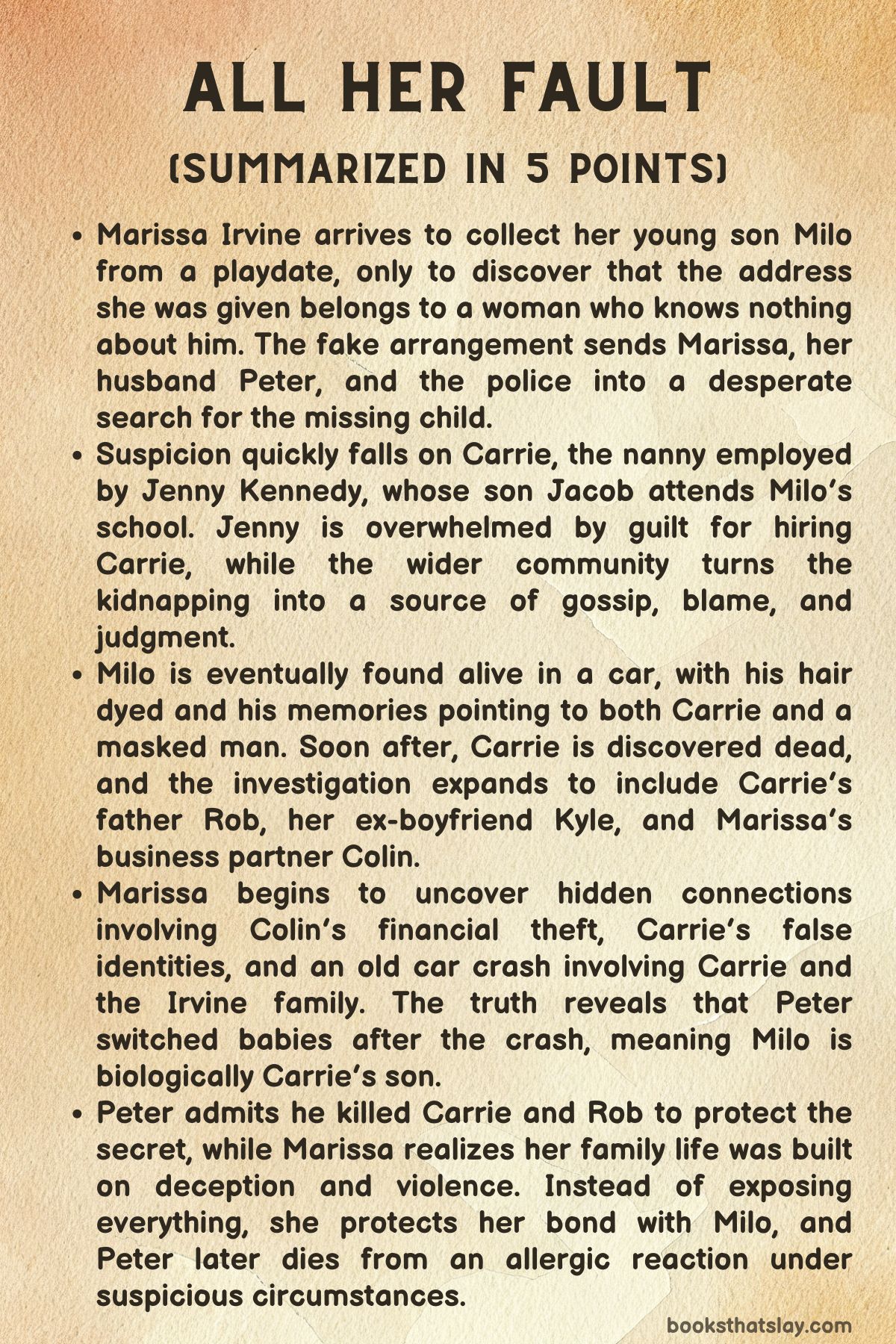
Marissa Irvine is a successful solicitor living in wealthy Kerryglen with her husband, Peter, and their four-year-old son, Milo. One Friday, she arrives at 14 Tudor Grove to collect Milo from what she believes is his first playdate with Jacob Kennedy, a boy from his school.
An elderly woman named Esther answers the door and says she knows nothing about Milo, Jacob, or Jacob’s mother, Jenny. Marissa realizes that the playdate was a lie, and Milo is missing.
Marissa had arranged the visit by text with someone who signed the message as Jenny. The supposed Jenny had given Esther’s address and said a nanny would mind the boys.
Marissa calls Peter and then the police. Detectives McConville and Breen begin investigating.
They question Marissa and Peter about their own au pair, Ana, who is meant to be away for the weekend. Ana’s phone is found in the garden, which makes her absence look suspicious at first, but she later returns and explains she had the day off and knew nothing about the pickup.
The police learn that Milo left school with Carrie, the nanny who works for Jenny and Richie Kennedy. Jenny is away in Paris for work when the crisis begins.
She is shocked when the police contact her, because she never arranged a playdate for Jacob and Milo. Jenny returns home under a cloud of guilt.
She had hired Carrie through an online agency and thought of her as quiet, timid, and harmless. Her mother-in-law, Adeline, is quick to blame her for using a nanny at all, and Jenny feels the judgment of the wider school community as well.
Carrie’s real name is Caroline, and her mother, Irene Turner, recognizes her photograph in the news. Irene has not seen her daughter in years and is more concerned with protecting herself, and later with selling her story to the press, than with helping the investigation.
Carrie had a troubled past, a criminal ex-boyfriend named Kyle Byrde, and a difficult relationship with both parents. Irene lies to the police about what she knows, including the whereabouts of Carrie’s father, Rob Murphy.
As the search continues, Marissa and Jenny form an uneasy friendship. Jenny visits Marissa and offers support, even though Peter blames her for hiring Carrie.
The two women distribute flyers and speak with neighbors. They learn that Carrie and Milo were seen together and that Milo did not seem distressed, suggesting he trusted her.
Ana eventually reveals that Carrie had befriended her at the playground and asked many questions about the Irvine family, their routines, Milo’s allergies, and Marissa’s work. Carrie had carefully gathered information before taking Milo.
The investigation appears to point toward Carrie and Kyle Byrde. A raincoat belonging to Milo is found near the sea, but a witness later says a man threw it there, making it look like a false trail.
Then a dead man is found and later identified as Kyle, though at first he is known as Danny Vaughn. Jacob’s chalkboard gives Jenny another clue: he has written a childlike version of Danny Vaughn’s name, showing that Kyle had been around Carrie.
After seven days, Marissa and Peter receive the call they have been desperate for. A boy matching Milo’s description has been found in a car in Sandymount.
It is Milo. His hair has been dyed brown, but he is alive.
In interviews with a child specialist, Milo explains that Carrie kept him in a house, dyed his hair, dressed him differently, and would not let him go outside. He also says a masked man with a strange voice took him from Carrie’s house and put him in the car where he was found.
At first, Milo’s safe return seems to end the worst of the nightmare, but the mystery only grows. Carrie is found dead in the house where Milo was held, apparently smothered.
The police believe there was another person involved. Colin Dobson, Marissa’s long-time business partner, comes under suspicion when Marissa discovers that he had gone on a date with Carrie, who used the name Lena and changed her appearance.
Colin claims he did not know she was the nanny involved in Milo’s kidnapping, but Marissa is not fully convinced.
Marissa soon discovers another problem: Colin has stolen a large amount of money from client accounts connected to the Downey and Fenelon files. She suspects the kidnapping may have been arranged to distract her from uncovering the theft.
Before she can get answers, Colin is killed alongside Rob Murphy. The police believe Rob shot Colin and Colin shot Rob, but the details do not fully satisfy Marissa.
Meanwhile, Jenny’s personal life becomes strained. Her husband Richie has been distant and resentful, partly because of Jenny’s work and partly because he believes she may be having an affair with her colleague Mark.
He has received anonymous notes accusing Jenny of being unfaithful. Jenny realizes Carrie may have written them after hearing about Mark’s flirtation, though the ending later reveals Adeline is also capable of such cruel interference.
Jenny and Richie eventually talk honestly and reconcile, but the damage caused by suspicion is clear.
The truth emerges when Milo tells Marissa that the masked man who took him from Carrie’s house called him “Milo-Mouse,” a pet name used by Peter. Marissa confronts Peter, and he admits part of the truth.
Years earlier, Marissa and Carrie were involved in a serious car crash. Both women had babies with them.
Carrie’s child was believed to have died, and Marissa and Peter raised Milo. Carrie later saw Milo at a playground and noticed that he had synesthesia, just as she did.
She became convinced he was her biological son.
Peter then reveals the full horror. After the crash, he regained consciousness before anyone else.
He saw that his own baby had died. Before the paramedics arrived, he switched the infants, allowing Marissa to believe Carrie’s baby was hers.
Carrie, lacking money and support, never managed to challenge what had happened through official means. Years later, after recognizing Milo, she joined with her father Rob and Kyle to take him back.
Carrie got close to Jenny’s family so she could reach Milo through school.
Peter found the address where Carrie was holding Milo after seeing it among papers connected to Marissa’s office. Instead of calling the police, he went there himself, killed Carrie, and left Milo in the car to be found.
When Rob later blackmailed him over Carrie’s murder, Peter used Colin as a courier because Colin’s theft gave Peter leverage over him. The meeting ended with Rob killing Colin, and Peter killing Rob, then staging the scene.
Marissa is horrified. She almost calls Detective McConville to reveal everything, but stops herself when Peter warns that Milo could be taken from her.
She chooses silence, protecting the life she knows even after learning it was built on a stolen child and multiple deaths.
A week later, Marissa meets Jenny for coffee and pretends her family is fine, though Milo now seems frightened of Peter. Six months later, Peter dies in Marbella from an allergic reaction after eating food containing shellfish.
Marissa cannot find his EpiPen in time. The report presents it as an accident, but the implication is clear: Marissa has found a way to remove Peter from their lives while keeping Milo with her.
Characters
Marissa Irvine
Marissa Irvine stands at the emotional center of All Her Fault, beginning as a mother whose life is shattered by a terrifying mistake: she arrives to collect her son from a playdate that never existed. At first, she appears to belong to a world of security, wealth, order, and professional success.
She is a respected solicitor, lives in an impressive house, and seems to have built the kind of family life that others envy. Milo’s disappearance destroys that surface almost immediately.
Her confidence turns into panic, dependence, suspicion, and exhaustion. Yet Marissa is not written only as a helpless victim.
As the story develops, she becomes increasingly observant, especially when she begins noticing gaps in Peter’s behavior, Colin’s evasions, Brian’s odd movements, and Milo’s altered reactions after being found.
Her relationship with motherhood is complicated by the final truth. For most of the story, her love for Milo seems absolute and unquestionable, and the reader understands her terror as the natural response of a mother whose child has been taken.
The revelation that Milo is biologically Carrie’s child does not weaken Marissa’s attachment; instead, it exposes how motherhood in the novel is shaped by care, possession, class, fear, and moral compromise. Marissa is devastated by Peter’s crimes, but she also protects the life she has with Milo.
Her final silence shows that she is not morally innocent, even if she has been betrayed. By the end, Marissa has changed from a woman seeking justice into someone who understands exactly how far she is willing to go to keep her son.
Peter Irvine
Peter Irvine is one of the most disturbing characters because his violence hides behind respectability. For much of the story, he appears to be a worried father and protective husband.
His anger toward Jenny, Ana, and others seems at first like the reaction of a desperate parent. However, his need for control is visible long before the full truth is known.
He dominates Brian, dismisses concerns when they do not suit him, manages Marissa’s emotional state with sleeping pills and instructions, and tries to control the story around Milo’s disappearance.
Peter’s defining trait is entitlement. After the car crash, he sees his own loss as more important than Carrie’s truth, and he decides he has the right to switch the babies.
That single act turns him into the hidden architect of nearly every tragedy that follows. He allows Carrie to believe her child died, lets Marissa raise a child who is not biologically hers, and builds a family on deception.
When Carrie reappears, Peter does not confess or seek help. He threatens her, then later murders her, manipulates Colin, kills Rob, and stages evidence to protect himself.
He repeatedly frames his actions as protection of the family, but the family he protects is one built around his original crime. Peter is not just a villain because he kills; he is a villain because he believes his privilege, fear, and desire give him permission to rewrite other people’s lives.
Milo Irvine
Milo is the innocent child around whom the central conflict turns. His disappearance creates the mystery, but his presence also reveals the emotional and moral stakes of the story.
He is bright, sensitive, and distinctive, especially because of his synesthesia, which becomes a crucial clue to his true parentage. His way of seeing colors in letters, numbers, and days links him to Carrie and eventually helps Marissa understand the truth Peter has buried.
Although Milo is very young, his memories matter. His comments about Carrie, the house, the man in the mask, the schoolyard sounds, and the name “Milo-Mouse” slowly dismantle the false version of events created by adults.
The novel uses his childlike language to show how children often perceive more than adults expect, even when they cannot fully explain what they know. Milo is also caught between competing claims of love.
Carrie sees him as the son stolen from her. Marissa sees him as the child she has raised and adored.
Peter sees him as proof that his crime must remain hidden. Milo’s fear of Peter near the end suggests that truth can survive even when adults suppress it.
His trauma remains unresolved, making him more than the object of a kidnapping plot; he becomes the living consequence of adult selfishness and secrecy.
Carrie Finch / Caroline Murphy
Carrie is one of the most tragic figures in the novel. Introduced as a suspected kidnapper, she initially appears deceptive, manipulative, and dangerous.
She lies about her background, invents dead parents and brothers, uses a false identity, and gets close to Jenny’s family in order to reach Milo. Yet as more is revealed, her actions become rooted in grief, class disadvantage, and a terrible injustice.
Carrie lost the child she believed was hers in a crash and was led to think she was partly responsible. In reality, Peter had switched the babies and allowed her to live with a false loss.
Carrie’s behavior is morally wrong, but the novel makes it difficult to dismiss her as simply evil. Her plan to take Milo is criminal and cruel to Marissa, but from Carrie’s perspective, Milo has already been stolen from her.
Her synesthesia gives her a private bond with him and confirms what she already suspects. Her transformation into “Lena” also shows her intelligence and adaptability.
She knows how to present herself differently depending on the person she needs to influence. With Jenny, she becomes meek and lonely.
With Colin, she becomes glamorous and flirtatious. With Milo, she becomes familiar and caring enough that he trusts her.
Carrie is both victim and offender. Her death is especially grim because she never receives justice, and the truth of her motherhood remains buried by those with more power.
Jenny Kennedy
Jenny Kennedy functions as both a secondary protagonist and a mirror to Marissa. She is a working mother trying to balance career, marriage, childcare, and social judgment.
Her decision to hire Carrie becomes a source of crushing guilt after Milo disappears, even though she could not have known Carrie’s real motives. Jenny is constantly judged by others: Adeline criticizes her for working, school parents blame her for using a nanny, and Richie resents her professional success.
Through Jenny, the story examines how mothers are often held responsible for every failure in a child’s environment, even when fathers and social systems escape the same scrutiny.
Jenny is also one of the more emotionally generous characters. Instead of retreating from Marissa out of shame, she visits her, helps distribute flyers, shares information, and offers comfort.
Her friendship with Marissa grows out of crisis, but it also reveals Jenny’s need to be seen without judgment. She is tempted by Mark’s attention, not because she is actively seeking betrayal, but because her marriage has become strained and lonely.
Her arc involves reclaiming honesty in her own home. When she and Richie finally confront the anonymous notes and his suspicions, Jenny is able to defend herself and expose how easily mistrust can be planted.
She is practical, empathetic, flawed, and resilient, making her one of the most grounded characters in All Her Fault.
Richie Kennedy
Richie Kennedy is Jenny’s husband and Jacob’s father. He is not cruel in the same way as Peter, but he often fails Jenny through passivity, resentment, and insecurity.
Early in the story, he seems detached from childcare duties and irritated by Jenny’s work commitments. His attitude reflects a quieter form of domestic imbalance: he expects Jenny to manage crises, arrange care, and absorb guilt, while also resenting the demands of her career.
His mother’s influence worsens this dynamic because Adeline repeatedly attacks Jenny’s choices, and Richie does not always defend his wife when he should.
Richie’s jealousy over Mark reveals his vulnerability, but also his weakness. Instead of speaking honestly to Jenny, he reads her messages and allows anonymous notes to shape his view of her.
His suspicion is understandable only to a limited degree; the real problem is that he lets fear and pride replace trust. However, Richie is not beyond growth.
When the truth about the notes and Kyle’s visits becomes clearer, he begins to recognize how wrong he has been. His defense of Jenny against Adeline shows that he can still choose loyalty over resentment.
Richie’s character represents the ordinary strains of marriage under pressure, especially when gender expectations, money, childcare, and pride are left unspoken for too long.
Jacob Kennedy
Jacob is Jenny and Richie’s young son, and his role is quieter than Milo’s but still important. Through Jacob, the story shows how children absorb adult danger without fully understanding it.
His chalkboard becomes a key source of clues because he writes names connected to Carrie, including the childlike version of Danny Vaughn. Like Milo, he notices more than adults assume, even if he cannot interpret the significance of what he knows.
Jacob also reflects the emotional cost of the kidnapping on families beyond the Irvines. He has to process the idea that his nanny, someone who cared for him, is being described as a “baddie.” His distress over his teddy bear Jem and his confusion when adults talk carelessly around him show how vulnerable children are to adult cruelty, gossip, and moral simplification.
Jacob’s relationship with Jenny also highlights her role as a caring mother, contrary to Adeline’s criticism. Jenny is attentive to his feelings and tries to protect him from the harsher details of the case.
Jacob may not drive the plot directly, but his presence deepens the novel’s concern with how adult secrets damage children.
Irene Turner
Irene Turner is Carrie’s mother, and she is one of the harshest portraits of failed parenthood in the novel. She is defensive, resentful, class-conscious, and often self-serving.
When Carrie is wanted in connection with Milo’s disappearance, Irene’s reaction is not maternal fear but irritation, shame, and later curiosity about whether she can profit from the situation. Her decision to speak to the press shows her hunger for attention and money, even when her daughter is in danger.
She repeatedly withholds information from the police, partly because of her background and distrust of authority, but also because she does not want to be inconvenienced or exposed.
Yet Irene is not written without context. Her suspicion of the police comes from class experience, and her marriage to Frank has placed her in a more comfortable life without fully erasing her older fears and resentments.
She envies Rob’s apparent freedom and wealth, resents Carrie’s troubled nature, and seems unable to face her own failures as a mother. Her grief when Carrie is found dead appears real, but it exists beside vanity and self-interest.
Irene shows how parental failure can take the form of emotional abandonment long before any public scandal occurs. She is a contrast to both Marissa and Carrie: unlike them, she does not seem willing to sacrifice much for her child.
Frank Turner
Frank Turner, Irene’s husband, is a more conventional and stable figure than Irene, though not a central moral force. He encourages Irene to contact the police and tell the truth, showing more responsibility than she does.
His middle-class background shapes his belief that the authorities should be trusted, which clashes with Irene’s deeply ingrained suspicion of them. This contrast helps reveal the class divisions running through the novel.
Frank assumes cooperation is safe because his life has taught him that institutions are generally protective. Irene’s life has taught her the opposite.
Frank also represents social respectability and fear of embarrassment. He worries about his workplace finding out about his connection to Carrie, and later threatens to leave Irene if she continues courting media attention.
His role is mostly reactive, but he acts as a measure of ordinary decency beside Irene’s opportunism. He does not have the emotional connection to Carrie that might have made him a more active figure, yet his frustration with Irene’s behavior shows that he understands the seriousness of what she refuses to face.
Frank is not heroic, but he is a useful contrast to characters who treat truth as something to hide, sell, or manipulate.
Colin Dobson
Colin Dobson is Marissa’s business partner and initially appears harmless, loyal, and slightly bumbling. He comforts Marissa, offers to help with work, and seems like a dependable friend during Milo’s disappearance.
This presentation makes the later suspicion around him more effective. When Marissa discovers that he had gone on a date with Carrie, who called herself Lena, Colin becomes a possible conspirator.
His explanation may be partly true: he was manipulated by Carrie and did not understand her real identity or purpose until late. However, Colin is also guilty of serious financial wrongdoing.
His theft from client accounts reveals another form of betrayal. Colin may not have engineered the kidnapping, but he has been exploiting Marissa’s trust for money.
His false tears when confronted suggest a man practiced at performing innocence. He is weak rather than openly monstrous, but his weakness makes him easy for Peter to manipulate.
Peter uses Colin’s crime to force him into acting as courier in the blackmail exchange with Rob, leading to Colin’s death. Colin’s character shows how smaller corruptions can place a person inside much larger crimes.
He is not the central villain, but his dishonesty makes him vulnerable and morally compromised.
Brian Irvine
Brian Irvine, Peter’s brother, is presented as odd, secretive, and dominated by Peter. His behavior creates suspicion at several points: he lies about painting his house, moves around the neighborhood strangely, and seems to hide aspects of his life from the family.
These details make him a plausible suspect in the reader’s mind, especially while the story is still concealing Peter’s role. However, Brian’s secret turns out to be personal rather than criminal.
He is having an affair with an engaged woman and wants to keep it hidden.
Brian’s more important function is to reveal Peter’s controlling nature. Peter treats him as someone who should obey instructions, whether about family logistics or housing arrangements.
Brian’s submissiveness suggests a long history of being overshadowed by his brother. He is not innocent in every respect, but he is not dangerous in the way Peter is.
His awkward secrecy adds tension to the plot while also showing how many private lives contain hidden behavior that can look sinister from the outside. Brian helps create the novel’s atmosphere of suspicion, where almost everyone seems to be concealing something.
Lia Irvine
Lia Irvine, Peter and Brian’s sister, brings a different energy into the Irvine household. She is glamorous, independent, and detached from the domestic pressures that define Marissa and Jenny’s lives.
Her life in New York and her lack of interest in settling down make her a contrast to the mothers around her. She speaks lightly and sometimes carelessly, but her presence helps reveal important information.
Her conversation with Marissa about Colin, past relationships, and old social connections opens new lines of suspicion.
Lia also contributes to the discovery of Colin’s link to Carrie. By showing Marissa a social media photo, she helps Marissa notice Colin in the background with Carrie.
Lia does not fully grasp the emotional weight of the situation in the way Marissa does, but she is observant in her own casual manner. Her character provides social context for the Irvine siblings and exposes the romantic histories and family patterns that Marissa does not fully know.
Lia’s freedom from domestic responsibility can look shallow at times, but it also allows her to see certain things from the outside.
Ana Garcia
Ana Garcia is the Irvine family’s Brazilian au pair, and her character highlights the vulnerability of immigrant domestic workers. At first, she is briefly suspected because she is absent when Milo disappears and her phone is found at Marissa’s house.
However, Ana is not involved in the kidnapping. Her real mistake is that she befriended Carrie and shared information about Milo and the Irvines without understanding how it would be used.
Ana’s fear of the police is significant. Carrie manipulates her by suggesting that foreigners are easily arrested, which makes Ana delay telling the full truth.
This shows how social position affects behavior during a crisis. Ana is not protected by wealth, citizenship, or confidence in institutions in the same way Marissa is.
Peter’s fury toward her is disproportionate and reveals his tendency to shift blame onto people with less power. Ana cares about Milo, but she is also young, socially exposed, and vulnerable to manipulation.
Her role shows how domestic labor places workers close to family secrets while leaving them with little authority or protection when something goes wrong.
Adeline Furlong-Kennedy
Adeline is Richie’s mother and one of the novel’s clearest representatives of judgment disguised as concern. She criticizes Jenny for working, for hiring a nanny, and for not being present enough for Jacob.
Her views are traditional and punitive, and she uses motherhood as a standard by which to attack other women. She is especially cruel because she directs her criticism at Jenny when Jenny is already frightened, guilty, and emotionally strained.
Adeline’s interference is not limited to spoken judgment. The ending reveals that she continues sending anonymous notes to Richie about Jenny, encouraging suspicion in their marriage.
This makes her more actively destructive than she first appears. She is not simply an old-fashioned mother-in-law; she is someone who manipulates her son’s fears to weaken his marriage.
Her treatment of Jacob’s teddy bear also shows her belief that harshness is a form of improvement. Adeline represents a domestic form of cruelty that can flourish inside families without looking criminal.
Her power lies in shame, guilt, and emotional pressure.
Detective McConville
Detective McConville is the main investigative authority in the story. She is professional, steady, and persistent, but the case is shaped by layers of deception that even careful police work struggles to untangle.
She follows evidence from Ana to Carrie, from Kyle to Rob, from Colin to financial motives, and from Milo’s interviews to the Sandymount house. Her presence gives the plot structure and momentum, while also showing the limits of official investigation when key witnesses lie or withhold information.
McConville’s role is especially important because many characters project fear, blame, or hope onto the police. Marissa depends on her but later chooses not to tell her the full truth.
Irene distrusts and lies to her. Ana fears what might happen if she speaks.
Peter manipulates evidence to mislead the investigation. McConville is competent, but she cannot solve what the people closest to the truth refuse to reveal.
This makes her less a triumphant detective figure and more a reminder that justice depends not only on investigation, but on whether people are willing to give up the lies that protect them.
Sergeant Fiona Sheridan
Sergeant Fiona Sheridan specializes in interviewing children, and her careful work with Milo becomes essential to the truth. She understands that Milo’s memories must be approached gently, without pressure or leading questions.
Through her interviews, details emerge about the masked man, Carrie’s house, the dyed hair, the red car, the schoolyard sounds, and the way Milo was moved before being found. Her patience allows Milo’s fragmented memories to become meaningful evidence.
Sheridan’s character also highlights the difference between adult interpretation and child perception. Adults keep building theories around money, trafficking, revenge, and professional betrayal, while Milo quietly holds details that point toward Peter.
Sheridan gives those details space to surface. She represents a more humane side of policing, one based on listening rather than intimidation.
Her role may be smaller than McConville’s, but she is crucial because she treats Milo not merely as a rescued victim, but as a child whose voice matters.
Esther
Esther first appears as the woman who opens the door at 14 Tudor Grove, the fake address used in the playdate arrangement. She is not involved in the kidnapping, but her kindness matters.
She helps Marissa when Marissa collapses, calls Jenny, and later comforts Jenny and Jacob. In a story filled with blame and suspicion, Esther offers a rare form of uncomplicated decency.
Her connection to Kyle through foster care adds another layer to her role. Kyle chooses her address because he believes Marissa should land somewhere kind when her world falls apart.
That detail makes Esther symbolically important. She is placed at the beginning of Marissa’s nightmare, but she is not a source of danger.
Instead, she represents the possibility of care from strangers. Her experience with children, including foster children, also contrasts with the many damaged parent-child relationships elsewhere in the novel.
Esther is not central to the crime, but she is central to the story’s emotional balance.
Rob Murphy
Rob Murphy, Carrie’s father, is a criminal figure, but he is also a father responding to the belief that his daughter was wronged. When Carrie reconnects with him and reveals what happened after the crash, Rob becomes angry on her behalf.
He helps confirm the possibility that Milo is Carrie’s son, and he becomes part of the plan to take Milo. His involvement is dangerous and unlawful, but it grows from loyalty to Carrie as much as from criminal instinct.
Rob’s later blackmail of Peter shows his moral limits. After Carrie’s death, he uses the truth as leverage rather than going directly to the police.
This decision places him in Peter’s path and leads to more violence. Rob is not noble, but he is not without feeling.
Unlike Irene, he takes Carrie’s pain seriously. His tragedy lies in the way his support takes destructive forms.
He responds to injustice through crime, threat, and revenge, which makes him both a grieving father and an agent of further harm.
Kyle Byrde
Kyle Byrde is Carrie’s ex-boyfriend and part of the plan to kidnap Milo, though he seems less committed than Carrie and Rob. His criminal history makes him an easy suspect, and his presence around Jenny’s house becomes one of the clues that Carrie’s life is not what she claimed.
He helps create the false trail by suggesting Esther’s address for the fake playdate, but his reason is unexpectedly humane: he wants Marissa to be somewhere kind when she realizes Milo is gone.
Kyle’s role complicates simple judgments. He is involved in a terrible act, yet he may also have doubts.
The suggestion that he might have threatened to report Rob or tried to return Milo makes him a morally unstable figure rather than a straightforward villain. His death removes a person who might have revealed the truth earlier.
Kyle represents the messy space between guilt and conscience. He participates in harm, but he may not be able to live comfortably with the consequences.
Mark
Mark is Jenny’s coworker and a source of tension in her marriage. His flirtation with Jenny gives her attention at a time when Richie is dismissive and resentful.
Mark is not deeply developed as an independent character, but he plays an important role in exposing the fragility of Jenny and Richie’s relationship. His messages become evidence in Richie’s mind, especially after anonymous notes encourage suspicion.
Mark’s significance lies less in what he does and more in what he represents. He stands for the life Jenny has outside marriage and motherhood: work, competence, adult conversation, and recognition.
Richie interprets that world as a threat, partly because Jenny’s promotion has unsettled the balance between them. Jenny’s relationship with Mark does not become an affair, but the possibility of one reveals how neglected she feels.
Mark is therefore a catalyst rather than a central actor, pushing hidden marital tensions into the open.
Alex Fenelon
Alex Fenelon appears briefly but adds to the atmosphere of money, reputation, and hidden instability. He owns betting shops and is connected to Marissa professionally through estate work.
His personal life is also messy, since his wife May has left him for Mr. Williams. Marissa finds him unpleasant, and rumors suggest his business may be in trouble.
Alex’s role is partly to widen the field of suspicion. Because the plot involves client files, financial irregularities, and local networks of wealth, characters like Alex make the world of Kerryglen feel full of private motives.
He is not central to Milo’s kidnapping, but he belongs to the social and financial environment in which secrets circulate beneath polite surfaces. His presence also shows how Marissa’s professional world overlaps with her personal crisis.
May and Mr. Williams
May and Mr. Williams are minor characters, but they help build the social world around the school. Mr. Williams, the school principal, confirms that Milo left with Carrie, making him important to the early investigation.
May, his much-younger fiancée, is discussed by other parents because she left Alex Fenelon for him. Their relationship becomes part of the gossip culture that surrounds the school community.
Together, they show how quickly private lives become public material in Kerryglen. The parents observe, judge, and repeat stories about affairs, money, age gaps, and family choices.
May and Mr. Williams are not central suspects for long, but their presence reinforces the novel’s interest in appearances. In this community, everyone knows something about everyone else, yet the most important truths remain hidden.
The Coven
The group of gossiping school parents known as “The Coven” acts almost like a collective character. They judge Marissa’s appearance, Jenny’s childcare choices, May’s relationship, and the behavior of anyone who does not fit their standards.
They represent the social pressure surrounding motherhood and respectability in Kerryglen. Their comments are not physically dangerous, but they help create the climate of blame that makes women like Jenny and Marissa feel constantly watched.
Their role is important because the novel is not only about criminal secrets; it is also about everyday cruelty. The Coven’s gossip shows how communities turn tragedy into entertainment and moral judgment.
Rather than offering support, they search for fault. Their reactions echo the online commenters who blame parents, nannies, and mothers for Milo’s disappearance.
Through them, the story shows that public judgment can be vicious even when people know very little.
Themes
Motherhood, Possession, and the Fear of Losing a Child
Motherhood in All Her Fault is not treated as a simple biological fact or a purely emotional bond. Marissa raises Milo, loves him, knows his routines, fears for him, and suffers as his mother when he disappears.
Carrie, however, is revealed to be Milo’s biological mother, robbed of him through Peter’s act after the crash. This creates a painful moral conflict: Marissa’s motherhood is real because it is built through years of care, but Carrie’s claim is also real because Milo was taken from her before she ever had the chance to raise him.
The story refuses to make this conflict easy. Carrie’s kidnapping is wrong, but her grief has a legitimate source.
Marissa’s silence is wrong, but her terror of losing Milo is emotionally understandable. The novel also shows how mothers are judged more harshly than fathers.
Jenny is blamed for hiring Carrie, Marissa is blamed online for trusting others with childcare, and Irene is blamed for Carrie’s damage. Men make many of the most destructive choices, especially Peter, yet women carry the visible burden of guilt.
Motherhood becomes a contested space where love, law, biology, class, and fear all collide.
Class, Privilege, and Unequal Access to Justice
Class shapes nearly every major event in the story. Marissa and Peter live in wealth and social comfort, with professional status, a large home, and access to authority.
Carrie comes from a far less secure background, with a troubled family history, limited support, and no comparable power after the crash. When Peter switches the babies, his privilege helps protect the lie.
He has the confidence, status, and resources to control the aftermath, while Carrie is left to believe that her child has died and that she may be responsible. Her inability to challenge the situation through legal or official channels is one of the story’s most painful truths.
Irene’s distrust of the police also comes from class experience; she does not see the guards as protectors because her life has taught her to fear institutions. Ana’s hesitation to speak shows another kind of vulnerability, tied to immigration and employment.
Even public sympathy follows class lines. The Irvines are envied and attacked for their wealth, but they are still better positioned than Carrie ever was.
The novel shows that justice is not only about truth. It is also about who has enough money, confidence, credibility, and social standing to be believed.
Blame, Judgment, and the Public Hunger for Fault
The title’s idea of fault spreads across the entire story, as nearly every character tries to assign blame. When Milo disappears, people blame Marissa for trusting a text, Jenny for hiring a nanny, Ana for speaking to Carrie, and Carrie for being damaged or dangerous.
Online commenters and school parents turn the case into a moral performance, using a child’s disappearance to criticize working mothers, childcare arrangements, wealth, and parenting choices. This hunger for blame is often easier than facing uncertainty.
If someone can be blamed, then the world feels more orderly and less frightening. Jenny suffers deeply under this pressure because her mistake was ordinary: she hired someone she believed was safe.
Marissa herself briefly judges Irene as the reason Carrie became who she became, then catches herself thinking in the same cruel way others have judged her. The theme becomes more complex as the truth emerges.
Peter is the person most responsible, yet he is hidden behind the appearance of the protective father. The people most loudly blamed are often women with less power or less information.
The novel shows how public judgment usually reaches for convenient targets before it reaches the truth.
Secrets, Marriage, and the Violence of Protection
Many relationships in the novel are built around things left unsaid. Peter and Marissa’s marriage rests on the largest secret: Peter switched the babies after the crash and allowed Marissa to build her life around a lie.
His later crimes are all committed in the name of protecting the family, but protection becomes a cover for control, violence, and self-preservation. Richie and Jenny’s marriage contains a quieter secrecy.
Richie hides the anonymous notes, reads Jenny’s messages, and lets suspicion grow instead of speaking to her directly. Jenny hides the emotional importance of Mark’s attention because her home life has become tense and unsupportive.
Colin hides financial theft behind a harmless personality. Brian hides an affair.
Irene hides information from the police. These secrets differ in scale, but they create the same effect: they distort reality for the people closest to them.
The theme is especially powerful because several characters convince themselves that concealment is safer than truth. Peter says he kills and lies to protect Marissa and Milo, but each act of protection creates new victims.
By the end, Marissa also chooses secrecy, proving how easily the logic of protection can become moral corruption.